
Posted in theology

The Great Cities of the Bible #2: Babylon

By Elizabeth Prata

Great Cities of the Bible #1: Damascus
Great Cities of the Bible #2: Babylon
Great Cities of the Bible #3: Rome
Great Cities of the Bible #4: Jerusalem
Great Cities of the Bible #5: Capernaum

Ruins at Babylon. By Osama Sarm – Own work, CC BY-SA 4.0, https://commons.wikimedia.org/w/index.php?curid=48596563

Babylon. City of mystery, history, prophecy. The very name Bab-iliu means “the gate of the gods” in Akkadian, which is the oldest recorded Semitic language and the most common language of the ancient Near East until the eighth century BC.

It was founded on the great river, Euphrates, about 200 miles north of where the Euphrates joins the Tigris and drains into the Persian Gulf, two of the 4 great rivers flowing out of Eden to “water the garden”. (Genesis 2:14).

Babylon was a sacred site dedicated to the (false) god Marduk, the city’s patron god. Often Marduk’s name is included with the title ‘Bel’ to Marduk’s name to indicate supremacy of all the gods. The city’s inhabitants celebrated Marduk at the start of their new year with a festival noting his ascension as king of all gods and his seating in his temple in the city.

Marduk was mentioned in the Bible in Jeremiah 50:1–2 where Yahweh ordered Jeremiah to declare:

Babylon has been captured;
Bel has been put to shame; Marduk has been shattered;
Her images have been put to shame; her idols have been shattered.’

For two thousand years Babylon dominated Mesopotamia.

The Lexham Bible Dictionary indicates that Babylon was a “cultural and political center of Mesopotamia during much of the second and first millennia BC. Located in modern-day Iraq along one branch of the Euphrates River, about 59 miles southwest of Baghdad.

Babylon Past

Throughout the entire Bible, Babylon stands as a dominating presence as an actual historical empire but also as a symbol of spiritual apostasy and evil opposition to God and His people. Its name Babel is first found in Genesis 11:9,

Therefore is the name of it called Babel; because the Lord did there confound the language of all the earth’

Babylon is the Greek form of the name Babel. Babylon began its ascent in 2300 BC to greatness but really exploded in cultural and architectural wonders during the reign of Hammurabi in 1792 BC, the sixth king of his line. During his reign and later his son’s reign, numerous temples were built and irrigation channels were excavated. King Hammurabi also conquered all of the surrounding cities, including the famous city of “Ur” where Abraham had lived centuries before.

Hammurabi (standing) receiving his royal insignia from Shamash (or possibly Marduk) By Mbzt – Own work, CC BY 3.0, https://commons.wikimedia.org/w/index.php?curid=59794940

But like many cities, Babylon then began to decline, and this up and down swing continued until Assyria was finally defeated. It then reached another pinnacle during the reign of Nebuchadnezzar II and entrenched itself as one of the most important cities in the Near East.

“The empire had been founded by Nebuchadnezzar’s father Nabopolassar (r. 625-605 BCE) after his victories over the Assyrian Empire. Nebuchadnezzar II would go on to even greater things, including the capture of Jerusalem in 597 BCE. The Babylonian king then set about making his capital one of the most splendid cities in the world”. Source World History Encyclopedia
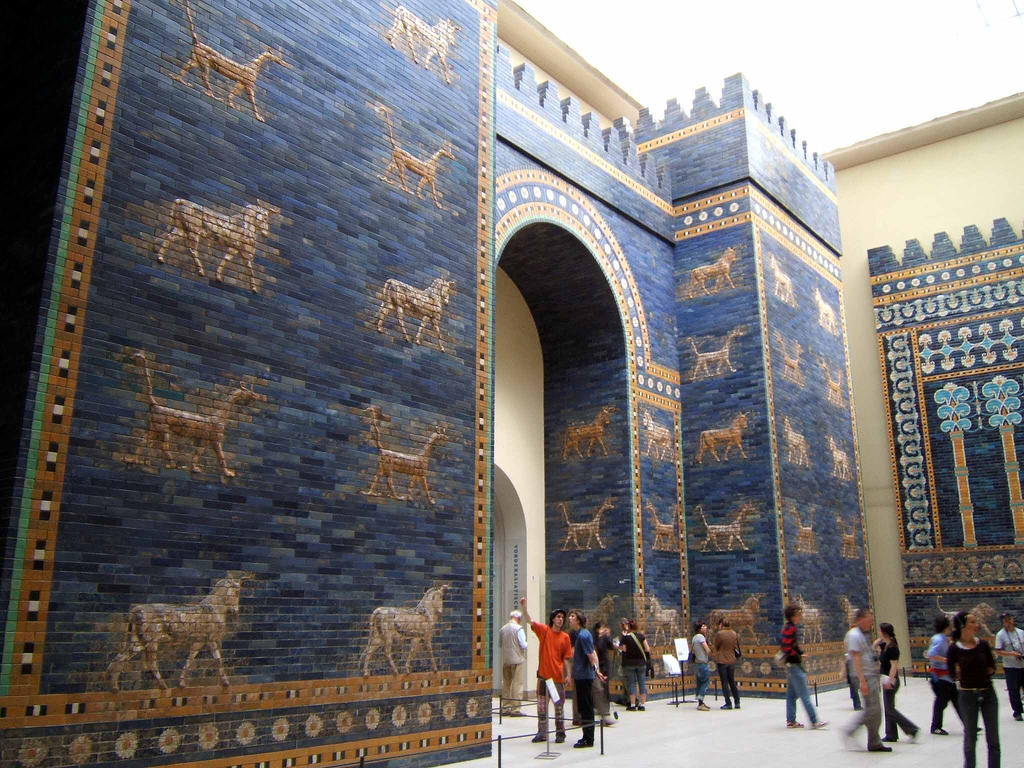
A reconstruction of the blue-tiled Ishtar Gate, which was the northern entrance to Babylon. It was named for the goddess of love and war. Bulls and dragons, symbols of the god Marduk, decorated the gate.
By Rictor Norton – https://www.flickr.com/photos/24065742@N00/151247206/, CC BY 2.0, https://commons.wikimedia.org/w/index.php?curid=1409322

Hanging Gardens

The most famous of these improvements to the city were the Hanging Gardens of Babylon, “ancient gardens considered one of the Seven Wonders of the World and thought to have been located near the royal palace in Babylonsays Encyclopedia Britannica. Though no one is quite sure where they were within the city, there were enough descriptions of them in classical literature to know that they likely existed, though no one is exactly sure of what they looked like.

The Gardens were said to be ‘hanging’ because perhaps they were perhaps on a tall ziggurat with terraces, “were set upon vaulted terraces. They were also described as having been watered by an exceptional system of irrigation and roofed with stone balconies on which were layered various materials, such as reeds, bitumen, and lead, so that the irrigation water would not seep through the terraces.”

A short video about the Gardens-

https://www.britannica.com/video/179976/creation-Nebuchadrezzar-II-designs-structure-video-Hanging

In Daniel 4:30 we read the perhaps most famous story about Babylon, where King Nebuchadnezzar admires his city from his palace rooftop, saying “‘Is this not Babylon the great, which I myself have built as a royal house by the strength of my power and for the glory of my majesty?’”

Barnes’ Notes says: “He greatly enlarged the city; built a new city on the west side of the river; reared a magnificent palace; and constructed the celebrated hanging gardens; and, in fact, made the city so different from what it was, and so greatly increased its splendor, that he could say without impropriety that he had “built” it.

Yet…the very next verse says that King Nebuchadnezzar’s pride and self-glorification was a mistake.

While the word was in the king’s mouth, there fell a voice from heaven, saying, O king Nebuchadnezzar, to thee it is spoken; The kingdom is departed from thee.

The city “under Nebuchadnezzar, who died B.C. 561 after a reign of forty-three years, attained great splendour. In the reign of Belshazzar the capital was taken by Darius the Median (Dan. 5:25–31), who entered it unexpectedly at the head of an army of Medes and Persians, as Isaiah (21:1–9) and Jeremiah (51:31) had predicted some 170 years before. Then began the decay and ruin of this proud city, and the kingdom of Babylon became a part of the Persian empire. In course of time the “great city” became “heaps,” and “an astonishment, and a hissing, without an inhabitant (Jer. 51:37–58).

“Many of the Jews who had been carried captive to Babylon remained there, notwithstanding the decree of Cyrus. After the destruction of Jerusalem there was established at Babylon a school of Jewish learning of great repute.” SourceEaston’s (1893) In Illustrated Bible Dictionary and Treasury of Biblical History.

Babylon future

Babylon is mentioned in Revelation numerous times. We read in Revelation 14:8, “and another angel, a second one, followed, saying, “Fallen, fallen is Babylon the great, she who has made all the nations drink of the wine of the wrath of her sexual immorality.

Babylon was not only a city in history, not only an empire that rose & fell, but the name Babylon is also figurative of an evil commercial-governmental system and an evil spiritual system.

Roy Gingrich interprets both the actual and the symbolic nature of Babylon:

“The fall of Babylon (Rev 14:8)-

“(1) The announcement—Another angel (other than the one in verse 6) announces the soon coming fall of Babylon. The “Babylon” mentioned here is not the religious system of chapter 17 -that “Babylon” was destroyed at the mid-point of “The Seventieth Week”. The “Babylon” mentioned here is the capital city of the political-religious-commercial system of chapter 18, which city and system will be destroyed when the Seventh bowl is poured out. God destroys her because she made the nations drink “the wine of the wrath of her fornication,” that is, because she caused them to commit spiritual fornication, which is punished by God’s wrath.” Gingrich, R. E. (2001). The Book of Revelation (p. 69). Riverside Printing.

Gingrich continues-

The destruction of religious “Babylon” as an ecclesiastical system, chapter 17. In the days of Nimrod, Gen. 10:8–12, and his wife, Semiramis, around 200 years after the Flood, two great systems came into existence, a God-defiant political system and a God-defiant religious system, the one founded by Nimrod and the other founded by Nimrod through his wife, Semiramis. These two systems are often called Political Babylon and Religious Babylon because they had their beginnings in Babylon, the one in the building of the city of Babylon and the other in the building of the tower of Babylon. The city of Babylon is the symbol of organized political rebellion against God and the tower of Babylon is the symbol of organized religious rebellion against God.” Gingrich, R. E. (2001). The Book of Revelation (pp. 76–77). Riverside Printing

“These two systems in varying forms, have continued on side by side down through the centuries, hating one another but for the sake of self-advancement, exchanging favors with one another. During the Middle Ages, these two systems were seen in the Holy Roman Empire and in the Roman Catholic Church. Today, they are seen in the United Nations Organization and in the Ecumenical Church Movement. During the first half of Daniel’s Seventieth Week, they will be seen in the Revived Roman Empire [“the Scarlet-colored beast,” Rev. 17:3] and in the rejected Lacodicean church] [“the great whore,” Rev. 17:1]. It is very helpful in understanding Rev., chap. 17, to know that “the scarlet-colored beast” and “the great whore” of chapter 17 are the final forms of two great God-defiant systems which have been in existence for over 3,000 years.” Gingrich, R. E. (2001). The Book of Revelation (pp. 76–77). Riverside Printing.

–end Gingrich quote

Babylon both actual and spiritual offer many lessons for us. Whenever I think of Dickens’ “A Tale of Two Cities” I often think of ‘Babylon & Jerusalem’. In the NT Babylon is always mentioned negatively, as a seat of evil, ungodly power. It signifies the world and its forces in opposition to God. It is often contrasted with “New Jerusalem”, in which God will finally reign supreme with no opposition ever again.

We will live in the city GOD built, not a city made by man like Assyria’s Damascus, Caesar’s Rome or Nebuchadnezzar’s Babylon. It will be a pure city, devoid of anything detracting from the glory of Jesus and his Light.

Babylon present

Whatever became of the actual, historical city of Babylon? It no longer really exists. It is a ruin, though it was opened to tourists again in 2009. There is not much to see. It is estimated that only about 5% of the old city has been excavated.

Babylon would stay under the Persian Empire’s rule for two centuries before Alexander the Great then conquered Babylon in 331 BC. He had plans to make Babylon the capital of his empire but died there in 323 BC before his dream came into reality. Alexander’s generals divided his empire among themselves immediately after his death. This is how general Seleucus obtained the historical city of Babylon. Not long after, he moved most of the population to his new capital Seleucia, which left the city decaying and deserted. Source

Will Babylon the city rise again? Only the Lord knows. Babylon the metaphor for an economy and an ecclesiastical system will indeed rise again to uncontested dominance, and be part of the major events prophesied to occur in the future, if the Babylonian system even can be said to have disappeared in the first place. Yet “Babylon” actual and Babylon figurative will finally be squashed in the future when Revelation events occur and Jesus’ wrath wipes out the evil system. The Lord as always, reigns supreme.

There will be no king looking out from his own rooftop and congratulating himself on his achievements. There will be no pagan priests celebrating a false god on a mythical throne. There will be no garden except the one the LORD himself planted, meaning, the world. It will be pure, verdant, and full of peoples who acknowledge Jesus as the supreme Lord of Lords and King of Kings. What a day that will be!
Posted in theology

The Great Cities of the Bible #1: Damascus

By Elizabeth Prata

Great Cities of the Bible #1: Damascus
Great Cities of the Bible #2: Babylon
Great Cities of the Bible #3: Rome
Great Cities of the Bible #4: Jerusalem
Great Cities of the Bible #5: Capernaum

This begins a 4-part look at some of the Great Cities of the Bible. Cities are cities, but they are also seats of Empires, also they can be backdrops or even characters in the Biblical narrative. I chose the cities of Damascus, Babylon, Rome, and finally, Jerusalem to take a closer look at.

Damascus is one of the first cities mentioned in the Bible and the oldest continuously lived-in city in the world. Babylon dominated the Near East during its time, but also is symbolic of the struggle since the Fall of man vs. God. Its backdrop flows from Genesis to Revelation! Rome was at its height during the New Testament times, was the site of 4 Epistles written there, and perhaps will be at another height again if the prophecy about a Revived Empire will indeed be Rome as many interpret. And of course I chose Jerusalem because God set His name upon it, and it will be remade new as our eternal future home!

Modern Day Damascus is in Syria. It is the capital of Syria, and people have been living there since about 8000BC. When the Arameans arrived in about 3000 BC it went from villages to a notable city. That’s old!

We may think of that area of Asia as dry and dusty desert, but Damascus is considered one of the most beautiful cities in the world, as well as being ancient and notable. It is a UNESCO World Heritage site. To be sure, its dry and desert-y east is bordered by the Syrian-Arab desert and the west is bordered by the mountains of Lebanon. The mountains bar much rain from dropping on Syria. The mighty Euphrates, which represents more than 80 percent of Syria’s water resources, flows through far to the east of Damascus. Therefore, for Damascus to stay hydrated, the even more important river Barada River is the river on which the city of Damascus relies. Irrigation from the Barada River by aqueducts built during Roman times helps things along.

This river is divided into numberless channels and is distributed throughout Damascus and the region immediately about it. In almost every house there is a fountain, and one can stand still almost anywhere and listen to the murmur of the hidden streams that pass under and through the city. Source: Earthly Footsteps of the Man of Galilee, p. 274.)
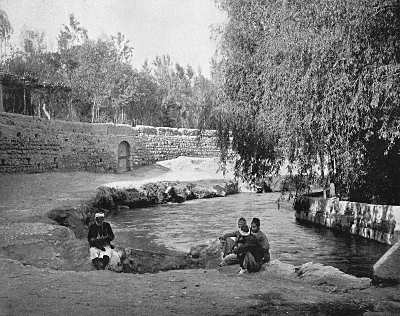
Barada river, Damascus. Shadi Hijazi photo, CC use

Barada is identified as Abana. This river is mentioned in the Old Testament (2 Kings 5:12), when Naaman argued that its waters would be better than the Jordan for curing his leprosy.

The International Standard Bible Encyclopaedia for the ‘Abanah’ AKA Barada says-

A few miles southeast of Suk Wady Barada the volume of the stream is more than doubled by a torrent of clear, cold water from the beautifully situated spring ‛Ain Fijeh (Greek, “fountain”), after which it flows through a picturesque gorge till it reaches Damascus, whose many fountains and gardens it supplies liberally with water. In the neighborhood of Damascus a number of streams branch off from the parent river, and spread out like an opening fan on the surrounding plain”.

Speaking of those gardens, we read from the 1894 book “Earthly Footsteps of The Man of Galilee and the Journeys of His Apostles”:

“No wonder the Moslems look upon Damascus as an earthly paradise. It is encompassed by gardens and orchards. These cover an area of over twenty-five miles in circumference. Here grow olive, fig, walnut, apricot, poplar, palm, cypress and pomegranate trees. In the above view we have a scene taken from the Jerusalem road in the western part of the city, and looking to the north a ridge of Anti-Lebanon is seen straight before us. In the richness of its soil, in the salubrity and semi-tropical character of its climate, in its varied vegetation, we find the reason for the constant association of Damascus with the thought of gardens.”

“It has been for four thousand years a garden. It is surrounded for miles with this splendor of verdure. Its gardens and orchards and far-reaching groves, rich in foliage and blossoms, wrap the city around like a mantle of green velvet powdered with pearls. The apricot orchards seem to blush at their own surpassing loveliness, and the gentle breezes that rustle softly through the feathery tops of the palms are laden with the perfume of the rose and the violet. Tristram, in his account of what he saw, says:”

“Tall mud walls extended in every direction under the trees, and flowing streams of water from the Barada everywhere bubbled through the orchards, while all was alive with the song of birds and the hum of bees. The great apricot trees were laden and bent down under strings of ripe golden fruit.” Whatever changes may be made by the hand of man in Damascus, whatever changes in government and in commercial activities, the city is sure to be for all time a paradise of fertility and beauty.”

In the Bible, Damascus is first mentioned in a casual comment in Genesis 14:15 (early!). It was the situation when Lot was taken prisoner and Abram had to go rescue him.

And he divided his men against them by night, he and his servants, and struck them and pursued them as far as Hobah, which is north of Damascus.

Damascus is mentioned again in the very next chapter, Genesis 15:2. Abram noted that the only heir he had was his servant Eliezer. And Abram said, “O Lord Yahweh, what will You give me, as I go on being childless, and the heir of my house is Eliezer of Damascus?

I mentioned the Arameans above, that Damascus in Syria didn’t become notable as a city until the Arameans settled it. According to Pulpit Commentary, “The Syrians of Damascus are known in the Hebrew, AramDammesek; that is, Aram-Damascus. The inhabitants of these regions and of Mesopotamia were descended from Aram, the son of Shem, son of Noah. (Genesis 10:22)”. See how old this region is? It is really amazing.

Damascus in mentioned frequently throughout the Old and New Testaments. Damascus played a major role in waging wars against Israel. From around 900 to 721 BC Syria was a terrible fearful opponent of Israel David was much occupied with subduing uprisings and incursions from Damascus, Syria throughout his Kingship. He eventually subjugated the Arameans but they rose again after the death of Solomon.

At various times, Israel and Judah made pacts with those who controlled Damascus (1 Kgs 15:18–20). War between Asa of Judah and Baasha of Israel led Asa to use the treasury of the temple and his personal wealth to pay for the support of Damascus against Israel (1 Kgs 15:19, 20).” Source The Lexham Bible Dictionary. Lexham Press.

When you look at the city in terms of the entire history of the Old Testament, you see how much of a role the Lord had Damascus play in the intertribal wars, alliances, rising and falling of kingdoms, and all impacting the Israelites. In fact, Damascus and Israel joined forces around 734 BC to attack Judah. The war almost destroyed Jerusalem, and evil King Ahaz of Judah asked Assyria’s king Tiglath-pileser to come defend Judah from the attack.

Eventually, Damascus was conquered by Alexander the Great and the city’s fortunes declined. It was taken over in 64BC in Roman times by Pompey. That is when the aqueducts were built that shuffled water from the critically important Barada river to water the great gardens and continue cultivating the crops.

In the New Testament Damascus is mentioned several times but always relative to Saul/Paul, his trip to Damascus, and his conversion. (Acts 9:1–25; 22:5–11; 2 Cor 11:32, 33)

However, despite the 8000 years of history we can trace back to Damascus and the nation of Syria itself, there is one stark piece of prophecy which we can possibly say has not come to pass within all that history yet: Isaiah 17:1 says that Damascus will be destroyed. Never has that ancient city been uninhabited. The prophecy says that the city will be razed and made into rubble, so that no one will live there.

Behold, Damascus will cease to be a city and will become a heap of ruins. The cities of Aroer are forsaken: they shall be for flocks, which shall lie down, and none shall make them afraid.(Isaiah 17:1-2).

Was this prophecy completely fulfilled during 732 B.C. when the Assyrians under Tiglath-pileser subjugated Syria? Has the city ever been so deserted that wild animals feel safe to wander about and even lie down?

Or was it a partial fulfillment, the rest to come at a future time? Whatever the answer, we know that 2 chapters later, the Lord promised good to that region of the world. In that day…Isaiah 19:24-25 says,

In that day Israel will be the third party with Egypt and Assyria, a blessing in the midst of the earth, whom Yahweh of hosts has blessed, saying, “Blessed is Egypt My people, and Assyria the work of My hands, and Israel My inheritance.”

Barnes’ Notes, “That is, the three shall be united as one people. Instead of being rival, hostile, and contending kingdoms, they shall be united and friendly; and instead of having different and jarring religions, they shall all worship the same God. The prophecy rather refers to the spread of the true religion, and the worship of the true God.”

And what a day that will be! The tumultuous epochs of this ancient, beautiful but war-like city shall finally find peace, and so shall all the inhabitants of the earth.

Posted in discernment, Uncategorized

Thinking of attending an If:Gathering? Please read this, it’s eye-opening

By Elizabeth Prata

PODCAST LINK HERE

Seven years ago I wrote a series on the IF Gathering. (2014). Four years ago I did an update. (2017)

The organization reports that in 2021, there were 6,648 IF:Local events in 66 countries. Because this para-church organization is still growing so much, it’s time for another reminder in discerning love and care for women everywhere, to avoid IF:Gathering.

The IF:Gathering and its women have only embedded themselves deeper into the faith and are tainting even more women with their brand of liberal theology, shaky hermeneutics, usurping lifestyles, and their idol of social justice. After 8 years of watching this organization (since its inception in 2013) we can see by now that it is essentially a female takeover of the church as a feminist, para-church/social justice/liberal organization, where women are drawn out from under their pastoral authority of the local church, fed false notions about Jesus and about our own identity, and reinserted as thorns and weeds to infect the local church with these modernly false ideas, only to turn around and recruit more women to do the same. It’s a multiplying movement that fulfills several scriptures about how false doctrine gets into the church.

jennie1
Source and video below.

PROBLEM #1: Their premise is based on doubt.

The title “IF:Gathering” comes from their motto, “If God is real, then what?” The purpose statement on their IRS forms is to equip women by having them share their feelings about Bible passages posted online, and the by-product is to instill or institutionalize doubt. Their IRS tax form statement of purpose states:

If:Lead: equipping women to share and learn through Christ-centered discussions

IF:Austin: a two-day gathering that brought thousands of women together in Austin and at local gatherings across the globe. The gathering is a fresh, deep, honest space for a new generation of women to wrestle with the essential question: if God is real… then what?

If:Equip: a holistic, strategic, deep way to connect online with a like-hearted community and relevant resources. We hope to prepare women around the world to know God more deeply and to live out their purposes by sharing comments and feelings about daily passages posted online.

PROBLEM #2: It’s based on feelings we have, not on biblical truths revealing who Jesus is

Did you notice the ‘like-hearted‘ community? The Christian faith is not about feelings, but about what we know about Jesus. It’s supposed to be like-minded. This is an organization that calls their homes ‘spaces’, their local communities ‘contexts’, and their goal is to ‘change the world’. Its mission is to wrestle with the notion IF God is real. Using this amorphous, non-specific language helps cultivate the doubt, which is the opposite of the certainty we are supposed to preserve and promote as believers. We’re believers, not doubters. It’s Good News, not Maybe News.

The ‘gathering’ part is actually brilliant. They aim to disciple women in gatherings at homes, dorms, and other locales, sometimes churches. It’s not public, nor it is under the authority of local churches or of men. Participants know where to gather through social media, which is employed in a major way. It’s why this is a stealth approach to infect the church. Galatians 2:4 and 2 Peter 2:1 said this would happen. Yet discipleship is supposed to take place within and around the local church.

PROBLEM #3: Secretiveness (I haven’t looked lately to see if they are still secretive, Jan, 2025). But for years, they were.)

There aren’t any posters, advertisements, billboards, pamphlets that one can see. They don’t normally make known who will be speaking at the annual large Gathering ahead of time. That’s allegedly so that people don’t come for the personalities but for the fellowship and learning. But would you want to spend time and money to go to a conference without being able to vet the speakers? Or your own pastor helping you vet the speakers?

Instead, there’s texts, social media whispers, person-to-person promotion, all of it done in a way that is more subterranean than any other generation’s Christian activity (apart from the actual persecuted church.)

IF:Gatherings are ongoing in living rooms and lawns by the thousands. There are A LOT OF GATHERINGS. Look. This map is four years old and their gatherings are only increasing in number:

The idea to disciple women is a good one. However, that is an activity that the church is responsible for. These gatherings take place outside of the auspices of the local church and its pastoral authority and is based on curricula that has shaky scripture interpretations at best.

PROBLEM #4: Founded on direct revelation

The gatherings were born from the mind of a young woman named Jennie Allen. At the first Gathering, she revealed that she had heard God whisper to her, and after a few years decided to step out from her church to enact this so-called God-whispered “vision to gather, equip, and unleash women to live out God’s calling on their lives.”

“together with a team of friends, formally established IF:Gathering. … Some of the first friends to believe in her vision put aside their own individual ministries to leverage their collective influence for the glory of God and the good of His Church.” (Source, source).

So they abandoned their local ministries to go online for the good of the global church? Exactly wrong. Here is Jennie Allen claiming direct revelation from God as the catalyst for IF.

Video is here, 2 min. Scroll halfway down.

PROBLEM #5: Draws women away from local churches, the place where we’re supposed to disciple

They abandoned their ongoing locally accountable ministries, to follow a young woman who’d heard a whisper, in order to establish Bible studies about a God they doubted existed, in order to equip women to discuss feelings about the Bible, enact social justice, reconcile the world, heal the nations, and disciple a generation. Hmmm. I’m not being satirical. All that verbiage is from their own statements.

PROBLEM #6: Feminist oriented

The constant refrain in the IF material is that these women will “change the world” (source, 2022 promotion). This is why I call it a stealth feminist takeover. I’m not being hyperbolic, it’s actual, from their own vision statement

women out from local authority, changing the world based on misinterpreted Bible verses and their feelings. Not promoting Jesus of the Bible to call people to repentance and salvation.

I wonder how it works to be submitted to a local church, yet to draw away women from other churches to come to your house to discus your feelings about direct revelation, extra biblical Jesus while then returning to church to ‘take initiative.’

IF’s founders are paying lip service to the concept of local church, while the entire movement’s thrust is about taking initiative to change the world, start global movements, heal the world, etc. (SOURCE) Not to return to one’s church, submit to local leadership, and operate in our spheres, nor to find contentment in our roles as wives and moms. There is nothing local about IF:Gathering.

Problem #7: If:Gathering and subsidiary output platforms false teachers such as Ann Voskamp, Christine Caine, some of which preach. This provides a poor example to younger women, who absorb the idea that women can preach despite what the Bible says about it.

Conclusion- Concerns with IF:Gathering are:

Founded on Direct Revelation: Founder Jennie Allen said she heard a whisper from God telling her to start a discipleship group. (source, also see above). Direct revelation is hazardous to one’s soul. If you test a direct, audible command from God against the Bible and it’s there, you do not need the audible command. If it is not there, it’s a lie and you don’t need it anyway. That’s a paraphrase from John Owen.

Doubting God: The premise itself is based on study of a God that those who gather doubt exist. IF God is real? Doubt is not noble. The Bible says doubt is a destroyer of life. (James 1:5-8).

Lack of male oversight and involvement and severe emphasis on women-led initiatives: Jennie’s husband Zac says he provides theological oversight, but he is listed as working only 10 hours per week at the 501(c) 3 non-profit, and the only other male on the Governing Board is David Willis for 2 hours per week. The 40-hour/weeks are put in by Jennie and Lisa Huntsberry. It’s Jennie’s baby, she is listed as Principal Officer on the tax forms. It’s led by Lisa Huntsberry who’s listed as CEO. The fact is, it operates as a woman-led, para-church organization with little male accountability or pastoral oversight.

The IF:Gathering’s premise is flawed and so are its goals. Again, from their IRS form, it states that their goals are to foment a ‘global movement’ that ‘promotes healing around the world’. Is that what the Bible says women are to do? Unleash movements? These women are mothers. With children at home. The Bible tells us what we are to do: raise the kids, support the husband. Did even Jesus come to promote healing around the world? And just what IS “healing”, anyway?

Goals are postmodern and extra-biblical: As Tim Challies said, the words reconciliation and healing have a different meaning to the postmodernist liberal than they do to the Christian fundamentalist:

“…perverts the Biblical meaning of “reconciliation.” The Bible does not use this word arbitrarily, but speaks of the reconciliation of man to God and how this can be accomplished. It speaks of redemption! Salvation! Our ministry of reconciliation is not relational healing of myself to my neighbor (right and good as that may be), but the far more important relational healing of a sinful man to a holy God.

The ‘reconciliation’ the IF-ladies intend is the latter, promoting relational healing. Hence their emphasis on feelings and their activity of social justice.

Very good critique from Lighthouse Trails on IF:Gathering. Please read. Emergent IF: Gathering Conference Coming to a Town Near You (Coming For Your Daughters and Granddaughters)!

Liberal-to-false teachers as partners and speakers. For example- Ann Voskamp. Does she even know how to use the English language anymore? Below is her tweet. I thought teachers were supposed to be ‘able to teach’. (2 Timothy 2:24). Being able to teach presumes a facility with the language so as to communicate truths in a way that will edify the hearer. Voskamp’s gone beyond #babble all the way to to #Babel.

Ann Voskamp (concern, concern, concern)

The list of IF speakers for the recent gathering that concluded in March 2021 is posted but their talks are behind a paywall. Nevertheless, this list is only a quarter of the amount of listed speakers, and demonstrates immediately that the speakers are part of the problem with IF:Gathering leaders’ discernment. Francis Chan, Christine Caine are false teachers, Lauren Chandler and Lysa TerKeurst are heavily suspect, as well as severe concerns with Jackie Hill Perry and Jefferson Bethke (of the ‘Why I hate religion‘ author)

Lysa Terkeurst (concern, concern, concern, concern)

Jennie Allen (concern, concern, concern, concern)

Jo Saxton (Female Pastor. A director of yet another ‘movement’ whose goal is “to CHANGE the world by putting DISCIPLESHIP and MISSION back into the hands of everyday people.” Emphasis theirs.

Rebekah Lyons (concern)

I hope any of this information helps you. IF gatherings are occurring every day in living rooms, dorms, (they are coming for your daughters-)

source from 2022 host guide pdf.

No town is too small, too rural, too citified or too sophisticated to host an IF:Table. The brand of Christianity the women promote is far from the Bible’s call to obedience for women, due to their emphasis on social causes, feminist living and usurping thrust of the IF:Movement, doubting God, and discussing their feelings. I pray you protect your daughters and granddaughters from any and all IF activities.

IF:Gathering says, IF God is real, then what?
Satan says, If you are the Son of God, command this stone to become bread.”
Satan says, If you are the Son of God, throw yourself down from here…” (Luke 4:3, Luke 4:9)

FURTHER RESOURCES

Sincere Doubt vs. Dishonest Skepticism

She Reads Truth, IF:Gathering, and women Bible teachers. Part 1 (What They Say)

She Reads Truth, IF:Gathering, and women Bible teachers. Part 2 (What They Do)

She Reads Truth, IF:Gathering, and women Bible teachers. Part 3, the IF:Gathering

She Reads Truth, IF:Gathering, and women Bible teachers. Part 4 (Women Teachers)

Posted in conemplative prayer, jen hatmaker, seven sacred pauses, spiritual formation

Book Review & Discernment- "7: An Experimental Mutiny Against Excess" by Jen Hatmaker, part 2

In Part 1 of this two-part book review of Jen Hatmaker’s “7: An Experimental Mutiny Against Excess”, I wrote that the book’s focus on social Gospel and try-harder, works mentality was really just Catholic Mysticism wrapped up in a new age monasticism. That the sweep of these kinds of books began a few years ago with David Platt’s “Radical: Taking Back Your Faith from the American Dream,” continued with Year of Living Biblically by AJ Jacobs and A Year of Biblical Womanhood by Rachel Held Evans. Radical began a craze of anti-consumerism as a spiritual means to ‘get closer to God’ rather than a focus on the discipline of Godly living and biblical shepherding of our means – whatever means we’ve been given – via biblical standards.

Hatmaker’s book states that she and her family “made seven simple choices to fight back against the modern-day diseases of greed, materialism, and overindulgence.” All of this is completely off-kilter, of course, because we are supposed to be doing that anyway, while living completely for Jesus as His witness in sharing the Good News about the real problem modern-day folks have: sin. The worst part of the book I’d mentioned in Part 1 was that the by-product of the Hatmaker’s legalistic and artificial methods of addressing their self-identified problem was that it meant they discovered “a greatly increased God.” If you really think about that statement, it means that they are teaching that because they recycled, God increased.

However, a more ominous clue as to the incorrect emphasis Hatmaker’s book is that she and her family participated in the “seven sacred pauses.”

The “seven sacred pauses” are code for the Divine Hours. Divine Hours, AKA Liturgical Hours, AKA breviary, are praying at set times, like the monks used to do. It is Catholic mysticism at its most ancient and its worst.

The Liturgy of the Hours or Divine Office or canonical hours, often referred to as the Breviary, is the official set of daily prayers prescribed by the Catholic Church to be recited by clergy, religious institutes, and laity. It consists primarily of psalms supplemented by hymns and readings. Together with the Mass, it constitutes the official public prayer life of the Church. The Liturgy of the Hours, along with the Eucharist, has formed part of the Church’s public worship from the earliest times.” (Source wikipedia)

The Catholic’s prayers at set times is very similar to the Muslim’s 5X daily prayers. In Islam the prayers prayed at set times per day is called the Salah. As this Muslim website explains, “The prayer times are before daybreak, at noon, mid- afternoon, after sundown and at night. We wake up thinking of Allah and we interrupt our daily busyness to worship and remember him.”

Below, a comparison of the Seven Sacred Pauses Hatmaker performed in her book and the false Catholic regime’s unbiblical Divine Hours. Click to enlarge.

Just as the Catholic rituals of contemplative prayer and labyrinth walking are unbiblical, so is ritualistic, set prayer. Matthew 6:5-8 specifically advises against prayer becoming ritualistic. Matthew 6:9-15 teaches us how to pray according to the way Jesus would have us do. It should be noted that when Jesus taught the disciples (and by extension, us) to pray, He did not say when to pray, He only said “When you pray…” Bible.org, in teaching about the Lord’s Prayer, says,

“It is not and was never intended to be a ritual prayer to be formally and liturgically recited. It was a model designed by our Lord to show the nature of prayer and what prayer should consist of by way of content. There is nothing wrong, of course, with reading or reciting it together as we would any passage of Scripture for a certain focus or emphasis or as a reminder of truth. I am convinced, however, it was never meant to be simply recited as a prayer to God in place of personal prayer poured out to God from the heart.”

Personal prayer is never meant to be replaced by a man-made schedule with man-made meanings. It easily becomes ritualistic and that is something the Lord spoke specifically against in condemning the Pharisee’s prayer and lauding the tax-collector’s. (Luke 18:13). However, we all like to feel that we are more deeply connected to God, so prayer labyrinths are re-emerging as a popular activity in emergent churches. So are Spiritual formation disciplines. However labyrinths and other ritualistic prayer practices are not biblical. Got Questions says,

“While prayer labyrinths have been used in Catholic cathedrals for centuries, the past decade has seen resurgence in their popularity, especially within the Emergent Church and among New Age groups and neo-pagans.”

So where did all this come from? Back along, conservative Christians discovered Dallas Willard, who was fascinated with the Catholic mystics. His rediscovery sparked an interest in the “spiritual formation disciplines,” a series of ritualistic actions designed to form us into higher spiritual beings if performed correctly. In Matthew 11:29-30, Jesus mentions his yoke being easy, a yoke Willard interprets as the practice of spiritual disciplines like solitude, silence, and simple living. You can easily see the rearing-up of Catholic mystical practices based on those monastic notions, in conservative circles in the solitude (ritualistic contemplative prayer) and the current push from people like Hatmaker for “simple living” (monasticism).

Critical Issues Commentary says Dallas Willard re-interpreted the Christian life. Willard wrote, “Although we call the disciplines “spiritual”—and although they must never be undertaken apart from a constant, inward interaction with God and his gracious Kingdom—they never fail to require specific acts and dispositions of our body as we engage in them. We are finite and limited to our bodies. So the disciplines cannot be carried out except as our body and its parts are surrendered in precise ways and definite actions to God…” Wirse, CIC says that Willard sees Jesus’ “yoke” as an offer to take up a life-style that will make us better people. This is tantamount to substituting works for grace, and making Jesus an ethical teacher whose example can be followed rather than the unique Son of God who alone always does the things that please the Father.” (source)

Neo-pagans are finding that some of those “specific actions” Willard promoted require dispensing with ‘stuff’ and stripping down to simple living, eschewing wealth as others define it, and living more at one with the world. Yet just as Jesus rebuked ritualistic prayers of the Pharisees, Paul rebuked man made ascetic disciplines designed to abuse the body (Colossians 2:20-23).

You can read more in the Critical Issues Commentary on the spiritual disciplines, here.

So why do women eat this stuff up? I don’t know. I imagine the language used by such authors appeals to women, language like this-

“You can learn to enter into the spirit of the hour wherever you are. No matter what you are doing, you can pause to touch the grace of the hour.”

Really? What does the grace of the hour feel like? How do I enter the spirit of the hour? Will it feel warm? Cold? Is there a door? Hours have a spirit? Who says?

Women like to feel they are warm, enveloped in love, watched over, and thus the romanticization of Jesus began. Jumping on to that notion, books like One Thousand Gifts, The Secret, and this book by Jen Hatmaker pierce the ancient desire of women for a gentle but strong white knight to speak to them in women-language, whispers that only they can covet and take in like perfume. Having an appearance of godliness only makes the book more enticing. Yet underlying the sensitivity of the language of these best selling books, the money side of things is the cold hard reality.

As female buying power increased, false prophets took note. Remember, the motivation for false prophets is money. (Titus 1:10-11 2Peter 2:1-32, Peter 2:14-151, Timothy 6:3-5)

This copy writing tutorial web page says that “Women’s buying power has increased tremendously in recent years. Mothers alone account for $1.3 trillion of sales per year. Romance fiction made $1.37 billion in sales in 2008 and, in fact, had the largest share of the book market (13.5 percent).” That figure is even higher now.

The same copy writing web page advises that if you want your books to sell there are ten key words to use: love, heart, secret, King, Queen, Princess, Prince (or some other honorable title), Temptation and Forbidden, Cloud, Moon, Stars (and other celestial bodies), heaven, paradise, kiss, Magic, Enchanted, Bewitched (and other references to the supernatural), and virgin.

We especially see this trend of romantic words in contemporary lyrics. It is a problem that women are succumbing to these ploys. 2 Timothy 3:6 says that a favorite ploy of satan is to capture weak willed women burdened with sins who then in turn influence the men.

MacArthur explains the 2 Timothy 3:6 women verse,

The false cults and isms of today are no different than this, they go after weak defenseless women. That’s their target audience. Why do you think they go door to door all day long and not at night? Who do you think they’re after? Weak women who are vulnerable because they’re out from some protection and who are captivated by these people because they promise them deliverance from the burden of sin and guilt and they promise them a system of truth. Those are the kinds of victims they pick on. They come from all kinds of angles. They come at them on the radio during the day. They come at them on the television. They come at them through the printed page. They come at them door to door. The word “weak women” is one word, it’s used in contempt here, feeble women, easy prey, literally means little women. But it’s the idea that they’re just defenseless. Just as Satan’s strategy was to deceive Eve, so heretical false teachers have frequently chosen to spread their falsehoods by the same method.” [emphasis mine]

And then in verse 7 it says they probably are the kind of women who have a curiosity about religion. They’re attracted to easy solutions that don’t really call for a radical change and don’t deal with the real issue, the issue of sin before a holy God and salvation in Jesus Christ.” 

So you find an attraction by women to a book that advocates turning off the TV and recycling as means for closeness to God rather than repenting and taking up one’s cross daily. The former is easier, the latter is harder.

I’m not saying that every woman who loved Hatmaker’s book, or The Secret, or Jesus Calling, One Thousand Gifts, or Seven Sacred Pauses are weak-willed. But rather, these books are the ploy of satan that match the verse in 2 Timothy where he will come after the women. And this is one way- slyly romance them. Thanks to Beth Moore and her spiritual daughters, we have a plethora of books and devotionals that use the exact methods we were warned about to get at the women, just as satan did in the Garden with Eve.

“For the time is coming when people will not endure sound teaching, but having itching ears they will accumulate for themselves teachers to suit their own passions, and will turn away from listening to the truth and wander off into myths.” (2 Tim 4:2-4)

“7: An Experimental Mutiny Against Excess” is not recommended.

As a final PS, I put the call out to men: in general, today’s female Christian book market is a mine field of falsity and sly enticement. Most of it is bad. Only a little is good. Just in this one blog entry I noted the dangers of the following best selling books–

–One Thousand Gifts ( #14 in Amazon.com Christian Living Books)
–Jesus Calling ( #4 Amazon.com Christian Living Books)
–The Secret ( #16 Amazon.com Books > Religion & Spirituality )
–7: An Experimental Mutiny Against Excess (released 4 months ago,  #24 in Books > Christian Books & Bibles > Theology) THEOLOGY???!!!
–A Year of biblical Womanhood (#18 in Religious Studies > Theology)
–Beth Moore (The sales of her book about Esther alone were credited as part of what made a “strong” quarter for Lifeway Christian Stores during the height of the Great Recession- source)

These women make a lot of money for their publishers and women are buying their stuff in droves. Men, I’d recommend monitoring your wife or daughter or girlfriend’s book consumption vigilantly.

Part 1 of Book Review, 7: An Experimental Mutiny Against Excess