We are in the section of my Advent thirty day flow where we examine PROPHECY, ARRIVAL, and EARLY LIFE of Jesus.
In this section I chose verses that reflect the prophecies that predict His coming. Prophecy warns of coming judgment but it also comforts in that it foretells the holy and wonderful resolution of all things for the believer. This resolution didn’t begin with Jesus’ incarnation as a babe in the manger, it didn’t even begin in the Garden when Adam and Eve sinned.
It began before the foundation of the world when the God-head held an intra-council discussion and Jesus voluntarily chose to become the sacrificial Lamb. When humans were created and Adam and Eve talked with God after the Fall, He proclaimed the Good News, partially veiled and not fully explained (Genesis 3:15), and continued gradually revealing His prophetic assurances throughout the Old Testament- until the day the savior took on flesh and was born! This one child, finite babe and infinite God, changed the world. His birth is a pivot point in human history.
Thirty days of exalting Jesus through selected verses with pictures representing the prophecy, life, death, resurrection, and Second Coming of our Savior.
We are in the flow of verses that prophesied his coming.
History tells us this is exactly what happened, with David’s royal dynasty all but dying out as a result of God’s judgment of His people through Assyria and Babylon. Nevertheless, Isaiah also saw that while the Davidic line would seem to be dead, life would remain within the stump. A shoot—life barely detectable at first—would emerge. But once this shoot went forth, it would become a mighty tree.
He comes forth out of the stem, or stump, of Jesse. When the royal family, that had been as a cedar, was cut down, and only the stump of it left, almost levelled with the ground and lost in the grass of the field (Dan. 4:15), yet it shall sprout again (Job 14:7); nay, it shall grow out of his roots, which are quite buried in the earth, and, like the roots of flowers in the winter, have no stem appearing above ground. The house of David was reduced and brought very low at the time of Christ’s birth, witness the obscurity and poverty of Joseph and Mary. The Messiah was thus to begin his estate of humiliation.
Jesse —jehovah exists or firm. The son of Obed and father of David, and grandson of Boaz and Ruth, and an ancestor of Christ (Ruth 4:17, 22). Jesse had eight sons and two daughters by different wives (1 Sam. 17:12-14, 25). Isaiah speaks of “the stock of Jesse,” a phrase indicating that it was from Jesse the Messiah would come. The humble descent of the Messiah is contrasted with the glorious kingdom He is to have (Isa 11:1).
“This is the famous text that foresees a shoot coming forth from “the stump of Jesse,” a shoot whose reign would destroy all evil and bring peace to the earth (Isa. 11:1–11).”
Thirty days of exalting Jesus through selected verses with pictures representing the prophecy, life, death, resurrection, and Second Coming of our Savior.
Adam & Eve’s fall into sin in the Garden of Eden precipitated God’s plan to redeem humanity. That plan was partially and indistinctly revealed to the pair in the subsequent discussion with God. (Genesis 3:15). And so it began.
The revelation of God’s plan to redeem humanity continued throughout the Old Testament, again, partially, hazily, for example, the prophecy above in Isaiah 7:14.
Charles Spurgeon on the prophecy of the virgin birth: “And, first, we see here, in speaking of this birth of Christ, a miraculous conception. The text says expressly, “Behold, a virgin shall conceive and bear a Son.” This expression is unparalleled even in Sacred Writ! Of no other woman could it be said beside the Virgin Mary, and of no other man could it be written that his mother was a virgin.“
“There is the finite and the Infinite, there is the mortal and the Immortal, corruption and Incorruption, the manhood and the Godhead, time married to eternity! There is God linked with a creature, the Infinity of the august Maker come to tabernacle on this speck of earth—the vast unbounded One whom earth could not hold and the heavens cannot contain—lying in His mother’s arms! He who fastened the pillars of the universe and riveted the nails of creation, hanging on a mortal breast, depending on a creature for nourishment! Oh, marvelous birth! Oh, miraculous conception! We stand and gaze and admire. Verily, angels may wish to look into a subject too dark for us to speak of! There we leave it, a virgin has conceived and borne a Son“. A sermon, The Birth of Christ
Charles Spurgeon on Christmas: “Though creation may be a majestic organ of praise, it cannot reach the compass of the golden canticle—Incarnation! There is more in that than in creation, more melody in Jesus in the manger, than there is in worlds on worlds rolling their grandeur round the throne of the Most High.” Sermon “The First Christmas Carol“, A sermon by Charles Spurgeon, Dec 20, 1857
We should think of the Savior, all the year, every day. (Philippians 4:8). But the Christmas season is a special time when we think more pointedly about His incarnation, life, death, burial, ascension, and return. Who is this Jesus? He was born, lived, died, rose again, and promised to return, to bring eternal life to those who believe and eternal death to those who reject. He tore the veil of human history, and changed everything.
I use my photographs of God’s beautiful creation and overlay a verse on them to publish every day. For Advent, the theme is Thirty Days of Jesus. Thirty verses, thirty photos of God’s creation that reflect His life and ministry.
This annually repeated series gives me an opportunity to continue posting edifying content but also it allows me to focus on my local life without the hours necessary to research and write new content every day. The series’ day 1 begins tomorrow, November 26, 2025.
Of course, “And there are also many other things which Jesus did, which if they were written one after the other, I suppose that even the world itself could not contain the books that would be written,” says John 21:25. No one can ever fully encapsulate Jesus’s life, death, resurrection, ascension, and future life with us in heaven. So I broke the series up into mini-themes, in order to present highlights.
I chose mini-themes for the Thirty Days’ scripture Advent photos that I believe will create a sufficient narrative of Jesus’ life.
FIRST SECTION: PROPHECY, ARRIVAL, and EARLY LIFE, 15 verses.
In this section I chose verses that reflect the prophecies that predict His coming the first time.
Then the beautiful verses that announce His arrival on the blessed morn.
Then a section are verses that mention Jesus as a child and boy, before He began His ministry.
SECOND SECTION: PREEMINENCE OF THE SON, HIS WORKS & MINISTRY, 15 verses
The Son 5 verses over 5 days
Beginning with verses that declare the Son, are verses that focus Him as the Second Person of the Trinity. His sonship is integral to His earthly ministry as the subordinate Person to God the Father. These verses reflect that reality.
Works & Ministry, 10 verses
This section, published over ten days, will present verses that detail His attributes while He was on earth; Jesus as servant, teacher, shepherd, healer, and so on. Of course, not completely. He has so many attributes. He has ALL the attributes, all at once, and in total holiness!
THIRD SECTION: RESURRECTION, ASCENSION, & RETURN
This last section Christ is unique in that He is the firstfruit of resurrection. He is unique in that He descended from heaven and ascended to heaven. Of the John 3:13 verse, says that only He is qualified to speak of heaven, being the only One who has been intimately involved with all its doings, and only he has seen the Father and come down from there and returned.
Jesus was raised to life and brought back to heaven, and several verses in this section will illustrate what He is doing while we wait the long centuries for the fulfillment of the end of all things, His glorious final return. The last verses will present Jesus in His glory, as He is in heaven now.
The flow mirrors the Revelation 1:8 verse, where it is declared,
“I am the Alpha and the Omega,” says the Lord God, “who is and who was and who is to come, the Almighty.”
Let’s enjoy the season. I pray that it does not become a hectic shopping slog, frantic with focus on gifts and cleaning houses and to-do lists, though given family obligations and work colleague expectations, some of that is always inevitable. But don’t let it encroach more than it has to. Jesus is the reason for this season. If you’re a believer, this season is a gateway to a new year filled with many reasons each day to glorify God and enjoy Him forever.
All the nations you have made shall come and worship before you, O Lord, and shall glorify your name. (Psalm 86:9)
Your people shall all be righteous; they shall possess the land forever, the branch of my planting, the work of my hands, that I might be glorified. (Isaiah 60:21).
For from him and through him and to him are all things. To him be glory forever. Amen. (Romans 11:36)
or you were bought with a price. So glorify God in your body. (1 Corinthians 6:20).
“Worthy are you, our Lord and God, to receive glory and honor and power, for you created all things, and by your will they existed and were created.” (Revelation 4:11).
The essay reflects on biblical gratitude, highlighting the lone thankful leper as a model for believers. It contrasts outward blessings with deeper spiritual gifts and reminds Christians to thank Jesus not only for physical provision but also for salvation and enduring spiritual blessings, especially at Thanksgiving (and always).
The holidays bring extra time off but also heightened stress, family pressures, and unrealistic expectations. A Blue Cross PSA highlights how social media increases comparison and anxiety. It offers tips for healthier online habits. I reminds school employees of available mental-health resources and free counseling support.
The ungodly are ever seeking after joy, but they do not find it: they busy and weary themselves in the pursuit of it, yet all in vain. Their hearts being turned from the Lord, they look downward for joy, where it is not; rejecting the substance, they diligently run after the shadow, only to be mocked by it. It is the sovereign decree of heaven that nothing can make sinners truly happy but God in Christ; but this they will not believe, and therefore, they go from creature to creature, from one broken cistern to another, inquiring where the best joy is to be found. Each worldly thing that attracts them says, “It is found in me”; but soon it disappoints. Nevertheless, they go on seeking it afresh today in the very thing that deceived them yesterday. If after many trials they discover the emptiness of one creature comfort, then they turn to another, only to verify our Lord’s word, “Whosoever drinketh of this water shall thirst again” (John 4:13).”
I have found this to be true. I searched for lasting joy unknowingly and then later, knowingly. I had achieved all my goals, graduated from college, was married, owned a home, had the job I wanted..but I was never lastingly happy. I could not figure out why.
Temporarily, yes. I’d be happy with a professional success, a compliment, joke. Unsaved people are happy, happiness is not foreign to humans. But where was true joy? A lasting joy that went down to the bones? Not to be found.
When I was approaching the cross, a process that took about two and a half years, I was also learning the craft of bookbinding. I found it easier to put my thoughts and feelings into picture form. Unknown to me, the Holy Spirit was starting to infuse biblical allusions and metaphors into my mind that came out in my art. Later after salvation when I read the Bible, I would constantly go, “Oh, so THAT’S what that meant!’ I used the metaphors of flies, shepherds, lions, angels, walk, transform, kingdom, etc.
I wrote a little picture book about a girl who was looking for the kingdom, who was always thirsty, who was unsatisfied but had nothing visible to be unsatisfied about, who tried to find the ‘map’ leading her to the kingdom but frustratingly could not find it.
I learned at the time of my repentance, of course, that the visible will not lead me to the Kingdom. Invisible sin is the problem, which I learned when the Lord sent some saved people into my life to explain the Gospel and answer questions I had about the Bible (mostly about Creation and the earth).
but whoever drinks of the water that I will give him shall never be thirsty; but the water that I will give him will become in him a fountain of water springing up to eternal life. (John 4:14).
It is not a carnal joy that we are here urging, by which we mean a joy that comes from carnal sources. It is useless to seek joy in earthly riches, for frequently they take to themselves wings and fly away. Some seek their joy in the family circle, but that remains entire for only a few years at most. No, if we are to “rejoice evermore,” it must be in an object that lasts for evermore.
Jesus and the word of God illuminated by the Holy Spirit is that joy.
I’ll finish with Pink-
The spring of joy is faith: “Now the God of hope fill you with all joy and peace in believing” (Romans 15:13). There is a wondrous provision in the gospel, both by what it takes from us and what it brings to us, to give a calm and settled glow to the Christian’s heart. It takes away the load of guilt by speaking peace to the stricken conscience. It removes the dread of God and the terror of death that weighs on the soul while it is under condemnation. It gives us God Himself as the portion of our hearts, as the object of our communion. The gospel works joy because the soul is at rest in God.
Chapel Library’s mission statement: Our purpose is to humble the pride of man, to exalt the grace of God in salvation, and to promote real holiness in heart and life, by sending Christ-centered materials from prior centuries worldwide without charge.
SYNOPSIS I reflect on entering a short rest period with deep gratitude for God’s spiritual and earthly blessings. Anchored in Christ’s unshakable kingdom, I emphasize learning contentment through all circumstances, inspired by Paul, and encourage believers to remain steadfast, faithful and definitely grateful amid any challenges.
SYNOPSIS I lament rising social-media conflict, highlighting Beth Moore’s recent divisive comments as an example. Reflecting on Christian discernment, I emphasize that teachers’ actions must match their words and that pursuing long-term holiness, especially in speech and conduct, is essential for evaluating true faith and character.
At the thrift store, I got this book called “Bizarre Birds”, a youth Peterson Bird guide. It lists 20 birds that have an unusual quality: such as feeding, migration, looks, call and so on. I am pleased that I’ve seen 10 of them!
Puffin. Seen off Canadian coast at Seal Island. EPrata photo
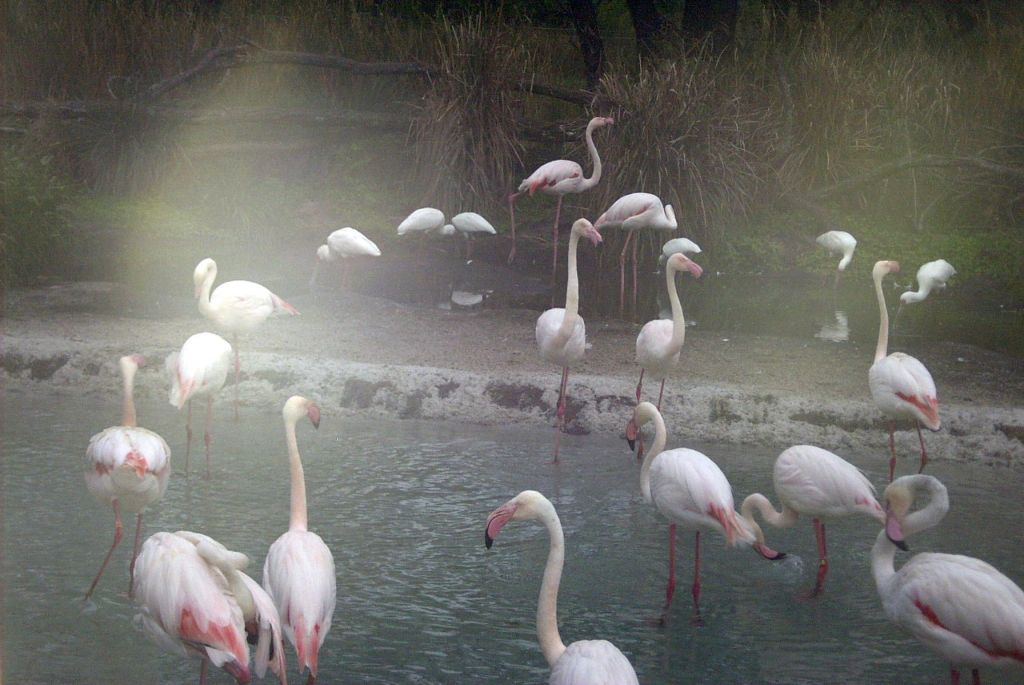
“Did you know? A flamingo’s bill is unlike any other bird’s. It contains rows of bony plates that act like filters. A flamingo finds food by dipping its head into the bottom of saltwater bays. It sucks up the ooze and uses its tongue to force the mud out through these bony filters, leaving a rich meal of tiny crustaceans in its mouth. A flamingo feeds with its head upside down. Unlike the jaws of other birds, the flamingo’s upper jaw moves up and down instead of its lower jaw.”
Cool. This couldn’t have evolved. The first flamingo to try eating like that would drown. God is amazing in His creative abilities! I also learned that the Arctic Tern migrates from the North Pole to the South Pole and back every year. That’s 22,000 miles round trip, and mostly over ocean!
FLamingoes. Seen in The Everglades of Florida. EPrata photo
Think on Him as Creator for a moment. He made all the birds of the air in one day, on Day 5 of Creation Week. Each bird uniquely suited to its habitat. Each bird delightfully different in plumage. God’s creative ability is so infinite my finite mind can barely even comprehend how He even made all the birds of the world in one day! Along with other animals, too. Wow.
Let’s pause for a moment and praise Him.
Then God said, “Let the waters teem with swarms of living creatures, and let birds fly above the earth in the open expanse of the heavens.” 21And God created the great sea creatures and every living creature that moves, with which the waters swarmed, according to their kind, and every winged bird according to its kind; and God saw that it was good. 22God blessed them, saying, “Be fruitful and multiply, and fill the waters in the seas, and let birds multiply on the earth.” 23And there was evening and there was morning, a fifth day.







 the-end-time.org