I am posting a few encouraging essays this week (at least I hope they are encouraging to you), because I think we need to absorb some positivity based on glorious promises from the Bible. It’s a rough week for many people.
There is such inexpressible and perpetual activity in the holy realms, it is breathtaking to think of. All heaven is working under command of our Holy God to ready for the Time. What time? The time when God says to Jesus, “Go get your bride!” And His deposit of our inheritance will be redeemed in full! (Ephesians 1:14; 2 Corinthians 1:22).
All of time, history, prophecy, and Holy Sovereign Decree has been moving toward the time of fulfillment of the promises of Jesus to His Bride and the promises of God to His people the Jews. Everything.
But back to the Bible’s pictures of activity. Didn’t Jesus say, “In my Father’s house are many rooms. If it were not so, would I have told you that I go to prepare a place for you?” (John 14:2).
Things are being prepared, right now. Our lodging in New Jerusalem. Our feast. He is preparing. He is engaged in activity to ready for the moment when a flood of redeemed souls enter glory to dwell with Him forever.
He is also preparing for the moment when His promises to his people the Jews come to fulfillment and the Kingdom Comes. Here is one specific glimpse of that preparation:
A Vision of a Man with a Measuring Line “And I lifted my eyes and saw, and behold, a man with a measuring line in his hand! Then I said, “Where are you going?” And he said to me, “To measure Jerusalem, to see what is its width and what is its length.” (Zechariah 2:1-2).
Zechariah had been awakened and was shown a series of 8 astounding visions all in one night. One of them is that God sent a surveyor (likely The Angel of the LORD, Jesus) to measure the place where the final Jerusalem will be, its exact size and placement! Rejoice O Jerusalem! “Rejoice with Jerusalem, and be glad for her, all you who love her; rejoice with her in joy, all you who mourn over her;” (Isaiah 66:10).
Right now Jerusalem is split and under contention. Later it will be called Egypt and Sodom, (Revelation 11:8), but someday it will be cleansed, and it will become the holy city God intended it to be.
Look! He is so gracious, He showed Ezekiel also! “In the visions God brought me to the land of Israel, set me on a high mountain in which there was a structure like a city on the south. And he brought me there and behold there was a man whose appearance was like the appearance of bronze with a line of flax in his hand and a measuring reed and he stood in the gate.” (Ezekiel 40:2).
Measuring … preparing … So much activity:
William Blake, Jacob’s Ladder
“And he [Jacob] dreamed, and behold, there was a ladder set up on the earth, and the top of it reached to heaven. And behold, the angels of God were ascending and descending on it!” (Genesis 28:12).
Going and coming … ascending and descending … Not just in the Old Testament but the activity continues in the New:
“He then added, “I tell you the truth, you shall see heaven open, and the angels of God ascending and descending on the Son of Man.” (John 1:51).
The Sovereign God, His Perfect Son, and the Holy Angels are working to bring about the fulfillment of all the glorious promises of the Bible. I know we know the judgment promises will come true. The world and the heavens will be UNcreated in a reverse orderly progression that mirrors the 6 days in the Creation. Mountains will crumble. Rivers will dry up. Sun will blink out. Stars will fall. People will die.
But to the positive, He is also readying His universe for the new heavens and the new earth, for the moment when the Father says, “Son, it is time for you to be married. GO GET YOUR BRIDE!”
Is there any doubt that the preparations will have been completed and the glowing glorious heavens will be inexpressibly beautiful? No, no doubt.
“And I saw the holy city, new Jerusalem, coming down out of heaven from God, prepared as a bride adorned for her husband. And I heard a loud voice from the throne saying, “Behold, the dwelling place of God is with man. He will dwell with them, and they will be his people, and God himself will be with them as their God. He will wipe away every tear from their eyes, and death shall be no more, neither shall there be mourning, nor crying, nor pain anymore, for the former things have passed away.” (Revelation 21:2-4)
Our Savior who saves by grace, our Father, the architect of the earth and the universe, the author of our faith, the redeemer of souls, the Chief of all the Holy Hosts, is preparing…for us.
I focused on the phrase “fix your eyes upon Jesus” from Hebrews 12:2. I looked up the word “fix” and the Strong’s says
872 aphoráō (from 575 /apó, “away from” and 3708 /horáō, “see”) – properly, “looking away from all else, to fix one’s gaze upon” (Abbott-Smith).
How helpful. I should not glance, not peek, not glimpse, but FIX my GAZE upon him, looking away from all else and steadily drinking in all that He is.
Looking away from all else…what does that mean? It means not being attached to the things of this world. Your country, your job, your family, your spouse, your car, your ‘stuff’, your health, is not more important than Jesus. He is the source and the giver of those things. Fix your eyes on Him.
We need to spend more time with Jesus to look more like Him. Moses only got to see God’s ‘back’ and His face after being with God was so bright it had to be veiled. We have the privilege of looking at Jesus’ “face” as it were, through His word. I want my face to be shining, to have my being conformed to Him, to have my mind transformed. But it won’t happen unless I read the Bible. I must look away from all other distractions and FIX my GAZE on Jesus. A Bible skim won’t even do.
Read the book of Revelation. There are some symbols in it, but most of them are already explained elsewhere in the Bible (scripture interprets scripture). Admittedly, there are some symbols that are hard to figure out at first pass. But those don’t diminish the overall majesty and awe-provoking wonder of the book, nor its intended meaning. It takes study, like any Bible book. It’s not harder than Romans…IMO
When the Antichrist, Man of Perdition, appears, it will be a devastating time on earth. Jesus Himself said it will be the worst time on earth there ever has been or ever will be. (Matthew 24:21). Satan will have come to the climax of his eons-long effort to de-throne God and to take over the world. He will indwell the Man of Perdition, and so there will be mostly only sin upon the earth. Sin will prevail- for a time.
In former times, people could not understand how certain things would occur that are described in Revelation. Like, for example, the verse that says all peoples will look upon the bodies of the slain Witnesses in the streets and not allow their bodies to be buried, and they will make merry and exchange gifts.
As a temporary aside, the unsaved HATE Christianity and all it represents. When sin is allowed its full measure on the earth, look how that hate is finally fully expressed: instead of Christmas celebrating the Babe with gift exchange, the world celebrates the Two Witnesses’ deaths and putrefying bodies with gifts. Instead of celebrating life, they will celebrate death.
Never think we can ‘woo the seeker’ with soft words. Only the actual Gospel will serve, and the world will love the Two Witnesses’ deaths because, as the scripture says, the world was ‘tormented’ by their words. (Revelation 11:10-11). The Gospel offends.
Anyway, before television was invented, before even film, radio, telegraph, the old timey people wondered, HOW would the whole world see this spectacle? There is no doubt that it will occur, but the means by which it will be fulfilled was beyond their imaginations.
But now technology has advanced so we say ‘Oh, satellite/cable/cellphones/wifi… THAT’S how.’
And now we come to another technological crossroad. You have heard of AI. AI stands for Artificial Intelligence. AI can generate art or literature based on key word inputs. It can also mimic voices. It is getting better at voice fakes. AI is even about to be able to produce 3D-holograms that can be done on a smartphone.
There is a verse in Revelation that people can’t really decide on how to interpret:
And he makes the earth and those who live on it worship the first beast, whose fatal wound was healed. He performs great signs, so that he even makes fire come down out of the sky to the earth in the presence of people. And he deceives those who live on the earth because of the signs which it was given him to perform in the presence of the beast, telling those who live on the earth to make an image to the beast who *had the wound of the sword and has come to life. And it was given to him to give breath to the image of the beast, so that the image of the beast would even speak and cause all who do not worship the image of the beast to be killed. (Revelation 13:12b-15)
Wut? Is the Antichrist killed? Is he dead? Not dead? Dead but resurrected?
Does it matter? With deep fakes and holograms, and AI that can mimic the person’s voice, any of the above is possible.
I thought about this from Revelation 13 when I came across a news story about a High School Principal who was framed by a staff member under investigation who used AI to make it seem like the principal had engaged in a racist rant. The swift circulation of this supposed clip caused significant disruption to the school and its students, a devastating impact to the man’s reputation, and a huge risk of harm to the principal and his family from others. But it was AI and only a fake from the disgruntled staffer.
The technology person interviewed in the news story said that there were clues in the audio that let police know this was a fake. He said that the person making it seemed a bit rushed, “but, if he had taken a bit more time, it would have been impossible for naked ears to tell the difference” between the fake and the real voice. I was interested to see that the AI voice fake was generated by the staffer who was a PE teacher. He wasn’t an underground shadowy guy like you see on the spy shows using massive technical materials in the ‘deep web’. He was just a regular teacher who created the fake easily. But it fooled people for a time.
AI is causing issues. I hear that scammers have latched onto AI to use voice mimicry to pose as grandchildren to ask Grandma for her banking details in order to ‘help’ her. Below is a quote from New York Department of Consumer Affairs:
As advancements in artificial intelligence and machine learning continue to impact many aspects of our lives, consumers should keep up to date with the newest types of scams that may target them and their loved ones. Scammers may try to impersonate your family and friends using AI voice-cloning technology to ask for money or personal information. Scammers may also use deepfake technology to alter pictures or video to impersonate public figures or loved ones. “Scammers are becoming increasingly more creative and using new technologies, like AI, to prey on consumers,” said DCWP Commissioner Vilda Vera Mayuga.
In January, CNBC reported a faked AI robocall allegedly from President Biden to urge voters not to participate in the New Hampshire primary.
You know the adage, ‘a picture is worth a thousand words’? No more. Anything and everything can be faked. Is it any wonder the Antichrist will easily perform lying signs and wonders at the height of his popularity?
He performs great signs, so that he even makes fire come down out of the sky to the earth in the presence of people. And he deceives those who live on the earth because of the signs which it was given him to perform in the presence of the beast, (Revelation 13:13-14a).
Matthew 24:24 warns that these signs will be so realistic that if it was possible, even the elect would be deceived.
It is more important than ever to cling tightly to Jesus in prayer, in the Word, and in holy living. Work to increase your sanctification. Pray for protection from the deceptions of the day. Jesus is Truth, the source of Truth in His word and the only place these days you can trust 100%.
We should be grateful we do not have to navigate these earthly treacherous waters unaided. The Holy Spirit in us preserves us and daily transforms our mind to the mind of Christ. If I were you, and I’m preaching to myself too, I’d ramp up our walk to a run and strive harder for a closer walk with Him. He is the high ground, the Rock, the safe zone. In Him, we cannot be deceived away from the truth.
Poetry by Kay Cude. Used with permission. Right click on image to open larger in new tab. Artist’s statement below.
I keep returning to our (me!!) needing to “remember” God’s promises and provision. GOD THE I AM is the only fortress in Whom we find a righteous protector, defender and provider. He is the only place of eternal refuge from the world’s continuing tragedies and chaos. He is the stronghold Who is and Who will provide peace, wisdom, understanding, instruction and endurance.
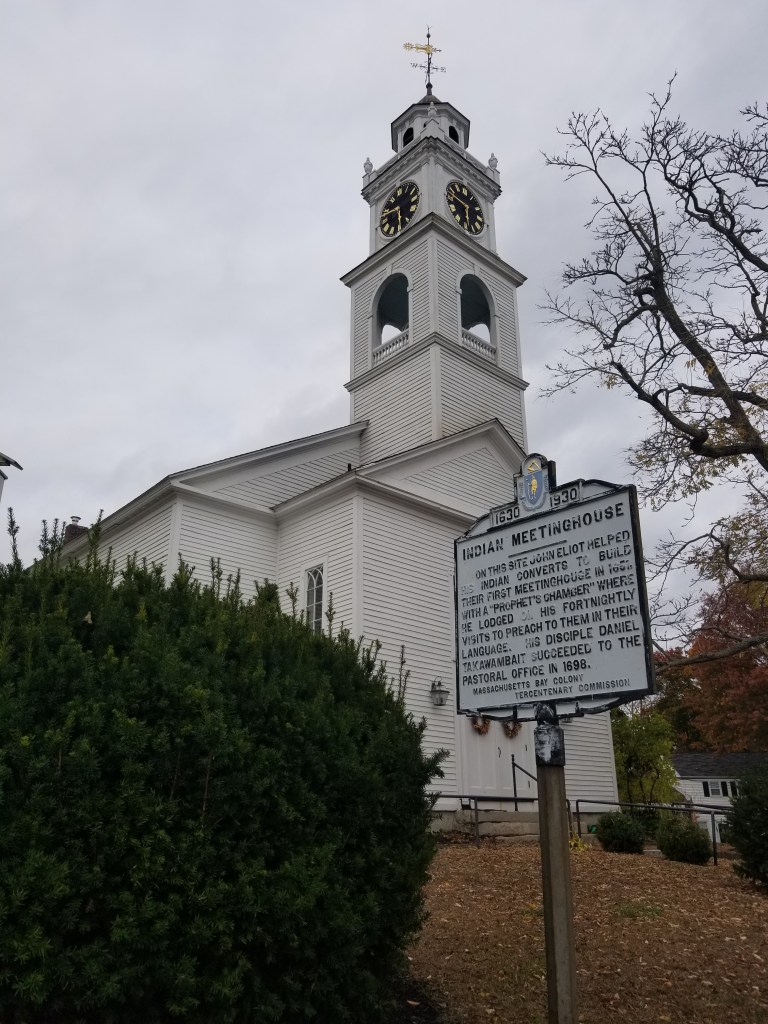
When I was researching for my series on Puritan Wives entry on Margaret Winthrop, I read this in a footnote and followed it up to the source. “In 1640, Margaret Winthrop was deeded 3,000 acres of land at the mouth of the Concord River, which was later sold for establishing Wamesit, an Indian Praying Town.” Source
Wait, wut?! An Indian Praying Town? I need to know more about this please. It all starts with Puritan John Eliot.
“Eliot left England, the land of his birth, in 1631 as a young Puritan pastor. He worked in Boston for a year, then established a church five miles away in Roxbury, where he remained for 58 years, until his death. From the beginning he established an excellent relationship with the Narragansett Indians in the area and gradually also with other peoples speaking related languages.” Source
It seems that shortly after settling in Massachusetts, the Puritans recognized the need to evangelize the Native Americans. The language barrier was a difficulty, though. John Eliot was particularly burdened for these souls, and attempted a sermon in 1646 which was a failure, mainly due to the butchered language. Nevertheless, Eliot continued to meet with the leader (sachem) of the Massachusetts tribe, Cutshamekin, and soon he converted.
But the language barrier bothered Eliot, and he decided to do something about it. The Pequot Cockenoe, who had been captured in the 1637 Pequot War between the colonists and the Indians, served Eliot as translator and teacher. In return, Eliot taught Cockenoe how to write. The first things Eliot transliterated was the Lord’s Prayer and the Ten Commandments, plus some other prayers. By the late 1640s, Eliot was preaching to the Indians in their language. The earliest converts were from Eliot having conducted sermons and visited Native American homes, these were the earliest ways of propagating the gospel. But it was slow and cumbersome, and there was only one of Eliot.
Eliot wrote to England for help. In 1649, the government in England chartered the “Corporation for the Promoting and Propagating the Gospel of Jesus Christ in New England”. The Act endowed the parties with an official Corporation, complete with President and Treasurer. It was allowed to collect and send money to the Puritans in New England for the purpose of missions to the indigenous peoples on this side of the Atlantic. They raised 12,000 English pounds! That is equivalent to 2million dollars in today’s currency (according to one history calculator).
As converts increased, Eliot then set about finding acreage for these newly converted Indians to live, called “praying Indians”. He wanted to separate them from their tribal obligations and mode of dress, and reduce temptations. He also wanted to have the Native Americans and Colonists mix more.
This is where the acreage mentioned at the top of this essay comes in. The Winthrop acreage established an “Indian Praying Town”. It was and to this day is called Natick, Massachusetts. Eliot taught them how to establish a Christian community.
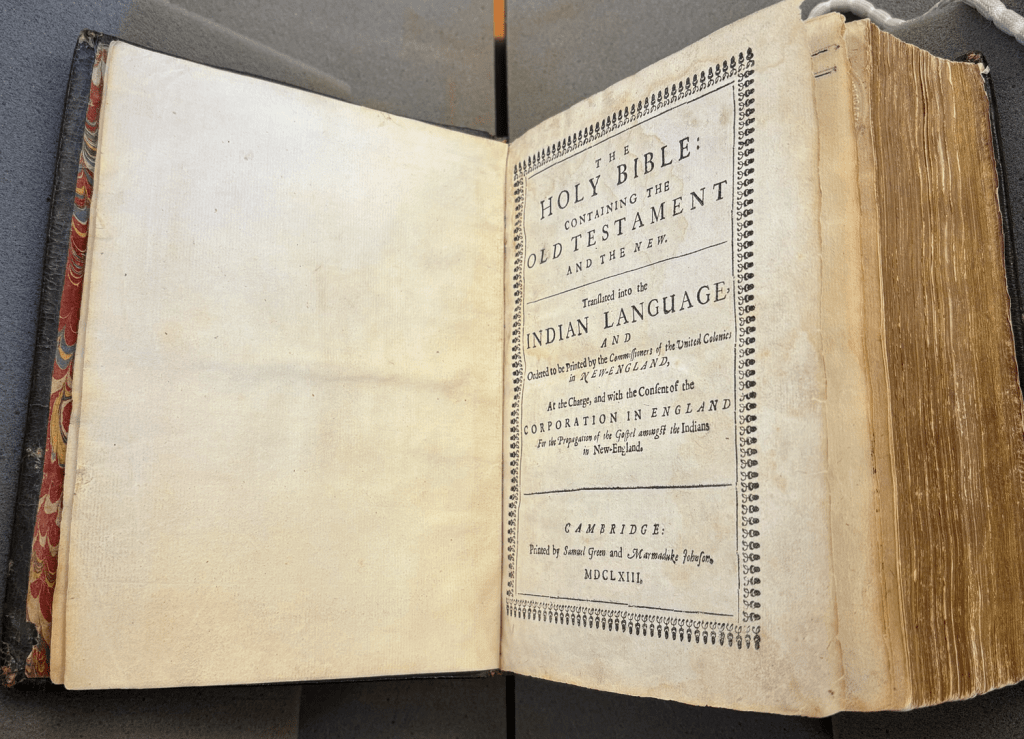
Eliot then ramped up his commitment to translate the Bible into their language, Algonquin. No easy task, there was no Algonquian alphabet! Eliot had to devise one, and thus became a lexicographer and grammarian in their language. He spent the next 14 years doing this but eventually in 1663, published “Mamusse Wunneetupanatamwe Up-Biblum God”.
The Eliot Indian Bible, published in 1663 as the first Bible printed in North America, was published with the support of the Society
Three years later, The Indian Grammar Begun was published also.
Now that it was translated, the Bible needed to be printed. Eliot wrote to the Corporation-
“I shall not trouble you with anything at present save this one business of moment, the printing of the Bible in the Indian language, which business sundry of the elders did petition unto the Commissioners, moving them to further it, as a principal means of promoting religion among them. … [Please send a printer] to New-England at the press in Harvard College, and work under the College printer, in impressing the Bible in the Indian language and with him send a convenient stock of paper“. (Source- The early Massachusetts press, 1638-1711, by George Emery Littlefield)
And the Corporation did just that, sending professional printer Marmaduke Johnson, 100 reams of paper, and 80 pounds of new type for the printer.
“Eliot was the only missionary to devise a new alphabet from an unwritten language for the purpose of teaching and preaching the scriptures“, we read in The American Puritans by Benge and Pickowicz. Eliot helped found the first missionary society in the New World, printed the first Bible in the New World, and was known as ‘Apostle to the Indians.’
Meanwhile, the “Indian Praying Towns” were multiplying. Eliot’s son John Jr. was now helping, then his son-in-law came to serve as well. There were 14 Indian Praying Towns in Massachusetts and 3 in Connecticut at the height. Eliot also established schools for the Christian Indians, established churches, and encouraged commerce between the Natives and the Puritan colonists. All was going well until…
Metacomet (English name: King Philip, 1638 – 1676) was chief of the Wampanoag people. The King Philip War – the most devastating war (1675 – 1676) between the colonists and the Native Americans in New England – is named according to him. Wood engraving, published in 1884. Source
King Philips War ended things abruptly. King Philip was actually a Native American called Metacom who started a war in 1675 until 1676 between a group of Indians and the English Colonists & their Native allies. Metacom’s father was Massasoit, you may remember, the Native American who helped the earliest Pilgrims who landed at Plymouth. Massasoit helped them avoid starvation. After Massasoit passed away, Metacom was not as friendly, claiming violations of the English in the treaties, and encouraged raiding parties. Eventually as tensions increased, war broke out.
Praying Indians offered to aid the Colonists in this war but were rejected. Many were either confined to their towns or relocated to Deer Isle. When the war was concluded relations among any and all Native Americans’ including the Praying Indians, was permanently damaged. It was said that it was a violation to even speak well of an Indian.
In 1675, when Philip’s war broke out, the English inhabitants generally were jealous of the praying Indians, and would have destroyed them, had not General Gookin and Mr Eliot stepped forth in their defence.Source, “History of the town of Natick, Mass. : from the days of the apostolic Eliot, MDCL, to the present time” by William Bigelow, 1830.
Things never got back to the height of the well-thought-of Praying Town. Ten of the original fourteen MA towns were disbanded. A few stragglers filtered back to Natick, the original Praying Indian Town, but it was closely supervised by the colonists.
John Eliot poured out his life for the Native Americans in his sphere. He was earnest for these souls and in return was beloved by the people he helped convert. Tokkohwompait was one of these men. At the end of Eliot’s life, he wrote to John Eliot,
“God hath made you to us and our nation a spiritual father, we are inexpressibly engaged to you for your faithful indefatigable labors, and love, to us and for us, you have always manifested the same to us as well in our adversity or prosperity, for about forty years making known to us the glad tidings of salvation of Jesus Christ.”
What a testimony for the name of Jesus Christ. What a well-done life poured out on behalf of pagan souls. Many do not know of John Eliot’s missionary endeavors, but I encourage you to search further and read up on this inspiring man.
If people would simply stop accepting at face value the proclamations of celebrity pastors and lady ‘Bible’ teachers, that they are Christians, the faith would be stronger.
When a megapastor, such as the types like Mr Furtick, Mr Driscoll, or Mr Stanley, or a lady ‘Bible’ teacher like Beth Moore or Jennie Allen or Joyce Meyer teach something that isn’t in the Bible, or otherwise make an outrageous statement, the thinking goes something like this:
“What?! How could Pastor So-and-So say that? He says s/he’s a Christian, so how can s/he not know that isn’t the truth?! Since s/he says they are a Christian, we have to find out what s/he really meant. It must be a mistake, or s/he said it because s/he must be temporarily under the influence of NyQuil. Of course s/he is a Christian (because Pastor So-and-So says he is) and Christians would know better than to teach that.”
Complex rhetorical pretzel-logic ensues.
You know, most people who say they’re saved, are not saved. Am I pessimistic? Am I “judging the heart”? Am I “judging their motives”? No. Jesus said that many go on the broad way to destruction and few find the way to salvation. (Matthew 7:14). Jesus followed that statement immediately in the next verse, saying
Watch out for false prophets. They come to you in sheep’s clothing, but inwardly they are ferocious wolves. (Matthew 7:15). Further on we read the devastating verses in Matthew 7:21-23 where many are unveiled to not have been a Christian all along. Jesus says ‘Depart from me, yu worker of iniquity, I never knew you.’
In the New Testament ‘false prophets’ are pastors, a word we’re more familiar with today. Or they are teachers.
If someone in real life says to me that they are saved, I don’t dismiss their statement, of course. But I do not accept it at face value, either. I listen to testimony, I watch for fruit, I reserve comment or opinion on their self-proclamation until I see one way or another which way their wind blows. That takes time.
But if someone is a pastor or teacher at the highest levels with a following or influence, and thus a body of work to examine and compare to the Bible (Acts 17:11), and they say something incontrovertibly against a foundational doctrine, (like when Billy Graham says we can go to heaven without knowing Jesus; or the wild abuses against the Spirit of Benny Hinn or Joyce Meyer, or the greed with which a Joel Osteen bows to Mammon), then it’s understood in my mind that someone with the Holy Spirit in them would never teach that or behave that way. Ever.
There are some simple items to help people begin to understand whether to call someone a brother. Here are a few-
1. True believers will understand, confess, and defend the true Gospel of Jesus Christ. (See Corinthians 15:1-5.)
2. Actual Christians will discerningly spot counterfeit gospels and conclusively reject all of them. (See Galatians 1:6-9).
3. Believers, while not morally perfect until glorification, will care about holiness and will strive to live according to God’s commands. If pointed out to be teaching falsity or to be in sin, they will hasten to correct (See I Corinthians 6:9-11).
Remember, the Holy Spirit indwells a true believer. He will not allow decades of falsity to spew from the pastor’s or teacher’s mouth. He will not allow decades of behavioral abuse to continue. If an actual believer teaching something falls into sin, after a short while it will be resolved through repentance, or even in the case of the Corinthians they were disciplined with sickness or even death for abusing the Lord’s Table, or the Thyatirans who followed metaphorical Jezebel, Jesus threatened to kill them. The Spirit’s ministry is to point to Jesus, not allow falsity from one of His sheep to confuse the unwary and pollute the faith. We must see Jesus with clear eyes. Many, believe it or not, do not profess the true Jesus, but sadly, many do not know that the foundation of their faith is sand and not the Rock. (see Matthew 7:21-23).
How goes the Gospel in the world at the end of the twentieth century? There is no way of getting full or accurate statistics (though there are many useful attempts). One can only make educated guesses. Mine is that the vast majority—maybe 90 percent—of professing Christendom does not profess Christianity. Or rather, it does not understand the Christianity it professes.
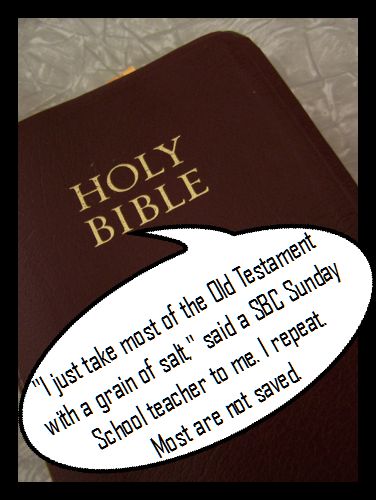
Most of the people who profess Christ do not believe the essential doctrines that set one apart as a regenerated, saved Christian. I have seen this up close. A Southern Baptist Convention Sunday School Teacher/Director laughingly said to me once, “Oh, I just take most of the Old Testament with a grain of salt.”
Here is John MacArthur with an essay on “What kind of things do and do not prove the genuineness of saving faith?” Do not be caught by the conditions observed in a person that do not prove OR disprove genuine saving faith, such as: Visible Morality, Intellectual Knowledge, Religious Involvement, Active Ministry, Conviction of Sin, The Feeling of Assurance, A Time of Decision. Then MacArthur continues in showing Nine conditions that DO prove genuine saving faith. Here is the link.
Ever since the beginning of my walk with the Lord, I have been concerned with the notion of false professions, false Christians, and polluted faith. I work at not contributing to the problem by examining myself, confessing sin when necessary, and keeping my eyes on “This Same Jesus” who departed in Acts 1:11 and will return the same way.
I dread the day when Matthew 7:21-23 comes true, when many (hopefully not me!) will be unmasked as false believers and sent to hell. However, that will be one way that Jesus’ glory will be shown to be even more glorious than we ever could imagine. These things must be pondered.
Angels are mentioned almost three hundred times in the Bible. Let’s look at who these created beings are and what they do for God. This essay will be divided into three sections. First, we’ll have a very brief overview in looking at what angels do and who they are, from scripture. I say very brief because the subject is so deep that one essay, or even a dozen essays, can’t do it justice.
In the second section there will be some fast facts and trivia.
In the third section at the end I’ll look at some weighty matters concerning angels.
Section 1: Overview
The Bible says that “In the beginning, God created the heavens and the earth.” (Genesis 1:1) Since God has always existed, ‘the beginning means’ the beginning of what He wants to reveal to us. Job 38:4-7 says that when God did that work, the angels praised Him by shouting with joy. So the angels already were created by God when God created the worlds. We do not know how long before, but they were blessed spectators to the Creation.
“Where were you when I laid the foundation of the earth? Tell me, if you have understanding. Who determined its measurements—surely you know! Or who stretched the line upon it? On what were its bases sunk, or who laid its cornerstone, when the morning stars sang together and all the sons of God shouted for joy?” (Job 38:4-7)
“Sons of God” is a term sometimes used to describe angels. (Job 1:6, Genesis 6:2). Angels then, were created before the foundation of the world was laid, but the point is, they are created beings. They have intellect, will, and emotions. They are a higher order than humans. (Hebrews 2:7). They are spirit beings that sometimes take on a body likeness when they come to earth. And they do come to earth. (Genesis 32:24, Hebrews 13:2).
In Genesis 18:2, Abraham saw three ‘men’ approaching him but in the next verse Abraham immediately bowed and called one of them Lord. Though they were in the form of men, Abraham knew they were not of this world. One of them was a pre-incarnate visitation of Jesus, of course. Sometimes an angel appears and they do not look like men but they do look like they are from glory. (Matthew 28:2-4). Usually in those cases where even their full stature and countenance is hidden, the men and women viewing them still fall down.
They serve us by obeying God. They praise and honor God in His temple (Revelation 4:8; Hebrews 12:22) bring messages, (Luke 1:19, Daniel 10:11), minister to us, (Hebrews 1:14), fight for God against the forces of evil, (2 Kings 6:17).
Or not, as the case may be. Angels rebelled in heaven and a third of the angels sided with satan. (Revelation 12:4). These became the demons. They attempt to thwart God and His people. They may seem to be temporarily successful but of course they are not in any sense victorious over God. His plan reigns supreme. All that happens to those who love God He turns to the good for His glory.
“But its distinctive application is to certain heavenly intelligences whom God employs in carrying on his government of the world. The name does not denote their nature but their office as messengers. (1.) The existence and orders of angelic beings can only be discovered from the Scriptures. Although the Bible does not treat of this subject specially, yet there are numerous incidental details that furnish us with ample information. Their personal existence is plainly implied in such passages as Genesis 16:7, 10, 11; Judges 13:1-21; Matthew 28:2-5; Hebrews 1:4, etc. These superior beings are very numerous. “Thousand thousands,” etc. (Dan. 7:10; Matthew 26:53; Luke 2:13; Hebrews 12:22, 23). They are also spoken of as of different ranks in dignity and power (Zechariah 1:9, 11; Dan. 10:13; 12:1; 1 Thessalonians 4:16; Jude 1:9; Ephesians 1:21; Colossians 1:16). (2.) As to their nature, they are spirits (Hebrews 1:14), like the soul of man, but not incorporeal. Such expressions as “like the angels” (Luke 20:36), and the fact that whenever angels appeared to man it was always in a human form (Genesis 18:2; 19:1, 10; Luke 24:4; Acts 1:10), and the titles that are applied to them (“sons of God, ” Job 1:6; 38:7; Dan. 3:25; Comp. 28) and to men (Luke 3:38), seem all to indicate some resemblance between them and the human race. Imperfection is ascribed to them as creatures (Job 4:18; Matthew 24:36; 1 Peter 1:12). As finite creatures they may fall under temptation; and accordingly we read of “fallen angels.”
FMI: Sermon by Martyn Lloyd-Jones, Common and Special Grace, Ephesians 6:10-13, “examples of special grace in Scripture; the ministry of angels.“
Note: Even though the audio to MLJ’s part 2 on angels is lost, for now at least, the companion lecture to Good Angels, titled “‘The Devil and the Fallen Angels'” can be read at this link. (start on p 78).
Trivia question: Who are the only named angels in the Bible? Answer below.
Fast Fact: Angels that rebelled will not be redeemed. Their condemnation is fixed. (Matthew 25:41)
Fast Fact: Humans do not turn into angels when we get to heaven. Angels and humans are separate orders of beings in creation. Angels are angels and humans are humans. Forever.
Cherubim is a class of angel who guarded the way back to the tree of life with a flaming sword. (Genesis 3:24)
Peter was freed from prison by an angel. Even locks and prison bars cannot stop angels from ministering to us, when God sends them! (Acts 12:4-8)
An angel announced the birth of Samson. (Judges 13:1-7,24)
Food for thought: If sometimes we entertain angels unaware, and a third of them sided with Lucifer and turned into unholy demons, then there is a 1-in-3 chance that when an angel visits us he is an unholy demon. (Genesis 6:1-2). However the good news is that they obey God and do His bidding within limits. (Job 1:12, 2 Chronicles 18:21)
Do angels marry? Not in heaven. (Mark 12:25). But the rebellious ones did on earth. (Genesis 6:1). That’s why they are in chains awaiting judgment. (Jude 1:6; 2 Peter 2:4)
Trivia answer: The named angels in the Bible are Gabriel, Michael, Lucifer, and perhaps also Apollyon/Abaddon of Revelation 9:11.
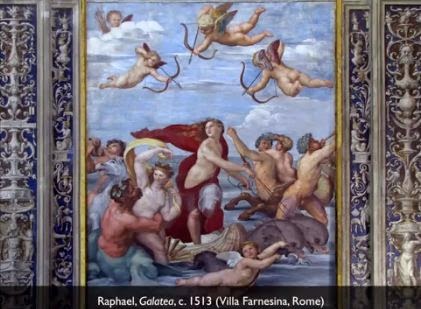
The Renaissance was a period of renewal and discovery. So much beautiful art, architecture, and advanced thought came out of that period between the 14th and 17th century that we have much to be grateful for. However, not all that came from the Renaissance was good. We have our current view of angels as chubby munchkins with tiny wings shooting love darts into people insidiously placed in our minds thanks to the Italian painters.
Wikipedia explains the difference between putti and cherubs (as opposed to the biblical cherubim).
“A putto (plural putti) is a figure in a work of art depicted as a chubby male child, usually nude and sometimes winged. Putti are commonly confused with, yet are completely unrelated to, cherubim. In the plural, “the Cherubim” refers to the biblical angels, which have four heads of different species and several pairs of wings. While “cherubs” represent the second order of angels, putti are secular and present a non-religious passion. However, in the Baroque period of art, the putto came to represent the omnipresence of God. A putto representing a cupid is also called an amorino (plural amorini). During the Middle Ages, the putto disappeared and was revived during the 15th century. The revival of the figure of the putto is generally attributed to Donatello, in Florence in the 1420s”
At least at the end of the Gothic age as the Renaissance dawned, Giotto, the era’s most famous painter, was depicting angels as full grown men. Below is his “Nativity” from the Arena Chapel, Late Gothic/Early Italian Renaissance 1305-1306. The angels are engaged in full-blown worship of God. They had wings, unfortunately, but at least they were fully grown. By the beginning of the Renaissance around 1420, they had been reduced to putti/cherubs.
Here is an example. Though the putti were meant to be secular, their similarity to cherubs in vastly reduced in size and position contributed to the false imagery about angels that persists to this day. They are constantly shown as mischievous sprites chasing love and napping, not full the grown, powerful created holy beings who serve Almighty God that they are. I’m harping on this for a reason.
Here is a piece of art called “The Cherub Harvesters,” Francis Boucher, ca. 1733-34
Angels in the Bible are potent beings with incredible power. Did you know that the Law was given to Moses by angels?
“you who received the law as delivered by angels and did not keep it.” (Acts 7:53),
“Why then the law? It was added because of transgressions, until the offspring should come to whom the promise had been made, and it was put in place through angels by an intermediary.“(Galatians 3:19)
Deuteronomy 33:2 mentions that He came to give the Law with myriads and ten thousands of His holy ones. Angels by the side of God as He delivered the Law! Incredible!
How powerful are angels? This was astounding to me when I read it. I studied the book of Revelation. It becomes terribly obvious that angels are the means that God uses to deliver judgment.
Begin with Chapter 5:2,
“Then I saw in the right hand of him who was seated on the throne a scroll written within and on the back, sealed with seven seals. And I saw a mighty angel proclaiming with a loud voice, “Who is worthy to open the scroll and break its seals?”
The word loud in this verse is from megas, meaning ‘in the widest sense’, large, great. It’s where we get ‘mega’ from. Mighty is from a word meaning powerful in the physical sense.
“Then I looked, and I heard around the throne and the living creatures and the elders the voice of many angels, numbering myriads of myriads and thousands of thousands, 12saying with a loud voice, “Worthy is the Lamb who was slain, to receive power and wealth and wisdom and might and honor and glory and blessing!” (Revelation 5:11-12)
Angels hold back the wind and rise with the sun. They proclaim praise, render judgment, and fulfill God’s wishes.
“After this I saw four angels standing at the four corners of the earth, holding back the four winds of the earth, that no wind might blow on earth or sea or against any tree. Then I saw another angel ascending from the rising of the sun, with the seal of the living God, and he called with a loud voice to the four angels who had been given power to harm earth and sea, 3saying, “Do not harm the earth or the sea or the trees, until we have sealed the servants of our God on their foreheads.” (Revelation 7:1-3)
How about this powerful scene with angels from Revelation 8:1-5
When the Lamb opened the seventh seal, there was silence in heaven for about half an hour. 2Then I saw the seven angels who stand before God, and seven trumpets were given to them. 3And another angel came and stood at the altar with a golden censer, and he was given much incense to offer with the prayers of all the saints on the golden altar before the throne, 4and the smoke of the incense, with the prayers of the saints, rose before God from the hand of the angel. 5Then the angel took the censer and filled it with fire from the altar and threw it on the earth, and there were peals of thunder, rumblings,a flashes of lightning, and an earthquake.”
Cherubs? NO! Flying babies? Never! They are holy and powerful! Skim through Revelation to see the massive amount of angelic intercession in the affairs of men during the Tribulation. I could quote many more instances but if I did, I’d essentially be repeating the entire book of Revelation. John MacArthur sums it up
“Angels, you know, have played very prominent roles already in Revelation. The four horsemen that we saw in chapter 6 were called by angels, the seven trumpets were blown by angels, Satan and demons were defeated by angels, the seven bowls will be poured out by angels, Armageddon is announced by an angel, Satan and demons are bound by an angel, and here is another angel. And this angel comes out of the temple in heaven and he also has a sharp sickle.” This is the angel that reaps the earth.
Matthew 13:39 says that angels reap at the end of the age:
“and the enemy who sowed them is the devil. The harvest is the end of the age, and the reapers are angels.” (Matthew 13:39)
Once you’ve read through, then ask the Spirit to heighten your awareness of the holy work of angels in the Bible. They are mentioned quite often, and as you read through the book you’re reading through, you will notice their works. Even the demons are powerful. The fallen ones are still called majesties and those false teachers who unwisely mock and deride them are themselves awaiting judgment. (2 Peter 2:10-11). Even Archangel Michael dare not bring an accusation against satan but instead said simply, “The Lord rebuke you!” (Jude 1:9).
Not that we worship angels, (Revelation 22:9) but be aware of their powerful work for our Holy God. Just as we are instruments of His plan used to bring Him glory, so are angels. Yet they have supernatural powers and dwell in the very temple of heaven. Refuse to allow this image to stay with you-
and instead remember that even this image won’t do them justice.
Chris Koelle
They are majestic, intelligent, powerful and we are not to revile even the fallen ones. Our God is amazing in His creation of all the universe, the worlds, the animals, stars, humans … and angels.
Further Reading:
Angels, a 2-part free lecture series from RC Sproul
This is a common comment from women responding to discernment issues: “I don’t agree with everything she says, but let’s not attack her”. Also, “I don’t agree with all that she teaches, but she’s a sister so let’s treat her like one.”
Both of these comments indicate that the person needs a deeper understanding of what discernment is. They also need more fully to understand the words attack and agree.
The REAL attack
What these women don’t know, or refuse to see, is that the false teacher is actually the attacker. She is attacking the faith either overtly as a ravenous wolf, or covertly as a moth chews in the dark and only when exposed to light we see the garment is full of holes. The discernment people are the ones shining the light and saying, ‘she’s a wolf, devouring the unwary!’ or, ‘she’s a moth, destroying the fabric of someone’s faith!’
False teachers are spoken of in every New Testament book (except Philemon). Thus, the Holy Spirit obviously spent much time advising, warning, and teaching about the dangers of these wolves and moths.
“The word “moth” occurs 7 times in the Old Testament, in Job, Psalms, Isaiah and Hosea, always in figurative expressions, typifying either that which is destructive (Job 13:28; Psalms 39:11; Isaiah 50:9; 51:8; Hosea 5:12) or that which is frail (Job 4:19; 27:18).” The mother moth lays the eggs, but “the adult is only indirectly harmful, as it is only in the larval stage that the insect injures clothing.” Source Bible Study Tools
So that means at first you don’t see the damage. It’s done invisibly. By the time you see the adult moth, the damage has been done. This is why the Spirit dispensed a spiritual gift of discernment to some, who can see the larvae before they do the damage. They can see the wolves lined up in the shadows of the tree line before they devour the faithful.
It’s why you should listen to your discernment people. Not blindly, but take heed.
We are all familiar with the verse in Matthew 7:15, “Beware of the false prophets, who come to you in sheep’s clothing, but inwardly are ravenous wolves.” The false ones come in sheep’s clothing. They say and do things that attempt to make them blend in. But so did Judas. They will say they love Jesus- repeatedly. They will appear to be godly- consistently. They spout scripture. So did satan when tempting Christ.
They do things that on the surface seem appropriate for a sheep. But if you look carefully, they have dregs of meat in their teeth. Do sheep eat meat? No. If you listen to their utterances, there will be a howl behind that bleat, it doesn’t sound like a normal bleat. This is what sheep’s clothing means.
Another verse that spells it our further is that one from 2 Corinthians 11:14-15, No wonder, for even Satan disguises himself as an angel of light. Therefore it is not surprising if his servants also disguise themselves as servants of righteousness, whose end will be according to their deeds.
They masquerade. Their show of godliness is only a put-on. It’s a show. No matter how effective the mask and costume, there are always hints that it’s not real. Look for those hints, eventually they grow into flags and then you can unmask the deceiver.
Too many women accept a false teacher’s profession of faith on the face of it, putting more weight on the profession from the false teacher than they put in the scriptures that show how to discern the wolf from the sheep, the moth from the butterfly.
The deceiver, the false teacher is ATTACKING you. She is ATTACKING the faith. Wolves like Lori Alexander, Beth Moore, Jennie Allen of IF:Gathering and so on, are the attackers. They are attacking Jesus.
The seem gentle and nice and helpful, but they are among those “who will secretly bring in destructive heresies.” (2 Peter 2:1b).
See? They operate secret agendas that are in fact destructive to the faith because they are heresies.
If anyone advocates a different doctrine and does not agree with sound words, those of our Lord Jesus Christ, and with the doctrine conforming to godliness, 4he is conceited and understands nothing; but he has a sick craving for controversial questions and disputes about words, from which come envy, strife, abusive language, evil suspicions, 5and constant friction between people of depraved mind and deprived of the truth, who suppose that godliness is a means of gain... (1 Timothy 6:3-8)
See? These women are conceited, puffed up, they love quarrels and strife, they’re ignorant (understands nothing), and are actually sick, nosōn, in craving strife.
They are attackers, destroyers, assaulters. When discerning people point out their destructiveness, we are not attacking them. We are defending the faith, protecting the sheep, warning the sisterhood that there is danger. It must be said, if you defend a false teacher for any reason, please examine where your real allegiance lies.
This is important: 2 Timothy 4:3 says that false teachers don’t just appear out of nowhere for no reason. They appear and stay because the undiscerning with diverse lusts prop them up. If you defend a false teacher, you’re part of the problem.
For the time will come when they will not tolerate sound doctrine; but wanting to have their ears tickled, they will accumulate for themselves teachers in accordance with their own desires,
The real ‘agreeing’
It’s not a matter of “agreeing”. It’s a matter of submitting.
First of all, no one at any time or anywhere in any sphere agrees with “everything they say.” Do you agree with everything your boss says? Your mother? The President? No, of course not. You likely don’t even agree with everything your pastor says or does. Uniformity of content is a phantom. So stop prefacing a defense of a false teacher by saying, “I don’t agree with everything she says but…” You have failed even before you get to the ‘but’.
But what? You are willing to taste her meal even though there’s poison in it? If there was a pan of brownies served to you and the baker said, ‘I mixed a little poop in here but you should be all right to eat from this corner.’ Would you? No! You throw the WHOLE PAN out because the whole pan is polluted. ‘A little leaven spoils the whole lump’.
Did Paul accept the true words from the demon-possessed slave girl? “She followed Paul and us and cried out repeatedly, saying, “These men are bond-servants of the Most High God, who are proclaiming to you a way of salvation.” (Acts 16:17)
No! Why not? The words are true but Jesus doesn’t need truth to come from lying lips. So whatever parts you may “agree” with the false teacher just remember it comes from polluted lips.
Many people say “I don’t agree with what they teach but she’s a sister…” This is backward. It is not a matter of agree or not agreeing with the teacher. Its a matter of submitting to what the word of God says.
The agreement part should be “I don’t follow this teacher because what she teaches does not AGREE with the Bible.”
Now here’s an interesting notion: Even IF a teacher teaches all that is correct in the Bible, if she lives a life at odds with behavioral standards, she is a false teacher. She must be humble, teachable, living in peace and harmony with others, or good character. Numerous verses attest to this. The primary one is that anyone who is not these things cannot “teach what is good” because they are living bad.
If someone is preaching heaven but living like hell, avoid her. Doctrine matters, and so does behavior.
Ladies, a false teacher who won’t see her error and won’t repent is not a sister. There are ONLY sheep and goats. If a teacher has been teaching something that is pointed out to her as error, the Holy Spirit inside them will prick their conscience and illuminate the scriptures to them. She will correct it. She will hasten to correct it – because Jesus is too precious to her.
If it’s a false teacher, there is no Holy Spirit in her and she will continue teaching falsely. Do you suppose that a teacher who has the Spirit in her can or would resist Him and continue to teach falsely for decades? No. Not possible. Holy Spirit absolutely would not allow this.
If there is a teacher who refuses correction, is unteachable, proud, she is false, not a sister.
Peacemakers
Women tend to be peacemakers, nurturers, and relational. Many women are hesitant to engage in something controversial. Women like to look for the good in someone. In discernment, we have to overcome these natural tendencies sometimes, and engage in warfare, which is always uncomfortable.
Discernment is spiritual warfare. Not against people, and many times not even against external philosophies (though it is, says Ephesians 6:12), but warfare is to suppress our own tendency to overlook sin and to paper over what should remain a schism. We gird ourselves with the truth that offends.
Discernment means wrestling and striving, resisting any philosophies, concepts, or traditions that oppose Jesus. If a person resists delving into why so many people are saying this women or that women is false, then sadly, you might have an idol. NOTHING should come between you and your Savior. If you do delve and notice more than a few errors, but still support the false teacher, sadly, you may have an idol. Do you love the false teacher more than Jesus? Examine yourself.
For most women, discernment simply means working toward consuming meat and training one’s self in distinguishing the healthy from the unhealthy. Most women don’t need to wade into controversies online or raise issues at their home church. Romans 16:17 says of the false teacher to turn away from them. Just don’t consume their output, don’t follow them online, don’t attend parachurch meetings where they’re taught, leave Facebook groups that promote them. 2 Thessalonians 3:6 says to keep away from the undisciplined brother (and sister).
Pray for discernment, stay in the word of God, fellowship with wise saints, and all this will become easier over time. Then finally, heaven! No false teachers will be there and nothing will impugn the good Name of Jesus ever again!
It started as a partnership between Anchor and Spotify. Then Spotify nudged Anchor out. All my podcast drafts went away. Spotify provided a recording platform, for a while, but then got absorbed by Riverside. All my podcasts went away.
Now in June the podcast platform is changing. AGAIN. Spotify quit the podcast recording biz and it will be ONLY Riverside. Their recording platform is complicated and only allows 2 (free) hours a month. So that’s out. I’m not looking forward to another change, which means I have to re-learn another whole podcast platform AGAIN.
Apparently all my old podcasts on Spotify with the button at the top of the blog are moot. If you press it, it will take you to Spotify but not to the episode. Maybe. Sigh. Technology is great, except when it’s not.
I hear good things about Audacity, which is free. I have tried hard not to spend money on hosting platforms or equipment. I have only an older laptop and its internal microphone, and whatever recording platform is freely available to post The End Time Blog podcast.
At least it’s a grace that when Spotify quits I’ll be home on summer break and will have time to search for and learn a new platform.
All that to say, I’m sorry for the blog’s podcast button not being reliable. You can still listen to the podcast (which is just me, reading the bog) at your usual outlets. Amazon music, iTunes, Spotify, etc.
I do want to keep the podcast up because ladies in real life (RL) tell me that they appreciate the alternative to reading, since they are either busy commuting to work or busy at home with the kids. This is why I do it. My commitment is to get solid content out there, connect people with credible ministries, and share thoughts from past people on missions or women of the historical faith, as well as doctrine and encouragement.
So as technology evolves I will too. Keep on truckin’!
I love to linger in thoughts of the supernatural. God is supernatural, of course. He is above us here in the natural world. The Trinity is supernatural. Who can understand it? The creation in 6 days is supernatural, and amazing too. His omnipotence is surely on display right from the first verses of Genesis.
Angels are supernatural. Sometimes invisible hordes are all around us (2 Kings 6:17). And demons (unholy angels) are supernatural. They are real, led by satan, formerly the highest angel. The Bible depicts demon possession. Jesus spent quite a bit of time casting them out. Just because 2000 years have gone by does not mean the demons are gone. They are still around, and will make an even more prevalent appearance during the Tribulation. (Rev 9:3, Rev 16:14, Rev 18:2, Matthew 24:37).
Heaven is absolutely a real place, it has physical properties, inhabitants, and activities within it. Bible verses say that it is above the earth, or people are called to ‘come up here.’ Or that they ‘went down’ from heaven to earth. But that could be language indicating that its heights are gloriously high because of the One who dwells there.
Do you ever wonder where heaven is? Is it right there, in a nearby dimension we can reach out and touch? The unseen gathering chariots at Elisha’s battle were there and became visible after Elisha prayed and God graciously opened his servant’s eyes. (2 Kings 6:17-20).
On the Mount of Transfiguration, Jesus was changed as His glory shone out, and ‘suddenly’ He was speaking with Moses and Elijah personally and bodily at the same time He was speaking with Peter and John. Is heaven parallel with us, alongside with us the whole time? After all, Jesus is omnipresent, and always ‘near.’ As Daniel was praying, before he even finished his request, Gabriel appeared. (Daniel 9:21). Is heaven that close?
I love the old story of the rich man who, on his death bed, negotiated with God to allow him to bring his earthly treasures with him when he came to heaven. God’s reaction was that this was a most unusual request, but since this man had been exceptionally faithful, permission was granted to bring along just one suitcase. The time arrived, the man presented himself at the pearly gates, suitcase in hand – BOTH hands, actually, since he had stuffed it with as many bars of gold bullion as would fit. St. Peter said, “Sorry, you know the rules – you can’t take it with you.” But the man protested that God said he could…one suitcase. St. Peter checked, found out that this one would be an exception, prepared to let the man enter, then said, “OK, but I will have to examine the contents before you pass.” He took the suitcase, opened it, saw the gold bars and asked quizzically, “You brought PAVEMENT?”
Certainly this cute story makes the point to us that what we value here on earth will not be what we value in heaven, wherever heaven may be now or in the future. We will value Jesus above all, His glory, His ways, His nail-scarred hands and riven side. We will value each other as HIS trophies of grace, having no pride, love and care for our brethren as Jesus cares for us. We will value past salvations borne from His grace, the cross, His plans and ways.
The most precious commodity currently on earth, gold, will then be just dusty matter under our feet, our eyes not upon its glitter any longer, but upon the glorious Light shining from every corner of the Universe, Jesus.
These are fun things to ponder. One of our Elders always says ‘Think Eternally!’ and, “We’re almost home!”
——————————————–
Further reading
My essay was just a few thoughts, not an exhaustive or scholarly treatment of the location of heaven. Others have written aobut that, in the following links that may be of interest to you:

















 the-end-time.org