Posted in potter, sanctification

Of Pottery and Christian living, honor and beauty

When I visited Italy with a friend, we went to Deruta, a town near Perugia. It is a pottery town, where the major ‘majolica’ comes from. Somehow we ended up at the 13th oldest family run business in the world: U. Grazia Maioliche.

Ubaldo Grazia was on hand and we were personally escorted by him around the facility. When I say ‘facility’ picture a 16th century Umbrian rambling farmhouse. However the age of the place can’t hide the fact that they make high-end pottery in both traditional and cutting edge designs and the world’s top importers clamor for Grazia maiolica. Williams Sonoma, Neiman Marcus, and Tiffany import from Grazia, who is one of the better ceramics producers.

We were allowed to take photos, so here are some that I took and others are from the Grazia website.

“But now, O Lord, you are our Father; we are the clay, and you are our potter; we are all the work of your hand.” (Isaiah 64:6)

The LORD formed Adam from the dust of the ground and His breath (Genesis 2:7). To heal the blind man, Jesus “spat on the ground and made mud with the saliva. Then he anointed the man’s eyes with the mud.” (John 9:6)

He is sovereign and He makes us as He wills. Can the clay speak back to the Potter? No, we are depraved, unfit for any use!

“We have all become like one who is unclean, and all our righteous deeds are like a polluted garment.” (Isaiah 64:6).

Yet our Father, who is holy, makes us useful for His glory. He cleans us. Then He uses us. This is a privilege. He doesn’t need to use us, as He is perfectly self-sufficient. But He does use us and what an honor it is.

Grazia workers hand painting the vessels

We are cleaned inside when we become born-again. And as we work out our salvation with fear and trembling, (Philippians 2:12) we become brighter on the outside too. Slowly the Potter’s hand adorns us with righteousness as the Spirit’s sanctification process saturates us even more each day.

“But we all, with unveiled face, beholding as in a mirror the glory of the Lord, are being transformed into the same image from glory to glory, just as from the Lord, the Spirit.” (2 Corinthians 3:18)

While here on earth, we can see the progression of a person’s sanctification, dimly. We see the transformation of their lives in their speech, and their acts, and in their countenance. They shine.

But imagine what shining countenances and trophies of grace we will see in each other when we are fully glorified! We will see Him as He is.

“Beloved, we are God’s children now, and what we will be has not yet appeared; but we know that when he appears we shall be like him, because we shall see him as he is.” (1 John 3:2)

Like the unfinished pottery above, the Potter’s hand is always at work upon us. The dish is pretty, its design is nice and the color is sweet. However, not until we get to heaven will we see the full effect of His work upon the formerly shapeless lump which He formed, and made, and decided for which use, and then adorned with good works. (1 Timothy 2:8-10).

Jesus’s life, death and resurrection; the Spirit’s ministrations, the Father’s creation of us work together to make a vessel which has been made holy and beautiful. In all eternity, I will never comprehend the Goodness of a Savior who redeems polluted lumps of clay to His very bosom, and then spends our lifetimes making us beautiful.

Someday the work will be complete, and we shall see Him, and we shall be like Him…

“For those whom he foreknew he also predestined to be conformed to the image of his Son, in order that he might be the firstborn among many brothers.” (Romans 8:29)

We will adorn His table at the Marriage Supper of the Lamb. (Matthew 22:2; Revelation 19:9). All praise the Lamb who was slain!

“Then I looked, and I heard around the throne and the living creatures and the elders the voice of many angels, numbering myriads of myriads and thousands of thousands, saying with a loud voice, “Worthy is the Lamb who was slain, to receive power and wealth and wisdom and might and honor and glory and blessing!” (Revelation 5:11-12)

Thank you, Jesus. Just…thank you.

Posted in adam, calvinism, conrad mbewe, super bowl

Stuff from other writers you may enjoy

Here are some uplifting or interesting essays from some elders in the faith that you might enjoy. This first one is by Thabiti Anyabwile, Senior Pastor of First Baptist Church of Grand Cayman in the Grand Cayman Islands and a Council member with The Gospel Coalition.

And Such Were Some of You: “If we’re Christians, we’re not now what we once were. A great change has been wrought in our souls and our future.” Uplifting short story of a Muslim’s conversion. Salvation gets me crying every time.

Clint Archer writes about the biblical position of “Dad” and uses a sports analogy even this book nerd enjoyed.

Let’s not forget the moms. The Christian Pundit opines about The Stay-At-Home-Martyr? Not so, it’s about how blessed moms are.

If you have longer to spend, Pastor John Downey posted two video sermons by David Platt on biblical manhood and biblical womanhood.

Theologian Caleb Schumacher expertly addresses the Top Five Misconceptions of Calvinism. Read this if you’re confused about why all the hubbub, or just want to know more.

Conrad Mbewe writes from the land of Victoria Falls about The African Phenomenon of The Rented Crowd. Important to note when looking at photos and reports of filled-to-bursting congregations in Africa.

I thought this essay from the Reformation21 blog on “Losing Adam” was extremely interesting in light of the discernment essay I’d written yesterday about the recent attack on the accepted interpretation of Adam and Eve by Rabbi Manis Friedman. Jeremy Walker opened his essay by saying, “Losing Adam means losing so much more besides. That is because losing Adam is likely to prove the beginning of losing our Bibles.” “In the beginning” is in the beginning for a reason.

In The Daily Bible John MacArthur reminds us of God’s special provision for widows and orphans:
“Exodus 22:22 widow or fatherless child. God reserved His special attention for widows and orphans who often had no one to care for them. He also reserved a special reaction, His wrath, for those abusing and exploiting them. This wrath would work out in military invasions as the sword reduced the abusers’ families to the same status of being without spouse or parents.”

God is such a wonderful God- “For the eyes of the Lord run to and fro throughout the whole earth, to give strong support to those whose heart is blameless toward him.” (2 Chronicles 16:9a)

Whether you’re in America or Africa, east to west, here or there, whether you’re a young man struggling with the sins of the Super Bowl half-time spectacle, a widow or orphan, a dad or mom keeping the family together, or just a sinner (we all fall under that category!) then just remember His eyes scan the earth, miss nothing, and see you there, little one, valiantly going forth day after mundane day, serving Him the best you can for His glory

Posted in alton brown, barley bread, gospel grains

Gospel Grains: barley bread and Alton Brown

In the Tribulation it is said that a day’s wages will only buy a loaf of bread. That is, the good, wheat bread. A day’s wages will buy three quarts of barley grain, for three loaves.

Revelation 6:6

“And I heard what seemed to be a voice in the midst of the four living creatures, saying, “A quart of wheat for a denarius, and three quarts of barley for a denarius, and do not harm the oil and wine!”

A denarius is about a day’s pay, or roughly equivalent to 22 dollars today. You remember that the woman who poured the alabaster box’s contents of spikenard onto the feet of Jesus was chastised by Judas for wasting 300 denarii, or a year’s pay (Mark 14:5)

The lesser grain was barley, it is why even in the Tribulation you can buy more of it than you can buy wheat grain. The more refined grain was wheat.

Here, Food Network’s Alton Brown (who is a Christian & lives in GA) does a short spot as a sermon introduction on the Right from the Heart Ministries web page, a media ministry of Johnson Ferry Baptist Church in Metro Atlanta. It is called Gospel Grains, and he shows how the women of bible times made barley bread. It is very interesting. As always, I hope it brings to life for you the reality of the people who came before us were not just bible characters, but real men and women who carried the lamp of faith forward to you and I here today.


Gospel Grains – Sermon Intro from Johnson Ferry on Vimeo.

Posted in adam, discernment, Eve, Garden, holy, sin

Discernment lesson- A rabbi’s new twist to the Adam and Eve story

The attack on Genesis 3 is an old attack and that is for a reason. It is the basis for everything, it is the foundation for all that comes after. It is the beginning of sin, rebellion, and God’s interaction with man. Humans want to deny their culpability in their rebellion against God, so they twist and deny and slyly change the bible’s foundational doctrine…like this rabbi does.

In discernment, first and foremost, any religious person who says that have a “new twist” on the ancient word is lying. In essence, they are saying, ‘I, and I alone, have found the one and only interpretation that escaped everyone else for 3 thousand years.’ Not.

But here is Rabbi Manis Friedman telling his story in an essay titled
A New Twist to the Adam and Eve Story

Right away, discernment bells should go off in your mind.

Additionally, I will make a comment that is sure to rankle some. Our friends, the Jewish scholars and Jewish people, are not saved. They are not under the covering of blood that saves them from the wrath of Gods and are not brethren as defined in the bible (Matthew 12:50). They may be expert in the history of the Jewish people, but they do not have the indwelling Holy Spirit in them because they have not believed on Jesus’s death and resurrection as the Messiah and become saved. Therefore it is easier for satan to work in them. We pray for all the lost, and we know that God is not finished with His people the Jews and His nation Israel, they will come to national salvation at the end of the Tribulation. (Zechariah 12:10, Revelation 7:1-8). But unless a person is a Messianic Jew, they are not saved and therefore have no clue about the whole plan of God in the Old Testament to the New.

I want to link to and excerpt some part from the Rabbi’s piece in the Huffington Post today. He made some statements that a careful reading will show what he is about.

He begins by restating the story of Adam and Eve in Genesis 3. So far, so good. He does say that “within an hour of those explicit instructions,” that they ate the fruit but the bible does not say how long of an interval occurred between God delivering the instructions and the time they ate of the fruit of the tree. It could have been long and it could have been short, as little as a day. Butthe bible does not say it was an hour. So he took a liberty there.

Then he asks, ‘Hasn’t it ever struck you as a bit odd? Why would G-d choose to start the Torah with such a horrible story?”

He didn’t. He started the Torah with the book of Bereishit, which we know as Genesis 1, and the Creation. He began by revealing His power.

Now, asking questions of the bible is good. I ask all the time, not to doubt (like Zacharias) but to wonder (like Mary) ,(Luke 1:5-17) My questions are like, “Wow, I wonder why He did that? I want to study that more!”

But the question the rabbi asked about beginning the story of human history seems more like Zacharias’s question to me, “hath God really said…” More of a doubting nature, questioning the event itself. God began the story there because that is where the story began. Period.

Then the rabbi says the Garden was “a place where the evil inclination cannot even exist, and after being given just one simple commandment they break it within the hour.”

First, he is obviously wrong. Evil inclination did exist, because satan was there. He had already fallen and he was evil through and through. (Ezekiel 28:15). Unless the rabbi does not believe that the serpent speaking to Adam and Eve was satan, which he was.

And there is that ‘one hour’ thing again. The rabbi makes it sound that because Adam and Eve disobeyed so quickly, something else must have been going on. ‘They couldn’t have been so weak as to be unable to resist one ‘simple’ command… Come on….’ However the rabbi’s sly approach denies the strength of the sin nature, which is exactly what God was showing us here.

And then his sly work deepens. He writes, “And if there is no evil inclination in the Garden of Eden, how could they have transgressed this one commandment, and so soon?! If G-d Himself told us to eat from any tree that we wanted, except for one, wouldn’t we listen?”

The rabbi builds upon his false premise that evil couldn’t have existed in the Garden, and cements his proposition that because it happened so quickly something else was happening. He is essentially saying that man has the internal strength to resist sin and to perfectly listen to God on our own. Now his essay is really getting deep into treacherous waters of non-belief in the meaning of the plain text.

Rabbi: “But when He asks Adam to refrain from eating from a tree, Adam’s response is, “I’ll try”? That can’t be; it’s not possible.”

Where has the rabbi been for all of human history? Why does he not take the example from his own people’s history, one of continuous disobedience to what God said not to do?! It’s not possible? Of course it’s possible, it happened over and over! But he is chipping away at the authority of God’s word by denying the fact that we succumb to sin so easily when tempted.

Then the rabbi says that God is a bad psychologist. “It is also bad psychology. When you tell a child, “Don’t touch that crystal vase,” you do not add, “if you do…” What do you mean “if you do”? You don’t! You never introduce the possibility that they will break your rules. When you say, “If you do…” you’re in effect saying that it’s possible that they will touch that vase.”

So God is never to tell us not to do anything against His wishes because we’re children and He knows we will disobey anyway? Doesn’t that make God into a slave to OUR sin-nature?

Rabbi: “And where did Adam learn to blame someone else? His automatic response to G-d’s query was that Eve had forced him to eat the fruit. This man was only a few hours old, having been created just that morning, and he’s already blaming others?”

If the rabbi read Genesis 3:7 he would know that after they disobeyed, a sin nature came alive into them, their eyes were opened, and they knew shame. Before the Fall, they did not know shame (Genesis 2:25) After the Fall, they did. And blame, too, obviously. “Then the eyes of both were opened, and they knew that they were naked. And they sewed fig leaves together and made themselves loincloths. (Genesis 3:7).

Adam did not remain sinless/righteous after he disobeyed. He then knew the full pantheon of good and evil, just as God had told Adam would happen when He said not to eat the fruit. (Genesis 2:16)

Rabbi: “The whole story as we know it appears quite problematic. But the main problem is, if you would want to start teaching your child the Torah, would you start with this story? Even if it did happen, why talk about it? And right in the beginning of the book? Maybe the story isn’t all that simple.”

Here it comes. Wait for it…

“Adam and Eve consciously remembered being in heaven when they were informed that their souls would have a special spiritual mission to fulfill in a physical world.”

Really? I can’t find that in my bible.

In order to create a new doctrine, and that is what the Rabbi is doing here, you need to stray off the path. But false teachers don’t grab you by the hand and yank you off the path, They lead you gently. He has brought us to the edge of the path with his questions and false premises and building on those premises as if they were true. Sly questions incrementally drift us to the edge of the narrow road God set before us. Hebrews 2:1 says we must pay careful attention to what we have heard, lest we drift away. Illegitimate questions nudge us off the way and soon we are drifting to the edge. Eventually, the false teachers leave the left foot on the path but take their right foot off it into new territory. It doesn’t feel totally unfamiliar to you because one foot is still on familiar terrain. This is to get you to feel comfortable with the new terrain before he leads you totally off it. Now we take one foot off the path on our veering away into new doctrinal territory.

He sets up quite an argument, beautiful in its false logic, superficially logical in all its evil. Read it. I will post the summary statement here–

“Adam wanted to ensure that his children would all remain righteous. How do you do that? Don’t eat from the tree. If you don’t eat from the tree then you’ll stay in the Garden of Eden, you’ll never die, there will be no sins, and all of your children will be pious. Eve didn’t want that. She wanted her children to be forced to struggle, to have to repent for their inevitable shortcomings. She eventually convinced Adam that one who must struggle to find G-d is worthier than a naturally righteous man.”

Yeah, because who wants that. Perfect obedience to God and living a perfect, righteous life in perfect fellowship with Him? Nah.

Rabbi Friedman says that when God asked Adam if he had eaten the fruit, God was not angry. He was smiling, happy that the humans had figured it out. God is a riddler and woman is clever.

What the rabbi is saying in his piece are several things:

1. God tricked humans with a double-back command
2. Adam was too dumb to figure it out
3. Eve was smart and led the man to the right conclusion, (incidentally paving the way for feminism)
4. A typically Pharisaical hierarchy is cemented by this doctrine, that all Jews are equal, but some (struggling righteous Jews) are more equal that others (naturally righteous Jews). (HT to Animal Farm by George Orwell)
5. Some men are naturally righteous (not so says Romans 3:10)
6. Pure, unadulterated grace is less desirable than man’s self-effort at righteousness

Let’s get back to the beginning for a moment. The Rabbi had asked, ‘is it really that simple’? And proceeded to confuse things. But it is that simple. God said not to do something. They did it. He was angry. He proved He was angry by punishing them with departure from the garden and cursing all participants. He told them they were lost by promising them a savior. It is so very clear.

Back to the Rabbi: “Eating from the tree was not an act of rebellion against G-d, nor was it succumbing to their appetite, for they had no desires other than to serve G-d. The choice they had was between one holiness and another. Their motivation came from their G-dly souls. It is known as the “sin” of the tree for sin means stepping down from an innocent place to a lower place, and they certainly did — not out of weakness but out of devotion to their mission.”

Of course they had desires other than to serve God, The verse in Genesis 3:6 says so.

And in another HT to Orwell, the rabbi’s treatise on the “new” way to see the story of Adam and Eve is typical doublespeak. The rabbi’s evil conclusion- Rebelling against God is holy.

Doublespeak is language that deliberately disguises, distorts, or reverses the meaning of words. For example, in Orwell’s book 1984, we learn that in the dystopian, atheistic world of Orwell’s future, War is Peace, Freedom is Slavery, Ignorance is Strength.

In Rabbi Friedman’s world, Sin is Holy.

Hath God really said…?

Posted in arizona, desert, mystery, purple spheres

From the weird files: ‘They’re out of this world!’: Mysterious purple spheres found in the desert spark speculation

The look like they simply landed in one spot, appearing out of nowhere. And they’re pretty. Of course the Daily Mail has the story, along with great pictures.

‘They’re out of this world!’: Mysterious purple spheres found in the desert spark speculation
“Tuscon locals are baffled by the appearance of thousands of tiny, purple sphere that have appeared in the middle of a desert. Geradine Vargas and her husband discovered the strange collection Sunday while on a walk. ‘We were taking photos around the area and we just…. I mean, how could you miss this?’ Geradine said. ‘It was just like glittering in the sun.’ ‘It’s just one of those things that you’ve never seen before.’

“It’s just one of those things that you’ve never seen before”? Really? Ho-hum, here is something weird and unprecedented and oh yah, it’s just one of those things?

That’s where we’re at. Weird things happen so often we say, oh well, here is another one. Like when the mysterious creatures washed up on a Hawaii beach and no one, even biologists, had ever seen them before. They were purple too, looked like pea-sized crabs. In that story about the Oahu mystery creatures, it was reported,

“The south shore of Oahu is being invaded by something strange from sea, that even has sand crabs running for cover. “It’s the first time I’ve seen this, I’ve never seen it before,” says beach goer Bruce Kuwana. “It’s really weird, it looks like you want to eat it like a little berry,” says beach goer Sonya Lake. “There are probably millions I’d say,” says beach goer Scott Paddock.”

In the Tuscon Arizona purple spheres mystery, the mound was completely isolated from the rest of the terrain.

Here is the Arizona media’s reporting on the purple desert spheres if you want to read the local angle on it.

Weird and interesting! I think the earth is so complex and beautiful. Who knows what there is left to be discovered. I know that Marine biologist Bob Ballard was surprised to have discovered the underwater vents deep in the ocean that sustained life- not by photosynthesis but by chemistry. There is so much we don’t know, but when we are glorified and in New Jerusalem with Jesus, perhaps we will know so much more about the earth and all that is in it!

Posted in damascus, middle east

Assad: I can win the war if I destroy Damascus

Al Arabiya news reported

Assad: I can win the war if I destroy Damascus
“What happened in the last meeting between international envoy Lakhdar Brahimi and Syrian President Bashar al-Assad as reported yesterday by Asharq al-Awsat newspaper is worth noting. The first told the second, “You cannot remain in power. Apart from the opposition’s ability to win, the price would be the destruction of Damascus.” To this Assad replied, “I can win the war if I destroy Damascus.” This, in fact, is Assad’s plan: destroying Damascus, Syria, and the region. He had tried that in Iraq before and in Gaza and is still doing it in Lebanon.

“We are dealing with a real criminal [Assad] who had intentionally killed tens of thousands, not because they were party to the conflict, but rather because he believes that killing and destruction are tools of control.” ~Abdulrahman al-Rashed

Damascus will be destroyed —

“Behold, Damascus will cease to be a city and will become a heap of ruins. 2 The cities of Aroer are deserted they will be for flocks, which will lie down, and none will make them afraid. 3 The fortress will disappear from Ephraim, and the kingdom from Damascus; and the remnant of Syria will be like the glory of the children of Israel, declares the Lord of hosts.” (Isaiah 17:1-3)

We do not know how it will be destroyed, or who destroys it, or when. But on the day it is destroyed, and the areas around the city, Israel will be brought low, too–

“And in that day the glory of Jacob will be brought low, and the fat of his flesh will grow lean. 5 And it shall be as when the reaper gathers standing grain and his arm harvests the ears, and as when one gleans the ears of grain in the Valley of Rephaim. 6 Gleanings will be left in it, as when an olive tree is beaten— two or three berries in the top of the highest bough, four or five on the branches of a fruit tree, declares the Lord God of Israel.” (Isaiah 17:4-6).

Stay tuned.

Posted in buddhism, jesus, prayer, tibet

Tibetans wonder why 100 self-immolations won’t bring about a "Tibetan Spring"

I read the following this morning, and it got me thinking:

As Self-Immolations Near 100, Tibetans Question the Effect
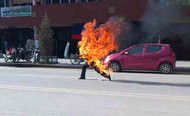
“A crowd of Tibetans came here to India’s capital last week, bearing flags and political banners and a bittersweet mixture of hope and despair. A grim countdown was under way: The number of Tibetans who have set themselves on fire to protest Chinese rule in Tibet had reached 99, one short of an anguished milestone. Yet as that milestone hung over the estimated 5,000 Tibetans who gathered in a small stadium, so did an uncertainty about whether the rest of the world was paying attention at all. In speeches, Tibetan leaders described the self-immolations as the desperate acts of a people left with no other way to draw global attention to Chinese policies in Tibet. … Billed as the Tibetan People’s Solidarity Campaign, the four-day gathering featured protests, marches, Buddhist prayer sessions and political speeches in an attempt to push Tibet back onto a crowded international agenda. If the Arab Spring has inspired hope among some Tibetans that political change is always possible, it has also offered a sobering reminder that no two situations are the same, nor will the international community respond in the same fashion.”

In Tibet prayer is going on most of the time. Tibetans pray in a special way. They believe that when certain sounds and words, called mantras, are said many times, they arouse good vibrations within the person. If a mantra is repeated often enough it can open up the mind to a consciousness which is beyond words and thoughts.

The reference in the article to the Arab Spring was the incident where “the catalyst for the escalation of Muslim protests was the self-immolation of Tunisian Mohamed Bouazizi. Unable to find work and selling fruit at a roadside stand, on 17 December 2010, a municipal inspector confiscated his wares. An hour later he doused himself with gasoline and set himself afire. His death on 4 January brought together various groups dissatisfied with the existing government system, including many unemployed, political and human rights activists, labor, trade unionists, students, professors, lawyers, and others to begin the Tunisian revolution” which in turn fueled the rest of the nations that ended up participating in the Arab Spring throughout 2011. You can read about Bouazazi’s story here. When Bouazazi died, protesters filled the streets chanting, “Farewell, Mohammed, we will avenge you. We weep for you today. We will make those who caused your death weep.” And they did. They made the world weep, and it is still weeping, but not in the way they intended.

The Tibetans keep burning themselves up but the people’s and the government’s reaction is not the same, and they wonder why. In the flesh, one reason is that the Tunisians themselves who reacted to the self-immolation of Bouazazi, protesting the current status and enacting change- mostly through violence. The Tibetans who self-immolate, expect the government to change as the reaction to the act of martyrdom. It won’t happen. In the spirit, though, ultimately all change is brought about by God. He sets up kings and governments and he takes them down. (Daniel 2:21, Psalm 75:7).

What got me thinking was the tragedy of it all. Neither Muslims nor Buddhists are saved. Therefore I think of the horrified reaction of Bouazazi and all 99 of the Tibetan monks who self-immolated. In Bouazazi’s case, he was angry and his act was borne out of frustration and rage against the corrupt government. In his last act of anger and frustration, he self-immolated a mere one hour after the government officials confiscated his fruit vendor scales.

The Tibetans who protest Chinese occupation in their homeland of Tibet also hope to make a positive change in a way that displays just as much frustration but in a non-violent way. Yet in all cases, the self-immolates woke up in hell. How horrible to have performed an ultimate act of self-sacrifice on behalf of your fellow countrymen only to find out to your eternal horror that your benevolent act landed you in hell, enduring God’s wrath forever. Whether Muslim or Buddhist, nice guy or evil one, upon your death it means that you will go to hell.

What do Tibetan Buddhists believe?

Tibetan Buddhism’s goal of spiritual development is to achieve a special enlightenment called Buddhahood in order to best help all other sentient beings attain this same state. Buddahood is a state of perfect omniscience, attained by self effort and/or adherence to teachings. (Omniscience is the state of knowing all things, having total knowledge).

The great mystic Padmasambhava (more commonly known in the region as Guru Rinpoche) merged tantric Buddhism with the local Bön religion to form what is now recognized as Tibetan Buddhism. While there are many forms of Buddhism, Tibetan Buddhism adheres to the following as some of its main principles:

–That all existence and manifestation can be found in one’s experience, that that experience is with one’s own mind, and that Mind is the source and the creator of all things.

–That Mind is an infinitely vast, unfathomably deep complex of marvels, its immensity and depth being inaccessible to the uninitiated.

–“Buddha-Mind is a GREAT ILLUMINATING-VOID AWARENESS”. The experience of enlightenment of the void is simple to state. It is the experience of awareness only, awareness that is aware of nothing at all except the existence of awareness itself.

–That the infinite compassion, merit, and marvels will spontaneously forth when this Buddha-Mind is fully unfolded. (source)

& etc. and so on.

When a Buddhist exalts one’s mind as the pinnacle of all experience and knowledge, it is really an exaltation of the self.

When a Tibetan Buddhist prays, they set up a prayer flag. These prayer flags were ones I took a photo of in San Francisco. Wikipedia says, “Prayer flags are used to promote peace, compassion, strength, and wisdom. The flags do not carry prayers to gods, a common misconception; rather, the Tibetans believe the prayers and mantras will be blown by the wind to spread the good will and compassion into all pervading space. Therefore, prayer flags are thought to bring benefit to all.”

So if the wind blows over the flag while you are walking near it, you will derive some benefit as its sacred air then passes over you…

To sum up, Tibetan Buddhism teaches by self-effort to become a little god. No? Yes, because they teach that one can attain by self-effort a perfect omniscience and a perfect compassion. However at the root of that perfect knowledge, is voiding one’s self of all sentience. Being aware of nothing is the goal, so that there are no hindrances to being able to help other people. First I must become perfect by emptying myself of all deisre, so than I can in turn help you, who is not perfect, being filled with desires.

Further, this little god-hood continues in a special level in Arya-bodhisattvas. These are ones who have attained a higher level and are able to escape the cycle of death and rebirth but compassionately choose to remain in this world to assist others in reaching nirvana or buddhahood. Yet no one can choose to escape the cycle of death, (and there is no rebirth, except for being born again in Christ) for God said,

“See now that I myself am He! There is no god besides me. I put to death and I bring to life, I have wounded and I will heal, and no one can deliver out of my hand.” (Deuteronomy 32:39)

There is no way to deny that a Tibetan Buddhist teaches a path through self-effort of becoming a little god. Being perfectly omniscient, perfectly compassionate, being able to create all things by your own self, and conquering death is what a god does. As James Stephens says in Ministry Today Magazine, “Buddhist theology and practice is antithetical to biblical Christianity. For instance, the Buddhist objective in meditation is to empty one’s mind while seeking union with the cosmos, ultimately buying into the Serpent’s ancient lie, “You shall become as gods.”

However the entire exercise is ironic, because though a Buddhist believes that all existence and manifestation can be found in one’s experience, it is ultimately the goal to destroy one’ awareness of one’s experience, and become void. Nothingness is the goal. How hopeless. How futile.

A Buddhist is without hope to begin with, and then spends a lifetime destroying any glimmer of any hope after that to become one big void. I can only see that despair is at the end of the road for a Buddhist.

Buddhism has deities, though Buddha himself is not generally thought of as a god. The Tibetan deities are, the Five Great Buddhas of Wisdom which are able to overcome a particular evil by performing a particular good, the Wrathful Deities, and Tara, the savior goddess.

I feel deep compassion for the Tibetan monks who have a desire to help humanity. Who devote their entire lifetimes to prayer and helps for their fellow man, Who even sacrifice their own lives in hope that their death will make a positive difference. But all their efforts are in vain. God does not listen to sinners. So the Tibetan monk’s prayer is unheard of by the only One who can answer. Tara does not exist. No Buddhist created anything of this earth. No person can become omniscient. Only God is omniscient.

The hubris in believing that man can attain these things on his own is a grave sin in itself.

Tara does not exist. The Wrathful Deities do not exist. They are figments of man’s vain imagination. Of the one true salvation deity, CARM.org describes salvation, “salvation is the state of being saved from God’s judgment upon the sinner. The only way to be saved is to trust Jesus for the forgiveness of one’s sins (John 14:6, Acts 4:12). All who do not trust Jesus alone, by faith (Rom. 5:1; Rom. 6:23; Eph. 2:8-9) are not forgiven and go to hell when they die (Matt. 25:46; John 3:18). When Jesus forgives someone, He forgives all their sins and gives them eternal life and they shall never perish (John 10:28).

When I drop my pencil, I go ‘oops’ When I stub my toe, I go “OOPS!” Those are mistakes that are easily recovered from. When a Muslim or a Tibetan Buddhist self-immolates, dies, and arrives in hell, ‘oops’ doesn’t begin to cover it. Discovering after all that the Christians were right, God does exist and He does require belief in Jesus to attain ‘nirvana’, is a mistake of eternal proportions. It barely is possible to comprehend the horror and fear of a person who hastened their own eternal destruction. It is why I don’t hate the Muslims who flew the planes into the Twin Towers, Pentagon and that Pennsylvania field. What can I possibly say about them that they are not saying themselves for all eternity? That God won’t say to them when they face Him on judgment day? I mourn the futility of the Tibetans’ acts, seeing as they are sinners in the hands of an angry God who will say- ‘I am omniscient, YOU thought you could become like Me?!

“I am the LORD, and there is no other, besides me there is no God” (Isaiah 45:5a)

This blog entry was about the futility of false religions and the compassion Christians should have on people who are in the dark. If you are a Buddhist reading this, and wondering why you’re not further along the “path” to nirvana, please read the following article

I am a Buddhist, why should I consider becoming a Christian?

Unfortunately, Buddhist practices are creeping steadily into Christianity. If you are a Christian who senses that your friend, relative or your church is starting to mix Buddhism with Christian practices (such as “contemplative prayer” or contemplative meditation, yoga, chanting, etc) Matt Slick at CARM.org offers these resources for help:

“Two of the best resources that make a clear distinction between Christianity and world religions such as Buddhism are “Jesus Among Other Gods: The Absolute Claims of the Christian Message,” written by Ravi Zacharias, and “The Universe Next Door: A Basic Worldview Catalog,” by James Sire. Zacharias examines the truth claims of Jesus Christ and the exclusivity of the Christian message against the messages of other faiths, while Sire lays the philosophical foundations that undergird every worldview and then analyses the major religions and the solutions they offer to each worldview category/question.

Ray Yungen, author of “A Time of Departing,” and “For Many Shall Come in My Name,” and Warren Smith, author of “The Light That Was Dark,” and “A Wonderful Deception,” demonstrate that eastern meditative practices are not harmless as many Christians insist but are instead dangerous dabbling with occultism. You also may try such online resources as Probe Ministries, which has several informative pieces on the subject, as well as Leadership U which also has many good articles on Buddhism.”

Probe Ministries article on Buddhism

And this one from Probe, “Can Christians practice Buddhism?

Christians should pray constantly in gratitude that He sent the spirit of repentance upon us and gave us the Light of Jesus in our souls. What a relief I am not in the dark anymore! Despite Buddhists’ attempts at a life of goodness and compassion, non-violence and prayer, Buddhists are still sinners in need of Jesus. Buddhists need witnessing to as well.

Posted in earthquakes, end time, ring of fire, warning

Ring of Fire earthquakes increasing

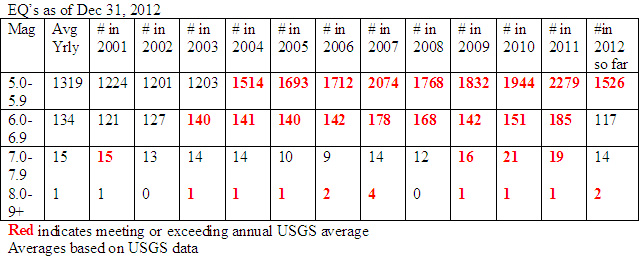
After a bit of a lull in earthquakes over 6.0 in 2012, this year has started with a bang. So far this week there have been ten quakes in the 6.0-6.9 rang and 13 major quakes overall.

The average amount of quakes in the 6.0-6.9 magnitude range typically average 134 per year. Last year was the first year the average was not met or exceeded. Click to enlarge.

So far this week, there have been what USGS categorizes as “major quakes” (higher than 5.9 mag) in the following places. The most recent is at the top-

6.1 SANTA CRUZ ISLANDS
6.9 HOKKAIDO, JAPAN REGION
6.4 SANTA CRUZ ISLANDS
6.3 SANTA CRUZ ISLANDS
6.0 SANTA CRUZ ISLANDS
6.0 SOUTHEASTERN ALASKA
6.2 SANTA CRUZ ISLANDS
6.0 SANTA CRUZ ISLANDS
6.8 ATACAMA, CHILE
6.0 EASTERN KAZAKHSTAN

There was also a 7.5mag near Craig, Alaska on January 5th, 2013. There have been 13 major quakes so far this year.

The Santa Cruz Islands look like they are getting the most action. So where are these islands?

globe showing location of 10-degree map

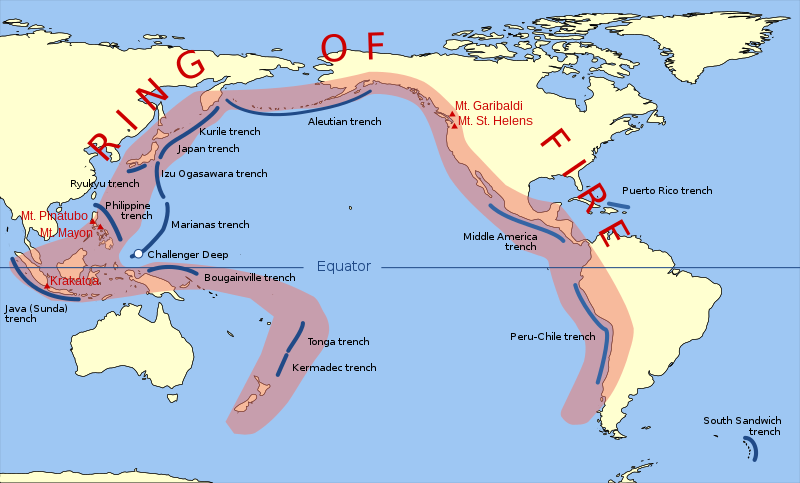
Many of these major quakes of late are along the “Ring of Fire.”

According to Wikipedia, “the Pacific Ring of Fire, or just Ring of Fire for short, is an area where a large number of earthquakes and volcanic eruptions occur in the basin of the Pacific Ocean. In a 40,000 km (25,000 mi) horseshoe shape, it is associated with a nearly continuous series of oceanic trenches, volcanic arcs, and volcanic belts and/or plate movements. The Ring of Fire has 452 volcanoes and is home to over 75% of the world’s active and dormant volcanoes.It is sometimes called the circum-Pacific belt or the circum-Pacific seismic belt. Eruption of Mount St. Helens on July 22, 1980. About 90% of the world’s earthquakes and 81% of the world’s largest earthquakes occur along the Ring of Fire. Also, many of the world’s volcanoes are located here.”

Dr. Stephen Austin at the Institute for Creation Research has produced an article outlining the history and future prophecy of earthquakes and the bible. It is called Greatest Earthquakes of the Bible. He listed 17 of the major quakes and scientifically and historically as well as prophetically looks at their power. It is an easily readable essay which I’ll excerpt parts of here, and encourage you to read in its entirety.

The Holy Land is a region where earthquakes occur frequently. By one means or another, big earthquakes have been documented in the Holy Land for a period exceeding 4,000 years.1 Many are known from history and literature, especially the Bible. Holy Land earthquakes are also evidenced from archaeological excavations. No other region of the earth has such a long and well-documented chronology of big earthquakes.

1. Day Three of Creation Week

On the third day of the creation week, the waters of the earth were collected into the oceanic basins as continents appeared (Genesis 1:9-10). Before Day Three, the waters had been over the whole earth. Continents seem to have been uplifted and the ocean floor was depressed during a great faulting process that established the “foundations of the earth.” We are told that angels saw and praised the omnipotent God as the earth-shaking process occurred (Job 38:4-7; Psalm 148:1-6; possibly Psalm 104:5-6). Today, the earth’s continental crust (41 percent of the earth’s surface, including the continental shelves) has an average elevation of 2,000 feet above sea level, whereas the oceanic crust (59 percent of the earth’s surface, excluding the continental shelves) has an average elevation of 13,000 feet below sea level. Can anyone properly comprehend the colossal upheaval that formed continental crust on Day Three? Angels must have watched in awe!

2. Noah’s Flood
3. Destruction of Sodom and Gomorrah
4. Moses on Sinai
5. Korah’s Rebellion in the Wilderness
6. The Fall of Jericho
7. Philistine Camp near Geba
8. Elijah on Mount Horeb
9. Amos’ Earthquake of 750 B.C.
10. Qumran Earthquake of 31 B.C.
11. The Crucifixion in Jerusalem, April 3, 33 A.D.
12. The Resurrection in Jerusalem, April 5, 33 A.D.
13. Jerusalem Prayer Meeting, Summer 33 A.D.
14. The Prison at Philippi

15. Today’s Earthquakes
When Jesus was asked by His disciples what the sign of His coming would be, He talked of wars, famine, epidemic disease, and earthquakes. Jesus said, “These are the beginning of sorrows” (Matthew 24:8; Mark 13:8; cf. Luke 21:10-11). The word “sorrows” is the Greek word meaning “birth pangs.” Seismograph analysis reveals that the frequency and energy of large earthquakes was not constant throughout the twentieth century. According to a popular urban legend, big earthquakes have been increasing in both frequency and energy. This legend is not supported by the seismograph data. There appears to be about a 30-year cycle of increasing and decreasing earthquake frequency, suggesting the “beginning of birth pangs” theme. Furthermore, seismographs demonstrate that earthquakes are indeed distributed throughout the globe (the “divers places” as described by Jesus in Matthew 24:7 and Mark 13:8).

[Ed Note: the article to which Austin refers that states big earthquakes are not quantifiably increasing was written in 1999. I think from the data above that I’ve gathered into a chart, we can see by now from the perspective of 14 years later that the cycle of big earthquakes is on the upswing]

16. Gog’s Future Earthquake in Israel
17. Messiah’s Earthquake in the Future (Sixth Seal)

Conclusion

A review of the 17 earthquakes listed above shows that virtually the entire story of the Bible can be summarized by its association with earthquakes. Biblical events emphasized by earthquakes are creation, Noah’s Flood, separation of Abraham and Lot from judgment of the wicked cities, the giving of the Law on Mount Sinai, authentication of the leadership of Moses, God’s provision in the conquest of Canaan, vindication of the messages of Hebrew prophets, the crucifixion of our Lord in Jerusalem, the resurrection of our Lord, the ministry of the apostles and the church, the modern “birth pangs” sign of the end times, the national conversion of Israel, and the Second Coming of the Lord Jesus Christ. History, archaeology, and geology appear to confirm independently many earthquakes mentioned in the Bible.

Earthquakes have been used distinctively by God to highlight some of the most important events of the Bible. The three main purposes for biblical earthquakes are judgment, deliverance, and communication. The lesson is obvious—God does not do anything really big without emphasizing it with an earthquake! In our fast-paced, man-centered, technology-based society of the twenty-first century, God would have us pause and consider His sovereign nature and the program He has been accomplishing in the world.

I love the last paragraph of Austin’s conclusion. “Judgment, deliverance, and communication-The lesson is obvious—God does not do anything really big without emphasizing it with an earthquake!” How interesting! As we watch the major earthquakes come one upon another in our present day, let us definitely pause to consider God’s sovereign nature and the program He has been accomplishing in the world. Austin’s overview of the world’s major earthquakes since the Creation to the Tribulation gives me pause to bow in humility. God’s power and might are surely magnificent, and His love and patience are even more so. We are blessed to be living in the Church Age, a long span of time when His patience restrains His wrath. However, the Day will come when the grace He has extended for so long will end and He will unleash His wrath against sin and sinners.

“For my name’s sake I defer my anger, for the sake of my praise I restrain it for you, that I may not cut you off.” (Isaiah 48:9)

Barnes Notes explains,

“Here it means that God would restrain himself; He would not put forth His anger in order to destroy them. Learn hence:
1. That God acts with reference to his own glory, in order to manifest his own perfections, and to secure his praise.
2. That the reason why the wicked are not cut off sooner in their transgressions is, that He may show his forbearance, and secure praise by long-suffering.
3. That the reason why the righteous are kept amidst their frequent failures in duty, their unfaithfulness, and their many imperfections, is, that God may get glory by showing his covenant fidelity.
4. That it is one evidence of piety – and one that is indispensable – that there should be a willingness that God should secure his own glory in his own way, and that there should be a constant desire that his praise should be promoted, whatever may befall his creatures.”

As it was for His people the Israelites, so it is for His Bride today. As Peter reminds us in 1 Peter 1:12, the Gospel is so tremendous a gift that even angels desire to look into these things. What praise and glory He collects to Himself by restraining His wrath so that mercy might be displayed! What honor He heaps to Himself by shaking the world but not destroying it! Though an earthquake may be devastating to a person in terms of injury or destruction of possessions, so far they have truly been as gentle as a shake on the shoulder from a loving Father to a sleeping child. “Wake up, little one!”

Posted in God, hail, India, weather

Freak storm: hailstorm with ice boulders rain down in Indian villages

The Daily Mail has the story, along with their typically fantastic photos

Nine people killed as freak hailstorm rains massive boulders down on Indian villages
Hailstones the size of boulders have rained down on villages in southern India.
“At least nine people were killed when the violent weather hit several villages in the state of Andhra Pradesh. The hailstorm which lasted for almost 20 minutes, destroyed crops, houses and live stock, causing devastating financial implications for residents. It was once-in-lifetime experience for people living in seven villages in Chevella, Moinabad and Shankarpally. The hailstones started falling from the sky on Tuesday night and covered the entire villages under the snow-like blanket.”

This area in India which received the hail is prone to huge hailstorms. The Weather Underground reports,

“The deadliest hailstorms, and perhaps the largest hailstones, in the world occur on the Deccan Plateau of northern India and in Bangladesh. The heaviest authenticated hailstone ever measured was one of 2.25 pounds that fell in the Gopalganj district of Bangladesh on April 14, 1986. The stones size was not measured although anecdotal reports claimed the stones were the size of “pumpkins”. Ninety-two people perished as a result of the storm although how many of these can be attributed to the hail is uncertain. A hailstorm in the Moradabad and Beheri districts of India killed 246 people on April 30, 1888, the deadliest hailstorm on record in modern history.”

But even this storm has the Meteorological Office scratching their heads.
“HYDERABAD: Two days after a severe hailstorm lashed parts of Chevella mandal in Rangareddy district, a two-member team of meteorologists from the Indian Meteorology Department (IMD) visited the affected areas, but were clueless as to what caused the unusual phenomena and were only able to give textbook answers. … Officials said that hailstorm normally occurs during summer months but not in January. … When asked if the hailstorm of such a scale as the one witnessed on Wednesday ever occurred, Rao said that there was no record and did not rule out such a possibility.”

Here is a gentle reminder:

God controls the weather. He either sent the storm or He allowed satan some latitude to cause it. (Job 1:9-12, 19; Isaiah 30:30).

The other reminder is that He will send 100lb hailstones in the Tribulation.

“And great hailstones, about one hundred pounds each, fell from heaven on people; and they cursed God for the plague of the hail, because the plague was so severe.” (Revelation 16:21)

You notice the verses ‘they cursed God for the hail’. The people by that time will know it is God sending these things as plagues, or judgments. It is better to know it now, before the judgment comes.

Do you acknowledge God is King (Psalm 29:10)? Do you understand that you are a sinner, that He sent His Son as the sacrifice to die for your sins, and God accepted the sacrifice by raising His Son from the dead to reign in heaven, and who will come again in glory to judge the living and the dead? That’s the Gospel. (1 Corinthians 15:1-8)

Posted in Uncategorized

A note about comments

I don’t have a formal comment policy, per se. I figure, just be normal and nice and it will all work out.

However I have had to slightly change several comments recently and I will tell you why. If you choose to comment and leave a link within your comment, several thing are going to happen.

First, I always check out each link. I will not post a comment that has a link to an unscrupulous or otherwise bad website or blog. I have ‘Web of Trust” as an add-on. This is a website rating system which makes a color appear at the end of a link. There’s dark green, light green, yellow, and red. I won’t allow websites with red to go through. If it is any other color, I read the webpage you linked to, or watch the video. If the site being linked to or referred to is doctrinally unsound, I will not put that up. It is a stumbling block to the babes in Christ and I won’t be a part of passing along bad information. There is enough bad information out there already without me helping it along.

But sometimes the comment itself is good enough to go thru. It is germane, or it is pointed, or displays a fervor on the part of the person commenting. It didn’t have vulgarity or wasn’t disrespectful. These comments have a bad link but otherwise would make it through (and usually this is a comment that disagrees with the post). I don’t want to delete it all, because I’m sensitive to the fact that someone took time to read, respond, and type. In these cases, I excise the link when I put the comment in.

I don’t change any comment or otherwise edit it. In the cases I’m speaking of, I simply take out the hyperlink and leave the rest.

Just wanted you to know.