Posted in earthquake, mount of olives, prophecy, signs

Large earthquake at Cuba felt in Florida from the Keys to Orlando

Quake off Cuba shudders folks from Keys to Orlando
January 10, 2014|By Robert Nolin and Adam Sacasa, Sun Sentinel

“A rare but moderate earthquake off the Cuban coast shook buildings and rattled residents from the Keys to Orlando on Thursday afternoon. The 5.1 magnitude quake occurred just before 4 p.m. in the ocean about 24 miles north of the Cuban city of Corralillo, more than 100 miles east of Havana. … Becky Herrin, spokeswoman for the Monroe County Sheriff’s Office, felt her building shake. It was the only quake she’s experienced in 28 years in the Keys. “It’s certainly unusual,” she said. “I haven’t heard any reports of damage or injuries so that’s really fortunate.” Still, the ground shook as far north as Central Florida, nearly 400 miles from Cuba. … Thursday’s temblor happened in a region not known for earthquakes. “It is an uncommon area for a quake,” he said. But in 30 years, in a 150-mile radius of Thursday’s quake, only two other weak ones have occurred, Abreu said. In 1982, a 4.5 magnitude quake struck, and in 2005, there was a magnitude 4.1 in the area. Florida, far from the margins of the earth’s tectonic plates, is traditionally not subject to quakes.“

Jesus said that in advance of His second coming there would be signs. This was in answer to the Disciples’ question in Matthew 24:3, “As he sat on the Mount of Olives, the disciples came to him privately, saying, “Tell us, when will these things be, and what will be the sign of your coming and of the close of the age?””

Verse 24:4 begins, “And Jesus answered them…

One of the signs He said would occur is that there will be earthquakes in various places. (Matthew 24:7b).

It is important to know that the “last days”, the “last times”, the “end time” is now, and it has been since Jesus ascended. Paul warned Timothy of the last days in 2 Timothy 3:1, Peter did in 2 Peter 3:3, Paul again in 1 Timothy 4:1, and Jude did in 1:18 for example. They all repeat the warning of the last days. These were not warnings of some far-off time, they were warnings for the Church at that time until Jesus returned. What they didn’t know was that there would be a 2000 year gap.

In my opinion, the warning of the last days in Jesus’s Discourse in Matthew 24 (AKA The Olivet Discourse, because He delivered it atop the Mount of Olives) can be sectioned off into parts. When Jesus begins to answer, He offers some warning signs from Matthew 24:4-8. Even twice within that short time frame, He said that the end is not yet. Then He launched into a section from verse 9-14 of a kind of overview of the entire Tribulation. Then Jesus backtracks and gives specifics of the Great Tribulation from verse 15-28. This part is aimed mostly at Jewish believers living during those days who will have converted by that time. At the passage’s end He speaks of the signs of His actual, physical return. (Vv. 29-31.)

John MacArthur said in his sermon “The Grim Reality of the Last Days“,

“Luke’s account says great earthquakes, seismos megalos, mega quakes, like the 9-point quake 80 miles off the shore of Japan. Through history, millions and millions, countless millions have died in earthquakes. I read this week that there are one-half million earthquakes a year every year. You are on a shaky place. A hundred thousand of them are felt. But half a million register on Richter scales. … And the worst is yet to come. …[O]ur Lord says, “Those things…in verse 7…must take place but that’s not yet the end.” It’s the nature of living in a cursed planet. It’s not yet the end. In fact, if you will look at the end of verse 8 it says they’re merely the beginning of birth pangs.

That’s an analogy of a woman’s contractions. They are separated, they are mild, and they intensify and intensify and intensify to a great degree just before birth. What we’re seeing in human history is just the beginning, is just the mild contractions. Wait till you see what’s going to happen just before the very end. Two thousand years of these milder contractions will explode in the end, in the time of Tribulation described starting in verse 14.“

The verse is clear when it says earthquakes will be in various places. Other translations say diverse places. In my opinion the quake near Cuba the other day qualifies for being in a diverse place. It did to the USGS. They highlight quakes on their list that are significant. Though the 5.1 magnitude quake wasn’t a mega-quake like the March 2011 9.0 magnitude off Japan, it was listed as significant anyway. USGS explains,

“List items with a red background have been identified as “significant”, based on a combination of magnitude, PAGER alert level, and the number of Did You Feel It? responses.“

The location of the quake surprised officials. As we saw in the data Dr MacArthur provided, there are a great many quakes occurring each year on this planet. As the time draws nearer to the return of Jesus, scientists, officials, and humankind will discover that there is no place that is earthquake-free. There will be more and more frequent quakes and they will occur any place at all. Just as the Cuban quake did.

Pray for the return of Jesus.

“Look, I am coming soon! Blessed is the one who keeps the words of the prophecy written in this scroll.” (Revelation 22:7)

Posted in encouragement, psalm

His steadfast love endures forever

It’s so strange. More than a few people in my circle (both internet and real life) have said that their recent days and weeks have been full of trials and difficulties. Things have popped into their life seemingly out of nowhere, and caused trouble and trials, heartache and hurt.

For others, they have said or written that discernment is hard work,and they are tired. I’m tired too. The flood of falsity is just a tsunami now. Not only do we get discouraged because the spotless name of Jesus is constantly dragged through the mud, but our friends and family might be falling under the sway of a false teacher or doctrine, and we just want to cry and tear our hair out.

Lately, people really need encouragement and grace more than ever. Let’s give it to them just as we would like to receive it from other people when we are in a bad way.

Yesterday and today I’ve been unsettled myself, so my go-to is always prayer, and bible reading. It really helps to pray to Jesus, we know He listens.

Consequently, he is able to save to the uttermost those who draw near to God through him, since he always lives to make intercession for them. (Hebrews 7:25)

It helps more, I’ve found, to pray for other people when I’m unsettled. Focusing on others helps me put my problems into perspective. It also gives me the joy of lifting another person up to Jesus for their benefit, and to be obedient to the scriptures. (James 5:16; Ephesians 6:18)

As for my other security blanket in addition to prayer, it is reading His word. There is nothing like it. I read Psalm 136 this afternoon and it just crumbled me. The recurring refrain in the psalm is:

“his steadfast love endures forever”

He loves us–(a gift in itself!)
His love is steadfast; faithful, immovable–(amazing!)
His love is forever; speaking to His eternality. (FOREVER!!)

My oh my, what a gift. No wonder the psalmist spends so much time in exhorting thanks! The psalm continues to outline His attributes and His works. It is just beautiful. I posted it below so you can read it here. Friends, if you are going through something, or hurting, or just plain weak and tired, read the psalms. Read the word. Pray. Here is Psalm 136. I hope it blesses you.

Give thanks to the Lord, for he is good,
for his steadfast love endures forever.
2 Give thanks to the God of gods,
for his steadfast love endures forever.
3 Give thanks to the Lord of lords,
for his steadfast love endures forever;
4 to him who alone does great wonders,
for his steadfast love endures forever;
5 to him who by understanding made the heavens,
for his steadfast love endures forever;
6 to him who spread out the earth above the waters,
for his steadfast love endures forever;
7 to him who made the great lights,
for his steadfast love endures forever;
8 the sun to rule over the day,
for his steadfast love endures forever;
9 the moon and stars to rule over the night,
for his steadfast love endures forever;
10 to him who struck down the firstborn of Egypt,
for his steadfast love endures forever;
11 and brought Israel out from among them,
for his steadfast love endures forever;
12 with a strong hand and an outstretched arm,
for his steadfast love endures forever;
13 to him who divided the Red Sea in two,
for his steadfast love endures forever;
14 and made Israel pass through the midst of it,
for his steadfast love endures forever;
15 but overthrew Pharaoh and his host in the Red Sea,
for his steadfast love endures forever;
16 to him who led his people through the wilderness,
for his steadfast love endures forever;
17 to him who struck down great kings,
for his steadfast love endures forever;
18 and killed mighty kings,
for his steadfast love endures forever;
19 Sihon, king of the Amorites,
for his steadfast love endures forever;
20 and Og, king of Bashan,
for his steadfast love endures forever;
21 and gave their land as a heritage,
for his steadfast love endures forever;
22 a heritage to Israel his servant,
for his steadfast love endures forever.
23 It is he who remembered us in our low estate,
for his steadfast love endures forever;
24 and rescued us from our foes,
for his steadfast love endures forever;
25 he who gives food to all flesh,
for his steadfast love endures forever.
26 Give thanks to the God of heaven,
for his steadfast love endures forever
Posted in covering, laodicea, naked, robes

Do you know you’re naked?

New Years are times when we feel we want to start fresh. When everything is new, including resolutions, hopes, plans. We look ahead, not behind. We take a deep breath and plunge in. Like the dawn dew on fresh grass, we haven’t had time to see the fire ants underneath, or the mosquitos above.

There was a day in the Garden of Eden when all things stopped being new. The humans that God had created rebelled against Him. They had sinned. Adam and Eve became aware of their nakedness, and it was a problem. The moment they sinned their bodies because a problem to them.

EPrata photo

We usually focus on the part of the verse that states they were naked, and tried to cover themselves. But for now, let’s focus on the word “knew”.

God is so good He sent His son Jesus to die for us and take God’s wrath for sin in our place. That was the most horrible AND the most blessed moment of the entire universe for all time. He died, but He did not remain dead. He conquered death and was raised again, now making a way into heaven for all the rebellious but forgiven humans since Adam and Eve.

God is a God works all things to the good for those who are called according to His purpose. (Romans 8:28).

Hold that thought for a moment. Let’s go back to another famous naked person. The Emperor. As Steven Goddard posted, the Hans Christian Anderson story is like this:

The emperor’s new clothes

The label given to any fictional item that viewers have been induced into believing as real.

Anderson’s tale involves a vain king who was preoccupied with his appearance and his wardrobe. A pair of swindlers took advantage of this by pretending to be able to weave the finest cloth, which couldn’t be seen by people who were either unfit for office or were particularly stupid. The king decided to have a suit of clothes made from the fabric in order to test which of his courtiers was unfit for office. As he didn’t want to appear stupid or unfit for rule himself, he pretended to be able to see the new clothes, as did all of his courtiers. He paraded the ‘new clothes’ through the streets and the onlookers, also not wishing to appear stupid, all admired them. A small child, who didn’t understand the apparent necessity for pretence, piped up ‘But he has nothing on!’. The bubble of pretence burst and soon all the onlookers were repeating what the child had said, whilst the king continued the procession, attempting to maintain his dignity by pretending that nothing had happened.

Adam and Eve were naked, uncovered, and exposed to the world. That was bad. But there are worse things than being naked. Worse is being naked and not knowing it.

The Emperor in this fable believed his own press, that he was not naked, and he confidently went out and strutted among the people. This state of the human condition is reflected in the bible, you know. Even better to add to the conversation than Hans Christian Anderson’s fable is the verse:

“For you say, I am rich, I have prospered, and I need nothing, not realizing that you are wretched, pitiable, poor, blind, and naked.” (Revelation 3:17).

Jesus accuses the Church at Laodicea of being Emperors without clothes. They did NOT know they were naked. They did NOT know they were uncovered, exposed, all their flesh and flaws visible to the world. Lost and wandering, they did NOT know they were without the covering of Jesus Christ! Worst of all, the Laodiceans thought they were covered. But they were in fact naked, absent the linen robe of righteousness of Christ.

In 2 Corinthians 5:2-3 Paul said,

“For in this tent we groan, longing to put on our heavenly dwelling, if indeed by putting it on we may not be found naked.”

He’s telling the Corinthians to look forward to the resurrection after death/rapture where we have a body, clothed in His righteousness. In Laocidea, they were hypocrites pretending to know Christ, pretending to wear the fine spiritual robes, but and indeed were naked.

In Genesis they knew they were naked. They tried to cover themselves but God covered them. (Genesis 3:21). In Revelation…they did not know they were naked. What a tragic progression from understanding our need for Jesus to selfish self-reliance in a lost state with Jesus as an afterthought.

Are you longing to be clothed with our bodily dwelling from heaven, fine linen robes? Are you relying on the covering of Jesus in the meantime? He is ALL. This is a good verse to use in praise of Him and the righteous deed HE did so as to be able to clothe His Bride:

“Consequently, he is able to save to the uttermost those who draw near to God through him, since he always lives to make intercession for them. For it was indeed fitting that we should have such a high priest, holy, innocent, unstained, separated from sinners, and exalted above the heavens. He has no need, like those high priests, to offer sacrifices daily, first for his own sins and then for those of the people, since he did this once for all when he offered up himself.” (Hebrews 7:25-27)

Posted in homosexuality, jesus, legalism, rapture

Debit v Credit cards; Solar flare, The Rapture is a Necessary Inference, Homosexuality IS different

Here are a few items of interest for you:

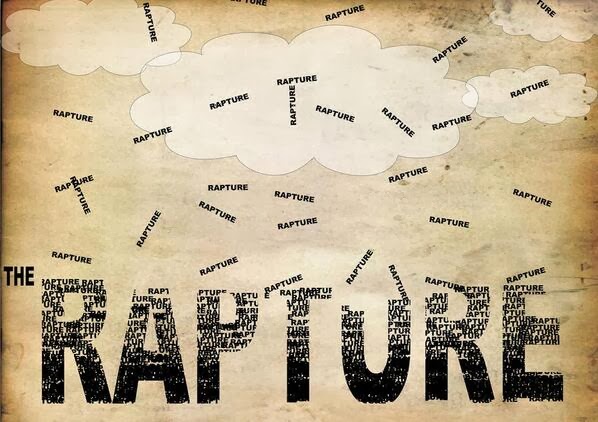
In this first one I was drawn in by the illustration. It is the best visual representation of the rapture I’ve seen. Then I read the article and it is excellent too.

The Rapture—A Necessary Inference
By Dr. Steven Hayes

“…This new (or renewed) consistency in the use of a literal hermeneutic naturally led to new insights in many areas of theology. As an example, a literal hermeneutic applied to prophetic passages in the New Testament led students of the Bible to conclude that the Rapture of the Church was a phase of the return of Christ that had to be distinguished from the 2nd Coming. That is, the yet future return of Christ will actually be comprised of two distinct events separated in time: 1) the Rapture of the Church, in which Christ comes in the air to receive His Bride and take her back to heaven with Him (e.g., John 14:1-3; 1 Thessalonians 4:13-18), and 2) the 2nd Coming, in which Christ comes from heaven with all His saints to establish His kingdom on this present earth and personally reign over it for a thousand years (e.g., Matthew 24:30; Revelation 19:11-16; 20:4-6).

~~~~~~~~~~~~~~~~~~~~~~~

FIRST-PERSON: Why homosexuality IS different Mike Goeke
“…Many churches have taken to heart the level nature of sin and clearly acknowledge that sin is sin, be it gossip, envy, lust, gluttony or homosexual behavior. The level nature of sin, however, makes many reticent to discuss or address the issues surrounding homosexuality in more detail or with any special emphasis. “We don’t want to highlight any one sin,” they reason. The truth is that homosexuality IS different. It is not different as a “sin.” God sees the sin of homosexual expression as He sees all sin. It is different, however, in that no other sin (or, better said, an identity based primarily on sinful behavior) has impacted, or is likely to impact, culture in the dramatic way that homosexuality has done and will do.“

An interesting secular article on the debate over credit cards vs. debit cards. How we spend is a good topic for the Christian to think about carefully.

Debit Cards vs. Credit Cards: Your Best Arguments
Credit cards and debit cards both have their advantages, but one must emerge victorious in an all-out battle of financial usefulness and security. Which will it be? Here are your best arguments.

Stormy spaceweather, large sunspot and an X-flare. Spaceweather.com has the story
STORMY SPACE WEATHER: Giant sunspot AR1944 is directly facing Earth and crackling with solar flares. Yesterday, Jan. 7th, an X1-class explosion in the sunspot’s magnetic canopy hurled a CME in our direction.

Here is the quote I read on Twitter that I liked so much. It’s  from pastor JD Hall: JD Hall ‏@PulpitAndPen

“Want to know if someone is an idolater? Speak ill of their idol. You’ll find out really quickly.”

And another quote to get us going today:

From Jimmy Needham ‏@JimmyNeedham

Don’t mistake obedience for legalism. Legalism seeks to justify self. Obedience celebrates the justification of Christ.

Posted in polar vortex

An analogy for the polar vortex

Telegraph UK reports: “All 50 of America’s states recorded temperatures below freezing at some point on Tuesday and even the polar bear at Chicago zoo spent most of the day indoors, as bitterly cold air gripped the country.”

Ken Stevens/AP

Yes, even Hawaii had below freezing temp. It was 18 degrees atop Mauna Kea.

In my opinion, the United States has turned a cold shoulder to Jesus. Why should it NOT be cold here? Why shouldn’t we think of the temperatures as an exterior manifestation of our own behavior?

“And because lawlessness will be increased, the love of many will grow cold.” 
Matthew 24:12
Posted in adopted son, beth moore, book review, God, jesus, Michael

Book Review: "Things Pondered," Beth Moore’s story of adopting a boy and giving him back

Beth Moore published a book in 2004 called, Things Pondered: From the Heart of a Lesser Woman. It is a book of vignettes and poetry, recollections and descriptions of the various events in Beth Moore’s life from young womanhood as a bride through early days of her marriage, becoming a mother, and her adopted son. This book review pertains to the kindle version. Moore’s words from the book are in italics.

~Beth Moore & Privacy~

For all of Beth Moore’s outward seeming openness, her frequent discussions about herself, her thoughts, trials, self-esteem issues, sexual molestation, motherhood, and hysterectomy, she rarely if ever speaks of the fact that she adopted a son at his age of 4 and then at age 11 gave him back to the birth mother.

Her public persona is one which creates a (false) sense of intimacy with women, of being open and transparent. Her books and conferences strive to create an atmosphere of a slumber party, sharing secrets, and giggling over the love of our Groom Jesus. But when it comes time to be transparent in one-on-one situations, Moore is quite zipped up. Moore is “closely protected by assistants who allow very few media interviews. After several interview requests from CT, her assistants allocated one hour to discuss her latest book and ask a few questions about her personal life. Each question had to be submitted and approved beforehand, I was told, or Moore would not do the interview. Follow-up interview requests were declined. I was permitted to see the ground level of her ministry, where workers package and ship study materials. But Moore’s third-floor office, where she writes in the company of her dog, was off limits.” (Christianity Today)

There is some curiosity from people regarding the little-known topic of the son Moore adopted, named Michael. Though Things Pondered is about other events in Moore’ life too, the bulk of it is about Michael, and so will this review.

~Mary~

The title of the book refers to Mary’s thoughts when the angel told her she would bear a Son. (Luke 2:19). Moore speculates on what Mary was thinking, the nuts and bolts of Mary’s ponderings. Such speculations are not good and not bad. It all depends on the point of view from which they make the speculation. Moore is a contemplative navel gazer who talks about herself constantly and thus her p.o.v. stems from herself. Therefore the thoughts she imagines Mary to be thinking were also about herself. To wit:

“In that moment a host of memories must have been dancing in her head. The angel’s appearance. His words. Her flight to the hill country of Judea. Elizabeth’s greeting. Their late-night conversations. The first time she saw her tummy was rounding. Joseph’s face when he saw her. The way she felt when he believed. The whispers of neighbors, the doubts of her parents. The first time she felt the baby move inside her. The dread of the long trip. The reality of being full-term, bouncing on the back of a beast. The first pain. The fear of having no place to birth a child. The horror of the nursery. The way it looked. The way it smelled. …The following is my response to her worthy example.”

Except, that in reading the things Moore believes Mary was pondering, you would never know Mary was bearing the Son of God.

Here is the same verse with a mature preacher of the word also speculating on what Mary was pondering. Please compare.

“It [verse 19] takes us into the heart of Mary. It says, “But Mary treasured up all these things, pondering them in her heart.” This is just mulling them over, contemplating them deeply. She went much deeper, believe me, than the amazed people in verse 18. I mean, this is just…this is just beyond comprehension. Here is a 13- or 14-year old girl, she’s looking into a feed trough and she’s seeing there a baby that’s come out of her womb. She’s never known a man. This baby was conceived and born without ever knowing a man. This baby is the Son of the Most High God. This baby is the rightful heir to the throne of David. This baby is the Savior of the world. This baby is the anointed Messiah. This baby is God, the Lord.

I mean, it’s all so mind-boggling in the common world of human beings. Mary must have wondered, you know, when is He going to start saying profound, theological things? Tomorrow? Is He going to do miracles? What’s going to happen here? What am I to expect out of this child? Will I have a normal relationship with this child that a mother has to a baby? Will I nurse this child as mothers do? Will I raise this child as mothers do? What will this child be like? And when will He enter into His glory? When will He take His Kingdom? When will that all happen? And how am I going to be a mother to a child that is God? She must have wondered all those kinds of things. Must have wondered even about discipline, setting an example. How do you set an example for God? I mean, anything that would come into a mother’s mind must have come into her mind. She just pondered it. She just thought deeply about it. And she thought deeply about God’s redemptive purpose and how God had promised a Savior and a Savior had finally come.” (source)

Moore instills self-ponderings in Mary. They are self-focused. Dr MacArthur’s are Jesus-centered. So if Moore is following “Mary’s worthy example” as she stated the purpose of the book to be, you see the focus of the book is off-kilter already.

~Michael~

In Things Pondered, Moore says she and her husband wanted a son but several years passed and they assumed they were not going to receive one. Then on February 14, 1990 the Lord answered their prayer and her husband “gave the gift of a boy” for Valentine’s Day.

In her 2005 memoir, Feathers from My Nest, Moore said her husband saw “urgent needs of a certain little boy that “could really use a home.” … We were oblivious, I had nothing but romance in my eyes. Happily ever afters. Utter certainty that love will conquer all.“

I searched for clarity in the book and got none. On one page Moore said Michael was “orphaned”, on the next she said that his birth parents “gave up on each other and on him”, and that the “marriage of his second guardians collapsed”. After 7 years, Moore says the mother (Anne) “resurfaced,” even though she was “a close family member“, “strongly desiring” her son back. However, there was no mention of any legal proceeding nor any custody battle, even though she consistently said in the book that they had adopted him. Chapter 3 is called “The Adoption.” On page 54 Moore said she sat in a restaurant with Anne and after assurances that this was what Anne wanted, Moore said that Anne “granted him to us.”

Moore says his birth mother was “a close relative” named Anne. No other details, but later in the book Moore said that “I didn’t love him like an aunt… I loved him like a mother.” Perhaps the boy is her sister’s son.

Very early on Moore says the family saw the emergence of Michael’s angry behavior. She said she “envisioned the adoption to be a glorious romance” but was instead the family became increasingly traumatized by his “fits of violence and anger”. There were many school disciplinary hearings, and many nights Moore and her husband were at a loss on how to deal with him. In his 4 short years prior to being adopted by the Moores, she wrote he was continuously abandoned, abused, neglected, and had Child Protective Services intervening on a rotating basis. When Michael entered the Moore home at age 4, it wasn’t long before they knew they had a long haul on their hands. Fear of abandonment again raised its head while during the day he refused to cry, laugh, or love. Yet at night he insisted on falling asleep by holding Moore’s head and chanting “Mommy please don’t leave me.” Finally Moore said they were “stretched to the point of ripping”.

Screen shot from “Things Pondered” by Beth Moore

It’s more than unsettling to see a woman who had committed to adopt a boy but then lay down conditions for his continued residence, which if not adhered to would result in giving him back. More unsettling still is that Moore set the condition very early on in Michael’s tenure. Most unsettling to me is the way she phrased it- “he refuses to be helped,” putting the onus onto the boy.

Here is a similar real-life case from a couple of months ago. Please compare.

“Ohio Couple, Give Back Adopted Son After 9 Years “
“An Ohio couple who authorities say returned their 9-year-old adopted son to the county after raising him since infancy have been charged with abandoning the child…the parents said the boy has aggressive behaviors and would not agree to get help….County Prosecutor Michael Gmoser said Thursday that he doesn’t usually seek indictments in misdemeanor cases but views this as “reckless” abandonment. “When you are the parent and you recklessly abandon a child or children, there are criminal consequences,” Gmoser said. “These children don’t have a return-to-sender stamp emblazoned on their forehead.” … “If your 9-year-old needs help, you get him help,” Olivas told the newspaper. “It is not a question of a 9-year-old wanting it or not.“

In the book, Moore explains in the next scene that her husband convinced her to let Michael stay. A short while later Moore was complaining in her book again. She said Michael “needed more than they had.” She asked “Why hadn’t God given him to parents who really knew what they were doing? Who didn’t have such demanding lives already? Who didn’t have other children?”

They decided to stick with it and just and love him. They kept him for 7 additional years and his behavior slowly but inconstantly improved. Cut to years later-

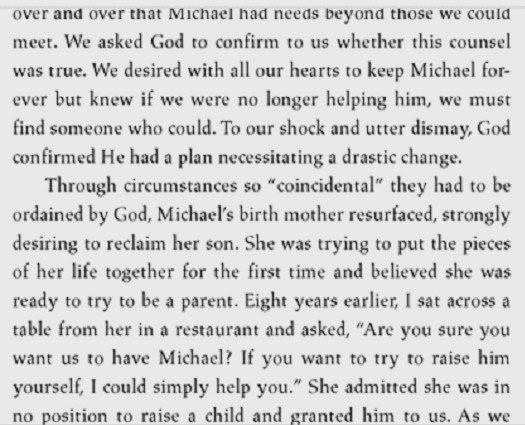
Screen shot from “Things Pondered” by Beth Moore

It is hard to gain a settled clarity as to the what the author is saying, when one reads a sentence that says they knew they needed to find someone else, not them, to help Michael, and in the next sentence that “to their shock and utter dismay, God confirmed” that Michael needed to go.

If you add up the timing, when Moore says Michael’s alarming behaviors surfaced he was approaching pre-adolescence. If he was “granted” to the Moores at age 4 and they returned him 7 years later at age 11, then the approaching preadolescence must mean age 10. He was at most 10 when he evidenced behaviors that alarmed them.

She wrote this book ten years ago, but Moore refuses to add to the narrative or be any more open than she already has been. Though Moore has famously been open and clear about other situations in her life that are equally as emotionally difficult to discuss, such as her self-esteem issues, her sexual molestation and her hysterectomy, Moore adamantly refuses to discuss with any clarity or detail about the Michael issue. In her book published a year later titled Feathers from My Nest, Moore said the adoption engendered “complexities of circumstance and emotions like nothing I have ever known” (unlike sexual molestation?) and that she is “fiercely and unapologetically private about it” but she “could not possibly write about my children without writing about all my children…even one who was only “mine for a season.”

So there is another internal inconsistency that fails to clarify the situation and instead muddies it further. ‘I’m private about Michael but I could not possibly NOT write about him.’

Other statements in Things Pondered don’t add up. For example, was Michael orphaned as stated on page 27? Or abandoned as stated on page 35 and 41? Did the mother “strongly desire” her child returned, or did she demand “custody”? Was it a legal “adoption” as stated on page 29 or private matter of a family temporarily taking in one of their own as described on page 54?

Moore’s whole book, and subsequent responses to inquiries about him could be reduced to an easy one paragraph with clear language and Christian transparency: “My sister Anne couldn’t handle being a mother so I agreed to raise her son as my own. Seven years later Anne got her life together and wanted Michael back. With a mixture of sadness and relief, we gave him up. To this day we still aren’t sure if it was the right decision.”

See how easy it is to be transparent and clear?

How did it all turn out? Moore said Michael is now a tattoo artist covered in tattoos and that she is very, very proud of him.

Moore’s penchant to be overly dramatic in her live studies carries over to Things Pondered. Kim at Upward Call blog said this of Moore and I agree,

“My personal reaction to Moore may not be the same as others. She is overly emotional and dramatic. I find that tedious. I don’t want tear-jerking stories. I want the Word of God. I don’t want forced allegorizations; I want to know God more. Her style, I’m told, is quite dynamic. I listened to a few of her broadcasts. I don’t care for her “dynamic” style. I am immediately on guard with speakers who rely on their dynamism. Let’s say Moore goes through a personal trial and she loses her edge. Let’s say she becomes rather mild and sedate. What will she be relying on then?”

“One of the best speakers I have ever heard is S. Lewis Johnson. He spoke with such a calm, quiet, authoritative tone and manner. I learn so much from him. A bible study should NOT rest on the strength of the speaker; it ought to rest with the strength of how God’s Word is presented and explained. When we rely on style alone, it becomes a matter of taking the Scripture and adjusting it to make us look more dynamic.“

The same is true of Things Pondered. From the opening explanation I was disappointed. Moore’s perspective of Mary’s ponderings unfortunately showed the shallowness and earthliness of Moore’s own ponderings. Her hyper-drama, the soaring language of forced dynamism, the promise of transparency but ultimately the muddiness of the issue of her son, I was hoping to learn more about the adoption issue and like all of Beth Moore’s material, simply came away with less understanding and more questions.

In conclusion, the book is not something I enjoyed. Moore’s foundational perspective I’d described, being from herself about herself, to herself, is circular. It ultimately excludes Jesus. And if you don’t believe Moore is not Jesus-focused, a simple look at the numbers will tell you. In Things Pondered, she mentions Jesus 8 times. She mentions God 117. My recommendation is to ponder no further and read a better memoir.

Tim Challies reviewed and recommends the following books for women:

Glimpses of Grace by Gloria Furman
The big question Furman explores is simply this: How does the gospel change the way a woman lives out her calling as a homemaker?

Fierce Women by Kimberly Wagner. Wagner’s concern is for women to embrace their “fierce” qualities and to use them for God’s glory instead of for destructive ends.

Desperate by Sally Clarkson & Sarah Mae – This one is written especially for the mother of young children.

Women’s Ministry in the Local Church by Ligon Duncan, Susan Hunt – Duncan and Hunt focus specifically on the unique opportunities women have to serve in the life of the local church.

One popular book for women [Challies] does not recommend is Created To Be His Help Meet by Debi Pearl.

Challies recommends you get to know these women (biographies):

Lady Jane Grey by Faith Cook. Here is the short, tragic life of Lady Jane Grey.

John & Betty Stam by Vance Christie. Christian martyrs who sparked a great resurgence of missionary fervor.

Posted in evil, prophecy

What does a seared conscience look like?

“Now the Spirit expressly says that in later times some will depart from the faith by devoting themselves to deceitful spirits and teachings of demons, through the insincerity of liars whose consciences are seared,“
(1 Timothy 4:1-2)

What does a seared conscience look like? Like this:

Now as the king of Israel was passing by on the wall, a woman cried out to him, saying, “Help, my lord, O king!” And he said, “If the Lord will not help you, how shall I help you? From the threshing floor, or from the winepress?” And the king asked her, “What is your trouble?” She answered, “This woman said to me, ‘Give your son, that we may eat him today, and we will eat my son tomorrow.’ So we boiled my son and ate him. And on the next day I said to her, ‘Give your son, that we may eat him.’ But she has hidden her son.” (2 Kings 6:26-29)

You see the issue. The woman was appealing to the King for justice. For a breach of contract. But what a breach of contract! She was SO SEARED in mind that she never stopped to think of what she was saying. “I want justice because the other woman broke our deal to cannibalize our children?!” The horror is that she related this so matter of factly. The worse horror is that she was so unconscious about her sin that she simply and unemotionally stated the facts of the case without stopping to think of what she was actually saying.

That is a seared conscience.

That is also a judgment. Judgment for their apostasy was prophesied by Moses in Deuteronomy 28:56-57:

The most tender and refined woman among you, who would not venture to set the sole of her foot on the ground because she is so delicate and tender, will begrudge to the husband she embraces,to her son and to her daughter, her afterbirth that comes out from between her feet and her children whom she bears, because lacking everything she will eat them secretly, in the siege and in the distress with which your enemy shall distress you in your towns.

Cling fast to the faith. In my opinion, this is why Paul said to take very thought captive, every thought. (2 Corinthians 10:5). Do not listen to liars with seared consciences, who have already been pre-judged for their lies by having the seared conscience to begin with. The road which they travel and lure followers only gets darker and more evil with every step. As with everything biblical, there exists a progression. Ascent into holiness and then glorification is a process and descent into evil and the final apostasy is also a process. It all begins with one step.

This is where sin brings the unwary to: cannibalism…and worse. How can it get worse you ask? Apostasy is a terrible thing. It brings people so deep into sin they can’t even feel their sin anymore. People who have seared consciences are not only sinners, but are “inventors of evil”! (Romans 1:30) Worse, they not only sin deeply, don’t care, and invent ways to perform more evil, but they give hearty approval to those who practice the evil. (Romans 1:31).

Times of great apostasy are always dangerous for the vulnerable- the physically vulnerable and the spiritually vulnerable. In the Tribulation, the vulnerable will be at most risk once again. (Matthew 24:21-22; Luke 12:51-53). It will be a free-for-all of sins like we saw in the 2 Kings passage. A seared conscience is a terrible thing.

If you still feel conviction over your sin, great! Keep that feeling alive by remaining in a humble and penitent relationship with your Holy God. If you do not feel the same about sin as you used to, you must check yourself to see if you are in the faith. (2 Corinthians 13:5). If you don’t, you know the outcome. You will get eaten up- either by your neighbor because love has gone cold (Matthew 24:12) …or by satan, for the wages of sin is death.

Posted in Felix, peace, Sunday martyr moment

Sunday Martyr Moment: the Overseer of the church at Rome, Felix

Foxe’s Book of Martyrs. According to this summary from Christian Book Summaries,

Writing in the mid-1500s, John Foxe was living in the midst of intense religious persecution at the hands of the dominant Roman Catholic Church. In graphic detail, he offers accounts of Christians being martyred for their belief in Jesus Christ, describing how God gave them extraordinary courage and stamina to endure unthinkable torture.

From the same link, the book’s purpose was fourfold:

  • Showcase the courage of true believers who have willingly taken a stand for Jesus Christ throughout the ages, even if it meant death,
  • Demonstrate the grace of God in the lives of those martyred for their faith,
  • Expose the ruthlessness of religious and political leaders as they sought to suppress those with differing beliefs,
  • Celebrate the courage of those who risked their lives to translate the Bible into the common language of the people.

Text from Foxe’s Book of Martyrs

We left off with the conclusion of the eighth persecution under Emperor Valerian. Here we begin The Ninth Persecution Under Aurelian, A.D. 274.

From the modern language version of Foxe’s Book of Martyrs, it is stated that “Historians know Aurelian as the Roman Emperor who held the barbarians in check beyond the Rhine River and regained Britain, Gaul, Spain, Syria, and Egypt for the Empire. Christans know him as just another barbarian and persecutor of the Church of Jesus Christ.”

The overseer of the church at Rome, Felix, was the first martyr during Aurelian’s reign. Felix was beheaded in AD 274. Agapetus, a young gentleman, who sold his estate, and gave the money to the poor, was seized as a Christian, tortured, and then beheaded at Praeneste, a city within a day’s journey of Rome.

These are the only martyrs left upon record during this reign, as it was soon put to a stop by the emperor’s being murdered by his own domestics, at Byzantium. Aurelian was succeeded by Tacitus, who was followed by Probus, as the latter was by Carus: this emperor being killed by a thunder storm, his sons, Carnious and Numerian, succeeded him, and during all these reigns the Church had peace.
~~~~~~~~~~~~~~~~~~~~~~~

The Christian rarely has peace on this earth. Even while the Apostles were laying the foundation of the church, spiritual war erupted in the heavenlies and satan sent his minions to lob weapons of false doctrines and false teachers to enter the church and sow tares. Spiritual war is continuous and we are never at real peace.

Though when our church and its doctrines are being attacked in the heavenlies by false prophets, AND we are being attacked in the earthly realm by bodily threats, harm, and death, it is a wonder that the church remains alive at all.

Thank the Lord that He is the Overseer of the Church at Earth and in Heaven! He is powerful enough that the gates of hell will never prevail against it. (Matthew 16:18).

It is only by His power and His Spirit that we have true, inner, spiritual peace, being reconciled to God once again. When Jesus comes in His glory, then all the saints will also have the peace that eludes us on earth, freedom from sin’s effects, and freedom to proclaim His name without persecution. I can’t wait for that day.