Posted in theology

The Truth Behind Heaven Tourism: Biblical Perspectives

By Elizabeth Prata

There is a social media story going around that alleges a man died in a hospital and spent 11 hours in heaven. It’s an older story, 6 or 7 years old, but getting traction now. The man said he got a full tour, complete with glowing-eyed monsters, demons climbing out of the pit to claw his back, fires, green grass so beautiful and symmetrical, feathered angels hugging him, and Jesus face to face.

Jim was never a religious man. When it came to matters of God and faith, he was ambivalent. But as he lay in the hospital bed, clinically dead for more than 11 hours, his consciousness was transported to the wonders of Heaven and the horrors of hell. When he returned to this world, he brought back the missing peace his soul had been longing for.

He told his story on Youtube, saying he was never particularly religious, if anything, he was agnostic. He said, “I hoped that someone was in charge of the chaos but I never sought it out.”

Stop and think, if the people who Jesus has chosen from the foundation of the world to be one of His, and this man was a Jesus-rejecting sinner, why would Jesus give him, and not others the opportunity to preview what he would be missing if he continued in his unsaved state?

The man has traveled around North and South America, having spoken to about 20,000 people so far.

“James, my son, this is not yet your time. Go back and tell your brothers and sisters of the wonders we have shown you. While he now attends church, Woodford doesn’t affiliate with any denomination, eschewing labels. ‘Labels do not matter to God. He knows your heart better than you do,’ he states. For Woodford, it boils down to living a life of kindness and service. “That’s how simple the love of God is. It requires nothing more of you other than a dedication to doing good for others.source.

Didn’t the Rich Man in Hades beg Abraham to send his servant Lazarus to his brothers to warn them of their impending doom? And didn’t Abraham say,

‘They have Moses and the Prophets; let them hear them.’ 30But he said, ‘No, father Abraham, but if someone goes to them from the dead, they will repent!’ 31But he said to him, ‘If they do not listen to Moses and the Prophets, they will not be persuaded even if someone rises from the dead.‘” (Luke 16:19-31).

some heaven tourism books, still popular

Was Abraham wrong? This man’s friends will listen to him since he rose from the dead? You see how the contradictions mount up.

It is not your time? Doesn’t the precision of God dictate perfection in birth and death? Was his entrance to heaven a mistake?

The man said that the experience apprised him of how wasteful his life had been, accumulating wealth, being unkind, unhelpful. These are normal things a convert says when truly converted, we recognize that. But the method of his alleged conversion is distinctly false. Jesus is not giving guided tours of heaven, personal messages or warnings, and then sending the person back to their body. In normal life, a near-death experience often changes people, but the change is not sourced from the blood of the Lamb to His elect. It’s a moral decision from inside the person.

And just as it is destined for people to die once, and after this comes judgment, (Hebrews 9:27)

Tim Challies said of one particular book during the height of the heaven tourism era 12 years ago, “I am not going to review To Heaven and Back. It’s pure junk, fiction in the guise of biography, paganism in the guise of Christianity.”

In fact, there came to be such an outcry against the spate of these books being pumped out, that in 2014, “LifeWay Christian Resources has stopped selling all “experiential testimonies about heaven” following consideration of a 2014 Southern Baptist Convention resolution on “the sufficiency of Scripture regarding the afterlife.”

Paul reluctantly, very reluctantly described some of his experience in heaven, not for titillating or self-serving purposes, his trip to third heaven. He refused even to name himself as the ‘traveler’, and he said specifically there were some things man was not even permitted to say.

And yet all these people allegedly return from ‘heaven’ and gush about their experience. And make money off them…

Did Mary and Martha’s brother Lazarus write a parchment and travel around telling his story of being dead for 4 days and his experience of the afterlife? No.

One minute after you slip behind the parted curtain, you will either be enjoying a personal welcome from Christ or catching your first glimpse of gloom as you have never known it. Either way, your future will be irrevocably fixed and eternally unchangeable. Erwin Lutzer, One Minute After You Die

Our eternity should be taken seriously. It is a weighty matter, and not one for merchandising, flippantly joking about, or bearing tales about. Lutzer again,

And so while relatives and friends plan your funeral- deciding on a casket, a burial plot, and who the pallbearers shall be— you will be more alive than you have ever been. You will either see God on His throne surrounded by angels and redeemed humanity, or you will feel an indescribable weight of guilt and abandonment. There is no destination midway between these two extremes; just gladness or gloom.

The scriptures are sufficient to tell us how to prepare for the moments after our bodies cease, and our souls go to its place, awaiting judgment and a fitted body for heaven. Failing to prepare, which means failing to repent and believe in the resurrected and ascended Jesus, a person will be fitted with a body for hell.

A way to determine that these stories are false, aside from the time that one author came out and said he had been lying all along, is that the people who claim to have gone to heaven claim to have spoken with grandma or seen family or been hugged by friends, and had been shown green grass and beauty…fail to mention the ONE THING that will capture our attention: Jesus on his throne.

Here is Todd Friel with a one minute comment on that: Auto-start at 5:07- ends at 6:29

https://youtu.be/o_pmjd0Zggg?si=yxLroACZO5_2GKP1&t=307

For a longer treatment on the issue, here is a biblical talk by Justin Peters, Mysticism: The Deadly Dangers of Trusting Personal Experience Over Biblical Authority

Anytime somebody tells you they’ve been to heaven, do not believe it. This is mysticism. This is trying to get in touch with the divine, with deity through subjective experience and disengaging the mind

Source

Just as visions are not happening today, just as God isn’t directly speaking/whispering to anybody today, trips to heaven are not happening. They either come from a lying tongue or a deceived mind.

Posted in theology

The Masters University’s New Movie, Review of “The Descent”

By Elizabeth Prata

“The Descent” follows the story of a small, tranquil community suddenly grappling with a series of horrifying attacks from mysterious creatures that have emerged from the depths of darkness.

The Great Tribulation of Revelation is one of the next prophetic events on God’s timeline. Many Christian filmmakers have made movies about this period in Earth’s life. Some were fairly successful, others not. The main issue people usually have with these kind of movies is the poor production values make some of these films nearly unwatchable. The Descent’s production values are excellent, stunning in fact.

The main issue with movies based on events in Revelation is that the prophesied events are so horrific, the worst of the horror genre movies cannot capture them realistically. Nor would we want to. Even Jesus said in Matthew 24:21,

For then there will be a great tribulation, such as has not occurred since the beginning of the world until now, nor ever will again.

The Descent is a film made by the Department of Cinema and Digital Arts from The Masters University, a Christian University. Its premise is that the Tribulation had begun three years ago, and now the Great Tribulation is beginning with the opening of the abyss to let out the demon horde. Here is the passage, which is read to several characters in a pivotal scene in the movie:


Then the fifth angel sounded, and I saw a star from heaven which had fallen to the earth; and the key to the shaft of the abyss was given to him. 2 He opened the shaft of the abyss, and smoke ascended out of the shaft like the smoke of a great furnace; and the sun and the air were darkened from the smoke of the shaft. 3 Then out of the smoke came locusts upon the earth, and power was given them, as the scorpions of the earth have power. 4 They were told not to hurt the grass of the earth, nor any green thing, nor any tree, but only the people who do not have the seal of God on their foreheads. 5 And they were not permitted to kill anyone, but to torment for five months; and their torment was like the torment of a scorpion when it stings a person. 6 And in those days people will seek death and will not find it; they will long to die, and death will flee from them!


Movie Recap (skip down to avoid spoilers)

The movie opens in stunning scenes of a spacewalk, displaying the Milky Way, the universe, and the Earth, the blue marble that sustains the only life. The character says in communication with ground control at Houston he is looking forward to returning to earth in a few days. As he is speaking, static enters the communication lines and soon all communication is lost. On Earth we see with numerous bombs going off that global war has erupted. The movie later calls this ‘Red Friday.’

The tension building in the cold open is excellent, as are the visual effects. Next we see a slick advertisement for the Unity program, “working toward the greater good” in a push for a rebuilding earth’s damage.

We see a montage of chaos and war and death in quick-flashing fashion. All the things you’d expect to see if the earth was at war with itself. It’s explained that though the world’s social and civic infrastructures were crumbling, there were small pockets of relative normalcy, and we soon join the characters in the US Northeast in one of those pockets.

The characters are meeting with an older man who is a leader in this global party called Unity. He is singing its virtues, and there is one character, Wyatt, who is hesitant to join, though his girlfriend Mia is all-in.

As they conclude the meeting the couple go outside to dispose of trash and they see a man sitting on his porch, whom they get a weird feeling about and try to avoid. This is Markus, a Tribulation saint (played by Jubilant Sykes). He later explains that his wife tried her best to evangelize him but he rejected her push to convert and didn’t listen. “The she was gone” he said, in a moment the earth’s remaining unsaved call “The Abductions.”

As characters in the neighborhood go about their business this night, they hear strange chattering sounds and the music builds the tension. One by one, ‘something’ takes them, and there are some scenes of screaming, and some blood, though the rating is (if I remember correctly) TV-14. Nothing gory is shown. Only parts of the creatures are shown, leaving the rest to the imagination. The tension builds as the creatures stalk and drag away characters, and this is effective. I did slide forward a bit, myself, to relieve the tension.

Jubilant Sykes is ‘Markus’, the tribulation saint who later explains to the curious (and wounded) characters what is happening and what will happen. The leader of Unity slowly descends into madness, the unsaved entrench further into their deception, and the fence-sitter Wyatt eventually parts with his stubborn girlfriend, and walks over to Markus’ house, presumably to learn more about Jesus.

The movie ends with ‘Wyatt’ deciding to join with Markus, not with Unity.

My Review

A critic who reviewed the movie was perplexed as to why the producers chose to call this movie The Descent. I was quizzical about that myself. He said that there is another, more famous horror movie with the same title, and people no doubt would get the two mixed up. Additionally, he said he didn’t see what the title had to do with the movie. Me either. Unless, since I know about the events in Revelation, that the world descends into chaos and sin?

Anyway, I am not a cinephile but I thought it was pretty well acted, and also the shot composition, camera placement, and pacing were good. Some complaints I have read say it has a lot of talking in rooms, and it does, but the conversations are interspersed with outside scenes of the creatures and other goings on.

My Conclusion

Rating: Cinematically: B+. Good job on the first feature length movie!

Rating theologically: F. There was a glaring error, omission, and flaw in this film. It is Gospel-less. None of the scenes where Markus is talking about his conversion or what was happening to the world contained the words sin, repent, wrath, grace, nothing.

Markus’ first conversation with seeker Wyatt was that Markus’ wife tried her best and she read the Bible and prayed every day, but Markus would not listen. After the ‘Abductions’, AKA the rapture, Markus read the Bible “and it all made sense.” WHAT made sense?

In another conversation Markus had with Wyatt and his girlfriend, he said the Bible is the “very word of God” and that these events are ripped straight from the Bible, “I heard the truth. I hadn’t listened to it. The Bible changed my life, man.” The Bible doesn’t change your life, it changes your position in front of Jesus the King from wrath-bound sinner to saved penitent rightly worshiping the Savior. It changes your eternity, your soul, and then, yes, your life.

“It’s all real, it’s all foretold,” Markus said. He said he’s “a Christ follower” but he never says what it takes to become one, nor WHY these events were happening (wrath for sin).

When Wyatt seemed ready to convert, that would have been the moment, but Markus simply gives Wyatt a Bible to read. It wasn’t even open to the Gospels, but to Revelation.

I didn’t hear the Gospel and this is a heinous omission. Even the self-identifying atheist reviewer I listened to gave the movie props for acting and a good job on a limited budget for its production values, but he said the the movie “doesn’t really give you a lot of context about what’s happening.” I agree. And who better than an atheist to hear the Gospel in context?

The movie is here at Tubi (it’s hard to find there if you search, but here’s the direct link: https://tubitv.com/movies/100034175/the-descent. It will also be on Amazon later, they say.

I recommend it as a watchable movie in itself, and as a well done thriller. The movie does a good job of showing the unsaved’s reactions to the events unfolding in front of them, and giving very plausible reasons, too. But theologically there is no excuse for the lack of gospel. For all the ‘talking in rooms’ in the film, just once I’d liked to have heard the gospel and the biblical explanation for the events happening. Shame on TMU for leaving this out.

Posted in theology

John MacArthur: “I realize I’m on the last lap…”

By Elizabeth Prata

The annual Shepherds Conference held at Grace Community Church, currently pastored by John MacArthur, is a highlight of all the conferences on the Christian circuit. Drawing top-notch speakers from around the world, the sermons are encouraging, deep, and convicting.

The mission of Shepherds Conference is to provide the opportunity for men in church leadership to be challenged in their commitment to biblical ministry. It also aims to refresh men in ministry for the three days through the sermons, songs, and fellowship, and to BE served.

It began over 40 years ago. Thousands of men pour into the campus and overflow rooms are also filled. It has grown from 100 men to this year around 6000 men from all over the world attending.

For all of the ShepCons, as it’s nicknamed, John MacArthur has been the host. He has pastored Grace Community Church in Sun Valley, CA for 56 years and has said ShepCon is the highlight of the year for him. He has always said he has had two goals as a pastor: preach the word and raise up men. In this, he has been faithful.

Of all the 6000 men attending, there is one man who is not attending this year, and that is MacArthur himself. Previously he has opened and closed the conference with a sermon based on the conference’s theme, which this year is “Proclaiming Christ to the ends of the earth”. It is the first time in 40 years he has not been able to attend.

On March 7, 2025 published a video explaining why. In January 2023 he was preaching the first morning service and he became short of breath. “I went on to preach for 50 minutes” he said. But after the service as elders to attended him, “they sidelined me” and he was not allowed to preach the second service, MacArthur said. Doctors later confirmed he’d had a heart episode. Thus began an 18 month journey through numerous heart operations, lung surgeries, and dialysis. He has most recently been in the hospital for 7 weeks straight and was only recently released.

Disappointed he could not deliver his sermon to close out the conference this year, he gave a video message.

Below is a clip from the short published by Grace to You on Youtube, it’s not the entire message, which at present I cannot find online except from Phil Johnson of Grace To You, on Twitter. Watch the entire 2:30 message here if you are on Twitter/X. https://x.com/i/status/1898192033367609452

Or here on Facebook, the John MacArthur Appreciation Page: https://www.facebook.com/groups/MacArthur.111/posts/24010591651863596/

MacArthur said he had his message he’d intended to deliver printed and distributed to the conference attendees. It will also be sent to the people on GTY’s mailing list. Here is the cover:

It hits hard. Here is a transcription of the message from John MacArthur from the video.


I want to say ‘grace to you’, all of you who are at the Shepherds Conference. For me it’s a highlight of the year so you have to know my disappointment in coming to you through video. It really came down to being the only option because I haven’t had such a speedy recovery as I’d hoped to have. I feel great, I just lost a lot of strength by being 7 weeks in the hospital. It’s the hospital that can kill you. You can survive the illness…if you can survive the hospital then you’ve won on every level. It took a toll on me physically, so I’m seeing therapists and trainers trying to get back as soon as possible.

I had this message on my heart and I didn’t want to lose the opportunity to give it to you so we printed it up in a booklet. The good news is, you don’t have to listen to me, you don’t have to take notes because you’re going to get the sermon in a booklet form.

Just know how much I miss being at Shepherds Conference. I love the fellowship, I love the preaching, I especially love the singing…every aspect of it. And the camaraderie and fellowship of meeting people is always a highlight. Thank you for your prayers, thank you for your faithfulness, and being a part of Shepherds Conference. I’ll be praying for you, asking the Lord to bless in an unusual way, and sharpen all of us for whatever the Lord has for us in the future.

I realize I’m on the last lap. That takes on a new meaning when you know you’re on the short end of the candle, but I am all thanks and praise to God for everything He’s allowed me to be a part of and everything He’s accomplished by His word in these years of ministry.

Grace and peace from God our Father and the Lord Jesus Christ.


John MacArthur is 85 years old. His acknowledgement of being near the end of his life is not only a statement of the obvious. His great age, shrunken body, tremulous voice, and numerous heavy medical issues all testify to that. But knowing MacArthur’s care for his elders and his people, his statement of being at the short end of the candle was a care in itself- preparing his people and the wider world for his translation in body on this earth to heaven’s glories. This is how a lion of the faith finishes well, indeed.

Posted in theology

The Role of Almonds in Biblical Texts

By Elizabeth Prata

Why almonds? They appear a lot in the Bible. There must be some kind of symbolism to almonds, almond blossoms, and almond trees.

Then he made the lampstand of pure gold. He made the lampstand of hammered work, its base and its shaft; its cups, its bulbs, and its flowers were of one piece with it. There were six branches going out of its sides; three branches of the lampstand from the one side of it and three branches of the lampstand from the other side of it; three cups shaped like almond blossoms, a bulb and a flower on one branch, and three cups shaped like almond blossoms, a bulb and a flower on the other branch—so for the six branches going out of the lampstand. And on the lampstand there were four cups shaped like almond blossoms, its bulbs and its flowers; and a bulb was under the first pair of branches coming out of it, and a bulb under the second pair of branches coming out of it, and a bulb under the third pair of branches coming out of it, for the six branches coming out of the lampstand. Their bulbs and their branches were of one piece with it; the whole of it was a single hammered work of pure gold. And he made its seven lamps with its tongs and its trays of pure gold. He made it and all its utensils from a talent of pure gold. (Exodus 37:17-24).

Aaron’s Rod sprouted ripe almonds:

Now on the next day Moses went into the tent of the testimony; and behold, Aaron’s staff for the house of Levi had sprouted and produced buds and bloomed with blossoms, and it yielded ripe almonds.  (Numbers 17:8).

The LORD used almond trees in speaking to Jeremiah:

And the word of the Lord came to me, saying, “What do you see, Jeremiah?” And I said, “I see a branch of an almond tree.” 12 Then the Lord said to me, “You have seen well, for I am watching over My word to perform it.” (Jeremiah 1:11-12).

What do almonds mean in biblical symbolism?

The early-appearing white bloom of the almond apparently serves as a picture of the early graying of a person’s hair, pointing the writer of Ecclesiastes to the certainty of death (Eccles. 12:5). The early blossom meant for Jeremiah that the almond watched for spring and gave the prophet a wordplay on the almond (Hb. shaqed) and his task to watch (Hb. shoqed) (Jer. 1:11). Source: Holman Illustrated Bible Dictionary

The reference to the image white hair of age is conspicuous, since the almond blossoms in early February, sometimes January, and the white blossoms would stand out as the only color on the hillside, as nothing else was blooming or growing yet.

The almond is Amygdalus communis (N.O. Rosaceae), a tree very similar to the peach. The common variety grows to the height of 25 feet and produces an abundant blossom which appears before the leaves; …This early blossoming is supposed to be the origin of the name shāḳēdh which contains the idea of “early.” The masses of almond trees in full bloom in some parts of Palestine make a very beautiful and striking sight. The bloom of some varieties is almost pure white, from a little distance, in other parts the delicate pink, always present at the inner part of the petals, is diffused enough to give a pink blush to the whole blossom. (The International Standard Bible Encyclopaedia (Vols. 1–5, p. 100), 1915.).

Barnes’ Notes says, “The name almond in Hebrew denotes the “waking-tree,” the “waking-fruit;” and is applied to this tree, because it blossoms early in the season. It serves here, as in Jeremiah 1:11-12, to set forth the speed and certainty with which, at God’s will, His purposes are accomplished. So again the blossoming and bearing of Aaron’s rod, naturally impotent when severed from the parent tree, may signify the profitableness, because of God’s appointment and blessing, of the various means of grace (e. g. the priesthood, the sacraments), which of themselves and apart from Him could have no such efficacy”

The beautiful almond trees are in full bloom once again in Northern Israel, and this year our mountaintop city is virtually covered in a blanket of pink and white blooms! The almond trees are the first to bloom, signaling that spring is on it’s way, and it’s so very exciting every time! Source

Beautiful!

Posted in theology

A question about Lifeway Resources and my response

By Elizabeth Prata

Photo by Rachel Coyne on Unsplash

I was asked about the Lifeway Bible Study “When You Pray.” The study involves a collection of authors, who wrote a chapter each. They are- Kelly Minter, Jackie Hill Perry, Jen Wilkin, Jennifer Rothschild, Jada Edwards, and Kristi McLelland. It is a 7-session lesson designed for small groups, self alone, or a retreat accompanied by the separately purchased ‘Group Experience Kit’. Each session was written by the different author listed above. It includes a video component for each session. The study uses 6 different Bible translations, including the NLT.

GotQuestions: FMI and Review of the NLT here.

It is not best practice to use multiple translations in one study.

Using many translations in one study: AI says, “A Bible teacher should generally not use six different translations in one study as it can be overwhelming and confusing for students, potentially detracting from the focus on understanding the text rather than comparing translation nuances; it’s usually better to stick with one primary translation and only reference a few others when necessary to clarify meaning or highlight translation variations in specific passages.”

I thanked the questioner for the query and for the encouragement and for reading my material here on the blog. Discernment is always good.

I am sorry to say that uniformly, almost anything from Lifeway is going to be bad. They unashamedly platform false teachers. A while back Lifeway published a spate of “heaven tourism” books where people who said they’d died were given a tour of heaven, some of them claiming to have met Jesus. Lifeway continued to publish these books for years until a big outcry finally pushed them off Lifeway’s shelves. Their years-long persistence in publishing these books, some of which contradicted each other and all contradicting the Bible, despite appeals, petitions, and rebukes, displayed a wanton lack of concern for the spiritual state of their customers, a lack of discernment, and a prioritizing of greed over truth.

Jen Wilkin left, Jackie Perry right

As for this specific study titled “When You Pray”, I’ve written several times about the authors Jackie Hill Perry, and Jen Wilkin. Both are egregious Bible twisters. Perry came out with an announcement that she receives direct revelation from Jesus and was instructed to tell people the different pieces of news ‘He’ tells her. Like this: “Ok ok. I’ll say this. God primarily deals with me in dreams. I’ve been enlightened, warned, and led to intercede for others through them.” She has since removed this Twitter announcement. You can read a transcript of it at the link above.

G3 on Why Modern Prophecy is False

Jen Wilkin is obsessed with two things, preaching and women. This equals women preaching, she twists almost every sermon, Q&A, panel, or interview into a women need to be leaders WITH men (in roles the Bible denies us, of course). In one famous sermon she likened period blood (excerpt) from women to the blood on the cross, saying women have a better understanding of the gospel because of this. I am not kidding.

As for Minter & Rothschild, Michelle Lesley has written about them, discerning that these women preach to men and they support and promote false teachers. She does not recommend either of these women.

Alternatives to Lifeway’s When you Pray ‘study’ might be:

At Ligonier, there is a 6-week lesson series with video etc, called Prayer, where RC Sproul “uses the acronym ACTS and the Lord’s Prayer to teach us how to pray” 24 min each. It costs $9.00/month.
https://connect.ligonier.org/library/prayer-27945/about/

G3 Ministries has small group studies, https://g3min.org/resource-category/small-group-study/?

The Hidden Life of Prayer by David MacIntyre is a classic gem, video on youtube (https://youtu.be/ODz1aOo6EOk?si=-P_LP270APU8PqwN and 39 page book can download for free at Chapel Library, https://www.chapellibrary.org/book/hlop/hidden-life-of-prayer-the-macintyredavid?

Praying the Bible by Donald S. Whitney is a small book and 5-min youtube videos by the author go thru how to pray daily without falling into the rut of saying the same old thing. https://youtu.be/A-HziKu5Ot0?si=yU70QoTBvrklUrbw

Grace Community Church led by MacArthur has a huge small group ministry section for men and women, many of the lessons are taped or video’d and have accompanying pdf or notes.

I’d say any of those alternatives are better than Lifeway. 🙂

Lifeway is not a trustworthy source for any Christian material, sadly.

Posted in theology

Pulpit Fashion

By Elizabeth Prata

Pulpits. If you attend church, you’ve got one. It may be a music stand, a desk, a simple or an ornate traditional pulpit. But the preacher needs to stand somewhere to face his audience, and preach the truth visibly and audibly. A pulpit, in Western church architecture is “an elevated and enclosed platform from which the sermon is delivered during a service.”

Here is Spurgeon opining on how horrible many pulpits are, lol. At the time apparently, the Pulpit was enclosed in some way, either by rails or a box, and between being confined and having gas lamps near the head, Spurgeon said, “is very apt to make a preacher feel half intoxicated, or to sicken him. We ought to be spared this infliction.” More here, Pulpits

Remarkable are the forms which pulpits have assumed according to the freaks of human fancy and folly. Twenty years ago they had probably reached their very worst. What could have been their design and intent it would be hard to conjecture. A deep wooden pulpit of the old sort might well remind a minister of his mortality, for it is nothing but a coffin set on end: but on what rational ground do we bury our pastors alive? Many of these erections resemble barrels, others are of the fashion of egg cups and wine glasses; a third class were evidently modeled after corn bins upon four legs; and yet a fourth variety can only be likened to swallows’ nests stuck upon the walls. Some of them are so high as to turn the heads of the occupants when they dare to peer into the awful depths below them, and they give those who look up to the elevated preacher for any length of time a crick in the neck. I have felt like a man at the mast-head while perched aloft in these “towers of the flock.” These abominations are in themselves evils, and create evils.


Even 200 years ago they were looking for that sweet spot of design for a pulpit. Seems like at some point, Spurgeon found it.

Here is HB Charles on the making of the only 3rd replica of Spurgeon’s pulpit desk from which HB will now preach. He was overcome with joy at how this structure supports and aids the preacher in his preaching: The Charles Spurgeon Pulpit at Shiloh


Pastor David Tarkington was asked by a woodworking congregant what kind of pulpit he would like if he could design one, and he promptly said, ‘Like Spurgeon’s- go see HB Charles’ to see what it looks like.‘ Then he wrote,

Why the Pulpit?

What is the significance of having a replica pulpit of Spurgeon’s? I know that throughout our community and around the world, God’s men are preaching God’s Word faithfully while standing behind home-made stands, music stands, milk cartons stacked up, ornate pulpits, tall tables, and some with no stand at all. Yet, in our church, with the facility God has blessed us to have, this stage set-up and pulpit says more than most know. The desk where the copy of God’s Word is opened each Lord’s Day for the preaching of the word is more than just a piece of furniture. It is a heavy responsibility for the pastor to preach the Word, rightly divide it, and feed the flock well, trusting the Holy Spirit to empower the spoken words from the written Word so that God may be glorified.

Rebecca Van Doodewaard wrote an 8-part series on Ecclesiastical Architecture. I enjoyed that series very much. Here is an excerpt from that series, the entry focusing on pulpits:


So, “because the Word is indispensable, the pulpit, as the architectural manifestation of the Word, must make its indispensability architecturally clear” (Bruggink and Droppers, 80). The sacraments are necessary. Congregational singing is important. Prayer is needed.

Proclaimed gospel, however, has historically held and should hold primary importance in Protestant worship. Everything else in worship and the sanctuary should revolved around it and point to it. Presbyterians, low Anglicans, Baptists, and Methodists (among other Protestant groups), despite their differences, all originally put the preached Word front and center, theologically and architecturally.

This most basic element of biblical Christianity found consistent architectural expression across the board. You will see in old churches that have not renovated their sanctuaries, that even in times of strong denominational affiliation, large, beautiful, central pulpits were ubiquitous.

The pulpit was large, not only so that it was visible from all parts of the sanctuary, but also so there was space to hold the preacher’s notes, a hymn book and a copy of the Scriptures which the congregation could see. The other reason that pulpits were large was to make the minister look smaller, hiding most of the man behind this architectural manifestation of the Word. Source Rebecca Van Doodewaard, Ecclesiastical Architecture.


The Pulpit at Grace Community Church, By Phil Johnson:

Pastors often express interest in the pulpit at Grace Community Church. It is famous as one of the first pulpits ever mounted on a hydraulic lift, so that it can be adjusted for height, (side note: Spurgeon complained that as a short person “They are generally so deep that a short person like myself can scarcely see over the top of them, and when I ask for something to stand upon they bring me a hassock…” which is unstable.)
and it can even descend all the way beneath the platform, all at the touch of a button.

(This was made necessary by the placement of the baptistery, which is at the congregation’s eye level, in the platform behind the pulpit. The pulpit was built to descend so that it could be permanently located at the very front of the platform, yet be easily moved—almost imperceptibly—so that the baptistery can be seen.)

I’ve often said this is my favorite pulpit to preach from, for several reasons. Of course, it’s a historic pulpit with an unrivaled reputation as a place where biblical preaching always meets an eager congregation.

But I like the pulpit for pragmatic reasons, too. It offers more real estate for notes than any pulpit I have ever preached from anywhere. Its top is almost flat, not slanted like a music stand. (Slanted pulpits always allow my notes to slide beneath the reach of my bifocals. I’d prefer a totally flat pulpit-top.) Our pulpit is high enough that the line of sight between my notes and eye-contact with the congregation is very short.

As a piece of furniture, our pulpit is not particularly remarkable. There’s nothing ornate or extraordinary about its craftsmanship. But what it lacks in aesthetics it more than makes up for in serviceability.


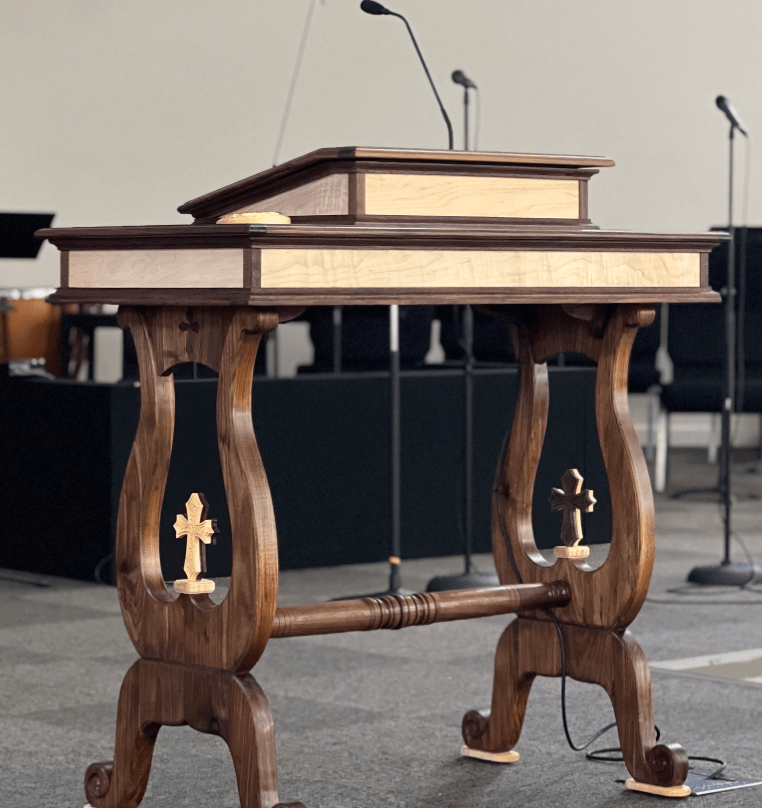
CR Wiley says, “I was recently asked, “What makes a good pulpit?” Here’s one I designed and had built for me at my last church. Here are a few convictions and practical considerations that went into the design of this one.

1.A pulpit has a liturgical function—it isn’t a lectern, it is the throne of the Word in Reformed churches. Consequently, it should make the pulpit Bible visible from every part of the sanctuary. It’s not supposed to enhance the status of a preacher, instead it should say something about the authority of God’s judgements. To reinforce this I had what appear to have armrests on either side of the pulpit Bible—and it just so happened that these provided places for a preacher to place his hands.

2.It should be substantial, even heavy, made of the highest quality materials a congregation can afford. This pulpit is made of quarter sawn red oak from the Berkshires in Massachusetts and it weighs roughly 400 pounds.

3.On the practical side of things, it should have places to put notes and books that might be used during preaching. As you might be able to tell, this pulpit provides plenty of space on either side of the pulpit Bible for those things. Source


What is your opinion on pulpits?

Posted in theology

Elisabeth Elliot: Faith, Controversy, and Legacy

By Elizabeth Prata

A reader asked me about Elisabeth Elliot. This is the answer I gave.

Elliot was one of the five wives whose husbands were killed by the unreached Ecuadorean Auca Indians back in 1956. She decided to remain in the mission field and minister to the same natives who had speared her husband. Later, returning to the US, she remarried and began speaking on a circuit. Her second husband, Addison Leitch, died agonizingly of cancer 4 years later. Elliot wrote books and hosted a radio program for 13 years called Gateway to Joy. She married for a third time in 1977 to Lars Gren and remained so until her death caused by dementia in 2015. She had one daughter, Valerie. Elisabeth was seen as a graceful, valiant, strong woman, but she was also disillusioned at times, complex, and had bouts of depression.

The question I was asked about Elliot was, was her theology off? It seems a bit off to the reader. I answered, yes her theology IS off. Elisabeth seems to be something of a sacred cow in evangelical circles, and has escaped scrutiny or critique. She gets a pass.

Some years ago I read an interview a Catholic lady was involved in with Elisabeth Elliot. A remarkable exchange occurred which the interviewer put in her resulting article. Elisabeth’s evangelical brother Thomas converted to Catholicism. He became an apologist for Roman Catholicism and wrote many books on the religion.

She said of her brother, the Catholic, that she wished she was brave or she’d be a Catholic too. From Catholic Exchange, an interview:

Do you know my brother, Thomas Howard? He entered the Catholic Church some years ago. I only wish I had his courage. … “Cowardice, I suppose. My listeners and readers simply would not understand.” Source: Courage to be Catholic

No, we would not.

Though these things happen, it wasn’t solely wanting her child to go to American schools that made Elisabeth leave the mission field, it was constant interpersonal conflict with fellow widow Rachel Saint that was the final straw. They could not stand each other. Though Elisabeth apparently tried to heal the fracture, it never did heal. It’s really not here or there, but the press gives Elliott a winsome graciousness or a settled placidity which was not always true.

She also preached to men. Christianity Today wrote, “Elliot, like many prominent conservative women, also manifested certain contradictions amid her complementarian advocacy. Though she insisted that only qualified men could serve as pastors, she taught church audiences that typically included adult men. Along with her second husband, she joined the Episcopal Church, one of the denominations most adamant about ordaining female pastors.

In her early life and especially when courting Jim, she had weird ideas about personal will and divining the will of God, using almost mystical means such as circumstances and experience. Her Keswick Holiness upbringing instilled this in her. This led her to excessive self-introspection and sometimes paralysis in decision making.

Elliot biographer wrote in her essay Why Elisabeth Elliot Changed Her Beliefs about Finding God’s Will, “She saw God’s care as dependent on her perfect obedience, and obedience as including not only her actions and her will but every aspect of her life right down to her natural inclinations. Human free will involved only the choice to obey or disobey God’s direction, and God’s will was so minutely specific that even an earnest seeker could miss the narrow path of obedience.”

Elisabeth Elliot teaching men

The fear of missing God’s direction caused Elliot much grief. While it is admirable to want to lay down the whole body, mind, strength, and heart down for the Lord, it is a kind of personal sovereignty that thinks our own decisions can and do thwart God’s will.

Did not Mordecai say to Esther, “Then Mordecai told them to reply to Esther, “Do not imagine that you in the king’s palace can escape any more than all the other Jews. For if you keep silent at this time, liberation and rescue will arise for the Jews from another place, and you and your father’s house will perish. And who knows whether you have not attained royalty for such a time as this?” (Esther 4:13-14), making it clear that Esther could decide what she wanted to decide, but that God’s plan would proceed regardless of Esther’s decision.

Elisabeth developed a rubric for divining what God wanted her to do,

(1) the circumstances,
(2) the witness of the Word,
(3) peace of mind

It’s an unstable thing to depend on emotions to confirm a personal decision. Whether it’s fear or peace, emotions should not figure in. No doubt Paul did not ‘feel peace about it’ when he got up from the road from being beaten almost dead to confront the mobs again, or when he floated on a shipwreck plank for days. In Acts 9:16, Jesus tells Paul, “For I will show him how much he must suffer for the sake of my name.” Knowing the certainty of suffering was ahead, I am sure Paul didn’t feel a spiritual placidity all the time. Our emotions should not be a guide for obedience.

On the plus side, Elisabeth was staunchly against feminism, and spoke frequently about headship submission, roles in marriage, and resisting cultural norms. On the downside, she often said these things at predator Bill Gothard’s events. And she began this professional relationship with Gothard in the mid 1990s, AFTER accusations began to come out against Gothard, which were later confirmed by his Board.

She certainly endured horrific tragedies, martyrdom of her first husband, agonizing long death of 2nd from cancer, and a semi-abusive relationship with the 3rd, and a 10-year battle with dementia, which caused her death at age 88. Her work on the mission field is beyond admirable, and her writing no doubt has helped many, as well as her popular radio program.

However, her legacy is definitely complicated, wrapped in grace under suffering, obedience to the Lord even under the most difficult trials, and an advocate for gender roles- which are all good things. However her search for HOW to obey God, her yearning for Catholicism, and her evident hypocrisy in preaching to men, are sad complicating factors in her life’s story.

Posted in theology

The Puritan Fashion Police: A Look at Sumptuary Laws

By Elizabeth Prata

Costumed interpreters, wearing historically accurate dress, gather around a table for the Harvest Feast of 1621, or “The First Thanksgiving,” at Plimoth Plantation in Plymouth, Mass. Pam Berry/The Boston Globe via Getty Images. Source

You can’t legislate behavior. The 18th Amendment to the United States Constitution prohibited the sale, transportation, and manufacture of alcohol. It went into effect on January 17, 1920.

It didn’t work. The 21st Amendment repealed it in 1933. It had little effect on alcohol consumption.

I was watching a Youtube history video on the Renaissance in Europe. This is the period around the 1400s to the 1600s. In the video the history expert mentioned Italian “Sumptuary laws.” I learned that these were laws designed to regulate personal spending, often based on religious or moral grounds. The idea was to limit extravagant spending on food, drink, clothing, and/or household items.

Sumptuary Laws extend as far back as ancient Rome and ancient Greece. The secular point of sumptuary laws was to distinguish one’s class by the manner of dress. The religious point was to prevent lavish and wasteful expenditures on finery of those in ‘mean condition.’

The American Puritans tried Sumptuary Laws on the new colony as well. It worked about as well for them as these laws did for everyone else: not too good. But they tried it anyway, and so, the American Puritans became fashion police for a while.

Hannah Lyman was a Connecticut Puritan who, in 1676, was hauled to court for her manner of dress, along with about three dozen other women. Charged with overdressing, their crime was wearing a silk hood. In a moment of rebellion, Hannah wore her silk hood to court. The judge was not amused, and she along with the other women, were fined.

In another example of a specific sumptuary law, no one except those in high government were permitted to wear gold in their clothes. “Declaring its “utter detestation and dislike” of men and women of “mean condition, education and calling” who would wear the “garb of gentlemen,” the Massachusetts General Court in 1639 particularly prohibited Puritans of low estate from wearing “immoderate great breeches, knots of riban, silk roses, double ruffles and capes.” Women of low rank were forbidden silk hoods and scarves, as well as short sleeves “whereby the nakedness of the arms may be discovered”— the daring new fashion popular among the upper classes.We Were What We Wore.

As the Puritan colony settled, trade resumed between our side of the Atlantic and Europe. People were just as fond of their frills and frippery as they always had been. More exotic garb was coming in, including short sleeves, gasp! This infuriated the Reverend Nathaniel Ward so much that, under a pseudonym, in 1647 he issued an angry and somewhat cryptic treatise called ‘A Simple Cobbler of Aggawam‘,  and called out the ladies:

I truly confesse, it is beyond the ken of my understanding to conceive, how those women should have any true grace, or valuable virtue, that have so little wit, as to disfigure themselves with such exotic garb, as not only dismantles their native lovely lustre, but transclouts them into gant bar-geese, ill-shapen-shell-fish, Egyptian Hyeroglyphicks, or at the best into French flirts“…  geese, shellfish, hieroglyphics, and French flirts!? Egad! The reverend was truly worked up! (Source).

To be fair, the reverand also called out other religious sects, such as Familists, Antinomians, Anabaptists, and other enthusiasts

Governing personal behavior and individual choices is always a dicey proposition. Hannah and the other women were fined. It was said specifically that Hannah was “wearing silk in a fflonting (flaunting) manner, in an offensive way…” I really don’t know how you’d wear a silk cap in a flaunting way. Perhaps she flirtatiously tipped it over one eye?

According to Claudia Kidwell, the former head curator of the Smithsonian Institution’s Costume Division, “Clothing’s most pervading function has been to declare status.” The early Puritans loved finery, but only the ones who could afford to have it tailor made enjoyed the finer points of it, and these were usually the leaders of the community, wealthy merchants, or high-born immigrants from England. It wasn’t until the late Industrial Revolution when ready made clothes appeared on the shop shelves.

But in the early days, we read,

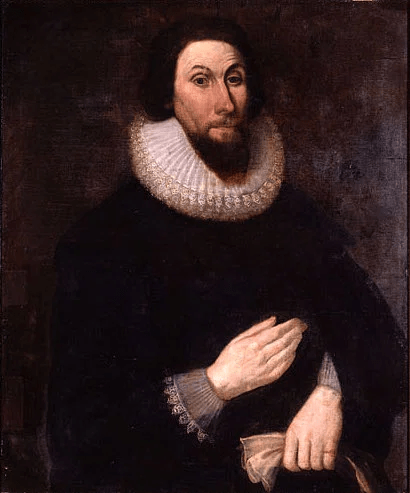
Massachusetts lawyer and later governor of Massachusetts John Winthrop with his lace collar and cuffs.  Charles Osgood/Public domain

Though simplicity of dress was one of the cornerstones of the Puritan Church, the individual members did not yield their personal vanity without many struggles. As soon as the colonies rallied from the first years of poverty and, above all, of comparative isolation, and a tide of prosperity and wealth came rolling in, the settlers began to pick up in dress, to bedeck themselves, to send eagerly to the mother country for new petticoats and doublets that, when proudly donned, did not seem simple and grave enough for the critical eyes of the omnipotent New England magistrates and ministers. Hence restraining and simplifying sumptuary laws were passed. In 1634, in view of some new fashions which were deemed by these autocrats to be immodest and extravagant, an order was sent forth by the General Court.

Though we most often see a Puritan portrait where the subject is wearing black, this was not usually the case in real life. Puritans wore black for paintings becuase black was their Sunday best. Black was a hard color to achieve and it faded quickly. But their daily mode of dress sported all sorts of colors.

Margaret Winthrop, the Massachusetts governor’s wife, ordered her clothing from John Smith, her family’s tailor in London. Margaret wanted “the civilest fashion now in use.”

Even then the clothes made the man. Or woman. In 1652, Jonas Fairbanks was called to the court in Salem for “wearing great boots.” Someone had spotted him wearing them, and snitched. The court record reads: “Jonas Fairbankes presented for wearing great boots. Discharged, it appearing that he did not wear them after the law was published.” Not today, snitcher. Not today.

A few other court decisions from that time in Salem (1646-1651) read:

Henrye Bullocke fined for excess in his apparel in boots, ribbons, gold and silver lace, etc.

Marke Hoscall of Salem fined for excess in his apparel, wearing broad lace.

John Bourne and his wife presented for concealing some pieces of cloth, stuff and thread committed to them and converting them to their own use. To make treble restitution and public acknowledgment at a public meeting in Salem within one month or pay fine.

In England in the late 1500s, a sumptuary law was passed requiring wool caps to be worn. In New England, such wool caps, called Monmouth caps, proved to be practical, and the people who had come from England were used to wearing them, so they were worn without resistance. These ‘Monmouth caps’ became widely used, but as a personal, practical choice.

Every person above the age of six (excepting “Maids, ladies, gentlewomen, noble personages, and every Lord, knight and gentleman of twenty marks land”) residing in any of the cities, towns, villages or hamlets of England, must wear, on Sundays and holidays (except when travelling), “a cap of wool, thicked and dressed in England, made within this realm, and only dressed and finished by some of the trade of cappers, upon pain to forfeit for every day of not wearing 3s. 4d.” Sumptuary Law of 1651 Massachusetts Bay Colony and the Fairbanks Family

Partly, the old issue of Job’s friend tinged the American Puritans’ thinking. They believed that wealth ordained by God, the wealthy were in favor with Him. Thus, to dress below one’s class would be highly incorrect. However, this use of sumptuary laws to identify class distinctions and maintain hierarchies in class waned as there was more socio-economic movement between classes occurring than it did in England. It became impossible to enforce, too. “Clothing is created out of motivation,” says Claudia Kidwell. “The wealthy wanted to maintain distinctions. Everyone else wanted to close the gap.”

In Puritan Massachusetts, the Sumptuary Law was instituted less to maintain a hierarchy, though that was part of it, but based on biblical standards of wise shepherding and to institute frugality. In this, New Englanders do owe a debt, because if you have heard of the “Thrifty Yankee”, that regional characteristic is real and pervasive to this day. Enacted in the Massachusetts Bay Colony in the fall of 1634, the General Court ordered,

That no person either man or woman shall hereafter make or buy any apparel, either woolen or silk or linen with any lace on it, silver, gold, or thread, under the penalty of forfeiture of said clothes. Also that no person either man or woman shall make or buy any slashed clothes other than one slash in each sleeve and another in the back; also all cut-works, embroideries, or needlework cap, bands, and rails are forbidden hereafter to be made and worn under the aforesaid penalty; also all gold or silver girdles, hatbands, belts, ruffs, beaver hats are prohibited to be bought and worn hereafter.” (Old English updated to modern language, Source).

Problem is, Christian liberty is still Christian liberty. It should not be legislated. But it kept happening anyway, people insisting on personal choice with their money, including where or when to buy finery. The court opined there was-

“intolerable excess and bravery hath crept in upon vs, and especially amongst people of mean condition, to the dishonor of God, the scandal of our profession, the consumption of estates, and altogether unsuiteable to our povertie…”

Obedience to God’s ways is a personal choice and a matter of Christian liberty when it’s in the areas not prescribed. Attempts to regulate one’s choices, whether tobacco, alcohol, clothing, or spending have always proved impossible to enforce and have failed in almost all cases. Hannah Lyman was 16 years old when she faced the court. Her bold stand for personal fashion choice resounds to this day.

However, there IS something to “the clothes make the woman.” The Bible advises us to be modest, and it also advises to shepherd our means well. Paul wrote of women in 1 Timothy 2:9, “Likewise, I want women to adorn themselves with proper clothing, modestly and discreetly, not with braided hair and gold or pearls or expensive apparel,”

and in, 1 Peter 3:3-4, “Your beauty should not come from outward adornment, such as braided hair or gold jewelry or fine clothes, / but from the inner disposition of your heart, the unfading beauty of a gentle and quiet spirit, which is precious in God’s sight“.

In the Old Testament, showy attire is likened to haughtiness. Being haughty is behavior that attempts to bring excessive attention to self,

Isaiah 3:16-24, “The LORD also says: “Because the daughters of Zion are haughty—walking with heads held high and wanton eyes, prancing and skipping as they go, jingling the bracelets on their ankles— / the Lord will bring sores on the heads of the daughters of Zion, and the LORD will make their foreheads bare.” / In that day the Lord will take away their finery: their anklets and headbands and crescents…

But legislation is not the way. Simple obedience to Jesus is the way. It DOES say something about a woman who wears short-shorts and halter tops. It says, ‘look at my body on display.’ It also says something if a woman goes in the other direction with a constant neck-high and floor length mode of dress, which in my opinion says, ‘look at my modesty on display.’

The indignant Reverend does make a sensible plea, “to avoid morose singularity, follow fashions slowly, showing by their moderation, that they rather draw in the other direction with their hearts, then put on by their examples.

All things in moderation. Including laws!


Further Resources

Our Puritan Ancestors: Mass Bay Residents Waged a Fashion War in the Colony

Records and files of the Quarterly courts of Essex county, Massachusetts

We were what we wore

Sumptuary Law of 1651 Massachusetts Bay Colony and the Fairbanks Family

The Puritan Experiment with Sumptuary Legislation

Posted in creation grace, glassy sea

Creation Grace: A Glassy Sea

By Elizabeth Prata

EPrata photo

This picture was taken in Lubec Harbor, easternmost point in the US and next to New Brunswick Canada. The waters are part of the Bay of Fundy, known for having the highest tidal range in the world. A large volume of water has to rush in and out within a few hours. The more water that needs to come in, the more it roils. When the tide comes in, the roiling starts abruptly and for a while it almost looks like it’s boiling. The weather in northern Maine and Canada is rough, too, with constant wind and storm.

This picture was taken because it is unusual to see such calm waters in this area of the world. Calm mid-tide, no storm, no fog, no wind.

The world isn’t calm now, not for more than mere moments in a few places, sometimes. There will come a day when the sea will be glassy always, and hearts will be calm. We will fully know peace.