Posted in theology

Dudette, where’s your gravitas?

By Elizabeth Prata

A while ago I asked Do You Like or Dislike Podcasts? I’d admitted that my toleration level for any and all auditory stimuli is low, due to my autism. Therefore if I’m going to listen to something I’d rather it be a sermon or soft classical music (very calming).

The title question is a paraphrase from a Council for Biblical Manhood and Womanhood article which asked the men “Dude, Where’s Your Gravitas?

Gravitas is a Latin word meaning dignity, seriousness, or solemnity of manner. Bible teachers, speakers, and podcasters are handling the word of God. They are conveying or teaching doctrines or concepts related to theology and its application to Christian living.

Sadly, many podcasts by both men and woman sink into silly behavior from the podcaster, especially when there are two or more hosts, or a host and a guest. There’s so much giggling, laughing, and off-topic, random chats that I usually reach my limit within just a few minutes, and turn it off or move the dial to something more productive. I also think it’s asking a lot of the podcaster to expect busy moms and outside the home working women to devote their limited time listening to their tee-heeing and non-productive repartee.

Quite often when I publish an essay regarding false doctrine brought by a false teacher, I receive angry comments and emails telling me to ‘judge not’ and the like. But strangely, the angrier emails and comments I receive come when I publish an essay urging women to behave biblically. My, how so many women resent being urged to behave like biblical women!

But the Bible demands certain behavior from all of the faithful in every age group. We women, we are told to be a graceful pillar

May our sons in their youth be like plants full grown, our daughters like corner pillars cut for the structure of a palace; (Psalm 144:12).

Pillars, ladies, Not a braying donkey.

clipboard3

A friend sent me a link to an Elisabeth Elliot talk on Youtube. Elliot (1926-2015) was a missionary along with her husband to the unreached group the Auca of eastern Ecuador. After what seemed a successful first few contacts, the Auca massacred her husband and four other missionaries with him. Elliot remained in Ecuador after her husband’s death for two years as missionary to the tribe members who killed her husband. She remained in Ecuador overall until 1963.

Elliot was a popular speaker and author. Many of her talks to women about wifelihood or missionary life were recorded, as the one my friend sent.

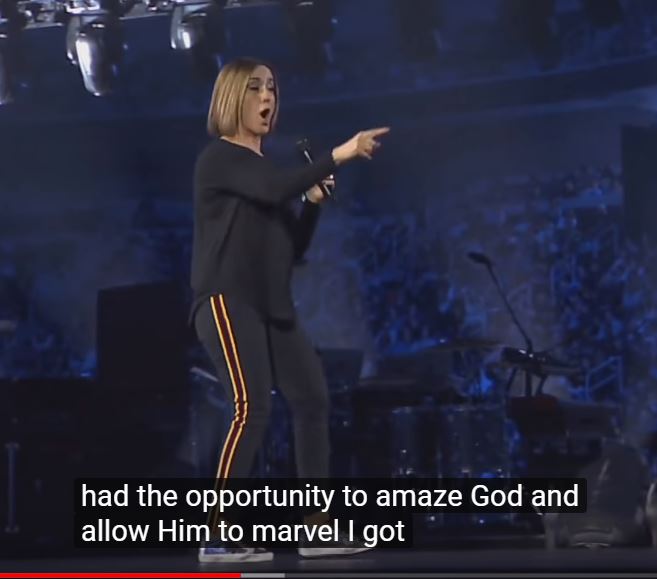
Something one notices immediately upon listening to Elliot is her demeanor. She speaks slowly, carefully, soberly. (Titus 2:3,5). I think of someone like Beth Moore, where her speech patterns are so frenetic that when Chris Rosebrough introduces a segment about her he plays “Flight of the Bumblebee”. Or Christine Caine, who, at Passion 2019, yelled a lot and never stopped striding around the stage (in a track suit). A Bible teacher’s demeanor like Elisabeth’s will cause one to stop, listen, and take what is said more seriously because of the gravitas inherent in the woman. She spoke of heavenly things with respect for heaven.

The following is from Council of Biblical Manhood & Womanhood, it says of gravitas in men (change the pronoun to woman)-

“That is a man of gravitas. There is a solemn weight to the way he carries himself. He believes in truth. He walks in love, joy, passion, and conviction. There’s an undeniable winsome seriousness evident in his character, his words, his thoughts, and his motivations.”

The Bible says of women,
Older women likewise are to be reverent in behavior, not slanderers or slaves to much wine. They are to teach what is good, and so train the young women to love their husbands and children, to be self-controlled, pure, working at home, kind, and submissive to their own husbands, that the word of God may not be reviled. (Titus 2:3-5).

From Strong’s,

  • reverent in Titus 2:3- means, befitting men, places, actions, or things sacred to God, reverent
  • self-controlled in Titus 3:5- sṓphrōn makes someone genuinely temperate, i.e. well-balanced from God’s perspective. This root then reflects living in God-defined balance.
  • The root is the root of “diaphram,” the inner organ (muscle) that regulates physical life, controlling breathing and heart beat.
  • Example: An opera singer controls the length (quality) of their tones by their diaphragm which even controls the ability to breathe and moderates heartbeat. Hence it regulates (“brings safety”) to the body, keeping it properly controlled.

A gracious woman gets honor, and violent men get riches. (Proverbs 11:16)

The word honor as used in the Proverb here means ‘of a woman’. It’s used elsewhere to indicate- a doe (Nahum 3:4); a precious stone (Proverbs 5:19); of ornaments (Proverbs 17:8; Proverbs 1:9; Proverbs 4:9; Proverbs 3:22.) Source, Strong’s.

One thing that Phil Johnson and Todd Friel remarked upon when discussing a “teaching” clip from Beth Moore was that her demeanor strayed from teaching the Bible with reverence and gravitas, to performance as a stand-up comedian. Dear sister, speaker, podcaster, ladies, if we are blessed with the gift of teaching and undertake that endeavor, do we want to point to ourselves in performance, or do we revere the subject matter enough to speak about our subject with not only skill and clear doctrine, but reverence and self-control?

If women are going to teach on Bible subjects, shouldn’t we act like the Bible says to act?

Just some thoughts. Let me know what you think.

———————————————–

Further reading/listening

Podcast by The Thankful Homemaker: Cultivating Self-Control. Contains good thoughts on approaching Christian life and holy things with reverence, which includes self-control.

Michelle Lesley and Amy Spreeman are Christian bloggers, speakers, and teachers. They project a demeanor of joy without silliness. Both the theological content and their speaking style are, in my opinion reverent, and self-controlled. Check out their A Word Fitly Spoken podcast here.

Dr. Shelbi Cullen and Kimberly Cummings at The Women’s Hope podcast also speak with a quiet, self-controlled demeanor, respecting the biblical content with proper gravitas.

Not to say that they all speak with grave intonation as one would at a funeral, they speak normally but handle the material from heaven with respect and devoid of fluff, silliness, without random asides and without distractions.
Posted in theology, word of the week

Word of the Week: Exegesis

By Elizabeth Prata

The thread of Christianity from generation to generation depends on a mutual understanding of our important words. Hence the Word of the Week.

Past Words of the Week have included Justification, Transcendence, Immanence, Propitiation, Sanctification, Glorification, Orthodoxy, Heresy, Omniscience, Aseity, and Immutability. I then went to a series examining each of the 9 characteristics of the Fruit of the Spirit: Love, Joy, Peace, Patience, Kindness, Goodness, Faithfulness, Gentleness, and on December 29, 2018, wrapped up the Fruit series with Self-Control. Now it’s back to individual words of the week. Last week I chose Angel.

This week the word is EXEGESIS

Exegesis – the study of a particular text of Scripture in order to properly interpret it; the process of understanding a text and making plain its meaning (see 2 Timothy 2:15)

Exegesis is when a person interprets a text based solely on what it says. That is, he extracts out of the text what is there as opposed to reading into it what is not there (Compare with Eisegesis). There are rules to proper exegesis: read the immediate context, related themes, word definitions, etc., that all play a part in properly understanding what something says and does not say.

Ex- means out of. As in excuse, Latin for ‘out of’ and cause, literally, free from a charge.

Expel, ex- meaning out and pellere, to drive.

Excentric (eccentric) out of, and center.

Exegesisexēgéomai, (Greek) I explain, interpret and ex, out

The author of the exegesis definition immediately above puts to practice the rules for interpretation he’d outlined in the Exegesis essay. He shows how to interpret Matthew 24:40, the famous statement by Jesus about two people in the field and one taken and one left. Most people who do not apply the rules for exegesis interpret that by looking at the surface and thinking it means the rapture. But does it? See for yourself.

At Ligonier, Anthony Carter’s essay outlines the Consequences of Poor Exegesis.

John MacArthur asks and answers in this sermon, How Should We Interpret the Bible?

Tim Challies’ essay on two examples of exegetical fallacies (misinterpretations)

greek

Posted in theology

Peace and War, War and Peace

By Elizabeth Prata

When people say, “There is peace and security,” destruction will strike them as suddenly as labor pains come to a pregnant woman, and they will not be able to escape.” (1 Thessalonians 5:3)

The world will always be seeking the increasingly elusive quality of peace and security. The word security is from the Greek compound word, meaning not and totter. The notion behind the word is they will be looking for a ‘firmness that equates to security.’ There is nothing on the earth that offers a foundational firmness that equates to security. There is no treaty, no house, no nation, no leader, no idea, no government that will offer the security that God does. The only security there is, is God. That is why the drive to find peace and security ratchets up at a frenzied pace as time marches on, because as the world crumbles into not-peace (war) and not-safety (chaos), they look toward something, anything, that will provide security.

We know war does come. There is no peace. The Tribulation opens with a horseman riding on the waves of war, unleashing it upon the world. (Revelation 6:3-4). Damascus is destroyed, (Isaiah 17), The Middle East goes to war (Psalm 83), Iran attacks Israel (Ezekiel 38-39), and the rest of the world is drawn into war after war (Matthew 24:6).

Jeremiah 8:10b-12 speaks of conditions that mirror ours today,

“From the least to the greatest, all are greedy for gain; prophets and priests alike, all practice deceit. They dress the wound of my people as though it were not serious. “Peace, peace,” they say, when there is no peace. Are they ashamed of their loathsome conduct? No, they have no shame at all; they do not even know how to blush. So they will fall among the fallen; they will be brought down when they are punished, says the Lord.”

The Old Testament priests and prophets spoke of superficial things, not getting to the heart of the matter, which was their sin and their failure to repent. We have that today, preachers refusing to speak of sin but instead treating the people with a bandage when what they need is a tourniquet. They dress the wound as if the people are not dying. They focus on stamping our social ills, proclaiming a ‘woke theology’ which is no theology,  refraining from speaking true Gospel words such as sin and repent.

The false prophets speak of peace (“God loves you”) but there is no peace, none inside themselves with God and none outside themselves with each other. They are so seared with sin that they don’t even blush anymore. They have no shame at their deeds, and they will be brought down and punished. As it was then, it will be again.

Jesus is the author of time, the conductor of events, the creator of all the universe. He knows what will happen because He created the plan for it happening, and He told us about it. We can trust it because He cannot lie. The stunning thing is that He shares His intentions with us at all! He did so in the Bible, and if you own one, read it. It will make you love our Savior all the more.

If you are not saved, then the Bible will never make sense to you but you can turn on the linguistic translator almost instantly, by repenting and submitting to Jesus as Forgiver of your sins. He will send the Holy Spirit to you to indwell you and reveal the truths of His word. Then you will understand it.

And what of us, still here, still walking in His light on this side of the veil? Well, we continue to do what we do. We raise our children, we love our families, we share His name and His truths where He has planted us. Until He uproots us through death or catches us up through rapture, we persevere, fighting the good fight. These are exciting times, because His word is vibrantly flowing from His book to life and beyond. The true prophets (in this ea, pastors and teachers) are going aobut their business and fulfilling their ministry.

Praise Him that we have His word, can read it, cling to it, and through it, look toward the most important person of the Universe: Jesus Christ, crucified and resurrected. And soon to return.

What a day that will be!

peace 4 verse

Posted in theology

Do you like or dislike podcasts?

By Elizabeth Prata

This essay isn’t scripture or a review of something, it’s a plain old editorial. An opinion piece. I don’t often write editorials here, because my opinion really doesn’t matter much. I don’t need to weigh in, or vent, or get anything off my chest.

Except now.

I’d like to bring to your attention the object of my opining today: podcasts.

Definition: “Podcast: a digital audio file made available on the Internet for downloading to a computer or mobile device, typically available as a series, new installments of which can be received by subscribers automatically.”

Podcast timeline: It all began in 2004 when the first podcasting platform was launched. Other platforms, from iTunes and Yahoo, soon followed. In 2005, President Bush became the first President to deliver his address via podcast. The social media app was soon to become widespread.By now in 2018 we’re used to podcasts. Many of my online friends do a podcast, and I’m grateful for their addition to the Christan social media landscape. They do a good job.

I have to say, however, personally, I don’t enjoy podcasts. I’m not a fan of banter, filler, giggling, or circuitous points which most of them fill up most of their time with. I know podcasts are more casual than a sermon, but my point is, they shouldn’t be. Not that much.

If I may offer some things to think about if you are thinking of starting a Christian-oriented podcast or vlog (video log).

1. Are you “Able to teach”?

1 Timothy 3:2 says “An overseer, then, must be above reproach, the husband of but one wife, temperate, self-controlled, respectable, hospitable, able to teach,”

and 2 Timothy 2:24 says “And the Lord’s servant must not be quarrelsome but kind to everyone, able to teach, patiently enduring evil,

Gill’s Exposition explains this term able to teach which I underlined above, which in Greek is didaktos

Apt to teach; who has a considerable store of knowledge; is capable of interpreting the Scripture to the edification of others; is able to explain, lay open, and illustrate the truths of the Gospel, and defend them, and refute error; and who is not only able, but ready and willing, to communicate to others what he knows; and who likewise has utterance of speech, the gift of elocution and can convey his ideas of things in plain and easy language, in apt and acceptable words; for otherwise it signifies not what a man knows, unless he ha.s a faculty of communicating it to others, to their understanding and advantage

Before you start a podcast, do you feel you possess those qualifications? Have others noted your ability in this area?

2. Homiletics

Homiletics is the art of preaching or writing sermons. Now, a podcast isn’t a sermon, but the podcaster is delivering truths from the word of God. The situation is similar in terms of gravitas. You might have an aptitude to teach but though teaching could be either or both speaking or writing, these are two different skills. Many people have an incredible ability to write but when speaking to audience, they lack skill to convey truth or to edify, and vice versa. Homiletics is a honed talent for conveying truth in a useful way. Do you have this talent when you speak?

Do your best to present yourself to God as one approved, a worker who has no need to be ashamed, rightly handling the word of truth. (2 Timothy 2:15).

In the phenomenal speech that Phil Johnson, Executive Director of Grace to You delivered titled, The Preaching of John MacArthur: Expository & Polemical, he was asked to assess the preaching career of John MacArthur. One of the things Phil notes was John’s speaking voice. It lacked any idiosyncrasies, verbal tics, or anything else that would distract from the message. It was well-modulated, and amazingly, JMac pronounces every syllable. This makes a difference, Phil said. The clarity of voice with which JMac speaks means that his voice fades into the background and the message comes to the fore.

In addition, some people simply do not have a voice for podcasts. Many women, especially when they laugh and giggle (as podcast after podcast seem to be filled with) become very high pitched. It’s grating to listen to an hour of this. Or even half an hour. (For me, one minute is too long)

3. Goals

What’s your goal for doing a podcast? Just because the technology is there and it’s easy to start one, does not mean that you should. Are you going to be adding to the general profusion? Or have you detected a need that the podcast will fill within the body of Christ? It’s very easy for podcasts to become either an echo chamber or a vanity project.

Secondly, are you able to keep it up? I know so many women decide to start a blog, then find that daily life interferes too much and their fervent writing has tapered off to a once-per-month essay, then sputters to once or twice a year, then stops completely. Veteran blogger Tim Challies has often said he is surprised at how many blogs, particularly by women, have gone cold. Nascent Bloggers, Vloggers, and Podcasters, what we are doing is for the Lord. Can you sustain the podcast you start, for the glory of His name?

As for you, always be sober-minded, endure suffering, do the work of an evangelist, fulfill your ministry. (2 Timothy 4:5)

4. Is Your Podcast Beautiful?

I am of the opinion that if one wants to have a speaking career, one should speak clearly and concisely. This skill is directly taught to pastors in Homiletics classes. But it seems that anyone with an internet connection who decides to launch a podcast or embarks on a speaking career does so without a minimum benchmark most people learn in high school speech classes. There IS such a thing as adhering to a minimum standard of craftsmanship.

So, is your podcast beautiful?

RC Sproul in his course Recovering the Beauty of the Arts said that whatever we do for Christ must have a simple beauty. He said that there are “three dimensions of the Christian life that the Scriptures are concerned about: the good, the true, and the beautiful. We tend to have cut off the third from the other two.”

For example, the tailor-made robes for the temple priests were anything but rags—they were made beautiful for a purpose: to draw the spirit of a person heavenward.

In like manner, Sproul said, the architecture of old was deliberately intended to bring people into a  reverent posture toward a transcendent holy God. Compare that with today’s church-buildings, where the main goal in the architecture seems to be creature-comfort, which unfortunately communicates the idea that the church is no different than the world.

He continued, that granted, it does not matter where we worship, so long as we worship in Spirit and in truth. But we must also remember that our external forms communicate something about our convictions, and will influence those visiting us.

So for the budding podcaster, the question becomes “What kind of art will we have? Good art or bad art?”

5. Gravitas

Gravitas is a Latin word meaning dignity, seriousness, or solemnity of manner. Podcasters are handling the word of God. They are conveying or teaching doctrines or concepts related to theology and its application to Christian living. I am personally offended at all the silliness, giggling, and boisterousness I hear on so many podcasts. I’m not saying Christianity is dour or should lack fun. It IS fun, and we often smile and laugh. We rejoice! But if a pastor came to the stage and engaged in as much silliness with his associate pastor or partner as we hear on these podcasts, we’d run him out of town on a rail. The podcaster usually begins her session if it’s with another person by jollying around and telling anecdotes about the dirty laundry or the spi-up from the baby and they laugh and maybe sip a beverage and laugh some more. Then they want to talk about the glories of God. It’s jarring, and it’s unnecessary.

I don’t have a lot of time to listen to lots of different things. If I’m going to listen, it will usually be a sermon. Give me a reason, podcaster, to carve out some time to hear your thoughts, and why I should spend half an hour or an hour of my time listening to your program and not a MacArthur or Sproul or Ferguson sermon.

Since podcasters are handling the word of God, there should be some semblance of import to it! Please think about the silliness factor when you produce your podcast.

Conclusion

Doing a podcast means that the podcaster is able to teach, has skill, delivers quality content that edifies and does not confuse, h/she denotes some sense of gravitas into the proceedings, and can and will sustain it. I don’t think it does the Christian body and the watching world much good to litter the landscape with quickly written blog essays, podcasts, and half-hearted vlogs. Podcasts are not performances, they are not giggle-fests, that should not be vanity fairs (one hopes). They are supposed to be a medium or another tool that delivers God’s truths in a theological or a practical way (depending on one’s goal) to eager listeners.

Bless you in your podcast, and may your listeners come to know Christ better through it. I’ll just be over here, quietly reading a book…

perfection of beauty shines verse

————————————————

Further reading

The Man Who Accidentally invented the word Podcast

Posted in creation, theology

“There is no such thing as transgender”

By Elizabeth Prata

Male and female he created them, and he blessed them and named them Man when they were created. (Genesis 5:2)

Though some people these days (and fewer than we are presented with by the news) claim that there has been some sort of mistake, or that they don’t feel right in their gender, and abuse the medical profession to change that, there’s no such thing as mistakes with God. He made them male and female, period. If a person doesn’t feel right int heir own physiology, there is a mistake with them, not with God.

“You’re either XX or XY. That’s it. … This notion that you are something other than your biology is a cultural construct intended as an assault on God.” John MacArthur

Transgender is a rebellion against God because He made each person as He intended, male or female. Claiming that one wants to switch genders, or that there has been a mistake, is saying God isn’t God, That He is not sovereign, he doesn’t know what He is doing, and it’s OK to make one’s self their own god.

Here is a five-minute clip I thought answered the question of transgenderism sensitively, but heartbreakingly. When a person switches genders, they obliterate themself. Transgender folks are 19X more likely to commit suicide. If you or someone you know is going through a desired gender switch, or wants to, get them help immediately, and pray fervently for them.


Posted in theology

Those first few minutes after Dad comes home…

By Elizabeth Prata

I grew up in a non-Christian home. My father was a strong atheist. He worked hard, very hard. In his mid-thirties he left the family business and struck out on his own, starting his own manufacturing company. I admired him for that. It’s not easy.

He worked long hours, and being a boss in a new start-up in difficult economic times was frustrating. He often came home angry or grumpy or just wanted to be alone. He was not very much interested in the family anyway, so when he came into the house he went straight to his bedroom and closed the heavy door. Then locked it.

The lock was solid and made a loud CLICK when it caught. I hated that sound. Though too young to understand why, I often cried when I heard it. It was a barricade. Dad was inside the room, and we were excluded. The family seemed fractured at that point. Wasn’t Dad happy to be home? Didn’t he want to see us as much as we wanted to see him?

The excitement of dad returning home as always dampened by the reality of him sequestering himself in his room for long periods. When he came out it was dinner time then bed, and we were away from him for another night and most of a day.

The Bible has much to say about fatherhood, being specific in some areas and in others leaving the practicalities up to us to implement.

Fathers are to be compassionate toward their children, (Psalm 103:13)
They are to be patient and not provoke them (Ephesians 6:4; Colossians 3:21)
Fathers are to display integrity (Proverbs 20:7)
Dads are to be leaders of the household (Genesis 18:19; 1 Corinthians 11:3)
Husbands are to love their wives as Jesus loves His church (Ephesians 5:25)
But not to be harsh with them (Colossians 3:19)
And discipline his children (Proverbs 13:24; Proverbs 3:11-12)
He is to teach them (Proverbs 22:6)
Fathers should love their wayward children too (Luke 15:20-24)

In all, He must manage his own household well, with all dignity keeping his children submissive, (1 Timothy 3:4).

My own father has passed away by now, gone to his eternal resting place, but I often still think about how fathers impact daughters. Well, I’m not the only one who is mulling over this relationship of fathers to his family. On Twitter we read from Michael Foster some practical takes on those precious moments when the father re-enters the home after a long day away at work. [Note: I’m unfamiliar with the entirety of beliefs of the person administering the Twitter account, but I thought this particular tweet series was worthwhile].

I hope you do too. 🙂

——————————————–

Michael Foster @thisisfoster

1) For years, I’d expect my family to leave me alone for a period of “decompression” when I got home from work.

I’ve always worked in highly relational/conversation based jobs. I’d often arrived home in a very overstimulated state and disappear to my office.

2) My wife would want me to deal with a discipline issue with a kid or be interested in what happened in my day. My kids would want to tell me about their day or have thousand requests requiring permission from dad.

But I just wanted space. I was fried. “Give me a min, family!”

3) I slowly came to see that this was a missed opportunity. It really was a failure of leadership. The way I re-entered my home after a long day of work played an important role in the forming of my home’s culture.

A man doesn’t just provide resources. He provides leadership.

4) I decided that I would use “re-entry” as an opportunity to provide leadership with 3 habits:

#1 – I didn’t listen to anything on the way home. I used the drive to pray, organize my thoughts & prepare myself to do some more work. Habits two & three flow from this first one.
5) Habits 2 & 3 start the moment I walked thru the door.

#2 When I get home I asked my wife if there were any discipline or pastoral issues that needed a father’s touch (Heb. 12:11). There are many situations in which a mother needs the father to step in. Jump on those!

6) After dealing with my kids, I move to

#3 Telling my wife something about my day. She’s been with kids all day. Zero adult conversation. Moreover, she is the key support to the mission I’m engaged in. I want her to know what she is accomplishing by being a ‘helpmeet’ to me.

7) I see a lot of complementarian pastors chiding men for not chipping in with the dishes & laundry.

I rarely do either. I’m not above it. She just usually has it knocked out.

Plus, me fathering my kids & encouraging my wife does 10x more for wellbeing of our household.

8) My household doesn’t need a second mother. It needs a father. These habits have helped me get to that work the moment I walk thru the door. Find what works for you. Look for ways to seize all opportunities to lead your home.

————–end—————–

prata place graceful garlands 43 final father

Posted in theology

Praying for riches or prosperity this year? Consider this warning from Proverbs

By Elizabeth Prata

Proverbs 30:7-9 says

7Two things I ask of you;
deny them not to me before I die:
8Remove far from me falsehood and lying;
give me neither poverty nor riches;
feed me with the food that is needful for me,
9lest I be full and deny you
and say, “Who is the LORD?”
or lest I be poor and steal
and profane the name of my God.

In reference to the first part of the verse, God hates lying, slander, gossip, all the negative things involving the tongue. Heed the many warnings of scripture about that.

In reference to the latter part of the verse… there are also many warnings about money. Judas’s sin was greed. He stole from the purse as he wanted. (John 13:29). The Rich Young Ruler forewent eternal salvation because “he had great possessions”. (Matthew 10:22).

Jesus warns twice in the same sermon how riches obscures your view of God, saying, “Again I tell you, it is easier for a camel to go through the eye of a needle than for a rich person to enter the kingdom of God.”

It is not a sin to be rich, but having a lot of money makes it very hard to let go of the world and open one’s hands to Jesus, clinging to Him, as Proverbs verse 9a states. Alternately, poverty also puts temptation on one’s life, tempting the impoverished person to steal, as verse 9b indicates. Poverty also gives rise to discontent, jealousy, and covetousness.

Our sin nature gives us so many different paths to take, doesn’t it? Learning to be content with what we have, under any circumstances (Philippians 4:11) is a good goal for 2019. The scriptures tell us to cast all our cares on him, (1 Peter 5:7; Philippians 4:6) and to pray daily for our bread (i.e everything necessary to sustain life, Luke 11:3) so I believe it is perfectly all right to pray for provision. Learning to pray for what we need rather than what we want is the goal.

The key is to pray for sustenance, i.e., means to live as we need to live in the circumstances in which God placed us. We should find that middle ground where we aren’t hoarding wealth rather than looking to Jesus, nor so lacking we’re tempted to sin. Relying on His bountiful grace, is the true prosperity.

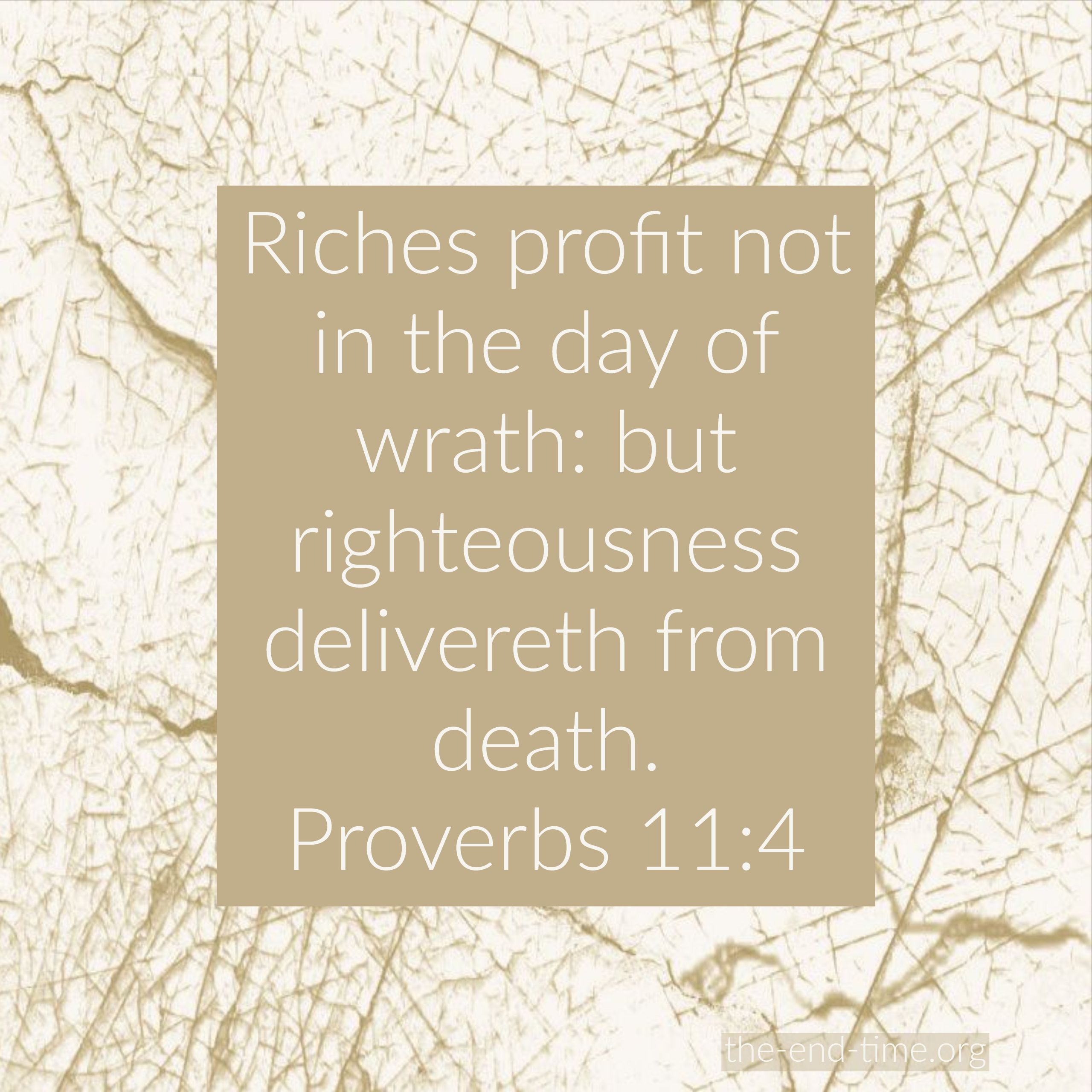
riches profit not verse

Posted in discernment, theology

Looking at Christine Caine’s speech at Passion 2019

By Elizabeth Prata

The Passion 2019 conference concluded last weekend. The event has expanded to four simultaneous venues spread among three cities, and all four were sold out. A total of just over 43,000 youths between the ages of 18-25 were in attendance.

One of the speakers this year was Christine Caine. Christine hails from Australia and is known for having founded the Propel Women organization and A21. Propel aims at “Activating every woman’s passion, purpose, & potential.” A21 “is abolishing slavery everywhere, forever.”

Caine is popular, but sadly she is a false teacher. Michelle Lesley wrote about Caine here. I wrote about her here.

The three-day Passion conference event is specifically a youth-oriented event. There is a restricted age-range that is allowed to attend. No one under 18 (unless you’re a senior in High School) and no one over the age of 26. Only the Pastor or Leader of the group attending may enter. No parents, no elder siblings, no elders of your church. Access denied.

Here are videos of the event.

I received a query about Caine’s sermon, so listened to Caine’s it, which was almost an hour. Well, I muted the sound and pushed forward the slider in ten second increments while reading the closed captions. I read what she taught and it was straight Word of Faith, twisted verses and all. Here are specifics on how to detect Word of Faith teaching.

The Word of Faith movement is decidedly unbiblical.

At the heart of the Word of Faith movement is the belief in the “force of faith.” It is believed words can be used to manipulate the faith-force, and thus actually create what they believe Scripture promises (health and wealth). GotQuestions

Here are a few screen shots from the video with the captions of statements that stood out to me. Her base text is from Matthew 8:10,

When Jesus heard this, he marveled and said to those who followed him, “Truly, I tell you, with no one in Israel have I found such faith.”

In Word of Faith you’ll often hear the word ‘allow.’ The WoF believes (GotQuestions again) that ,

“Laws supposedly governing the faith-force are said to operate independently of God’s sovereign will and that God Himself is subject to these laws.”

In WoF world therefore, when we do something according to these laws, God can then be ‘allowed’ to operate within them. The section of Caine’s lecture as seen on the screen shot shows she is teaching classic WoF.

In WoF land, you will hear the word “activate” a lot. In WoF teachings, the object of our faith is our faith (really, us). We possess faith. Something we DO activates it, then God works within it. That’s why within WoF if something doesn’t happen the way we decreed it, (healing, prosperity) it means WE didn’t have enough faith. Things depend on us and our faith, not on God. You see the switch: in WoF teachings it’s switched from God being sovereign to us being sovereign. Word of Faith teachers need to read and re-read Job 38-41 to learn man’s place befroe a sovereign God.

As for activating things, God is not a dried up sea monkey waiting for a drop of water to activate Him. If we are regenerated, then the Holy Spirit is in us and He is always working. His will is independent of ours and He does as He wants. He needs no “activation.” Even the printed word of God is living and “active.” Nothing WE do activates it.

In WoF you will hear the word “miracle” a lot. Miracles are important to these people because they are the proof of ‘our’ faith. The emphasis, again, is on our faith, and the results from our faith, such as miracles (or health or prosperity). Biblically, miracles were a sign authenticating the unique personage of Jesus, who was sent from God. (John 20:30,31; John 2:23). The WoF teachers do not focus on Jesus as He is for Who He is.

So why did Jesus marvel at the centurion’s faith? Doesn’t Jesus already know everything? We remember that Jesus is God, but in His incarnation He was also man, and when He marveled it is this side of his dual-single nature that comes into play.

For example, Jesus “grew in wisdom”, (Luke 2:52). The God side of Jesus already knows everything, but the man side of Jesus grew because that is what men do, grow. We can’t really grasp how He can know everything but also grow wiser- but that is the mysterious nature of the hypostatic union. [FMI see this Theological Primer from Keven DeYoung on the Hypostatic Union].

Alternately, can Jesus be surprised enough to marvel at a person’s faith? It is the man-God nature again. Jesus dispenses all faith, so the Centurion received it from Jesus as God. Remember the verse in Mt 16:17 when Jesus told Peter,

“And Jesus answered him, “Blessed are you, Simon Bar-Jonah! For flesh and blood has not revealed this to you, but my Father who is in heaven.”

Jesus as man can be astounded at a man who was a Gentile, had never learned the scriptures, but who had faith enough to trust that Jesus’s power permeated all the universe and that His physical presence or absence to do a miracle was of no matter.

MacArthur:

“When Jesus heard this remarkable expression of the centurion’s humble faith, He marveled at him. Here is a glimpse of Jesus’ true humanity, since as God He is omniscient and cannot be surprised by anything. But just as in His humanity He became tired (John 4:6), hungry, (Matt. 4:2), and thirsty (John 19:28; cf. 4:7), so also could He be astonished at the faith displayed by this Roman soldier.”

Matthew Henry:

He turned him about, as one amazed, and said to the people that followed him, I have not found so great faith, no not in Israel. Note, Christ will have those that follow him to observe and take notice of the great examples of faith that are sometimes set before them—especially when any such are found among those that do not follow Christ so closely as they do in profession—that we may be shamed by the strength of their faith out of the weakness and waverings of ours.

RC Sproul explains why WoF folks like Caine believed as she does, here is a snippet from his devotional,

“Some professing Christians have concluded from texts like this that human faith gives power to God.”

In addition to Caine’s Word of Faith doctrines showing her as a false teacher, she was inappropriate elsewhere in her speech. She spoke twice of how husbands can be “getting some action” out of their wives. She spoke of a skiing accident where she was loaded onto a stretcher and bemoaned the fact that she wasn’t wearing any underwear. Yes, these items were included in her speech to thousands of teenage and young male adults listening. Should a teacher or pastor say this ever? Of course not.

Jude 1:4 warns that false teachers will pervert the grace of our God into sensuality-

For certain people have crept in unnoticed who long ago were designated for this condemnation, ungodly people, who pervert the grace of our God into sensuality and deny our only Master and Lord, Jesus Christ.

If Christine Caine’s “sermon” raised red flags to you, good for you. If anything in this essay raised red flags for you, good. He needs no activation, no Word of Faith Law to operate within, and He does not depend on us.

Our God is in the heavens; he does all that he pleases. (Psalm 115:3).

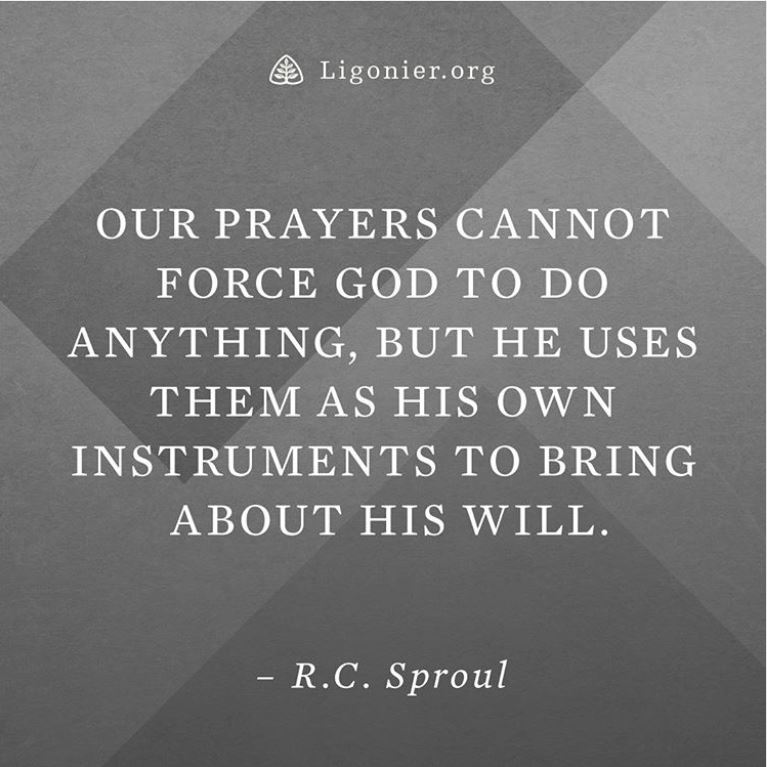
sproul

Posted in theology

Word of the Week: Angel

By Elizabeth Prata

The thread of Christianity from generation to generation depends on a mutual understanding of our important words. Hence the Word of the Week. Past Words of the Week have included Justification, Transcendence, Immanence, Propitiation, Sanctification, Glorification, Orthodoxy, Heresy, Omniscience, Aseity, and Immutability. I then went to a series examining each of the 9 characteristics of the Fruit of the Spirit: Love, Joy, Peace, Patience, Kindness, Goodness, Faithfulness, Gentleness, and on December 29, 2018, wrapped up the Fruit series with Self-Control. Now it’s back to individual words of the week and this week I chose Angel.

Angel

Aren’t we fascinated with Angels! They appear in art, literature, drama, and of course, the Bible. They are first mentioned in Genesis 2:1 where it is written,

Thus the heavens and the earth were finished, and all the host of them.

Host is another name for the angel army. Since God finished His work and called it all good, why does there need to be an army, which fights in warfare? Warfare isn’t good. Matthew Henry explains,

The creatures made both in heaven and earth are the hosts or armies of them, which denotes them to be numerous, but marshalled, disciplined, and under command.” (Matthew Henry Commentary on the Whole Bible)

Other names for angel besides host or heavenly host is sons of God, Morning Stars, Principalities, Rulers and Authorities, and Watchers. Because the Heavenly Host of angels is an army, some of their divisions or classes are also named, Seraphim, Cherubim, and Archangel. Also possibly Rulers, Authorities, Powers and Forces of evil (Ephesians 6:12).

Some angels’ names are given. They are Gabriel, Michael, Lucifer and Apollyon/Abaddon. Wormwood is also another possible name for a specific angel.

Angels are a class of beings that are not human and not part of the Trinity. They have superior power and abilities than humans, but are not human. When humans die, they do not turn into angels. We should stop saying things like “Heaven gained another angel with the death of…”

A personal peeve of mine is the continual depiction of angels as babies with wings. In Italian Renaissance art (where they became ubiquitous) these beings are called putti and that morphed into what we think of as cherubs or cherubim. However, this is a gross distortion of the actual cherubim, who are extremely powerful and magnificent, as are all angels. In 2 Peter 2:11 they are referred to as “angelic majesties”, beings whom the false prophets are unafraid to rebuke, and this is written as a negative. (So don’t go around “rebuking satan”).

Angels roam between the three heavens. When God completed Creation week, we learn that the angels were present in the universe and “the heavenly host sang together [gave a ringing cry] and all the sons of God shouted for joy” (Job 38:7). Angels appear in the throne room of heaven, (Isaiah 6:2) and they roam the earth. (Job 1:7). Some angels are even under the earth AKA in the abyss, chained up and waiting for the day of judgment. (Jude 1:6). Angels are everywhere!

When Lucifer rebelled, he convinced a third of the host to ally with him. They sinned, and thus they fell. These unholy angels are now the demons. They oppose God, His people, and His plan. Though they fell morally, they still have access to the heavenly throne room. (Job 2:1). The unholy angels still retain the power and strength they were created with. So be careful, they can deceive and masquerade as holy angels and they do it well!

It will be during the Tribulation that the door to the throne room will be shut against the unholy angels and they will no longer have access. This enrages Lucifer, now called Satan (because that means adversary) and his wrath ramps up the Tribulation into high gear. He takes his anger out on the remaining earth population. (Revelation 12:7-9, 13-17). Angels who rebelled will not be redeemed. Their condemnation is fixed. (Matthew 25:41)

Angels are spirit beings (Hebrews 1:14) but sometimes when they appear to humans they appear as flesh and blood men (the Bible always refers to angels as men, there are no female angels). We don’t know how they change to flesh and blood looking men when they appear on earth but suffice it to say that part of it is a mystery. Angels have personal will (otherwise Lucifer & Co. would not have fallen). They also have intelligence and emotions.

They holy angels praise God, perform His will, minister to humans, render His judgments, learn (“angels long to look into these things” 1 Peter 1:12), and so much more!

In fact there is an entire niche of study called Angelology. Different areas of Biblical study include,

Theology Proper (Doctrine of God)
Angelology (Doctrine of angels & demons)
Anthropology (doctrine of man)
Bibliology (origin of the Bible)
Christology (Doctrine of Jesus)
Ecclesiology (Doctrine of the Church)
Eschatology (Doctrine of The End Times, or Last Things)
Hamartiology (Doctrine of the Holy Sin)
Pneumatology (Doctrine of the Holy Spirit)
Soteriology (Doctrine of Salvation)
Prayers & Worship

So rest assured if you want to study the topic of Angels it is a legitimate field of study. They are certainly fascinating beings. Caution is warranted, however. Though the field of study is legitimate, many people who write about angels are not. There is a glut of less than credible resources out there.

C. Fred Dickason’s book Angels Elect & Evil is a good resource I am told.

Martyn Lloyd Jones did a sermon on Good Angels, here. Though the sermon for Jones’s companion to Good Angels sermon, called The Devil and Fallen Angels is lost, the transcription of that sermon is here.

S. Lewis Johnson has a sermon series on angels, here

RC Sproul has a couple of teaching series at Ligonier. This one on angels is two parts and can be listened to for free. This one on Angels & Demons is 4 parts and just the first lecture can be heard for free.

Further reading:

GotQuestions: Angels (this page lists a series of further essays)

Essay by Phil Johnson- Angels: Messengers of God

The End Time: Back to Basics- All About Angels

angel

Posted in theology

Encouraging global news from Grace To You

By Elizabeth Prata

Brother Justin Peters tweeted this monthly newsletter from John MacArthur at Grace To You. It is a year-end wrap up letter. I found it so encouraging! With so much negative news today (another shooting at a bowling alley last night) and negative Christan news constantly barraging us with the alleged imminent failure of the church, the alleged Exodus of youth from the faith, and the rising number of false teachers and doctrines, we tend to get overwhelmed with the sad news.

So here is some great news. The Lord is alive and constantly working in the world, making converts in every nation for the glorification of His name!

———————————————————————–
From John’s Desk
Dear Friend,

A couple of weeks ago our board of directors met. I am part of the board, and every fall we review Grace to You’s finances, hear reports on how the Lord is using the ministry, and receive updates on current projects and new endeavors. I can’t imagine how the meeting could have been more encouraging. Here are some of the key points and highlights:

The men and women who benefit from Grace to You, share our commitment to Bible exposition, and want a role in reaching others with it, are supporting our efforts at an unprecedented level. By God’s grace, all our financial needs are being met. I’m so thankful.

  • Users of our website and apps are downloading or streaming an average of more than 60,000 sermons every day. In the ten years since we opened the vault, visitors worldwide have downloaded nearly 190 million sermons, all at no charge.
  • We continue serving our Grace to You family through the more than 100,000 CDs, booklets, and books we distribute by mail free of charge every year. Since 2017 we have given away four major titles, including 35,000 copies of The MacArthur Study Bible anniversary edition.
  • We recently formed a new radio network partnership. We now air on that network’s nearly one hundred stations, expanding our reach to more than 1,350 outlets in the United States and Canada. We also air on more than one thousand radio outlets across dozens of nations in the Spanish-speaking world.
  • We are more than halfway finished with phase one of our Grace Reaches Out initiative, a project begun in 2015 to translate six hundred of my sermons into Arabic, French, Mandarin, and Portuguese. We’re adding the sermons to our website for free download as soon as they’re recorded.
  • We also received a report on the ministry’s plans for an important celebration in 2019. I delivered my first sermon as pastor of Grace Community Church on February 9, 1969, which means this year marks the fiftieth anniversary of Grace to You. Our celebration will span all of 2019, and of course you are a part of our plans. Our goal as we mark the occasion will be to minister to the Body of Christ and to thank the Lord for His faithfulness and goodness—and to thank the many people through whom He has blessed us.
  • Our board meeting culminated with a report from a pastor in Asia who has translated a large number of my sermons and placed the recordings on portable “radios.” A ministry partner that specializes in international broadcasting is now spreading the devices across urban and rural areas, reaching an estimated 600,000 people. (We were told of a farmer hanging the radio on the horns of his water buffalo and listening while working in his field.) These same ministry friends have also translated the entire MacArthur New Testament Commentary series for free electronic distribution to pastors nationwide. All of that started when the pastor found—and began downloading—sermons at our website.

As I ponder what I’ve written in this letter, I am utterly amazed. Amazed by the goodness of God. Amazed by the power of His Word to transform lives. Amazed by how He is using our resources to evangelize, edify, and equip His people. And amazed by the thought of the opportunities, known and unknown, that await us in the future.

As we launch into 2019, I really believe this ministry’s best days are yet to come. Every day that we air on radio and TV, every day that all the resources of our website are available for download by people wherever they live, every day that men and women are receiving and using the CDs and books we mail out—every day is an opportunity to reach a person, a family, a church, and a community with biblical truth. It’s a big world, and the spiritual needs are significant; we are poised to help in significant ways.

Of course, we don’t want to presume on God’s provision for next year. So if the opportunities that are before us—opportunities to reach people with the Word of God—resonate with you, I encourage you to help make them realities through your support for Grace to You. Your generous gift now will help us sustain and extend our ministry in your neighborhood and others like it around the world, bringing clear, transforming, biblical truth to people who desperately need it. Thank you for doing whatever the Lord leads and enables you to do.

Love in the Truth,
John MacArthur

———————end———————-

hydrant