
Posted in encouragement, theology

The story of the rock wall

By Elizabeth Prata

The year was 1962. The couple was young, and it was their first house. They had saved up and moved from a small apartment over a funeral home in the city, to the best suburb in the state. The happy couple now owned 4 acres of rolling hills and wooded yard, a 90 foot chicken barn, and a 100 year old cozy Cape Cod home with a wide front porch, across the street from a pond. They had made it.

It was New England, which meant that the yard was full of rocks. If the wife wanted a garden, the rocks would have to be dealt with. What do you do with all these rocks? They did as all New Englanders had done since the first Puritans had stepped foot onto the rocky land: build a wall.

Being Italian, and knowing the best masons and builders were Italian (yes, the husband was proud of his heritage), they hired Sal and Guido to take the rocks dotting the soil of this lovely yard and the ones all strewn about, haul them to the front of the yard, and build a wall. Being Italian, it would not only be functional, but it would be beautiful. It would also last.

Sal and Guido, knowing that the best walls aren’t held together with cement, but gravity, set to work. Slowly. Sal and Guido did not move fast.

First they gathered the rocks from all about and laid them along the front of the yard. They made sure they could see each one. Once the rocks of all sizes and colors were carefully laid from one end of the yard to the other, they examined each rock, turning it over to check its size and its properties, then laid it back down. Then they did the same with all the other rocks.

This process took a while. The husband was becoming impatient. He could not see any progress. Just a bunch of rocks littering his front yard. He did not see any point to all this examination and care. The old Italian masons told the impetuous young man that anything built to last must be done slowly and carefully. Wait, they said.

There came a day that the old men started piling rock upon rock. They knew each rock well by then, and knew exactly where to place each one. They all seemed to fit! Gravity held the wall together. The careful eye from each of the old masons, knowing where to place each rock for maximum strength and performance had done its job.

At last, the wall was done. It was strong, and it was beautiful.

wall

The wall is real, and the couple were my parents. I grew up here. This is part of the wall, there is more to the left unseen in the photo. There used to be more to the right, but it was done away with to cut a driveway. Fifty-five years later, the old builders’ work is still standing strong.

you yourselves like living stones are being built up as a spiritual house, to be a holy priesthood, to offer spiritual sacrifices acceptable to God through Jesus Christ. (1 Peter 2:5)

The Great Builder is building His eternal church from living stones – us. He is taking care to examine each one, turn it over to see all the different properties and facets. He knows just where to place each of us for maximum effect and use. It takes time, but anything well-built takes time.

We are being gathered, shaped, honed for maximum use. One day, the spiritual wall will be complete, the last stone will be laid (Romans 11:25). His spiritual house will stand forever.

But we do not want you to be uninformed, brethren, about those who are asleep, so that you will not grieve as do the rest who have no hope. 14For if we believe that Jesus died and rose again, even so God will bring with Him those who have fallen asleep in Jesus. 15For this we say to you by the word of the Lord, that we who are alive and remain until the coming of the Lord, will not precede those who have fallen asleep. 16For the Lord Himself will descend from heaven with a shout, with the voice of the archangel and with the trumpet of God, and the dead in Christ will rise first. 17Then we who are alive and remain will be caught up together with them in the clouds to meet the Lord in the air, and so we shall always be with the Lord. 18Therefore comfort one another with these words. (1 Thessalonians 13-18)

Posted in love, theology

Does God hate anyone?

By Elizabeth Prata

Psalm 5:5, The foolish shall not stand in your sight: you hate all workers of iniquity
John 3:16, For God so loved the world, that He gave His only begotten Son, that whoever believes in Him shall not perish, but have eternal life.

I was asked about an apparent contradiction between a God who says he hates people who sin and the love He expresses in John 3:16.

There are different types of God’s wrath. There’s cataclysmic wrath such as in when He sends tornadoes or hurricanes or earthquakes. There’s His wrath of abandonment such as when he ‘gives a person over’ to their sin (Romans 1:24, for example, or hardening Pharaoh’s heart). There’s eschatological wrath, prophesied to come in the future. And so on.

There’s different kinds of love. There’s God’s beneficent love to all general mankind we see in John 3:16 (That kind of love is shown as common grace, sending the rain to the wicked and the righteous alike). Then there’s His covenant love toward those He has purposed to save.

There’s different kinds of hate, too. Look at Luke 14:26,

If anyone comes to me and does not hate his own father and mother and wife and children and brothers and sisters, yes, even his own life, he cannot be my disciple. Whoever does not bear his own cross and come after me cannot be my disciple.

Is Jesus telling people to literally hate their parents? No. How do I know that? Because Jesus would not advise breaking the Fifth Commandment, “Honor thy Mother and Father.” No, He was using hate as a metaphorical comparison, you must love Jesus SO MUCH that by comparison is seems that your love for your parents is hate.

Is the hate expressed Psalm 5:5 the same kind of hate? No that is literal hate. It seems weird that God is love is also a God who hates.

That’s because in this day and age people vastly underestimate God’s hatred of sin. We’ve had a generation or two of “Jesus loves you and wants you to have a good life” kind of evangelism. It used to be “You’re a sinner that God will send to hell for rebelling against Him.” Sin is a huge problem to a thrice holy God. (Revelation 4:8, Isaiah 6:3).

Since God is love, sin is the polar opposite of everything He is. He hates sin- and the people who perform sin. Which makes his love for us all the more spectacular. When Adam and Eve sinned in the Garden, He clothed them. Even though they had just done one of the most evil deeds in the universe of all history (Judas’ betrayal being #1, this can be seen as #2) He still loved them enough to clothe them and send them on their way and did not kill them immediately. That’s love through hate.

We’re familiar with the phrase “Love the sinner but hate the sin”. It’s a wonky phrase that actually does more damage than is helpful. If we are to love the sinner we must confront his sin. Here, Cameron Buettel explains in a clear and concise way about how important it is not to divorce the two, the sin and the sinner performing it.

That determination to separate who a person is and what he does has also infiltrated the church. The exhortation to “love the sinner and hate the sin” is a clever Christian cliché regularly used to deflect people’s responsibility and accountability for their sin. While it’s true that we should both love sinners and hate sin, the cliché distorts those truths by unbiblically severing the two.

We should love sinners. We should hate sin. And we shouldn’t divide those two truths into separate categories. Our hatred of sin should manifest itself in a love that warns sinners—compassionately, but no less clearly—of the dire consequences their sin demands. Short of that, how could we ever claim to truly love them? Source

We can take this trajectory to its ultimate conclusion. Once a sinner has been warned, given the Gospel, refused and rejected, we turn it over to God. God knows the heart and knows when it it time for His general love to turn to hate, giving the person over to his sin with the sure and devastating consequences. Since He knows the heart, He knows when it’s time to love and a time to hate.

If we agree with the advice in the essay, and apply the same principle to God, we know He would do it in perfection and purity since He is perfectly holy.

Here are two good articles talking about God’s hate. This short devotional from Ligonier makes the love-hate situation really clear. Ken Ham of Answers in Genesis short article is good also.

God’s love and God’s hatred

Does God Hate Anyone?

psalm 5 hate

Posted in discernment, theology

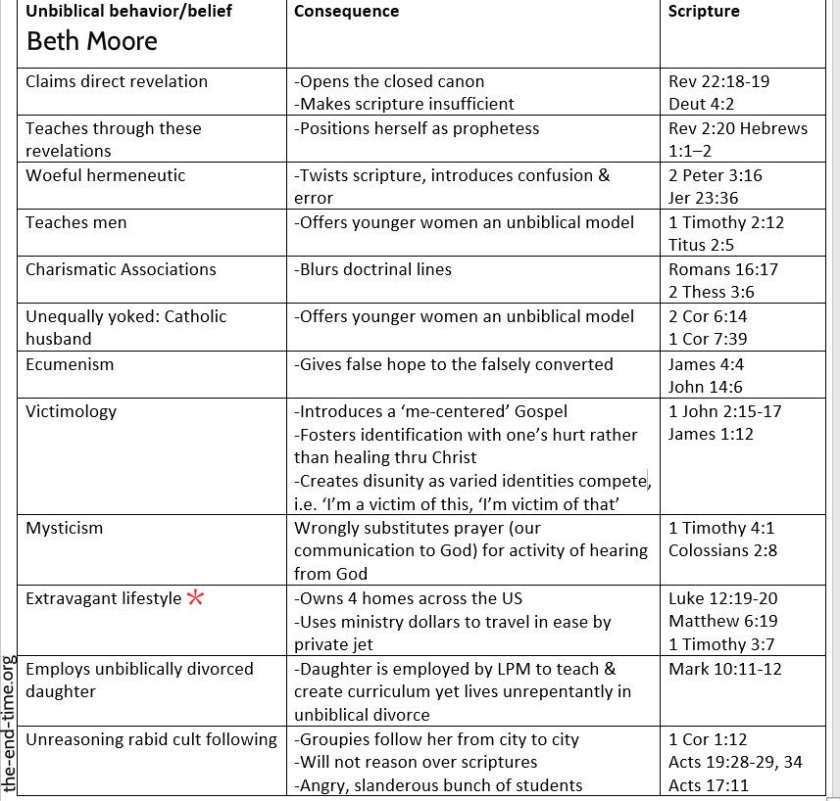
Problems with Beth Moore’s teaching in list form- did you know there were this many?

By Elizabeth Prata

If I hire someone to do a service for me, like install the flashing on my deck, or clean my chimney, or fix my car, I want to ensure a quality job done. It is unlikely that I would re-hire a plumber who has demonstrated serial-mistake-making.

“I installed the wrong size pipe and that’s why it burst in the middle of the night.”

Would you rehire that same plumber? If you did, and he made another mistake…

“I forgot to turn the water off before I uninstalled the pipe, that’s why the laundry room is flooded.”

Would you hire him again?

“I used the wrong size wrench and that’s why the pipe is crushed now.”

Of course not, at some point very early on, you would seek a different person for the job.

So why is it that people continually overlook a false teacher’s wrong acts? Dismiss obvious errant theological interpretations? Why do they put their soul at risk in ignoring the myriad issues others have raised?

I know the biblical answers to these questions, my mind is at rest with God’s ordination of these things. I ask them because though my mind is at rest, my heart mourns.

We don’t call someone false after one mistake or two. But after decades of credible problems in a ministry with no hint of its teacher repenting or showing willingness to be corrected, it becomes obvious what is happening: that teacher is falling, not rising. Yet some people disregard scripture violation after scripture violation, and they keep drawing water out of the same poisoned well, even asking for more.

This hurts me. I grieve for the women who follow false teachers, who willfully resist the attempts from discipleship mentors, elders, pastors, discernment people, to instruct them of the imminent danger to their soul.

Beth Moore has been on a downward trajectory since the beginning of her ministry. Her issues are not new. I thought if I put some of the issues in list form, it might make things plainer. This list doesn’t even contain problems about her legalism, pop psychology, or her atrocious behavior on Twitter toward those who raise objections to her teaching. It doesn’t mention unethical publication practices such as deleting half a chapter from her Kindle version and leaving it in the hard copy without letting readers know there was a substantial difference in content they were paying for. One can only fit so much into one table.

And that is the point. This list isn’t even complete. Would you hire a plumber to fix your bathroom if he has year upon year made significant foundational errors? No, and he would probably lose his license! Would you seek a doctor whose practice is riddled with malpractice – or deaths? And how much more important is your soul to keep healthy and alive?

Please accept this table as an earnest proffer. I listed the unbiblical teaching or behavior, the consequence of that belief or behavior, and the scripture we can refer to.

There are links I can provide and substantiations for each of Beth Moore’s errors. I can provide documentation, if you ask. Let us reason over scripture and let our hearts become joyful as we seek purity in our walk, good teaching, and collegial fellowship with one another.

Issues with Beth Moore in List Form2

* The lifestyle issue is not because Moore is rich (she is). The Bible has no problem with wealth. Job, Abraham, Solomon, Nicodemus, Joseph of Arimathea and others were rich. The issue is what Beth Moore does with her money, how she uses it, and how open she is about her wealthy status. Jesus didn’t mourn the Rich Young Ruler because the man was wealthy, but because he gave up eternal life to retain his earthly property and money.

Posted in theology

Enough with the ‘Girl, you are enough’

By Elizabeth Prata

“Girl, you are enough.”
“Girl, you are beautiful.”
“Girl, you’re a princess.”
“Girl, you’re fine just the way you are.”

I suppose it was inevitable. The Jesus is my boyfriend trend naturally morphs into the “I am a beautiful princess of God and I’m enough” trend. Browse Pinterest on the ‘Christian’ side of things and you’ll see plenty of soft-filtered flowery photos with mottos declaring these kind of statements.

Clipboard
Lower right by Madison K. Smith

Now, it’s true that we are daughters of the King. Galatians 3:26, John 1:12 declare we are children of God. And taking it a step further, God is King. And further, that children of a King are Princes and Princesses. All true, as far as it goes.

But wait a minute, if we literally take the metaphor stretched that far, wouldn’t men as Princes compete with THE Prince!? Yes. That’s why you almost always only see women being called Princesses and not male Christians as Princes.

Doing so manipulates women in an area where many are emotionally weak and needy, which is sad.

I am reminded of a scene in Exodus. Moses had been dwelling in the wilderness of Midian for 40 years when God called Moses to his ordained task, leading the Hebrews out of Egypt. Moses had just been instructed to remove his shoes at the Burning Bush because he was standing on holy ground. He is having a conversation with God. God told Moses he must speak to Pharaoh to let the Hebrews go.

Moses asked couple of questions which could be called legitimate. But as chapter 3 rolls into chapter 4 he crossed a line from earnest questioning to not-so-thinly disguised objections. By the time we read the conversation in chapter 4 verse 10, Moses has argued he is inadequate to the task. He is supposed to speak for God to Pharaoh but is ‘slow of speech,’ he complained.

Then Moses said to the LORD, Please, Lord, I have never been eloquent, neither recently nor in time past, nor since You have spoken to Your servant; for I am slow of speech and slow of tongue. (Exodus 4:10)

In the “Girl, you’re enough, you magnificent princess” world, we would see scripture reassuring Moses that indeed he IS enough, right? We’d see God cooing over Moses, telling him, ‘Guy, don’t you know you are enough? You’re my Prince, my love, my cherished bouquet in the garden of God.”

Moses’s objections would be met with a thousand assurances six ways to Sunday of all the good things Moses is. God would assure Moses that he was…enough. Wouldn’t He?

But that didn’t happen. What happened was, God essentially said, ‘You’re NOT enough, Moses. You’re inadequate to the task. But I AM adequate. I AM enough.’

The LORD said to him, “Who has made man’s mouth? Or who makes him mute or deaf, or seeing or blind? Is it not I, the LORD? (Exodus 4:11).

The problem with the ‘you’re enough’ trend is that it downplays our weaknesses and dismisses God’s power to perfect us in our weakness.

And He has said to me, “My grace is sufficient for you, for power is perfected in weakness.” Most gladly, therefore, I will rather boast about my weaknesses, so that the power of Christ may dwell in me. (2 Corinthians 12:9)

Moses wasn’t enough. And God considered Him a friend, and spoke to Moses face-to-face! (Exodus 33:11). But we are NOT enough. That is as it should be. The wider the gap in our abilities for the task, the more we praise God that He fills that gap with His strength, His power, His abilities.

If we were enough, we would be God.

not enough

Posted in theology, worship

Is your church a spectacle in the right way or the wrong way?

By Elizabeth Prata

Where are your eyes looking? What’s claiming your attention?

spectacle

The church was the one institution whose mission depended on galvanizing attention; through its daily and weekly offices, as well as its sometimes central role in education, that is exactly what it managed to do. At the dawn of the attention industries, then, religion was still, in a very real sense, the incumbent operation, the only large-scale endeavor designed to capture attention and use it. ~Tim Wu: The Attention Merchants

These days there are competing operations, all vying for our attention.

For politics, power, war, sex, sports, social media, gaming, or entertainment the best spectacles grab mass attention. Our culture is no longer banded together by shared beliefs; it’s drawn together by shared spectacles. ~Tony Reinke, Competing Spectacles

If  culture is no longer banded together through shared beliefs but by shared spectacles, what of the church, where we’re supposed to be banded by beliefs but now share only spectacles? Woe!

Hopefully your church hasn’t sunk into the idea that maintaining a spectacle is the only way to capture a person’s attention. It’s our beliefs that unite us, with that three-fold cord not easily broken.

When a preacher lifts up Christ crucified, it is the premier spectacle that captures us, the doctrines around that cross are the only draw that holds us together. Not concerts or hot dog barbecues or revival extravaganzas. Those spectacles hold attention only for a moment. Just the preaching of Christ and Him crucified is the pivotal sight before our eyes.

I pray your Lord’s Day is filled with the Word, song, prayer, fellowship, and the saturation of the shared belief that sustains and nurtures our souls.

cross

Posted in theology

Work, work, work

By Elizabeth Prata

I’ve got one week left and then I go back to work. I will have had 9 weeks off.

I realize that 9 weeks off, in a row no less, is an understandably wondrous gift, one that many people don’t get in 4 years of working. (Please understand that I live for 12 months on a 9-month salary, so there is a downside).

I work in the education system, so the cycle of my life follows the school year, not the calendar year. The rhythm of my life is one of hectic, fulfilling, busy, challenging, joyful work, then summer collapse rest.

There were some years where I worked for 16, 18, and one notable moment, 20 hours a day, with one week off at Christmas and one week at Independence Day. I’ve in the past felt the relentless grind, overlaid with feelings of accomplishment and satisfaction but sometimes accompanied with frustration and dispiritedness. I’ve been in the work force for 42 years, give or take. There were periods in life where I had to work two jobs and even three, laboring for 7 days a week. I’m not unfamiliar with hard work, relentless grind, whether it comes in the self-employment world, as a minimum wage minion at the bottom of the heap, or in the education world with its benefit of work then rest sprinkled throughout the year.

The job I have now is the best one I’ve ever had. I love working with children. It is a pure joy to be around kids. I enjoy the school breaks that come with the school calendar (being older now, I tire more easily). I have the best colleagues and the absolute most wonderful bosses I could ever hope for. It’s all good.

But the beginning of the school year those first days back at work are a shock to my system. And Monday morning blues still hit.

It didn’t used to be like this. In the Garden of Eden, Adam worked, but it wasn’t work that tired him out or frustrated him, or dispirited the man. It was good work, done without sweat. God gave Adam three tasks; cultivate the Garden and keep it, name all the animals, and lead his wife Eve. (Genesis 2:15, 19, 24; Ephesians 5:22-23).

Can you imagine working without sweating? Not just physical sweat, though that will be nice, but work was absent the heart-pumping stress, hustle, hectic work that office people feel, or bus drivers, or police bomb defusers or…

How do I know work wasn’t the kind of work we think of these days? The verse where God curses work. Genesis 3:17b-19

Cursed is the ground because of you; In toil you will eat of it All the days of your life. Both thorns and thistles it shall grow for you; And you will eat the plants of the field; By the sweat of your face You will eat bread, Till you return to the ground Because from it you were taken; For you are dust, And to dust you shall return.”

We know that heaven, i.e. the eternal state after the conclusion of all things, will be one of rest. But it will also be one of work. Whattt?

Reagan Rose covers this in his essay Will We Work in Heaven?

But for now, assuming Earth is redeemed man’s final destination, we would be right to wonder, “what will we do on that renewed Earth?” The answer is that we will worship our Lord, we will wonder at His majesty, and we will work.

Mr Rose continues with explaining that Heavenly Work Will Be Restful Work, and Heavenly Work Will Be Enjoyable Work, before he comes to his conclusion.

James M. Hamilton Jr wrote Work and Our Labor for the Lord, looking at work as it was meant to be, as it is, as it can be, and as it will be.

As work will be, “We can scarcely imagine it, but everything that makes work miserable here will be removed. All our sinful concerns about ourselves will be swallowed up in devotion to the one we serve. All our frustrations that we have to be doing this task and not the other one we prefer, will be abolished because of our experience of the one who gave the assignment. All inclination to do evil will have been removed from our hearts, so we will enjoy the freedom of wanting to obey, wanting to serve, wanting to do right.”

Imagine, being released from the bondage to sin and working in complete and perfect freedom to serve to the utmost in righteousness and in joy!

On earth our work often distracts us from worship, but in heaven work will BE worship.

What of work now, here on earth? We do need to work. “if anyone is not willing to work, then he is not to eat, either” (2 Thessalonians 3:10)

On the Chris Craft podcast, Chris asked guest Phil Johnson “How should we represent Christ in the workplace?”

“Work hard.”

Amen to that. I know of a custodian who works very hard all day long. She never stops. She cleans toilets, hustles to classrooms to wipe up kid-vomit, sweeps the cafeteria floor after kindergarten has been through like storming Huns. She is kind, constantly smiling and always ready to praise Jesus whenever you talk with her.

One day a second grader was waiting and I was waiting with her in the lunchroom. The kid was watching the lone custodian clean the cavernous cafeteria. After a while the child turned to me and said “She works hard. And she has to do all that by herself. But she never stops.”

When a person works so hard (for the Lord as I know she does) and a child notices the work ethic, you know it’s a good ethic. A shining ethic. Do I work that hard? Do cheerfully perform any menial task set before me? With purity of heart and a sincere effort? Sometimes no, but the lady I’d mentioned is my role-model inspiration. She represents Christ in a way that few people I’ve ever seen do so, and she does it through work.

Work hard on earth, as Colossians 3:23 says

Whatever you do, do your work heartily, as for the Lord rather than for men,

And look forward to the day when you and I will be FREE to serve without sin tainting our work ethic or the work product. What a day that will be.

Meanwhile…Happy Monday!

—————————————–

I made this collage some years ago when I was pondering work and being busy even in ministry work. Do we work so hard we become too busy for God? On the left side of the collage top and bottom we see heaven and worship in heavenly peace. Below that scene are the animals, who know what to do in their spheres. Even creation groans for release. On the right side, top and bottom, is the heaving, pulsating spectacle of humanity going to and fro, with only a few looking at the Light, even noticing it.

too busy for God

Posted in book review, theology

Book Review: Mary Rowlandson’s captivity

By Elizabeth Prata

Narrative of the Captivity and Restoration of Mrs. Mary Rowlandson
Mary White Rowlandson

It’s a riveting account of a Puritan woman’s travail through an Indian massacre and three months’ captivity, and eventual ransomed release. (1675-6). It was the time of King Philips War and the colony had gotten very bloody very quickly.

Mary is articulate in her afflictions and fervent in her reliance on God through the ordeal. Contains many scriptures and references to God. If a reader is not a Christian they will likely not enjoy the account as much or at all. I enjoyed  seeing how Mary relied on certain scriptures as she saw her family killed, her children ripped from her, and as she endured hunger, thirst, physical hardship, and the devastating emotional loss of her child dying in her arms and her other children taken to different Indian villages, fate unknown.

In one scene that remains vivid in my mind, she looked to the left and only saw hundreds of Indians, and looked to the right and only saw hundreds of Indians, and became aware of the fact that she was the only Christian for miles and miles.

Some say the antiquated English the narrative is written in makes it hard to read. I didn’t, I found it less difficult than Shakespeare and enjoyed it at every part.

I first heard of this book (short narrative at 55 pages) when author Nathanial Philbrick referred to it in his book Mayflower, which I also enjoyed.

Free on Kindle.

Represents one of the first publications of a woman in the New World (Anne Bradstreet’s poetry was first).

mary illustration.jpg

Posted in cross, theology

The cross is the greatest spectacle there ever was or will be

By Elizabeth Prata

Tony Reinke’s last chapters of Competing Spectacles so moved me I designed this picture to stare at and better ponder its truths. The mental picture of it was so vivid before my eyes I had to draw it out.

Initially I drew just the wavy line and the cross. The cross is lifted up, the sole item on the bloody landscape. To view it, all eyes must look UP. The cross of Christ is the only thing has any meaning in the world. When I was an unsaved person I rejected this notion immediately. As a saved person, by the grace of God, I am humbled to kneel and stare at this wonderful, terrible cross.

The line represents not only the hill, for the Son of Man must be lifted up, and it was a hill He died on and a hill he will return to.

The line is also the dividing line of all human history. The above and below, the hell and the heaven, the line that divides before Christ’s birth and after Christ’s incarnation and is both the starting point and the ending point of all that is and all that will be.

“Christ’s victory is the spectacle that holds the attention of the universe.” ~Tony Reinke, Competing Spectacles

Christ’s glory is the spectacle of all spectacles, and its power is most clearly seen in how it equips and motivates and animates our faithful obedience in all other areas of life.

Christ was not merely made a spectacle on the cross, the cross became a shorthand reference for everything glorious about Christ- His work as creator and sustainer of all things, his incarnation, his life, his words, his obedience, his miracles, his shunning, his beatings, his crucifixion, his wrath bearing, his resurrection from the grave, his heavenly ascension, his kingly coronation, and his eternal priesthood- all of his glory subsumed into his heavenly spectacle. ~Tony Reinke, Competing Spectacles

To be able to love Jesus and not hate Him any longer is the joy of my life.

We love because he first loved us. (1 John 4:19)

Posted in salvation, theology

When God speaks a name twice

By Elizabeth Prata

Bible trivia: When a name is used twice in a row it is an expression of intimacy, communicating great emotion.

Abraham! Abraham! Genesis 22:11.

Jacob, Jacob. Genesis 46:2.

Moses, Moses! Exodus 3:4.

Samuel! Samuel!1 Samuel 3:10.

Martha, Martha. Luke 10:41.

Simon, Simon. Luke 22:31.

Jerusalem, Jerusalem Matthew 23:37.

Saul, Saul. Acts 9:4

My God! My God! Matthew 27:46; Psalm 22:1.

Now think of the other time a name is used twice, this time not from God or Jesus to a beloved person, but from people who thought they had beloved intimacy with Jesus- but didn’t.

Lord, Lord. Matthew 7:21-23.

“Not everyone who says to Me, ‘Lord, Lord,’ will enter the kingdom of heaven, but he who does the will of My Father who is in heaven will enter. “Many will say to Me on that day, ‘Lord, Lord, did we not prophesy in Your name, and in Your name cast out demons, and in Your name perform many miracles?’ “And then I will declare to them, ‘I never knew you; DEPART FROM ME, YOU WHO PRACTICE LAWLESSNESS.’

That verse takes my breath away in its devastating truth. Many in this case means in Greek a high number, great in extent. If many will say to Him Lord, Lord, pleading an intimacy that had never existed, we know that on this day there are many who claim an intimacy with Jesus they do not have. They think they do, but they don’t. They’ll find out later. It’s the unsettling truth that we live with now, and will sadly watch later as the bitter truth emerges.

This should enhance our gratitude to Jesus all the more. Prayers of thanks to Jesus for His cross, His resurrection, His salvation, and His assurance are not inappropriate at any time.

If you are unsure whether you say ‘Abba, Father’ and will be received, or wonder if you will be one who says Lord, Lord later and be rejected, then I recommend these resources to you:

Is It Real? 11 Tests of Genuine Salvation

Can I Be Sure I’m Saved?

by faith you have been saved verse1

Posted in secret sin, theology

‘Looking this way and that’: About that secret sin…

By Elizabeth Prata

Now it came about in those days, when Moses had grown up, that he went out to his brethren and looked on their hard labors; and he saw an Egyptian beating a Hebrew, one of his brethren. 12So he looked this way and that, and when he saw there was no one around, he struck down the Egyptian and hid him in the sand. (Exodus 2:11-12)

I think the American law enforcement system would charge Moses with premeditated murder, right? Have you seen enough Law & Order episodes to click onto this? 🙂

I love the Bible. Its honesty, its knowledge of human behavior. That little nugget in the middle of the verse, “looked this way and that…” just makes my heart sing. Not happy that Moses killed someone, we all agree that murder is wrong and a gross violation of God’s commandment. (Exodus 20:13).

Think of how transcendent God is. He is above us, unknowable, not understandable, holy to a degree that would instantly kill us if we got near Him. (Isaiah 55:8-9, Psalm 145:3, Exodus 3:5) .

But also He is immanent. As Emmanuel, He is with us and knowable (1 Corinthians 2:2).

Our God who is both transcendent and immanent is a mighty and majestic God. Moses knew this, and yet as he purposed to kill the Egyptian, he looked this way and that and saw no one was around.

God was around.

How often do we do that though? We purpose to sin. We are deliberate about it. Sin is not ever truly accidental. We look around to see if anyone will see…because we know what we are about to do is wrong. Sin is easier to do when no one’s looking. Why? Because of the Law written on the unsaved’s hearts, they know sin is shameful. If we are saved and we have the Law and the Gospel, we know sin is shameful. It’s better to do it in private, in secret.

Sin is never secret.

For God will bring every act to judgment, everything which is hidden, whether it is good or evil. (Ecclesiastes 12:14).

In any case, Moses was not alone as he thought. There are often people who see what we do even if we don’t see them. The minute Moses tried to mediate between two fighting men, one of them said to Moses in Exodus 2:14,

But he said, “Who made you a prince or a judge over us? Are you intending to kill me as you killed the Egyptian?” Then Moses was afraid and said, “Surely the matter has become known.”

Moses had destroyed his witness.

Unknowingly as Moses did, when he thought he was alone he might get away with murder but actually the Egyptian had seen Moses. This is why people call us hypocrites. If I gossip, I can’t turn around and chide another woman for gossiping. If I become angry, I have nothing to say to a lady who is angry.

We hear that on the playground, ‘Who made you the boss?’ If we destroy our witness because of our purposeful sin, we have nothing to say about Jesus when the time comes. We will rightly be called a hypocrite. We might be speaking to a person who has witnessed our secret sin and calls US out on it! How embarrassing that is!

Paul told Timothy to watch his life and his doctrine closely, “persevere in these things, for as you do this you will ensure salvation both for yourself and for those who hear you.” (1 Timothy 4:16).

Paul was telling Timothy to watch his personal holiness and his teaching as a leader, but of course we lay people should watch our personal holiness too, as Paul says in verse 15, Be diligent in these matters and absorbed in them, so that your progress will be evident to all.

No one will listen to a stalled-out Christian whose secret sins are known to all. But they may listen to a diligent, growing Christian who has a good word from God.

In that moment you’re considering a sin, and you ‘look this way and that’, stop. If you have sense enough to look this way and that, you have sense enough to consider the Savior who died on the tree for that sin you’re about to do.

I’ll take my own advice too.

secret sins