I wrote on Facebook that I’d discovered a recommendation from Stephen J. Nichols, president of Reformation Bible College and chief academic officer for Ligonier Ministries, of a book that Johnny Cash had written. Nichols had said that Cash, yes, the singer/musician, had novelized the life of Paul and it was “A piece of genius.”
Excited, I made mention of this on Facebook. A question came up, a good question. It was asked sincerely. I decided to follow it up here because it bears discussion.
Growing up, I used to watch the PBS Masterpiece Theatre classic “I, Claudius”. It was about one of the least known Emperors of the Roman Empire, Claudius. Claudius is not as well known, being sandwiched in history between the more famous emperors Caligula and Nero. I was fascinated with the Roman banquets, of which the show “I, Claudius” had many. I used to wonder why they ate while reclining. It seemed cumbersome to me.
We’re a week into the new year. How long do you say “Happy New Year?” LOL, I say it only on the day or a day or so after. Are you still keeping up with your New Year’s Resolutions, if you made any? I don’t make resolutions but I did make some changes. Tweaks in my routine.
Yesterday I posted an article about the fact that hell exists, why it exists, and why people go there (and how to avoid it). Here-> Betty White talks about her own death with Larry King. I was asked about how to handle knowing a loved one is very likely in hell enduring eternal torment. It’s a troubling question, an important concept to dig though – if tough on the heart and mind.
Actress and animal advocate Betty White died last week. She was 99 years old. She was just two weeks shy of her 100th birthday.
She had longevity not only in years that the Lord graciously gave her, but had longevity in her career that she loved so much. It’s a wonderful thing to love what you do and be given so many years to do it.
When she died, as many times happens with a celebrity death, the concept of death suddenly becomes real to people. It does to me, it brings the afterlife into the forefront of my mind. I am in Christ and I fear death no more. The curiosity I’d had about what happens two seconds after my last breath is finally satisfied in the certain knowledge that I will be with Jesus in heaven. I do not know what I’ll be doing, apart from praises and songs of worship to Him, but given His intellectual creativity these last 7000 years, I know it’ll be wonderful.
The Bible is replete with warnings about how worthless the assigned shepherds of Israel can be, (Ezekiel 34:2-3), and how worthless the shepherds of a church can be. (Jude 1:12). The verses warn about their judgment for feeding themselves and not the sheep, and more. See Ezekiel 34:4,
Those who are sickly you have not strengthened, the diseased you have not healed, the broken you have not bound up, the scattered you have not brought back, nor have you searched for the lost; but with force and with violence you have dominated them.
In the New Testament Jude calls these false ones selfish, and Peter calls them indecent, destructive, self-centered, greedy, and much more.
It’s painful to think that the ones in whom we put our trust to teach us well and lead us into righteousness by example and by the preaching of the word, may have ulterior motives that are actually as dastardly as all that. But think of how awful the Pharisees were! They were a group that emerged from times past who were concerned with stricter adherence to the Law. First called Pharisees in around 135BC, the Pharisees held to a strict belief in the Oral Law that God gave to Moses at Sinai, plus the Torah. The Torah was the Written Law, and was open to interpretation.
While it is often hard to picture someone’s evil who operates under the cloak of righteousness, we can look at the Pharisees’ deeds to see just how evil they were. Jesus reserved His worst rebukes for the priests, scribes, Pharisees, and Sadducees. There is a reason for that!
–Lazarus suffered an illness, and then suffered death. However, Jesus raised Lazarus from the dead. The chief priests wanted to kill Lazarus AGAIN!!
–They cared more about tithing cumin and mint than for justice and righteousness. They abandoned their duty to minister to the people by offering mercy, and instead focused on minutiae. Mint over people is a bad trade, Jesus said in Matthew 23:23.
–They ignored the needs of the people,
–They co-opted Judas into sin by paying him to reveal where Jesus was so they could arrest him,
–Instead of celebrating his healing, they grilled the recently healed blind man, AND his family, and they all feared the Pharisees. Our shepherds are not supposed to instill fear in us…
–They put people out of the synagogue. Cutting people off…?…Instead of helping them in their sin by showing them the way in love?
The same sins and traits exist today in the worthless shepherds exist today in pastors and elders. How do I know? There is nothing new under the sun. As long as we’re still human living in flesh, as long as there is sin in the world, there will be some shepherds (pastors) who exhibit the same traits the Pharisees did. They are often hard to spot, or if we do spot them, it’s hard to accept their evil. But is IS evil. We rationalize their behavior away.
Are there pastors who put people out of church? Yes, and not for properly followed church discipline reasons. Are there worthless shepherds today who focus on their tithes of mint and enjoy the chief seats instead of helping people in sin? Yes. Are there pastors who manipulate people so they can satisfy their own agenda (which usually is about building their fiefdom inside the church). Yes.
I’m making two points here,
1. Worthless shepherds exist today as they did back in the Pharisee days. Don’t look under every rock for one, that’s the wrong focus. But if you begin to suspect one, don’t ignore the discernment warning, either. 2. If you have a worthwhile shepherd, (pastor/elder) protect him in prayer, support him, meet his/their needs. Praise the Lord for him! The Bible says,
The elders who lead well are to be considered worthy of double honor, especially those who work hard at preaching and teaching. (1 Timothy 5:17).
Paul, Silvanus, and Timothy, To the church of the Thessalonians in God the Father and the Lord Jesus Christ: Grace to you and peace. We always give thanks to God for all of you, making mention of you in our prayers; constantly keeping in mind your work of faith and labor of love and perseverance of hope in our Lord Jesus Christ in the presence of our God and Father, knowing, brothers and sisters, beloved by God, His choice of you; for our gospel did not come to you in word only, but also in power and in the Holy Spirit and with full conviction; just as you know what kind of men we proved to be among you for your sakes.(1 Thessalonians 1:1-5).
EPrata photo
I hear so many people say “I want to be filled with the Spirit.” And that is a good thing to seek (if you mean in the true sense of the word and not Charismatically.)
But have you thought about how being filled with the Spirit might also include what Paul is extolling here that the Thessalonians received? “Full assurance”?
We want to be filled with, energized, dominated by the Sprit so our sins diminish and so our deeds grow. But deeds for Christ rest on the assurance that they will be-
1. Performed for His glory 2. Go out and not return void
If Paul praised the Spirit for the full assurance the Thessalonians had received (it’s a passive reception, not humanly-catalyzed) then we can ask for the same.
And in much assurance - That is, with firm conviction, or full persuasion of its truth. It was not embraced as a doubtful thing, and it did not produce the effect on the mind which is caused by anything that is uncertain in its character. Many seem to embrace the gospel as if they only half believed it, or as if it were a matter of very doubtful truth and importance; but this was not the case with the Thessalonians. There was the firmest conviction of its truth, and they embraced it "heart and soul;" compare Colossians 2:2; Hebrews 6:11. From all that is said in this verse, it is evident that the power of God was remarkably manifested in the conversion of the Thessalonians, and that they embraced the gospel with an uncommonly strong conviction of its truth and value. ~Barnes' Notes on the Bible, on 1 Thessalonians 1:5
We want the filling of the Spirit, but let’s start with asking for full conviction as the foundation upon which the filling will rest. Doubt isn’t noble. It might be part of the human mind and heart, but we can and should ask the Spirit to fill us with conviction, as well as strength, energy, power etc.
[P]pursuing a course of holiness (in conjunction with the hearty acceptance of saving truth) provides evidence that one is indeed elect and not merely self-deceived. Paul affirms essentially the same understanding of election and its evidences in 1 Thessalonians 1:4–7. ~Founders Ministries
For the time will come when they will not tolerate sound doctrine; but wanting to have their ears tickled, they will accumulate for themselves teachers in accordance with their own desires, 2 Timothy 4:3.
The verse says that they, meaning professing Christians, will refuse sound doctrine. Instead, they will heap up teachers to suit their passions…so, Jesus raises up an Osteen for those who want to suit their easy life, no speaking of sin passions; a Beth Moore for those who want to indulge their usurping passions, a Kenneth Copeland or Joyce Meyer for those who want to indulge greedy passions, and so on.
Far from being innocent victims of false teachers, followers of false teachers are guilty in their intentional accumulation of them to suit their desires. False teachers would not exist if people subdued their ungodly lusts and submitted themselves to God. Instead, He raises up people like a Beth Moore so that those who do have ungodly passions will be drawn to her. He raises up a Benny Hinn so that those who want attention and fame through false healing will suit their ungodly desire and it will become evident where their heart is. And it’s not a heart that tolerates sound doctrine. A false teacher exists to scratch their wicked itch.
What does a false teacher get out of it? Indulgence in his or her own ungodly passions- money, fame, attention, whatever it is in their heart that needs to perpetuate this appearance of Godliness, though they deny its power. (2 Timothy 3:5).
It’s a symbiotic relationship made in hell, the worm and the serpent, intertwined, rolling around on the stubble, indulging their wickedness in the name of Jesus. Woe to them all.
Kay Cude is a Christian poet who uses photos or illustrations as a backdrop to her poetry on major Christian themes. The following is used with permission. Click to enlarge. Here is the Artist’s Statement.
~~~~~~~~~~~~~~~~~~~~~~~~~~~~~
We are so very enthralled by the beauty of this earth. Its splendor loudly declares it to be the handiwork of GOD THE I AM. How profound is His grace to share the wonders and workings of His creation with all mankind, the righteous and the unrighteous (Matthew 5:44-45). But as His redeemed Bride of Christ, we know this earthly realm is not our “home;” its final stages are playing out vividly before our eyes. We therefore live expectantly awaiting “eagerly our adoption as sons, the redemption of our bodies” (Romans 8:18-25; 1 Thessalonians 4:13-18) while this present earth and sin continue their measured steps into a final death throe.
We, the Bride of Christ, yearn for the many who do not know Christ to listen to our pleas for their salvation. These end times are a herald for false teachers and “religions” to present counterfeit and deceptive narratives of another Gospel (Mathew 24:24; Mark 13:22; Galatians 1:3-10; 2 Timothy 2:13; 2 Peter 2:1-3; Revelation 13:13-14), the Rapture (Harpazo, Strong’s G726 – harpazo; 1 Thessalonians 4:15-18) and the Day of the Lord (Isaiah 13:6-13; 1 Thessalonians 5:1-11; 2 Peter 3:1-10).
Too easily “natural” man succumbs to error ignorantly, willingly or because satisfying the “flesh” is the only thing one knows and it is preferable and seems, sounds or feels “right.” Perhaps one has never heard the TRUTH that GOD or that He as Creator is Sovereign over all things, and is patient and loving and ready to forgive and reconcile man to Him through Christ. Or perhaps they don’t understand that man’s life was never meant to be separate from GOD and that their sin and futility initiated through Satan, the deceiver (Matthew 13:19; John 8:44; 2 Corinthians 11:3, 14; Daniel 8:25) can be voided through receiving Christ as Saviour (What Does it Mean to be Saved?” Ephesians 2:8-10″ https://bible.org/seriespage/lesson-2-what-does-it-mean-be-saved-ephesians-28-10).
So while we speak of our catching away, we also speak warnings of the coming Tribulation.
Yesterday I posted a critique of Beth Moore’s Instagram tutorial on prayer. There was some that was good in it and much that was concerning. That critique is here. Today I’m posting information I’ve learned from a course I’m taking at The Master’s Seminary track called Institute for Church Leadership. It is titled The Practice of Prayerand Dr. Brad Klassen is leading it. The class provides lay training for the local church. Previously I completed one track and earned a certificate in Sound Doctrine. Now I’m taking classes in the track in Christian Living.
The class is so rich with biblical concepts, practical guidelines, and is so highly exalting of Jesus that I wanted to share some of what I am learning. I’m 50% finished with the class so there is more to go, but of what I’ve learned so far, it’s tremendous.
I don’t think anyone, if asked, would answer a query about their prayer life with “It’s perfect! No need to improve!” We all can do better in praying. This infographic from Crossway asked 14,000 people about the state of their prayer life. Here are the results:
Jesus prayed. The New Testament shows him constantly slipping off to a place by himself to pray, as seen in Mark 1:35, Luke 5:16, Matthew 14:23. Jesus is the model for us in all things, since we are to pursue being Christ-like. If He pursued prayer, we should too. Therefore prayer should be a priority for us. In addition, there are many benefits to prayer for the willing and disciplined Christian:
Foremost, it effects forgiveness of sin unto salvation. It also cleanses the conscience of the penitent.
Prayer promotes holiness and mortifies sin, not just unto salvation but for every and any Christian afterwards.
Prayer taps God’s strength to meet daily needs.
Prayer gives opportunity to experience God’s goodness.
Prayer submits us to the will of God and acknowledges His sovereignty.
Prayer expresses true love for others; our hearts follow what we pray for.
Prayer acknowledges dependency for success in ministry.
Prayer renders the study of scripture effective.
Prayer indicates the condition of one’s soul.
Prayer gives God glory!
So, prayer is important. But what IS prayer? It’s not just slapping two hands together in thoughtless requests as you distractedly think of all the stuff you have to do that day. It’s not a mumbled request for traveling mercies as you hurtle down the driveway, late for work. All too often we relegate prayer to the last item on the list and then it gets short shrift, if we do it at all. I’m guilty of this.
Prayer is not a wish, magic that ‘releases’ God, a mystical meditation, or a way to receive revelation. We were created in the image of God to have communion with our Creator on a personal level, therefore prayer is natural to us. However, the Fall and the original sin has distorted our innate impulse to commune with the true God. (Romans 1:21, 25). We need to have a biblical concept of prayer.
“As the creature communes with his Creator, he also fastens it to the assistance of the Holy Spirit, to the Intercession of Jesus Christ, and to the bedrock of the Word of God.” ~Dr. Brad Klassen, The Practice of Prayer.
We’ve looked at the importance of prayer, the benefits of prayer, what prayer is and is not. Now we look at the components of prayer.
In my class, Dr. Klassen recommended the ACTS approach. A stands for Adoration, C = Confession, T = Thanksgiving, S = Supplication. It follows the concept Jesus gave in the Lord’s Prayer.
Components of prayer ACTS: Adoration
Adoration renders to God the reverence, trust and love He deserves. Biblical prayers of adoration include Moses’ prayer in Deuteronomy 32:1-4; Job’s prayer in Job 42:1-6; Solomon’s prayer in 1 Kings 8:22-24, and Daniel’s prayer in Daniel 9:4. You can review those prayers to see what adoration is and how these men structured their prayer. You can even use these prayers as a basis for speaking scripture back to God, something He loves. When we use God’s own verses by praying Scripture to Him, what we are doing is aligning ourselves with His heart and praying according to His will.
You can use those biblical prayers and others I’ll share under the C, T, and S acronyms,, by re-stating it, reading it directly to Him, allowing its concept to form a picture in your mind, or just meditate on the verse before you begin your prayer.
Components of Prayer ACTS: Confession
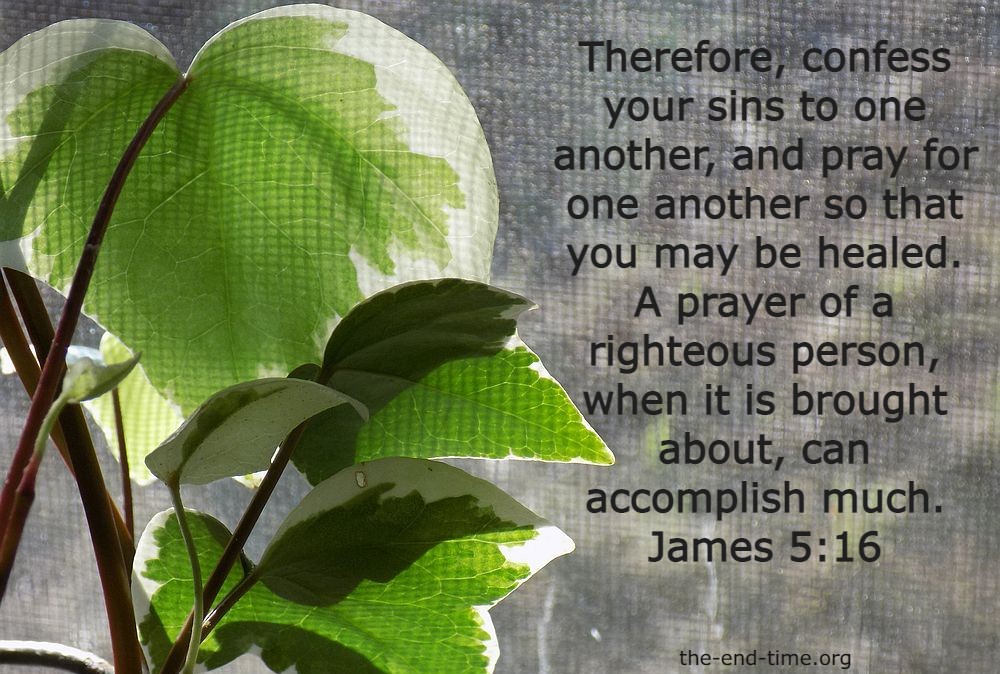
Confession is to express our agreement with God’s revelation of Himself and His assessment of us. Our confessions must be based on what God has already revealed in scripture about that sin. Don’t be general about your sin, saying , ‘O Lord, forgive my many sins…’ I’m guilty of this. I gloss over the sin and use generalities, as of it makes it less ugly to God. We’re not fooling God. He already knows about our sin. Confession is to acknowledge His sovereignty and omniscience by aligning our heart and mind with the ugliness He sees in that specific sin. So be specific in showing your hatred for that sin as it is expressed in His word.
Biblical confessions include the negative (our own sins) and positive (who Jesus is). Biblical confessions of sin can be seen in many Psalms, and also Psalm 32:5 and Daniel 9:13-20.
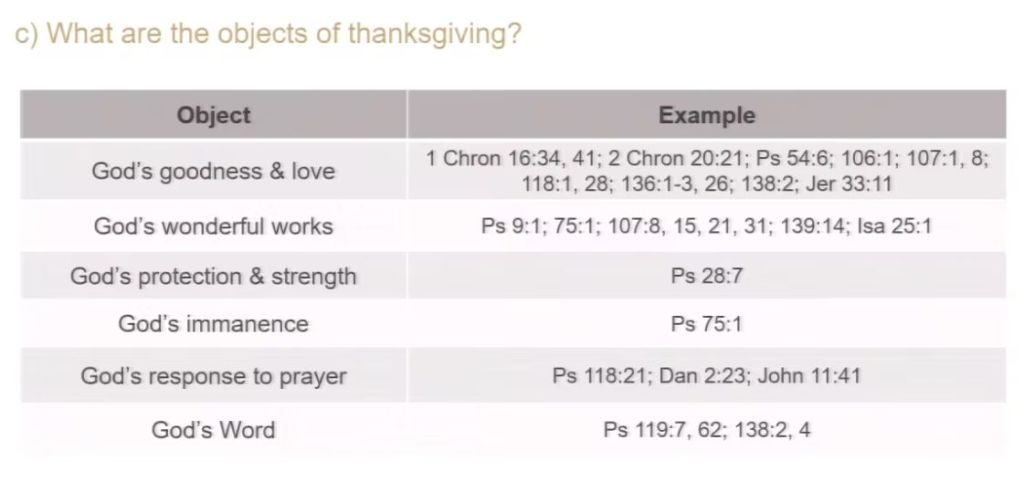
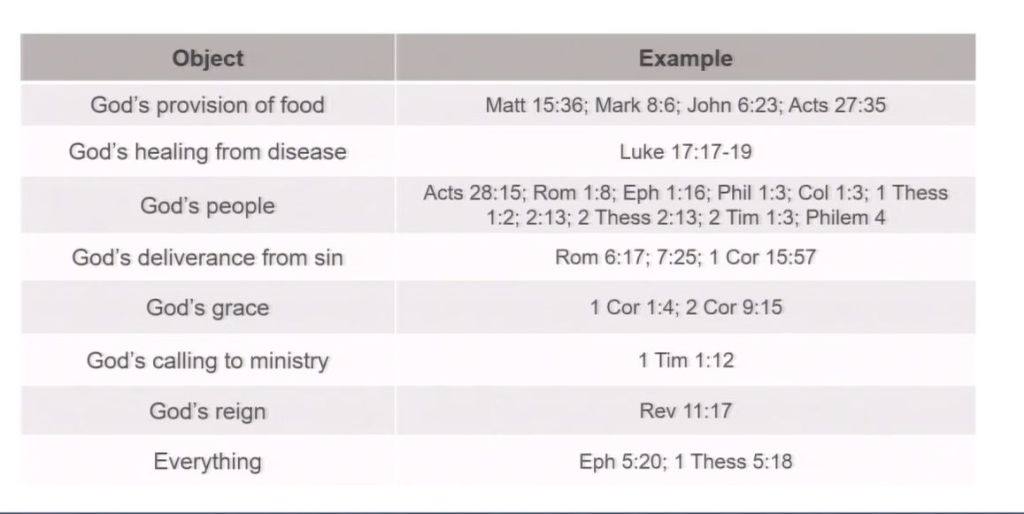
A definition of biblical thanksgiving (gratitude) is to “express our appreciation for the benefits or blessings to the one who is the source of such gifts, in a humble spirit of dependency.” ~Dr. Brad Klassen
Synonyms for thanksgiving are; appreciate, acknowledge, contentment, or ‘to bless’. Praying our gratitude to God cultivates an awareness, or an alertness, to intentionally observe the goodness of God and His undeserved mercies on us, the creatures, in our lives.
We are thankful for so MANY things! From ICL Class The Practice of Prayer
Components of Prayer ACTS: Supplication
Supplication or petition means bringing our requests for the needs of others and ourselves to God. Supplication is not only physical needs, for God knows what we need before we even ask Him. He is mindful of our physical needs (Matthew 6:25-32), though we certainly can and should ask for help with food, clothing, housing, and the like. It’s OK to bring our physical needs to Him in prayer. But don’t stop there. Ask Him to aid you in pursuing holiness, in sanctifying your walk, in being diligent in ministry, etc. As it’s said in Matthew 6:33,
But seek first His kingdom and His righteousness, and all these things will be provided to you.
I hope you have enjoyed my quick tutorial on prayer. We looked at what prayer is & isn’t, the importance of the discipline, praying God’s word back to Him, the components of prayer using the acronym ACTS, and verses of prayer we can read, meditate on, and model.
Below please find good resources on prayer that may help you further as you engage with God in prayer. I hope you do. I hope I do! Personal communion with Him is a privilege, and a duty, and a loving act to a good and gracious Father.
EM Bounds is known for his classics on prayer. Here is one that happens to be online. E.M. Bounds on Prayer
Simplify your Spiritual Life: Spiritual Disciplines for the Overwhelmed, book, Don Whitney
Valley of Vision: A Collection of Puritan Prayers, book, compiled by Arthur Bennett, Editor. Also online: here
Tim Challies’ chart in visual theology, 25 Attributes of God. You can include acknowledgement of these attributes day by day in your prayers as part of your adoration.
The Hidden Life of Prayer, David McIntyre, book available at Amazon etc., but also online for free.
The Doctrine of Repentance, Thomas Watson. A Puritan Paperback.
A Method for Prayer, Matthew Henry, online here updated in modern language, also available as a book to buy.









 the-end-time.org