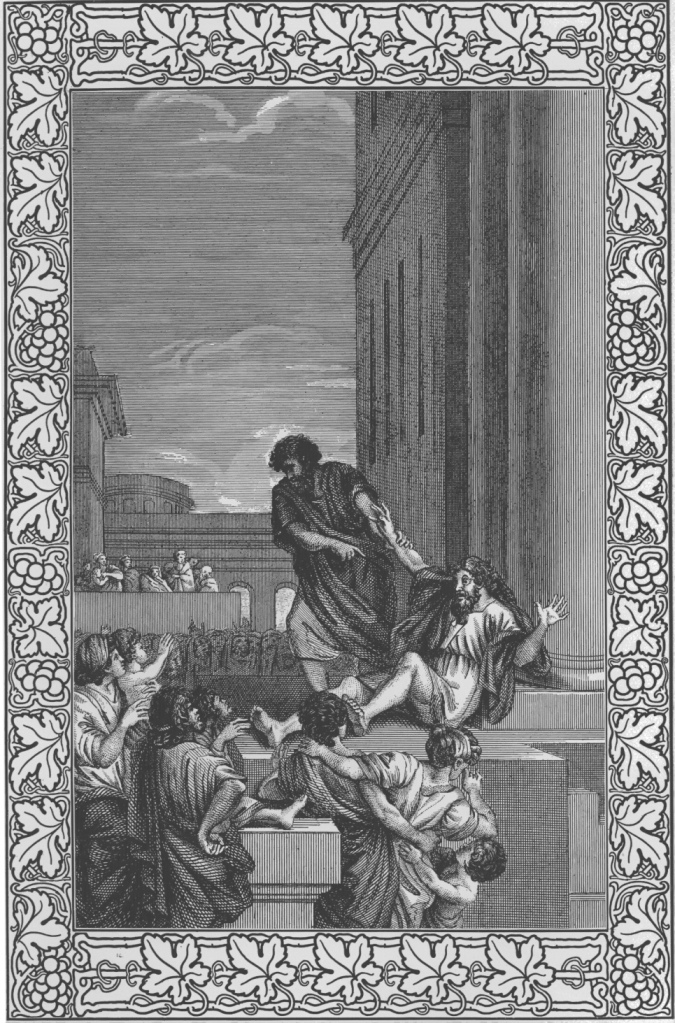
Deep was Ezra’s despair when on arriving within the walls of Jerusalem, after his desperate journey he discovered the condition of affairs existing there. G Euzet, Print taken from a book, copyright 1910
I’m looking at what the Bible says about lamenting, in three parts. Part 1 dealt with three biblical figures who allowed their grief to send them into depression, anger, and bitterness (Jacob, Mrs. Job, Naomi.)
In Part 2 I looked at the laments of 2 biblical figures, David and Job, and what they did right, according to God.
Today I will look at explaining more of what a lament is, and also the importance of music to help us when our deep grief turns to lamenting.
Yesterday I introduced the subject of lamenting. I looked at what happens when we allow grief to take over, and improperly expressed, can lead to depression, anger, or bitterness. I showed three biblical people who allowed that to happen: Jacob, Mrs. Job, and Naomi.
Today I’ll look at two biblical figures who expressed their grief in laments, properly, which even including complaining! David and Job.
“I am always on the hunt for podcast right now that talks about lament what does it look like to lament biblically? I am learning as I go through this grieving process.”
I received that message from a listener to The End Time Blog podcast. I am on various social media and as I scroll I inevitably see pain, grief, sorrow, anger, confusion, and fear. People are hurting right now. People are dealing with miscarriages, child death, parent dementia, accidents, tragedies, and dread diagnoses. The person above reached out asking about how to express grief in ways that would be honoring to God. What a great question.
We say things like “Oh no that’s lamentable” without really knowing what lament is. We see biblical characters putting ashes on their head and wearing sackcloth and think, “Gee, that’s kind of a weird way to grieve”. Sometimes we’re just embarrassed or struck silent at the outpouring of another’s grief and we stiffen up, or edge away.
How DO we express our grief? We know there is a right way to worship Him, is there a right way to lament? Is complaining acceptable, or not? Can we be angry at the things coming upon us? We are so tired of our own sin, and definitely tired of the waves of the world’s sin washing up on us. There’s nothing we can do about our own and others’ sin as long as we are in this flesh, except strive toward the prize, mourn, and strive some more. How do we keep depression, anger, or bitterness away?
It’s a big topic but I am going to tackle lamenting as best I can, in hopes that it will both honor Jesus, and help women who might be going through unimaginable pain. It will be probably 3 parts: what biblical figures did wrong in their grief, what biblical figures did right in their grief, and what lamenting is.
What not to do
God is orderly. He has a right way to do things and a wrong way. He demands worship, as well He should, but in proper, certain ways. He also expects self-control on our emotions. For example, we know we can be angry, but not sinfully angry (Ephesians 4:26). We know we can demand justice (Psalm 82:3, Isaiah 1:17) but only if our motivation is for God’s glory and not our own personal vengeance (Romans 12:19).
Since the first sin that caused the fall of humans and the entire creation to become cursed, which groans even now for redemption, sinful actions flowing out from the first action have caused grief.
Immediately after the Fall, we see all the sins begin to rear their head; lying, blame, guilt, jealousy, rebellion, and murder. Cain did not fear God. He argued with God and was irreverent with Him. “Am I my brother’s keeper?” Soon after, he killed his brother.
A scene which is not in the Bible but probably happened, was depicted in the painting called The First Mourning (Adam and Eve mourn the death of Abel); oil on canvas 1888 by William-Adolphe Bouguereau. Here it is:
When they discovered the body of their son lying lifeless on the ground, they must have mourned. They knew what death was, since God had killed an animal and given them its skins to wear for clothing. They must have killed animals in order to eat, since having been thrown out of the Garden. Abel was a keeper of sheep. Their death was graciously staved off, but their son! O, their son! Their original sin comes back to haunt them in an intimately devastating way.
We have been grieving ever since.
Grief and deep grief of lament, is laced throughout the Bible. Some of the causes for it are largely unimaginable for us westerners in this day and age. Not only in personally intimate scenes like the one with Abel’s death, but widespread. The Pharaoh who demanded the death of all the firstborn sons, what a horrible grief for all the mothers! And again in Ramah, when Herod ordered all boys under the age of two killed, known as the Massacre of the Innocents. I can’t imagine killing babies, and the wails of the mothers!
This is what the LORD says: “A voice is heard in Ramah, Lamenting and bitter weeping. Rachel is weeping for her children; She refuses to be comforted for her children, Because they are no more.” Jeremiah 31:15.
How does one deal with that kind of grief? I’ve mourned in my life. The emotion swelled up into a ball in my spirit so massive it could not emerge from my throat constricted with tears. But it must emerge. Stoic suppression of such grief ruins a mind and a heart, poisons it. Constant petty venting of such grief allows for anger and bitterness to slide in. Wallowing in it caused depression. Let’s look at three biblical people who did this.
One example of a way not to deal with grief and anger might be Naomi, who was bitter.
But she said to them, “Do not call me Naomi; call me Mara, for the Almighty has dealt very bitterly with me. I went away full, but the LORD has brought me back empty. Why do you call me Naomi, since the LORD has testified against me and the Almighty has afflicted me?” (Ruth 1:20-21).
Naomi, hardened by life, grief, and want, was not only bitter, but she blamed God in her grief. This is not the way.
Naomi could not bear the contradiction between the name she bore, and the person she was. Ten years in Moab with all its anguish, and also the loss of fellowship with God and His people had dried up her finer feelings. Once so sweet, Naomi was now sour, and blamed God for the poverty and desolation she had endured. But why chide God? Was not her cup of bitterness the result of the act of disobedience when, with her husband, she left Bethlehem for Moab? Had she stayed in her own land and maintained her trust in God, in spite of the famine, He would have undertaken for her and her family and brought them through. But the journey to Moab was a journey from God, and consequently her bitterness was the fruit of such an act of disobedience. Source- The Woman Who Tasted the Cup of Bitterness, from Lockyer’s All the Named Women of the Bible
We know the story of Job. Satan demanded to show God that prosperous Job would cave in and blame God if He removed the hedge of protection around Job and suddenly Job was not prosperous anymore. Job never caved. But Mrs. Job did.
Then his wife said to him, “Do you still hold firm your integrity? Curse God and die!” (Job 2:9). Mrs. Job had had enough. Remember, Mrs. Job had lost all her ten children, too. She was grieving. But her grief turned to anger against God and against her husband. Ladies, this should not be.
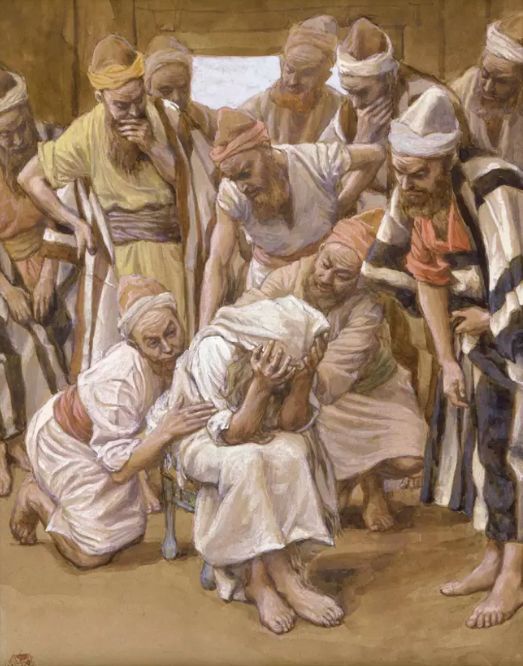
Improper grief can lead not only to anger or bitterness, but also depression. When Jacob was told that his son Joseph had ‘died’ (he was really put into a pit then sold as a slave so the death report was a lie).
So Jacob tore his clothes, and put sackcloth on his loins and mourned for his son many days. Then all his sons and all his daughters arose to comfort him, but he refused to be comforted. And he said, “Surely I will go down to Sheol in mourning for my son.” So his father wept for him. (Genesis 37:34-35).
Jacob sunk into a depression that only looked downward into Sheol (the grave) instead of up to God. He outwardly mourned in the way his customs dictated, with sackcloth and ashes. But his inner spirit was broken and he refused to be comforted. He had 11 other sons, but they did not matter to him as much as the favorite Joseph. Jacob never really recovered … until many years later the brothers returned from Egypt and told their father that Joseph was alive. THEN his spirit revived. (Genesis 45:26-27). Wrongly expressed grief can turn to depression.
All three did exactly the wrong thing: they focused on their circumstances, and for a long time too. They nursed the circumstances. They did not look to God.
Grief is perfectly fine as an emotion. Jesus was the Man of Sorrows. He wept for Lazarus. He wept for Jerusalem. But grief wrongly expressed can dishonor God, as Naomi, Jacob, and Mrs. Job did.
Grief Expressed outwardly
The Bible has plenty of scenes where people mourned a death and expressed that outwardly in their custom. Covered heads, sackcloth, torn clothes, ashes, loud cries, and weeping are main expressions of deep grief. Sometimes they refrained from washing or stripped their jeweled adornments off. They may have sat barefoot on the ground with hands on their head, as Job did and his friends with him. Sometimes hired mourners were brought in who cried and wailed. But that was then, it is not our custom now.
And what of the inward expression? How do we deal with such massive grief in a God-honoring way? How do we let it out and not let it turn to bitterness or anger or depression? The difference between grief and lamentation is that lamentation is the voice of grief, and it is a process of grieving. Grief you feel. Lamenting you do.
We will see tomorrow some biblical figures who lamented and did not dishonor God in their grief.
Our teaching elder read this portion of scripture prior to the sermon. It made me smile and my soul expand with joy. I thought I’d post it so that I could read it aloud too, in hopes that someone else may also be lifted by the glorious words promising such great hope and wonder. It’s all ahead for us, sisters. It will happen!
Kay Cude is a poet whose sensitivity to the glorious salvation of Jesus Christ is uniquely expressed through poetry and picture. Here is her latest offering, in which she explains her thought process. Enjoy
—————————–Kay Cude—————————–
If you look closely at the tower, you’ll see a tiny figure of someone, which refers to the statement, “As gazed I o’er the valley fair, to there below from tower high.”
That little figure caught my eye, as well as the city lighted up and the storm approaching from the left (approaching spiritual death). So I began to write. The city represents the safety of true salvation in Christ and understanding His Gospel.
The people represent those captured by a “different gospel” suggested as the “real” place of safety. Even though they “know” God’s truth — they are persuaded to run to false teaching and reject Christ.
Christ’s refuge is known to them and still stands in its truth, but when extreme peril approaches, they are convinced by someone’s whim (spiritual deception), to flee to eternal death and separation. Even the donkey digs in his heels against the “unknown” way,” and the dog barks at their sudden rejection.
Their end is eternal separation and eternal living death because they quickly deserted Christ’s truth for a distorted gospel.
I wrote the essay below in 2014. Eight years ago is a lifetime on the internet, and many people do not know this about Beth Moore. I publish it again now after a short conversation with a few people on Twitter brought it back to mind. I hope to show:
1. Publicly available information on the internet consistently shows Moore as an unbeliever in what she says and does,
2. Moore talks a lot and writes a lot, but is an expert at obfuscating even the largest and most obvious details about her life. You come away after reading 153 pages of this book more confused about it when you started. See section below about true Christian transparency,
3. As always, my refrain is, though 2.8 million people follow Beth Moore on Twitter, Instagram, and Facebook, don’t you be one of them. Beth Moore is a false teacher who seeks to disqualify you from the prize.
Whatever you do, do your work heartily, as for the Lord and not for people, knowing that it is from the Lord that you will receive the reward of the inheritance. It is the Lord Christ whom you serve. (Colossians 3:23-24).
Because I work in a school, my work year is only 190 days. I get paid for only 190 days, but they stretch out my pay in equal amounts over 12 months so I get a paycheck every month.
I dearly love the time off. By the end of summer I miss the kids though, so I’m glad to go back. This year it’s something different, we go back to school for preplanning (meetings and setting up rooms) on July 25th. Open House where students and parents come is July 28th, and the 29th we have the county wide meeting where the Superintendent speaks. Kids come on August 1.
People don’t refer to cardinal directions of north, south, east, west very much any more. If someone asks for directions and you tell them to go north three blocks, they look at you like you just lapsed into Hindi.
In the days before we were too reliant on GPS, people traveled by using the sun, moon, and stars. They spoke of cardinal directions.
In the Bible there is a lot of talk about the east and the west. (Of course, north and south is also spoken of but I’m concentrating on east-west today).
East is a major direction in the Bible and not just for the directions, but for the symbolism. Let’s look at a few examples.
The Garden of Eden was planted toward the east. (Genesis 2:8).
The scriptures specify the LORD placed cherubim at the eastern entrance of the Garden, to protect it and the tree of life.
After God drove out the man, He placed a cherubim with flaming sword to protect this eastern entrance. (Genesis 3:24).
When God’s glory comes/came to the Temple, it comes/came from the east:
Then he led me to the gate, the gate facing east. And behold, the glory of the God of Israel was coming from the east. And the sound of his coming was like the sound of many waters, and the earth shone with his glory. (Ezekiel 43:1-2).
The wise men followed the star which had risen in the east.
Saying, Where is he that is born King of the Jews? for we have seen his star in the east, and are come to worship him. (Matthew 2:2 KJV)
The Lord will return from the east. (Matthew 24:27): For as the lightning comes from the east and shines as far as the west, so will be the coming of the Son of Man.
The sun rises in the east and its rays shine from that direction. John 1:5 says God is Light, in Him there is no darkness at all. The west is where the sun sets, bringing darkness. The east is where the Light is.
When the sun rises, the light comes from the east. When the Son returns, His Light comes from the east.
There is much more that can be studied on even so mundane a topic as cardinal directions. The wonder of the Bible is that you can take practically any topic, any word, and explore. And do you know what you will come up with?
Jesus.
That’s why the Bible is so great. All scripture points to Jesus.
Search the scriptures; for in them ye think ye have eternal life: and they are they which testify of me. (John 5:39 KJV)
A friend was permanently suspended from Twitter recently. He is a pastor, boldly unashamed of the Gospel. So, you know what happens next…Twitter, intolerant of religious views of Christians, suspended him. I’m not sure which tweet sent Twitter over the edge, probably something about judgment and eternal death. The world isn’t fair to Christians and we don’t expect it to be.
The blood of Christ is not spoken of much. If it is, sadly, too often mystical properties are assigned to it, or it’s just misunderstood.
Admittedly the subject is a difficult one, and resources on the subject are scarce. I’ve found these following resources to be excellent:
Chapel Library is a ministry of Mount Zion Bible Church. Their “purpose is to humble the pride of man, to exalt the grace of God in salvation, and to promote real holiness in heart and life, by sending Christ-centered materials from prior centuries worldwide without charge.” They have a large library and will send you material in pamphlet form through the mail for free, or allow electronic downloads for free.
I ordered several pamphlets on the subject of the blood of Jesus.
These are the three pamphlets I got from Chapel Library:
–Spurgeon’s The Blood of the Lamb: The Conquering Weapon;
–The Blood of the Cross by Horatius Bonar (he wrote a lot about the blood many different times)
–Chapel Library’s monthly topical magazine, Free Grace Broadcaster “The Blood of Christ”.
In the Broadcaster booklet are essays about the blood from Andrew Murray, Stephen Charnock, Wm Reid, 2 from Horatius Bonar, Spurgeon, and LR Shelton.
The recent book “Blood Work: How the Blood of Christ Accomplishes Our Salvation” by Anthony J. Carter is an excellent treatment of the subject. I read it.
In Spurgeon’s The Blood of the Lamb: The Conquering Weapon, I was moved over and over by his points, moved by the way Spurgeon phrased things, and moved by the concept itself of our God who came down from Glory to die on the cross. It was originally a sermon and it can be found here. I will post several of Spurgeon’s quotes that moved me:
Near nineteen hundred years ago Jesus paid the dreadful debt of all His elect, and made a full atonement for the whole mass of the iniquities of them that shall believe in Him, thereby removing the whole tremendous load, and casting it by one lift of His pierced hand into the depths of the sea.
This makes me think of how heavy the load of sin was that Jesus atoned for, and also his mightiness and strength to be able to lift it and fling it away!
We are to preach that the Son of God has come in the flesh and died for human sin, and that in dying he did not only make it possible for God to forgive, but he secured forgiveness for all who are in Him. He did not die to make men savable, but to save them.
Here, Spurgeon reaffirms that Jesus’ atonement is effectual, not potential. IT IS FINISHED Jesus cried, and indeed it is!
[T]hese saints used the doctrine of atonement not as a pillow to rest their weariness, but as a weapon to subdue their sin.
Spurgeon is speaking of how, after salvation, while the saints do rest from their war against God, but now go to war against their sin.
The foul fiend tells out the wanderings of our hearts, the deadness of our desires in prayer, the filthy thoughts that dropped into our minds when we have been at worship. Alas! we have to confess that we have even tolerated doubts as to eternal verities, and suspicions of the love and faithfulness of God. When the accuser is about his evil business, he does not have to look far for matter of accusation, nor for facts to support it. Do these accusations stagger you? Do you cry, “My God, how can I face thee? for all this is true, and the iniquities now brought to my remembrance are such as I cannot deny. I have violated thy law in a thousand ways, and I cannot justify myself.” Now is your opportunity for overcoming through the blood of the Lamb. When the accuser has said his say, and aggravated all your transgressions, be not ashamed to step forward and say, “But I have an advocate as well as an accuser. O Jesus, my Saviour, speak for me!” When he speaks, what does he plead but his own blood? “For all these sins I have made atonement,” says he, “all these iniquities were laid on me in the day of the Lord’s anger, and I have taken them away.”
That was a longer quote, but I could not help it! The language: ‘foul fiend’! The accuracy: deadness of desires in prayer! Ouch! The crumbling and quivering of the Christian soul who approaches His majesty on the throne, ‘How can I face thee?’ The comfort of knowing He says He has done it, made atonement! O!
Come, brother or sister, the next time thou hast to do with Satan as an accuser in the heavenly places, take care that thou defend thyself with no weapon but the atonement. All comfort drawn from inward feelings or outward works will fall short; but the bleeding wounds of Jesus will plead with full and overwhelming argument, and answer all. “Who shall lay anything to the charge of God’s elect? It is God that justifieth. Who is he that condemneth?
Satan the accuser has a voice, but no trustworthiness. Satan the adversary opposes, but is already defeated. Satan the evildoer has schemes, but no power against the blood of the Lamb!