I wrote the essay below in 2014. Eight years ago is a lifetime on the internet, and many people do not know this about Beth Moore. I publish it again now after a short conversation with a few people on Twitter brought it back to mind. I hope to show:
1. Publicly available information on the internet consistently shows Moore as an unbeliever in what she says and does,
2. Moore talks a lot and writes a lot, but is an expert at obfuscating even the largest and most obvious details about her life. You come away after reading 153 pages of this book more confused about it when you started. See section below about true Christian transparency,
3. As always, my refrain is, though 2.8 million people follow Beth Moore on Twitter, Instagram, and Facebook, don’t you be one of them. Beth Moore is a false teacher who seeks to disqualify you from the prize.
Whatever you do, do your work heartily, as for the Lord and not for people, knowing that it is from the Lord that you will receive the reward of the inheritance. It is the Lord Christ whom you serve. (Colossians 3:23-24).
Because I work in a school, my work year is only 190 days. I get paid for only 190 days, but they stretch out my pay in equal amounts over 12 months so I get a paycheck every month.
I dearly love the time off. By the end of summer I miss the kids though, so I’m glad to go back. This year it’s something different, we go back to school for preplanning (meetings and setting up rooms) on July 25th. Open House where students and parents come is July 28th, and the 29th we have the county wide meeting where the Superintendent speaks. Kids come on August 1.
People don’t refer to cardinal directions of north, south, east, west very much any more. If someone asks for directions and you tell them to go north three blocks, they look at you like you just lapsed into Hindi.
In the days before we were too reliant on GPS, people traveled by using the sun, moon, and stars. They spoke of cardinal directions.
In the Bible there is a lot of talk about the east and the west. (Of course, north and south is also spoken of but I’m concentrating on east-west today).
East is a major direction in the Bible and not just for the directions, but for the symbolism. Let’s look at a few examples.
The Garden of Eden was planted toward the east. (Genesis 2:8).
The scriptures specify the LORD placed cherubim at the eastern entrance of the Garden, to protect it and the tree of life.
After God drove out the man, He placed a cherubim with flaming sword to protect this eastern entrance. (Genesis 3:24).
When God’s glory comes/came to the Temple, it comes/came from the east:
Then he led me to the gate, the gate facing east. And behold, the glory of the God of Israel was coming from the east. And the sound of his coming was like the sound of many waters, and the earth shone with his glory. (Ezekiel 43:1-2).
The wise men followed the star which had risen in the east.
Saying, Where is he that is born King of the Jews? for we have seen his star in the east, and are come to worship him. (Matthew 2:2 KJV)
The Lord will return from the east. (Matthew 24:27): For as the lightning comes from the east and shines as far as the west, so will be the coming of the Son of Man.
The sun rises in the east and its rays shine from that direction. John 1:5 says God is Light, in Him there is no darkness at all. The west is where the sun sets, bringing darkness. The east is where the Light is.
When the sun rises, the light comes from the east. When the Son returns, His Light comes from the east.
There is much more that can be studied on even so mundane a topic as cardinal directions. The wonder of the Bible is that you can take practically any topic, any word, and explore. And do you know what you will come up with?
Jesus.
That’s why the Bible is so great. All scripture points to Jesus.
Search the scriptures; for in them ye think ye have eternal life: and they are they which testify of me. (John 5:39 KJV)
A friend was permanently suspended from Twitter recently. He is a pastor, boldly unashamed of the Gospel. So, you know what happens next…Twitter, intolerant of religious views of Christians, suspended him. I’m not sure which tweet sent Twitter over the edge, probably something about judgment and eternal death. The world isn’t fair to Christians and we don’t expect it to be.
The blood of Christ is not spoken of much. If it is, sadly, too often mystical properties are assigned to it, or it’s just misunderstood.
Admittedly the subject is a difficult one, and resources on the subject are scarce. I’ve found these following resources to be excellent:
Chapel Library is a ministry of Mount Zion Bible Church. Their “purpose is to humble the pride of man, to exalt the grace of God in salvation, and to promote real holiness in heart and life, by sending Christ-centered materials from prior centuries worldwide without charge.” They have a large library and will send you material in pamphlet form through the mail for free, or allow electronic downloads for free.
I ordered several pamphlets on the subject of the blood of Jesus.
These are the three pamphlets I got from Chapel Library:
–Spurgeon’s The Blood of the Lamb: The Conquering Weapon;
–The Blood of the Cross by Horatius Bonar (he wrote a lot about the blood many different times)
–Chapel Library’s monthly topical magazine, Free Grace Broadcaster “The Blood of Christ”.
In the Broadcaster booklet are essays about the blood from Andrew Murray, Stephen Charnock, Wm Reid, 2 from Horatius Bonar, Spurgeon, and LR Shelton.
The recent book “Blood Work: How the Blood of Christ Accomplishes Our Salvation” by Anthony J. Carter is an excellent treatment of the subject. I read it.
In Spurgeon’s The Blood of the Lamb: The Conquering Weapon, I was moved over and over by his points, moved by the way Spurgeon phrased things, and moved by the concept itself of our God who came down from Glory to die on the cross. It was originally a sermon and it can be found here. I will post several of Spurgeon’s quotes that moved me:
Near nineteen hundred years ago Jesus paid the dreadful debt of all His elect, and made a full atonement for the whole mass of the iniquities of them that shall believe in Him, thereby removing the whole tremendous load, and casting it by one lift of His pierced hand into the depths of the sea.
This makes me think of how heavy the load of sin was that Jesus atoned for, and also his mightiness and strength to be able to lift it and fling it away!
We are to preach that the Son of God has come in the flesh and died for human sin, and that in dying he did not only make it possible for God to forgive, but he secured forgiveness for all who are in Him. He did not die to make men savable, but to save them.
Here, Spurgeon reaffirms that Jesus’ atonement is effectual, not potential. IT IS FINISHED Jesus cried, and indeed it is!
[T]hese saints used the doctrine of atonement not as a pillow to rest their weariness, but as a weapon to subdue their sin.
Spurgeon is speaking of how, after salvation, while the saints do rest from their war against God, but now go to war against their sin.
The foul fiend tells out the wanderings of our hearts, the deadness of our desires in prayer, the filthy thoughts that dropped into our minds when we have been at worship. Alas! we have to confess that we have even tolerated doubts as to eternal verities, and suspicions of the love and faithfulness of God. When the accuser is about his evil business, he does not have to look far for matter of accusation, nor for facts to support it. Do these accusations stagger you? Do you cry, “My God, how can I face thee? for all this is true, and the iniquities now brought to my remembrance are such as I cannot deny. I have violated thy law in a thousand ways, and I cannot justify myself.” Now is your opportunity for overcoming through the blood of the Lamb. When the accuser has said his say, and aggravated all your transgressions, be not ashamed to step forward and say, “But I have an advocate as well as an accuser. O Jesus, my Saviour, speak for me!” When he speaks, what does he plead but his own blood? “For all these sins I have made atonement,” says he, “all these iniquities were laid on me in the day of the Lord’s anger, and I have taken them away.”
That was a longer quote, but I could not help it! The language: ‘foul fiend’! The accuracy: deadness of desires in prayer! Ouch! The crumbling and quivering of the Christian soul who approaches His majesty on the throne, ‘How can I face thee?’ The comfort of knowing He says He has done it, made atonement! O!
Come, brother or sister, the next time thou hast to do with Satan as an accuser in the heavenly places, take care that thou defend thyself with no weapon but the atonement. All comfort drawn from inward feelings or outward works will fall short; but the bleeding wounds of Jesus will plead with full and overwhelming argument, and answer all. “Who shall lay anything to the charge of God’s elect? It is God that justifieth. Who is he that condemneth?
Satan the accuser has a voice, but no trustworthiness. Satan the adversary opposes, but is already defeated. Satan the evildoer has schemes, but no power against the blood of the Lamb!
I know how it goes. You decide to gird your loins, face the family at the next gathering, and speak of Jesus. You’ll gently and lovingly point out some of those idols they have around the house (whatever type they may be). You decided that this time you’ll speak of sin and repentance. You maybe decide to do it at the 4th of July picnic, or the summer family reunion, or on vacation with the extended fam, or the Labor Day blast…whatever it is, you decide that THIS is the time to forthrightly speak against their beloved worldview and evangelize them.
But then you chicken out.
And you berate yourself, kick yourself, and generally feel crummy, calling yourself a wimp.
It’s OK.
Let’s look at the example of King Asa of Judah. There was still idol worship going on during the first part of his reign. There were male shrine prostitutes, Asherah poles, all sorts of evil being done in God’s sight. Azariah was a prophet in those days, spoken of actually only once, in 2 Chronicles 15 (2 Chron. 15:1). Azariah reassured Asa that God would be with Asa if Asa did right, and against him if Asa did wrong. The Prophet encouraged Asa to seek the Lord, and this gave Asa the impetus to face down the idol worshiping going on.
Now when Asa heard these words and the prophecy which Azariah the son of Oded the prophet spoke, he took courage and removed the abominable idols from all the land of Judah and Benjamin, and from the cities which he had captured in the hill country of Ephraim. He then restored the altar of the LORD which was in front of the porch of the LORD. (2 Chronicles 15:8).
His people and even his own mother worshiped idols! This is a sketchy situation for anyone to face. That Asa was king made no difference. Personal reassurance from a prophet was the catalyst for Asa, and even then, he had to “take courage.”
It’s HARD to face down the world. It’s harder when it’s your own family. But Asa did it because God is greater. God is worthy. He deposed his own mother as Queen. He commanded the People to worship God alone. He led by his own worship example.
Asa still didn’t remove ALL the high places of worship…but his heart was committed to God all his life.
If you haven’t ‘taken courage’ yet or you’re sad that you missed an evangelizing opportunity, all is not lost. I know I say this all the time, but it is a real solution all the time: PRAY.
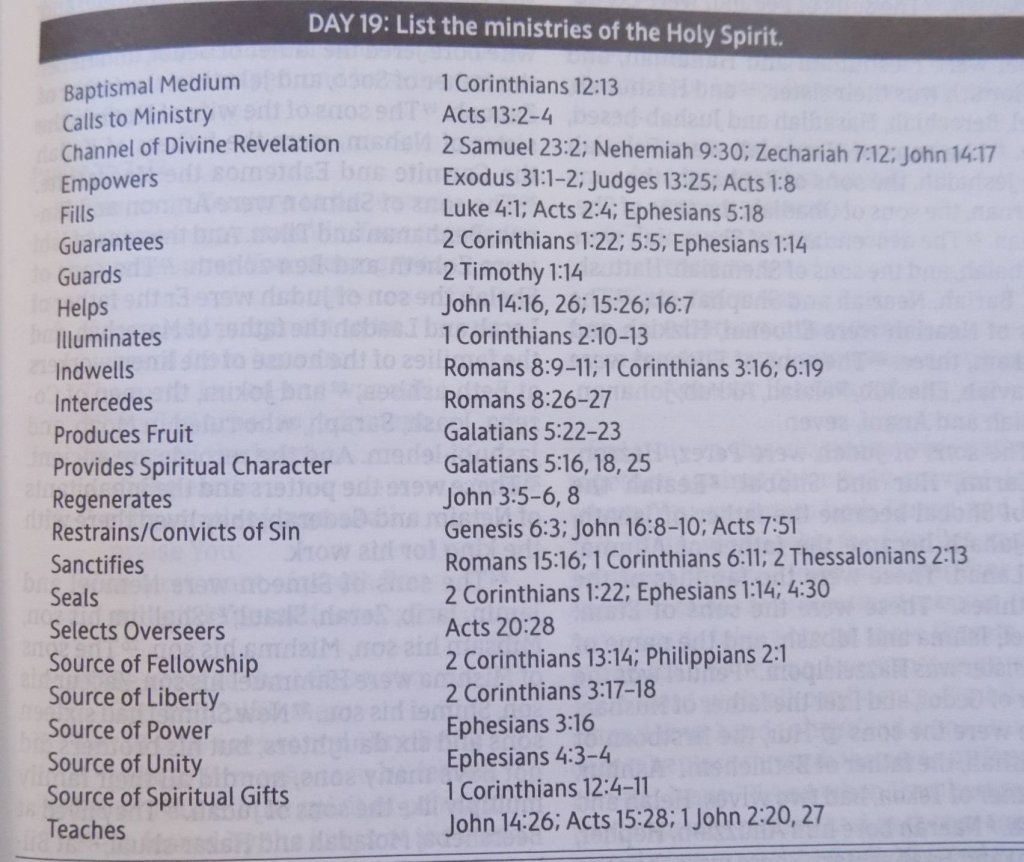
It is the Spirit who draws all men to Jesus. It is the Spirit who gives us courage. It is the Spirit who brings the verses to mind. It is the Spirit who delights in pointing people to Jesus. Look at all His ministries, just look at them!
The Ministries of the Holy Spirit. List from John MacArthur Daily Bible, June 19
So, dear sister, prepare ahead. First, pray at the start of the day for the Spirit to send you opportunities. Pray in advance of a specific opportunity you know will be coming. Pray for the words to say the time to be right (a moment alone with her apart from the hubbub, a calm conversation…), pray for the courage it takes. It’s hardest with family and close friends, I know. I got a chuckle out of King Asa deposing his mother as Queen because she was attached to the Asherah worship. THAT must have made for some awkward Sunday dinners!
Also, prepare with a few verses, or a mildly rehearsed opening. You can watch Todd Friel (short video on evangelizing parents here, start at 3:22) or Ray Comfort (how to evangelize friends and family- video here) or read an an essay here, to see how they do it.
Mainly, remember it is the Holy Spirit’s job to draw men, no matter if you stumble, or just leave a tract, or if they get angry…it is up to the Spirit to take God’s word and translate it to their heart and mind. It’s not all up to you. So take the pressure off yourself and just do your best. God knows.
For this is what the Lord has commanded us: “I have made you a light for the Gentiles, that you may bring salvation to the ends of the earth.” Acts 13:47
Ray Comfort – interview with Doreen Virtue: How to Evangelize Friends and Family “Why is it so uncomfortable to witness to our loved ones? Ray Comfort teaches us how to share the Gospel with our friends and family. It can be intimidating to discuss Jesus with unbelievers; however, we want to do everything we can to make sure that our loved ones have heard the good news of the Gospel. Sharing the Gospel is an act of love and courage, because we care about the eternal destiny of our friends and family.”
The following is a newsletter sent by Pastor James Bell of Southside Church in Gallatin TN. Pastor Bell is a wise Christian with almost 5 decades of local pastoring experience in one church, a soldier of God laboring for His name you don’t hear about but are stationed in his spot in the global body, persevering every day for the saints in love and grace.
Sadly the fall of pastors and teachers into reproachable public sin is not news these days. Since the earthly visible church of Christ is composed of unforgiven sinners and of forgiven sinners (wheat and tares mixed), sin is going to happen. It is especially lamentable when a public Christian person or a publicly known pastor falls. In the case of JD Hall, he was both publicly known Christian online and a pastor of a local flock.
Let’s start by being very clear with the basis: Women are not biblically qualified to preach or teach in authority over men in church. This means women are unqualified to be ordained or as layperson to serve in church as bishops, deacons, pastors (senior pastor, youth pastor, lead pastor, worship pastor, whatever you want to call the office), elders, and so on. Please read through this first part first. It’s the foundation.
But I do not allow a woman to teach or to exercise authority over a man, but to remain quiet. (1 Timothy 2:12).
Women are to be silent in the churches. They are not permitted to speak, but must be in submission, as the law says. (1 Corinthians 14:34). In 1 Corinthians 14:35 we learn that it is improper for a woman to preach. The word ‘improper’ in the Greek means shameful, disgraceful. (Source)
This standard of men-only preaching does not exist because God thinks the lesser of women. It’s not because of misogyny. It’s not because the Bible is old and we’ve ‘evolved’ in gender roles by now. God is the same, there is no shadow of turning in Him and He has always held to the same standards. (James 1:17).






 the-end-time.org