
Right-Click to see larger in new tab.
The Lord of the universe gives us peace, HIS peace. No longer at enmity with Him, we possess peace in our heart and fear is dispelled.
Poetry by Kay Cude. Used with permission.

Right-Click to see larger in new tab.
The Lord of the universe gives us peace, HIS peace. No longer at enmity with Him, we possess peace in our heart and fear is dispelled.
Poetry by Kay Cude. Used with permission.

By Elizabeth Prata
Paul wrote in Romans 8,
However, you are not in the flesh but in the Spirit, if indeed the Spirit of God dwells in you. But if anyone does not have the Spirit of Christ, he does not belong to Him. If Christ is in you, though the body is dead because of sin, yet the spirit is alive because of righteousness. But if the Spirit of Him who raised Jesus from the dead dwells in you, He who raised Christ Jesus from the dead will also give life to your mortal bodies through His Spirit who dwells in you. (Romans 8:9-11).
The little words in the Bible matter. Paul often says, “therefore” which, when we encounter such a word, my Bible teacher says we should mentally say to ourselves ‘what’s it there for?’ The word ‘however’ at the start of the excerpt means Paul has been explaining something and is now contrasting the previous something with what is coming next. My focus today, though, is on the word “if” that Paul uses here.
What a weighty thought; “IF” the Spirit dwells in us or IF the Spirit does not dwell in us.
We should not be constantly engaging in introspection, mulling over our past life prior to salvation, or pondering our sins to a gross extent, or constantly wailing ‘woe is meee, I’m such a vile sinner’… but a bit of introspection is often warranted. Paul said in 2 Corinthians 13:5, that we should examine ourselves to see if we pass the test. In 1 Corinthians 11:28 we must examine ourselves before we take the cup of remembrance and the bread at the Lord’s table.
John MacArthur said, “Churches are full of spiritual cripples, paralyzed by the grudges, bitterness, sins, and tragedies of the past. Others try to survive in the present by reliving past successes. They must break with that past if they are to pursue the spiritual prize.” Source, MacArthur, J. F. The MacArthur New Testament Commentary: Philippians.
Here, Paul makes a flat statement, ‘If the Spirit is in you, then…’ The word ‘if’ warrants a quick look-see in this case. What does it mean IF the Spirit is in us? It means then we are changed and changing. We know the Spirit is in us because when we examine ourselves, we discover that our affections have changed. We now hate sin. We enjoy the word of God. We bring glory to Jesus, not ourselves. No one in the flesh will do those things. The flesh is only ever selfish.
Genesis 6:5 says, “Then the LORD saw that the wickedness of mankind was great on the earth, and that every intent of the thoughts of their hearts was only evil continually.” That verse is not meant only for people living in the pre-flood times (antediluvian) but it applies to all living and dead humans who are not in the Spirit.
Gill’s Exposition of the Entire Bible says of the Romans 8:9-11 verse-
“But ye are not in the flesh, but in the Spirit,…. That is, ye are not carnal, but spiritual men; or ye are not in a state of unregeneracy, but in a state of grace: the reason proving this is, if so be, or “seeing”
“that the Spirit of God dwell in you; the inhabitation of the Spirit is a distinguishing character of a regenerate man; which is to be understood not of his omnipresence, nor of a participation of his gifts, whether ordinary or extraordinary: nor does the Spirit of God only dwell in his people by his graces, but in person as in office, and in a way of special favour; as a spirit of illumination, regeneration, sanctification, and faith, as a comforter, a spirit of adoption, an intercessor, and as a pledge and seal of happiness:”
“which inhabitation is personal; is not peculiar to him to the exclusion of the Father and of the Son; is expressive of property and dominion; is not confined to the souls of men, for he also dwells in their bodies; it is operative, powerful, and perpetual; it is the security of the saints’ perseverance, and the pledge of their resurrection and future glory.”
“This is owing not to any goodness in them, or to any fitness and preparations of theirs to receive him; but to a federal union to Christ and relation to him, to our Lord’s ascension and intercession, and to the love and grace of the Father; and this proves a man to be a regenerate man, to be in the Spirit, and not in the flesh; for the Spirit of God is never in this sense in an unregenerate man, nor is he in any such sense without his grace; so that the indwelling of the Spirit is the grand evidence of relation to God, of an interest in Christ and union to him, and of a man’s state and condition God-ward;” –end Gill’s
If you have been saved by grace for any length of time, and you look back, do you notice changes in yourself? Do you feel pricked by sin more? Is your conscience softer? Do you understand the Bible better? Are you releasing attachment to sins you used to enjoy, finding you enjoy them less or have abandoned them altogether? This is the Spirit at work in you. In that case the Spirit IS in you! Rejoice for the Lord is gracious and powerful to save sinners!
The End Time Blog Podcast Season 2, Episode 275
By Elizabeth Prata
Sometimes I read in the news, or see in a novel, a particularly tragic event that happens in a war. I am thinking particularly of WWI, where a famous armistice was the prelude to the final peace treaty. An armistice is a cessation of hostilities as a prelude to peace negotiations. The armistice in WWI was signed on the 11th hour on the 11th day of the 11th month. The commemoration of WW1 Armistice Day is now known to Americans as Veterans Day. It is different from a truce and it is not a treaty, but it is effectively the beginning stages of the end of the war. Did you know that though the 11-11-11th 1918, is held to be the official end of the First World War, final peace with Germany was not ratified until 1919, and peace was not finally ratified on all other fronts until January 1920?
Anyway, the when the news of Armistice got around, soldiers started to relax because they knew they were going home soon. The war is almost over. Almost.
It is such a tragedy when a soldier dies after the armistice is signed. In France, 3,500 casualties occurred between the armistice signing and the official end of hostilities.
Here is an article about the aftermath of those deaths. It is a good article that explains the thinking of the commanders and generals and what happened to cause so many to die when the end was so near. Were those soldiers’ lives wasted?
Wasted Lives on Armistice Day
“On November 11, 1918, Armistice Day, the American Expeditionary Forces (AEF) on the Western Front in France suffered more than thirty-five hundred casualties, although it had been known unofficially for two days that the fighting would end that day and known with absolute certainty as of 5 o’clock that morning that it would end at 11 a.m.”

General John J. Pershing, in a Congressional hearing a year after the armistice period, said, “When the subject of the armistice was under discussion we did not know what the purpose of it was definitely, whether it was something proposed by the German High Command to gain time or whether they were sincere in their desire to have an armistice; and the mere discussion of an armistice would not be sufficient grounds for any judicious commander to relax his military activities….”

You see, although the soldiers and commanders knew that the end was near, they were not sure what the enemy was going to do, whether it was a feint or not. They remained vigilant because they knew that the enemy was likely still out to kill and destroy.
Besides, the thinking went, the word had not gotten to all the soldiers that the end was near. They could not relax because some of their compatriots were not relaxing their guard. They were all in this together, one unit, even though strewn on different battlefields. The article continues with Pershing’s testimony:
“No one could possibly know when the armistice was to be signed, or what hour be fixed for the cessation of hostilities, so that the only thing for us to do, and which I did as commander in chief of the American forces, and which Marshal Foch did as commander in chief of the Allied armies was to continue the military activities.”
 |
| My grandfather, serving in WW1, British Army, Royal Leicestershire Regiment |
It makes sense, doesn’t it, if the soldiers didn’t know the day or hour, then they were duty bound to continue the good fight.
“Marshal Ferdinand Foch, commander in chief of Allied forces in France, issued on November 9, to keep up the pressure against the retreating enemy until the cease-fire went into effect. …Foch had described to his staff his intention ‘to pursue the Feldgrauen [field grays, or German soldiers] with a sword at their backs’ to the last minute until an armistice went into effect.”
Keeping up the pressure on the enemy, pouring ourselves out as a drink offering… As Paul said in the Bible, “However, I consider my life worth nothing to me, if only I may finish the race and complete the task the Lord Jesus has given me–the task of testifying to the gospel of God’s grace.” (Acts 20:24).
Pershing continued, on the notion that the very idea of an armistice was repugnant, because the enemy was still fighting. The enemy was still the enemy, after all:
‘Their request is an acknowledgment of weakness and clearly means that the Allies are winning the war,’ he maintained. ‘Germany’s desire is only to regain time to restore order among her forces, but she must be given no opportunity to recuperate and we must strike harder than ever.’ As for terms, Pershing had one response: ‘There can be no conclusion to this war until Germany is brought to her knees.’ “
Pershing is right to say that the war is not over until every knee bows and all acknowledge the victor.
“that at the name of Jesus every knee should bow, in heaven and on earth and under the earth,”(Philippians 2:10.)
“Pershing saw his army akin to a fighter ready to deliver the knockout punch who is told to quit with his opponent reeling but still standing. Conciliation now, he claimed, would lead only to future war. He wanted Germany’s unconditional surrender.”
That’s right. Unless the job is done thoroughly, the enemy comes back stronger than before.
“When the unclean spirit has gone out of a person, it passes through waterless places seeking rest, but finds none. Then it says, ‘I will return to my house from which I came.’ And when it comes, it finds the house empty, swept, and put in order. Then it goes and brings with it seven other spirits more evil than itself, and they enter and dwell there, and the last state of that person is worse than the first. So also will it be with this evil generation.” (Mt 12:43-45).
I hope by now you have caught the metaphor. Though we old Christian soldiers can see the signs that the end of our war in the spiritual realms may be near, we cannot relax. “And let us not be weary in well-doing: for in due season we shall reap, if we faint not.” (Galatians 6:9)
It feels so close, doesn’t it! But the enemy is still on the field and actively engaged. We won’t go home until the Commander in Chief calls for us, and until then, we continue to fight the good fight with all due vigor and attention. Until we hear the Trump of God, carry on, soldiers! (1 Thess 4:6).
By Elizabeth Prata
The Shepherds’ Conference at Grace Community Church, hosted by John MacArthur and GCC member/volunteers, is one of the largest and best conferences of any of them in the world. It caters to weary pastors and elders who shepherd a flock. Every year there is a different theme chosen, upon which the sermons are based. The theme for the next Shepherds’ Conference at Grace Community Church is “Shepherding the Remnant”.
I found this to be exactly right. It’s a telling statement that solid pastors who pastor solid churches are filled with a remnant of Christians, not an abundance. It is obvious that the Christianity Jesus expects and the beliefs and actions His people are to hold, are exhibited by only a few. These days, when you see a steeple, it more often means that goats are swirling around within it, not sheep. Sheep are an endangered species these days.
I’ve been in battles. Each time, it seemed that the battle was overwhelmingly stacked in the favor of the other side, with tremendous pressure exerted against me and seeming to be immovable on their behalf.
“When the servant of the man of God rose early in the morning and went out, behold, an army with horses and chariots was all around the city. And the servant said, “Alas, my master! What shall we do?” (2 Kings 6:15)
Each time when it seemed that I was trying to push through a Hoover Dam with my pinkies, the whole thing broke suddenly and collapsed. If I had been pushing the Hoover Dam, I’d have fallen over with the suddenness of the vacuum created by the collapse of the dark principalities and their dispersal from sudden shining light. This is because you are not alone and there are ALWAYS unseen holy angels with you, fighting.
I have seen, over and over, that just when it seems that you’re about to be defeated, it means good. That’s why when something unexpected happens it is a sure signal that things are happening big time in the heavenlies. Always, it is darkest before the dawn.
That phrase, by the way, comes from The English theologian and historian Thomas Fuller in 1650, who visited the Holy Lands and wrote a descriptive geography in a book called, “A Pisgah-Sight Of Palestine And The Confines Thereof,” saying, “It is always darkest just before the Day dawneth.”
My only advice to you is, keep doing what you are doing. Put on your armor, pray, and stand. Jesus’ church will NEVER be overcome He will never forsake it! True believers in the global church are triumphant, loved, and nurtured through all circumstances, no matter how seemingly dark to us. Waves will come and try to wash us away, but Jesus will not let us be removed from His hand.
Wikipedia explains the famous photo below:

“One of those infamous storms on the Iroise Sea happened on 21 December 1989. A front of low pressure coming from Ireland brought gale force winds and huge waves of 20 to 30 metres high which crashed spectacularly against the lighthouse.”
“The waves smashed through the lower windows of the lighthouse, ripped the front door, flooded the tower and washed away the furniture. Lighthouse keeper Théodore Malgorn decided to take refuge up in the lantern room while waiting to be rescued.”
The waves smashed through the lower windows of the lighthouse, ripped the front door, flooded the tower and washed away the furniture. Lighthouse keeper Théodore Malgorn decided to take refuge up in the lantern room while waiting to be rescued.”
“About the same time, photographer Jean Guichard was in Lorient hiring a helicopter to take aerial pictures of the storm. Guichard wanted to fly over the Iroise Sea despite extremely dangerous flying conditions.”

“The helicopter made it to La Jument and hovered around for Guichard to take shots of the waves pounding the lighthouse. Inside the tower, Théodore Malgorn heard what he thought was his rescue helicopter and hurried downstairs to open the door.”
“At that very moment, a giant wave rose over the rear of the lighthouse and Guichard took his world-famous shot as the wave smashed against the tower. Théodore Malgorn, suddenly realising that a giant wave was about to engulf the structure, rushed back inside just in time to save his life.”
“You may be engulfed by angry waves, a few of them may make the furniture swirl around and buffet you, but you are standing in the secure structure of the Lighthouse, eternal glory light of Jesus. He has you. Note the tiny figure of the keeper standing in the door, a secure soul in the grip of a killer wave. All you need do is stand.
Photo credit: Jean Guichard
The End Time Blog Podcast Season 2, Episode 274
By Elizabeth Prata
We’re all intensely curious about the ‘other side’ aren’t we? I think it’s natural for people to wonder about the realms we cannot see. The fact that we do wonder is testament to the fact that we believe those realms exist. But the occult is forbidden, and there is a very good reason why.
Some examples of occultism are: astrology, witchcraft (Wicca), the black arts, ghost hunting, aura readings, fortune telling, magic (all kinds), Ouija boards, Tarot cards, mediums/spiritism, parapsychology, and Satanism, for a few.
Before I was saved by Jesus’s grace, I used a Ouija board, went to a Tarot Reading, had my palm read, and had my Aura photographed. I was looking for answers to those secrets I knew were beyond my grasp. But to be honest, each time I felt a little silly. I didn’t think that looking at my own palm’s flesh was going to reveal the secrets of the other side. For that, I needed to look beyond myself. Besides, how could I trust any information I got? What was the source of it? I remained uneasy.

When I was born again, the messages from the other side became clear, because Jesus sends Holy Spirit to guide us into truth. The scales fell from my eyes, and questions about the other side were answered- in the Bible. Jesus is the only reliable source!
Any information we get from the other side that’s not from God’s Word is occult and is outside His bounds. Therefore it’s bad for us.
The Bible condemns such activity in the strongest possible terms. Verses in both New and Old Testament call divination an abomination. Exposing children (or yourself) to realms that God condemned, because He knows to partake of them invites hell into your house.
If you’re not a Christian and you’re reading this, don’t dismiss it. Divination is not a “harmless” activity. As a parent, if your daughter came home with Tarot cards and books on palm reading, do you say, “Goodie! I hope she makes a career out of it!”? Do you say, “What a relief, this is such a wholesome activity!” You don’t say those things, because in your heart you know that the uneasiness you feel is there for a reason. Kids who get sucked up into occult activity rarely come out the other side without experiencing a downward spiral first.
Though it is disheartening to me to be on a battlefield that has satanic ammunition constantly lobbed from any direction, at any time, I praise the Lord He gave us His Word, His armor, His Son, and His victory so that we can go forth in confidence and joy in doing His work.
The answer to what is on the other side is Jesus. If there are Christian participants and leaders who are involved in occult activity: Stop. Repent and ask Him to forgive you. He will. Non-Christian participants and teachers who are involved in occult activity: If you ask Him to forgive you of all your sins, He will do that too. You won’t need to read lines on your palm anymore, because you’ll have an eternity to discover the secrets of the other side that Jesus is waiting to share.
Does the bible take a position on clairvoyance and parapsychology?
What kinds of things can open you up to demonic oppression?
Is there demonic activity in the world today?
What does the bible say about palm reading
The End Time Blog Podcast Season 2, Episode 273
By Elizabeth Prata
Great news! Gather ’round, dweebs, nerds, and geeks! The Math3ma Institute is live!
The Math3ma Institute is a research institute based at The Master’s University, “esteeming the voice of Christ in STEM through research, exposition, and dialogue”.
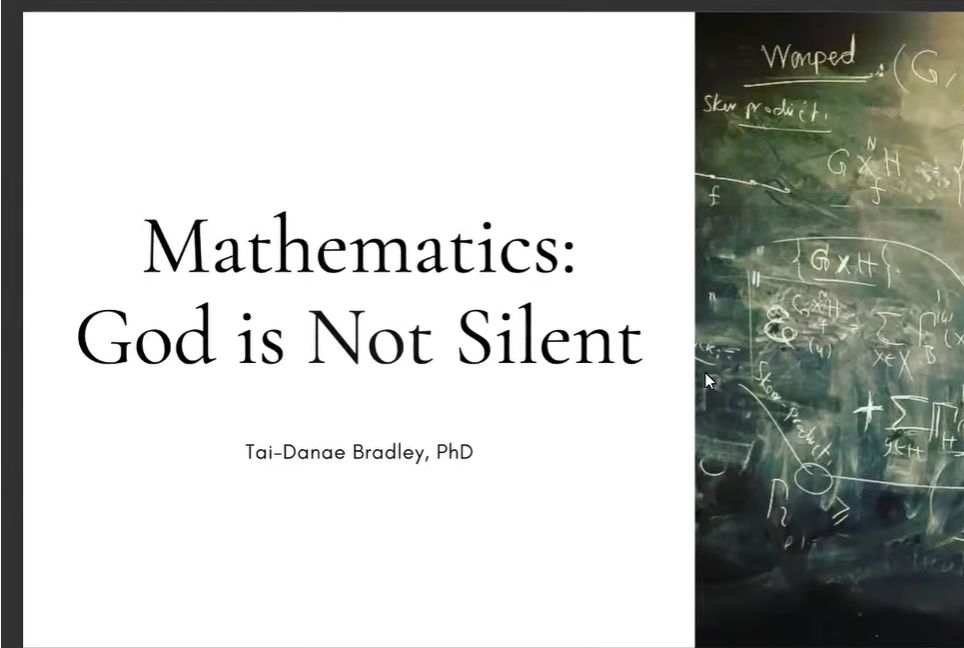
Pagans know that the world is created. I did when I was a heathen stomping about the world in my sin and going up and down upon it. It’s evident. Besides, my experience or opinion of this doesn’t count, not when the word of God tells us so:
For the wrath of God is revealed from heaven against all ungodliness and unrighteousness of people who suppress the truth in unrighteousness, 19because that which is known about God is evident within them; for God made it evident to them. 20For since the creation of the world His invisible attributes, that is, His eternal power and divine nature, have been clearly perceived, being understood by what has been made, so that they are without excuse. (Romans 1:18-20).
After salvation, we glory in His creation and the orderliness of it all. We praise Him for it!
The heavens tell of the glory of God; And their expanse declares the work of His hands. (Psalm 19:1).
I love learning about God as Creator. I enjoy nature shows and science shows, but often have to steel myself for the inevitable lies that secular science, physics, and math documentaries spout, that evolution made humans or a big bang made the worlds emerge from nothing or the earth is so many billions of years old…

So I got excited when I read the mission of the Math3ma Institute:
In light of this, the mission of The Math3ma Institute is to reclaim the glory of God in Christ by acknowledging His supremacy and preeminence as Creator, and in doing so to help students grow closer to the Lord by seeing more clearly His glory, His majesty, and His genius in creation. As we explore the scientific and mathematical landscapes, our love and admiration for Christ and our sense of wonder and amazement at His handiwork motivates our day-to-day research. This then drives our desire to share the complexities of our work with wide audiences with simplicity and clarity — we find great joy in discussing the beauty, order, precision, and sheer brilliance of the Creator. In short, we are here to esteem the voice of Christ.
If you want to enjoy STEM lectures with a Christian base, then please know that The Math3ma Institute has a public lecture series, here.
Aimed at a general audience, The Math3ma Institute Public Lectures are engaging and accessible talks by TMU faculty and colleagues on a wide range of topics in mathematics, engineering, science, and technology, all from a Biblical perspective. All lectures are free and open to the public and include time for discussion and dialogue with speakers and attendees. Additional information on current and upcoming Math3ma Institute Public Lectures can be found here: https://www.masters.edu/lectures.
In addition to the public lectures, they also offer a Journal and a blog, here.
REVEL in scientific knowledge that won’t make your stomach clench when you hear lies, won’t make your head spin with the deep blindness of the scientist, won’t make you upset at their constant learning but unable to come to knowledge of the truth.
In addition, the TheoTech Conference is another arm of the Math3ma Institute and the 2021 conference videos are available. Happily, Saturday, October 29 was the 2nd Annual conference! The theme is “Inerrancy, Electricity + Divine Power.” Topics and speakers were:
9am: Joey Kim: “Maxwell’s Magic“
10am: Jason Lisle: “Power of the Planets“
11am: Joe Francis: “Electromagnetic Life“
12pm: Grant Horner: “Zeus’ Thunderbolts“
2pm: Speaker Panel 1: Kim, Lisle, Francis, Horner
3pm: Monica Vroman: “The Breath of Life“
4pm: John Eickemeyer: “Classical, Quantum, Artificial Faith and Ungrounded Power“
5pm: Speaker Panel 2: Lisle, Vroman, Eickemeyer, MacArthur, Horner
6pm: John MacArthur: “Fire from Heaven“
The TMU chorale sang at 9am, 2pm, and 6pm (Pacific time)
I do not know if the sessions will be recorded live of when or if the sessions will be uploaded (last year’s were, so I’m hoping).
Anyway, just a couple of resources for you on the science and math front. These resources of the Math3ma Institute and TheoTech Conferences offering edification from a Christian perspective, so needed!
The Queen of Sciences: Reclaiming the Rightful Place of Theology and Creation. Video Lecture/Q&A with Dr. Abner Chou, who “surveys through the issues surrounding creation and argues that a realism of biblical authority and revelation establishes theology and creation as a necessary framework for science. It also will contend that the interpretation of Genesis 1–3 is clear and clearly historical as well as that the doctrine of creation is inextricably linked with the totality of Christian theology.”
His article on the subject is here
The End Time Blog Podcast Season 2, Episode 272
By Elizabeth Prata
I saw this arresting photo on Twitter. It’s from History Defined:

The first thing I thought was, man that guy had good teeth! The next thing that struck me were the verses about crowns in scripture:
Everyone who competes in the games trains with strict discipline. They do it for a crown that is perishable, but we do it for a crown that is imperishable. (1 Corinthians 9:25)
in the future there is reserved for me the crown of righteousness, which the Lord, the righteous Judge, will award to me on that day; and not only to me, but also to all who have loved His appearing. (2 Timothy 4:8)
We are flesh, and flesh is but grass. Within 3 generations a person’s name is forgotten. No one remembers what that Greek man’s achievement was, and it doesn’t matter anyway. Was he fast? Strong? Agile? Who knows? Who cares?
Peter, quoting Isaiah 40:6, For, “All flesh is like grass, and all its glory like the flowers of the field; the grass withers and the flowers fall, (1 Peter 1:24).

And never was that verse brought more to life than the dead Greek’s skull with the gold leaf still sticking to it.
What matters is God’s glory! That is the ONLY thing that matters in this fleshly life and after resurrection for eternal life. How do we give God glory? By obeying Him, proclaiming Jesus’ name everywhere, being salt and light in submission to His calling us out of our perishable darkness into everlasting light, and so on.
Even if the crown the Greek received was the high point of his life, the skull it was placed on was perishable. Perhaps the Greek was a believer and if so, his skull will be remade new on resurrection Day. Probably wasn’t a believer though. For a few decades he enjoyed his crown, apparently was attached to it enough so that when his family buried him, they buried it with him. And that was the end of that!
What is not the end is that after our resurrection on the Day of Judgment, people will be divided into two groups, the sheep (Believers) and the Goats (non-believers). According to the Bible, this is what will happen:
“But when the Son of Man comes in His glory, and all the angels with Him, then He will sit on His glorious throne. 32And all the nations will be gathered before Him; and He will separate them from one another, just as the shepherd separates the sheep from the goats; 33and He will put the sheep on His right, but the goats on the left.
34“Then the King will say to those on His right, ‘Come, you who are blessed of My Father, inherit the kingdom prepared for you from the foundation of the world. 35For I was hungry, and you gave Me something to eat; I was thirsty, and you gave Me something to drink; I was a stranger, and you invited Me in; 36naked, and you clothed Me; I was sick, and you visited Me; I was in prison, and you came to Me.’ 37Then the righteous will answer Him, ‘Lord, when did we see You hungry, and feed You, or thirsty, and give You something to drink? 38And when did we see You as a stranger, and invite You in, or naked, and clothe You? 39And when did we see You sick, or in prison, and come to You?’ 40And the King will answer and say to them, ‘Truly I say to you, to the extent that you did it for one of the least of these brothers or sisters of Mine, you did it for Me.’
41“Then He will also say to those on His left, ‘Depart from Me, you accursed people, into the eternal fire which has been prepared for the devil and his angels; 42for I was hungry, and you gave Me nothing to eat; I was thirsty, and you gave Me nothing to drink; 43I was a stranger, and you did not invite Me in; naked, and you did not clothe Me; sick, and in prison, and you did not visit Me.’ 44Then they themselves also will answer, ‘Lord, when did we see You hungry, or thirsty, or as a stranger, or naked, or sick, or in prison, and did not [i]take care of You?’ 45Then He will answer them, ‘Truly I say to you, to the extent that you did not do it for one of the least of these, you did not do it for Me, either.’ 46These will go away into eternal punishment, but the righteous into eternal life.” (Matthew 25:31-46).
There are only two things that will happen to a crown: it will either be burned up in when the earth is remade new, or it will be cast onto Jesus’ feet in joy for His enabling us to achieve a crown of glory in the first place. Everything always goes back to Him, including all achievements.
To become a sheep instead of a goat, means to believe on the Christ and repent of your sins.
For I handed down to you as of first importance what I also received, that Christ died for our sins according to the Scriptures, and that He was buried, and that He was raised on the third day according to the Scriptures, (1 Corinthians 15:3–4)
Now after John was taken into custody, Jesus came into Galilee, preaching the gospel of God, 15and saying, “The time is fulfilled, and the kingdom of God is at hand; repent and believe in the gospel. (Mark 1:14-15)
Repent and believe today. Your trophies won’t save you. Only Jesus saves.
The End Time Blog Podcast Season 2, Episode 271
By Elizabeth Prata
A week ago, on Reformation day 2022, (October 31) I tweeted a thread and subsequently posted a longer piece from the blog about something Beth Moore had said. She proclaimed with certainty that her 87 year old mother-in-law (who had passed 2 weeks before) was “in the presence of Jesus” and reunited with family members. The problem was, besides the fact of claiming you know with certainty anyone’s final destination, was that her Mother-in-law was a “devoted” life-long, “staunch” Catholic.
I’d said that if anyone who believes the dogmas of Rome, when they depart this world, is likely not in heaven. That was what the Protestant Reformation was all about, protesting the apostasy evident in that false religious structure. The Catholic Church by Martin Luther’s day had become apostate, rife with man-made traditions, schemas for salvation, merit, works, and indulgences (monetization of religion). It is still the same today. The Roman Catholic Church is a false church with an evil religious structure that opposes God. Believers in that church are sadly deceived that they are worshiping ‘this same Jesus’ in Acts 1:11 who departed this world and who will return in wrath and fury. (Revelation 19:21, Colossians 3:6).

That first tweet in my thread garnered 172,000 impressions and over 10,000 engagements within a day or two. Of the responses and discussions I’d seen, only 2 were positive or encouraging. The rest elicited a host of attacks, swears, curses, insults, and evil accusations. Some were poisonously corrupt to the Nth degree.
The attacks were almost instant, cruel, and ruthless. Many were from self-identified Christians, self-stated liberals, however, which explains a lot. Yet it was unbelievable what some of them felt it was OK to say in public the things they said.
I pondered and processed that event over the next few days, and here’s my conclusion:
1. I got to share the Gospel again and again and again. In the Twitterverse, there are not only the people you are directly engaging with, but all the people watching. There are a lot. So the Gospel was presented (as best as one can with the character limit). That is satisfying. Ultimately my first goal as a social media user is to proclaim the excellencies of Jesus.
2. I got to say several times that the Catholic church is corrupt and not Christian, and attach resources for further exploration. This is also good. It’s the second goal of mine to present credible resources to people. There is a lot of false out here. Putting out links to good ministries is a privilege and my joy.
3. I got to say many times that Beth Moore is a false teacher. I was expecting the outcry. It happens almost every time Beth Moore is presented in a negative light. It happened when I and 5 other ladies published the Open Letter to Beth Moore. It happened when I broke the news after she departed the Southern Baptist Convention that she was serving at the pulpit at her new Anglican church. Because Moore is destructive to one’s walk and one’s soul, I am pleased to say as many times as I can that she is false, in hopes that even one sister in Christ will go away from Moore. She’s one of the worst false teachers of past decades. Stating this in hopes of some eyes opening is my privilege and my joy.
4. Such activity reveals. It is an Elisha servant moment. When Elisha’s servant looked out and saw that the King of Syria’s army had surrounded them at Dothan, the servant moaned and said,
And his servant said to him, “This is hopeless, my master! What are we to do?” And he said, “Do not be afraid, for those who are with us are greater than those who are with them.” Then Elisha prayed and said, “Lord, please, open his eyes so that he may see.” And the Lord opened the servant’s eyes, and he saw; and behold, the mountain was full of horses and chariots of fire all around Elisha. (2 Kings 6:15-17).
Can we see the demons? No. They are spiritual beings. But we can see their activity.
For our struggle is not against flesh and blood, but against the rulers, against the powers, against the world forces of this darkness, against the spiritual forces of wickedness in the heavenly places. (Ephesians 6:12).
In your mind’s eye, envision a still pool in a verdant forest. It looks inviting, pretty, calm. Throw a big rock into the pool, and suddenly there is motion, ripples, splashes. Waves reverberate against the shore. Cattails along the edge wave wildly. Chaotic splashing spreads poison spray on the upper reaches of the grass on shore, which wilt and some die. Piranhas lurking just under the surface leap and scream wildly, revealing themselves.
That is what happens when you throw a big rock into the polluted pool of Beth Moore defenders. At once you can see the verdant pool is not inviting after all, it is an unpleasant cauldron of malevolent schemes and percolating brimstone.
Tweet
I’ll gladly take the splashback from the false teacher cesspool if whatever I post roils up the demonic so that its activity can be identified. I wish we all could be given an a glimpse like Elisha’s servant was, but unfortunately such privileges are few and far between these days. But God did give us His word, which is always available to one and all who are regenerated and can spiritually discern its contents. He did give us discernment to be trained up in. Discernment always roils the false. When you see such outcry, take note, it’s your discernment people trying to point out the mines in the minefield.
5. It became clear to me how many people need to be educated on the falsity of the Catholic church, what the Reformation was, and that there is a massive, fundamental, and eternal difference between Protestant and Catholic. The agitated activity showed us that ignorance is rife even among believers. Why?
Over the last couple of decades, the Southern Baptist Convention, the largest Protestant denomination in the world (formerly led in part by the self-same Beth Moore), tolerated Catholic practices such as Lectio Divina, Contemplative prayer, and other mystical practices such as visions and direct revelation, used by the Catholic Church for centuries. When Moore herself publicly stated several times that Catholics are just another denomination, there was no public correction from the actual leaders of the SBC. In time, the undiscerning Baptists (and others) came to accept what leaders were saying overtly and by omission, and now have a hard time understanding that Catholicism isn’t Christian.
If you, dear sister, are tired of the wrangling and pushback from your social media posts, I understand. People have no common sense these days. They lack basic charity and grace. Politeness seems to have flown the coop. But also know that all things work to the good of those who love God, and He is glorified even in the disorder created by Tweet storms, Facebook posts, and blog essays. Let’s not become discouraged in doing good, for in due time we will reap, if we do not become weary. (Galatians 6:9).
The demons don’t get weary. Malignant activity still performs its evil in this world. It’s up to us to shine the light. Ephesians 5:11 says Do not participate in the useless deeds of darkness, but instead even expose them;
The Gospel goes on, it is the joy and light of salvation. Its proclamation sometimes is received well, other times not. But we persist in being ambassadors for His name, THE name-
through whom we have received grace and apostleship to bring about the obedience of faith among all the Gentiles in behalf of His name, (Romans 1:5).
Are Catholics saved? (GotQuestions essay)
Are Roman Catholics Christian? (CARM essay)
What’s the Problem with Beth Moore? (video-1:33)
Discernment in Days of Defection (sermon by Phil Johnson)
The End Time Blog Podcast Season 2, Episode 270
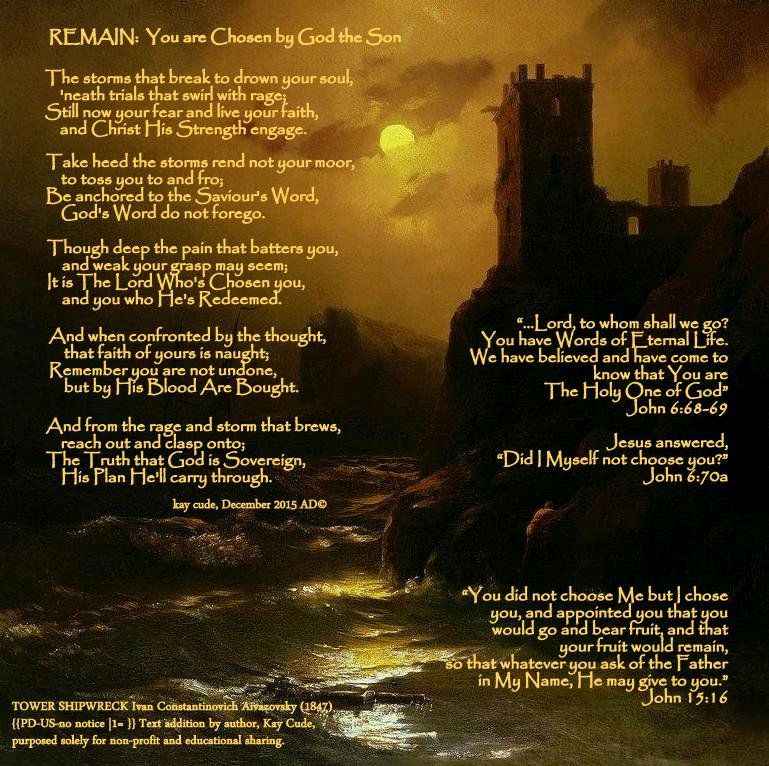
Kay Cude is a Texas Poet. Used with permission. Right-click to open larger in new tab
By Elizabeth Prata
Pastor James Bell is a pastor at Southside Baptist Church in Gallatin TN. He is one of the faithful pastors who labor diligently, outside of social media fame or Big Eva celebrity. He simply for 47 years has pastored in the same church, delivering the Good News week in and week out. He publishes a Grow in Grace newsletter, which I enjoy. It is always full of scripture and wisdom. Pastor Bell urges the recipients of the newsletter to use as we feel motivated, to share if we feel led or as a resource. I do share it now. Part 1 here.
Please use the Grow in Grace Newsletter for your own spiritual growth; and as a resource to help equip you to minister to others! Volume 47, No. 41, October 18, 2022 / Southside Baptist Church / P.O. Box 1594 / 1028 South Water Avenue, Gallatin, TN 37066 (615) 452-5951 / The Grow in Grace Newsletter is a weekly Bible Study, plus local church news notes— designed first and foremost for members and those attending services at Southside Church; and is sent forth with the desire to aid one and all, (including friends far and wide), in the experience of 2 Peter 3:18. “But grow in grace, and in the knowledge of our LORD JESUS CHRIST!”

QUESTION: In light of this reality, why is the Church-wide Prayer meeting so neglected by us today?
NEEDS in the congregation JESUS IS BUILDING:
There is a need to genuinely praise God corporately— So that when we are singing hymns or choruses or praying; or reading Scripture; or preaching; and/or giving testimony, we are truly before the Throne of God in worship in a spirit of unity and holiness! (Eph. 4:1-16)
There is always an urgent need for laborers— EXAMPLES: Laborers are needed for the sometimes thankless, monotonous tasks that make it possible for us to be a well-equipped, well-nourished, gospel army. There are many needs for laborers: – People to be responsible in the nurseries. – People to help get dinner ready at fellowship meals. – People to help cleanup. – People to open and close. – People to help with music and singing. – People to teach classes. – People to disciple others. – People to visit the sick, shut-ins, and widows. – People to write letters. – People to minister to folks at home…, etc. – People to ‘own’ specific missionaries we support— so that each month those missionaries will receive specific ministry from the assembly of saints at Southside. – PEOPLE TO evangelize.
REALITY: No assembly of believers can function with power if it doesn’t have an army of people COMMITTED to do the ‘every day and unseen’ jobs purely as acts of worship unto our LORD! (Worship is not just PRAISE, as in singing! Worship is SERVICE unto the Lord!) SO, WE HAVE THESE TWO BOTTOM LINE NEEDS: MORE PRAISE! MORE LABORERS! THUS,
[1] WE go to the Word of God and behold GOD and His gospel of mercy and grace. (Rom 12:1-2) [2] AND when we need laborers— we go to the LORD of the harvest! (Matt 9:36-38; Luke 10:17-20)
NOTICE: (1) Going to God IN ONE ACCORD IN PRAYER brings forth PRAISE! (Acts 4:23-33); (2) DEALING WITH SIN in the church brings forth new laborers! (Acts 5:1-14) JESUS knows what we need better than we do. – He cares more than we do! Jesus builds His church through the intercession of His saints! (Acts 4:23-33)
WITH GOD’S WAY of JESUS BUILDING HIS CHURCH— there are seasons of many (Acts 2) and there are seasons of few who remain, (John 6:63-66; Phil. 3:18-19) — BUT AT ALL TIMES, we must LOOK UNTO THE LORD!
MOREOVER, the true work of God can NEVER be judged by size, only by SORT! (1 Cor. 3:13)
“Lord, give us a spirit of true praise!”— BUT WHAT ARE WE ASKING? Well, we can picture SINGING hymns and Choruses with our whole hearts, even with uplifted hands and with wonderful God-honoring testimonies, etc. – and these things should happen!
But true praise is something much more than that— the true praise of God is to serve God well with body, soul, and spirit, 24/7: “Make a joyful noise unto the Lord all ye lands. Serve the Lord with gladness. Come before his presence with singing.” (Ps 100:1-2; Rom 12:1-2)
If our joyful noise to the Lord is real and our singing in His presence is truly music to His ear— then we’re going to be serving Him gladly as we serve Him well.
MOREOVER, WE WILL NOT ONLY SING WITH THE CONGREGATION; WE WILL SING AT MIDNIGHT IN THE PRISON! (Acts 16:22-40) AND, we will be manifesting holiness and the fruit of the Holy Spirit and not the works of the flesh! (Galatians 5:19-23; Isaiah 1:11-20)
GOD REQUIRES HOLINESS, LOVE, and FORGIENESS! GOD REQUIRES THAT WE REPENT OF all works of the flesh! Moreover, God’s way to JOY and gladness, (which is foundational to worship), is serving others after the pattern of Jesus! (John 13:13-17; 13:34-35)
GENUINE PRAISE is the offering up of our body as a living sacrifice, committing it gladly in the service of God without grumbling; and praise from hearts repenting and being purified from sin! (Ps. 51)
“I appeal to you therefore brethren by the mercies of God to present your bodies as a living sacrifice, holy and acceptable to God which is your spiritual worship.”(Rom. 12:1-2)
How did Jesus live so as to receive His Father’s pleasure? By emptying Himself of His glory, taking the form of a servant, and serving obediently even unto death.
How did Paul live manifesting spiritual worship to God? It was through endurance in afflictions, hardships, beatings, imprisonments, labors, fasting … REJOICING in the LORD always… seeing every situation as one to further the gospel! (Phil. 1-4)
So if we’re asking the Lord to shower us with a spirit of true praise, we’re really asking Him to help us yield ourselves to a spirit of glad service in the everyday and in the thankless places and the cruddy jobs. We are really asking Him for BOLDNESS to take the gospel to the lost in our world. Moreover, we are willing to be done with the filth of this world, to be done with bitterness, anger, lust, etc. LET US: … Serve the Lord with gladness… and come before his presence with singing… with cleansed hearts. (Isa. 1:10-20)
We also need to get clear in our minds what we’re asking for when we’re asking for more laborers. “Lord, give us more laborers!” …
We might picture MORE people gathered for OUTREACH ministry … more help in the nurseries … help with various Classes … faithful ministry to the widows… parents nurturing their children in the ways of the LORD… men and women reaching out boldly proclaiming the gospel … somebody going out to a foreign land to help those missionaries … All this and more may well happen.
HOWEVER: (1) But every laborer who is truly serving the Lord with gladness is first of all a person whose heart is on fire with praise and thanksgiving toward God!
(2) GETTING RID of all manner of sin that has been allowed to dirty a believer’s heart is a foundational key to PRAISE-JOY-FILLED LABORS for the souls of others! (Psalm 51:12-15; 40:1-3) When King David repented of his sin, then he began to SING again and then he went AGAIN into the harvest! (Psalm 51)
(3) TODAY, the Holy Spirit is already PRESENT and indwelling; but even so we must follow the same pattern: Acts 4:23-33; Acts 5:1-14!! All too often the Holy Spirit is grieved and quenched. Nothing so quenches the Holy Spirit as lovelessness and ungodliness.
Who are these laborers who get the work done?
People who live a life of repentance and faith… People who have first learned to enter into God’s gates with thanksgiving and into His courts with praise … People who have learned truly to be thankful unto Him and bless His name. They work diligently with songs of praise in their hearts … they continually renew their strength… for they that wait on the Lord shall renew their strength… (Isaiah 40:31)
JESUS: “… I will build my church, and the powers of death shall not prevail against it.” (Matthew 16:18) Jesus is building His church all over the earth, including the place where you and I are.
As we lay these two needs [More Praise and More laborers!] before Him we can be sure that our very desire to pray for these things is coming from Him. And we can be sure that He waiting to give us these two miracles in the coming days in greater measure than we could ask or think! But we have not because we ask not!
SHALL WE BECOME A HOUSE OF PRAYER? Or shall we to go to the world for methods and techniques, drawing people to religious clubs rather than being those through whom JESUS CHRIST BUILDS HIS CHURCH?
(1) A spirit of true praise to serve the Lord with gladness – May we yield to it! (2) An army of laborers who will joyfully live and die praising Him – May we be found among them! [Additions and Edited from R.E. Bieber]
The End Time Blog Podcast Season 2, Episode 269
 the-end-time.org