When Adam and Eve trusted the words of the serpent instead of GOD and stepped out into disobedience, they fell from grace.
To the woman God said, “I will greatly multiply Your pain in childbirth, In pain you will bear children; Your desire will be for your husband, And he will rule over you.” ” (Genesis 3:16).
Then God made His prophetic pronouncements to Adam (the ground is cursed because of you, labor will be painful, you’ll sweat and toil, the serpent will be bruised under the heel of the woman’s offspring)
When God was finished speaking, the man called his wife’s name Eve, “because she was the mother of all living.” (Genesis 3:20)
God Judging Adam, cropped, by Wm. Blake, 1795
Was Eve a mother yet? No. Adam’s naming of Eve was a step into faith based on the future promises of God.
If Adam’s faith was so great based on such little revelation, how much more faith should we have based on the incarnation of Christ, the indwelling work of the Holy Spirit, and the completed revelation of God?
“For in it the righteousness of God is revealed from faith for faith, as it is written, “The righteous shall live by faith.” (Romans 1:17)
Are you living in faith? (am I?) With the great revelation we have in our complete Bible, revelation wisdom that we can turn to at any time, freely, let us today and forever live by the promises of God. His word will never fail. Whatever happens today is for our good (which is good) and His glory (which is best!)
Peter, an apostle of Jesus Christ, To those who reside as exiles, scattered throughout Pontus, Galatia, Cappadocia, Asia, and Bithynia, who are chosen according to the foreknowledge of God the Father, by the sanctifying work of the Spirit, to the obedience of Jesus Christ and the sprinkling of His blood: May grace and peace be multiplied to you. (1 Peter 1:1-2)
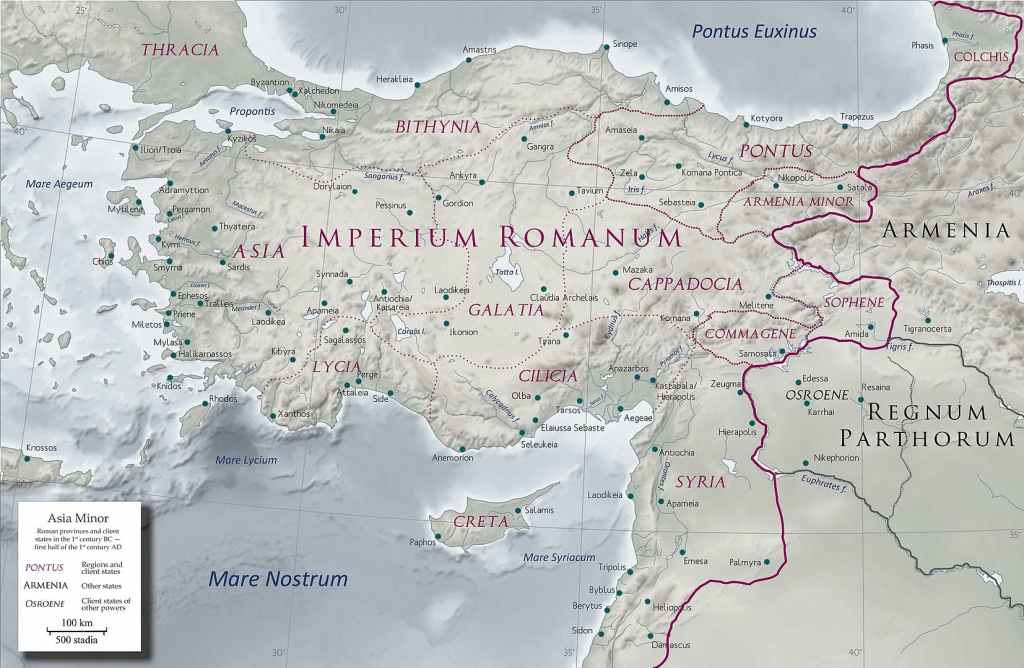
Did you ever wonder where those places were/are? I do. I find it helps me to look at a map in order to orient myself to the places mentioned in the Bible. Here we go!
Asia Minor in the 2nd century AD – general map – Roman provinces under Trajan. CC BY-SA 4.0. Right-click to open larger in new tab
You notice the word “Thracia” in the northwest part of the map. Thrace, according to Wikipedia, “is a geographical and historical region in Southeast Europe. It is split among Bulgaria, Greece, and Turkey, which is bounded by the Balkan Mountains to the north, the Aegean Sea to the south, and the Black Sea to the east. It comprises southeastern Bulgaria (Northern Thrace), northeastern Greece (Western Thrace), and the European part of Turkey (East Thrace).“
Galatia is the region where Paul wrote to the Galatians to correct them in that Epistle. Notice the eastern part of the map, the location of the Tigris and the Euphrates, those mighty rivers. At the southern part of the map you see the city of Damascus. About 160 miles south of the city of Damascus is the Israeli border, and from Damascus to Jerusalem is about 200 miles.
You see the island of Cyprus, where the city of Paphos is mentioned at the southern end of the island. Acts 13:6 mentions Paphos, where the crew “met a magician, a Jewish false prophet whose name was Bar-Jesus,“
You see the region of Cilicia, that was the region that contained the city of Tarsus, where Apostle Paul was born. That area was known for its expertise in tent making, and we know Paul was a tentmaker. (Acts 18:3). After Paul’s conversion, he was mainly itinerant. He spent the most time in Antioch, the closest place to a home he had until he gained heaven. He mentioned several times that he was self-supporting, not wishing to be a burden to anyone. He likely employed his skills at tent-making throughout his missionary career.
This map area is called Asia Minor. World History website says “The earliest reference to the region comes from tablets of the Akkadian Dynasty (2334-2083 BCE) where it was known as The Land of the Hatti and was inhabited by the Hittites. It was among the most significant regions of antiquity.” Genesis 15:20 mentions the Hittites.
On the western part of the map you see cities facing the Aegean Sea. Look for Smyrna, mentioned in Revelation 2:8, and Pergamum, mentioned also in Revelation 2. Pergamum was known for its incredible library, second only the the Great Library at Alexandria.
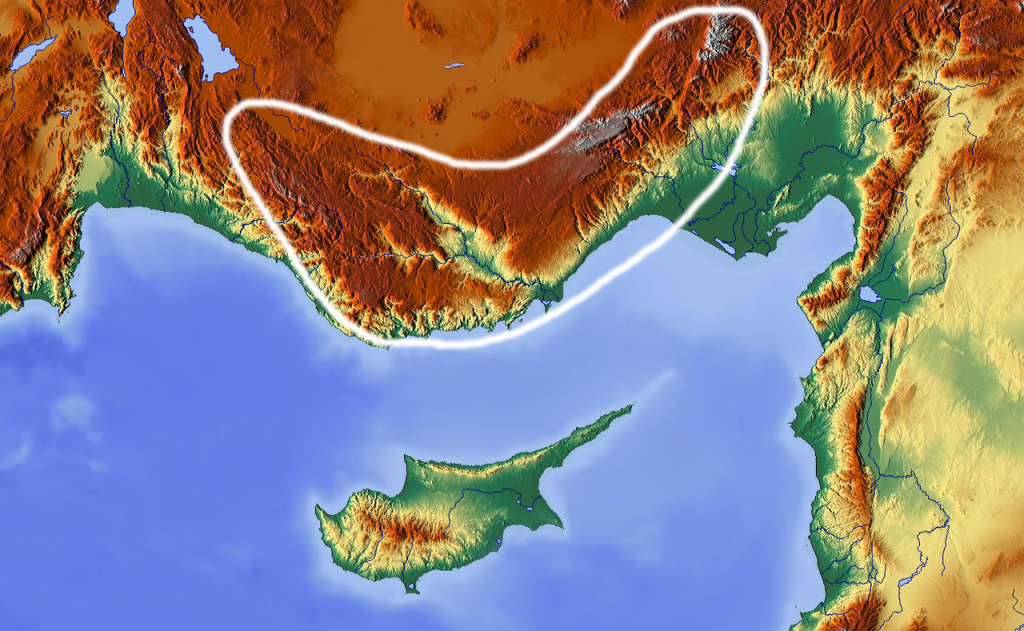
Asia Minor is riddled with difficult mountain ranges. Some of the steepest and most difficult to traverse were the Taurus Mountains. Some peaks extended upward of 12,000 feet. So when we read Paul went here or there, think of all his footsteps up mountains and down mountains… Amazing.
The earth is amazing and the LORD planned it to look and be exactly as He wanted. When the Flood happened, much of the earth’s topography was changed. Mountains formed, seas and lakes filled in, etc. When the events of Revelation occur, it is sort of an un-creation, a return of the topography to what it was before the flood. Mountains will flatten, islands will flee away, and so on. Then at the very end, the earth will be made anew, completely new. I can’t await to see what it looks like then… If you believe in Jesus Christ and have repented of your sins, you will also see it, and dwell on this beautiful earth forever.
I’m actually not following the event taking place at the Kentucky Christian college, Asbury University. Apparently after the usual required Chapel service, Theology Professor Tom McCall said on February 13,
But this past Wednesday was different. After the benediction, the gospel choir began to sing a final chorus—and then something began to happen that defies easy description. Students did not leave. They were struck by what seemed to be a quiet but powerful sense of transcendence, and they did not want to go. They stayed and continued to worship. They are still there.
The chapel service that allegedly set all this off was held on February 8. One person noted that the sermon was absent a discussion of sin, repentance, cross, confession of Christ as Lord. It’s been a week since. They are still there. It’s standing room only. People singing, praying, crying, repenting. They are confessing sin. They aren’t flopping around on the floor or emitting hysterical laughter. Is this a genuine move of God? Is it emotionalism? Groupthink? The debate has been ongoing in social media.
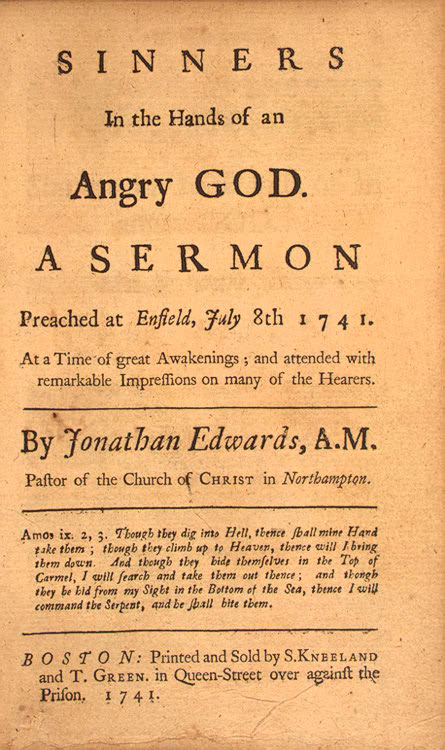
One of the most famous revivals in history was the First Great Awakening that began during church services in Northampton Massachusetts and Enfield Connecticut where Jonathan Edwards preached the sermon titled Sinners in the Hands of an Angry God. The sermon was delivered in 1741, but the awakening began in various parts as early as 1730. In England, John Wesley was preaching fervently during a revival there, and in the colonies here in what became the US, George Whitfield and Jonathan Edwards were preaching.
Edwards was also praying. He had prayed for a long time for revival, and God answered his prayers. During the height of it and afterward, Edwards thought much on the mechanism of revival, the definition of revival, and how to determine if a revival is genuine. He sought to reconcile the mind – which studies the Bible, and the heart’s affections for its Author – with revival as backdrop.
Edwards explains in several of his subsequent works, such as A Narrative of Surprising Conversions, (which can be read online at the link), The Distinguishing Marks of a Work of the Spirit of God, and An Account of the Revival in Northampton in 1740-42, (al linked below free to read online) that there are two underlying causes of biblical revivals: prayer and the preaching of God’s Word. True revivals are not the product of man’s efforts to bring it about, except for prayer and preaching.
Edwards relates that revival began the same way in a number of cases, great groups of people seemed to have “been seized” by the Spirit. Many who had previously been saved but doubted were now content in great assurance. Others who had not yet been saved, suddenly were preoccupied with religious things, including sermons, meeting together in groups to study and pray, and forsaking previous dalliances with immoral hobbies. They were dressing modestly, and their conversations were seasoned with grace and of the Savior. Edwards noted that rare was a day when people were converted past middle age, but that many in the elderly category as well as the young were converting.
Was it genuine? We all wonder when we are either participating or observing such a work and ponder if it is of God or of satan. Misattributing to one or the other in error would be disaster! Edwards pondered the same. In his treatise The Distinguishing Marks of a Work of the Spirit of God, which can be read online at the link, Edwards said,
And as to the fruits of this work, (which we have been bid so often to wait for,) blessed be God! So far as there has been time for observation, they appear to be abiding. I do not mean that none have lost their impressions, or that there are no instances of hypocrisy and apostacy. Scripture and experience lead us to expect these, at such a season. It is to me matter of surprise and thankfulness that as yet there have been no more. But I mean, that a great number of those who have been awakened are still seeking and striving to enter in at the strait gate.
“Sinners in the Hands of An Angry God, A Sermon Preached at Enfield, July 8, 1741,” by Rev. Jonathan Edwards, Printed by S. Kneeland and T. Green, Boston, 1741. Image courtesy of the Library of Congress, and the Rare Books Division, the New York Public Library.
The passage of time will always tell. The work God begins in a heart will continue until the Day. Others, for many reasons if not genuinely saved will fall away. The broad gate will beckon those.
Some, Edwards, noted, are prejudiced against the work of God in revival, and revile it. They do so out of ignorance of the facts, or jealousy- not having seen or experienced such a thing in their own spheres, or they “may dislike the present work, because it supports and confirms some principles which they have not yet embraced, and against which such prejudices hang about their minds, as they cannot easily shake off.“
Edwards did go on in the above linked booklet with noting marks of genuine revival. One of them, he warned, is that “A work is not to be judged of by any effects on the bodies of men; such as tears, trembling, groans, loud outcries, agonies of body, or the failing of bodily strength.” He said that a person not exhibiting such effects on the body may indeed be genuinely converted, or a person who does exhibit such effects might be apprehending the horrors of hell upon their soul, or apprehending their own wickedness in the face of a holy God- and trembling from righteous fear.
After giving negative marks of the true revival, Edwards continues with genuine marks of a true revival. He said foremost, “When the spirit that is at work operates against the interests of Satan’s kingdom, which lies in encouraging and establishing sin, and cherishing men’s worldly lusts; this is a sure sign that it is a true, and not a false spirit.“
It makes for interesting reading, to be sure. However, Jonathan Edwards was not the only person concerned with whether an Awakening, or a Revival, was genuine. The Second Great Awakening occurred in America in the late 1700s when Ebenezer Porter observed one between 1773-1778. He wrote his “Letters On Revival” and noted the results of revival: Changed lives (few examples of apostatizing professors; Assembly faithfulness, Unity, Humbled pastors, A spirit of gratitude. (excerpt from a study guide on Porter’s book, here).
The Chapel Library offers one of their entire magazines on Revival. The Free Grace Broadcaster Issue 223 has within it many good essays on revival. You can read this online or order a free hard copy mailed to you for free. Authors and topics include-
What Is Revival? Horatius Bonar (1808-1889): a helpful definition of and general introduction to the subject of spiritual awakening:
Motives for Revival: David Martyn Lloyd-Jones (1899-1981): many Christians pray and long for a mighty move of God’s Spirit in revival; but what should our motives for this be? This survey is a helpful answer to the question.
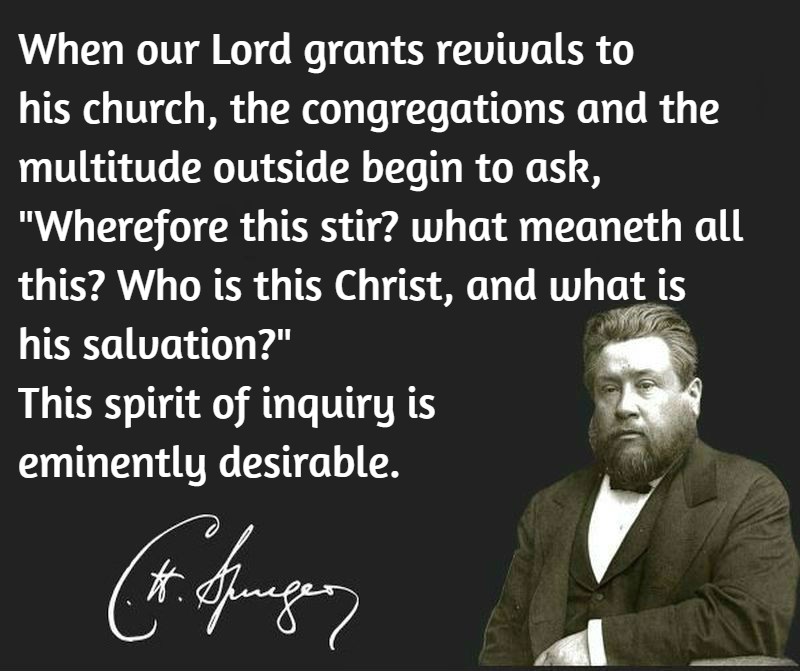
Preparation for Revival: Charles H. Spurgeon (1834-1892): an earnest exhortation for Christians to prepare their hearts for revival by agreeing with God, His Word, and His ways.
Pray for the Spirit: James W. Alexander (1804-1859): there can be no revival without a mighty outpouring of God’s Holy Spirit. God’s people must pray to our gracious heavenly Father for just such a blessing.
The Outpouring of the Holy Spirit: Robert M. M’Cheyne (1813-1843): a weighty, thoughtful discussion regarding the powerful changes God’s Spirit works in the human heart.
Solemn Pleadings for Revival: Charles H. Spurgeon (1834-1892): an ardent and solemn appeal for God’s people to plead with God for great works of grace and a call to renew our strength in Him.
The Men God Uses in Revival: Horatius Bonar (1808-1889): a challenging and provocative look at the kind of preachers God uses in spiritual awakening.
Preaching for Revival: William Reid (1814-1896): an overview of the all-important truths that men must proclaim if we would experience revival.
Crucial Doctrine and Revival: David Martyn Lloyd-Jones (1899-1981): a brief examination of two crucial doctrines God blesses to the salvation of souls.
The Effect of Revival: Jonathan Edwards (1703-1758): a first-hand observation of what God-sent revival really produces in sinful men and women.
Charles Spurgeon called the basement prayer room “The Boiler Room” because prayer and his people praying was truly the power of the church. Photo by Peter Herrmann on Unsplash
Paul Washer said of revival, “Many people have the idea that they are going to “pray in” a revival. Other people say, “Revival will come whether you pray or not.” I am not in either one of those camps. But I know one thing. When I see men, women, and young people all over the world praying for an awakening, to me that is the firstfruits of revival. And I can count on the fact that He Who gives these firstfruits will bring in the full harvest.“
Revival and Reformation- what do they have in common? in an essay called The Spirit of Revival, RC Sproul said,
“It is noteworthy that this period in history is commonly referred to as the Reformation and not the Revival. What is the difference between revival and reformation? As the etymologies of the words suggest, revival describes a renewal of spiritual life, while reformation describes a renewal of the forms and structures of society and culture. It is not possible to have true reformation without first having true revival. The renewal of spiritual life under the power of the Holy Spirit is a necessary condition for reformation but not a sufficient condition for it. Therefore, though it is not possible to have reformation without revival, it is possible to have revival without reformation’ –end Sproul
The most startling awakening was what occurred at Nineveh under Jonah’s preaching. Jonah was disobedient, but he was a true man of God. He preached of his Holy God to the pagans at cruel and inhuman Nineveh. They heard.
Jonah 3:5, 3:7-9, “And the people of Nineveh believed in God; and they called a fast and put on sackcloth, from the greatest to the least of them. In Nineveh by the decree of the king and his nobles: Do not let man, animal, herd, or flock taste a thing. Do not let them eat, and do not let them drink water. But both man and animal must be covered with sackcloth; and let men call on God with theirstrength that each may turn from his evil way and from the violence which is in his hands. Who knows, God may turn and relent and turn away from His burning anger so that we will not perish.”
The King was acknowledging the sovereignty of God there. He had put on sackcloth himself. God saw their repentance was genuine and he relented of the doom formerly pronounced upon the Ninevites.
In Acts 19:18-20 we read that the Spirit of God entered many at Ephesus and they repented.
Also, many of those who had believed kept coming, confessing and disclosing their practices. And many of those who practiced magic brought their books together and were burning them in the sight of everyone; and they counted up the price of them and found it fifty thousand pieces of silver. So the word of the Lord was growing mightily and prevailing.
Spencer Smith who was present at Asbury for 2 hours, said that people were openly confessing their sins. That’s the first part of a genuine revival as seen in the verse describing Ephesus. The second part remains to be seen. The college at Asbury is host to a nest of false organizations such as Passion Conferences and Bethel for the Collegiate Day of Prayer on campus next week. If the Collegiate Day of Prayer organizers are part of this revival, they will repudiate those organizations and not accept their presence and partnership any more, no matter the financial cost at this late date to stop their entry. Smith said actually, the Kenneth Copeland folks arrived on campus to enter the current revival – and they were asked to leave.
The word of God prevailing is the key.
Whether the event going in in the Asbury Chapel is a genuine move of the Spirit or not, time will tell. As Matthew 3:8 says, we must bear fruit in keeping with repentance. If the Asbury folks are truly repentant, they will not fall away and they will bear fruit for the glory of God.
As always, we pray for more to come to know the Lord, more and more prayer every day as the world darkens. We are the light. Has the Light come upon students in Kentucky? One hopes. No matter what, let us proclaim Christ, and not lose hope nor grow weary.
Encouragingly, whether the Asbury event is genuine move of the Spirit or not, people are hurrying to various sources to learn more about what revival is and isn’t and to the Bible to seek verses which may explain what is happening in Kentucky.
Two solid people went to the event and observed first hand. Alisa Childers and Spencer Smith. I’ll post both their comments below. Alisa’s video was 11 min, Spencer’s is about an hour.
Yesterday I wrote a post and published a podcast about the things that God hates. It is important to mention these things since they are half of the Gospel.
People rebut. Many people unfortunately don’t believe that the unsaved are due wrath from God, or that God hates anything at all. I repeat what Paul Washer said, ‘OK, well, you’re saved. What did He save you FROM?’
His wrath.
Anyway, I decided to follow up the bad tasting medicine from yesterday with a focus on a tender moment in the Bible. I have been reading commentaries on Habakkuk. I love the Minor Prophets. It is prophet-able to read them. Ha ha see what I did there? Habakkuk’s story is that in three short chapters, he went from doubt and angst, to full and complete trust and joy in God, despite the dire circumstances that Prophet was told to announce. Part of his story is a tender moment in chapter 2:1.
The Prophet had agonized over the sins of the wicked tribes that God was (seemingly) doing nothing about. Habakkuk was indignant. Chapter 1 is his lengthy charge against God. Chapter 2 begins with the Prophet having concluded his complaint to God, and saying he will return to his place at the watchtower, curl up and wait to “see what He will speak to me And how I may respond when I am reproved.” He has spoken out against God and he knew he was in a position to be turned to a cinder.
It’s like he then curled up into a fetal position, all tired out from the constant sight of the wicked prospering, and then protesting to God about it, and collapsing in a heap in the corner of his tower to wait for the lightning bolt.
But God.
But God did not send any lightning. Almost like a parent who bemusedly and compassionately watches their terrible two year old toddler have a tantrum, trying to grapple with emotions that are beyond their ability to control or even understand, when Habakkuk calmed down, the LORD put His arms around the prophet, lifted up his chin and allowed him to gaze upon the LORD of Glory while He explained the future.
Wow.
The LORD did not harshly reprove Habakkuk, instead He gently explained to the perplexed prophet what He was doing in the world and in future history.
There are many such moments in the Old Testament. The Lord tenderly speaking with a heartbroken Hagar (twice)… God sending an angel to be with depressed and broken down Elijah after the 400 Prophets of Baal incident. In that one, Elijah woke up with an angel touching him and offering bread and drink. (1 Kings 19:5-8).
The Lord our God is loving and tender. He loves His own with a heart that’s perfect, a mind that’s holy, with wisdom and compassion. I am grateful to know a God like this.
So many people have followed soft teaching women’s ministries for so long, with their constant focus on “God is love”, combined with an absence of teaching on sin, holiness, and wrath, that now we have slews of women who disbelieve God hates anything.
I had a Twitter interaction with a woman, who began her interaction with me by calling me a liar. I am very sad that civil discourse seems to have gone by the wayside, and people feel so free to resort to name calling to make their point, and worse, at the outset. She was commenting on my tweet thread on things God hates, which was accompanied by the verse from Proverbs 6. Ignoring the verse, she said that God doesn’t hate those He created.
I agree it would seem to be a contradiction, for God to make people and then hate them. But we must remember the beginning. It didn’t start out that way. He created Adam and then Eve. He created them in love, to have fellowship with them and for them to know Him and have fellowship. Then they sinned, bringing upon the world a curse, and upon themselves a sin nature which reverberates down to this generation and every human ever born (except for Jesus). God didn’t start out hating his created beings.
Remember also, He created the angels and He did not hate them either, until ‘Lucifer’ AKA satan the adversary sinned and brought a third of the angels with him in rebellion. Sin entered the world when he enticed Eve and she disobeyed. God hates sin. Always remember that.
And the phrase, “God hates the sin but loves the sinner”? It isn’t biblical. God does not cast only ‘sin’ into the Lake of Fire. He casts sinners into the Lake of Fire.
While I agree it isn’t profitable to focus only on His hate of sin, His wrath, and His punishment, it is also not good to focus only on His love, His care, and His tenderness in saving us. As my pastor says, there are two wings to the airplane. Love-hate, law-gospel, salvation-wrath, sin-repentance and so on. The plane is lopsided with only one wing, and it won’t fly right.
Our believing lives are two sides of one coin. While the redeemed are loved and no wrath is due us (because of our risen Jesus from the cross), even after salvation we should remember the position of the unredeemed. They dwell on an earth that’s cursed and they personally are dangling on an ephemeral spider’s web strand over the Lake of Fire to be dropped into it for all eternity if they fail to respond to the Gospel.
But that is where we are with so many women’s ministries. A decades-long hyper focus on love has given younger women the notion that no matter what, God is love only.
But God … is holy holy holy.
“Can God be good, and not move against wickedness? No. Can God be good and be apathetic towards evil? Absolutely not.” ~Paul Washer
God hates six things, no, seven…Haughty eyes, a lying tongue, And hands that shed innocent blood, A heart that devises wicked thoughts, Feet that hasten to run to evil, A false witness who breathes out lies, And one who spreads strife among brothers. Proverbs 6
And it isn’t even a comprehensive list of what God hates. Do you notice the last one? It isn’t just the sin God hates, but people who sin.
The title of this blog essay is a quote from Paul Washer. Below is an excerpt of a sermon he delivered years ago, called “The Hatred of God”. To paraphrase something he said in the excerpt of this sermon, ‘if you love babies…you must hate abortion. If you love African Americans…you must hate slavery. If you love the Jewish people…you must hate the Holocaust’. What he was describing there is the two sides of the same coin. One cannot have a holy hate unless you have love. You cannot have a Christian love unless you also hate. We MUST hate what God hates. Washer said:
You know that wonderful statement that goes something like this “God loves the sinner and hates the sin.” Just look at this text. [Psalm 5:5]. Is that what it teaches? It’s not what it teaches. I’m sorry, I know it’s a pretty thing to say and it looks good on the back of a contemporary Christian t-shirt, but it’s not what the scriptures teach.
[Ps 5:5] does not say here that God’s hatred is manifested towards the wicked deed. It says God’s hatred is manifested towards the one who commits it. ~Paul Washer
Don’t be fooled by ministries that omit half the Gospel. God does hate. How could He not? He’s perfectly holy. Therefore sin offends Him. Sinners offend Him!
BUT GOD: We are amazed and grateful that even though He is thoroughly offended by sin AND sinners, hates it, He sent Jesus to die for us!
Now- my disclaimer. This is not to say that we go around hating unbelievers who sin. They can’t help it. And, we redeemed are not perfected yet so we falter when we attempt to have a righteous indignation or a holy hate. Our motivations are born out of love for God so we try our best, but our sin nature can still corrupt the end result.
God is love. God does hate. Never forget that He is perfect, so His hate is perfect, always just the right amount and in the right degree and toward the right things. Dear ladies, please try to have a right view of God, a comprehensive view containing all of His attributes. Look at Him as He is revealed, through scripture, not through ourselves and our own notions of what love and hate is.
,Ladies please take a listen to this 19 minute clip. Washer at his best.
Kay Cude is a poet whose sensitivity to the glorious salvation of Jesus Christ is uniquely expressed through poetry and picture. Here is her latest offering, in which she explains her thought process. Enjoy. Used with permission. Right-click to see larger in new tab.
—————————–Kay Cude—————————–
If you look closely at the tower, you’ll see a tiny figure of someone, which refers to the statement, “As gazed I o’er the valley fair, to there below from tower high.”
That little figure caught my eye, as well as the city lighted up and the storm approaching from the left (approaching spiritual death). So I began to write. The city represents the safety of true salvation in Christ and understanding His Gospel.
The people represent those captured by a “different gospel” suggested as the “real” place of safety. Even though they “know” God’s truth — they are persuaded to run to false teaching and reject Christ.
Christ’s refuge is known to them and still stands in its truth, but when extreme peril approaches, they are convinced by someone’s whim (spiritual deception), to flee to eternal death and separation. Even the donkey digs in his heels against the “unknown” way,” and the dog barks at their sudden rejection.
Their end is eternal separation and eternal living death because they quickly deserted Christ’s truth for a distorted gospel.
Loyalty. How often do we hear that word these days? Not so much. How often do we see it displayed these days? Even less.
Loyalty is defined as “a strong feeling of support or allegiance.”
In my growing up days, the 1960s, in the business world loyalty was everything. The employee worked all their working lives for a business, say, IBM, and in return the company was loyal to the employee. The atmosphere was like a family and the employee worked until the then-retirement age of 65. At the end when retirement loomed, the employee received a thank you and a retirement dinner and a gift of a gold watch. Loyalty was a thing.
Nowadays, we have job jumpers all over the place. Whenever an employee believes a better opportunity lay elsewhere, they think nothing of hopping over to it. While it is normal to seek a better opportunity, few people realize the heavy financial investment a business makes in an employee to train them, pay them, insure them, and offer benefits to them. Thoughtless departures for a transitory better opportunity is normal in this new millennium.
The US Bureau of Labor Statistics reports the number of jobs held during a lifetime for younger baby boomers (born between 1957 and 1964) has greatly increased. On average, men will have 12.6 jobs whereas women will have 12.3. It used to be just a few jobs, 3 or 4.
On the other hand, loyalty from the company to the employee has also diminished. Too often we tragically read of middle managers being fired while top managers reap financial rewards with fat salaries and cushy benefits. Or long-term employees being fired just before tenure is available or just as retirement looms.
In friendship, loyalty often evaporates too. When the chips are down, people you thought were your firm friends are nowhere to be found. Paul said that his friends deserted him-
2 Timothy 4:16, “At my first defense no one supported me, but all deserted me. May it not be counted against them.”
Barnes’ Notes says of the 2 Timothy 4:16 verse,
“No man stood with me – Paul had many friends in Rome (2 Timothy 4:21; compare Romans 16); but it seems that they did not wish to appear as such when he was put on trial for his life. They were doubtless afraid that they would be identified with him, and would endanger their own lives. It should be said that some of the friends of the apostle, mentioned in Romans 16, and who were there when that Epistle was written, may have died before the apostle arrived there, or, in the trials and persecutions to which they were exposed, may have left the city. Still, it is remarkable that those who were there should have all left him on so trying an occasion. But to forsake a friend in the day of calamity is not uncommon, and Paul experienced what thousands before him and since have done. Thus, Job was forsaken by friends and kindred in the day of his trials; see his pathetic description in Job 19:13-17;”
He hath put my brethren far from me, And mine acquaintance verily are estranged from me. My kinsfolk have failed, And my familiar friends have forgotten me. They that dwell in my house, and my maids, Count me for a stranger. I am an alien in their sight. I called my servant, and he gave me no answer; I entreated him with my mouth. My breath is strange to my wife. Though I entreated for the children’s sake of mine own body.
“Thus, the Psalmist was forsaken by his friends in the time of calamity; Psalm 35:12-16; Psalm 38:2; Psalm 41:9; Psalm 55:12. And thus the Saviour was forsaken in his trials; Matthew 26:56; compare, for illustration, Zechariah 13:6. The world is full of instances in which those who have been overtaken by overwhelming calamities, have been forsaken by professed friends, and have been left to suffer alone.” end Barnes Notes
“To forsake a friend in the day of calamity is not uncommon” – Albert Barnes on 2 Timothy 4:16
On the plus side, we do read in the Bible of great loyalty. Eliezar was Abraham’s servant. They were tight. Abraham was so sure of Eliezar’s loyalty, he sent him abroad to find a wife for Isaac. He was SO sure of it that he considered Eliezar would continue to be loyal even after Abraham had passed away, considering him his heir.
Ruth’s loyalty to Naomi was such that she stuck with Naomi even though Naomi was sour, difficult, and traveling to a new place under a new-to-Ruth God. Jonathan was loyal to David under extremely adverse circumstances.
Social capital is real. It is the value of the positive relationships shared among people. It is founded on trust, reciprocity, mutual understanding through committed relationships. I don’t mean just love relationships, but workplace relationships, friendships, relations among club members, sports teams etc. It’s about human sociability – our ability to work together and to solve complex problems, and to form the groups that make up society. People accumulate social capital by investing in people, listening, caring, involving. If you borrow tools from your neighbor and he borrows them from you, your social capital has been established because your relationship is based on trust and reciprocity.
Some people have more social capital than others, they are regarded as “pillars of society”. These folks are seen as trustworthy (relational capital), or wise (intellectual capital) or useful (having expertise). Have you ever noticed when a group is together, say, trying to solve a problem or brainstorm, and everyone is gabbing all at once, but when one certain person begins to speak everyone stops talking to listen to them? They have a greater amount of social capital.
But what if something happens to damage the person’s reputation?
Social capital can be very easily destroyed. It can take a long time to build social capital through repeat positive actions and interactions, but it can be destroyed by a single action. Generally social capital is lost or damaged by anything that reduces feelings of goodwill or disrupts networks. Any action that is antisocial. Anything that makes people feel less social, sharing, giving, or caring towards their fellow humans. These actions could be things like a betrayal of trust, selfish acts, perceived indifference or exclusion, violence or threat of violence, or deceit or deception. Source
THAT is when loyalty is tested. If a colleague was in hot water with the boss, would you publicly stick with her? (Hypothetical situations among believers- we don’t expect loyalty from unbelievers, they love the world, like Demas). We often edge away when someone we know has done something antisocial, or even just made a faux pas. We don’t want to be associated with them, lest our own reputation be damaged, too.
We often speak of Christian persecution, of being martyred for the faith. Or even lawsuits against us or our business, or being jailed. Big, traumatic things.
Those things are surely difficult trials, but God has not appointed hard persecution to everyone. But everyone in the faith makes decisions every day that either enhance or hinder our walk. Making these little decisions on how and when to uphold our testimony is the walk. Satan tries to influence us bit by bit to lower our standards where they’re important. Eventually, these little compromises add up.
For example, if someone you know at work or at a club or other gathering, even church, has fallen into hot water, do you edge away? Do you decide, ‘hm I’ll walk down the other hallway so I won’t run into them and have to talk to them.’ ‘I don’t want to be seen with them so I’ll make up an excuse to get out of our weekly coffee gathering…’ It’s ridiculously easy to fool our own conscience, but we don’t fool God.
Are you a loyal friend only when it’s all good vibes? What about bad vibes times? Photo by MARK ADRIANE on Unsplash
In secular society we may have accumulated social capital, but in God’s economy we are all equal at the foot of His cross. We love without reservation and through thick and thin. Our loyalty should be steadfast. When we are loyal to our believing friends, co-workers, family, we are not only being loyal to them. We are being loyal to the Savior in them.
Was it easy for Ruth, Jonathan, or Paul’s friends to stick with him? Not at all. In fact, loyalty to Paul must have made more than one of his friends re-think being with him. It is human nature to look to self-preservation first. In Acts 14 after they dragged Paul out and left him for dead, he rose up and went back in, lol. Then Barnabas loyally stuck with Paul and the next day they both went to Derbe.
Soon we will have to make more and more decisions like these. We may not all be destined for martyrdom or even jailing for the Name. But as the world’s noose tightens it comes against us in a thousand smaller ways. Will you be loyal to your friend in the face of unpalatable circumstances? Will you visit her in jail?Will you continue to support her in love even though her reputation suffers badly? Will you sit with her in the pew?
A man of too many friends comes to ruin, But there is a friend who sticks closer than a brother. (Proverbs 18:24). Barnes’ Notes says
“It is not the multitude of so called friends that helps us. They may only embarrass and perplex. What we prize is the one whose love is stronger and purer even than all ties of kindred.
Proverbs 17:17 says a friend loves at all times. Will you be a loyal friend to a sinner? Because, you are a sinner too.
A couple of days ago, Allie Beth Stuckey spoke a good word summarizing her Episode 749 of podcast Relatable. She said the overt demonic visuals of the recent Grammy Awards dance (let the reader understand) is dangerous, but more dangerous is the soft teaching of women like Jen Hatmaker or Glennon Doyle. Listen to her teaser summary here or the whole episode here.
This week also, Amy Spreeman & Michelle Lesley at A Word Fitly Spoken in their recent February 8 segment called The Pew, warned against Jennie Allen and her organization called IF:Gathering.
This reminds me that I’ve done several essays about these women and what they teach. I always forget to unearth my previous blogs for your consideration. I should circulate them more. So with that in mind, I thought this might be a good time to unearth them and present them to you in conjunction with good reminders from Allie Beth, Amy, and Michelle.
Do listen to Allie Beth’s explanation of why teaching like Hatmaker’s or Doyle’s is so dangerous. Are we not warned in the very third chapter of the holy Word that satan is subtle? That he is crafty? In the 4th chapter of the Bible are we not warned that sin is crouching at the door waiting to have you?
Use all your mental faculties to read the word, understand the word, meditate on the word and apply the word. This is training in discernment and it is necessary to keep from stumbling. Hebrews 5:4 tells us this-
But solid food is for the mature, who because of practice have their senses trained to discern both good and evil.
Discernment doesn’t happen overnight, it takes training to develop it and constant application to hone it. We need to be careful who we follow and whose teachings we absorb. Our sinful flesh likes to heap up teachers whose sinful teachings match our own desires. A false teacher’s doctrine will be subtle and it does ensnare us, but only because we like what they’re selling within our own sinful desires.
For the time will come when they will not endure sound doctrine, but wanting to have their ears tickled, they will accumulate for themselves teachers in accordance to their own desires, (2 Timothy 4:3).
I wrote about Glennon Doyle in 2014, warning about her, and concerned she had gained a massive following.
These may be worth your while to read as well. I wrote them before I was doing a podcast, so it doesn’t have a ‘listen button’, but I will try to record them over this weekend and add one.
I do many types of essays, from natural history to encouragement to doctrinal to discernment. There are two things that get me riled up in discernment. One is how ‘Christian’ celebrity moms have presented a feminist lifestyle under sinful cover of ‘doing ministry’ and have distorted true biblical motherhood (see above essays). The other that upsets me is ‘Christian’ Bible teachers who claim to have had direct revelation. See this essay:
Well I hope any of these essays help you. As always, if you have questions, comments, or concerns, make a comment below or shoot me a message or email. Thanks for reading and listening!
Actually let’s back up a bit. It all begins and ends with God.
Sunset at Jerusalem. Source Faithlife media
Before the foundation of the world, God determined in His mind and His heart to select a people for Himself to have fellowship with. (Ephesians 1:4). He began with Adam and Eve, then made covenants through Noah, Abraham, David, and the entire People Israel. He revealed His extended operations and dealings with man by grafting in the Gentiles (all the world) to His promises of Redemption and grace through faith with any person who repents to Jesus, God’s Son.
Through all this Jerusalem has remained for almost the entire period the central city of God. Earlier named Salem, when we meet King Melchizedek of Salem, this city of Jerusalem is the true eternal city, not Rome as man has dubbed that ancient urban center.
Jerusalem! It is the eternal city, (Psalm 46:4, Revelation 3:12) God’s city where He has set His name, (1 Kings 11:36, 2 Chronicles 12:13) and is the city in which Immanuel (Matthew 1:23) will dwell in all His glory, (Zechariah 8:3) calling it Jehovah Shammah, The Lord is There. (Ezekiel 48:35). It is the nickname He uses when he calls His people. (Zechariah 3:2). When Jesus returns, “Then Jerusalem will be called the City of Truth, and the mountain of Yahweh of hosts will be called the Holy Mountain.'” Says Zechariah 8:3.
It is a place that figures solely as the most important land, city, and people in the history of the earth. All of history is dwindling down to one focal point: Jerusalem. So let’s take a look at this incredible place.
In all of history, there’s never been a distinct people group who dwelled outside of a national homeland for thousands of years yet retained their identity like the Jewish people have. There has never been a people on earth restored to their homeland after dozens of generations. There has never been a case where generations upon generations who forgot their own language and let it die, had it restored to the entire nation. No people, that is, except for God’s people in God’s land and in God’s city- Jerusalem. This is God’s hand.
This tiny nation is mighty in many ways, because her very existence has generated hate and war since her birth. Just existing provokes the entire world into hating her. Allowing her to make her own sovereign decisions as a nation inflames the world (satan).
Ancient maps placed Jerusalem in the center of the page. They knew that Jerusalem is God’s city and is the fulcrum of history, the axle of the wheel, and the center of the world stage. In the Jewish tradition, the Ark in the Temple in Jerusalem, through which God dealt with his people through the High Priest, it is the Foundation marking the “navel of world”. Ezekiel 5:5, “This is Jerusalem; I have set her at the center of the nations.”
We read a similar reference in Ezekiel 38:2, “to seize spoil and carry off plunder, to turn your hand against the waste places that are now inhabited, and the people who were gathered from the nations, who have acquired livestock and goods, who dwell at the center of the earth.”
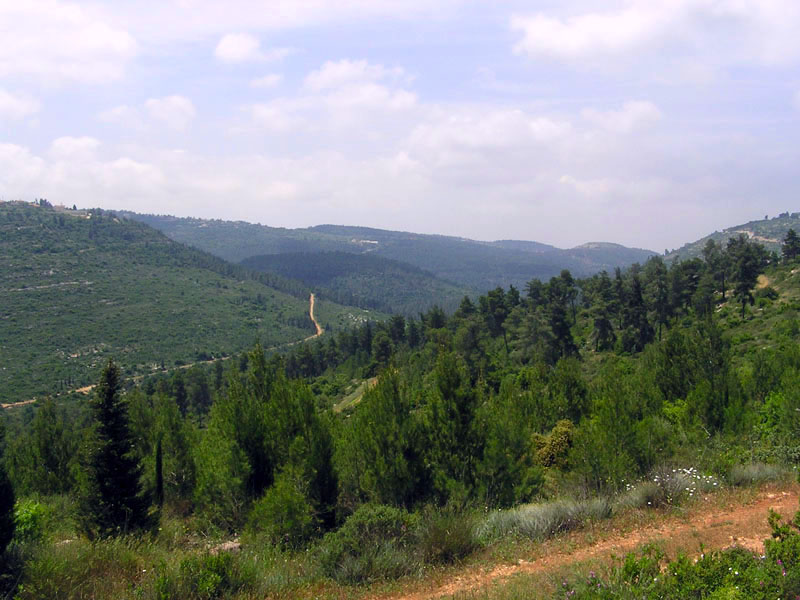
And what of this land? What is it like? It is wonderful! From deserts of the southern Negev to the snow-capped mountains to the north, to the 270 miles of coastline along the Mediterranean and to the frontier at the east, it is a diverse land.
Mountains of Judea, source Wikipedia commons
Northern coast. Source Wikipedia commons
Jordan’s Rift Valley, Source Wikipedia commons
Acacia tree in Negev Desert, Makhtesh Gadol, Wiki photo
Jerusalem itself is about 2500 feet in elevation. It sits on a plateau within the mountains, which includes the Mount of Olives, and Mount Scopus. Valleys surround the city. We read in the Psalms some “Psalms of Ascent” because when Jews made the annual trek to the City for Passover, they climbed to the old City. They were ascending.
As the mountains surround Jerusalem, So Yahweh surrounds His people From now until forever. (Psalm 125:2).
And many mountains do surround the city, almost like a rampart. Some count the peaks numbering 7, and refer to the Revelation 17:9 verse describing a city of seven mountains upon which the harlot sits as Jerusalem, not Rome.
1. Mount Scopus, 2. Mount of Olives 3. Mount of Corruption 4. Mount Ophel 5. Mount Zion/Moriah (AKA the Temple Mount) 6. New Mount Zion 7. the Roman Antonia Fortress peak
The Kidron Valley runs to the east of Old Jerusalem and the Mount of Olives is actually separated from it. Along the southern side of old Jerusalem is the Valley of Hinnom, a steep ravine where hell or Gehenna is mentioned and the trash heaps blazed night and day. In biblical times, lush forests surrounded the city, forests of almond, pine, and olive. These forests are gone now. Due to the steep incline, farmers used a terracing system to keep the soil in place and those can still be seen today.
I’d mentioned that Jerusalem was the primary city for the Israelites for “most” of their life, but in the early years of the Israelite kingdom, the Ark of the Covenant was sometimes moved around to several sanctuaries, especially those of Shechem and Shiloh. Shiloh was the capital for almost 400 years, before the first temple was built. Jeremiah 7:12a says
“But go now to My place which was in Shiloh, where I made My name dwell at the beginning,
After King David’s capture of Jerusalem, the Ark was moved to Jerusalem. Its presence there signified the presence of the LORD within the Holy of Holies. Sadly, the people’s idolatry, bloodshed, and disobedience meant that eventually the glory would depart from the Temple (Ezekiel 9-10). This happened in advance of the Babylonian sacking of the temple. In fact, God’s glory would never again occupy a temple or a building on earth.
Today the glorious temple is mostly gone. Only the grounds and the Western Wall (a retaining wall) are left of the original building. Atop the grounds lies the Dome of the Rock, the 3rd most holy site in Islam. Will there be a third temple? Some believe so, that the events of Ezekiel 37 indicate a future restoration of the temple with Jesus bodily present and with His people:
And the nations will know that I am Yahweh who sanctifies Israel, when My sanctuary is in their midst forever.
Jerusalem today is a bustling city, the intersection of three religions- Islam, Christianity, and Judaism. One day the ‘City of Truth’ will know only 1 true religion, and its inhabitants will worship Yahweh properly. What a day that will be!
This is the third of a 4-part series on the Great Cities of the Bible. I’ve written about Damascus and Babylon in the first two parts. Damascus first because it is among the first cities mentioned in the Bible and is the oldest continuously inhabited city in the world. And I chose Babylon second because its presence from Genesis to Revelation dominates the Bible’s spiritual and historical landscape.
Now we turn to Rome. GotQuestions notes that – “Rome is not mentioned in the Old Testament but figures prominently in the New Testament. Although the city of Rome is not often directly mentioned, every place and event in the New Testament has Roman rule as its background.“
Part of the reason I’m doing this series is because we tend to be myopic in our day and age, thinking we are the most advanced or the most sophisticated or our culture is the best. It’s hard to physically go see that in Babylon because it is mostly a ruin now. Damascus is considered to be one of the most beautiful cities in the Arab world, but sadly, the ongoing war has destroyed much of it by now. However ROME! Ahh, Rome, one can wander the streets and see many buildings from the Bible days intact. One can envision Paul standing up in court…writing his ‘Jail Epistles’ (Ephesians, Colossians, Philippians and Philemon). We can visit the Colosseum where so many Christians were martyred.
Underfloor of the Roman Colosseum, where many Christians were martyred. EPrata photo
Rome is both the city and was an Empire. It is urban setting and also a character itself in the Bible history. It is a city past from Bible days, a thriving city today, and it is an Roman empire future in prophecy. Rome was the oppressor of the Jews in Judea but its engineered roads allowed for the dispersed believers to bring the Gospel out to the world.
It was first called The Eternal City (Latin: Urbs Aeterna; Italian: La Città Eterna) by the Roman poet Tibullus in the 1st century BC, and the expression was also taken up by Ovid, Virgil, and Livy. Rome is also called “Caput Mundi” (Capital of the World).
Rome is also known as the City of Seven Hills, due to the hills that it is founded on and provide a backdrop. This may become important later when in prophecy, discussed more in the postscript.
For almost a thousand years the continent’s people were either one of the unfortunate tribes conquered and absorbed into the vastly growing Roman empire, or were one of the privileged Romans citizens enjoying the engineering marvels the Romans invented and especially Pax Romana (widespread peace) during the 200 years of the Empire’s height. Paul the Apostle was a Roman Citizen, and this fact allowed him to escape one of the intended beatings, to stand in a Roman Court and plead his case, and at the end, legend says, given the less painful execution of beheading.
Rome was said to be founded around 625 BC in the areas of ancient Italy’s center known as Etruria and Latium. Etruria was home to the mysterious people of the Etruscans (from which we get the name Tuscany). Not much is known of the Etruscans, except they were a sophisticated culture, master bronzesmiths, their tombs were expertly painted, they formed city-states all over Tuscany as far south as Rome, and began sewer and other construction projects in Rome. It is said that the Etruscans had a heavy influence on the conquering Romans.
For about a hundred years or so, this merging and overlap of the Etruscans and the Romans led to the period known as the Age of Kings, which came to an end when the Etruscans disappeared, and the Roman Republic was born. (510 BC). It was during this time that Romans codified their laws and were led by the citizens (upper class senators and knights).
They continued to expand their empire with masterful military strategies and successive victories. By 338 BC they had conquered the entire Italian peninsula and a few years later gained control of the Mediterranean as a dominant maritime power.
The time of Jesus’ birth through his death & resurrection, the rise of the Church, and the last of the first generation witnesses (31BC to 90 AD and beyond) was known as the Imperial Rome era. During this period, Rome saw decades of peace, prosperity, and expansion. Its maximum land expansion occurred in about AD 117, near when Apostle John died. Its empire spanned three continents including Asia Minor, northern Africa, and most of Europe as far north as Scotland.
Unlike many other conquering empires, Rome allowed worship of personal gods. They were a pantheistic society. We remember in Daniel 1 when Nebuchadnezzar besieged and conquered Jerusalem and carried off its captives, “among them from the sons of Judah were Daniel, Hananiah, Mishael, and Azariah.7 Then the commander of the officials set names for them; and for Daniel he set the name Belteshazzar, for Hananiah Shadrach, for Mishael Meshach, and for Azariah Abed-nego.” (Daniel 1:6-7). The practice of forced assimilation was common. The boys were given new names, forced to eat what was eaten by the natives, and forced to worship what the natives worshiped, namely, the king. But unusually for an Empire, that was not Rome’s practice.
Definition: Assimilation is one outcome of acculturation. It involves the complete adoption of the ways of life of the new cultural group, resulting in the assimilated group losing nearly all of its original or native culture.
Rome practiced assimilation. Captured peoples from the many wars were brought to Rome as slaves but allowed to practice their religion and maintain their culture. The building in Rome called The Pantheon was originally a temple built for all Roman gods, then later any gods. Pan means “all” and “theos” means “gods”.
The Pantheon in Rome, one of Rome’s best preserved buildings to this day. EPrata photo
The Roman Empire was a primarily polytheistic civilization, which meant that people recognized and worshiped multiple gods and goddesses. Despite the presence of monotheistic religions within the empire, such as Judaism and early Christianity, Romans honored multiple deities. They believed that these deities served a role in founding the Roman civilization and that they helped shape the events of people’s lives on a daily basis. Romans paid allegiance to the gods both in public spaces and in private homes. While the Roman state recognized main gods and goddesses by decorating public buildings and fountains with their images, families worshipping at home also put special emphasis on the deities of their choosing. Source
The Jews in Judea were overseen (oppressed) by Rome, which sent it governors and soldiers to keep the peace, but largely (except for taxes to keep up the empire) they were allowed to continue as they were and that included worship.
Romans built things. Bridges, temples, mansions, aqueducts, and roads. They had sewers, hot and cold running water, and spas. They had colosseums for their beloved games. It was the roads that allowed the dispersing Christians to take the Gospel to the outermost parts of the empire and beyond. It was the spread of the Latin language in the huge Empire that allowed folks to understand one another when sharing the Gospel with natives. The Roman influence on art and architecture was massive and stands to this day. They loved games and competitions, and they built amphitheaters to play them in. The round and oval stadiums we see today are derived from the Romans. They even held “naumachia” in them, or sea battles. They engineered a system where the amphitheaters could be flooded to host maritime competitions with ships!
Because of their sophisticated government, art, engineering, culture, and lifestyle, the Romans often referred to all other tribes as “barbarians.” They deeply believed they were a superior race to the Germanic tribes or the Celts, both of which they had conquered. However, the Romans for all their marvels and sophistication in the arts, were still pagans, which means, barbaric themselves. Any culture that enjoys live bloody competitions to the death, which invents crucifixion as a method of execution, or dips Christians in tar and sets them alight for garden illumination, is barbaric themselves. No veneer of art or poetry or law can hide the fact that without Christ, any society will die. And the Romans did. After its Pax Romana era came to a close, the city declined until 410 when the Visigoth King Alaric successfully sacked the city of Rome. The “Eternal City” was no more.
POSTSCRIPT
After Alaric and the beginning of the Middle Ages, Rome slowly fell under the political control of the Popes, and in the 700s, Rome became the capital of the Papal States, which lasted until 1870. Even today, Vatican City is a sovereign state inside Rome. The Pope is one of the very the last absolute monarchs on earth. An Absolute Monarchy, which Vatican City is governed by, is defined as “a form of government in which a single person—usually a king or queen—holds absolute, autocratic power. In absolute monarchies, the succession of power is typically hereditary, with the throne passing among members of a ruling family.”
“Absolute monarchies, where the monarch is the final authority, are few and far between these days. There are currently five, excluding subnational monarchies: Brunei, Eswatini, Oman, Saudi Arabia and Vatican City.”
In Revelation 17:7, we read that Babylon the harlot is riding on a beast having seven heads and ten horns. The seven heads are called seven hills or seven mountains in verse 9. Everyone at the time that passage was written was so familiar with Rome being called the city of seven hills it is likely that they understood this to be Rome. As Daniel 2 describes the flow of the world empires from beginning to end in a vision of a statue, will the last empire be a revived Roman Empire? One that includes an absolute monarchy, that already exists today, led by a false prophet (of the Catholic Church?) Many think so.
Further Reading
Book- SPQR: A History of Ancient Rome by Mary Beard. (I’m reading this book. It’s good).













 the-end-time.org