Posted in bible, encouragement, exhortation, worship

Worship Jesus

By Elizabeth Prata

Worship Jesus and Jesus alone. Worship this same Jesus as God revealed Him to the world.

Do not worship Prophets, past or present.

“And Peter said to Jesus, “Lord, it is good that we are here. If you wish, I will make three tents here, one for you and one for Moses and one for Elijah.”” He was still speaking when, behold, a bright cloud overshadowed them, and a voice from the cloud said, “This is my beloved Son, with whom I am well pleased; listen to him.” (Matthew 17:4-5).

Jesus stopped Peter from making three tabernacles. It is acceptable to worship ONLY Jesus. This is such a strong truth that the Spirit stopped Peter from proclaiming worship of Moses and Elijah while he was still saying it.

Do not worship Angels.

“I, John, am the one who heard and saw these things. And when I heard and saw them, I fell down to worship at the feet of the angel who showed them to me, but he said to me, “You must not do that! I am a fellow servant with you and your brothers the prophets, and with those who keep the words of this book. Worship God.” (Revelation 22:8-9).

Again we read, ‘Worship God.’ Angels are fellow servants with us of the Most High God.

Do not worship men.

“And when the crowds saw what Paul had done, they lifted up their voices, saying in Lycaonian, “The gods have come down to us in the likeness of men!” Barnabas they called Zeus, and Paul, Hermes, because he was the chief speaker. And the priest of Zeus, whose temple was at the entrance to the city, brought oxen and garlands to the gates and wanted to offer sacrifice with the crowds. But when the apostles Barnabas and Paul heard of it, they tore their garments and rushed out into the crowd, crying out, “Men, why are you doing these things? We also are men, of like nature with you, and we bring you good news, that you should turn from these vain things to a living God, who made the heaven and the earth and the sea and all that is in them.” (Acts 14:11-15).

Worship Jesus. Listen to Him.

Posted in church, contemporary music, encouragement, music, worship

Is Music Worship? Do singers "lead worship"?

By Elizabeth Prata

The selection of music in churches is important and is not based simply on preferences. Do not pooh-pooh the music by marginalizing it to a second tier of concerns and assigning it as simply a “preference.” Music is doctrine, sacred music is unique to the redeemed because it is our response to His redeeming work, and it is either reflective of the culture or it is reflective of the worshipful heart.

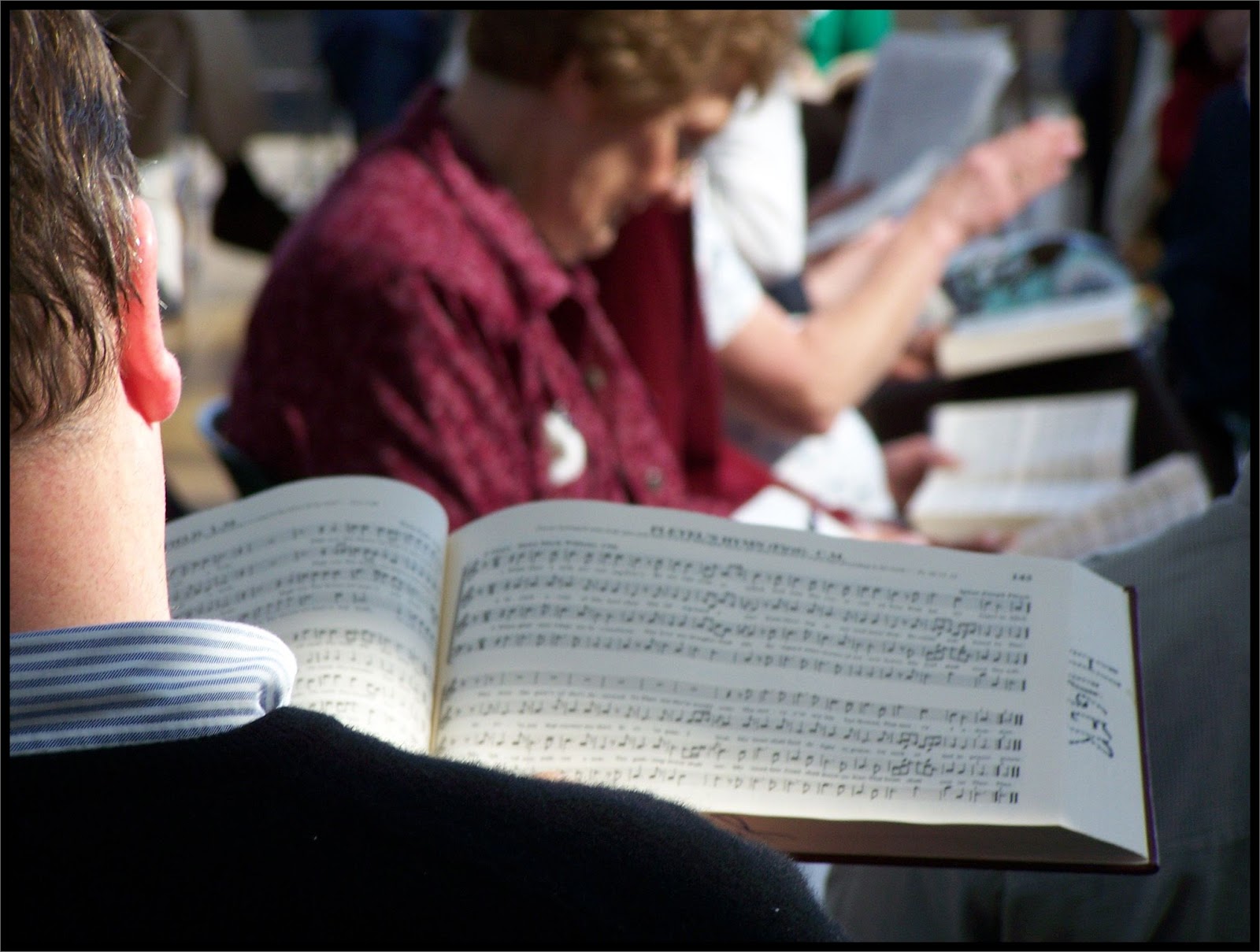
Old Harp singers. EPrata photo

First, let’s talk about what music in church is NOT. These are taken from John MacArthur’s sermon “Is Music Worship?” based on the verses at Ephesians 5:18-20.

  • Music is not worship. Music is a means to express worship, but it is not worship.
  • Secondly, a misconception is that music motivates worship, music induces worship. That’s not true either. … [T]he motive for all of our songs is not a sound, it’s a truth.
  • Another misconception is that when people have trouble worshiping, music will create worship, music will create the mood for worship. Worship is not a mood experience.

What true worship IS, is-

a permanent attitude. John 4, “We worship in spirit and truth.” That’s who we are. … The music of the redeemed is different. We live in a different world. We are citizens of a different kingdom. The music of the redeemed is alien to the music of the world. The music of the redeemed is reflective of that which is most lofty, most elevated, most exalted, most noble: the truth of God – it never changes. So our music doesn’t ride the culture. Music doesn’t ride the culture among the redeemed, it simply reveals the truth, and the truth never changes. (Source)

I encourage you to listen to the sermon. The explanation about music and its place in worship among the redeemed is stupendously explained, especially when you arrive at the powerful ending.

Meanwhile, I’d read missionary Gladys Aylward’s autobiography and was struck by something described at the end of the book. The following is my retelling of Aylward’s event.

Unsplash photo, free to use

There is a great story in China Missionary Gladys Aylward’s autobiographical book “The Little Woman.” This occurred in the mid-1930s. She is trying to escape the invading Japanese, because they had put a price on her head. So she walked in a direction no Chinese went, over some mountains where the map was blank. She was with one other missionary. At dusk, seeing no human, no town, no habitation at all, they were debating whether to go back. The man told Aylward to sit on this nearby stump and he would go ahead a bit and see what’s what. Alone, Gladys began to sing hymns.

Soon the man came back and said, no luck. They might freeze out there or if they go back they might be killed. Just then a Lama (Buddhist Monk) came up. He said, come with me, we will take you to our lamastery. No people were EVER invited into a lamastery. But the duo believed it was an ordained appointment. I mean, what were the odds, right? So they went. They were led up the side of the mountain high up to a lamastery carved into the rock. They were greeted happily and warmly and fed and made comfortable.

She asked the head Lama the next day why they had been so cordially welcomed to such a private and mysterious place. Lama said that 7 years ago they brought to town their licorice that they pick and sell. They heard a lone man in the square saying that there is a God who loves them and salvation is free, if they believe- come to this building tonight to hear more. They were astounded that such a doctrine existed. There is a God? He loves? They accepted the tract the man was handing out, simply the verse at John 3:16 and the address, nothing more.

For five years they sought to learn more but were unable. Every time they went to town to sell their licorice they asked everyone about where to find “the God who loves.” No one else could tell them. Then one day a man was there and he did say yes, go to the China Inland Mission over there and they will tell you. A Mission house had been established.

They went to the Mission house and received New Testament Bibles and tracts, which they brought back to the lamastery and read eagerly. They delighted in the notion that there was a “God who loves” but there was much in the book they did not understand. Still, they read, and they came to the verse where Christ had said of his apostles, “Go ye into all the world and preach the Gospel.” And the monks believed that one day a person would come and preach to them them, because it said so in the book.

And three years later when they heard singing, they knew the person had come, because as the Monk said, “Only people who know God will sing.” And the person was Gladys and her companion. They rejoiced, knowing they were about to learn more. So she and the other missionary told all the monks about Jesus and then they left the next day, not knowing if the lamas were saved or became saved, but trusting that some would, sometime.

~~~~~~~~~~~~~~~~~~~~~~

I had never thought about it before, but no other major religion really sings. Of course anything other than biblical Christianity is a false religion. You get chants, but no hymns. No singing. On that cold, dusky night, Gladys was recognized by Buddhists because she sang. Our music IS unique and we are eternally identified with it. It is not simply a preference. Toward the end of his sermon, John MacArthur said this:

And by the way, Christians are the only religion that sing. Muslims don’t sing, Buddhists don’t sing, Hindus don’t sing. They don’t sing. Some chant in a minor key; Christians sing. But when the Reformation came, music was reintroduced to the church; and you sing a hymn written by Martin Luther who launched the Reformation: A Mighty Fortress is our God. Five-hundred years after that, we’re still singing that hymn.

We sing because we have been redeemed. We sing a new song, one that the world does not hear. We sing because-

He brought me up out of the pit of destruction, out of the miry clay, and He set my feet upon a rock making my footsteps firm. He put a new song in my mouth, a song of praise to our God; many will see and fear and will trust in the Lord. (Psalm 40:2-3)

Posted in theology, worship

Passion itself is not worship

By Elizabeth Prata

Oftentimes the method or expression of our response to preaching (i.e. ‘worship’) becomes an idol. Depending on denomination, geographic location, or even age of the believer, people express themselves in church service in various ways. That’s OK. The worrying part comes when, rather than focusing on the object of worship, the method of worship becomes the focus. Don’t let that happen. Continue reading “Passion itself is not worship”

Posted in theology, worship

Is your church a spectacle in the right way or the wrong way?

By Elizabeth Prata

Where are your eyes looking? What’s claiming your attention?

spectacle

The church was the one institution whose mission depended on galvanizing attention; through its daily and weekly offices, as well as its sometimes central role in education, that is exactly what it managed to do. At the dawn of the attention industries, then, religion was still, in a very real sense, the incumbent operation, the only large-scale endeavor designed to capture attention and use it. ~Tim Wu: The Attention Merchants

These days there are competing operations, all vying for our attention.

For politics, power, war, sex, sports, social media, gaming, or entertainment the best spectacles grab mass attention. Our culture is no longer banded together by shared beliefs; it’s drawn together by shared spectacles. ~Tony Reinke, Competing Spectacles

If  culture is no longer banded together through shared beliefs but by shared spectacles, what of the church, where we’re supposed to be banded by beliefs but now share only spectacles? Woe!

Hopefully your church hasn’t sunk into the idea that maintaining a spectacle is the only way to capture a person’s attention. It’s our beliefs that unite us, with that three-fold cord not easily broken.

When a preacher lifts up Christ crucified, it is the premier spectacle that captures us, the doctrines around that cross are the only draw that holds us together. Not concerts or hot dog barbecues or revival extravaganzas. Those spectacles hold attention only for a moment. Just the preaching of Christ and Him crucified is the pivotal sight before our eyes.

I pray your Lord’s Day is filled with the Word, song, prayer, fellowship, and the saturation of the shared belief that sustains and nurtures our souls.

cross

Posted in theology, worship

Songs of praise, looking up

By Elizabeth Prata

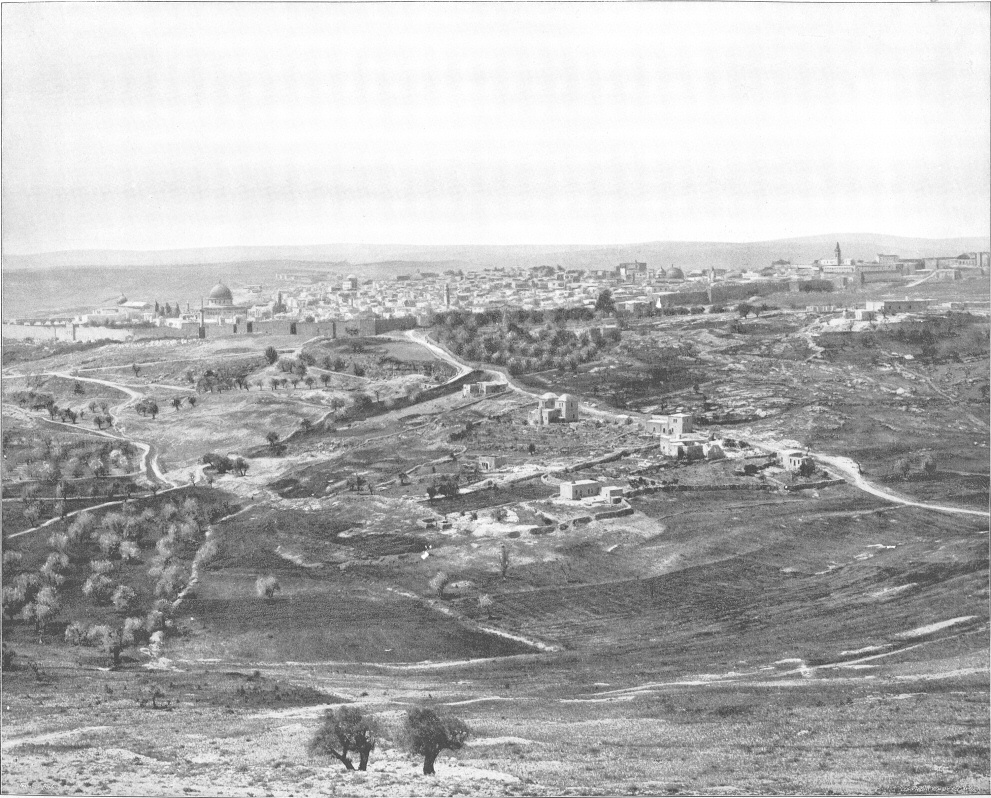
jerusalem from scopus

Jerusalem from Scopus

‎We have no means of knowing whether Joseph and Mary entered Jerusalem on their way to Bethlehem. They certainly passed in sight of the Holy City. Scopus, from which our view is taken, is to the north on the road from Nazareth to Bethlehem. We will assume that they saw Jerusalem from this point. It was not the same Jerusalem we saw for the last time, as we made our way to the north on May 2d, 1894, but Josephus has left on record a description of the city as it existed in the time of Herod, and it is possible for us to construct in imagination the city of that time.

The framework is the same to-day as it was in the year 5 B. C. The same hills are there: Zion, Moriah and Acra. The same valleys are there: Hinnom, Tyropeon and Jehoshphat. The Temple of Herod, which was eighty-three years in building, had been in course of erection for fourteen years. From Scopus where we are standing they could have seen the ground plan of the temple, within the same enclosure of thirty-five acres, where we now see in the distance the Mosque of Omar.

Source: Earthly Footsteps of The Man of Galilee, being three hundred and eighty-four… views and descriptions of the places connected with the earthly life of Our Lord and His Apostles … By Bishop J.H. Vincent, etc. – 1894. This striking photographic journey throughout the Holy Land illustrated with no less than 384 b/w photographs taken in 1894 by R. E. M. Bain in order to document the expedition to Palestine headed by clergyman James Wideman Lee.

You can see that Jerusalem sits atop the mount, and the road leading up to it ascends. That is likely why the Psalms between Psalm 120-134 are named Psalms of Ascents. Though no one is quite positive about this, it is believed that these particular Psalms are gathered into a little hymnbook inside the larger body of Psalms because they were meant to be sung as the Israelites ascended the road to Jerusalem in advance of the several feasts and celebrations they were required to attend under the Law. The previous bunch of Psalms are called the Hallel Psalms, hallel meaning songs of praise, you can see we get the word hallelujah from hallel.

Phil Johnson explains it all here, in The Song of a Truly Blessed Man:

The position in the canon is significant, I think. They are grouped with Psalm 119 and the hallel Psalms. Most commentators nowadays believe these 15 psalms were sung by groups of pilgrims as they made their way to Jerusalem for those three pilgrim festivals—the same holy convocations where the Hallel psalms were sung.

So it’s my conviction that the “Psalm[s] of Ascents” were songs for the journey. These are songs for pilgrims as they ascend to a higher place. You know that Jerusalem is situated on a high elevation. The Temple was built at the very top of Mount Zion, and the city itself was the highest populated place in Israel. So no matter where you were coming from, it was always up to Jerusalem. Every journey to Jerusalem was a pilgrimage to a higher place—and those annual pilgrimages therefore made a perfect metaphor for spiritual growth.

Whether your church is up a mount or down a valley or on even ground, sing praises as you look UP today to the highest of the High, the exalted and lifted up Jesus.

By common confession, the mystery of godliness is great: He appeared in the flesh, was vindicated by the Spirit, was seen by angels, was proclaimed among the nations, was believed in throughout the world, was taken up in glory. (1 Timothy 3:16)

May your Lord’s Day be blessed.

Posted in church, contemporary music, encouragement, music, worship

Is Music Worship? Do singers "lead worship"?

The selection of music in churches is important and is not based simply on preferences. Do not pooh-pooh the music by marginalizing it to a second tier of concerns and assigning it as simply a “preference.” Music is doctrine, sacred music is unique to the redeemed because it is our response to His redeeming work, and it is either reflective of the culture or it is reflective of the worshipful heart.

EPrata photo

First, let’s talk about what music in church is NOT. These are taken from John MacArthur’s recent sermon “Is Music Worship?” based on the verses at Ephesians 5:18-20.

  • Music is not worship. Music is a means to express worship, but it is not worship.
  • Secondly, a misconception is that music motivates worship, music induces worship. That’s not true either. … [T]he motive for all of our songs is not a sound, it’s a truth.
  • Another misconception is that when people have trouble worshiping, music will create worship, music will create the mood for worship. Worship is not a mood experience.

What true worship IS, is-

a permanent attitude. John 4, “We worship in spirit and truth.” That’s who we are. … The music of the redeemed is different. We live in a different world. We are citizens of a different kingdom. The music of the redeemed is alien to the music of the world. The music of the redeemed is reflective of that which is most lofty, most elevated, most exalted, most noble: the truth of God – it never changes. So our music doesn’t ride the culture. Music doesn’t ride the culture among the redeemed, it simply reveals the truth, and the truth never changes. (Source)

I encourage you to listen to the sermon. The explanation about music and its place in worship among the redeemed is stupendously explained, especially when you arrive at the powerful ending.

Meanwhile, I’d read Gladys Aylward’s autobiography and was struck by something described at the end of the book. The following is my retelling of Aylward’s event.

~~~~~~~~~~~~~~~~~~~~~~
Unsplash photo- free to use

There is a great story in China Missionary Gladys Aylward’s autobiographical book “The Little Woman.” This occurred in the mid-1930s. She is trying to escape the invading Japanese, because they had put a price on her head. So she walked in a direction no Chinese went, over some mountains where the map was blank. She was with one other missionary. At dusk, seeing no human, no town, no habitation at all, they were debating whether to go back. The man told Aylward to sit on this nearby stump and he would go ahead a bit and see what’s what. Alone, Gladys began to sing hymns.

Soon the man came back and said, no luck. They might freeze out there or if they go back they might be killed. Just then a Lama (Buddhist Monk) came up. He said, come with me, we will take you to our lamastery. No people were EVER invited into a lamastery. But the duo believed it was an ordained appointment. I mean, what were the odds, right? So they went. They were led up the side of the mountain high up to a lamastery carved into the rock. They were greeted happily and warmly and fed and made comfortable.

She asked the head Lama the next day why they had been so cordially welcomed to such a private and mysterious place. Lama said that 7 years ago they brought to town their licorice that they pick and sell. They heard a lone man in the square saying that there is a God who loves them and salvation is free, if they believe- come to this building tonight to hear more. They were astounded that such a doctrine existed. There is a God? He loves? They accepted the tract the man was handing out, simply the verse at John 3:16 and the address, nothing more.

For five years they sought to learn more but were unable. Every time they went to town to sell their licorice they asked everyone about where to find “the God who loves.” No one else could tell them. Then one day a man was there and he did say yes, go to the China Inland Mission over there and they will tell you. A Mission house had been established.

They went to the Mission house and received New Testament bibles and tracts, which they brought back to the lamastery and read eagerly. They delighted in the notion that there was a “God who loves” but there was much in the book they did not understand. Still, they read, and they came to the verse where Christ had said of his apostles, “Go ye into all the world and preach the Gospel.” And the monks believed that one day a person would come and preach to them them, because it said so in the book.

And three years later when they heard singing, they knew the person had come, because as the Monk said, “Only people who know God will sing.” And the person was Gladys and her companion. They rejoiced, knowing they were about to learn more. So she and the other missionary told all the monks about Jesus and then they left the next day, not knowing if the lamas were saved or became saved, but trusting that some would, sometime.

~~~~~~~~~~~~~~~~~~~~~~

I had never thought about it before, but no other major religion really sings. Of course anything other than biblical Christianity is a false religion. In these false religions, there are chants, but no hymns. No singing. On that cold, dusky night, Gladys was recognized by Buddhists because she sang. Our music IS unique and we are eternally identified with it. It is not simply a preference. Toward the end of his sermon, John MacArthur said this:

And by the way, Christians are the only religion that sing. Muslims don’t sing, Buddhists don’t sing, Hindus don’t sing. They don’t sing. Some chant in a minor key; Christians sing. But when the Reformation came, music was reintroduced to the church; and you sing a hymn written by Martin Luther who launched the Reformation: A Mighty Fortress is our God. Five-hundred years after that, we’re still singing that hymn.

We sing because we have been redeemed. We sing a new song, one that the world does not hear. We sing because-

He brought me up out of the pit of destruction, out of the miry clay, and He set my feet upon a rock making my footsteps firm. He put a new song in my mouth, a song of praise to our God; many will see and fear and will trust in the Lord. (Psalm 40:2-3)

Posted in encouragement, praise, scripture photo, worship

Scripture photo: Love unmerited; and a praise to the Lord

I attended a church service today that was so sweet, so fresh, so fine, it sparked my thirst for seeing Jesus face to face all the more. Heaven’s worship is going to be so wonderful, I can hardly think on it!

The service began with five baptisms at the middle service. The pastor said there were several baptisms at the early service and several more would be conducted at the later service. Upon stating their desire for baptism, the prospective baptizees must complete a four week ‘new member’ course prior to being immersed. Baptism at this church is a serious thing, being a weighty ordinance of the Lord, and it is not undertaken casually. Therefore, knowing this, I celebrated their obedience into the faith all the more! I always tear up at baptisms, and this one was so beautiful I did have many more tears than usual. The elderly lady sitting next to me put her arm around me and said “Is one of them yours?” I said “No, but yes, they all are, now. They are my family.”

And Peter said to them, “Repent and be baptized every one of you in the name of Jesus Christ for the forgiveness of your sins, and you will receive the gift of the Holy Spirit. (Acts 2:38)

What a blessing to see new believers step forward and openly declare their intent to follow Jesus. Some of the baptizees were adults, some were college aged, some were younger. One man was an exchange student from China. What a wondrous display of the Holy Spirit’s move, to bring a person here to be baptized into the faith and when his school term ends, will return to plant his own seeds.

I planted, Apollos watered, but God gave the growth. (1 Corinthians 3:6)

After some good music, “Holy Holy Holy is the Lord God almighty…” the pastor said that next Sunday the congregation will come together to vote on purchasing a house and 4-acre parcel adjacent to the existing 16-acre campus, it will complete their long-term vision. They believe they are meant to be in that spot, stay in that spot, and to grow disciples who in turn go out and plant churches in the neighborhood, county, state, nation, and the world. And they are doing this. They are committed to this biblical model, and it is a joy to see their obedience to it and the Spirit’s working through them in it.

Go therefore and make disciples of all nations, baptizing them in the name of the Father and of the Son and of the Holy Spirit, teaching them to observe all that I have commanded you. And behold, I am with you always, to the end of the age. (Matthew 28:19-20)

The sermon was at once Jesus-exalting and personally humbling as the pastor exposited the word of God and gravely and lovingly explained a parable from Matthew. What a balm to receive the word from a mature preacher who understands the scripture and is eager and sober in explaining it to his flock.

And I will give you shepherds after my own heart, who will feed you with knowledge and understanding. (Jeremiah 3:15)

After the sermon we had the privilege of praying over and commissioning a couple with their baby who are finishing their furlough and are returning to their mission field into East Asia. Anyone who wanted to pray aloud for this humble and obedient couple was invited forward to do so. Hands were laid upon them, tears were shed, and hope was ignited that many living in darkness would hear the Gospel and be saved.

And he did not permit him but said to him, “Go home to your friends and tell them how much the Lord has done for you, and how he has had mercy on you.” And he went away and began to proclaim in the Decapolis how much Jesus had done for him, and everyone marveled. (Mark 5:19-20)

I know the state of the visible church and it is not good. But the gates of Hades will not prevail against the church that Jesus is building and where there IS a solid visible congregation, it is a beautiful thing.

Built on the foundation of the apostles and prophets, Christ Jesus himself being the cornerstone, in whom the whole structure, being joined together, grows into a holy temple in the Lord. In him you also are being built together into a dwelling place for God by the Spirit. (Ephesians 2:20-22)

The worship of the Holy head of our church, Jesus Christ, no matter where you are, is a life-affirming, sobering, joyful, glad thing, and something we have privilege to do each day for all eternity when we arrive en masse at New Jerusalem at the rapture. O blessed day.

Praise the Lord! I will give thanks to the Lord with my whole heart, in the company of the upright, in the congregation. (Psalm 111:1)