Posted in buzz words, Christian vocabulary, discernment, words

New liberal buzzword: "faith streams"

The definition of jargon is Jargon is

“a literary term that is defined as a use of specific phrases and words by writers in a particular situation, profession or trade. These specialized terms are used to convey hidden meanings accepted and understood in that field. Jargon examples are found in literary and non-literary pieces of writing.”

It’s not only a literary device, but certain buzzwords can exist in any organization, including Christianity. When you hear or read new ones, discernment picks up. The words release, favor, manifest, anointing, seed are markers of a prosperity speech. Gnosticism is rife with references to secret, knowledge, levels, ascend, divine, lost books, etc. An emergent church will speak of vision casting, contextualize, becoming, having a conversation, missional, narrative, story

I’ve been seeing and reading people use the word streams or faith streams lately. As in, “People from different faith streams came together at the football field for prayer.” Or, “People from different faith streams are welcome to attend our church.” I’ve seen it used on various liberal websites and recently I heard Beth Moore use the term. I decided to look into it.

Streams or faith streams comes from Richard Foster’s book Streams of Living Water: Celebrating the Great Traditions of Christian Faith. Richard Foster is known in Mystical/Emergent circles as an expert on spiritual formation. He has been deeply influenced by Mother Teresa and other Catholic mystical contemplatives, and in turn has influenced many others such as Watchman Nee and Henri Nouwen. Streams of Living Water is synopsized here in this Resource Guide,

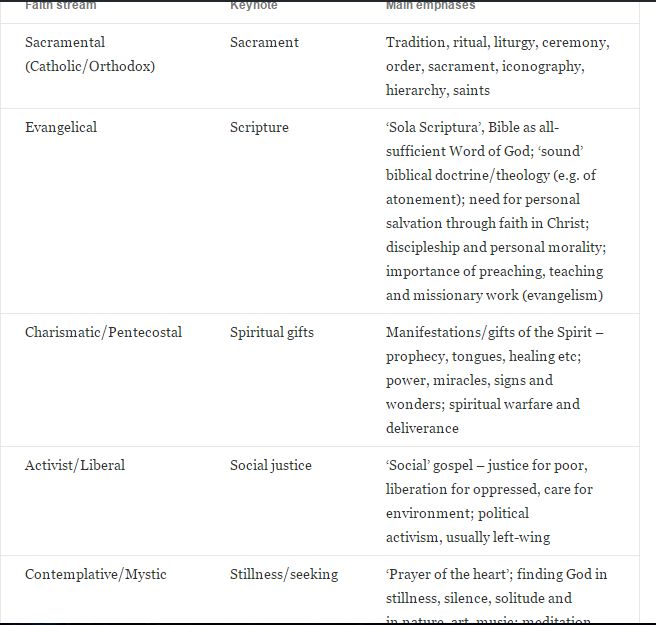
Foster begins Streams of Living Water with the assertion that Jesus is the source of each of the great traditions of Christian spirituality—Contemplative (the prayer-filled life), Holiness (the virtuous life), Charismatic (the Spirit-empowered life), Social Justice (the compassionate life), Evangelical (the Word-centered life) and Incarnational (the sacramental life). Once Foster persuades us that each tradition has its source in the life of Jesus, he devotes a chapter to each of the six traditions.

Incarnational really means Roman Catholic. Immediately we understand there is a problem, if the author of Streams is saying that Jesus is the source of Roman Catholicism. He is not, Satan is the source of Roman Catholicism. The Resource Guide continues,

The church is the Body of Christ. Not surprisingly, its history has been washed by movements that have become great traditions. And each of these traditions finds its origin in the life of Jesus. The life of Christ is our template for living a life of prayer, purity, power, passion, proclamation, and presence. Jesus is our model for balanced and holistic living. An overemphasis on doctrine and division has resulted in the visible church bearing more resemblance to a shattered vase than the pulsating body of Christ. It’s time to put the pieces of the chalice back together.

Streams means that those who believe the liberal/Richard Foster doctrines, one will claim brotherhood in Christ with the following versions of Christianity, only one of which is truly and thoroughly valid. Below we have not a summary as we did above, but a table from the “Evangelical Liberal’s” blog, illustrating Foster’s version of faith streams, or traditions.
Words matter. Sin is not mistake. Justification, sanctification, glorification are important doctrinal words to know, understand, and use. Propitiation, redemption, adoption, are theological words with meaning, a meaning that used to be commonly understood by Christians. Redefining words or worse, co-opting words and symbols are satan’s work. Gay used to mean happy. Rainbow used to mean God’s covenant with man, now when it’s used it means perverted love among and between homosexuals. The term contemplative prayer confused many people because we are told in the Bible to contemplate God and to pray. Therefore contemplative prayer can’t be bad. Can it? Yes, it can.

Look into the origins of words. Think about what you’re saying. Before you use a new word, know and understand its origins. It might be the culture’s substitute for a theological word that is important to keep using. The word, like contemplative prayer, might not mean what you think it means, inconceivable as that may be. When you say faith streams, you’re picking up on Richard Foster’s melding of false faiths with Christianity. All streams do not lead to the ocean, just as all paths do not lead to God. Beware, think, study, and don’t be quick to abandon OUR words that have been commonly understood for centuries. Our Christian vocabulary is important, protect it.


Posted in discernment, doctrines, Jesus follower, power, words

Do you "follow Jesus"? Or are you "saved by Jesus?"

People today are starting to say “I follow Jesus.” Or, “I’m a Jesus follower.”  I’m sure you’ve seen this.

People used to say “I’m saved by Jesus.” Or, “Jesus saved me.”

I don’t like saying ‘I follow Jesus’. I’ll tell you why.

Saying “I follow Jesus” puts me as the subject. ‘Look at meeee, I follow.” The verb is about me too. The verb alerts the hearer to something I am doing, following. It puts a picture in the mind of the hearer on two people walking, the second one being the follower, and that is where you’re mind’s eye rests in forming the picture of the words spoken to you. On the one doing the following and not on the One doing the leading.

EPrata photo

It is also kind of boasting. If one is saved by the atoning work of Jesus Christ, it stands to reason that a person would then follow His commands and abide by His statutes. No one says, “I’m saved by Jesus but I don’t follow Him.” The following is tacitly understood by one and all.

But one can say “I follow Jesus” and not be saved. Mormons follow Jesus and are not saved. Catholics follow Jesus and are not saved. Judas followed Jesus for three years and he was not saved. I understand that saying “I’m saved by Jesus” doesn’t guarantee a person is saved, but at least it includes the acknowledgement of sin and the need for a savior. Following Jesus is something a lot of people do, and saying so only increases the likelihood that what they are doing is simply an activity. When you decide to call yourself a Jesus follower, in my opinion it increases the likelihood that are one of the people DOING things for Christ and not actually saved by Christ.

All these people followed Christ, too:

On that day many will say to me, ‘Lord, Lord, did we not prophesy in your name, and cast out demons in your name, and do many mighty works in your name?’ And then will I declare to them, ‘I never knew you; depart from me, you workers of lawlessness.’ (Matthew 7:22-23)

Saying that “Jesus saved me” puts the emphasis on Him. Referencing my salvation by constantly saying “I follow Jesus” puts a boasting aspect to the phrase the speaker may not have intended, but is there nonetheless.

Now, someone could reply that the comment is not about salvation, but is about sanctification. Sanctification is the growth we experience in Christ after we are saved (justified). They could argue that they were saved by Jesus and now they follow Him in His statutes, ever growing in sanctification. After all, Jesus said, “Follow me”.

Yes, Jesus said “Follow me” many times. He said it in Matthew 4:19, Matthew 16:24, John 8:12, Luke 5:11, 1 Peter 2:21, John 10:27, etc. It is biblical to say that one is a follower of Jesus. I cannot categorically condemn the phrase.

I can make a statement that it is unwise to speak solely of one’s salvation OR sanctification in terms of the self. The growth we experience when we follow Jesus is partly done under our own steam but not fully. The Holy Spirit grows us. Our part is aggressive obedience, fervent pursuit, and a total submission. Therefore saying “I follow” seems just so…anemic.

‘Following’ as opposed to submitting, pursuing, or obeying is one step away from Jesus. Who are we following? Why? That small shift in emphasis is incremental but dangerous nonetheless. Once the shift is made away from the object of our pursuit, then the following becomes the main theme. And one can easily go astray. One can follow your bliss.

Creative Commons, source

One can follow a leader. Paul addressed this in 1 Corinthians 1:12-13, because errant ‘following’ was causing divisions.

What I mean is that each one of you says, “I follow Paul,” or “I follow Apollos,” or “I follow Cephas,” or “I follow Christ.” Is Christ divided? Was Paul crucified for you? Or were you baptized in the name of Paul?

The members at Corinth were split along doctrinal lines and had shifted their eyes from Jesus and their unity in Him to personal preferences among different teachers and the doctrines these teachers were teaching.

Erin McCrum wrote about the “why” this trend eschews the name ‘Christian’ in favor of  ‘Follower of Jesus:

…proponents of the “follower” lingo claim two advantages over the label “Christian” or “evangelical.”  “First, it doesn’t carry baggage.  You can wear it abroad, in Islamic countries, or at home with your Jewish or Buddhist friends, without causing offense.  Second, it distances the bearer from the culture wars that have made American politics so divisive.”

In this scenario, one can envision saying to a Muslim, “I’m a follower of Jesus!” and they reply “I’m a follower of Isa!” Hugs all around. It is precisely the offense which makes a Christian a Christian. Paul said if there is no offense then the cross has been taken away (Galatians 5:11). If claiming Jesus as our Christ doesn’t offend, there is something wrong. There should be love in witnessing, but there should be no attempt to cloak, diminish or otherwise distort who we are and who Christ is. Of course the term “Christian” carries baggage. That is the point. The ‘baggage’ is the cross which offends everyone.

Satan is so subtle and so skillful. Satan managed to convince a third of the holy angels who saw the face of God every day, to follow him instead. He convinced Eve to bite the forbidden fruit just by asking a question. It is unwise to allow incremental creep into our language regarding who we are or what we do. Satan will quickly take advantage of it. Instead, we must be mindful, biblical, and vigilant in our language about Jesus and in our active holy walk. See the difference:

The Jesus Follower: I am a pretty good person who just made some mistakes and so I decided to follow Jesus and I want to live out His plan for me because after all, He loves me.

The Christian Saved by Grace: I am a totally depraved sinner saved by unmerited grace of the Son of Man who came to live a sinless life, die as the atoning sacrifice for my sin, and endure all God’s wrath for it. I pursue the resurrected Jesus who has holy standards for the ones He has saved, and am living by those standards to the best of my craven ability, by submission to and obedience in the Holy Spirit. I rest on the promises Jesus the Christ has made to His chosen ones to both activate the faith He has given me, and to empower me to live in ever-growing sanctification. I’m looking forward to obeying him all the days of my life until He deems it the time to bring me home.

I have a very small leak in the tub faucet. A tiny drop comes out every few seconds. One day, the cat had tripped the drain shut. I went into the bathroom a few hours later and there was an inch of water on the bottom of the tub. The litter box was floating. Small doctrinal leaks add up. Explosively wrong doctrine can pop a balloon or a tiny leak of slowly shifting language can drain it. The result is the same.

I’m not a Christian. I’m a Jesus follower.

The terms Christian, sinner, salvation, justification, sanctification etc have lasted so long and been so understandable to everyone for centuries is because they are biblical. These terms transcend time. Be mindful of falling into a trap of exchanging words attached to known and commonly understood concepts with new terms that are nebulous, temporary, cultural and lack Spirit power. Sometimes synonyms aren’t synonyms, but a subtle trick of satan to drain power from our witness.

~~~~~~~~~~~~~~~~~~~~~

Further Reading:

Liberals change word meanings with intent to deceive

The cults are infamous for perverting historically accepted biblical terms. “Is it any wonder then,” said the late Christian apologist/polemicist Dr. Walter Martin in The Riddle of Semantics, “that orthodox Christians feel called upon to openly denounce such perversions of clearly defined and historically accepted biblical terminology, and claim that the cults have no rights — scholastically, biblically, or linguistically — to redefine biblical terms as they do?” (Source)

Posted in amazing grace, discernment, hymns, savior, sinner, words, wretch

Do you mind when they change the lyrics to ‘Amazing Grace’ and leave out "wretch"?

Words matter. I was a newspaperwoman for 7 years and let me assure you, the words we choose to put in print color our perceptions of the world, of people, and of concepts. The same goes for poems, stories, and textbooks. I can’t imagine any writer who doesn’t take care with choosing exactly the right word to use at particular points of his or her piece. (Except maybe Proust).

Consider this sentence,

“The large group of activists marched through town”
“The large group of protesters walked through town”

A different take, depending on which word was chosen, isn’t it?

On March 11, 2003 an actual NY Times headline read:
Iraq forces suspension of U.S. surveillance flights

And on the same day the headline reporting the same incident in USA Today read:
U.N. Withdraws U-2 Planes

This is known as bias. As the essay from ‘News Bias Explored: Word Choice‘ defines, “Words are very precise building blocks that form the basis for all communicated ideas…Bias, in many forms, is not necessarily explicit in the words that have been used but can be recognized when seen in the fuller context that the words represent. Journalists do this by manipulating single words in such a way that whole sentences’ meanings are subtly changed…and sometimes not so subtly.

I wasn’t saved by grace until I was 43 years old. That meant I had many years as a youth and a fully grown adult to reject Jesus and all He stands for. I remember several times being in places where the hymn “Amazing Grace” by John Newton was sung. Whether it was a concert or a church wedding, the hymn is usually familiar to even the most oblivious of a non church-going person, like me, because it is played even at so many places other than church where the lost tend to congregate.

Wikipedia says of the song:

Author Gilbert Chase describes “Amazing Grace” as “without a doubt the most famous of all the folk hymns.” Jonathan Aitken, a Newton biographer, estimates that it is performed about 10 million times annually. “Amazing Grace” stands as an emblematic Negro spiritual and exemplar of Appalachian shape note hymnody. In the nineteenth century the hymn was sung by Native Americans enduring the ordeal of the Trail of Tears, by abolitionists, by soldiers in the U.S. Civil War, and by homesteaders settling the Prairies. Today it has attained international popularity…” (Left, John Newton, author of Amazing Grace”)

What an opportunity the lost person has to learn of the grace of the Great Savior! That they are lost, which they do not know! That grace awaits, which they do not understand. They they are a wretch but can be saved, that they need but do not want. In places where bibles are banned and sermons are stopped, songs can be sung with loaded words which carry the grace of Jesus and the first, dawn-like whiffs of hope and deliverance.

Wretched man that I am! Who will deliver me from this body of death? (Romans 7:24)When I was lost, I liked the hymn. I thought it was pretty, and had a good message and stirred me somehow. Except one part I hated. When it got to the lyric that said, “saved a WRETCH like me.” When it got to that part, I closed my mouth and refused to sing the line. ‘I’m not a wretch’ I’d think to myself. ‘I’m a good person! How ridiculous to have such low self-esteem!’

Of course, that was the point Newton was trying to make. He was a very great sinner, but so are we all. No matter who is singing this song, save one exception in the universe (Jesus), that wretch lyric can and does apply.

Now that we are in such an apostate world, no one likes to believe they are a wretch. But unless we understand how very great of a wretch we are, we will not understand how very great a Savior we have. I heard “Amazing Grace” this week by a new artist. The lyric had been changed. This is what she sang-

“Amazing Grace, how sweet the sound, that saved a SOUL like me.”

For you say, I am rich, I have prospered, and I need nothing, not realizing that you are wretched, pitiable, poor, blind, and naked. (Revelation 3:17)
We all have a soul. Even the most atheistic of people believe we have a soul and it goes somewhere after we die, if even to be annihilated or changed into a centipede. What’s so amazing about grace that saves a soul? Nothing. It is the wretch that is saved that is so amazing.

but God shows his love for us in that while we were still sinners, Christ died for us“. (Romans 5:8)

Jesus didn’t die for souls, He died for sinners, wretched sinners. If you are confronted with a lyric or a verse where it has been changed, please know that it makes a difference. Remember that what you read or hear are words, and words communicate ideas. The most important idea in the universe is that we are all sinners in need of a Savior, and that Savior IS Jesus Christ and no other. We are all wretches, and Jesus as the Sinless One lifted us up and gave us new life in Him. As the article above I’d quoted and linked to states, the lost world likes to change ideas and they do “this by manipulating single words in such a way that whole sentences’ meanings are subtly changed.” Wretch and soul are not the same. Words matter.

~~~~~~~~~~~~~~~~~~~~~~~~~~~~
Further Reading:

Here is a short documentary about the song and how it came to be written.

Amazing Grace: The Story Behind the Song

Wretched Radio with Todd Friel