Posted in encouragement, Uncategorized

The Practical Grace of Alana L.

Alana L. is a Christian, a wife, a mom, an entrepreneur, and a Youtuber. She has been making videos about her life as a mom in Christ for five years, which are published nearly every day. In her first couple of videos, Alana articulates the Gospel and her beliefs. The remaining videos are simply how these beliefs play out during a regular old day, a kind of practical grace.

One video I liked of hers was just over 1 minute long. It showed an empty glass on the floor next to a rocking chair. Her husband had left it there after getting up from eating his sandwich. You know how the Mexican standoff begins, you sinfully say to yourself, ‘Well if he couldn’t bring the glass to the sink, I won’t.’ Or passive-aggressively waving the glass around while asking “Are you done with this glass? I’ll put it in the sink for you.‘ Or just ignore the glass and leave it for him to pick up eventually, when he gets the hint. [They never get the hint]. Or…how to handle this issue lovingly, and what thoughts Jesus would want us to have as Alana muses (while taking the glass to the sink). Practical grace.

Sunny Shell at Abandoned to Christ has some thoughts on motherhood, fatherhood, and family-hood titled The Hands That Rock The Cradle, Heals or Hurts The World

Please read her piece for an encouraging thought for the day. Then enjoy Alana L.’s take on living it out. She covers submission, wife-hood, spanking, discipline, homeschooling, working from home, raising boys, cleaning, marital irritations, lovemaking and attractiveness, bitterness, and more. All the things. Her videos run from 1 minute to 20 minutes. Enjoy.

Alana Lagares Youtube Channel

Posted in encouragement, Uncategorized

The Sifting Hour

My pastor is preaching slowly through Jonah. I love Jonah. What’s not to be intrigued by? The book has everything. A disobedient prophet, action, sovereignty of God, grace, patience, repentance, revival, and miracles- ten of them! (Jonah 1:4, 1:7, 1:15, 1:17, 1:17, 2:10, 3:10, 4:6, 4:7, 4:8).

I think it is amazing that the Spirit inspired Jonah to write his deeds down –  all of them, from the petulant, to the racist, to the rebellious, to the glorious. The Bible doesn’t hide our foibles, sins, and rebellions. The Bible is not a sanitized record of perfect human behavior. Far from it. It’s an honest record of our relationship with God.

Anyway, there’s danger, action, and supernatural miracles, ten of them, in just four short chapters. So naturally I bought the book Moby Dick at Amazon and started reading it. LOL, of course I’m following the pastor and reading the actual Bible. I also listen to other sermons on the topic, as well as give a repeat listen to his sermon later in the week, thanks to podcasts.

But it’s summer, and I’m tired of reading badly written modern books, and the trusty classics never fail me. I had never read Moby Dick, though I’ve read some of author Herman Melville’s short stories. I started reading it and I’m in love with the story.

I got to chapter 9 and Father Mapple’s sermon. It’s a good one, and it’s on Jonah, of course. In the book, Mapple is preaching to New Bedford seamen, including whalers. They’d click with the topic. In Moby Dick, Mapple illustrated the supposed scene as Jonah was ushered to his bunk in the bowels of the ship,

The air is close, and Jonah gasps. Then, in that contracted hole, sunk, too, beneath the ship’s water-line, Jonah feels the heralding presentiment of that stifling hour, when the whale shall hold him in the smallest of his bowels’ wards.

I read that stifling hour as “that sifting hour.”

I like “that sifting hour” better. Not to re-write Melville. But the phrase stuck in my mind. It brought me to Peter. The Lord told Peter,

Simon, Simon, behold, Satan demanded to have you, that he might sift you like wheat, but I have prayed for you that your faith may not fail. (Luke 22:31-32).

This one verse clues us in to so many things. The spiritual war. Satan’s activity. Satan’s targets. God’s sovereignty that satan needed to ask permission. Our cluelessness about whom satan has asked to sift like wheat today. The fact that Jesus prayed for Peter.

It wasn’t more than a few hours that Peter encountered his sifting hour when he denied Jesus three times.

Thoughts of ‘the sifting hour’ brought me to Job.

And the LORD said to Satan, “Have you considered my servant Job, that there is none like him on the earth, a blameless and upright man, who fears God and turns away from evil?” (Job 1:8).

Satan’s answer certainly reveals that satan had considered Job, more than once.

Then Satan answered the LORD and said, “Does Job fear God for no reason? Have you not put a hedge around him and his house and all that he has, on every side? You have blessed the work of his hands, and his possessions have increased in the land.” (Job 1:9-10).

Satan had in fact been carefully watching Job for a long time. He’d noted the hedge, the increase of possessions, the blessings (plural) and all the sides of Job’s life that satan had tried to access, unsuccessfully thus far. Yes indeed. Satan had considered Job.

The sifting hour did come to Job soon after. Absolutely everything was taken away from Job. Except his wife, who told him he should die.

Our own sifting hour might come soon enough. Satan does have a lot of power in this world, being the god of it. (2 Corinthians 4:4. Ephesians 2:2). He messes with God’s people, he has power to bring winds/tornadoes, to draw fire from heaven, to incite armies to raid your home, and to attack your health. Those are just a few of the things satan did to Job. Satan has much power, and is allowed to operate within that power fully as long as it is within God’s will and permission.

Our trials do not always come from satan. Sometimes God Himself brings about chastisement and we endure a sifting hour. He appointed the storm in Jonah’s case, appointed a big fish to swallow him, appointed the hot wind to scour Jonah, and appointed the worm to eat the shade sheltering him. All to bring about obedience and repentance so God’s will and plan would proceed.

Your and my sifting hour might be coming tomorrow or today or next week. Either because we are devout, like Job, or because we are rebellious, like Jonah, or somewhere in the middle like Peter to strengthen our faith. If we stand for Jesus in this world we will have troubles. (John 16:33). When we rebel and are not repentant, we can expect discipline. (Hebrews 12:6, Proverbs 3:12). Trials strengthen us, James says.

Count it all joy, my brothers, when you meet trials of various kinds, for you know that the testing of your faith produces steadfastness. And let steadfastness have its full effect, that you may be perfect and complete, lacking in nothing. (James 1:2-4).

The sifting hour is something I dread emotionally but spiritually I know that it will be good for me in the best possible way- my faith will be strengthened and Jesus’ glory will be gotten.

Let’s go back to Peter’s sifting hour and focus on the wonderful part of the scripture. Satan has asked to sift you like wheat and Jesus said,

but I have prayed for you that your faith may not fail.

Our Mediator and interceder prays for us! John 17:20-23 shows once again that He prays for His sheep. Has ‘the sifting hour’ come upon you? Rest assured that Jesus ordained it, appointed it, and is praying for you and is interceding for you and intends the best for you. And when it happens to me, I’ll repeat those comforts to my own mind and heart as well. Jesus said in His high priestly prayer, this is-

-so that the world may know that you sent me and loved them even as you loved me. (John 17:23b)

What is sifted out of the chaff is love and glory. And this is the best of all.
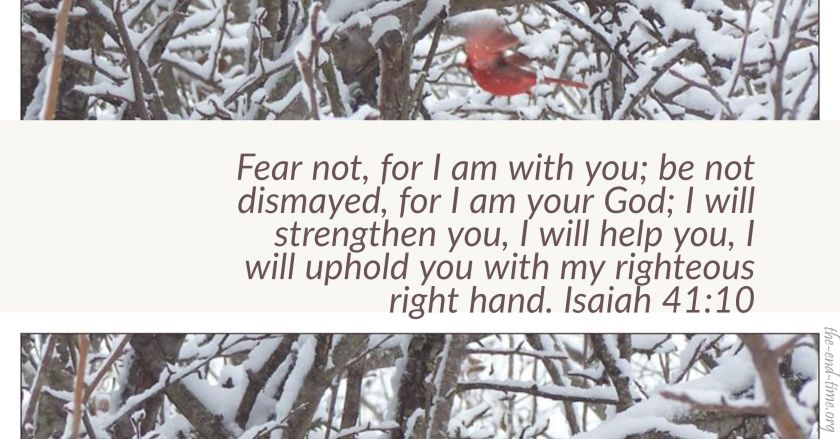
fear not verse

Posted in encouragement, Uncategorized

How is incense like prayer?

Yesterday I wrote about incense, and how the LORD told Jeremiah to tell the people that their sacrifices of incense were not going to be received, because of their sin. He was going to send judgment instead. I’d said that there is a connection between incense and prayer, to be explored today.

First, let’s look at the Temple and the altar of incense, called the golden altar. (Exodus 39:38).

for the altar of incense made of refined gold, and its weight; also his plan for the golden chariot of the cherubim that spread their wings and covered the ark of the covenant of the LORD.
(1 Chronicles 28:18–19).

The Lexham Bible Dictionary explains that pure incense was manufactured from equal parts of the following substances:

•      stacte—oil of myrrh
•      onycha—an extract from a Red Sea mollusk
•      galbanum—thought to come from the gum of an umbelliferous plant
•      frankincense

This mixture was seasoned with salt (Exodus 30:34–38). The LORD raised up perfumers whose job it was to produce the incense. (Exodus 30:34-38). One of the responsibilities of the priest was to keep incense burning on the altar daily. (2 Chronicles 13:11). Not to burn it was disobedience. (2 Chronicles 29:7-8).

There’s much more to the actual incense ingredients, blending, burning, and spiritual uses, but for now, let’s turn to the main idea for today- the connection between incense and prayers.

Now while he was serving as priest before God when his division was on duty, according to the custom of the priesthood, he was chosen by lot to enter the temple of the Lord and burn incense. And the whole multitude of the people were praying outside at the hour of incense. And there appeared to him an angel of the Lord standing on the right side of the altar of incense. (Zechariah, in Luke 1:8-11)

John Owen in his commentary on Hebrews makes a distinction between the two times incense is used in the temple.

Whereas, therefore, there was a twofold use of the altar of incense; the one of the ordinary priests, to burn incense in the sanctuary every day; and the other of the high priest, to take incense from it when he entered into the most holy place, to fill it with a cloud of its smoke; the apostle intending a comparison peculiarly between the Lord Christ and the high priest only in this place, and not the other priests in the daily. discharge of their office

Incense both accompanies and symbolizes prayer. ( Psalm 141:2; Revelation 5:8; Revelation 8:3-4). The burning of incense as a sweet smelling offering before the Lord, indicated the worshiper’s duty to present prayers or offerings that were pleasing to God (1 Samuel 2:28).

When the New Covenant came, the new way of praying came. (Matthew 6:9, HebrewsNo longer needing a priest to intercede,no longer needing incense to symbolize types and shadows, we now have the Spirit in us to intercede, and resurrected Jesus next to the right hand of the Father to intercede. We can ourselves go boldly before the throne of grace.

John Owen in his commentary on Hebrews lays out four ways incense is like prayer.

1.) In that it was beaten and pounded before it was used. So doth acceptable prayer proceed from “a broken and contrite heart,” Isaiah 51:17.

(2.) It was of no use until fire was put under it, and that taken from the altar. Nor is that prayer of any virtue or efficacy which is not kindled by the fire from above, the Holy Spirit of God; which we have from our altar, Christ Jesus.

(3.) It naturally ascended upwards towards heaven, as all offerings in the Hebrew are called “ascensions,” risings up. And this is the design of prayer, to ascend unto the throne of God: “I will direct unto thee, and will look up;” that is, pray, Psalms 5:3.

(4.) It yielded a sweet savor: which was one end of it in temple services, wherein there was so much burning of flesh and blood. So doth prayer yield a sweet savor unto God; a savor of rest, wherein he is well pleased.

Owen further observes:

We are always to reckon that the efficacy and prevalency of all our prayers depends on the incense which is in the hand of our merciful high priest. — It is offered with the prayers of the saints, Revelation 8:4. In themselves our prayers are weak and imperfect; it is hard to conceive how they should find acceptance with God. But the invaluable incense of the intercession of Christ gives them acceptance and prevalency.

What an inexpressible privilege it is to pray. The curtain is parted, we may boldly approach the throne of God. He not only hears our prayer, he Himself intercedes for us when we utter groanings too weak to understand. (Romans 8:26).

Do not neglect prayer, a sweet smell of our sacrifice of praise to our Lord who hears.

smoke2

Posted in encouragement, Uncategorized

Feeling weak and weary? It’s OK. Even Timothy needed urging

For this reason I remind you to fan into flame the gift of God, which is in you through the laying on of my hands, 7for God gave us a spirit not of fear but of power and love and self-control. (2 Timothy 1:6-7).

Has your zeal waned? I’m not talking about the normal subsiding of a fervency that first ignites in the heart upon salvation but then matures to a steady fire. I’m talking about the day to day, month to months or year to year faith that, if left untended or un-nurtured, diminishes to an ember, with cold ashes all around. Or the faith that is timid and retiring, waiting for igniting or just fearful.

It happens.

As we see in the verse above, Paul was urging Timothy to fan into flame his gift (of faith). One who already has a flame doesn’t need someone to urge him to fan it. Only someone who is dimming needs such encouragement. Paul knew this was true of Timothy, so Paul wrote to encourage Timothy to nurture his faith.

Barnes’ Notes:

The idea is, that Timothy was to use all proper means to keep the flame of pure religion in the soul burning, and more particularly his zeal in the great cause to which he had been set apart. The agency of man himself is needful to keep the religion of the heart warm and glowing. However rich the gifts which God has bestowed upon us, they do not grow of their own accord, but need to be cultivated by our own personal care.

We all need that exhortation. Fan into flame the gift of God.

OK. How? What are the actions we should take when we sense our spiritual walk is slowing?

In the Spurgeon sermon Our Gifts and How to Use Them, we note that to stir up one’s faith requires action.  Spurgeon here has some ideas. The following are excerpts from the above link ‘Our Gifts and How to Use Them.’

~~~~~~~~~~~~~~~~~~

And this brings us, secondly, to the consideration of HOW WE ARE TO STIR UP OUR GIFTS.

EXAMINE YOUR GIFTS
First, we should do it by examination to see what gifts we really have. There should be an overhauling of all our stores to see what we have of capital entrusted to our stewardship.

STIR UP YOUR GIFTS
The next mode of stirring up our gift is to consider to what use we could put the talents we possess. To what use could I put my talents in my family? Am I doing all I could for the children? Have I labored all I ought for my wife’s conversion; my husband’s conversion? Then about the neighborhood: is there nothing more that I could do for the salvation of my poor godless neighbors?

… Are you doing all you can for Jesus? Come, answer like an honest man! Having done so, I have more for your self-inspection! Will you examine yourself in every relation in which you stand? As an employer, stir up your gift in reference to those you employ; as a servant, stir up the gift towards your fellow servants; as a trader, and stir up your gift in reference to those with whom you come in contact… If our churches were in a right state of spiritual health, men would not first say, “What can I do to make money?” but, “What can I do to serve Christ, for I will take up a trade subserviently to that.”

ACT IN AND THROUGH YOUR GIFTS
But, next, stir it up not merely by consideration and examination, but by actually using it. We talk much of working, but working is better than talking about working. To get really at it, and to do something for soul-winning and spreading abroad the glory of God is infinitely better than planning and holding committees. Away with windbags! Let us get to acts and deeds! … Work, work, and the tool that is blunt will get an edge by being used! Shine and the light you have shall grow in the very act of shining! He who has done one thing will find himself capable of doing two, and doing two will be able to accomplish four; and having achieved the four will soon go on to twelve, and from 12 to fifty! And so, by growing multiples, he will enlarge his power to serve God by using the ability he has.

IMPROVE YOUR GIFT
We have for years endeavored to stir up the young Christians of this congregation to educate themselves. … I think every man ought to feel, “I have been Christ’s man with a talent; I will be Christ’s man with 10 if I can; if now I do not thoroughly understand the doctrines of His gospel, I will try to understand them; I will read, and search, and learn.” We need an intelligent race of Christians, not an affected race of boasters of culture—mental fops who pretend to know a great deal, and know nothing! We need students of the word, adept in theology like the Puritans of old!

PRAY OVER YOUR GIFTS
—that is a blessed way of stirring them up, to go before God and spread out your responsibilities before Him. … It stirs one up to preach with all his might when he has laid before God in prayer, his weakness; and the ability which God has given him, and asked that the weakness may be consecrated to God’s glory, and the ability accepted to the Lord’s praise. Should we not do just the same, whatever our calling is—take it to the Lord and say, “Assist me, great God, to live for You; …

~~~~~~~~~~~~~~~~~~

End Spurgeon. Don’t you love his bluntness? ‘Don’t just talk about working, actually work. Away with windbags!’ Lol.

Does the flame of faith in your bosom need fanning? It is not sin, not yet. Fainting youths and weary soldiers give opportunity for stronger brothers to come alongside and exhort and encourage. Perhaps that strong soldier will need fanning one day, and you can return the favor. In addition, we are pitiful human creatures, stained with a sin-drenched mind always attempting to get the better of the Mind of Christ that is given to us. Or, our timid hearts stray to the back of the crowd. Or, our spotted souls seek to grow the spots instead of slay them.

The battle is long and the fight is tiring. It was for Timothy. What a blessing the Bible includes the weaknesses and flaws of our fainting brethren who came before us. See? You’re weak. I’m weak. It happens.

If you need fanning, no matter. Stir up your gifts, the basis is which is the gift of God of faith and repentance, the gift of knowledge of our own sin, and so seek to revive that flame to a burning love giving light and warmth to fellow soldiers and to the cold and wandering lost.

flame