My Sunday School is working through Romans. We are just finishing Romans 8. One of our teachers in the class has a deep connection with Romans 8:28, which says,
“And we know that God causes all things to work together for good to those who love God, to those who are called according to His purpose.”
At age 17 his neck was broken in a high school football game, and he became a quadriplegic. He teaches High School Bible now in a Christian School and one of his courses is Romans. Between his deep personal connection with Romans 8:28 and his professional association with teaching it, you can imagine that we spent a good deal of time in Sunday School Class, discussing how and why all things work together for the good of those who love Him.
I was driving along this week and Adrian Rogers came on the radio with a sermon about Romans 8:28. Oh boy! I love Adrian Rogers. I love Romans 8:28. This will be good, I thought.
And it was. Because he came at it from the opposite point. Rogers said in part of his sermon, that if all things work together for the GOOD of those who love Him, then all things work together for the BAD for those who hate Him.
Wut?
Yes. For people who hate God, things work out to the bad for them. Now to be clear, God is not the author of sin and He doesn’t tempt people to sin. He is perfectly holy. But what people forget is the duality of the proposition. God is holy, sin is not. He is light, all else is dark. He can be found on the narrow way, others are on the broad way. Either a person is in the faith or not. There is heaven and there is hell. People are either good (based on Christ’s imputed righteousness) or they are bad (because, sin nature).
Haters of God cannot claim this promise. You can put Romans 8:28 in reverse. If all things work together for the good of those that love God, if a person does not love God, all things work together for the bad. A person might say ‘Well, I’m living high, wide, and handsome right now’. “But friends”, Rogers said, “it’s not working together for the good but for evil for those who don’t love God.” Even a good thing like preaching to those who who do not love God and reject the Gospel, Jesus said to go your way and shake the dust off your feet. That very dust will be used as a testimony against them at the day of Judgment. (Luke 9:5). So even a good thing like preaching will be used against them that die in their hatred of God.
“Good” preaching, even a “good” life will tend to make a person harden their conscience, become too self-suffucient, stiffen necks, and turn hearts to stone.
The wicked pluck death from the tree of life. ~Adrian Rogers
Cling to the promise of God that you, dear believer whom Jesus saved on no merit or activity of your own, that all things (in heaven) are working for your good, no matter the circumstances (on earth). But if a person hates God, then all things work to the bad. Does that make you want to share the GOOD NEWS with someone today that hates God? I hope so.
Our own nation was founded on principles the Puritans brought with them as they fled persecution to start afresh in the New World. As a native southern New Englander, I was surrounded in Massachusetts and Rhode Island with puritan history. Statues, plaques, history, tours, homes, ships…from the Puritan and colonial era abounded. As a child growing up and a teen and young adult, I used to wonder deeply at the impetus that brought these luminaries here, like John Winthrop, William Brewster, Roger Williams…in school we studied The Mayflower Compact, went on field trips to see The Mayflower…
I pondered and wondered and thought the nagging question in my young mind: WHY did these people leave the comforts of a known world, to drift across a wild ocean in a leaky, small boat, to land where Indians may kill them, or scarcity may famine them to death? All to pursue religion? Just for religion?? I thought it was a worthless endeavor, not being saved and not knowing God. Yet my young mind struggled with the question. After all, they upended their lives to do this thing, there must be something to it all…wasn’t there?
I wondered, until the moment arrived that God had set from the foundation of the world: I became saved and knew God and His worth. Pursuing Him across continents, oceans, and new worlds was worth it for the privilege of worshiping Him in freedom.
I owe a debt to those long-ago people who struck a blow against satan and committed to founding a ‘new world’ here on earth so they could preach and teach in freedom about the world to come. Their act ignited my young mind, which the Spirit kept aflame until the MOMENT when He designated my salvation would come to life.
Today beginning at 1:00 Eastern time (10:00 am Pacific time) is the anticipated Puritan Conference! Hosted at Grace Community Church, a slate of Puritan experts will be preaching/teaching about the Puritans and their theology, among other interesting topics. Today’s schedule begins with:
10:00 am General Session 1: The Theological and Historical Foundation of the Puritans • Steve Lawson 11:30 am General Session 2: The Puritans on Adoption • Joel Beeke
I am eagerly looking forward to this talk later today by Joel Beeke: “The Writing of the Puritans.” And on Friday, General Session 9 • Ian Hamilton “The Need for the Puritan Mindset Today.” And so on, check out the schedule at the link above.
I’m sure the livestreams will be recorded for later. I exhort you, if you have time, to tune in at some point and learn about these people who made such an impact on this world…and the next.
There are many churches who participated in the fad known as The Daniel Fast authored by Mr Franklin or the Daniel Plan authored by Rick Warren. These are man-made so-called spiritual activities that are supposed to automatically draw you closer to God by eating things that are on a list and not eating things that are not on a list. If you partake of this fast, other benefits touted are: winning the battle over the flesh (hard to do when we are still flesh when the fast is done), losing weight, and healings from diabetes, allergies, arthritis and cancer. Another benefit from doing the Jentezen Franklin fast is said to be putting our spirit in charge of the other two parts of us, the soul and the body. It must be news to the Holy Spirit that we can put Him in charge of things. (source and source)
Fasting is in the Bible, but the way it is being taught in the Daniel Fasting plan and in Franklin’s book is off center. That is the genius of false teaching, take a true biblical doctrine or activity and twist it.
About fasting: it is good. I fast. Fasting is biblical. However the only New Testament explicit direction we are given is from Jesus’ sermon on the Mount, and in that, the only specifics we are given about fasting is as a voluntary activity and urged to do it in secret to reduce the risk of prideful boasting. Jentezen Franklin’s model calls for the opposite. Otherwise, Jesus said, the temptation to lean toward pride and hypocrisy is too great. We are told in Romans 14 that the kingdom of God is not what we eat or drink, but the Daniel Plan contains a long list of what we may eat or drink.
If a person engages in it for the wrong motivations, such as a weight loss plan, or as a healthy lifestyle, then it is not Godly but a fad of no worth!
So what IS fasting? Lexham Bible Dictionary says,
A ritual of abstaining from food and/or drink for a predetermined period; practiced in the Bible primarily as a means of mourning. Fasting frequently occurs in the Old Testament in response to suffering or disaster, in conjunction with other mourning rituals.
It is a spiritual practice, but the only required fast in the Old Testament required by Moses was for the Day of Atonement (Leviticus 23:26–32). It is called simply “the fast” in Acts 27:9 since the Jews would have known what is being referred to. Though Jesus urged fasting privately there are legitimate times when public fasting was called for, as in the Ninevites’ fast from the King on down, or corporate fasting as per Ezra. Thus, public national fasts on account of sin or to supplicate divine favor were sometimes held. 1 Samuel 7:6; 2 Chronicles 20:3; Jeremiah 36:6–10; Nehemiah 9:1, says the Easton Illustrated Bible Dictionary.
Sometimes in the Bible great emotion caused a natural loss of appetite. Hannah’s distress over being barren which was constantly made worse via Penninah’s provoking, caused Hannah to ‘weep and not eat’. (1 Samuel 1:7). Ahab’s sulking caused him to lose his appetite and not eat. (1 Kings 21:4). These were not true fasts, though, because they were not a deliberate abstention from food for a spiritual purpose.
A true fast is a deliberate setting aside of a legitimate pleasure of food in order to engage in a spiritual endeavor, such as a demonstration of grief over a death, a spiritual grief over sin, or a supplication to God, for example.
“In the Bible, fasting was also practiced to show the seriousness of one’s religious endeavors and to remind each other that people do not live by bread alone (Deuteronomy 8:4)“. (In Holman treasury of key Bible words)
For example, in Acts 13:2-3, as the believers prepared to send Paul off on his first missionary journey, they fasted. Fasting for medical reasons or dietary reasons or health reasons might be fine, but it is not the same as a biblical spiritual fast.
“Fasting in and of itself is unknown in Scripture as an end in itself. All of the benefits of fasting in the Scripture are indirect, not direct. Fasting is never isolated to create some virtue in and of itself. You don’t just say well, I’m going to be spiritual, I will not eat. You are no more spiritual because you don’t eat than because you do eat.” (source John MacArthur)
“Fasting is to deny self, but it is not done in a vacuum. You don’t just say well, I’m going to deny myself. I’m going to say no to myself and stop eating for no good reason. There is a reason to humble yourself in that manner. There is a reason to deny yourself in that manner. There is a reason to inflict yourself in that manner and the reason is a consuming one. [F]asting never occurs in a vacuum. It never occurs biblically without a corollary. So, fasting is almost not something you choose to do, but something you cannot avoid.” (source)
What is the reason people would go on a Daniel Fast? Is it just to do it? Because it will make you grow spiritually? It won’t, if that is your sole reason. It’s not an activity that causes growth, it is an outward expression of an interior spiritual need or circumstance. Fasting combined with prayer is a mark of a personal commitment to God for a specific reason (missionary journey, selecting leaders, salvations, repentance for sin, grief…). It’s not a diet, a fad, or a prideful show unto others.
Faddish fasting gurus promote fasting for the wrong reasons, twisting a legitimate spiritual discipline into a money-making endeavor- for themselves. There is no spiritual benefit to the people in these plans. (e.g. The Daniel Plan by Rick Warren, the Daniel Fast by Jentezen Franklin etc)
“What’s sad is the effect these self-appointed authorities have on those who follow them. They bind consciences with false guilt. Setting themselves up as judges of what goes into your mouth, they oppose our Lord Jesus Christ, who declared all foods clean and said that nothing should be rejected if it is received with gratitude (Mark 7:19; 1 Timothy 4:1-5). The New Testament leaves the details of fasting to the discretion of the believer and even de-emphasizes fasting in the progress of revelation. When Jesus taught against hypocrisy in Matthew 6:1-18, he taught us to give, pray, and fast privately. If you do, your Father who sees in secret will reward you.“
Jesus taught explicitly to “pray this way”, but He did not say “fast this way”. The specifics are left to the believer as to when or why or how. Jesus doesn’t advise how often to fast, but only cautions “when you fast” to do it in secret.
Fasting is a private activity usually and traditionally associated with grief, repentance, or for a specific purpose that Jesus Himself relegates to a private matter between a believer and God, vertically. The Daniel Fast promoters and Franklin have made it an activity on some name it-claim it spiritual check-off list, a horizontal display of public piety laden with potentials for hypocrisy and pride, exactly what Jesus said not to do.
Be careful not to fall into a snare of the devil as fads come and go. A merchandizing worthless shepherd will take a good sounding biblical activity and twist it just enough to make it man-centered and not God-centered. If there is a lot of merchandise associated with the activity, it’s a clue that at root it’s probably not edifying for your soul. (2 Peter 2:3)
A short series of essays on the proper approach to fasting can be found below. There are other resources on proper fasting below as well. I recommend fasting when you feel it’s necessary. It’s a fruitful activity and yields benefits spiritually to the faster, as well as likely kingdom benefits we will see on the Day!
If someone wants to listen to or read a good sermon series on fasting, again I direct them to the Grace to You website and the series entitled Fasting Without Hypocrisy, Part 1
The Doctrine of Fasting and Prayer, and Humiliation for Sin by Arthur Hildersham (Author). Reformation Heritage Books (2017), 168 pages. Hildersham was an English Reformer, born as a Royal, raised as a zealous Papist, educated at Cambridge, converted to Protestantism. His father yanked him from college and prepared to send him to Rome to be ‘reclaimed’. Arthur refused, and was disinherited. He remained a Protestant all his life and was dearly beloved by his people.
Understanding the Discipline of Fasting (Biblical Foundations for the Christian… by Paul David Washer. The book blurb says, “The oft-forgotten discipline of fasting is a devotion of great usefulness that unfortunately has had a severe lack of information written about it and has garnered an abundance of misunderstandings and misinformation regarding it. In “Understanding the Discipline of Fasting,” the fourth of his Biblical Foundations for the Christian Faith series, Paul Washer repeatedly points the student to the Scriptures to expose these erroneous ideas and to help the people of God understand the proper place of fasting in the Christian life. Also included in these pages is an abridged and modernized work from the Scottish theologian Thomas Boston on fasting and humiliation”.
Sundays are a good time to ponder who God is. He is worthy of service and worship. We have been taking a look at God’s attributes each Sunday. Links to previous weeks are below. Most definitions are taken from Tim Challies’ visual theology chart of the attributes of God.
Remember, God’s attributes are not parts that make up a whole. Everything good that there is, is 100% contained in God. He is 100% beauty, 100% aseity, 100% omniscient, etc. He is complete in Himself.
Tim Challies explained: “To study God’s attributes is to study his character, to answer questions like, Who is God? and What is God like? A typical classification of God’s attributes divides them into those that are incommunicable (those that he does not share or “communicate” to anyone or anything else) and communicable (those that he shares with other beings). Like most theological classifications, this one is imperfect but still helpful as we seek to understand what is so far beyond ourselves. God’s communicable attributes can be further categorized into: attributes of God’s being, mental attributes, moral attributes, attributes of purpose, and “summary” attributes (attributes that, in a more particular way, modify each of the others).”
RIGHTEOUSNESS (Moral Attributes) “God is the final standard of what is right and he always acts in accordance with what is right. (This is also known as God’s justice).”
God does not intend good towards wicked men, but only the glory of his justice. ~Thomas Valentine, The Church’s Need of Jesus Christ
SPIRITUALITY (Attributes describing God’s Being) “God is a being who is not made up of matter and who cannot be perceived by our bodily senses.”
(This is extremely important in light of worship). “God being a Spirit declares what he is; his other perfections declare what “kind” of Spirit he is.” ~Stephen Charnock, A Christian’s True Spiritual Worship to Jesus Christ.
TRUTHFULNESS (Mental Attributes) “God is the true God whose knowledge and words are both true and the final standard of truth.”
Truth came out of God’s heart, and is the manifestation of his life and glory, and it will turn the heart suitable to that life. ~Cuthbert Sydenham (1622–1654) The Greatness of the Mystery of Godliness
If you can imagine the scene here at my apartment…It’s early hours, pre-dawn. I’ve got some hymns on Pandora playing and the coffeepot is hissing and sputtering. The fall weather has finally arrived here in Georgia, always an eagerly anticipated event after the brutal heat of a southern summer.
I am gathering links that I think will edify, sip some coffee, pause to look out the dark windows and just let mind mind free to think its thoughts and ramble over mountains of memories and hills of remembrance.
After a few moments, I turn back to the screen and place another link into the list, and write a summary to attach that explains it. And so it goes, my delight in writing the day’s blog. It’s never a chore and for the past almost 14 years the Holy Spirit has given me the strength and energy to complete the task.
Here is today’s blog, a roundup of links I think you may enjoy:
I don’t know Andrew Tate but I saw this clip on a trusted friend’s Twitter and I listened to the 56 second clip. I thought it was a fantastic summary of the future grief that feminists will feel at the end of their lives when they mull over the devastating choices they’ve made. It all goes back to contentment in our individual roles that God has outlined for us. Please take a listen-
In this next video, 7 minutes of scorching Christianity, Pastor-Teacher Dr. John MacArthur addresses his congregation about California Governor Gavin Newsom’s national campaign for abortion. Gov. Newsom has funded and promoted billboards that offer to perform abortions for any women in the US if they come to California. The billboards were erected nationally, not just in CA. Worse, the Governor used actual Bible scripture to support his position to make it seem as if Jesus Himself were saying that child murder is loving.
This was over the top for Dr. MacArthur, a California resident. MacArthur composed an Open Letter to the Governor, reminding the Governor of his God-given responsibilities as a public leader, warning of his judgment to come, and pleading with Newsom to repent.
I post this because I was both convicted and encouraged by MacArthur’s quiet earnestness. MacArthur has always been quiet when preaching, believing the words should issue forth and his personality retreat to the background. So no podium pounding, no screeching, just quietly letting the TRUTH of God’s word do the work.
After listening, I felt sorrow for the times I failed to pray for my leaders, and when I tut-tutted their probable eternal torment with a quick drive-by and nary a tear of grief. Friends, eternity matters. And no one is beyond salvation. Pray, pray, pray.
Here is the link to read the actual letter. It echoes John the Baptist’s preaching in tone and strength. Letter HERE.
DebbieLynne Kespert wrote about The Confusing Aspects of Contending for the Faith. She compares the positions of two good podcasts that suggest an approach to discernment, adds a third to the mix, then sorts them out into a balanced middle ground. How should a church or a ministry approach the teaching of discernment? Read her essay to find a measured consideration of the question.
Have you ever done a “Spiritual Gifts test?” I have, when I was a new believer and anxious about how and where to serve. But do they work? Here is Justin Jackson at For the Church on why The Local Church is Your Spiritual Gifts Test.
Barbara Lee Harper posted about what to do When Your Spiritual Routines Get Boring. Have you had this happen to you? I have. I think her suggestions are good.
This was a rough week on Twitter. A dear brother whom I respect made a stance against another brother whom I do not respect as much and in fact I have deep concerns about, but who is hugely popular. The twitter mob either-
Bullied the brother into repentance, or
Pressured him consistently enough so that he saw his sin and repented, or
None of the above
I stayed out of it. I chose not to delve into the nuts and bolts of the fight, and it was a fight, a big one. So I make no statement on who was right or wrong, or both. The brother was spoken to by elders, his own and others. Subsequent to being addressed by elders, the brother put out a statement of repentance which seemed to me to be clear and honest. I read it and was encouraged by the humility displayed in it. I’m speaking of Costi Hinn and his statements about Doug Wilson and G3 Ministries.
I bring this up not just to refer to “the big fight,” but because as I was reading Costi’s letter of repentance, I was reminded of another hugely popular brother, a pastor, who recently was taken to task for a sin, (Matt Chandler). He seemingly came clean publicly in an emotional video taped before his congregation in a Sunday Service. His oral statement was not as clear or as humble- in my opinion. As I read Costi’s letter, I mentally compared it to Chandler’s, which was also issued recently. I believe it is a good comparison of two leaders of the faith being reined in by elders and the individual’s response to their sin being brought to light.
When you repent, it has to be ‘bare naked’, with no dissembling, precious clichés, or false humility. Costi’s was. Chandler’s wasn’t.
G3 Ministries and Statement Costi’s letter of repentance here.
I thought this gentleman’s parsing of Chandler’s ‘coming clean video’ in successive tweets in a thread was spot on. Twitter thread below or thread reader unroll here.
People in today's world apparently need a lot of help realizing when they are being manipulated. Let me walk you thru the Matt Chandler situation and expose for you the con game.
After another week of leaders publicly sinning, fights, twitter mobs, betrayals, evil abounding, government leaders wielding abusive power…how does one not become cynical? This was asked of a pastor with over 50 years in ministry, John MacArthur. His reply was encouraging! He always puts the center in the center and never drifts from it. Praise God for raising up men like MacArthur (and many others who are under the radar, like my friend James Bell, Allen Nelson, Darryl Dash, my own elders, and so many others). If you want 8 minutes of faith-filled encouragement, listen here
So that’s it for this week. I hope you enjoy the weekend, and the week ahead. The Lord is always in control, always loves His own, and will come again to bring us to eternity, where no sin will ever be present. What a day that will be.
This photo of a nineteenth-century German engraving shows a peppermint stalk and leaves with close-up views of flower components. Peppermint (Mentha x piperita) has been prized since ancient times for its flavor and for medicinal qualities. Experiments show that peppermint oil inhibits the growth of many pathogenic microbes. The plant was widely cultivated in first-century Galilee and Judea. In his dispute with his opponents over tithing, this was one of the mint species Jesus had in mind. Matt 23:23, Luke 11:42 Image by Franz Eugen Köhler, botanist and illustrator, from Wikimedia Commons. License: Public Domain
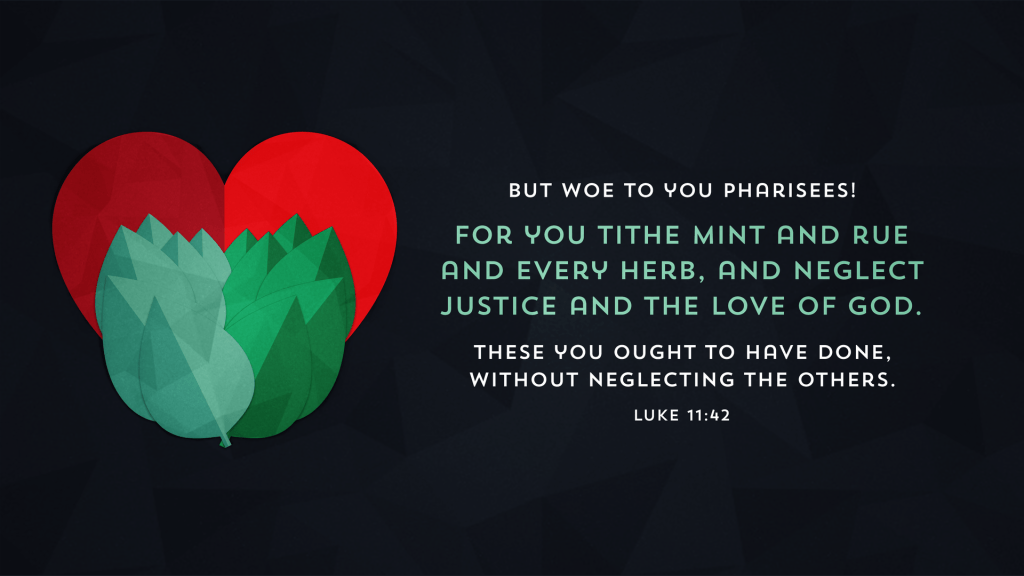
Jesus pronounced woe upon the Pharisees, saying
“Woe to you, scribes and Pharisees, hypocrites! For you tithe mint and dill and cumin, and have neglected the weightier provisions of the Law: justice and mercy and faithfulness; but these are the things you should have done without neglecting the others.” (Matthew 23:23).
Becuase I like the natural history of the Bible plants and animals, today just take a quick let’s look at what herbs Jesus is speaking of rather than the spiritual import of his pronouncement.
Holman Bible Publishers explains MINT AND CUMIN: Mint is a sweet-smelling herb used to season food. Cumin is a carawaylike herb Judaism also used in seasonings and in medicine. Jesus named mint, dill, and cumin as He criticized the Pharisees for requiring the tithe of the herbs while ignoring more important matters of the Law (Matt. 23:23). Mint and Cumin. In Holman Illustrated Bible Dictionary (p. 1135). Nashville, TN: Holman Bible Publishers.
Image from Faithlife
Isaiah 28:23-27 gives insight on how each of these herbs were harvested:
Listen and hear my voice, Pay attention and hear my words. 24Does the farmer plow continually to plant seed? Does he continually turn and break up his ground? 25Does he not level its surface And sow dill and scatter cumin And plant wheat in rows, Barley in its place and rye within its area? 26For his God instructs and teaches him properly. 27For dill is not threshed with a threshing sledge, Nor is the cartwheel driven over cumin; But dill is beaten out with a rod, and cumin with a club.
The spiritual explanation Isaiah is trying to get across to the stiff-necked people is that the farmer doesn’t do nothing but plow. Farers use a variety of methods to yield their crop. And so would not God do the same, but perfectly and in higher ways? But for the point here today, we see that Isaiah helps us city-dwellers understand the ancient ways of harvesting the spices that Jesus mentions 700 years later in his speech about the Pharisees.
MINT: The Greek word heduosmon, or heduosmos, which means “having a sweet smell,” occurs in two passages of the New Testament, Matthew 23:23, and Luke 11:42, and has been translated “mint.” It corresponds with the Latin mentha. The species of mint most common in Syria is that represented in the figure, and called by botanists Mentha sylvestris. It is often cultivated in gardens, and it is generally distributed over Europe, and reaches even to Kashmir. It is likewise found in Britain. The plant belongs to the natural order Labiatæ. It is an erect plant, with opposite, nearly sessile, ovate, lanceolate, and downy leaves, which are whitish below. The spikes of flowers are dense, and have a conically-cylindrical form. Another species is also common in Palestine, and is called field-mint (Mentha arvensis). The species of mint have all carminative qualities. (i.e. it relieves flatulence!) They grow usually in damp places, and have reddish flowers arranged in spikes or whorls. Mint was much used as a condiment. Source: Balfour, J. H. (1885). The Plants of the Bible (pp. 173–174). London; Edinburgh; New York: T. Nelson and Sons.
So often, people who deride the Bible as simply ‘an ancient document written by shepherds’ would do well to study the ingenious methods the ancients used to yield product from the land and from their animals. The ancients built the pyramids, after all. The farming methods of the ancients, their crops, and their animals are fascinating to me. Below are some other essays I’ve written about plants and animals of the Bible days.
Here is an excerpt from a sermon by Charles H. Spurgeon, Delivered On Lord’s-Day Morning, June 26, 1870, By C. H. Spurgeon, At The Metropolitan Tabernacle, Newington.
We have become used to the ‘you’re enough God is love, no judgments, flowers and rainbows’ kind of Christianity that once in a while I feel it’s important to push back against that by reminding us that Christians are at war until the day we die. We war against our sin, we war against temptation of sinning with others, we war against the principalities and powers of the dark prince of the air. War. Here’s Spurgeon, then I’ll have a comment at the end.
“Paul does not appear to have pictured true Believers as sluggards sound asleep upon the downiest beds. His description of a Christian in the text is that of a soldier. And that means something far different either from a religious fop, whose best delight is music and millinery, or a theological critic who makes a man an offender for a word. Or a spiritual glutton who cares for nothing but a lifelong enjoyment of the fat things full of marrow. Or an ecclesiastical slumberer who longs only for peace for himself. Paul represents him as a soldier and that, I say, is quite another thing.
For what is a soldier? A soldier is a practical man, a man who has work to do, and hard, stern work. He may sometimes, when he is at his ease, wear the fineries of war, but when he comes to real warfare he cares little enough for them. The dust and the smoke, and the garments rolled in blood—these are for those who go soldiering. And swords all hacked, and dented armor, and bruised shields—these are the things that mark the good, the practical, soldier. Truly to serve God, really to exhibit Christian graces, fully to achieve a lifework for Christ, actually to win souls—this is to bear fruit worthy of a Christian
A soldier is a man of deeds, and not of words. He has to contend and fight. In war times his life knows little of luxurious ease. In the dead of night, perhaps, the trumpet sounds to boot and saddle—just at the time when he is most weary—and he must hurry to the attack just when he would best prefer to take his rest in sleep. The Christian is a soldier in an enemy’s country always needing to stand on his watchtower, constantly to be contending, though not with flesh and blood—with far worse foes—namely, with spiritual wickedness in high places.
The Christian is a self-sacrificing man as the soldier must be. To protect his country, the soldier must expose his own bosom. To serve his King, he must be ready to lay down his life. Surely he is no Christian who never felt the spirit of self-sacrifice. If I live unto myself I am living unto the flesh, and of the flesh I shall reap corruption. Only he who lives to his God, to Christ, to the Truth of God, to the Church, and to the good old cause—only he is the man who can reckon himself at all to be a soldier of Jesus Christ.
A soldier is a serving man. He does not follow his own pleasure. He is under law and rule. Each hour of the day has its prescribed duty. And he must be obedient to the word of another and not to his own will and whim. Such is the Christian. We serve the Lord Jesus Christ. Though no longer the slaves of man so as to dread his frown, we are servants of Christ who has loosed our bonds.
The soldier is full often a suffering man. There are wounds, there are toils, there are frequent stays in the hospitals— there may be ghastly cuts which let the soul out with the blood. Such the Christian soldier must be ready to suffer, enduring hardship, not looking for pleasure of a worldly kind in this life, but counting it his pleasure to renounce his pleasure for Christ’s sake. Once again, the true soldier is an ambitious being. He pants for honor, seeks for glory. On the field of strife he gathers his laurels, and amidst a thousand dangers he reaps renown.
Paul does not exhort Timothy to be a common, or ordinary soldier, but to be a “good soldier of Jesus Christ.” For all soldiers, and all true soldiers may not be good soldiers. There are men who are but just soldiers and nothing more. They only need sufficient temptation and they readily become cowardly, idle, useless and worthless. But he is the good soldier who is bravest of the brave, courageous at all times. He is zealous, does his duty with heart and earnestness. He is the good soldier of Jesus Christ who, through Divine Grace, aims to make himself as able to serve his Lord as shall be possible.
Before I proceed fully to open up this metaphor, let me say that though we shall use military terms this morning, and stirring speech, it should ever be remembered that we have no war against persons, and that the weapons which we use are not such as are forged for the deadly conflicts of mankind. The wars of a Christian are against principles, against sins, against the miseries of mankind, against that Evil One who has led man astray from his Maker. Our wars are against the iniquity which keeps man an enemy to himself. The weapons that we use are holy arguments and consecrated lives, devotion and prayer to God, teaching and example among the sons of men.
——————————end Spurgeon————————–
Spurgeon then goes on for 12 pages, lol, and he begins his conclusion this way;
“A crown is prepared for that head though it is now made to ache with care for the cause. There is a palm branch for that hand which now toils in the fight. There are silver sandals for those feet which have now to march over weary miles for Christ’s sake. Honor and immortality not to be imagined till they are enjoyed await every faithful soldier of the Cross!”
“No soldier gets entangled in civilian pursuits, since his aim is to please the one who enlisted him.” 2 Timothy 2:4
My dear sisters who are reading this or listening to this, we are not civilians anyway, we’re not like unbelieving humanity. We are a peculiar people, dressed in battle gear, wielding the sword of the spirit and enacting the weapon of prayer. We are holy islands fighting to maintain the ground on which we stand- salvation, This blood-soaked ground on which Jesus died.
Now, I love flowers as much as anybody, but when it comes to women’s ministries, the flower covered Bibles, journals, bookmarks, etc are fine, but what about a sword, or a shield, or depictions of the struggle with sin, or armor? We are in a war: war against sin, war against principalities and demons, war against encroaching world views trying to capture us. It does us good to be reminded of that once in a while. Hence, today’s blog.
I subscribe to Sheehan Quirke The Cultural Tutor’s newsletter called Areopagus. (What a perfect name for a Cultural Tutor, isn’t it!). His free newsletter contains short tidbits on the following subjects: Historical Figure • Art • Classical Music • Architecture • Rhetoric • Writing • Historical Anecdote. I love it becuase the newsletter is so well written, and interesting. You had me at well written.
The Number X Edition (or 10 for Roman Numeral innumerate folk 😉 contained the following paragraphs on the topic of Writing:
Words as Thoughts
The importance of writing cannot be understated. And while its usefulness as a life skill is obvious, I think there is something of much profounder importance to writing than effective communication or academic and professional success.
Thinking is difficult – really difficult. Thoughts appear in your mind seemingly at random sometimes, and constructing coherent patterns of thought requires a great deal of effort. Even when you manage to think clearly and thrash out a few conclusions, they’re easily forgotten. And most of the rest of the time our thoughts are contradictory because we’ve barely had the chance to analyse and understand them.No wonder are all so prone to saying stupid things!
That’s where writing comes in: the practice of putting your thoughts into words. Or, more tellingly, the act of taking those thoughts out of your head.You can write a few words, read them, leave them, come back to them, and reconsider them. It’s much harder to do with that with thoughts, which are intangible and changeful.
But if you take those tangled, complex thoughts out of your head and write them down, you’ll see them much more clearly. And you can see the contradictions and inconsistencies, you can find out where you’re stuck and where you’re certain – you can deal with them, edit them, reword them, and make things clear. In the end, you’ll figure out what you actually think.
All of this to say that writing is an effective way of thinking. So when you’re faced with a problem – it could be professional or personal, a complex project at work or a struggling relationship – writing down your thoughts will inevitably help to solve that problem. (By Sheehan Quirke The Cultural Tutor at Areopagus).
I thought about what I had just read about writing for a long time. My first thoughts went to the children I teach. I’m a Literacy Interventionist and reading instructor at a public school. I’ve taught writing for a long time. I love seeing children develop skills. The process is beautiful to watch.
Then I thought about how hard it is, really hard for young children to not only acquire language, then use it to express themselves, but then to engage in the process Sheehan the Cultural Tutor outlined. I vowed to be extra patient with young writers.
Next I thought about me and my writing. I’ve been a writer for a long time. My first memory of writing something was when I was about 7 and I wrote quotes from song lyrics on my little cork bulletin board. Jimmy Buffett, “If we couldn’t laugh we’d all go insane”, and the Beatles, “And when the night is cloudy there is still a light that shines on me, shine until tomorrow”. And such like that.
In reorganizing my closet a few years ago I came across my travel journal, my first one. My senior class in High School had an end of year trip to London. I kept a journal of the trip and made notes about what I had seen along with opinions. My entry for the first time I flew above the clouds gushed with awe and contained lots of exclamation marks.
I’ve been writing ever since. Imagine my joy when the internet came along, then blogs that allowed a writer to just write then press ‘publish’! I didn’t care if anyone read it, even, I was just as happy to simply write.
I was saved at around age 42. Now I understood that the talent and drive the Lord gave me was to be used for the glory of the Lord. He had been honing me all those years. My thoughts then turned from my writing in general to writing on theological topics, with Jesus at the center of the goal. This is a totally different animal than just writing a chatty blog.
Anything I write must be theologically accurate, the word must be rightly divided. (2 Timothy 2:15). It must be well written, I do not want to serve up a sloppy joe to Christ when it should be a filet mignon. It should be helpful to the faith, and I don’t mean only ‘positive’ as our finite minds calculate.
I saw this tweet on an education topic.
I am in my head a lot, thinking. I can absolutely relate to that girl.
Even before we are saved by grace through faith, He prepares us for His future use for the kingdom. He gets all the glory, all the time. What talents did God give you that when you became saved, you turned and used for His glory?
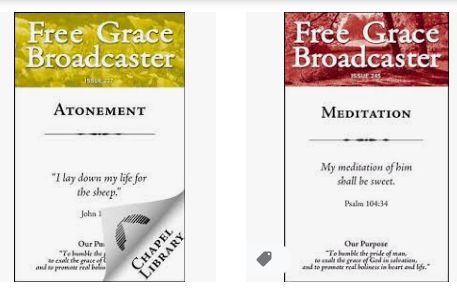
Chapel Library’s mission is sending Christ-centered literature worldwide without charge. Chapel Library offers almost 1000 titles in English, 200 in Spanish, and dozens in other languages. The Free Grace Broadcaster, our primary publication, is a collection of 6 to 10 articles on one subject from the best authors from prior centuries.
It’s awesome. Their library of quality essays is excellent, and you can download, read online, or have them send hard copy to you for free. Their library looks like this-
Chapel Library
Their monthly pamphlet, Free Grace Broadcaster, a series of essays based on one topic-
As with many ministries, occasionally they send out an update of their activities. I found the recent update to be encouraging. I received it a couple of months ago and I want to share it with you. With all the drastic sin we’re seeing nowadays, the collapse of civic diligence, the rampant violence etc, this ministry update helps remind us that the Lord is in control and He does not leave His people alone. He is with us. He is growing His people. He makes ministries thrive. His Spirit educates people. It’s so uplifting to see the Lord’s activity in the world in these ministry reports.
Here’s Chapel Library:
The Lord’s Faithfulness in the Last Three Years
The Lord has shown Himself faithful and kind to the ministries of Mt. Zion Bible Church in the last three years. With all the turmoil and uncertainties in our own country and around the world, we’ve wondered what this period of crisis holds for our literature ministry and the Bible Institute.
As we mentioned a couple of years ago, in 2019 the Lord blessed us to update our print shop[ and bindery with brand new equipment.
In 2020-2022 we have been blessed with generous giving from donors around North America, as well as some from around the world.
From 2018-2020, we began to see an increase in orders from other countries. We believe two factors contributed to that: the Lord blessed us to negotiate special rates with key international shippers and enabled us to streamline our processing of international orders through our website (www.ChapelLibrary.org).
In 2021, international requests for literature increased even more, twice as many as in 2020.
So far in 2022 (just into August),we’ve already surpassed the figures for all of last year!
We praise the Lord for the increasing volume. Please pray with us for wisdom, effectiveness, and fruit from the Holy Spirit’s work through the tracts, booklets, books, and courses that are going out all over the world!
That is the end of Chapel Library’s update, but wait! There’s more! The Lord has His own in every nation, tribe, and tongue. Chapel Library also lists the following praise reports from many different countries-
Kenya – “I have found your materials to be so useful not only to me but also to our church. I have not only been enriched and enlightened, but also I have found answers to questions that I never knew.”
Cuba – “Since I found your website online, I have dedicated long hours to reading literature in digital format. It has been a great blessing, consolation and edification in my life and that of my family. Less than a year ago I was diagnosed with Severe Dilated Myocarditis and I have spent most of my time at home in prayer and perseverance of the faith.”
Philippines – “Book received. I’m so happy. My heart leaps with joy. It really helped me, my family, and the church.”
Argentina – “Thank you for the shipment of literature for the prison ministry where I am sharing the Gospel.”
Namibia – “I have received my parcel. We trust that the Lord will use all these materials to build His church, even here.”
Yes, even there. The Lord is sovereign over all nations and there is no corner left untouched by His presence in some believing saints. It’s heartening to know that there are solid Christians stationed all over the world, ministering in churches, prisons, families, even the hard places.
As with Chapel Library and so it is with you- you never know where the words you produce, written or vocal, will reach ears needing to hear graceful speech.
Let no unwholesome word come out of your mouth, but if there is any good word for edification according to the need of the moment, say that, so that it will give grace to those who hear. (Ephesians 4:29).
Pray for ministries that are dear to you. Give, generously if you can. Even if you can’t, there are ways, such as Amazon’s Smile- where a portion of whatever you buy will go to a designated charity. Here is their explanation, “AmazonSmile is a simple way for you to support your favorite charitable organization every time you shop, at no cost to you.” FMI about Amazon Smile, go here. To view a list of their approved charities, go here. My designated charity Amazon Smile funds go toward is the Gideons International.
Praise the Lord for His work in the world! No matter how dark the days, His light never dims!
The LORD, the Psalmist’s Shepherd. A Psalm of David.
The LORD is my shepherd, I will not be in need. He lets me lie down in green pastures; He leads me beside quiet waters. He restores my soul; He guides me in the paths of righteousness For the sake of His name.
Even though I walk through the valley of the shadow of death, I fear no evil, for You are with me; Your rod and Your staff, they comfort me. You prepare a table before me in the presence of my enemies; You have anointed my head with oil; My cup overflows. Certainly goodness and faithfulness will follow me all the days of my life, And my dwelling will be in the house of the LORD forever.
This is a most familiar Psalm to many people. It’s beautiful poetry and solid comfort, too.
As with any scripture, just asking a simple question of the scripture will lead you on a path deeper and deeper into God’s truth. The question today is, What IS the valley of the shadow of death? How can I describe it?
The phrase is familiar to us and it makes sense- at first. The valley of the shadow of death is understandable both on a cognitive level and a poetic level. But when you really try to grasp what it is, then suddenly it seems as if we are standing on the precipice of a light-filled mountain so tall we cannot see the top. What is it exactly?
Did you know the phrase ‘shadow of death’ was a common Hebrew poetic phrase? As such, one might expect to find it in numerous scriptures besides the well-known 23. And it is. It’s in Psalm 107:10, Luke 1:79 (repeating it from Ps 107:10), Isaiah 9:2, Job 38:17, and others.
There were those who lived in darkness and in the shadow of death, Prisoners in misery and chains, (Ps 107:10)
To shine on those who sit in darkness and the shadow of death, To guide our feet into the way of peace. (Luke 1:79)
The people that walked in darkness have seen a great light: they that dwell in the land of the shadow of death, upon them hath the light shined. (Isaiah 9:2, KJV)
This is the best explanation I could find about that exactly the shadow of death means. It is from Barnes’ Notes on Isaiah 9:2-
In the land of the shadow of death – This is a most beautiful expression, and is special to the Hebrew poets. The word צלמות tsalmâveth, is exceedingly poetical. The idea is that of death, as a dark substance or being, casting a long and chilly shade over the land – standing between the land and the light – and thus becoming the image of ignorance, misery, and calamity. It is often used, in the Scriptures, to describe those regions that were lying as it were in the penumbra of this gloomy object, and exposed to all the chills and sorrows of this melancholy darkness. Death, by the Hebrews, was especially represented as extending his long and baleful shadow ever the regions of departed spirits; Job 38:17
By the way, the definition of penumbra is – the partially shaded outer region of the shadow cast by an opaque object.
In Job 3:1-5 we read
Job Laments his Birth: After this opened Job his mouth, and cursed his day. And Job spake, and said, Let the day perish wherein I was born, and the night in which it was said, There is a man child conceived. Let that day be darkness; let not God regard it from above, neither let the light shine upon it. Let darkness and the shadow of death stain it; let a cloud dwell upon it; let the blackness of the day terrify it. (KJV).
Barnes again explains the phrase ‘shadow of death’,
It occurs frequently in the sacred Scriptures; compare Job 10:21-22; Psalm 23:4; Job 12:22; Job 16:16; Job 24:17; Job 34:22; Job 38:17; Amos 5:8; Jeremiah 2:6. It is used to denote the abode of departed spirits, described by Job as “a land of darkness, as darkness itself; of the shadow of death without any order, and where the light is as darkness;” Job 10:21-22. The idea seems to have been, that “death” was a dark and gloomy object that obstructed all light, and threw a baleful shade afar, and that that melancholy shade was thrown afar over the regions of the dead. The sense here is, that Job wished the deepest conceivable darkness to rest upon it.
I can’t read Hebrews (or Greek) 2 of the original languages the Bible was written in (the others being Aramaic and a few words in Ugaritic). Knowing the verses in the original language would indeed illuminate the poetic qualities of our Lord who is the author and the Spirit who inspired it. But just knowing the phrase’s origin, its use in many verses, and reading Barnes’ explanation of the phrase, is enough to make me praise the Lord, author of the written, eternal word.














 the-end-time.org