Posted in theology

The world is baking soda and we’re…

By Elizabeth Prata

Photo by Nathan Dumlao on Unsplash

Our own limited spheres may seem calm and fine, but it’s a false calm. The world is baking soda. Once we step into the world and speak truth- whether at work or to unsaved family or in public- we’re vinegar (not the honey of the Gospel that can only be appreciated after salvation). What happens when vinegar is sprinkled on baking soda? It bubbles, foams, makes a frothy storm.

Vinegar to the world is “There’s only two genders”. Vinegar is “Transgenderism is sin”. Vinegar is “Women are biblically unqualified to preach”. Oh! Watch the foaming and the bubbling in anger when THAT vinegar truth bomb is poured onto the baking soda!

We as believers do not go around purposely stirring up the baking soda of the world, but it is a truism that speaking truth to a heretical world will stir it up. Some people avoid saying the truthful things because they fear man, or they’re tired and don’t want to deal with the fallout, or they ‘need’ the job, and so on. Being winsome and pleasant is wonderful, but if you are getting pushback because you’re speaking truth, that is all right too. It’s going to happen. You did nothing wrong and probably did everything right.

When Philip asked the Ethiopian Eunuch if he understood what he was reading, Philip received a courteous and open reply. Sometimes that happens. When Paul told the Ephesians the truth of God, they beat him almost to death. That happens sometimes too. It’s not that you’re doing something wrong if you never receive an open and calm reply. When Paul shared with the group of women at Philippi, Lydia listened and converted. But you notice it wasn’t because of persuasion or artfulness or winsomeness that Lydia converted. The Lord is the Lord of Salvation. It was He who opened her heart to receive the Good News. (Acts 16:14b).

We just don’t know who is one of the elect. We simply need to keep speaking truth to a lost and dying world. Sometimes people listen attentively. Sometimes they gnash their teeth and revile us. Sometimes they simply laugh and go their way.

Charles Spurgeon is said to have printed more words in English than anyone ever.  In print he published some eighteen million words. His sermons sold over fifty-six million copies in nearly forty languages in his own lifetime, and that steady pace continues today. Today, there is available more material written by Spurgeon than by any other Christian author, living or dead. He is said to have preached to more than 10Million people.

Charles Spurgeon said,

If God would have painted a yellow stripe on the backs of the elect I would go around lifting shirts. But since He didn’t I must preach “whosoever will” and when “whatsoever” believes I know that he is one of the elect.

Charles Spurgeon

And so we continue to be the vinegar whose truth stirs up the world’s baking soda. But out of that foamy stir, emerges Spurgeons, and Bunyans, and Warfields, and MacArthurs, and Riccardis. And Joes and Sallys and Petes and Janes who turn around and preach and teach and bring ever more people into the fold. Vinegar poured on a wound of sin will sting at first. Then it turns to the sweetest honey when one believes in Jesus. Sweeter, even:

The fear of Yahweh is clean, enduring forever; The judgments of Yahweh are true; they are righteous altogether. 10They are more desirable than gold, even more than much fine gold; Sweeter also than honey and the drippings of the honeycomb. (Psalm 19:9-10 LSB)

Posted in theology

Thoughts on the Christian school shooting

By Elizabeth Prata

Audrey Elizabeth Hale, a 28 year old woman from Nashville, packed herself with two assault-style rifles, a handgun, and lots of ammunition, drove to a Christian school, parked, and exited her vehicle. She shot out the glass on the side doors to the school. Entering the hall, she looked for people to kill. And kill she did, slaying a substitute teacher, a custodian, the head of school, and three nine-year-old children.

She apparently identified as a boy. She was a biological female, but preferred to think of herself as a male. She used he/him pronouns on her now defunct social media, and gave herself the name Aiden. She also dressed as a male, including a tie.

This tells us that she was on the far end of sin. As Romans 1:18-32 describes the process of deepening sin in both an individual and a society, we see that Hale was toward the end of the sin-spectrum, having a mind so futile she couldn’t figure out her own gender.

When a person is that deep into sin, Romans 1:28-31 says,

“And just as they did not see fit to acknowledge God, God gave them over to an unfit mind, to do those things which are not proper, 29 having been filled with all unrighteousness, wickedness, greed, evil; full of envy, murder, strife, deceit, malice; they are gossips, 30 slanderers, haters of God, violent, arrogant, boastful, inventors of evil, disobedient to parents, 31 without understanding, untrustworthy, unloving, unmerciful;“

Hale’s choice to look a 9-year old in the face and shoot her dead, along with 5 others before being killed by police herself, is evil. But sin is something that is inside each one of us.

Photo by Mike Labrum on Unsplash

I want us all to understand something.

In a sense, we are ALL capable (before salvation) of such evil deeds. Hitler might be seen as an anomaly but he wasn’t unusual. Genghis Khan, Attila the Hun, Timur, Bloody Mary, Lenin, Stalin, Idi Amin…all just as evil. History is littered with ruthless, evil leaders possessing a penchant to kill.

As for run-of-the-mill individuals, ABC News states that “There have been 131 mass shootings with four or more people wounded or killed so far in 2023.” John Wayne Gacy, Charles Manson, the Hillside Strangler, Skid Row Slasher…and I could go on with naming serial killers and murderers.

King David was a murderer. So was Saul/Paul.

We learn other things about murder in the Bible.  For example, we learn that murder is a crime authored by the devil himself. John 8:44 says the devil is a murderer.  And murder is basically authored by Satan. 

John MacArthur, “Who is a Murderer?“
Photo by K. Mitch Hodge on Unsplash

Hale’s decision to mass murder isn’t a fringe event (thanks to police’s swift action or there would have been many more victims, said the Metro Police Chief). Murder is a sin that is sadly in each one of us. The very first human-to-human crime was … murder. Cain slew Abel.

We tend to think sin is an abstract. We like to think it’s something that can be handled. We toy with it. We indulge sin, sometimes for a long season. Post-salvation, we respect the Bible’s stance on sin, but do we, really? Do we understand how strong sin as a force is?

Even Christians tend to overlook some sins. Ligonier Ministry wrote: “Have you ever found yourself so caught up and concerned with the rampant sinfulness of our culture that you forget about the subtle sins in your own heart? If so, Jerry Bridges has written a book for you. Respectable Sins: Confronting the Sins We Tolerate (NavPress, 2007) takes aim at the sins many Christians consciously or unconsciously consider “acceptable” behavior.”

NO! Sin is powerful and a HUGE PROBLEM.

If we are saved, there is blessedly one direction we will go- and that’s toward sanctification, holiness, Christ-likeness. We resist the sin that is in us, every day, a little more. The Holy Spirit sees to that. But just as we cannot fathom how much the Lord loves us, we cannot fathom how evil sin is.

Photo by Nick Fewings on Unsplash

But if a person isn’t saved, the direction they will always go will be deeper in sin. That’s the other direction. Sometimes the Lord calls some of them home before they reach the level of evil murder. But remember, Jesus said that,

“You have heard that the ancients were told, ‘YOU SHALL NOT MURDER,’ and ‘Whoever commits murder shall be answerable to the court.’ But I say to you that everyone who is angry with his brother shall be answerable to the court; and whoever says to his brother, ‘You good-for-nothing,’ shall be answerable to the supreme court; and whoever says, ‘You fool,’ shall be guilty enough to go into the fiery hell. (Matthew 5:21-22).

Jesus is saying that yes, murdering a human is bad. Slaying a body is breaking the Law. But the human heart harbors such evils (Galatians 5:20-21) that we can’t even know (Jeremiah 17:9). Yet, the scope of God’s commandment not to murder isn’t restricted to solely the fleshly demise at the hands of another. The commandment not to kill encompasses more that just that. It concerns the glory of God, divine judgment, God’s holy character, and a person’s inner attitudes. John MacArthur explains the Matthew 5:21-22 verse,

And that’s why Jesus goes on in verse 22, and says this, “But I say unto you – ”  Let Me tell what God really meant by that word in Exodus.  Let Me give you the right interpretation.  “ – whosoever is angry with his brother… “Whosoever is angry with his brother shall be in danger of judgment:  and whosoever shall say to his brother, Raca, shall be in danger of the council:  and whosoever shall say, Thou fool, shall be in danger of hell fire.” Jesus simply says, it isn’t the issue of murder alone, it’s the issue of anger and hatred in your heart. You cannot justify yourself because you don’t kill.  Because if there’s hatred in your heart, you are the same as a murderer.

Allowing sin to linger causes problems for the saved person-

If I regard wickedness in my heart, The Lord will not hear; (Psalm 66:18).

Sin is evil! We are all sinners! It is heinous to think of Audrey Hale gunning down sweet little children. Our minds recoil from that. Our hearts grieve over acts like that. But do our hearts and minds mourn and recoil over the 2 biggest sins in history? Sins worse than shooting a small child? Such as: Adam’s rebellion in the Garden, and Judas’ betrayal of Jesus?

If our mind hates that sweet innocents like the 9 year olds in Covenant Christian School were killed by Hale point blank, what about life in a perfect earth, personally knowing God, dwelling in a state of innocence, yet choosing to disobey God? What about a man like Judas, living with Jesus, seeing all his miracles, absorbing all His teaching, for three years, yet selling the most perfect and beautiful person in the universe, for money? Does our mind recoil from THAT?

Photo by Marcus Ganahl on Unsplash

This is why we all need the Gospel. We all need it, pre-salvation and even after salvation. Sin is THE most pervasive and most evil force upon the earth. Not gravity, not solar flares, not magnetism, SIN.

Do.Not.Underestimate.It.

Our hearts might be angry with a mass shooter of children, but our hearts should also ache for the sins we ourselves perpetrate. The respectable ones, the subtle ones, the overt ones. All of them. Jesus came to die for us so that we might be saved from His just wrath.

Audrey Hale wrote to a friend just before she shot up the school. She said she wanted to die. She said she’d see her friend in another life. Audrey Hale did die that day. Police shot her. She died, but sadly, her pain didn’t end then. It only began.

I grieve over the unsaved living in this ever-deepening cesspool world of sin. I grieve over their death and headlong plunge into hell and torment forever. Such was I before grace came. Be grieved or even angry over evil. But aim your anger over the true culprit: sin. Such were some of us- angry, confused, emotionally disturbed. And drunkards, addicts, homosexuals, liars, filthy beasts. The Gospel is the answer.

THANK YOU Jesus for living on earth as God-Man, a perfect life, and unjustly dying and rising again. Thank you for solving the world’s worst problem- sin and our separation from You. Thank you for giving us a right worldview and hope and peace.

Share the reason for the hope that is within us. No doubt Audrey Hale had been given the Gospel. Her parents were devout. Audrey Hale rejected it. Some will reject. But some won’t. And so we persevere, sounding forth His GOOD NEWS, until the Lord comes back –

For the word of the Lord has sounded forth from you, not only in Macedonia and Achaia, but also in every place your faith toward God has gone forth, so that we have no need to say anything. For they themselves report about us what kind of an entrance we had with you, and how you turned to God from idols to serve a living and true God, and to wait for His Son from heaven, whom He raised from the dead, Jesus, who rescues us from the wrath to come. (1 Thessalonians 1:8-10)


Photo by Tim Mossholder on Unsplash
Posted in theology

Am I a wretch?

By Elizabeth Prata

For the wages of sin is death, but the gracious gift of God is eternal life in Christ Jesus our Lord.
Romans 6:23.
Photo by Mia Golic on Unsplash

Before I was saved, I used to like that hymn “Amazing Grace”. Go figure. Usually only at Christmas or Easter services I was dragged to, we were not a church going family. But that was where I’d heard the song, and I liked it.

But I decidedly did not like the part that said “a wretch like me”. I stubbornly clung to the notion that I, a good person, was in no way a wretch. I closed my mouth when that part came up. What self-pitying, low self-esteem these Christians were, I’d thought.

I was so deep in my sin, of course I could not see my own depravity. But His grace abounded. Now I’m saved, and far from thinking that Christians are being pitiable doormats with no self-esteem, now, acknowledging my position before Christ is a relief. I had been comparing myself to others, and comparatively I might have been slightly nicer than the other guy, who was also a thoroughly depraved wretch by the way, but at the judgment we do not compare ourselves to other people. We must be like Christ, who is perfectly holy. So, yes, I am a wretch. I had been strutting and roaming the earth in sin, proud of my sin, doing nothing for God and happy in my pigsty of a life.

Those who will humble themselves He will lift up, but the proud, He opposes.

It bears repeating, and repeating, and repeating, just how sinful we were before salvation – yet God loved us. He loved his enemies! We were His enemy, hating Him and rejecting Him at all points. No one seeks for God. We only seek for ourselves. Yet His grace descended on each person who is and will be in heaven, plucking us up from the sinner’s nest of sin, and cleaning us with his own blood, standing us upright, and bestowing on us all the benefits of heaven as His children.

Every human is made in the image of God but only people that His grace opened their eyes to repent are His children.

For the wages of sin is death, but the gracious gift of God is eternal life in Christ Jesus our Lord. (Romans 6:23)

Do not let the wonder of salvation dwindle in your mind. Allow the beauty and eternal gift of His Spirit in us to dwell richly in a bed of gratitude deep within, welling up at all points to share the glory that is Jesus.

Posted in theology

Real Zeal vs. False Zeal part 2

By Elizabeth Prata

Part 1 Discerning false zeal, here

Brothers, my heart’s desire and my prayer to God for them is for their salvation. For I testify about them that they have a zeal for God, but not according to knowledge. (Romans 10:1-2).

By this verse we see there is such a thing as a zeal that is not of God. There can be zea, or fervor or energy around religious things, but not according to what we know from the Bible. AKA knowledge.

Zeal: great energy or enthusiasm in pursuit of a cause or an objective. Synonyms: passion, fervor, enthusiasm.

Dr. Martyn Lloyd-Jones preached on the Romans 10:1-2 verse in a sermon called False vs. True Zeal. The sermon is stunning, relevant, and informative. He laid the foundation as he always does, logically, then laid out tests to determine of someone is exhibiting false zeal. Then in the later part of the sermon he laid out how to determine if a person is exhibiting true zeal. I paraphrased the part of his sermon discussing false zeal, here. Today, we have an exam of true zeal.

Lloyd-Jones’ sermon can be heard here, for free: True Zeal and False Zeal: A Sermon on Romans 10:1-2. Or on Youtube with closed captions (which might help due to his accent).

What follows is Dr. Martyn Lloyd-Jones’ excerpt from the sermon True Zeal vs. False Zeal, focusing on true zeal.


What are the characteristics of a true zeal? A true zeal is never a zeal that’s put on. It’s not put on you by anybody else it’s not put on by you yourself. If you’ve got a zeal you’ve got it not because you’ve been told it’s the thing to do when you join this church or this society. That’s not the reason if you are doing it, simply because it’s the thing to do in this society or company. It’s never put on or mechanical either by other people or the thing to do or by ourselves as the result of a decision.

Secondly, it is always the result of being the man who’s got a true zeal has it because he is what he is. He has it because he’s grown in grace and because he’s grown in sanctification. It’s not an act.

Thirdly and putting it still more specifically and in terms of our text true zeal is always the result of knowledge. It is always the outcome of knowledge. With the Apostle is really put this very wonderfully for us already in chapter 6 in verse 17, (KJV)

But God be thanked, that ye were the servants of sin, but ye have obeyed from the heart that form of doctrine which was delivered you.

Now you notice the order. He actually puts the obeying first. That the obeying actually in practice was the last. This is what he says has happened to you – he says the first thing was this a form of doctrine was delivered. The gospel was preached to them and they received it and believed it with their minds. But it wasn’t only in their minds, the heart was involved. They were moved by it and because the heart was involved they were moved by it. They gave it obedience. Their will came into action but that was the order they received it with the mind first, it moved the heart it moved them to action.

That is the true order of true zeal. The trouble with a false zeal is that it puts the will first and is not interested even in the heart nor in the head. The man who says ‘nothing matters but activity’ is exhibiting a false will. That’s the danger of activism. It goes on in his headlong blind manner. The right order is the mind, the heart, then the will.

The man who has the true zeal he knows what he’s doing and he knows why he’s doing it. Zeal is according to knowledge!

The fourth test is that it’s a deep zeal. Not superficial. It’s not a spectacular, showy blaze, but a controlled fire that’s longer lasting and more useful.

Photo by Ben White on Unsplash

As such, the true zeal displays control. Fire is a bad master, but when zeal is controlled by knowledge it’s as it should be. If a fire is in the hearth it’s controlled and warming the room and pleasant to be around. Fire that is out of control is damaging and unwanted. It burns and destroys. It is the same with zeal. A person exhibiting true zeal controls it.

Sixth, a true zeal is never self-confident. He’s always reverent. He doesn’t get excited. The Apostle Paul says to the Corinthians that when he went amongst them he did so in weakness and in fear and in much trembling, Paul, trembling, apprehensive, fearful nervous? How different that is from the false zeal and the confidence and the assurance and the mastery of the occasion some men show in their false zeal!

A person with true zeal knows he operates under grace and not in his own strength. His confidence comes from knowing his energy is deposited by the Spirit of God.

Remember, the Corinthians were despising Paul because he wasn’t boasting about himself. Some of the false teachers were boasting about themselves. They were recommending themselves. Well, says Paul, if you really want to know I laboured more abundantly than they all yet not I but the grace of God that was with me. I am what I am by the grace of God .

Seventh- What’s the motive that animates true zeal? Well it isn’t just to be busy and to do things and to get results. It’s the glory of God… the glory of God. The love of Christ. Their motivation is the love of Christ and wanting to share that with others who are lost.

A man of true zeal is not simply anxious that people should decide for Christ. He wants them to come to what Paul calls our knowledge of the truth. He’s not interested in superficial results. He is very concerned that men and women should have a knowledge of the truth that will save them from hell. 

It comes to this – that the man who is animated by a true zeal however successful he may be he is never elated he’s never excited with his own success. When the Lord sent the seventy out to preach and to cast out devils and they were so successful that they came back full of excitement. They said ‘master the very devils are subject unto us!’ and our Lord looked at them and said ‘In this rejoice not that the devils of the spirits are made subject unto you, but rejoice rather that your names are written in heaven.’

I ask you a question as I close. What’s the effect of all this upon you is it that you are so afraid of the false zeal that you do nothing at all. If it is I have spoken in vain if you are so afraid of a false zeal that it paralyzes you, then you’re the very antithesis of Paul. You’ve not understood the truth. Knowledge of the truth always moves the heart and moves the will.

If the knowledge of the truth hasn’t moved you, hasn’t engaged your affections and your emotions hasn’t made you do something, you have not known the truth properly. When a man really knows this truth he says we cannot but speak of the things which we have seen and heard.

In any case the Apostle teaches us in Romans that we must not be slothful in business we must rather be fervent in spirit serving the law not a false zeal but a true one. Fervent in spirit serving the Lord. He’s not writing to apostles he is writing to ordinary church members. Are you fervent in spirit? Are you moved by what you claim to believe? Do you really believe it? If you do you know that everybody who doesn’t believe it is going to hell, can you be passive and quiet and paralysed and say nothing and do nothing?

To what extent are you concerned about the souls of the Lost? How can a man believe the gospel and not be concerned about those who don’t? How can a man sit down feeling his own pulse worrying about his own temptations and sins and problems and have no concern about the lost?

————end MLJ sermon part 2 on true zeal.

We don’t often talk about zeal, or energy, or fervor for the lost. We talk of how ‘busy’ we are, but as we saw in part 1 and in part 2, there can be a false motivation, a false energy propelling us in this busyness that is completely vain. Make sure your energy comes from the Spirit, that it isn’t something put on and springs from a fountain of carnality. Matthew 7:21-23 shows the unmasking of people who exhibited a false zeal, only to find they were doing it in their own strength and not in the Lord.

Brothers, my heart’s desire and my prayer to God for them is for their salvation. For I testify about them that they have a zeal for God, but not according to knowledge. (Romans 10:1-2).

The only way to obtain knowledge of God is to go where God is: the Bible. That is where he has revealed Himself, and is the source of truth and knowledge.


Posted in theology

Real zeal vs. False Zeal part 1

By Elizabeth Prata

Real Zeal vs. False zeal part 2

Photo by Luan Cabral on Unsplash

A regenerated heart means different affections, different point of view, different citizenship. It means the world will hate the believer. And it does. It does.

Post-salvation, I learned that some of the most vicious and difficult evangelistic responses don’t come from the world, but sometimes actually come from people calling themselves other Christians. That is because I learned there are false Christians who possess a false zeal. Or, actually, it’s a true zeal, but it’s misplaced from glorifying God in truth, to glorifying satan in hate.

Brothers, my heart’s desire and my prayer to God for them is for their salvation. For I testify about them that they have a zeal for God, but not according to knowledge. (Romans 10:1-2).

By this verse we see there is such a thing as a zeal that is not of God. There can be zeal, or fervor, or energy around religious things, but not according to what we know from the Bible. AKA knowledge.

This contrast of false zeal vs. true zeal was highlighted recently with several events in the news. Of course, the “Asbury Revival”, a week-long event that had occurred at a college in Kentucky where a seemingly spontaneous move of God spread across the campus, drawing hundreds of matriculated students, then busloads of students from other campuses, then rubber-neckers. The event seemed to indicate a spiritual move of the Spirit to awaken dead sinners. Or was it? There certainly was an abundance of zeal present. Was it real or false? How to tell? At the very beginning it was especially hard to tell.

Zeal: great energy or enthusiasm in pursuit of a cause or an objective. Synonyms: passion, fervor, enthusiasm.

In addition, another zeal event occurred. Beth Moore’s third memoir was released in February and the enterprising little Bible thumper from Texas has been busy as a bee flitting from interview to interview. The book rests at this writing at the top of famous best-seller lists. It’s creating quite a buzz. She has been on TV, streaming, and print, her opinions delivered with as much verve as ever, and are eagerly absorbed by audiences, never waning despite her 65 years and over 4 decades in the Christian biz.

Beth Moore has been consistently described through the years as “energetic”, “charismatic”, “passionate”. She puts out an energy as zealous for God.

But how can we discern if we observe a true zeal or a false zeal? Let’s turn to the scriptures.

As Paul finished Romans 9, and remember, there were no chapter breaks in the original letter, before he went on to mentioning false zeal in Chapter 10:1, had reminded the Roman Christians that Israel, pursuing a law of righteousness, did not attain that law. Why? Because they did not pursue it by faith, but as though it were by works. (Romans 9:31-32).

They appeared to be doing a religious effort, they looked like they were on the right track, and part of that appearance is because of their fervent energy.

They went across the world to make one proselyte, but wound up making him twice the sons of hell they were. (Matthew 23:15). That verse is the example of zeal without knowledge. You can be passionate, you can be busy making disciples, but a false zeal will make disciples who miss the mark completely and will wind up in hell as a son of hell. Zeal, no knowledge.

Dr. Martyn Lloyd-Jones preached on the Romans 10:1-2 verse in a sermon called False vs. True Zeal. The sermon is stunning, relevant, and informative. He laid the foundation as he always does, logically, then laid out tests to determine of someone is exhibiting false zeal. Then in the later part of the sermon he laid out how to determine if a person is exhibiting true zeal. I’ll paraphrase his sermon below in 2 parts. Today, we have an exam of false zeal. Tomorrow, true zeal.

Lloyd-Jones’ sermon can be heard here, for free: True Zeal and False Zeal: A Sermon on Romans 10:1-2. Or on Youtube with closed captions (which might help due to his accent).

I think almost invariably that zeal is one of the most prominent characteristics of people who belong to the cults.

Martyn Lloyd-Jones

Test of False Zeal
by Martyn Lloyd-Jones, paraphrased & quoted from his sermon

Here is one thing which should always raise the query in our minds and that is that our zeal has been imposed upon us by somebody else and we are just conforming to a pattern. You’re becoming just like the rest of them, conforming to an external pattern.

Secondly if it is a zeal that has to be whipped up or organized as it were, or that we have to be kept up to it. If the stimulus has to come from other people on the outside, it may very well be a false zeal.

A third test if you find that you put greater emphasis upon doing than upon being, it’s always an indication. You should be careful if you are more anxious to do things than to be a saint, you better examine your zeal again.

Another way of putting that my fourth test can be put in this form that involves zeal the activity is always very prominent and at the center of the life rather than the truth. The thing you are hit by all along is the activity, this energy that’s being put forth, rather than by the truth which even the people themselves claim to be representing. In other words, there’s always a tendency in false zeal to overdo things. There’s always an element of excess where the activity is more in evidence than the thing which is claimed.

In the fifth place the more prominent the machinery and the element of organization the more likely it is to be a false zeal. When methods and means and organization of machinery are very prominent it’s good presumptive evidence that it is a false zeal.

As my sixth test MLJ grouped a number of things together under the heading of carnality carnality. He meant that by that the flesh. In false zeal there is always this carnal element and it shows itself by a kind of lightness, a lightness of spirit, almost sometimes even a frivolity.

This can sometimes be seen even in religious meetings. There’s a lightness and a joviality and the kind of jovial superficiality. You can’t imagine such things anywhere near the Apostle Paul or any other of the Apostles or anywhere near our Blessed Lord himself, but you get it in these meetings. They’re very zealous. I’m not quitting their zeal I’m granting their zeal. I’m granting their enthusiasm but they always overdo it and there is this light touch about it.

Indeed I have often on some occasions in a certain type of meeting I’ve had to remind myself that I am in a religious meeting. The spirit I have felt present has been the spirit of a cricket team or a football team. The spirit of doing something worldly some wealthy entertainment. Now the people were absolutely sincere but there was lightness in the atmosphere there was no sense of awe, no sense of God, no sense of holiness no sense of reverence but everything was bright and breezy. It was being carried along with the verve and wonderful organizing power I say these are indications of carnality, not of true zeal.

Still under carnality, if there is an element of self-confidence and of assurance and of being in control of the situation, you can be quite certain it is false zeal. Any impression that is given by men – I don’t care how zealous he is, I don’t care how sincere he is – if he gives that impression that he’s in control and self-confident in the show I’m suspicious of his zeal and of his sincerity. If there’s any suspicion at all of his being proud of himself, it is still worse.

But let’s go on to test number seven – false zeal is always impatient to the examination. It dislikes being examined. It dislikes being questioned.

It resents this- it says ‘Can’t you see that I’m zealous … I’m enthusiastic … I’m sincere … I want to do …’ But you say ‘Well but let’s make sure because of the teaching.’ No, no, it’s impatient of all that. It wants to get on with things, must be doing something.

False zeal dislikes slowing down long enough to be examined.

Eighth, that is surely a very bad sign and when it is impatient of teaching. It is still worse they have a zeal of God but not according to knowledge. They don’t want the knowledge, for they’ve rejected the knowledge. They are not interested in it. They must get on with it they say. They don’t want to be taught and teaching is unnecessary. The thing to do is to be doing something that’s the spirit of the false zeal test number nine.

—end Martyn Lloyd-Jones tests of false zeal from his sermon.

As you read along of the 9 tests, did anyone come to mind? I can think of a lot of Christian celebs I see on social media who resist being tested, or don’t like their teaching being compared to the Bible. I can think of several people who exhibit a zeal but after having seen them PERFORM, their teaching actually evaporates. Their teaching has no substance when parted from their charismatic personality.

Monday I’ll post what Lloyd-Jones outlines as tests of true zeal. You’ll notice the difference immediately. Meanwhile, don’t be one of the many who think that just because a person seems passionate for God, they possess a true understanding of the faith. There IS such a thing as false zeal.

There is a danger of setting up zeal or sincerity to the supreme position.

Martyn Lloyd-Jones

Further Reading

Real Zeal vs. False zeal part 2

Today’s blog and podcast was about Romans 10:1-2, having a false zeal, that is, zeal about God but no knowledge of God. Zeal without knowledge Here is a good article on turning information into knowledge-

https://expositors.org/turning-information-into-knowledge/

Posted in theology

Contentment

By Elizabeth Prata

The face of discontent. EPrata photo

There’s a lot of discontent out there. I’m speaking both of the Christian world, and in the secular world. We know pagans are always discontent, their sins make them like restless waves washing up mire, as Isaiah says.

Even in the Christian world, though, there is discontent amongst those calling themselves Christians. Just scroll on any of your choice of Christian media and you will see grumbling, people acting vexed, peevishness, and so on.

I decided to start a little series on Facebook and Twitter and Instagram, the social media I’m on most, called ‘Little Things’. Just a sentence expressing something I’m content with, or charms me. Like picking a good coffee mug for the day, or fluffy white clouds against a blue sky. My hope is that focusing on these things will make me more grateful of the little things that we often overlook, and thus increase my contentment. I also hope that my timeline becomes an oasis for anyone else seeking solace and peace from the trolling tumults occurring on our screens.

I also went back to a Puritan book called “The Rare Jewel of Christian Contentment” by Jeremiah Burroughs. It is a spectacular book, one for the ages. I want to do everything I can to avoid getting weary in the well-doing, and to remain content no matter what is happening in Christendom or in the Gentile world. Burroughs wrote:


What contentment is opposed to: (says Burroughs, excerpted)

1. It is opposed to murmuring and grumbling at the hand of God, as the discontented Israelites often did. If we cannot bear this either in our children or servants, much less can God bear it in us.

2. To vexing and fretting, which is a degree beyond murmuring.

3. Peevishness – easily irritated by unimportant things.

4. To tumultuousness of spirit, when the thoughts run distractingly and work in a confused manner, so that the affections are like the unruly multitude in the Acts, who did not know for what purpose they had come together. The Lord expects you to be silent under His rod, and, as was said in Acts 19:36, “Ye ought to be quiet and to do nothing rashly.”

5. It is opposed to an unsettled and unstable spirit, whereby the heart is distracted from the present duty that God requires in our several relationships—towards God, others, and ourselves. We should prize duty more highly than to be distracted by every trivial occasion.

6. It ends with desperate risings of the heart against God by way of rebellion. Burroughs’ book is available as a Puritan Paperback at Reformation heritage Books, or at Amazon or other booksellers, or free download at Mt. Zion Chapel Library here: https://www.chapellibrary.org/pdf/books/rjoc.pdf


So, you see the progression of discontent. It begins with errant thoughts, of course, as all sin does. But once it’s ready to come out the mouth it begins as murmuring, then louder as grumbling, and on up the scale till it’s open rebellion.

We must actively squash discontent where it appears.

Posted in theology

Disorder in the churches!

By Elizabeth Prata

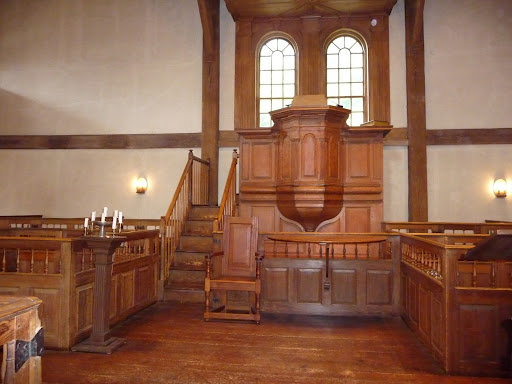
Pulpit

1 Corinthians 14:34-35 says

The women are to keep silent in the churches, for they are not permitted to speak, but are to subject themselves, just as the Law also says. But if they desire to learn anything, let them ask their own husbands at home, for it is disgraceful for a woman to speak in church.

It’s very clear. Women are not to preach, or teach men, (but I do not allow a woman to teach or exercise authority over a man, but to remain quiet says 1 Timothy 2:12.)

As Larry Farlow said of the 1 Timothy verse:

@LarryFarlow: Yep. If someone cannot teach or exercise authority over half the church, they can’t be a pastor.

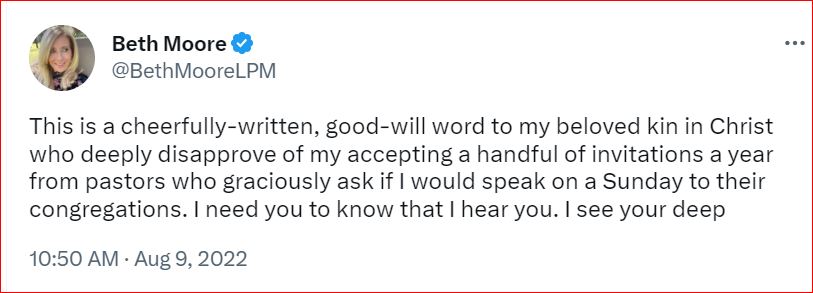
And, using the word speak instead of preach is not the ‘get out of jail’ card rebellious women think it is. The Greek word in the verse literally means speak. So when someone like Beth Moore coyly claims to be “speaking” on Mother’s Day, when she is actually preaching, it’s a double rebellion and thus doubly hypocritical because she tried to cover it up.

Changing “preaching” to “doing” doesn’t fool God. Or anybody else.

The Corinthian church was having special problems with disorders in their public meetings (1 Cor. 11:17–23). The reason is not difficult to determine: they were using their spiritual gifts to please themselves and not to help their brethren. The key word was not edification, but exhibition. If you think that your contribution to the service is more important than your brother’s contribution, then you will either be impatient until he finishes, or you will interrupt him. Add to this problem the difficulties caused by the “liberated women” in the assembly, and you can understand why the church experienced carnal confusion.” Wiersbe, W. W. (1996). The Bible exposition commentary (Vol. 1, pp. 614–615). Victor Books.

Ladies, do you “speak” in church to the congregation? Even if the Sunday School or Bible study leader teacher asks for comment, are you the first to leap in and state your opinions? If so, do you believe what you have to say is more important, more edifying than what the man next to you would say, if he could get a word in edgewise?

Yes, Paul was speaking of disorder in the church, when women who had not even been allowed in the synagogue but had to stand behind a partition if they wanted to hear, now allowed not only in the church but to pray and prophesy (before the canon was closed), caused a melee of chaos. Paul wanted it stopped.

But though Paul was speaking of a certain situation in history, it does not mean all is OK now. The tendency for women to usurp is still present in us. When Paul said women are not to teach or have authority in the church, he followed that up in the next verse by appealing to the creation order. The creation order Paul appealed to still stands. Men lead the church. Women do not. Women are to listen, learn, and submit to their elders and their teaching.

Yet there are so many ministries women are allowed to and even commanded in which to participate. Of course we share the Gospel, that’s for all of us to do. We are hospitable, we support our husbands, we teach women, we teach children, we can help with administering finances, or preparing budgets, we have gifts of mercy and helps… Egalitarian women today make it seem as though if we cannot teach or preach, we’re good for nothing.

Not so. Feminists and egalitarians are eternally discontent. But we find contentment in what the Lord has prepared for us, within His boundaries.

I appeal to you sisters, if you have an unhealthy and unbiblical desire to continually speak in church, in any way, before the gathered, please reconsider. Let the men speak. Listen, pray, sit attentively, to the glory of God and do not be a disgrace. Here is a short video on the subject:

Posted in theology

Tents and tentmaking

By Elizabeth Prata

The Lord has arranged my life so that now, though I have been a classroom teacher in the past, I am now a teacher’s aide. I am grateful because I still get to teach kids, but I have less stress and more energy after school – so that I can focus on ministry. I can support myself, (mostly) so in this way, the para-professional job I do is my tentmaking.

Let’s take a look at tents.

Now, when we speak of tents in the Bible, don’t think of Coleman tents you might use for a weekend in the nearby Park. These were homes. Portable, but heavy, large, and thick. The temple was actually a tent (tabernacle) for many hundreds of years in the Wilderness, then at Shiloh, before a permanent structure was built.

Noah was drunk inside his tent, remember? (Genesis 9:21).
Uh-oh, Lot pitched his tents near Sodom. (Genesis 13:2).
There were rules in case a person died inside his tent. (Numbers 19:14).
Moses would pitch a tent outside the camp and called it the ‘tent of meeting’. (Exodus 33:7).

It wasn’t easy to raise a heavy tent such as the ones used in those days. But it was a woman’s job to raise them, strike them, repair them, and care for them and their supplies like a large wooden mallet for driving in the pegs, and the women became expert in all the phases of making, pitching and striking tents. That is why Jael had a tent peg on her that she used to kill a man while he slept. (Judges 4:17-22).

In the late 1800s people from western Europe and America became fascinated with the Holy Lands. They flocked there to visit the sites from the Bible. In 1894 a book was published called Earthly Footsteps of the Man of Galilee (Info at the link about the book itself which is fascinating). Tourists visiting the Holy Land slept in tents each night as their hired dragomen set up camp. (There was no Marriott or Holiday Inn). The photo caption described these tourists “sleeping at night in carpeted tents most comfortably furnished”. Caption and photo below from Earthly Footsteps of the Man of Galilee, 1894.

Manners & Customs of the Bible further explains:

The large tents, still assuming they were made like Arab tents, had nine poles, placed in three rows, covering sometimes a space twenty to twenty-five feet long, ten feet wide, and eight to ten feet high in the middle, with the sides sloping. Such tents often had a curtain hung on the middle row of poles, dividing the tent into two parts, one for the men and one for the women. The poles that held up the tent and divided it into sections were further made useful by having hooks driven into them from which were suspended clothes, baskets, saddles, weapons, and various other articles of daily use. Freeman, J. M., & Chadwick, H. J. (1998). Manners & customs of the Bible (p. 343). Bridge-Logos Publishers.

Paul’s tentmaking

Now, we know Paul carried his cloak, scrolls, and likely quills to write with. Or his amanuensis did. But it is unlikely he also carried bags of goat hair with which to make or patch tents, or needles, and other tent making supplies.

In addition, there were the guilds. They were powerful monopolies, fraternal, and territorial. Guilds mentioned in the Old Testament were- 1 Chronicles 4:21 (linen), Nehemiah 3:8 (goldsmith), even the prophets had a guild (1 Kings 20:35).

In the postexilic period, guilds were powerful organizations and were recognized by the government. A guild could prevent a craftsman from another area from working in its territory. It had a trade monopoly in its particular locality. A guild could monopolize the market. Guild members were insured against loss of tools, animals, and boats used in their business, unless the loss was caused by their own negligence. Guilds had their own religious and social institutions, even their own synagogues, next to which there were burial grounds for the members. In some cases, members of a guild collectively built and operated businesses. Source Bible Gateway

Therefore it is unlikely Paul could waltz into a town and become a freelancer, the guild members would run him out. That he was staying with Prisca and Aquila in Corinth and assisting them (Acts 18:3) likely meant that the couple were members of the guild already, had an established business, and Paul could help them.

What were the supplies needed?

This goat’s hair cloth that is used in making these tents is porous when it is dry, but becomes waterproof after the first rains have shrunk it together. … The material that makes up the Bedouin tent is the same as the sackcloth of Bible days. It must be remembered that this Oriental sackcloth is not at all like the Occidental burlap, but is rather a material made of prickly, coarse goat’s hair. Source: Manners And Customs of Bible Lands

New tents are very seldom made among the Bedouins. About the only time this happens is when a young groom and bride set up housekeeping for themselves in a different location from that of the groom’s parents, and this rarely happens. The usual procedure is to accumulate the goat clippings of a year or so, and with these make a new strip with which to repair the old tent. The women do this work. The section of the tent roof that is most worn is ripped out, and a new piece of the cloth replaces it. The old piece is then used for a side curtain. Each year new strips of cloth replace old ones and the “house of hair” is handed down from father to son without its being completely new or completely old at any one time. Source.

As comfortable as the tents seemed, and by the photographs from the 1800s they do seem comfortable, (at least for the more wealthy desert dwellers) it was still a lot of work to care for tents.

Posted in encouragement, theology

Enriched beyond measure

By Elizabeth Prata

It rained yesterday. In other news, the cardinals that used to hang round in my yard, are back. About 8 years ago a tenant on the property had an aggressive yard cat, a hunter. Of course I didn’t mind that he cleared the yard of the mice. But then he apparently killed a bright red male cardinal, as I horrifyingly saw when leaving for work the next morning. He was under the feeder, so I surmised that he had been grazing on fallen seeds and was caught unawares.

Continue reading “Enriched beyond measure” →
Posted in theology

Falling into a pit!

By Elizabeth Prata

The Bible talks of falling into a pit quite often, when you really pay attention. I got interested in pits, lol.

What is a pit? “A hole in the ground, a cistern for water, a vault, a grave. It is used as a figure for mischief, and is the name given to the unseen place of woe. The slime-pits in the vale of Siddim were wells which yielded asphalt.” source from The International Standard Bible Encyclopaedia, Volumes 1–5.

Some verses are:

And He also spoke a parable to them: “Can a blind man guide a blind man? Will they not both fall into a pit? (Luke 6:39)

now the valley of Siddim was full of tar pits—and the kings of Sodom and Gomorrah fled, and they fell into them; but those who remained behind fled to the hill country. (Genesis 14:10).

Oof, that’s rough. Falling into a tar pit sounds deadly.

The Holman Illustrated Bible Dictionary describes pits:

Sometimes “pit” refers to a ditch or a marsh (Jer. 14:3; Isa. 30:14). Many times the word was used as a synonym for a place of destruction (Ps. 55:23), corruption (Pss. 16:10; 49:9; Isa. 38:17), or death (Isa. 14:15; Jon. 2:6). Three times KJV translated the word Sheol as “pit” (Num. 16:30, 33; Job 17:16). One Greek word is translated “bottomless pit” in Rev. 9:1, 2 (cp. Ps. 88:6). Source from Holman Illustrated Bible Dictionary

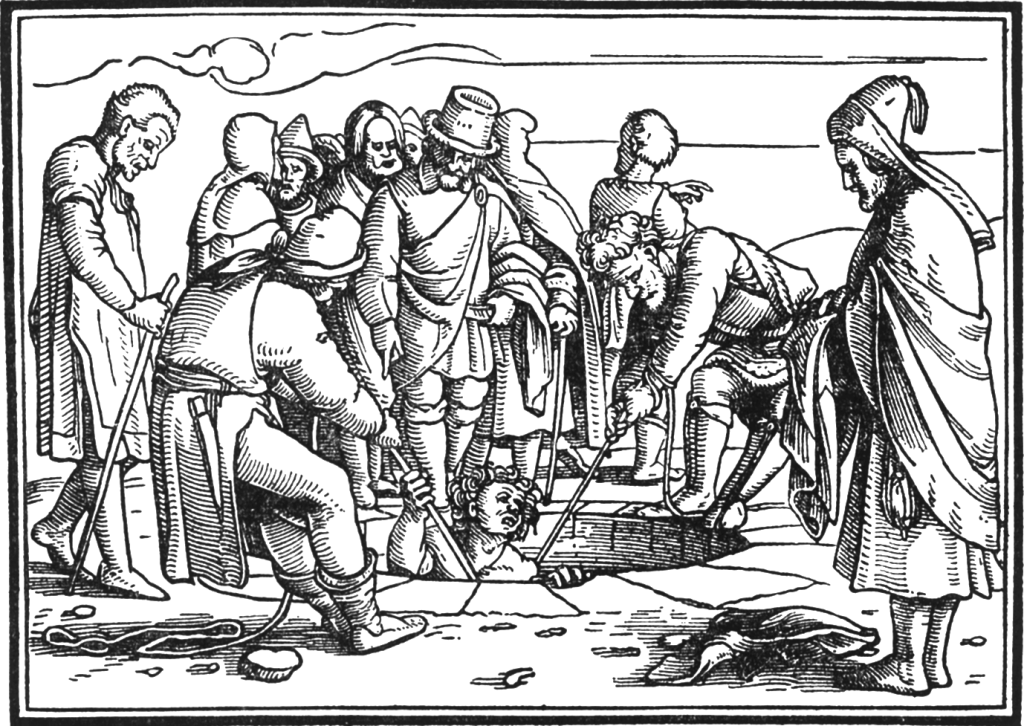
Joseph was thrown into a pit- by his brothers! (Genesis 37:28).

source: Images of the Old Testament, by Hans Holbein (1549)

The Hebrew word bowr can mean pit, hole, cistern, well, dungeon, the grave, or the abyss.

There were rules about pits. If you fall into an uncovered one, you could die. The animal would die. In Exodus 21:33-34, it states,

“Now if someone opens a pit, or digs a pit and does not cover it, and an ox or a donkey falls into it, the owner of the pit shall make restitution; he shall give money to its owner, and the dead animal shall become his.

When Absalom was killed they threw him into a pit and covered him with a very great amount of stones. (2 Samuel 18:17).

Zephaniah 2:9 refers to pits in the context of a place of utter desolation: “Therefore, as I live,” declares the Lord of hosts, The God of Israel, “Surely Moab will be like Sodom And the sons of Ammon like Gomorrah— A place possessed by nettles and salt pits, And a perpetual desolation.“

Most sobering of all, the pit is a synonym for abyss, and that is where satan will be thrown for a thousand years before his final destination of the Lake of Fire.

Then I saw an angel coming down from heaven, having the key of the abyss and a great chain in his hand. And he laid hold of the dragon, the serpent of old, who is the devil and Satan, and bound him for a thousand years; and he threw him into the abyss, and shut it and sealed it over him, so that he would not deceive the nations any longer, until the thousand years were finished. After these things he must be released for a short time. (Revelation 20:1-3).

EPrata collage

Matthew Henry’s Commentary says of Revelation 20:1-3, He cast him into the bottomless pit, cast him down with force, and with a just vengeance, to his own place and prison, from which he had been permitted to break out, and disturb the churches, and deceive the nations; now he is brought back to that prison, and there laid in chains.

(3.) He is shut up, and a seal set upon him. Christ shuts, and none can open; he shuts by his power, seals by his authority; and his lock and seal even the devils themselves cannot break open.

Henry, M. (1994). Matthew Henry’s commentary on the whole Bible: complete and unabridged in one volume (p. 2483). Hendrickson.

Just think on the Day when there shall be no more pits to fall into, no more metaphors describing an abyss that a sinner may descend into, no more empty cisterns, no more grave! Hallelujah, what a day that will be!