“Men are oppressing us with an overreach in their interpretation of a few verses”
These are statements I read and hear feminist women say when confronted with verses that affirm God’s plan for men to lead the church. These are not infrequent comments nor are they limited to a small group. The push to get women into the pulpit has heated up and is a massive groundswell.
But, do you notice some things about those statements?
1. They are similar to the conversation in the Garden when the serpent awoke the woman’s desire for more than what had been given, and for what she couldn’t have. Rather than focusing on all the bounty around her freely given and available without cost to her, the woman instead became desirous of the one thing she may not eat. Suddenly she thought that God was holding out on her and that He was not a Good and Perfect God. This is deadly thinking. It’s terrible sin, too.
It’s a similar vein with the usurping women who want the pulpit. The Lord gave women so many opportunities for ministry in order to glorify His name. Childbearing &childrearing is one- we have an opportunity to shape the minds and hearts of the gracious gift of children for His name. We can teach, perform administrative tasks, host, do mercy ministry, so many ways to work for Jesus. Yet, rejecting those, the usurpers want what is forbidden.
2. Gratitude. We have a God who includes sinful humans to share His name, to minister to Him, to come to his throne freely, to glorify Him with our work on earth, to be co-heirs! What a God! We should be grateful He wants us to do ANYTHING for Him, that He justifies us, sanctifies us, adopts us, is in union with us, rewards us, gives us His word, gives us His Spirit, gives us understanding of His word, and gives us LIFE. Being discontent and grasping for the one thing that He put out of reach is demonic in the extreme. It’s the Garden all over again. It is a desire worthy of spiritual death and banishment from His paradise.
God assigned men to lead Has church. He is allowed to do that, He’s GOD! If that is His design, so be it. We content ourselves with every bit of what He HAS given us to do, and we look forward with joy at the future with Him. If women complain, want more, strive for that forbidden fruit, they are being Eve influenced by satan. It is as simple as that.
If you are a woman who wants roles not assigned to you (preaching in church, teaching men) you should ask yourself why. Look at God as revealed in the Bible; holy, just, perfect. Look at yourself; sinner, polluted, depraved- and think why you are not content with what the Lord has given you. He has given us so much. Was God pleased to crush His Son on our behalf just so we could complain that we can’t stand in front of the church and preach? Did Jesus die a horrible death just so we can say what He has given us to do isn’t enough, we want more? Check yourself, woman.
Pride goeth before destruction, and an haughty spirit before a fall. (Proverbs 16:18 KJV)
We are still in the section of verses from the Bible depicting the prophecy of Jesus’ coming, His arrival, and His early life before ministry. With two more days after today to go, then we shift into looking at Jesus Himself, His earthly ministry, and the different aspects of Himself that He displayed.
There are not many verses recounting the childhood and pre-ministry life of Jesus, but there are a few. Here is one:
What happened during Jesus’ childhood? Other than Luke 2:41–52, the Bible does not tell us anything about Jesus’ youth. From this incident we do know certain things about Jesus’ childhood. First, He was the son of parents* who were devout in their religious observances. As required in the law, Joseph and Mary made the yearly pilgrimage to Jerusalem for the Feast of the Passover. When Jesus was 12 years old, they brought Him along on the trip to celebrate the Feast with them. Luke paints a picture of a typical boy in a typical family of that day.
The boyhood of Jesus Although the boy Jesus was gifted with a wisdom far beyond His years — a wisdom which was His because He was the Son of God, yet He lived much as other boys lived, doing the tasks that were given Him by His parents and being subject to them in all things.
Many people worshiped Jesus during His earthly ministry. They bowed before Him and called Him the Messiah, Son of God, or other titles indicating they knew they were worshiping the one True God. Some people worshiped extravagantly. We think of Mary with her bottle of expensive nard, or Joseph of Arimathea lavishly preparing His body with the most expensive ointments. Or from the OT, David worshiping God with all his might before the ark processional.
No one came farther or brought more expensive tokens of worship than the Magi, known as the Wise Men from the East. Their journey of about 900 miles was difficult, fraught with danger, and took months. Their gifts of gold and frankincense and myrrh were expensive. But that was nothing to them. They journeyed, they found the child, they knelt before Him in humble worship. Though they themselves were considered rulers of sorts, when they saw His place they rejoiced exceedingly with great joy. (Matthew 2:9). They knelt before a little child and presented their gifts of adoration.
During this Advent, let us do the same. We do not have the blessing of an incarnated Messiah in front of us to bow to, that will happen later, but we can rejoice today with exceeding joy and present to him our precious gift: our bodies as a living and holy sacrifice. (Romans 12:1).
Grace To You: What the Magi Mean To Christmas Just exactly who are they and why are they there? Well, the question as to why they’re there is answered in the text, and that is to worship Him. They came to worship. That becomes absolutely clear. In chapter 2 and verse 2, they say, “We have come to worship Him.” That is their point. Herod even acknowledges this in verse 8 and says, “Come back and tell me when you find Him, that I too may come and worship Him.” Answers in Genesis: We Three Kings The Magi Arrive These magi followed the star, which moved ahead of them, bringing expensive gifts of gold, frankincense, and myrrh to Jesus—who was now a young child living in a house (Matthew 2:9–11).5 They worshipped the Christ Child (Matthew 2:11). Jesus is called a “young child” (paidion, Matthew 2) instead of babe (brephos, Luke 2:16) at the time that the magi arrived. Brephos specifically refers to a baby, whether born or unborn, while paidion refers to an immature child, possibly an infant (Matthew 2:11), so we should not be dogmatic about His age. Love Worth Finding: The Gifts of the Wise Men and Our Gifts to Jesus It’s that time of year again…time for gift-buying, gift-wrapping, and gift-exchanging. What are the gifts we could bring Jesus this Christmas? One way we can discover that is to look at Matthew 2:1-12, which tells of the gifts the wise men brought Him on the night when God became flesh and dwelt among us.
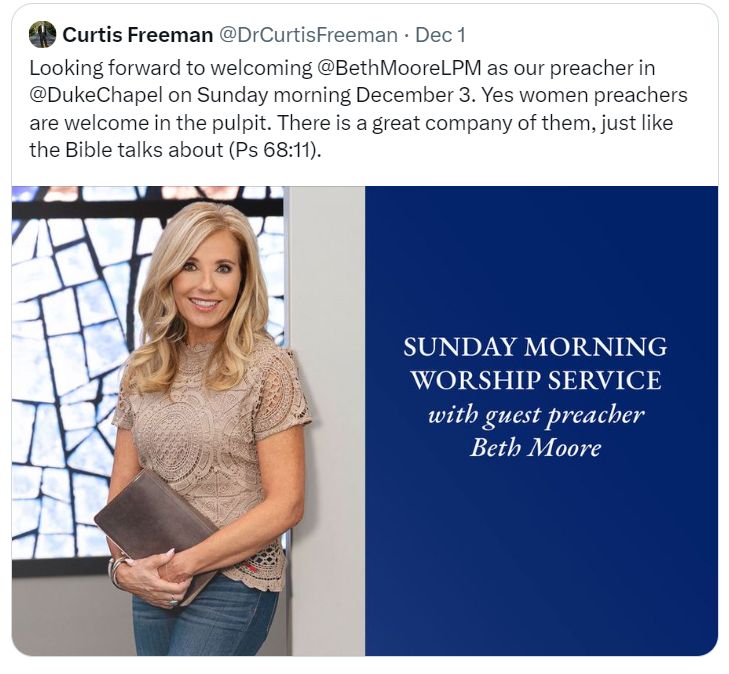
Beth Moore is preaching at Duke University chapel today. She is named as a preacher, welcomed as a preacher, and her sycophants are trumpeting their (seeming) victory of women as preacher, preaching.
The Baptists and the Anglicans are hosting the Sinning Jezebel after she finishes, sinning er, preaching.
Do they not know how Romans 1 ends? —>
and although they know the ordinance of God, that those who practice such things are worthy of death, they not only do the same, but also give hearty approval to those who practice them. underline mine.
Obviously, the women do not think they are sinning by preaching in church. They do not think they are sinning by applauding women who preach. They are also experts at twisting God’s word. The very first words from satan in the Bible were an undermining of what God had said, by asking: ‘was that really what God said?’ and the second words were a flat contradiction of what God had said. (Genesis 3:1-4)
I remember waaaay back on, oh, lemme see, it was the Spring of ’19 when Beth Moore let slip that she was preaching er, speaking er, doing Mother’s day at a church. Things were more coy then. Now they just say the sinning part out loud.
Just four years ago word manipulation was necessary. Moore used to say she was “speaking” at a pulpit.
How to subvert God’s word: 4 steps to female preachers
1. First, ask if God really said what He said. Did God really say that women may not preach?
To install a woman at the pulpit, one must subvert traditional interpretations of what God hath said. To wit: when the serpent asked Eve if God really said what He said, Eve answered the serpent correctly, mostly, but he no doubt noticed Eve had added a Law to what God had said. She repeated God’s command not to eat the fruit, but added to it- “nor touch it.” Since the interpretation varied from Adam to Eve, the serpent took that crack in the wall and ran with it.
Next, simply ignore thousands of years of settled interpretation with a snap of the fingers, by mirroring satan’s contradiction of the plain command. This implies that interpretations are never settled. No, God didn’t say THAT, did he? No you will not die. Yes you can preach.
They say they will review the verse to understand the interpretation. They look at word studies, (and cherry pick their preferred definition), and review previous interpreters (cherry picked, of course). They do this with an agenda, not looking for exegesis, drawing meaning out of what is there, but for ways around it. Here’s how-
The people who harp on women belonging in the pulpit say that the phrase in 1 Timothy 2:12 But I do not allow a woman to teach or to exercise authority over a man, but to remain quiet, doesn’t mean what it appears to mean.
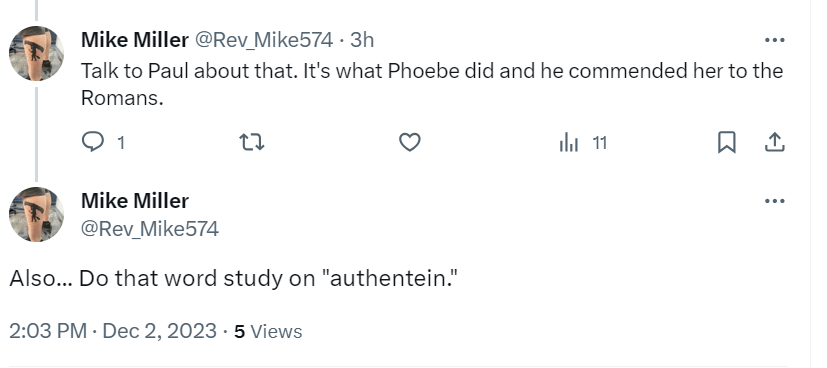
The word at issue with the ‘let’s all interpret this differently’ crowd is authentein.
This ‘reverend’ below is in the comments where it was announced Moore’s preaching at Duke, and applauding it. He says to study authentein.
This ‘word study’ involves re-interpreting the verse to say that as long as a woman doesn’t become a tyrant at the pulpit, it is OK to preach. They say that since the word in one of its usages means domineering, if a woman preaches humbly, it’s OK.
I’m not kidding. This “teaching” is what Beth herself taught in her 1995 book “To Live is Christ: Joining Paul’s Journey of Faith“. It’s an overview of Paul’s life and teaching. Here is how Beth Moore interpreted authentein, what follows are Beth Moore’s words, with a discernment mini-lesson for each paragraph from me:
“If you glance through the Book of 1 Timothy, you will notice a continuing exhortation for order in the churches. Paul wrote about servants (deacons), overseers, widows, elders, and slaves. In stressing order in the church, he made some statements about women that raise controversy. Although these statements are not my focus, I do not want to be charged with cowardice by omitting any mention of them. We are wise to view Paul’s exhortations in context. He used far more ink to address deacons and overseers.” ~Beth Moore
[My note: the verse wasn’t “controversial” for 2000 years. By her dubbing the verse “controversial” it slyly insinuates there is something wrong with it.]
“In 1 Timothy 2:11–12, Paul wrote, “A woman should learn in quietness and full submission. I do not permit a woman to teach or to have authority over a man; she must be silent.” When he said, “A woman should learn in quietness” and “be silent,” he did not use a Greek word that meant “complete silence or no talking. [He used a word] used elsewhere to mean settled down, undisturbed, not unruly.” Remember, Paul’s primary ministry was geared toward Gentiles who had never been trained to have respect and reverence in worship. Paul encouraged women to observe traditional customs lest the young churches suffer a bad reputation.” ~Beth Moore
[My note: It was cultural, Beth Moore says. Nope, it was a command.]
“Consider a traditional Jewish worship service. Men sat on the lower floor of the synagogue while women sat in the balcony or at the back of the room. Women were not allowed to utter a word; they merely listened. Contrast this picture with a Christian worship service in the New Testament world. The men and women were together in a private home. The worship centered around praising God, singing, fellowshipping, eating together, sharing testimonies, and receiving instruction in their new faith. Women were included as never before. Talk about a radical idea!” ~Beth Moore
[My note: This is true. Truth is often mixed in with false teachers’ lessons, in order to confuse the undiscerning.]
“The Christian movement was new and fragile. Any taint of adverse publicity could greatly hinder the mission of the church and mean persecution for believers. Women had to restrain their new freedom in Christ (Gal. 3:28) so as not to impede the progress of the gospel. Paul’s “weaker brother” principle (1 Cor. 8:9) applies. He said, “Be careful, however, that the exercise of your freedom does not become a stumbling block to the weak.” Thus, women were to learn quietly, without calling attention to themselves.” ~Beth Moore
[My note: The faith was never “fragile”. We don’t need to delicately walk on eggshells lest it all collapse. Women didn’t have to ‘restrain their freedom.’ In the paragraph above, Moore lauds their new freedom! Now suddenly women are unhappily restricted. Genesis 3:5, ‘God’s holding out on you!’]
“In regard to instructing women not to teach men, you must understand that most women in Paul’s day were illiterate. They were not taught in synagogue schools or trained by a rabbi. Paul goes on to say in verse 12 that women should not usurp authority over men. The Greek word authenteo, “one who claims authority,” is used only this one time in the Greek translation of the Bible. This word refers to an autocrat or dictator. Paul says women were not to come in and take over!” ~Beth Moore
[My note: Lydia, Priscilla, Lois, Eunice and other women were lauded as teachers and disciples of the word. Moore is stretching things now. But yes, women were not allowed to come in and take over… THE PULPIT. Why? God doesn’t want them preaching there.]
“We cannot regard verses 11 and 12 as a prohibition against women opening their mouths in church or men learning anything biblical from women. Paul gave instructions for how women are to pray and prophesy (1 Cor. 11:5). He was fully aware of Priscilla’s role in teaching Apollos in Ephesus (Acts 18:26). Paul issued differing instructions for churches based on their cultural settings and his desire for order in the church.” ~Beth Moore.
[My Note: Priscilla’s “role” was not a role, as in, an office of teacher in the church. She didn’t teach in church. The verse explicitly says she and her husband took Apollos aside. Priscilla is mentioned 6X in scripture and every time, with her husband.]
But a careful study of that word [authentein] means, leads us to understand that it means to take authority, period. It has nothing to do with abusive authority. In fact, if he was talking about abusive authority he wouldn’t be just talking about women; he’d also be talking about what? Men, because it would be just as much a sin for them as for women.
Remember, the false teachers like Beth Moore are wordsmiths. They know what to write to create doubt, they make allusive remarks, and they reinterpret traditionally interpreted verses to match their own agenda. Usurp means usurp. Take authority over means to take authority over.
3.After causing one to doubt that God actually said, then reinterpreting the verse, the next step is to designate the unwanted verses as Clobber Verses. In this, one must diminish the verse’s importance by saying it’s numerically insignificant compared to ‘the rest of the Bible’ or, by its nuance etc. AKA, it’s a “Clobber Verse”. Here’s Beth again on 1 Timothy 2:12 from the same book, this time, the introduction:
“Having admired the apostle Paul for years, I was somewhat surprised by a few comments made by people who learned I was writing a Bible study on his life. I received questions like, “How can you, a woman, write a Bible study about a man who obviously had no tolerance for women in ministry?” Sadly, the controversy surrounding small bits of the apostle’s teaching has often kept students from delving into the heart and liberating theology of the whole man.”
Wordsmithing: Moore said “no tolerance for women in ministry“. No, Paul (via the Spirit) had no tolerance for women in preaching. He welcomed Prisca, Phoebe, Susannah, Lydia and many other women in their ministries. Just not preaching. Clobber verse: Moore said, “small bits of the apostle’s teaching“. Small bits? Like those verses don’t matter? No, all scripture is inspired by God and beneficial for teaching, for rebuke, for correction, for training in righteousness; (2 Timothy 3:16). How many times does God have to say it before it isn’t a “small bit” any more?
4.Next on the agenda for feminists to get women behind the pulpit is to pretend there’s “tension” between what ‘Paul has said’ and ‘what Christ has said’. Drive a wedge between them, like satan did with Eve and Adam. Once Eve ate the fruit and handed it to Adam, he had a choice to make. We know what he chose.
4a.Include other verses that SEEM to affirm your position (but don’t really.) This is another masquerade at seeming pious and theological. Currently Psalm 68:11 is being used to support women preaching. Duke Chapel did in the photo screen shot at top, and many others did in Moore’s Twitter comment stream.
The Lord gives the command; The women who proclaim good news are a great army: (Ps 68:11)
No tension exists. That would be saying that there is tension between the Holy Spirit in one book and the Holy Spirit in another book. But the idea is to appear pious, eagerly and sincerely delving into the word of God so as to rightly divide it. Appearances are everything to a false teacher.
No wonder, for even Satan disguises himself as an angel of light. Therefore it is not surprising if his servants also disguise themselves as servants of righteousness, whose end will be according to their deeds. (2 Corinthians 11:14-15).
Tim Bates at Things Above Us parsed Moore’s statement of alleged ‘tension’ in his article –
Beth Moore, a teacher who is tossed about by every wind of doctrine, recently cited “tension” between the books of the New Testament that—through the inspiration of the Holy Spirit—recorded Jesus’ earthly ministry (Matthew-John) and the epistles that were also inspired by the Holy Spirit. In the context in which she jumped headlong into inevitable heresy (i.e. Jesus and Paul disagree or, better stated, the Holy Spirit and the Holy Spirit disagree) it was appropriate to call out her use of the word tension. There are not irreconcilable tensions about gender roles anywhere in the New Testament. The Bible has no contradictions because God cannot lie.
LOL, that was just the first paragraph. I love it.
Armin J. Panning, a Lutheran professor and Seminary president (passed on now) published a well-written, clear, 4 page word study of the word authentein, here, if you are interested. He rebuts the modern interpretation soundly and theologically.
Conclusion
Steps to get women preaching:
1.Hath God said? Pious doubt. 2.Contradict God’s word. 3.Declare your hated verse a ‘clobber verse’ and dilute its importance by burying it in a numerical pile under other verses. 4.Mourn an alleged ‘tension’ in God’s word between the hated verse and more preferred verses, driving a wedge between them. 4a.Misuse other verses to continue to appear pious and theological. 5.Emerge with a new interpretation, and stick to it.
Beth Moore ended her introduction to her book on Paul’s life this way:
Our focus today is on Paul’s personal exhortations to Timothy, his son in the faith. Midway through my preparation for this study, I began to realize that one of God’s priority goals is to raise up and encourage passionate, persevering servants who are completely abandoned to His will. Paul’s exhortations to Timothy stand as timeless words of advice to every servant of the living God, regardless of generation or gender.
This beginning part of my Advent series is a presentation of 11 verses overlaid on photos depicting the life of Jesus from prophecy to birth and boyhood.
The next section (#12-16) will feature verses about the Son as an adult God-Man.
From #17-26 we will survey the Preeminence of the Son, His attributes, and His ministry.
From #27-36 we’ll look at His Resurrection, Ascension, & Return.
Yes there are more than 30 verses. I just couldn’t pare it down! There’s a postlude.
All photos are by EPrata unless otherwise noted.
There is no better refreshment for the soul than to meditate on Him. Enjoy!
I will meditate on your precepts and fix my eyes on your ways. (Psalm 119:15).
Today’s verse: now that Jesus has been born, and the angels had announced His arrival to the Shepherds, who went to see with all haste this thing the angels had spoken of, now Jesus must flee. So we see from the first moments of His life, hatred against Jesus for who He is and what He has come to do. And so it will be for anyone IN Christ, as well. But His flight to Egypt did not happen before others made great efforts to come and see the Babe- namely the Magi from the East. It was their gift of gold which enabled the poverty-stricken Joseph and Mary to fund their flight to Egypt. God’s providence is perfect, and so is His timing.
Thirty Days of Jesus Series-
Further Reading
Bible Art: Adoration of the Magi by Giotto This picture—at once austere and tender—belongs to a series of seven showing the life of Christ. The masterly depiction of the stable, which is viewed from slightly below, and the columnar solidity of the figures are typical of Giotto, the founder of European painting. The impetuous action of the kneeling king, who picks up the Christ Child, and Mary’s expression of concern translate the biblical account into deeply human terms.
GotQuestions: What Does the Bible say about the Three Wise Men (Magi)? It is a common misconception that the wise men visited Jesus at the stable on the night of His birth. In fact, the wise men came days, months, or possibly even years later. That is why Matthew 2:11 says the wise men visited and worshiped Jesus in a house, not at the stable.
Answers in Genesis: We Three Kings The original meaning of mάgoi is likely in view here—wise men who interpreted special signs. There are at least three reasons for this identification. First, they acknowledged that they were interested in signs in the heavens.
Grace To You: Who Were the Wise Men? Vincent, who has written some very helpful word studies, says in regard to this, “Many absurd traditions and guesses respecting these visitors to our Lord’s cradle have found their way into popular belief and into Christian art. They were said to be kings and three in number. They were said to be representatives of three families of Shem, Ham, and Japheth and, therefore, one of them is pictured as an Ethiopian. Their names are given as Caspar, Balthazar, and Melchior.”
You’ve probably heard that. And supposedly their three skulls, amazingly enough, are said to have been found. Yes, they were found “in the twelfth century by Bishop Reinald of Cologne.” The bishop dug those up and knew right off they were skulls. It’s very clear. And their eyes were still in the sockets fixed toward Bethlehem. Today, believe it or not, friends, they are on exhibit in a priceless casket in a great cathedral in Europe. Hmmm. Maybe, we don’t believe it.
I got up at 5:00, and made a pot of coffee, and turned on the Christmas lights in the dark morning. I’m sitting here watching the day light up, sipping coffee in the peace and quiet of low-volume cello music and the ticking coffee pot. I have a lot to be thankful for.
I was talking with a friend about how so many people complain. It’s always an attitude of “What have you done for me lately” rather than reflect or ponder what HAS been done for you, whether from a friend, family, colleagues, or stranger. And whether it was done for you recently or long ago. It seems that increasingly, people immediately forget right away the graciousness given to us in the form of gifts or time, or love, or energy…
Not every gift to be grateful for has to be huge, like Oprah’s “You get a car! And you get a car!” A child shares a knock knock joke, a local merchant gave a discount, a bird tweeted in the fog, hearing laughter at work, a friend sent a card, your fridge is full of healthy food… Small daily gifts for which to be grateful.
But people are forgetting recent benevolence faster, while they expect future benevolence to increase in size, frequency, and scope sooner.
We should be content with what we have, and when something good comes our way, be grateful. Remember our bounties.
How might we might endure and be faithful in this? 2 Timothy 2:8, “Remember Jesus Christ, risen from the dead, descendant of David, according to my gospel.
Abner Chou on 2 Timothy 2:8 and endurance & remembering: “-we remember him in his person -we remember him in his power -and we remember him in his preeminence.”
In that verse, Chou said, remember doesn’t just mean casually recollect, it’s a perpetually active verb meaning a deep intention, and usually tied to sanctification.
More below with Abner Chou sermon The Secret to Endurance.
I personally believe that two of the many secrets to endurance are contentment and gratitude. When you are content with what you have, your spirit isn’t restless and always seeking something else. When you’re grateful for what you have and for what is given to you, large or small, it infuses your spirit with new eyes and leads to contentment with what you have.
The biggest item we should be grateful for is our faith of course, a gift from above made possible by the sinless life, death, resurrection, and ascension of Jesus. We best show our gratitude by obedience.
John 14:15, If you love Me, you will keep My commandments.
“Obedience is the best way of showing our gratitude to God for His grace.” (John OwenCommunion with God, p.140)
See in the meantime that your faith brings forth obedience, and God in due time will cause it to bring forth peace. ~John Owen
We’re in the section of the 30-day Advent flow of the prophecies of Jesus’ coming, his arrival, and his early life. Yesterday’s scripture picture was “The Babe has arrived” and the scripture was from Luke 2.
How can we go any further without pondering that He, the King of Glory, the Infinite, left glory in heaven to be wrapped in human flesh and dwell among sinners? To seek and save the lost, humbling himself not only as a God-Man, but departing His heavenly home of glory where He constantly received His due worship… To be rejected, despised among men, and killed. All for us, rotten sinners.
Our God is truly AMAZING!
Further information
God’s Glory: Ligonier Devotional “We turn today to the first verse of the second chapter of James, wherein the apostle refers to Jesus as “the Lord of glory.” Even though this is an acceptable translation of the original Greek text, it is not necessarily the most accurate way to render the verse in English. As the note in the Reformation Study Bible indicates, it is also possible to translate “the Lord of glory” as simply “the glory.” In reality, it does not really matter which one we choose because the two translations are synonymous. However, to say Jesus is “the glory” is a good way to encapsulate a portion of the New Testament’s description of the majesty of Christ.”
Thinking about Jesus: Owen on meditating on Christ’s glory In his devotional work, The Glory of Christ, John Owen provided five useful helps to meditate on Christ as a divine/human Person. I pass these meditations along to you, hoping that they will increase your devotion to Christ (you can read the full section in Owen’s Works, 1:312-322). John Owen’s quotes on Jesus’ glory (Goodreads) “No man shall ever behold the glory of Christ by sight hereafter who does not in some measure behold it here by faith.”
Bethlehem (around 2,000 years ago): Joseph and Mary arrive at the sleepy town in the middle of the night. Mary, already in labor, remains on the donkey while Joseph frantically searches for a room at the local inns. Desperate, he begs one reluctant innkeeper for any place at all to have this baby. The innkeeper finally relents and makes room for them in a tumbledown stable with the cows. There’s just one problem. This isn’t what the Bible teaches.
Read more from Answers in Genesis at the link above.
GotQuestions:What does it mean that baby Jesus was wrapped in swaddling cloths? Swaddling clothes are cloths and bands used in the practice of swaddling, or essentially “wrapping” an infant tightly in cloth. The idea behind swaddling is that it helps the baby transition from the womb (a very snug place) to the outside world. Swaddling clothes are still used today, but with some modifications…
Advent series in scripture photos. We are in the section of my Advent thirty day flow where we examine PROPHECY, ARRIVAL, and EARLY LIFE of Jesus.
‘He will save from sin…’ Do we even know of our sin? Matthew Henry says of the parallel Luke 1:35 verse:
JESUS! the name that refreshes the fainting spirits of humbled sinners; sweet to speak and sweet to hear, Jesus, a Saviour! We know not his riches and our own poverty, therefore we run not to him; we perceive not that we are lost and perishing, therefore a Saviour is a word of little relish. Were we convinced of the huge mass of guilt that lies upon us, and the wrath that hangs over us for it, ready to fall upon us, it would be our continual thought, Is the Saviour mine? And that we might find him so, we should trample on all that hinders our way to him. ~Matthew Henry Concise Commentary
What is sin? Sin is a riddle, a mystery, a reality that eludes definition and comprehension. Perhaps we most often think of sin as wrongdoing or transgression of God’s law. Sin includes a failure to do what is right. But sin also offends people; it is violence and lovelessness toward other people, and ultimately, rebellion against God. Further, the Bible teaches that sin involves a condition in which the heart is corrupted and inclined toward evil.
What is the definition of sin? – Got Questions Sin is described in the Bible as transgression of the law of God (1 John 3:4) and rebellion against God (Deuteronomy 9:7; Joshua 1:18). Sin had its beginning with Lucifer, probably the most beautiful and powerful of the angels. Not content with his position, he desired to be higher than God, and that was his downfall, the beginning of sin (Isaiah 14:12-15). Renamed Satan, he brought sin to the human race in the Garden of Eden, where he tempted Adam and Eve with the same enticement, “you shall be like God.”
Matthew Henry on Matthew 1:18-25 That she had conceived by the power of the Holy Ghost; not by the power of nature. The Holy Spirit, who produced the world, now produced the Saviour of the world, and prepared him a body, as was promised him, when he said, Lo, I come, Heb. 10:5. Hence he is said to be made of a woman (Gal. 4:4), and yet to be that second Adam that is the Lord from heaven, 1 Co. 15:47. He is the Son of God, and yet so far partakes of the substance of his mother as to be called the fruit of her womb, Lu. 1:42. It was requisite that his conception should be otherwise than by ordinary generation, that so, so though he partook of the human nature, yet he might escape the corruption and pollution of it, and not be conceived and shapen in iniquity.
Henry, M. (1994). Matthew Henry’s commentary on the whole Bible: complete and unabridged in one volume (p. 1613). Hendrickson.
Thirty days of exalting Jesus through selected verses with pictures representing the prophecy, life, death, resurrection, and Second Coming of our Savior.
Charles Spurgeon on the prophecy of the virgin birth: “And, first, we see here, in speaking of this birth of Christ, a miraculous conception. The text says expressly, “Behold, a virgin shall conceive and bear a Son.” This expression is unparalleled even in Sacred Writ! Of no other woman could it be said beside the Virgin Mary, and of no other man could it be written that his mother was a virgin.“
“There is the finite and the Infinite, there is the mortal and the Immortal, corruption and Incorruption, the manhood and the Godhead, time married to eternity! There is God linked with a creature, the Infinity of the august Maker come to tabernacle on this speck of earth—the vast unbounded One whom earth could not hold and the heavens cannot contain—lying in His mother’s arms! He who fastened the pillars of the universe and riveted the nails of creation, hanging on a mortal breast, depending on a creature for nourishment! Oh, marvelous birth! Oh, miraculous conception! We stand and gaze and admire. Verily, angels may wish to look into a subject too dark for us to speak of! There we leave it, a virgin has conceived and borne a Son“. A sermon, The Birth of Christ
Charles Spurgeon on Christmas: “Though creation may be a majestic organ of praise, it cannot reach the compass of the golden canticle—Incarnation! There is more in that than in creation, more melody in Jesus in the manger, than there is in worlds on worlds rolling their grandeur round the throne of the Most High.” Sermon “The First Christmas Carol“, A sermon by Charles Spurgeon, Dec 20, 1857










 the-end-time.org