Posted in missionaries, theology

Lottie Moon- Famous Single Woman Missionary, or Proto-Feminist?

By Elizabeth Prata

God does a powerful and magnificent thing by raising up missionaries. He not only regenerates hearts but He establishes some to go to the hard places, live a hard life, and some even to die for His name. The selfish will of the natural man would never do that. The self-sacrificing heart of a regenerated Christian, would.

I think of many woman missionaries who lived and died for His Gospel. One of my favorites is Gladys Aylward, missionary to China. We remember the female missionaries of the 1800s and early 1900s who first went places, like Lottie Moon, Amy Carmichael, Annie Jenkins Sallee, Mary Slessor, and Isabel Crawford… among many others.

This week and last week I’ve presented essays about a few of these female missionaries, including Elisabeth Elliot, Amy Carmichael, and Gladys Aylward. These are ladies who seem to have done “missionary” right.

There are some women who have not behaved well on the mission field, or whose motives for going became obvious via their words or their letters.

We might be inclined to even think of them like super-Christians, given extra strength or morality or character, or who were extra spiritual. LOL, they were simply women, with the same sins, tendencies, and foibles as the rest of us.

In fact, you might be surprised to find that some female missionaries may have possessed extra doses of foibles and struggles as they considered the mission field. Some of them may have mixed their motives for going, struggling with the exact same issues we do today- feminism and being conflicted about prescribed gender roles.

After William Carey, missionary to India and considered the Father of Modern Missions, died in 1834, a fervor arose among the faithful. He had founded the Baptist Missionary Society, spent 41 years in India (without a furlough) and raised consciousness among Christians of the need for bringing the Gospel to the nations. Missions exploded.

In addition to the missions movement powerfully springing up in the mid 1800s, in which many Christians desired to go, another powerful movement sprang up too- First Wave Feminism. (1848-1920). Whereas previously, the only credible careers available to women were teaching or nursing, now, many women found that a missionary life afforded them a chance at a fulfilling career and even leadership opportunities on the foreign field that would not have happened back home. The Civil War had helped with that, either with women handling the homestead or the business while the men were gone, or serving in the army itself as doctors. Once bitten by the independence bug, many women found that missions offered similar opportunity to lead an independent life free from most of the societal restrictions that squelched their more forward ambitions.

In 1834, New York businessman’s wife, Sarah Doremus, heard a sermon about the need for women on the field in China, in order to reach Chinese women. She tried to get an organization going, but it went nowhere. By the time of the Civil War in 1861, there was less opposition to females singly joining men on the foreign mission field. Doremus’ organization was finally founded in 1861 with success: the Women’s Union Missionary Society (WUMS). It proposed to send out only single women, and indeed it became the first American organization to send single women to the foreign mission field. Early results were sending two medical missionaries, Dr. Sara Seward and Dr. Mary Seelye to India, who in 1871 established a children’s hospital in Calcutta.

Let’s look at one of the famous missions ladies.

800px-lottie_moon-1

Charlotte ‘Lottie’ Moon (1840-1912) Missionary to China.

One of the earliest and easily the most famous single female missionary, Lottie Moon, seems to have been a relentless advocate for expanded women’s roles, a proto-feminist.

Lottie was indifferent to the Baptist religion of her parents until age 18, when she experienced an awakening during a series of revivals. She then attended Virginia Female Seminary and Albemarle Female Institute in Charlottesville, Virginia graduating in 1861 with the first master of arts degrees awarded to a woman by a southern institution.

Lottie taught at home for a while, but then responded to a call from her sister Edmonia in 1871 who had already been approved for the China mission field and had been there a year. Lottie’s other sister Orianna had previously served in the Confederate Army as a Doctor in the US Civil War.

Foreign missions often encountered an issue of gender. In many nations, only women could reach women. Men counseling or giving the Gospel or interacting in general with women presented a scandalous problem. The teaching career having palled for Lottie, she responded to her sister’s call and went to China to “go out among the millions” as an evangelist. Instead she wound up in the same work-situation as she had been back home, teaching what she termed as “unstudious children” in China and feeling like an oppressed class of single women missionaries. She complained about this. A lot.

In an article titled “The Woman’s Question Again,” published in 1883, Lottie wrote:

Can we wonder at the mortal weariness and disgust, the sense of wasted powers and the conviction that her life is a failure, that comes over a woman when, instead of the ever broadening activities that she had planned, she finds herself tied down to the petty work of teaching a few girls?

Lottie had planned it all out, did she?

I know, O LORD, that a man’s way is not his own; no one who walks directs his own steps. (Jeremiah 10:23)

It is sad how Lottie viewed women missionaries teaching children on the mission field. It was “petty work” to her.

Lottie Moon was in fact ardent activist for women’s rights and a tireless supporter for an expanded sphere for women’s evangelistic work, despite what the Bible said women’s roles are to be. Her specific directive from the SBC Missions Board was to teach women, not to plant churches, evangelize, or teach men. Rebelling, Lottie did all three, loudly. She decided that to make a lasting impact she had to reach the men of the community. So she incited curiosity in showy ways, so that the curious men would attend her teaching meeting, and Lottie ‘innocently’ said that she was just mainly preaching to women but would not send the men away if they chose to come. That attitude was similar to Beth Moore’s stance a hundred years later,

Being a woman called to leadership within and simultaneously beyond those walls [of an SBC church] was complicated to say the least but I worked within the system. After all, I had no personal aspirations to preach nor was it my aim to teach men. If men showed up in my class, I did not throw them out. I taught. ~Beth Moore

Lottie wrote,

“Simple justice demands that women should have equal rights with men in mission meetings and in the conduct of their work.”

Lottie did receive criticism from both men and women for her opinions, one of which included women entering the missions field in order to do the “largest possible work,” but other women abhorred Lottie’s “disorderly walk” and one Mrs. Arthur Smith called for her to stop her “lawless prancing all over the mission lot.” Lottie didn’t.

Lottie: “What women want who come to China is free opportunity to do the largest possible work…. What women have a right to demand is perfect equality.” Mission Frontiers

She found it easier to advance her expanded view of female missionary work on the foreign field. When no men were available to preach, she did. Around 1885 Lottie decided on her own without permission from the home Board, to move to China’s interior, P’ingtu. Her heart was burdened for the many who were ‘groping ignorantly for God,’ and where incidentally there was also less Board oversight.

By 1886, Lottie had completely abandoned the “woman’s work for women” policy that had she had agreed to in order to receive her appointment as a Southern Baptist missionary to China. Her move to P’ingtu accomplished, she had no male protection, no male supervision, and evangelized as she saw fit, experimenting with various methods.

And of her Field Director’s attempts to redirect her efforts toward the call to which she agreed, teaching, she wrote-

“[His plans] would make him, through the Board, dictator not only for life but after he had passed from earthly existence. If that be freedom, give me slavery.”

Forgoing biblical submission, she threatened resignation. Lottie Moon was an egalitarian who did much to erode the SBC’s stance on complementarian roles for men and women. Her rebelliousness resonates to this day.

Lottie remained unmarried to her death. As regards her death, the common story is that Lottie gave away all her money and gave her food to starving Chinese during a famine, dying a board a ship at Kobe Harbor weighing 50 pounds. Other documents indicate Moon suffered from an infection located behind her ear, which the missions doctor theorized had invaded her spinal column and caused dementia. Part of Moon’s end-of-days dementia included fixations on lack of money and refusal to eat.

While some see Lottie Moon as a lover of the Gospel and a lover of souls, she was certainly a rebellious and relentless campaigner for ‘women’s rights’ within the SBC, spending many years fighting the SBC (once safely out on the field), rights that went far outside the bounds of biblical roles.

Mary Slessor 1848–1915
Annie J. Sallee (1877-1967)

There were others also who wrestled with the biblical roles for women and found ‘independence’ and ‘freedom’ on the mission field, such as Mary Slessor (L)(Nigeria) and Annie Jenkins Sallee (R). (China).

As the missionary fever caught on the earnest people went out, many at risk to their lives or at the least, knowing they would never see near family again. There were others who were more led by personal passions than the glory of God. Some women went forth using Jesus as a vehicle to satisfy their aspirations, with a secondary consideration for His glory. No doubt many of these ladies did good. They healed, adjudicated, salved, built…but when unholy motivations factor in, the entire endeavor becomes tainted.

We praise God for the women and men missionaries who served well. As for the others, we leave it to Jesus to sort them out.

Posted in praise songs, theology

We are a singing people

By Elizabeth Prata

Continuing my mini-missionary series, picking up from where I left off a few days ago, today we learn of a certain moment in China missionary Gladys Aylward’s life. Previous missionary stories are linked at bottom.

music1.jpg
Photo: EPrata

We as believers are a singing people. In lesson 2 of RC Sproul’s teaching video series “What Did Jesus Do?: Understanding the Work of Christ” (free at Ligonier) Sproul talks of the Songs in the Bible; OT’s Song of Moses, Miriam, Deborah, and in the NT, the Infancy Hymns of Mary, Simeon, and Zacharias, and also Revelation’s New Song. He explained that whenever God does a huge act of redemption, gratitude and awe springs forth in praises in hymn of the great God. These are recorded in His word, these songs of praise and thankfulness being a beautiful segment of our faith.

Continue reading “We are a singing people”
Posted in theology

Two birthdays, two ministries, two trajectories

By Elizabeth Prata

The Bible is disgusted by false teaching and is strong on pure doctrine. Why? The consequences of error are dire.

Scottish Divine James Durham said, “Error destroys the soul (2 Peter 2:1; 2 Thessalonians 2:12). In fact, it brings on swift damnation ( 2 Peter 2:1). It overthrows the faith of many (2 Timothy 2:18), perverts Scripture to people’s destruction (2 Peter 3:16), and deceives many (Matthew 24:11). For this reason, it is also called damnable and pernicious (2 Peter 2:1-2).”

Further, Durham wrote, “No titles carry greater indignation and abomination than the titles given to such people. They are generally called dogs and evil workers (Philippians 3:2); wolves, or rather grievous wolves (Matthew 7:15; Acts 20:29), deceitful workers; ministers of satan, as if they were expressly commissioned by him (2 Corinthians 11″13); deceivers and liars (Revelation 2:2); evil men and seducers, who wax worse and worse (2 Timothy 3:13).

False teaching is not to be overlooked, dismissed, watered down, or ignored. It is serious, serious business. There is correct doctrine and there is incorrect doctrine. One pleases the Lord. The other provokes His wrath.

The problem is ancient, it began in time immemorial past in heaven when satan, puffed with pride and ambition to unseat God, lied and enticed many holy angels to quit following God and to follow him. They took the swap and thus they fell and became demons. Satan brought the problem to earth in the Garden where he tempted our first parents and they fell, bringing the future entirety of humankind with them. Satan’s deceptions have continued, with warnings and prohibitions to us from God, through the Old Testament to the New, and into this very day.

Photo by Jens Lelie on Unsplash

That’s one path, the wide one. One side of the light vs. dark saga.

Alternately there are those on the narrow path. God raises up ministers for His name in every generation who are stalwart, true, persevering, and edifying. After Jesus came the Apostles, then the church fathers, the medieval men like Wycliffe and Hus, the Reformation men like Luther and to the Puritans and post-Puritans like Edwards, and the mid twentieth century men like Gerstner, Sproul, Lloyd-Jones. Today we have the new men like Riccardi, Pickowitz, Buice, James Coates…

The Lord always raises up good men, and aside from the ones mentioned, there are thousands and millions more He raised up that we never heard of but who labored faithfully to their end, and were brought to the bosom of their Priestly Shepherd to enjoy rest from ministering and to the bliss of being with the leader of the true Church.

This dichotomy of false teaching vs. true was brought to mind this week as I noticed two famous people are having birthdays a few days apart.

John MacArthur and Beth Moore. I have been involved at a distance with both these folks for a long time. I’ve seen the trajectories. I’ve read and listened to their works. And the starkness could not be more clear. Beth Moore’s output has damaged the faith and in many cases brought it into disrepute, while MacArthur’s has strengthened it and honored the Lord’s name.

John MacArthur will turn 85 years old on June 19. He has been ministering as pastor-teacher at Grace Community Church for 56 years. He was ministering 5 years before that as an associate pastor. He has been actively serving the Lord for 61 years. The Lord is gracious to give us all these decades with him, and surely his impact has been great.

He has never wavered on the authority of scripture, cessationism, young earth creationism, complementarianism, dispensationalism, the Lordship of Christ, proper Christology, and gender and sexuality. He has preached through every book of the New Testament verse by verse, which took 45 years to accomplish. He has written over 150 books which have been translated into myriad languages, faithfully shepherded his congregation week after week, withstood the covid closures, led a solid seminary, and has been acknowledged by Christianity Today as one of the most influential preachers of his time. His MacArthur Study Bible has sold more than one million copies, receiving a Gold Medallion Book Award. That Study Bible has been in the hands of pastors from the icy Faroes in the Arctic Circle to dusty back roads in Africa, to the jungles of Peru.

Certainly there are many other private ministrations in Jesus’ name that only MacArthur and the Lord know about between them. He is in a long line of blood-bought pastors who have risen to public knowledge and have edified many who learn from him and watch his godly life as one to imitate. Paul said “Be imitators of me, just as I also am of Christ”. (1 Corinthians 11:1). This means, “he was instructing us as believers to carefully examine our Savior’s life and the lives of His faithful servants. He gave a similar command earlier in 1 Corinthians 4:16: “Therefore I urge you to imitate me.” In the original Greek, the verb translated as “imitate” in 1 Corinthians 11:1 and 1 Corinthians 4:16 is mimētai and means “become a person who copies the words and behaviors of another.” (Source GotQuestions).

Perhaps the Lord has left MacArthur on earth so long in order to demonstrate His sustaining power in a faithful life that started and so far is ending well. The Lord is good to us.


For 45 years Beth Moore has been speaking here, there, and everywhere she possibly could. Regrettably, her speaking engagements have been laced with error and deception. She began, by her own words, in her early 20s as a “Christian Motivational Speaker”. She never left that profession, really. Then when she was 27 she began teaching a Sunday School class, but she said she was also “learning the scriptures” at that time. It’s a tragedy that they put her into a position where she was simultaneously learning the Bible AND teaching. She wasn’t ready.

Again by her own words, her class was “packed” and they all “had a blast” but “we weren’t really studying the scriptures”. Why? Because Beth said she “just thought up things to talk about and then I got panicked on Saturday because I think where is a scripture to go with it.” She never grew out of that improper hermeneutic even with “the doctrine class” she took. It was still motivational speaking but with with a thin Christian overlay of out of context sprinkled verses.

Did you know that Beth briefly attended seminary but dropped out? Why? She was “reading the environment and coming to the realization of what my opportunities would and would not be.” She chafed against the biblical hierarchy of male led faith, she has been clear about that. She obviously wasn’t in seminary to learn about Jesus and to parse the scriptures correctly. She wanted “opportunities” for herself and quit when she saw she couldn’t go rogue.

Yet she was teaching a packed Sunday School class of 2000, including men. She was preaching Sunday Night at the request of her then-pastor. She’d started teaching ‘Bible classes’ outside of her church interdenominationally. Her first ‘Study’ was published by Lifeway. What other “opportunities” was she looking for? What other “opportunities” remain? I leave it to you to surmise the answer.

Beth Moore will celebrate her 67th birthday on June 16, which at this writing is tomorrow. She has been actively ‘ministering’ for about 44 years. The Lord has His reasons for allowing false teachers to persist, and one of them is in order to see who is approved, and by contrast who is not. (1 Corinthians 11:19). Another reason perhaps is also to demonstrate His grace and mercy and patience in allowing such people to exist on His earth, in order to give opportunity to repent.

Jesus considers false female prophetesses an abomination. See His threatened condemnation to the false prophetess of Thyatira, but consider His grace, as He said He gave her time to repent. (Revelation 2:21). But she did not want to repent. Here, Matthew Henry is commenting on Revelation 2:21, the false prophetess of Thyatira-

They made use of the name of God to oppose the truth of his doctrine and worship; this very much aggravated their sin. They abused the patience of God to harden themselves in their wickedness. God gave them space for repentance, but they repented not. Observe, Repentance is necessary to prevent a sinner’s ruin. Where God gives space for repentance, he expects fruits meet for repentance. Where the space for repentance is lost, the sinner perishes with a double destruction. Source Henry, M. (1994). Matthew Henry’s commentary on the whole Bible (commenting on Revelation 2:21).

The problem with false teachers is that spreading error teaches others to lie. (Matthew 5:19). This is evil because error has its origins in the devil.

Please do not let Beth’s Christianish veneer and firehose gushing about Jesus distract you from the greed and ambition that lies underneath. Just as the Pharisees made a show of prayers on the street corners and attended banquets (so they could be honored for the chief seats), at Beth Moore’s core is a career minded, Jesus-using deceiver on a fast trajectory to hell. (2 Peter 2:1).

Wheat and tares grow together – for a while. Then comes the reaping.

The Lord is good to give us faithful pastors, He is also good to give us faithless wolves. He s always good. We learn who to imitate and who not to. We learn true doctrine and practice discernment by seeing what is false.

Psalm 100:5
For the Lord is good; his steadfast love endures forever, and his faithfulness to all generations.

Posted in theology

The reality of missions to a dangerous place: Adoniram Judson

By Elizabeth Prata

I’ve been posting some missionary bios the last few days. The links to previous essays are at the end.

I post mission-minded posts, to remind us of the importance of evangelizing the lost not just near, but far. The letter from Judson to Ann’s father was extremely touching and reminded me once again of the danger that missionaries then and now face every day.

When missions began in earnest, missionaries often sent more ‘glowing’ letters back to the home church or overseeing Board. They needed support (translate, $$) and knew that people reading more positive reports tended to give more. Amy Carmichael didn’t do that and in fact, her accounts of the reality of the darkness she faced horrified readers. Her reports were rejected with notes to positive it up a little. She replied with a book titled “Things as They Are”.

John G. Paton knew he’d never see his father again, and Paton’s account of saying goodbye to him as Paton sailed for the South Pacific from Scotland was extremely touching. Below, Judson wrote clear-eyed to his fiancé’s father. We we a debt to the missionaries who submitted their lives to discomfort, danger, snares, seemingly fruitless toil, betrayals, sleepless nights, and hardship unimaginable.

illustration of Judson and wife Ann

In 1813, Adoniram Judson sailed to Burma from America with his wife Ann.

Before they married, Judson wrote a letter to Ann’s father asking for his blessing in marriage. This is what he wrote in the letter:

“I have now to ask whether you can consent to part with your daughter early next spring, to see her no more in this world?

Whether you can consent to see her departure to a heathen land, and her subjection to the hardships and sufferings of a missionary life?

Whether you can consent to her exposure to the dangers of the ocean; to the fatal influence of the southern climate of India; to every kind of want and distress; to degradation, insult, persecution, and perhaps a violent death?

Can you consent to all this, for the sake of perishing immortal souls; for the sake of Zion and the glory of God?

Can you consent to all this, in hope of soon meeting your daughter in the world of glory, with a crown of righteousness brightened by the acclamations of praise which shall resound to her Saviour from heathens saved, through her means, from eternal woe and despair?”

Soon after accepting Judson’s proposal of marriage and the life of a missionary, Ann wrote to a friend where she said the following:

“I feel willing, and expect, if nothing in providence prevents, to spend my days in this world in heathen lands. Yes, Lydia, I have about come to the determination to give up all my comforts and enjoyments here, sacrifice my affection to relatives and friends, and go where God, in his providence, shall see fit to place me.”

Ann became sick and died only a few years into their ministry.

Judson spent 38 years there until his death at 61.

Judson organized and published the Burmese dictionary.

Judson translated the Bible into the Burmese language.

Judson wrote gospel tracts and distributed tens of thousands in the first 6-years before seeing his first convert.

Judson preached the gospel faithfully.

Judson, along with his wife Ann, demonstrated what it was like to deny yourself, take up your cross daily, and follow Christ (Luke 9:23).

*Quotes taken from Courtney Anderson’s book: “To the Golden Shore: The Life of Adoniram Judson”

Further Reading:

“Missionary life is simply a chance to die” – Amy Carmichael

Missionary Moment: 20th century Martyrs Phil Masters and Stan Dale, a story of the Yali and Kimyals

Missionary Elisabeth Elliot: “Under the Shadow of the Almighty”

IMB: Missionaries You Should Know: Adoniram Judson

Posted in theology

Jesus judges whole cities

By Elizabeth Prata

In the New Testament, Jesus pronounced oracular woes. He pronounced doom for peoples, individuals, nations, kings. He also predicted doom for entire cities!

Atlanta, Georgia. Photo by EPrata

Of those cities that reject Him, He said-

be sure of this: The kingdom of God is near. I tell you, it will be more bearable on that day for Sodom than for that town. (Luke 10:11b-12).

Woe to you, Chorazin! Woe to you, Bethsaida! For if the mighty works done in you had been done in Tyre and Sidon, they would have repented long ago, sitting in sackcloth and ashes. (Luke 10:13).

for Sodom—Tyre and Sidon were ruined by commercial prosperity; Sodom sank through its vile pollutions: but the doom of otherwise correct persons who, amidst a blaze of light, reject the Saviour, shall be less endurable than that of any of these. Jamieson-Fausset-Brown Bible Commentary

And the sense of the whole is, that though the iniquities of Sodom and Gomorrah were very great, and their punishment very exemplary; yet, as there will be degrees of torment in hell, the case of such a city which has been favoured with the Gospel and has despised and rejected it will be much worse than the case of those cities, which were devoured by fire from heaven; and than that of the inhabitants of them in the future judgment, and to all eternity;

Gill on Matthew 10:15. Gill’s Exposition of the Entire Bible

One wonders with New York City’s rejection of the Gospel and acceptance at its highest levels the horrific infanticide of babies, what their judgment will be.

Scoffers set a city aflame,
but the wise turn away wrath.
(Proverbs 29:8)

And what IS wisdom? Fear of the LORD. Nineveh was wise:

Then the people of Nineveh believed in God; and they called a fast and put on sackcloth from the greatest to the least of them. When the word reached the king of Nineveh, he arose from his throne, laid aside his robe from him, covered himself with sackcloth and sat on the ashes. He issued a proclamation and it said, “In Nineveh by the decree of the king and his nobles: Do not let man, beast, herd, or flock taste a thing. Do not let them eat or drink water. But both man and beast must be covered with sackcloth; and let men call on God earnestly that each may turn from his wicked way and from the violence which is in his hands. Who knows, God may turn and relent and withdraw His burning anger so that we will not perish.” (Jonah 3:5-9)

Bethsaida and Corazin were not wise, they were scoffers at the Gospel presented to them. Therefore, a whole City is to come under judgment!

The men of Nineveh will stand up with this generation at the judgment, and will condemn it because they repented at the preaching of Jonah; and behold, something greater than Jonah is here. (Matthew 12:41)

Some people have the false notion that the OT God and the NT God are different. People often point to a meek and gentle Jesus speaking softly to the woman at the well about her adulteries, or mournfully but silently pitying the Rich Young Ruler who rejected Him in for favor his own lands and wealth. But Jesus pronounced DOOM for entire cities, that means populations of thousands if not millions.

The five Cities of the Plain were a connected metropolis with enormous populations. When Sodom and Gomorrah were smote for their sin the doom also included the cities of Admah and Zeboiim. (Deuteronomy 29:23). Four of the Five Cities of the Plain gone.

Not to mention His righteous anger at the Temple money changers, his firm pronouncement in Matthew 24 of the worst time on earth there shall ever be when His judgment comes, his warnings about hell (which were frequent), and the Lord of Revelation who judges the earth. The New Testament is full of the same God of the Old Testament who is both love AND wrath.

Jesus came in humility the first time but will come in wrath the second time. We can be praying for our leaders, that the Lord would instill in the Christian leaders courage to withstand the secular tsunami of sin that inevitably comes against them. We can pray for the unsaved leaders for God to instill repentance into their heart and then they may do good in His name within their position.

Whole cities will fall.

nyc1
NYC on 9/11

————————————————————————-

Further Reading

Chapter 8 of Moby-Dick, describing Father Mapple and his pulpit:

“The pulpit is ever this earth’s foremost part; all the rest comes in its rear; the pulpit leads the world. From thence it is the storm of God’s quick wrath is first described, and the bow must bear the earliest brunt. From thence it is the God of breezes fair or foul is first invoked for favorable winds. Yes, the world’s a ship on its passage out, and not a voyage complete; and the pulpit is its prow. ~Herman Melville, Moby-Dick”

Posted in creation grace, theology

Creation Grace: Build Your House Upon the Rock

By Elizabeth Prata

house
EPrata photo

Build Your House on the Rock

“Everyone then who hears these words of mine and does them will be like a wise man who built his house on the rock. And the rain fell, and the floods came, and the winds blew and beat on that house, but it did not fall, because it had been founded on the rock. And everyone who hears these words of mine and does not do them will be like a foolish man who built his house on the sand. And the rain fell, and the floods came, and the winds blew and beat against that house, and it fell, and great was the fall of it.”
~Matthew 7:24-27

Posted in theology

Great Cities of the Bible #3: Rome

By Elizabeth Prata

Great Cities of the Bible #1: Damascus
Great Cities of the Bible #2: Babylon
Great Cities of the Bible #3: Rome
Great Cities of the Bible #4: Jerusalem

Remains of the Roman Forum. EPrata photo

This is the third of a 4-part series on the Great Cities of the Bible. I’ve written about Damascus and Babylon in the first two parts. Damascus first because it is among the first cities mentioned in the Bible and is the oldest continuously inhabited city in the world. And I chose Babylon second because its presence from Genesis to Revelation dominates the Bible’s spiritual and historical landscape.

Now we turn to Rome. GotQuestions notes that – “Rome is not mentioned in the Old Testament but figures prominently in the New Testament. Although the city of Rome is not often directly mentioned, every place and event in the New Testament has Roman rule as its background.

Part of the reason I’m doing this series is because we tend to be myopic in our day and age, thinking we are the most advanced or the most sophisticated or our culture is the best. It’s hard to physically go see that in Babylon because it is mostly a ruin now. Damascus is considered to be one of the most beautiful cities in the Arab world, but sadly, the ongoing war has destroyed much of it by now. However ROME! Ahh, Rome, one can wander the streets and see many buildings from the Bible days intact. One can envision Paul standing up in court…writing his ‘Jail Epistles’ (Ephesians, Colossians, Philippians and Philemon). We can visit the Colosseum where so many Christians were martyred.

Underfloor of the Roman Colosseum, where many Christians were martyred. EPrata photo

Rome is both the city and was an Empire. It is urban setting and also a character itself in the Bible history. It is a city past from Bible days, a thriving city today, and it is an Roman empire future in prophecy. Rome was the oppressor of the Jews in Judea but its engineered roads allowed for the dispersed believers to bring the Gospel out to the world.

It was first called The Eternal City (Latin: Urbs Aeterna; Italian: La Città Eterna) by the Roman poet Tibullus in the 1st century BC, and the expression was also taken up by Ovid, Virgil, and Livy. Rome is also called “Caput Mundi” (Capital of the World).

Source

Rome is also known as the City of Seven Hills, due to the hills that it is founded on and provide a backdrop. This may become important later when in prophecy, discussed more in the postscript.

For almost a thousand years the continent’s people were either one of the unfortunate tribes conquered and absorbed into the vastly growing Roman empire, or were one of the privileged Romans citizens enjoying the engineering marvels the Romans invented and especially Pax Romana (widespread peace) during the 200 years of the Empire’s height. Paul the Apostle was a Roman Citizen, and this fact allowed him to escape one of the intended beatings, to stand in a Roman Court and plead his case, and at the end, legend says, given the less painful execution of beheading.

Rome was said to be founded around 625 BC in the areas of ancient Italy’s center known as Etruria and Latium. Etruria was home to the mysterious people of the Etruscans (from which we get the name Tuscany). Not much is known of the Etruscans, except they were a sophisticated culture, master bronzesmiths, their tombs were expertly painted, they formed city-states all over Tuscany as far south as Rome, and began sewer and other construction projects in Rome. It is said that the Etruscans had a heavy influence on the conquering Romans.

For about a hundred years or so, this merging and overlap of the Etruscans and the Romans led to the period known as the Age of Kings, which came to an end when the Etruscans disappeared, and the Roman Republic was born. (510 BC). It was during this time that Romans codified their laws and were led by the citizens (upper class senators and knights).

They continued to expand their empire with masterful military strategies and successive victories. By 338 BC they had conquered the entire Italian peninsula and a few years later gained control of the Mediterranean as a dominant maritime power.

The time of Jesus’ birth through his death & resurrection, the rise of the Church, and the last of the first generation witnesses (31BC to 90 AD and beyond) was known as the Imperial Rome era. During this period, Rome saw decades of peace, prosperity, and expansion. Its maximum land expansion occurred in about AD 117, near when Apostle John died. Its empire spanned three continents including Asia Minor, northern Africa, and most of Europe as far north as Scotland.

Unlike many other conquering empires, Rome allowed worship of personal gods. They were a pantheistic society. We remember in Daniel 1 when Nebuchadnezzar besieged and conquered Jerusalem and carried off its captives, “among them from the sons of Judah were Daniel, Hananiah, Mishael, and Azariah.7 Then the commander of the officials set names for them; and for Daniel he set the name Belteshazzar, for Hananiah Shadrach, for Mishael Meshach, and for Azariah Abed-nego.” (Daniel 1:6-7). The practice of forced assimilation was common. The boys were given new names, forced to eat what was eaten by the natives, and forced to worship what the natives worshiped, namely, the king. But unusually for an Empire, that was not Rome’s practice.

Definition: Assimilation is one outcome of acculturation. It involves the complete adoption of the ways of life of the new cultural group, resulting in the assimilated group losing nearly all of its original or native culture.

https://www.ncbi.nlm.nih.gov/books/NBK248431/box/ch1.box12/

Rome practiced assimilation. Captured peoples from the many wars were brought to Rome as slaves but allowed to practice their religion and maintain their culture. The building in Rome called The Pantheon was originally a temple built for all Roman gods, then later any gods. Pan means “all” and “theos” means “gods”.

The Pantheon in Rome, one of Rome’s best preserved buildings to this day. EPrata photo

The Roman Empire was a primarily polytheistic civilization, which meant that people recognized and worshiped multiple gods and goddesses. Despite the presence of monotheistic religions within the empire, such as Judaism and early Christianity, Romans honored multiple deities. They believed that these deities served a role in founding the Roman civilization and that they helped shape the events of people’s lives on a daily basis. Romans paid allegiance to the gods both in public spaces and in private homes. While the Roman state recognized main gods and goddesses by decorating public buildings and fountains with their images, families worshipping at home also put special emphasis on the deities of their choosing. Source

The Jews in Judea were overseen (oppressed) by Rome, which sent it governors and soldiers to keep the peace, but largely (except for taxes to keep up the empire) they were allowed to continue as they were and that included worship.

Romans built things. Bridges, temples, mansions, aqueducts, and roads. They had sewers, hot and cold running water, and spas. They had colosseums for their beloved games. It was the roads that allowed the dispersing Christians to take the Gospel to the outermost parts of the empire and beyond. It was the spread of the Latin language in the huge Empire that allowed folks to understand one another when sharing the Gospel with natives. The Roman influence on art and architecture was massive and stands to this day. They loved games and competitions, and they built amphitheaters to play them in. The round and oval stadiums we see today are derived from the Romans. They even held “naumachia” in them, or sea battles. They engineered a system where the amphitheaters could be flooded to host maritime competitions with ships!

Because of their sophisticated government, art, engineering, culture, and lifestyle, the Romans often referred to all other tribes as “barbarians.” They deeply believed they were a superior race to the Germanic tribes or the Celts, both of which they had conquered. However, the Romans for all their marvels and sophistication in the arts, were still pagans, which means, barbaric themselves. Any culture that enjoys live bloody competitions to the death, which invents crucifixion as a method of execution, or dips Christians in tar and sets them alight for garden illumination, is barbaric themselves. No veneer of art or poetry or law can hide the fact that without Christ, any society will die. And the Romans did. After its Pax Romana era came to a close, the city declined until 410 when the Visigoth King Alaric successfully sacked the city of Rome. The “Eternal City” was no more.

POSTSCRIPT

After Alaric and the beginning of the Middle Ages, Rome slowly fell under the political control of the Popes, and in the 700s, Rome became the capital of the Papal States, which lasted until 1870. Even today, Vatican City is a sovereign state inside Rome. The Pope is one of the very the last absolute monarchs on earth. An Absolute Monarchy, which Vatican City is governed by, is defined as “a form of government in which a single person—usually a king or queen—holds absolute, autocratic power. In absolute monarchies, the succession of power is typically hereditary, with the throne passing among members of a ruling family.”

Absolute monarchies, where the monarch is the final authority, are few and far between these days. There are currently five, excluding subnational monarchies: Brunei, Eswatini, Oman, Saudi Arabia and Vatican City.”

In Revelation 17:7, we read that Babylon the harlot is riding on a beast having seven heads and ten horns. The seven heads are called seven hills or seven mountains in verse 9. Everyone at the time that passage was written was so familiar with Rome being called the city of seven hills it is likely that they understood this to be Rome. As Daniel 2 describes the flow of the world empires from beginning to end in a vision of a statue, will the last empire be a revived Roman Empire? One that includes an absolute monarchy, that already exists today, led by a false prophet (of the Catholic Church?) Many think so.

Further Reading

Book- SPQR: A History of Ancient Rome by Mary Beard. (I’m reading this book. It’s good).

Essay- Rome and the Apostle Paul

Essay: What is the significance of Rome in the Bible?

Sermon: The Rise and Fall of the World part 3 (if you are interested in the revived Roman Empire)

Posted in theology

The Great Cities of the Bible #2: Babylon

By Elizabeth Prata

Great Cities of the Bible #1: Damascus
Great Cities of the Bible #2: Babylon
Great Cities of the Bible #3: Rome
Great Cities of the Bible #4: Jerusalem

Ruins at Babylon. By Osama Sarm – Own work, CC BY-SA 4.0, https://commons.wikimedia.org/w/index.php?curid=48596563

Babylon. City of mystery, history, prophecy. The very name Bab-iliu means “the gate of the gods” in Akkadian, which is the oldest recorded Semitic language and the most common language of the ancient Near East until the eighth century BC.

It was founded on the great river, Euphrates, about 200 miles north of where the Euphrates joins the Tigris and drains into the Persian Gulf, two of the 4 great rivers flowing out of Eden to “water the garden”. (Genesis 2:14).

Babylon was a sacred site dedicated to the (false) god Marduk, the city’s patron god. Often Marduk’s name is included with the title ‘Bel’ to Marduk’s name to indicate supremacy of all the gods. The city’s inhabitants celebrated Marduk at the start of their new year with a festival noting his ascension as king of all gods and his seating in his temple in the city.

Marduk was mentioned in the Bible in Jeremiah 50:1–2 where Yahweh ordered Jeremiah to declare:

Babylon has been captured;
Bel has been put to shame; Marduk has been shattered;
Her images have been put to shame; her idols have been shattered.’

For two thousand years Babylon dominated Mesopotamia.

The Lexham Bible Dictionary indicates that Babylon was a “cultural and political center of Mesopotamia during much of the second and first millennia BC. Located in modern-day Iraq along one branch of the Euphrates River, about 59 miles southwest of Baghdad.

Babylon Past

Throughout the entire Bible, Babylon stands as a dominating presence as an actual historical empire but also as a symbol of spiritual apostasy and evil opposition to God and His people. Its name Babel is first found in Genesis 11:9,

Therefore is the name of it called Babel; because the Lord did there confound the language of all the earth’

Babylon is the Greek form of the name Babel. Babylon began its ascent in 2300 BC to greatness but really exploded in cultural and architectural wonders during the reign of Hammurabi in 1792 BC, the sixth king of his line. During his reign and later his son’s reign, numerous temples were built and irrigation channels were excavated. King Hammurabi also conquered all of the surrounding cities, including the famous city of “Ur” where Abraham had lived centuries before.

Hammurabi (standing) receiving his royal insignia from Shamash (or possibly Marduk) By Mbzt – Own work, CC BY 3.0, https://commons.wikimedia.org/w/index.php?curid=59794940

But like many cities, Babylon then began to decline, and this up and down swing continued until Assyria was finally defeated. It then reached another pinnacle during the reign of Nebuchadnezzar II and entrenched itself as one of the most important cities in the Near East.

“The empire had been founded by Nebuchadnezzar’s father Nabopolassar (r. 625-605 BCE) after his victories over the Assyrian Empire. Nebuchadnezzar II would go on to even greater things, including the capture of Jerusalem in 597 BCE. The Babylonian king then set about making his capital one of the most splendid cities in the world”. Source World History Encyclopedia

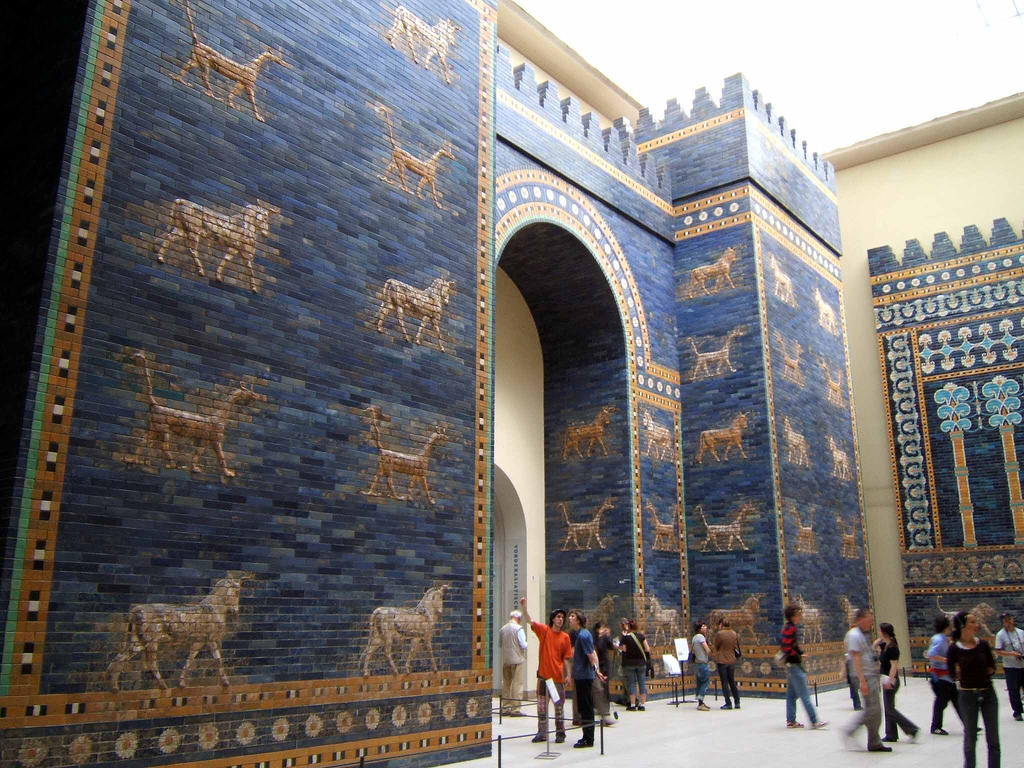
A reconstruction of the blue-tiled Ishtar Gate, which was the northern entrance to Babylon. It was named for the goddess of love and war. Bulls and dragons, symbols of the god Marduk, decorated the gate.
By Rictor Norton – https://www.flickr.com/photos/24065742@N00/151247206/, CC BY 2.0, https://commons.wikimedia.org/w/index.php?curid=1409322

Hanging Gardens

The most famous of these improvements to the city were the Hanging Gardens of Babylon, “ancient gardens considered one of the Seven Wonders of the World and thought to have been located near the royal palace in Babylonsays Encyclopedia Britannica. Though no one is quite sure where they were within the city, there were enough descriptions of them in classical literature to know that they likely existed, though no one is exactly sure of what they looked like.

The Gardens were said to be ‘hanging’ because perhaps they were perhaps on a tall ziggurat with terraces, “were set upon vaulted terraces. They were also described as having been watered by an exceptional system of irrigation and roofed with stone balconies on which were layered various materials, such as reeds, bitumen, and lead, so that the irrigation water would not seep through the terraces.”

A short video about the Gardens-

https://www.britannica.com/video/179976/creation-Nebuchadrezzar-II-designs-structure-video-Hanging

In Daniel 4:30 we read the perhaps most famous story about Babylon, where King Nebuchadnezzar admires his city from his palace rooftop, saying “‘Is this not Babylon the great, which I myself have built as a royal house by the strength of my power and for the glory of my majesty?’”

Barnes’ Notes says: “He greatly enlarged the city; built a new city on the west side of the river; reared a magnificent palace; and constructed the celebrated hanging gardens; and, in fact, made the city so different from what it was, and so greatly increased its splendor, that he could say without impropriety that he had “built” it.

Yet…the very next verse says that King Nebuchadnezzar’s pride and self-glorification was a mistake.

While the word was in the king’s mouth, there fell a voice from heaven, saying, O king Nebuchadnezzar, to thee it is spoken; The kingdom is departed from thee.

The city “under Nebuchadnezzar, who died B.C. 561 after a reign of forty-three years, attained great splendour. In the reign of Belshazzar the capital was taken by Darius the Median (Dan. 5:25–31), who entered it unexpectedly at the head of an army of Medes and Persians, as Isaiah (21:1–9) and Jeremiah (51:31) had predicted some 170 years before. Then began the decay and ruin of this proud city, and the kingdom of Babylon became a part of the Persian empire. In course of time the “great city” became “heaps,” and “an astonishment, and a hissing, without an inhabitant (Jer. 51:37–58).

“Many of the Jews who had been carried captive to Babylon remained there, notwithstanding the decree of Cyrus. After the destruction of Jerusalem there was established at Babylon a school of Jewish learning of great repute.” SourceEaston’s (1893) In Illustrated Bible Dictionary and Treasury of Biblical History.

Babylon future

Babylon is mentioned in Revelation numerous times. We read in Revelation 14:8, “and another angel, a second one, followed, saying, “Fallen, fallen is Babylon the great, she who has made all the nations drink of the wine of the wrath of her sexual immorality.

Babylon was not only a city in history, not only an empire that rose & fell, but the name Babylon is also figurative of an evil commercial-governmental system and an evil spiritual system.

Roy Gingrich interprets both the actual and the symbolic nature of Babylon:

“The fall of Babylon (Rev 14:8)-

“(1) The announcement—Another angel (other than the one in verse 6) announces the soon coming fall of Babylon. The “Babylon” mentioned here is not the religious system of chapter 17 -that “Babylon” was destroyed at the mid-point of “The Seventieth Week”. The “Babylon” mentioned here is the capital city of the political-religious-commercial system of chapter 18, which city and system will be destroyed when the Seventh bowl is poured out. God destroys her because she made the nations drink “the wine of the wrath of her fornication,” that is, because she caused them to commit spiritual fornication, which is punished by God’s wrath.” Gingrich, R. E. (2001). The Book of Revelation (p. 69). Riverside Printing.

Gingrich continues-

The destruction of religious “Babylon” as an ecclesiastical system, chapter 17. In the days of Nimrod, Gen. 10:8–12, and his wife, Semiramis, around 200 years after the Flood, two great systems came into existence, a God-defiant political system and a God-defiant religious system, the one founded by Nimrod and the other founded by Nimrod through his wife, Semiramis. These two systems are often called Political Babylon and Religious Babylon because they had their beginnings in Babylon, the one in the building of the city of Babylon and the other in the building of the tower of Babylon. The city of Babylon is the symbol of organized political rebellion against God and the tower of Babylon is the symbol of organized religious rebellion against God.” Gingrich, R. E. (2001). The Book of Revelation (pp. 76–77). Riverside Printing

“These two systems in varying forms, have continued on side by side down through the centuries, hating one another but for the sake of self-advancement, exchanging favors with one another. During the Middle Ages, these two systems were seen in the Holy Roman Empire and in the Roman Catholic Church. Today, they are seen in the United Nations Organization and in the Ecumenical Church Movement. During the first half of Daniel’s Seventieth Week, they will be seen in the Revived Roman Empire [“the Scarlet-colored beast,” Rev. 17:3] and in the rejected Lacodicean church] [“the great whore,” Rev. 17:1]. It is very helpful in understanding Rev., chap. 17, to know that “the scarlet-colored beast” and “the great whore” of chapter 17 are the final forms of two great God-defiant systems which have been in existence for over 3,000 years.” Gingrich, R. E. (2001). The Book of Revelation (pp. 76–77). Riverside Printing.

–end Gingrich quote

Babylon both actual and spiritual offer many lessons for us. Whenever I think of Dickens’ “A Tale of Two Cities” I often think of ‘Babylon & Jerusalem’. In the NT Babylon is always mentioned negatively, as a seat of evil, ungodly power. It signifies the world and its forces in opposition to God. It is often contrasted with “New Jerusalem”, in which God will finally reign supreme with no opposition ever again.

We will live in the city GOD built, not a city made by man like Assyria’s Damascus, Caesar’s Rome or Nebuchadnezzar’s Babylon. It will be a pure city, devoid of anything detracting from the glory of Jesus and his Light.

Babylon present

Whatever became of the actual, historical city of Babylon? It no longer really exists. It is a ruin, though it was opened to tourists again in 2009. There is not much to see. It is estimated that only about 5% of the old city has been excavated.

Babylon would stay under the Persian Empire’s rule for two centuries before Alexander the Great then conquered Babylon in 331 BC. He had plans to make Babylon the capital of his empire but died there in 323 BC before his dream came into reality. Alexander’s generals divided his empire among themselves immediately after his death. This is how general Seleucus obtained the historical city of Babylon. Not long after, he moved most of the population to his new capital Seleucia, which left the city decaying and deserted. Source

Will Babylon the city rise again? Only the Lord knows. Babylon the metaphor for an economy and an ecclesiastical system will indeed rise again to uncontested dominance, and be part of the major events prophesied to occur in the future, if the Babylonian system even can be said to have disappeared in the first place. Yet “Babylon” actual and Babylon figurative will finally be squashed in the future when Revelation events occur and Jesus’ wrath wipes out the evil system. The Lord as always, reigns supreme.

There will be no king looking out from his own rooftop and congratulating himself on his achievements. There will be no pagan priests celebrating a false god on a mythical throne. There will be no garden except the one the LORD himself planted, meaning, the world. It will be pure, verdant, and full of peoples who acknowledge Jesus as the supreme Lord of Lords and King of Kings. What a day that will be!

Posted in theology

The Great Cities of the Bible #1: Damascus

By Elizabeth Prata

Great Cities of the Bible #1: Damascus
Great Cities of the Bible #2: Babylon
Great Cities of the Bible #3: Rome
Great Cities of the Bible #4: Jerusalem

This begins a 4-part look at some of the Great Cities of the Bible. Cities are cities, but they are also seats of Empires, also they can be backdrops or even characters in the Biblical narrative. I chose the cities of Damascus, Babylon, Rome, and finally, Jerusalem to take a closer look at.

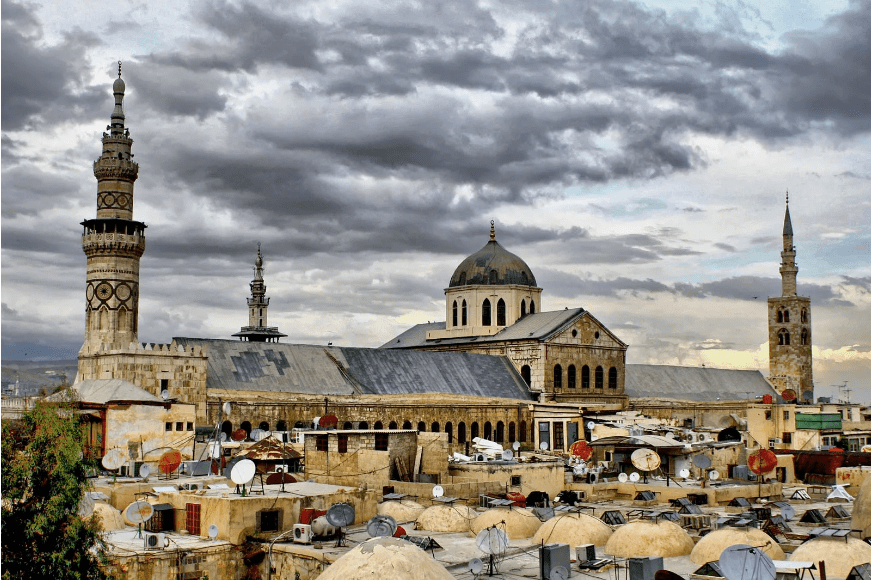
Damascus is one of the first cities mentioned in the Bible and the oldest continuously lived-in city in the world. Babylon dominated the Near East during its time, but also is symbolic of the struggle since the Fall of man vs. God. Its backdrop flows from Genesis to Revelation! Rome was at its height during the New Testament times, was the site of 4 Epistles written there, and perhaps will be at another height again if the prophecy about a Revived Empire will indeed be Rome as many interpret. And of course I chose Jerusalem because God set His name upon it, and it will be remade new as our eternal future home!

Modern Day Damascus is in Syria. It is the capital of Syria, and people have been living there since about 8000BC. When the Arameans arrived in about 3000 BC it went from villages to a notable city. That’s old!

We may think of that area of Asia as dry and dusty desert, but Damascus is considered one of the most beautiful cities in the world, as well as being ancient and notable. It is a UNESCO World Heritage site. To be sure, its dry and desert-y east is bordered by the Syrian-Arab desert and the west is bordered by the mountains of Lebanon. The mountains bar much rain from dropping on Syria. The mighty Euphrates, which represents more than 80 percent of Syria’s water resources, flows through far to the east of Damascus. Therefore, for Damascus to stay hydrated, the even more important river Barada River is the river on which the city of Damascus relies. Irrigation from the Barada River by aqueducts built during Roman times helps things along.

This river is divided into numberless channels and is distributed throughout Damascus and the region immediately about it. In almost every house there is a fountain, and one can stand still almost anywhere and listen to the murmur of the hidden streams that pass under and through the city. Source: Earthly Footsteps of the Man of Galilee, p. 274.)
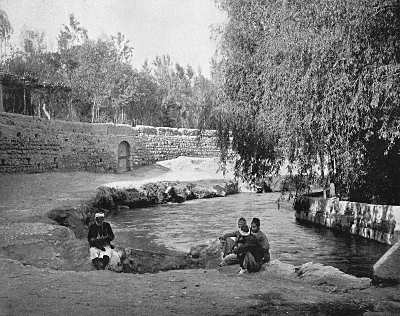
Barada river, Damascus. Shadi Hijazi photo, CC use

Barada is identified as Abana. This river is mentioned in the Old Testament (2 Kings 5:12), when Naaman argued that its waters would be better than the Jordan for curing his leprosy.

The International Standard Bible Encyclopaedia for the ‘Abanah’ AKA Barada says-

A few miles southeast of Suk Wady Barada the volume of the stream is more than doubled by a torrent of clear, cold water from the beautifully situated spring ‛Ain Fijeh (Greek, “fountain”), after which it flows through a picturesque gorge till it reaches Damascus, whose many fountains and gardens it supplies liberally with water. In the neighborhood of Damascus a number of streams branch off from the parent river, and spread out like an opening fan on the surrounding plain”.

Speaking of those gardens, we read from the 1894 book “Earthly Footsteps of The Man of Galilee and the Journeys of His Apostles”:

“No wonder the Moslems look upon Damascus as an earthly paradise. It is encompassed by gardens and orchards. These cover an area of over twenty-five miles in circumference. Here grow olive, fig, walnut, apricot, poplar, palm, cypress and pomegranate trees. In the above view we have a scene taken from the Jerusalem road in the western part of the city, and looking to the north a ridge of Anti-Lebanon is seen straight before us. In the richness of its soil, in the salubrity and semi-tropical character of its climate, in its varied vegetation, we find the reason for the constant association of Damascus with the thought of gardens.”

“It has been for four thousand years a garden. It is surrounded for miles with this splendor of verdure. Its gardens and orchards and far-reaching groves, rich in foliage and blossoms, wrap the city around like a mantle of green velvet powdered with pearls. The apricot orchards seem to blush at their own surpassing loveliness, and the gentle breezes that rustle softly through the feathery tops of the palms are laden with the perfume of the rose and the violet. Tristram, in his account of what he saw, says:”

“Tall mud walls extended in every direction under the trees, and flowing streams of water from the Barada everywhere bubbled through the orchards, while all was alive with the song of birds and the hum of bees. The great apricot trees were laden and bent down under strings of ripe golden fruit.” Whatever changes may be made by the hand of man in Damascus, whatever changes in government and in commercial activities, the city is sure to be for all time a paradise of fertility and beauty.”

In the Bible, Damascus is first mentioned in a casual comment in Genesis 14:15 (early!). It was the situation when Lot was taken prisoner and Abram had to go rescue him.

And he divided his men against them by night, he and his servants, and struck them and pursued them as far as Hobah, which is north of Damascus.

Damascus is mentioned again in the very next chapter, Genesis 15:2. Abram noted that the only heir he had was his servant Eliezer. And Abram said, “O Lord Yahweh, what will You give me, as I go on being childless, and the heir of my house is Eliezer of Damascus?

I mentioned the Arameans above, that Damascus in Syria didn’t become notable as a city until the Arameans settled it. According to Pulpit Commentary, “The Syrians of Damascus are known in the Hebrew, AramDammesek; that is, Aram-Damascus. The inhabitants of these regions and of Mesopotamia were descended from Aram, the son of Shem, son of Noah. (Genesis 10:22)”. See how old this region is? It is really amazing.

Damascus in mentioned frequently throughout the Old and New Testaments. Damascus played a major role in waging wars against Israel. From around 900 to 721 BC Syria was a terrible fearful opponent of Israel David was much occupied with subduing uprisings and incursions from Damascus, Syria throughout his Kingship. He eventually subjugated the Arameans but they rose again after the death of Solomon.

At various times, Israel and Judah made pacts with those who controlled Damascus (1 Kgs 15:18–20). War between Asa of Judah and Baasha of Israel led Asa to use the treasury of the temple and his personal wealth to pay for the support of Damascus against Israel (1 Kgs 15:19, 20).” Source The Lexham Bible Dictionary. Lexham Press.

When you look at the city in terms of the entire history of the Old Testament, you see how much of a role the Lord had Damascus play in the intertribal wars, alliances, rising and falling of kingdoms, and all impacting the Israelites. In fact, Damascus and Israel joined forces around 734 BC to attack Judah. The war almost destroyed Jerusalem, and evil King Ahaz of Judah asked Assyria’s king Tiglath-pileser to come defend Judah from the attack.

Eventually, Damascus was conquered by Alexander the Great and the city’s fortunes declined. It was taken over in 64BC in Roman times by Pompey. That is when the aqueducts were built that shuffled water from the critically important Barada river to water the great gardens and continue cultivating the crops.

In the New Testament Damascus is mentioned several times but always relative to Saul/Paul, his trip to Damascus, and his conversion. (Acts 9:1–25; 22:5–11; 2 Cor 11:32, 33)

However, despite the 8000 years of history we can trace back to Damascus and the nation of Syria itself, there is one stark piece of prophecy which we can possibly say has not come to pass within all that history yet: Isaiah 17:1 says that Damascus will be destroyed. Never has that ancient city been uninhabited. The prophecy says that the city will be razed and made into rubble, so that no one will live there.

Behold, Damascus will cease to be a city and will become a heap of ruins. The cities of Aroer are forsaken: they shall be for flocks, which shall lie down, and none shall make them afraid.(Isaiah 17:1-2).

Was this prophecy completely fulfilled during 732 B.C. when the Assyrians under Tiglath-pileser subjugated Syria? Has the city ever been so deserted that wild animals feel safe to wander about and even lie down?

Or was it a partial fulfillment, the rest to come at a future time? Whatever the answer, we know that 2 chapters later, the Lord promised good to that region of the world. In that day…Isaiah 19:24-25 says,

In that day Israel will be the third party with Egypt and Assyria, a blessing in the midst of the earth, whom Yahweh of hosts has blessed, saying, “Blessed is Egypt My people, and Assyria the work of My hands, and Israel My inheritance.”

Barnes’ Notes, “That is, the three shall be united as one people. Instead of being rival, hostile, and contending kingdoms, they shall be united and friendly; and instead of having different and jarring religions, they shall all worship the same God. The prophecy rather refers to the spread of the true religion, and the worship of the true God.”

And what a day that will be! The tumultuous epochs of this ancient, beautiful but war-like city shall finally find peace, and so shall all the inhabitants of the earth.

Posted in encouragement, theology

“To the city of refuge!”

By Elizabeth Prata

This week I’m posting a few essays about cities. Yesterday I wrote about “The Pride of Cities.” Today let’s learn about the biblical Cities of Refuge.

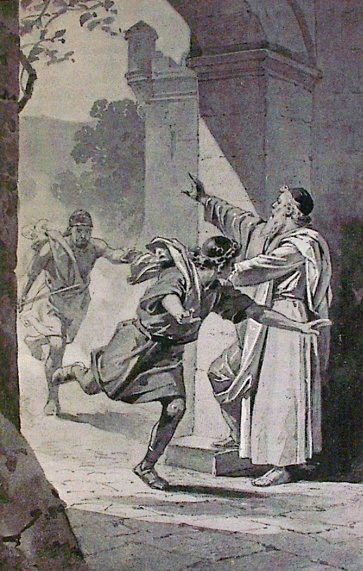
Left, Illustrator of Charles Foster, The Story of the Bible, 1884, “City of Refuge”.

Asylum. Sanctuary Cities. Manslaughter. Innocent. These are judicial terms that are not new, the men of Bible times knew them and we know these terms today.

Our God is a God of justice. He knows what is in a man, and it’s sin. He knows we hate and that we murder. Murder happened early on in human history, when Cain slew Abel in Genesis 4. And sin was only introduced in Chapter 3.

He knows that when blood is shed, blood must pay. Therefore, God made it possible for wrongful shedding of human blood to be avenged. In the Old Testament, the nearest relative of the wrongfully killed person had legal standing to hunt the murderer down and kill him with no repercussions to himself. (Numbers 35:19, 21, Deuteronomy 19:12).

Numbers 35:19, The blood avenger himself shall put the murderer to death; he shall put him to death when he meets him.

Numbers 35:21, or if he struck him down with his hand in enmity, and as a result he died, the one who struck him shall surely be put to death; he is a murderer; the blood avenger shall put the murderer to death when he meets him.

Deuteronomy 19:12, then the elders of his city shall send and take him from there and give him over into the hand of the avenger of blood, that he may die.

However, there are times when blood is shed accidentally, or unknowingly. This person is called a “Manslayer” as opposed to the aforementioned ‘murderer’. If a man accidentally killed another man, God made a way for that person to be able to flee to a City of Refuge, so called in the Bible, and hurl himself upon the judicial investigation of the priests or elders of that city. Here’s how Charles Spurgeon explains it:

You will remember that when the children of Israel were settled in Canaan, God ordained that they should set apart certain cities to be called the Cities of Refuge, that to these the man-slayer might flee for security. If he killed another unawares, and had no malice aforethought, he might flee at once to the City of Refuge; and if he could enter its gates before the avenger of blood should overtake him, he would be secure.

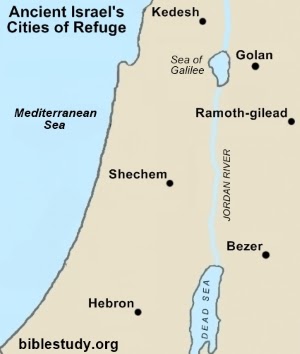
Cities of Refuge were carefully selected at strategic locations so that no person living in the Land would have to run far to access it. They were equally spread out. A person anywhere in the Land could reach them in a day or less. The Cities of Refuge were open to strangers, too.

Cities of Refuge (source Smith’s Bible Dictionary) were six Levitical cities specially chosen for refuge to the involuntary homicide until released from banishment by the death of the high priest. (Numbers 35:6,13,15; Joshua 20:2,7,9) There were three on each side of Jordan.

Source

Kedesh, in Naphtali. (1 Chronicles 6:76)

Shechem, in Mount Ephraim. (Joshua 21:21; 1 Chronicles 6:67; 2 Chronicles 10:1)

Hebron, in Judah. (Joshua 21:13; 2 Samuel 5:5; 1 Chronicles 6:55; 29:27; 2 Chronicles 11:10)

On the east side of Jordan –

Bezer in the Wilderness, in the tribe of Reuben, in the plains of Moab. (4:43; Joshua 20:8; 21:36).

Ramoth-Gilead, in the tribe of Gad. (4:43; Joshua 21:38; 1 Kings 22:3)

Goolan in Bashan, in the half-tribe of Manasseh. (4:43; Joshua 21:27; 1 Chronicles 6:71)

What you had to do, if, say you were chopping wood and your axe head flew off and killed the man next to you, is run to the city. Upon arrival, you would have to tell the elders what happened. You’d have to make it there before the ‘avenger of blood’, usually the nearest next of kin to the dead man, gets you and kills you.

The elders would provide you a place to stay and food, until they met to discuss your case.

If the case is adjudicated as accidental, you would be allowed to remain in the city of refuge freely until the High Priest died. After that you could go home. If you left the city of refuge prior to the death of the High Priest, the avenger of blood could perform the death penalty without penalty to himself.

I find all this amazing, that God provided opportunities for justice in these cases. What I find even more fascinating is just how seriously the Israelites took the cities of refuge.

These cities of refuge were a fact, real cities with real roads leading up to them. The roads leading up to it would need to be maintained. They erected signs at intervals so that the fleeing man-slayer would know where to go. They maintained the signs regularly also. Spurgeon again from the same link as above:

We are told by the rabbis that once in the year, or oftener, the magistrates of the district were accustomed to survey the high roads which led to these cities. They carefully gathered up all the stones, and took the greatest possible precautions that there should be no stumbling-blocks in the way which might cause the poor fugitive to fall, or might by any means impede him in his hasty course. We hear, moreover, and we believe the tradition to be grounded in fact, that all along the road there were hand-posts with the word “Refuge” written very legibly upon them, so that when the fugitive came to a crossroad, he might not need to question for a single moment which was the way of escape; but seeing the well-known word “Refuge,” he kept on his breathless and headlong course until he had entered the suburb of the City of Refuge, and he was then at once completely safe. Spurgeon

It’s true about the roads and the signs, not just tradition. This is from the Jewish Encyclopedia, written after Spurgeon preached that message:

Corresponding to the care for the proper location of these cities were the other ordinances referring to them. The roads leading to them were marked by sign-posts at the crossroads, with the inscription “Miḳlaṭ” (Refuge); the roads were very broad—32 ells, twice the regulation width—smooth and level, in order that the fugitive might not be hindered in any way (Sifre l.c.; Tosef. l.c. 5; Mak. 10b; B. B. 100b). The cities chosen must be neither too small nor too large: in the former case a scarcity of food might arise, and the refugee might consequently be forced to leave his Asylum and imperil himself; in the latter case the crowds of strangers would make it easy for the avenger of blood to enter undetected. There were other measures of precaution in favor of the refugee. Dealing in weapons or implements of the chase was forbidden in the cities of refuge. Furthermore they had to be situated in a populous district, so that a violent attack by the avenger of blood might be repelled, if necessary. Jewish Encyclopedia, 1906

God is incredible the way He set up society in those days. I look forward to the real, actual Millennial Kingdom, the 1000 year kingdom when God fulfills His promises to Israel and we live with Him on earth- Jesus as King and David ruling as under-King.

Meanwhile, the spiritual lesson is this: though there are sanctuary cities on earth today, there is one city to which every person on earth should flee. Or sins are high crimes against a Most Holy God. We all deserve the death penalty. However, if we flee to Jesus the High Priest, we may throw ourselves at His feet and plead His blood to cover our sins. If we repent and trust Him as Savior, He will forgive the crime and we will escape the penalty- which is death.

And since Jesus as High Priest never dies, we will live without fear of death forever.

Hallelujah!