By Elizabeth Prata
Kay Cude is a Texas Poet. Used with permission

By Elizabeth Prata
Kay Cude is a Texas Poet. Used with permission
By Elizabeth Prata

Sproul has passed on, Piper’s retired, JMac is aging, and Steve Lawson isn’t far behind. Voddie is getting there, and Washer had a heart attack. I frequently hear, “Where is the upcoming crop of pastors? Where are the next faithful men of God? What will we doooo?”
Continue reading “The ordinary pastors”By Elizabeth Prata
Does it bother anyone that the literal name of this new year is “2020 won”?
LOL I didn’t make that line up, I saw it on Twitter. It’s true, though, isn’t it? I feel like I’ve gone through 2020 with Jake “Raging Bull” LaMotta. Beaten up from pillar to post, knocked down only to get up and be knocked down again, emerging from the year battered and bloody and barely standing. I guess the ‘difficult times’ finally came to America. (2 Timothy 3:1-5).
2020 felt like the Time of Judges. If you are skeptical, look at this summary of the Book of Judges and see if it doesn’t fit:
Continue reading “Outlook for 2021: A Time of Judges?”By Elizabeth Prata
The year 2020 is over today. And here I thought 1968 was bad. I didn’t know nuthin’. I was so much older then. I’m younger than that now.
I think it’s good to ‘take stock’ and look back over the highs and lows, goals met and goals abandoned. People here and people gone. The stream of life is ever moving, an increasingly rapidly rushing brook that widens and bounds faster as it hurtles downhill to its source. It’s helpful to see where I’ve been and then resolutely turn my head to look forward. I’m not one to dwell.
Continue reading “2020 in Review”By Elizabeth Prata
As the virus called COVID-19 and government responses to it continue to tramp around the world and encroach on normal lives, there have been effects. Terrible effects. In many cases the effects of the various local and global governments’ response have been worse than the virus itself.
Suicide and food scarcity are two of the worst effects of the lockdowns but they are silent and hidden.

On December 7, the US Global Leadership Coalition issued a white paper warning of “a looming food crisis.” In it, they list some devastating facts.
Continue reading “Being a light amid the darkness”By Elizabeth Prata
Two days ago I published an update to the Ravi Zacharias situation here on this blog. I’d posted about the man other times, first in 2016, later that year here, and again in 2019. With the news that the Ravi Zacharias International Ministry (RZIM) had engaged a private investigative company to look into certain allegations against the now-departed Ravi, and that the Ministry announced this week allegations seemed to have merit, I published those facts Saturday.
No one likes it when a tower falls. Ravi was globally well known, a Christian celebrity if you will. His many decades of apologist speeches all over the world had affected many. Of course we would all prefer that any man of faith stay above reproach, but sadly, many do not. The Bible is replete with these sad facts, and it addresses them forthrightly.
WHAT IS DISCERNMENT?
Continue reading “What is discernment and how does it work? Like a pot of boiling water…”By Elizabeth Prata**
Update below

In 2016 I wrote an essay looking into Ravi Zacharias and his ministry for discernment purposes. I titled it, “On Discerning Ravi Zacharias: It’s time to say what needs to be said“. I phrased it that way because even though the Bible calls us all to be Bereans (Acts 17:11) and search for truth and confirmation, and that doing so is ‘noble’, looking into the doctrine or integrity of a popular and globally known Bible teacher/apologist/evangelist is often called divisive. As if the more famous people like Billy Graham or Beth Moore or Ravi get a pass.
They don’t.
Continue reading “About the Ravi Zacharias situation… (Updated)”By Elizabeth Prata
And she gave birth to her firstborn son; and she wrapped Him in cloths, and laid Him in a manger, because there was no room for them in the inn. (Luke 2:7).
Think of Jesus, divesting Himself of His majesty agreeing to become flesh. To incarnate. He lowered himself from His throne as King of all the universe, to be born as helpless babe, in poverty, in obscurity. He didn’t come as a boy, able to run away from danger or to feed and manage for himself. He didn’t come as a man, able to protect himself from dangers all around. He came as a newborn baby. Totally helpless. Total reliance on others.
Continue reading “The Babe”By Elizabeth Prata
Christmas advent. We are coming toward the end of our look at the life of Jesus through scripture. The first section of His life was seen through verses focused on prophecy, arrival, and early life.
The next section of verses looked at Him as the Son, second person of the Trinity.
We proceeded into looking at Jesus as the Son and His preeminence, His works, and His ministry. Under ministry & works, I chose verses showing His attributes and aspects of being servant, teacher, shepherd, intercessor, and compassionate healer; and His attributes of omniscience, having all authority and power, and sinlessness. Continue reading “Advent- Thirty Days of Jesus: Day 27, He Rises”
By Elizabeth Prata
I love biblical art, and I’m entranced with a few particular pieces. One I come back to a lot happens at Christmas time, and I love to look at it. I’ve written about it before, here, in December 2015, and here, in December 2017. It is called The Nativity, by Gari Melchers.
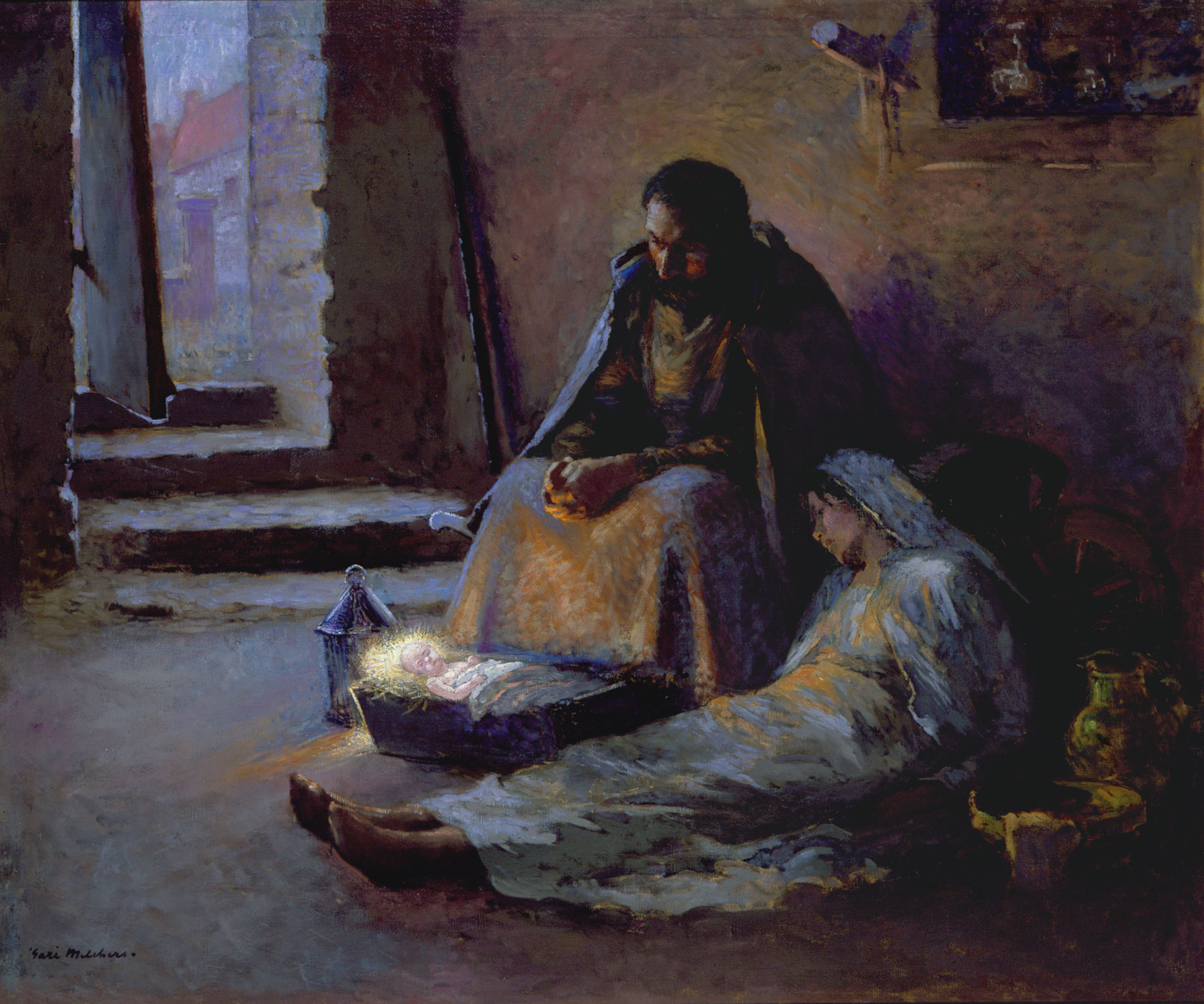
When preaching about this moment in history, Pastor S. Lewis Johnson emphasized the virgin conception rather than the virgin birth. He preached that the birth was typical, human, bloody, and messy. It was the conception that was immaculate. The art by American painter Gari Melchers depicts a scene more reflective of a birth than most nativity scenes usually do.
Here, we see a deeply concentrating Joseph gazing at his newborn son, perhaps pondering the spiritual implications of this new life that promised to bring new life to one and all. Note his furrowed brow. Mary, exhausted, drooping, leans against her husband sleepily, a recently used washbowl and cloth by her side. Is the glow from the Babe’s head, or the lantern that has been set next to Him? The scene depicts exhaustion, wonder, light, and hope.
Julius Garibaldi Melchers (1860-1932) was an American artist. He was one of the leading American proponents of naturalism. He won a 1932 Gold medal from the American Academy of Arts and Letters, according to Wikipedia.
As for the setting itself, it is unusual in that it does not show the usual display of a barn or stable, with animals around. Certainly the Wise Men from the East were not present. Historically we know that appeared up to two years later, when Mary and Joseph were living in a house and the babe was a toddler. This is another reason I’ve always liked this painting, above all others. It is more closely historical and accurate than many people know in setting the scene in the animal section of a house.
It was highly likely, almost certain, that Mary gave birth in a house. Perhaps the house was crowded with other relatives who’d arrived for the census prior to their arrival, so the only spot left was the downstairs entry where the animals were usually kept. Here is information about the likelihood that Jesus was not born in a barn or stable, but in a home, and probably a relative’s domicile. The essay also discusses what is meant by “inn”, and more.
Once More, Jesus was Not Born in a Stable
The mention of a ‘manger’ in Luke’s nativity story, suggesting animals, led mediaeval illustrators to depict the ox and the ass recognising the baby Jesus, so the natural setting was a stable—after all, isn’t that where animals are kept? (Answer: not necessarily!)
The third issue relates to our understanding of (you guessed it) the historical and social context of the story. In the first place, it would be unthinkable that Joseph, returning to his place of ancestral origins, would not have been received by family members, even if they were not close relatives.
Thanks be to God for his inexpressible gift! (2 Corinthians 9:15)

