Posted in theology

Kay Cude Poetry: Hymn and food for thought

By Elizabeth Prata

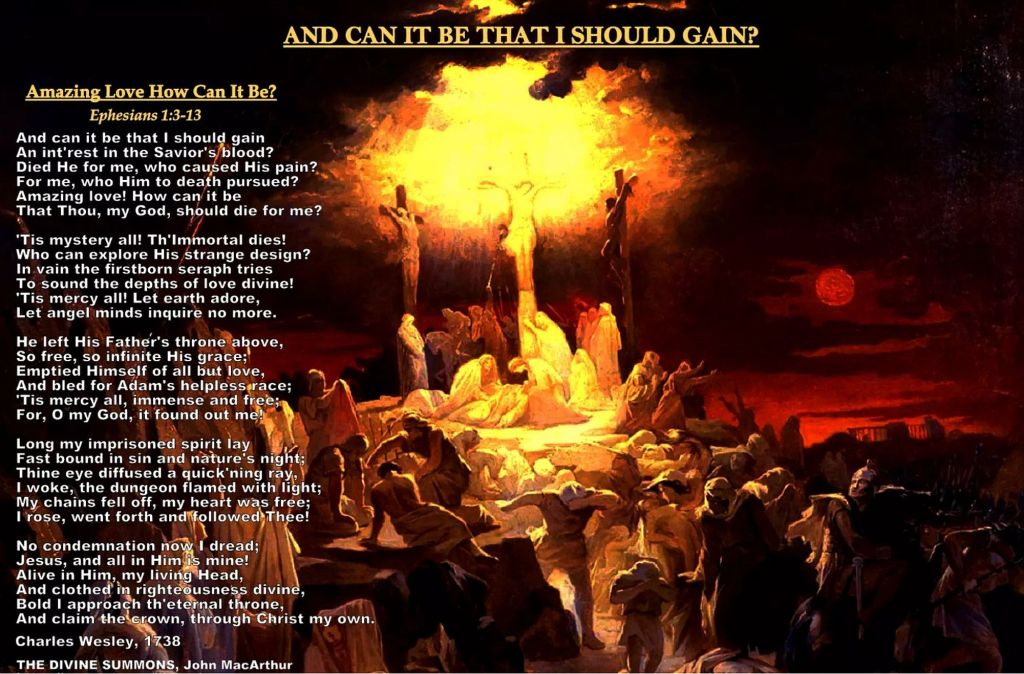
Today’s piece from Kay Cude is inspired by the hymn And Can it Be? by Charles Wesley, (his lyrics appear on the art and also below), and the sermon The Divine Summons by John MacArthur. Kay Cude is a Texas poet. Used with permission. Here is Kay Cude’s Artist’s Statement:

“Sometimes in the midst of our sanctification as we face some very inflexible, but necessary trials, we may find that we need the comfort of the deep sustenance that comes through feeding upon sound, Biblical truths that are richly expressed in many of the “old” hymns.  I know that I do.”

“I am still moved by “And Can It Be?” by Charles Wesley and find that Pastor MacArthur’s “The Divine Summons” goes hand-in-hand with it as instruction and edification for we whose circumstances compel us to return to the study of God’s sovereign act of salvation and the reassurance that it is God’s work in us and none of our own.”

Painting by Vasily Golinsky, “The Crucifixion of Christ” (1890-1900)

And Can it Be? Charles Wesley, 1738

And can it be that I should gain
An int’rest in the Savior’s blood?
Died He for me, who caused His pain?
For me, who Him to death pursued?
Amazing love! how can it be
That Thou, my God, shouldst die for me?
Amazing love! how can it be
That Thou, my God, shouldst die for me?

’Tis mystery all! The Immortal dies!
Who can explore His strange design?
In vain the firstborn seraph tries
To sound the depths of love Divine!
’Tis mercy all! let earth adore,
Let angel minds inquire no more.
’Tis mercy all! let earth adore,
Let angel minds inquire no more.

He left His Father’s throne above,
So free, so infinite His grace;
Emptied Himself of all but love,
And bled for Adam’s helpless race:
’Tis mercy all, immense and free;
For, O my God, it found out me.
’Tis mercy all, immense and free;
For, O my God, it found out me.

Long my imprisoned spirit lay
Fast bound in sin and nature’s night;
Thine eye diffused a quickening ray,
I woke, the dungeon flamed with light;
My chains fell off, my heart was free,
I rose, went forth, and followed Thee.
My chains fell off, my heart was free,
I rose, went forth, and followed Thee.

No condemnation now I dread;
Jesus, and all in Him, is mine!
Alive in Him, my living Head,
And clothed in righteousness Divine,
Bold I approach the eternal throne,
And claim the crown, through Christ my own.
Bold I approach the eternal throne,
And claim the crown, through Christ my own.

Posted in theology

God Told me, part 3: What’s the difference between hearing audible voices and claims that God “spoke to my heart?”

By Elizabeth Prata

I’m presenting a series of essays and podcasts that scripturally rebut the notion that God is still speaking to people individually today. Despite the glut of people, many of them women Bible teachers, who claim He speaks to them, dispenses life advice, or just whispers sweet assurances all day long, He is not speaking now.

Part 1 here
Part 2 here

Part 4 here
Part 5 conclusion

Now, for the past two parts in this series, I have been firm on the notion that God is not speaking to individuals today. I looked at where the Bible says He is not, at why He is not, and if this voice is not from God, then who is speaking? Today I want to look at the difference between God speaking audibly to people versus the Spirit’s inner work of sanctification, versus intuition and promptings.

4. What is the difference between hearing audible voices and claims that God “spoke to your heart?”

God speaking to my heart, or as often heard, “God laid it on my heart” is another shorthand like “God told me.” But it’s often an unwitting shorthand for a true doctrine- the doctrine of Providence. Just because God is not speaking directly to us today, does not mean He isn’t working in our lives. He is. How? Providentially. God is at work personally and intimately in each and every thing that happens on earth and in each person’s life, even if He isn’t telling us His business directly and even when He isn’t personally answering life questions like where to get a job or who to marry. God speaking today is not a question of His voice and how to hear it, but a question of HOW He works in our lives. We can read the definition of providence from Phil Johnson,

Providence is God’s continuous involvement with his creation whereby he preserves and governs all his creatures (from the greatest to the least)—so that in accord with his perfect will and design, he sovereignly orders everything he has made to accomplish everything he intends for his own glory. (Source)

Phil Johnson then goes on to speak about our intuition. It’s a tricky business to attribute our hunches and intuitions to God speaking to us directly, He doesn’t, but it IS true that He is working in our lives. We just cannot say that since an intuition turned out to be correct that it was direct revelation that prompted us. Phil Johnson goes on to explain.

[W]hat about those rare occasions when our intuition proves correct? Something we dreamed about seems to correspond to something in real life? A sense of foreboding motivates us to change plans, and it turns out to be a good thing?
Most of us have had experiences like that. Everyone has unexplained thoughts that seem to leap from nowhere into the mind. Most people likewise have hunches and instincts. Sometimes you just feel like you know a thing is true, but you can’t give an account for how you arrived at that knowledge rationally.
But how do we understand that inner sense, especially when God seems to use it to prompt us to pray, or witness, or duck and run at precisely the right moment? Because let’s be honest: that kind of thing does happen to most of us from time to time.
Here’s the point: I do believe that God might providentially use a spontaneous thought in my head to accomplish something wonderful. But that’s what it is, and no more. It’s a remarkable providence, not a prophecy. As I have been saying, God ultimately controls and uses everything providentially.
Here’s the problem: that’s as true of my sins as it is of the thoughts in my head. God can and does use them all for His own purposes. The fact that He uses an idea in my mind to achieve some good purpose doesn’t make the idea itself inspired. It also doesn’t make a bad idea good, just because God uses it for good.
Now, think this through with me: Since intuition is fallible—and almost everyone agrees that it is actually far more often wrong than right—we shouldn’t make much of it. Furthermore, since intuition is fallible, it cannot be considered “revelation,” even when it happens to be uncannily right in an instance or two. And if one or two of your guesses happen to prove accurate alongside a gaggle of dozens of failed prognostications, you should still be wary of granting your premonitions the status of a supernatural “spiritual gift.”
People who think moments of intuition are God speaking with a private message invariably become extremely superstitious. They foolishly order their lives by their feelings. They commit the sin of trusting too much in their own hearts.

Now, the ‘God spoke to my heart’ phrase could just be a casual shorthand for someone saying, “I have read the pertinent Bible passages and I now have a settled conviction that my decision to do X is consistent with God’s will.” But usually that is NOT what people mean when they say it.

Usually people mean it as a shorthand way of saying “God spoke to me and this is what He said I must do.” The latter is a way to escape accountability for their decisions.

Assigning to God the catalyst for your personal life decisions is a dangerous thing because it puts words in His mouth He didn’t say and pridefully indicates you know God’s mind at any given moment.

Phil Johnson, Shepherds Conference 2002, “Super Seminar: Private Revelations” said-

Now, does the Spirit of God ever move our hearts and impress us with specific duties or callings? Certainly. But, even in doing that, He works through the Word of God. Experiences like this, impressions and all, are not in any sense prophetic or authoritative except as they echo what the Word already says. They are not revelation. Those sensations, those impressions, those feelings you get are not revelation, but they are the effect of illumination. When the Holy Spirit applies the Word to our hearts, and opens our spiritual eyes to His truth. And, we need to guard carefully against allowing our experiences and our own subjective thoughts and imaginations to eclipse the authority and the certainty of the more sure Word of God. This is a very practical application of the principle of Sola Scriptura. Think about this…to what ever degree you seek private messages from God outside His Word, you have abandoned the principle of Sola Scriptura.

Part of decision making is trust- trusting God, trusting that He is in control of our lives, and trusting providential out-workings from our decisions. You will not ruin His plan if you make a life-decision. So go ahead and turn left instead of right, marry that person, go to the college you want to go to, take the job in another city. As long as you are adhering to the general, biblical principles outlined in the Bible, you can safely fill in the blanks with your own decisions. God knows how to merge our decisions with His fore-ordained plan.

In all your ways acknowledge Him, And He will make your paths straight. (Proverbs 3:6)

Judas decided freely in his own will to steal from the purse, to betray Jesus, to reject His miracles. Yet all was consistent with foreordained scriptures and was fulfilled exactly. God maintains that balance and we don’t have to know how.

In 2006 I decided to move to Georgia. I could have decided on Columbus Ohio, Honolulu Hawaii, or Anchorage Alaska, and it would have been the same. He established me in a church, found me a job, knit some friends into my life, gave me a dwelling place, and continued to sanctify me.

The LORD has established His throne in the heavens, And His sovereignty rules over all. (Psalm 103:19)

God does speak to our heart, because the Spirit dwells in us and transforms the evil desires of our heart to holy desires of God. But we can’t and don’t know at any given moment that this particular idea or thought is God’s. What we do know is that Romans 8:28 is true:

And we know that God causes all things to work together for good to those who love God, to those who are called according to His purpose. (Romans 8:28).

Posted in theology

‘God Told Me’ – part 2: How can we confirm a voice we hear? And if it’s not God, then who’s speaking?

By Elizabeth Prata

Part 2 of an ongoing discernment series addressing the issue of women, many of them ‘Bible’ teachers, who are claiming to hear directly from God. Part 1 here. Questions addressed in the previous part were

1. What is the “God told me” religion?
2. Does God talk to us audibly?

Today’s questions are:

3. If we do hear a voice, how do we know it’s from the Lord?
4. And if it’s not from God, then who is speaking?

Part 3 here
Part 4 here
Part 5 conclusion

Continue reading “‘God Told Me’ – part 2: How can we confirm a voice we hear? And if it’s not God, then who’s speaking?”
Posted in theology

‘God Told Me’ , part 1: What is it? And does God speak audibly today?

By Elizabeth Prata

Part 2 here
Part 3 here
Part 4 here
Part 5 conclusion

This month, the gentle and humble Jennifer Ross of Confidently Called Homemakers contacted me to interview about the rampant theological crisis in women’s ministry- expecting audible revelation from Jesus. We had a great discussion about it, weaving our way through the thorny issues of direct revelation. We talked about why so many women think God or Jesus is talking to them, and what to do about it. She posted the interview here on her site. She gave me permission to post my notes after her podcast had been published and propagated. So in this series of discernment lessons, over the next few days I am going to address this issue here on my blog and my own podcast.

It is a true problem. “Bible” teachers such as Beth Moore, Priscilla Shirer, Jennie Allen of IF:Gathering, and others claim that God talks to them, whispers to them, delivers prophecy to them, and directs them to launch ministries, even down to giving them the tagline. Many other women who claim Christianity but aren’t teachers per se, but have a large platform and influence, claim the same- God speaks to them, giving advice on career and daily matters. One example is Joanna Gaines of HGTV’s Fixer Upper and Magnolia Enterprises.

Continue reading “‘God Told Me’ , part 1: What is it? And does God speak audibly today?”
Posted in theology

Marriage is intended to be solely one man and one woman

By Elizabeth Prata

Yesterday I wrote about polygamy in the Bible. God does not accept polygamy as an appropriate marital configuration. His standard is seen in Genesis 2:24, where he brought one man to one woman and made them as one flesh for life.

This standard is emphasized both positively and negatively throughout the Bible. In the New Testament Jesus re-taught that standard, quoting the Old Testament. The negative examples of what happens to a family when they stray from it is clearly seen whenever polygamy is practiced. Abraham, Solomon, David, Elkanah, Jacob, and others suffered terribly whenever it’s shown they took on plural wives or concubines.

Despite that, there are religions that practice polygamy, which is one person married to multiple other spouses. Usually it’s the man who has many wives, which is technically called polygyny. We rarely see a culture that adopts polyandry, which is women taking on multiple husbands.

There is one cult that claims the God of the Bible and practices polygamy. That cult is Mormonism, or as they refer to themselves, The Church of Jesus Christ of Latter Day Saints. Many of their historical elders were polygamists, usually in secret, from almost the start of the founding of the cult. Founder Joseph Smith claimed to have had a revelation from Jesus to take plural wives. (Source). Smith did so, and taught the practice to close associates. In public however, they denied the existence of polygamy for a few of those beginning years. One wonders why, if this teaching truly was from God – who is good, holy, and pure – it needed to be a secret…

In fact, the Mormons’ 1835 founding and guiding document, Doctrine and Covenants (D&C), banned polygamy and said that monogamy was the only acceptable form of marriage. But men continued to take plural wives, and the practice spread. In 1852 polygamy was announced publicly and finally published in the 1876 version of the LDS Church’s Doctrine and Covenants, the practice became openly public. This caused much controversy between the LDS church and the United States government, which vehemently opposed the practice. Mormons called it having ‘spiritual wives’ or “plural marriage.” The government called it polygamy and against the law.

Recently the LDS church posted documents on their website admitting their early history was rife with “plural marriages”. Joseph Smith had up to 40 wives, the youngest of age 14.

Where do Mormons get that polygamy is biblical? First, this is their reasoning, aside from basing legitimacy on the alleged extra-biblical, direct revelation Joseph Smith allegedly received, Smith then wrote down the revelation and codified it into the documents they vault to equal stature as scripture, for example, their Doctrine & Covenants 132:34 says that God commanded polygamy.

34 God commanded Abraham, and Sarah gave Hagar to Abraham to wife. And why did she do it? Because this was the law; and from Hagar sprang many people. This, therefore, was fulfilling, among other things, the promises. 35 Was Abraham, therefore, under condemnation? Verily I say unto you, Nay; for I, the Lord, commanded it.

So, a direct command via revelation, plus an argument from silence. Their argument from silence explains that when Abraham took wives and concubines, since there was no explicit condemnation from God for doing that, it must be OK.

Further, they say that since the Prophet (Smith) was told to do it, and there was NO condemnation to Abraham for taking multiple wives, and further proof of the practice’s acceptability is that he was blessed with children. They say in paragraph 37, “Abraham received concubines, and they bore him children; and it was accounted unto him for righteousness, because they were given unto him,“.

Fourth, they say that when there is an apparent contradiction between what the LORD had said before in scripture, and the instructions now, obedience is key. The D & C use the example in 132:36 that God commanded Abraham to kill Isaac. We know the 5th Commandment says Thou Shalt Not Kill. It is interpreted that Abraham’s obedience to the voice of God commanding him to kill Isaac even though the Commandments forbid it, was accounted to him as righteousness. Similarly was Abraham’s acceptance of plural wives despite an apparent contradiction in Genesis 2:24, and that also was accounted. This interpretation is taught at the churchofjesuschrist.org, the legitimate Mormon website. We read, “It is important to remember that if God were to command His people to do something contrary to current commandments, such direction would come through His living prophet.” So, essentially the living prophet designated by the Mormons as the one to receive revelation, could say anything, claim it was “God told me”, and the Mormons would have to obey. This is so dangerous.

Yet scripture is clear that marriage is one man and one woman. We also read that, “But even if we, or an angel from heaven, should preach to you a gospel contrary to what we have preached to you, he is to be accursed!” (Galatians 1:8). And to watch out, “For such men are false apostles, deceitful workers, disguising themselves as apostles of Christ. No wonder, for even Satan disguises himself as an angel of light. Therefore it is not surprising if his servants also disguise themselves as servants of righteousness, whose end will be according to their deeds“. (2 Corinthians 11:13-15).

We see how easy it is for satan to twist the scriptures. All the most famous false teachers and false prophets we read about in the Bible or hear about in the news, start off with a hefty blend of truth mixed in with lies. That proportion changes as the false prophet’s following grows. His teachings become less truth and more lies. By then, people are hooked, as the frogs in ever-warming water, perhaps not noticing the drift from sacred scripture. Satan deceived Eve simply by insinuations and questions. The Judaizers made sense to the confused Jews coming out of the old covenant and emerging into the new. Cults always begin with truth and lies mixed, expertly proportioned so as to make sense to the people the false teacher or false prophet is trying to deceive.

Peter writes in 2 Peter 3:14-18,

Therefore, beloved, since you look for these things, be diligent to be found spotless and blameless by Him, at peace, and regard the patience of our Lord as salvation; just as also our beloved brother Paul, according to the wisdom given him, wrote to you, as also in all his letters, speaking in them of these things, in which there are some things that are hard to understand, which the untaught and unstable distort, as they do also the rest of the Scriptures, to their own destruction. You therefore, beloved, knowing this beforehand, be on your guard so that you are not carried away by the error of unscrupulous people and lose your own firm commitment, but grow in the grace and knowledge of our Lord and Savior Jesus Christ. To Him be the glory, both now and to the day of eternity. Amen.

From this we learn that:
1. Some biblical concepts are hard to understand,
2. We must be diligent to interpret correctly so as to understand according to the Spirit and not to the flesh,
3. There are unscrupulous teachers coming in the name of Christ. The word unscrupulous means lawless, licentious, and unrestrained,
4. Scripture can be distorted.

Whenever a ‘biblical’ teaching appeals to the flesh, it’s false. And who is unstable? The double-minded man, unstable in all his ways. (James 1:8). Again, if a teaching appeals to the flesh, it is false.

The beauty of the institute of marriage is that it’s a picture of Jesus and His Bride (the Church). The Church global is one body, (not plural bodies) whom Jesus gave His life for and will be presented to Him by His Father, Yahweh at the heavenly supper as spotless. Marriage is supposed to be instructive to us, where the man is head of the house, women are to submit to His leadership, He is to love his wife even unto death, and as a unit of one man and one woman, go forth to proclaim the excellencies of Jesus while striving for holiness. Just as it was intended in the Garden by God for Adam and Eve.

Posted in theology

Marriage: Polygamy in the Bible

By Elizabeth Prata

Last week I’d written a short series on Marriage for wives. The essays in the series were:

Persevering in Marriage: A True Story
Culture Calls this a Dirty Word
Recommending Confidently Called Homemakers
What are the biblical qualities God desires in a woman teacher? Not the ones Beth Moore exhibits
What if my marriage is to a difficult man?
Unequally yoked (or yoked to a minimal believer) but still need to submit?

A dear sister contacted me and asked me to write about polygamy. In my series, I’d only mentioned polygamy, noting that Abraham had multiple wives. So did, David, Solomon, Elkanah, and that even the institute of marriage crumbled as early as Genesis 4:19, when we read that Lamech took two wives.

As I was writing the series I briefly considered writing more about polygamy (multiple spouses supposedly married to one person) but discarded the idea since polygamy isn’t a huge concern in the US.

I was wrong.

Continue reading “Marriage: Polygamy in the Bible”
Posted in theology

If only God is good, how can we be called a ‘good’ servant?

By Elizabeth Prata

In Luke 18:19, a certain ruler approached Jesus and asked him a question starting with “Good Teacher…” Jesus replied,

“Why do you call Me good? No one is good except God alone.

Goodness is an attribute of God, one that is called a ‘communicable’ attribute, in that God chooses to ‘communicate’ or deliver to us, certain attributes. Incommunicable attributes are the attributes of God reserved for Him alone, such as omnipotence, or omniscience. But other attributes such as patience, goodness, etc, are given to us after salvation as we work out His salvation, obey His law, and develop fruit of the Spirit.

The only good there is comes from God, because He is the only Good. Let’s look at this attribute a bit closer. In Wayne Grudem’s Systematic Theology, he writes the definition of good,

Continue reading “If only God is good, how can we be called a ‘good’ servant?”
Posted in theology

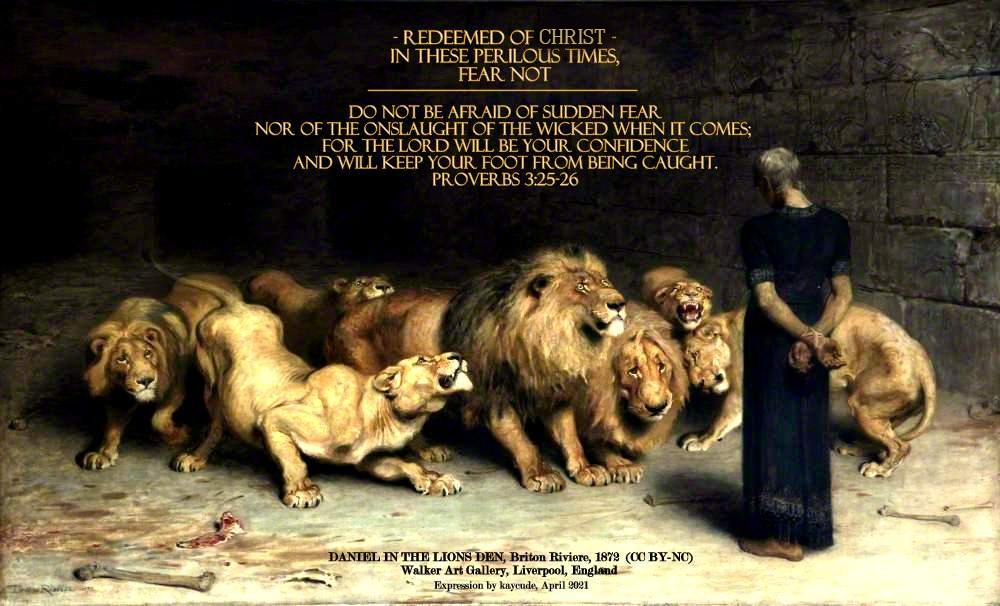
Kay Cude Poetry: In these Perilous Times- Fear Not

Kay Cude is a Texas poet. Used with permission. Here is Kay’s Artist’s Statement:

Kay Cude: Too often I've been caught up in the speculation, "How will I respond to the attacks of the wicked when I am face-to-face with persecution?"  \Will I have the strength, the resilience, and the courage to respond to them with patience and gentleness and point them to the eternal rescue that is available to them through Christ Himself?  Will words fail me? Will I be able to crucify my flesh and respond in the Spirit, even in overwhelmingly fearful situations that threaten my life or my family or my financial security?"
"Proverbs 3:25-26 speaks to what I and countless of the redeemed can rest in--that it is the Lord, not ourselves, who is our confidence when we face persecution! Look closely at the submission, even the awe and timidity displayed in the eyes of those lions! Then see Daniel as he faces a deadly situation but stands quietly in the confidence that only the Lord can supply!  That's for us too!!"

When they bring you before the synagogues and the rulers and the authorities, do not worry about how or what you are to speak in your defense, or what you are to say; for the Holy Spirit will teach you in that very hour what you ought to say.” (Luke 12:11-12 NASB’95).

Briton Riviere; Daniel in the Lion’s Den; Walker Art Gallery; http://www.artuk.org/artworks/daniel-in-the-lions-den-97646
Posted in theology

Unequally yoked (or yoked to a minimal believer) but still need to submit?

By Elizabeth Prata

The Bible calls married women to submit to their husbands, as they submit to the Lord. (Ephesians 5:22-25). But when your husband isn’t a believer in Christ, or is a minimal believer showing little interest in spiritual things, how does one navigate the minefields that pop up? Yesterday we saw young Abigail in that situation, and she used tact and diplomacy.

The question is, how to submit to husband without sinning against Jesus. Let’s start with a negative example of what NOT to do. I’d said on the first essay in this series that submission means you do not have to follow your husband into sin. In the days of the early church shown in Acts, everyone was selling their land and laying the proceeds at the apostles’ feet, so that there was not a needy person among them. (Acts 4:32-35). So Ananias and Sapphira decided they would do the same.

Continue reading “Unequally yoked (or yoked to a minimal believer) but still need to submit?”