So many spheres of our lives feels like they are unraveling, undergoing pressure, or otherwise getting worse than it was even a few years ago. It sure feels like things are spinning out of control.
They’re not.
I was musing on God’s orderliness. Time and time again in the Bible He shows us just how much He is in control. Everything happens in His schedule, in His timetable, in His timing, for His reasons. Nothing escapes His notice. Nothing happens unless He causes it, allows it, or oversees it and then brings it all to the good for those who love Him.
I pray you all had a blessed Resurrection Sunday service yesterday. Those services on Easter are especially sweet. We leave refreshed and fired up.
Now is the time to capture that fervor and those raised up feelings of endearment to Jesus and pursue! The Christian life is one of pursuit.
We pursue sin in ourselves so as to mortify it. We pursue holiness, the holiness that Jesus has graced us with in His propitiation. We pursue His ways, walking the straight street that led from the narrow gate that we entered at salvation. We pursue His word so as to hide it in our heart and meditate on it daily We pursue prayer.
We do not run from anything. We face trials, we face temptations, we face the road to sanctification ahead. As we read in The Pilgrim’s Progress, Christian faced Apollyon and was scared to death, but realized his armor was all in his front, there was nothing to cover his back!
But now, in this valley of Humiliation, poor Christian was hard put to it; for he had gone but a little way before he espied a foul fiend coming over the field to meet him: his name is Apollyon. Then did Christian begin to be afraid, and to cast in his mind whether to go back, or to stand his ground. But he considered again, that he had no armor for his back, and therefore thought that to turn the back to him might give him greater advantage with ease to pierce him with his darts; therefore he resolved to venture and stand his ground: for, thought he, had I no more in mine eye than the saving of my life, it would be the best way to stand. ~John Bunyan, The Pilgrim’s Progress
Isn’t it interesting that the Christian life is one of so many active verbs. Pursue, run, walk, strive, stand. Nothing about retreat, sleep, or rest.
There is no such thing as long as we are alive as a coasting Christian, a resting Christian, a sleeping Christian. In The Pilgrim’s Progress, Christian fell asleep at one point.
Now about the midway to the top of the hill was a pleasant Arbor, made by the Lord of the hill for the refreshment of weary travellers. Thither, therefore, Christian got, where also he sat down to rest him: then he pulled his roll out of his bosom, and read therein to his comfort; he also now began afresh to take a review of the coat or garment that was given to him as he stood by the cross. Thus pleasing himself awhile, he at last fell into a slumber, and thence into a fast sleep, which detained him in that place until it was almost night; and in his sleep his roll fell out of his hand. Now, as he was sleeping, there came one to him, and awaked him, saying, “Go to the ant, thou sluggard; consider her ways, and be wise.” Prov. 6:6. And with that, Christian suddenly started up, and sped him on his way, and went apace till he came to the top of the hill.
The roll or scroll Christian has is representative of his assurance of salvation. The arbor on the Hill Difficulty is supposed to provide a respite, a short one, not a long one. At first, Christian does what weary travelers are supposed to do in the Arbor, catch his breath, pause for a moment, and reflect on God’s graces. But self-satisfied Christian falls asleep. The Arbor is not meant for lodging.
In this verse we see another of those verbs, ‘press on’.
Not that I have already attained, or am already perfected; but I press on, that I may lay hold of that for which Christ Jesus has also laid hold of me. Brethren, I do not count myself to have apprehended; but one thing I do, forgetting those things which are behind and reaching forward to those things which are ahead, I press toward the goal for the prize of the upward call of God in Christ Jesus (Philippians 3:12-14).
Ken Puls’ Notes and Commentary on The Pilgrims Progress: “Earlier on the Hill Christian was running, going, or at least clambering, but now his inactivity and sloth give way to sleep until it is almost night. Jesus warns us“:
A little while longer the light is with you. Walk while you have the light, lest darkness overtake you; he who walks in darkness does not know where he is going (John 12:35).
By sleeping during a time when God had given him light that he might walk, Christian was guilty of presuming upon the grace of God and the Roll he so cherished fell out of his hand. He could not stay idly in one place, content with no more progress along the Way, and be assured that all was well with his soul.
Notice, however, that account of Christian’s failings also teaches us of God’s unending faithfulness and abiding love. Even as Christian lies sleeping, one comes and awakens him with wisdom from God’s Word:
Go to the ant, you sluggard! Consider her ways and be wise (Proverbs 6:6).
God is not content to leave His pilgrims in spiritual slumber and inactivity. His Word can be applied to the comfort and rest of our souls, but it can also come to warn us, arouse us and spur us to action. Christian hears the Proverb and realizes that now is not the time to sleep. He immediately arises and hurries up the Hill. End Ken Puls’ Notes and Commentary on The Pilgrim’s Progress
So, dear sister, pursue! Let the winds of refreshment from yesterday’s service propel you forward in our walk toward the Celestial City. We are content to walk, run, even clamber, but we must keep moving. Let the graces enjoyed yesterday at The Interpreter’s House (church) fill your soul with joy and awe for this life we have been given, here on earth and the one to come, forever and ever amen.
So they took the body of Jesus and bound it in linen wrappings with the spices, as is the burial custom of the Jews. (John 19:40)
Though the Bible does not systematically describe Hebrew burial practice, several features can be gleaned from individual passages. Joseph closed his father’s eyelids soon after Jacob’s death (Genesis 46:4). Jesus’ body was prepared for burial by anointing it with aromatic oils and spices and wrapping it in a linen cloth (Mark 16:1; Luke 24:1; John 19:39). The arms and legs of Lazarus’ body were bound with cloth, and the face covered by a napkin (John 11:44). The body of Tabitha was washed in preparation for burial (Acts 9:37). Putting them all together may give a picture of the Hebrew method of preparing bodies for burial. Source:
Freeman, J. M., & Chadwick, H. J. (1998). Manners & customs of the Bible (p. 523). Bridge-Logos Publishers.
O Lord Jesus Christ, Thou innocent and spotless Lamb of God, who didst suffer for us the ignominious death of the cross, which it is Thy will that it never be forgotten by us. From the depth of our hearts we again give Thee praise, honor and thanks for this Thy love and mercy, that Thou didst so dearly purchase us poor sinners by Thy innocent sufferings and death, and didst become obedient to Thy heavenly Father, unto death on the cross. Thou didst also shed Thy precious blood to wash away and blot out our sins, and didst lay down Thy life in order to rescue us from eternal death. O faithful Saviour! how much didst Thou suffer in our behalf; what unspeakable torture and pain didst Thou endure in body and soul in order that we might be free from it forever. O Lord Jesus!
Thou patient Lamb of God, that taketh away the sins of the world, we confess, that with our manifold and gross sins we have caused Thee such pains and labors and brought about this Thy death. Be gracious and merciful unto us and let this Thy bitter and painful suffering not be in vain for us. Grant unto us Thy grace that daily we may think of Thy death, heartily praise and thank Thee for the same, and by the contemplation of these Thy sufferings and crucifixion we may crucify and mortify in us all lusts of the flesh and evil passions of our corrupt nature, and since Thou didst suffer for us, help therefore also, that we may obediently follow Thee with the cross, which we daily deserve on account of our sins, and for Thy sake, bear all things patiently, that, finally, we may, with all the elect, be and forever remain with Thee in heavenly joy and bliss. Amen.
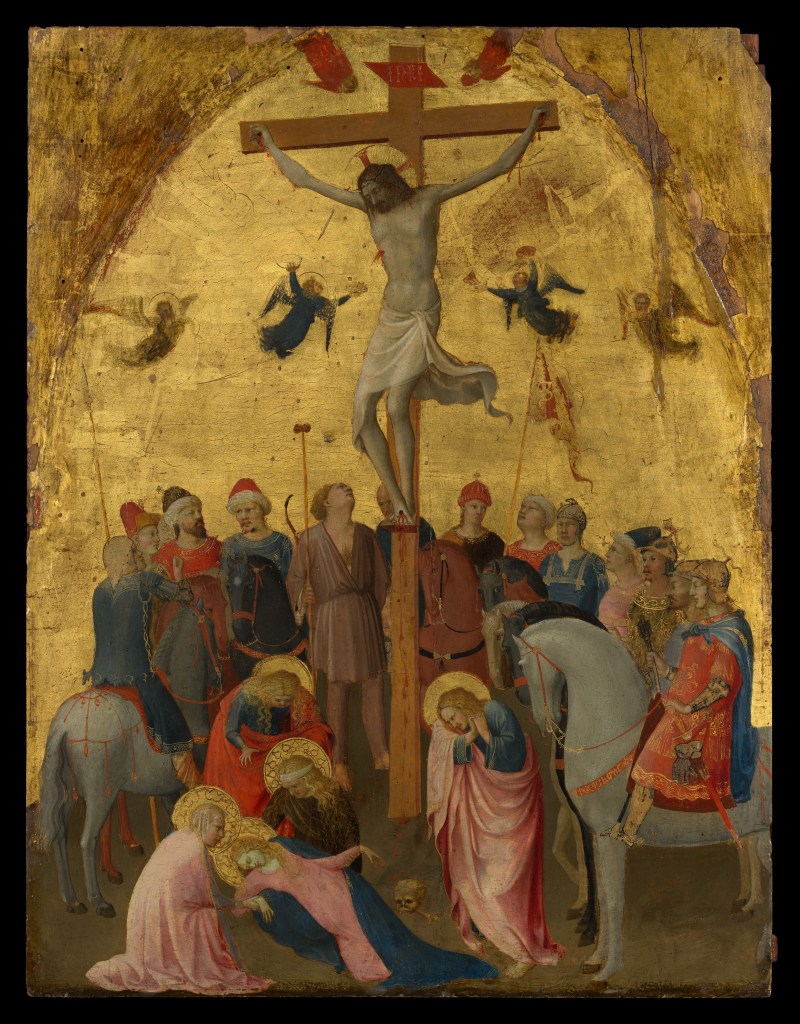
This early work by Fra Angelico accentuates the drama of the Crucifixion by showing the Virgin collapsed in grief with the lamenting Maries and emphasizing the varied attitudes of the Roman soldiers and their horses. There is an exquisite delicacy about this work that Fra Angelico will develop in his mature paintings. The innovative circular composition was inspired by the bronze doors created by Lorenzo Ghiberti for the Baptistry of Florence.
The following article is from GotQuestions.org. Link is above
Maundy Thursday, also known as “Holy Thursday,” is the Thursday of Passion Week, one day before Good Friday (the Friday before Easter). Maundy Thursday is the name given to the day on which Jesus celebrated the Passover with His disciples, known as the Last Supper. Two important events are the focus of Maundy Thursday.
First, Jesus celebrated the Last Supper with His disciples and thereby instituted the Lord’s Supper, also called Communion (Luke 22:19-20). Some Christian churches observe a special Communion service on Maundy Thursday in memory of Jesus’ Last Supper with His disciples. Second, Jesus washed the disciples’ feet as an act of humility and service, thereby setting an example that we should love and serve one another in humility (John 13:3-17). Some Christian churches observe a foot-washing ceremony on Maundy Thursday to commemorate Jesus’ washing the feet of the disciples.
The word Maundy is derived from the Latin word for “command.” The “Maundy” in “Maundy Thursday” refers to the command Jesus gave to the disciples at the Last Supper, that they should love and serve one another. Should we observe Maundy Thursday? The Bible neither commands nor forbids it. It is a good thing to remember the Last Supper and Jesus’ sacrifice on our behalf. It is a good thing to remember the Lord’s example of humility. However, at the same time, we should avoid ritualistic observances of holidays unless they are truly focused on God and our relationship with Him.
Observing a special Lord’s Supper service on Maundy Thursday/Holy Thursday in remembrance of the Last Supper is a good thing to do. Doing a foot-washing in remembrance of how Christ humbled Himself and washed the feet of the disciples is a powerful reminder of how we are to live the Christian life (Philippians 2:1-11). Let’s just make sure we are observing Maundy Thursday in a way that truly honors what happened at the Last Supper.
The Orientals wore only sandals, and this washing was refreshing as well as cleanly. In the case of ordinary people, the host furnished the water, and the guests washed their own feet, but in the richer houses, the washing was done by a slave. It was looked upon as the lowliest of all services (1 Samuel 25:41). Jesus pointedly contrasts Simon’s neglect of even giving Him water for His feet with the woman’s washing His feet with tears and wiping them with her hair (Luke 7:44). On the last evening of His life, Jesus washed the disciples’ feet (John 13:1-16). Their pride, heightened by the anticipations of place in the Messianic kingdom whose crisis they immediately expected, prevented their doing this service for each other. Possibly the same pride had expressed itself on this same evening in a controversy about places at table. Jesus, conscious of His divine dignity and against Peter’s protest, performed for them this lowliest service. His act of humility actually cleansed their hearts of selfish ambition, killed their pride, and taught them the lesson of love.
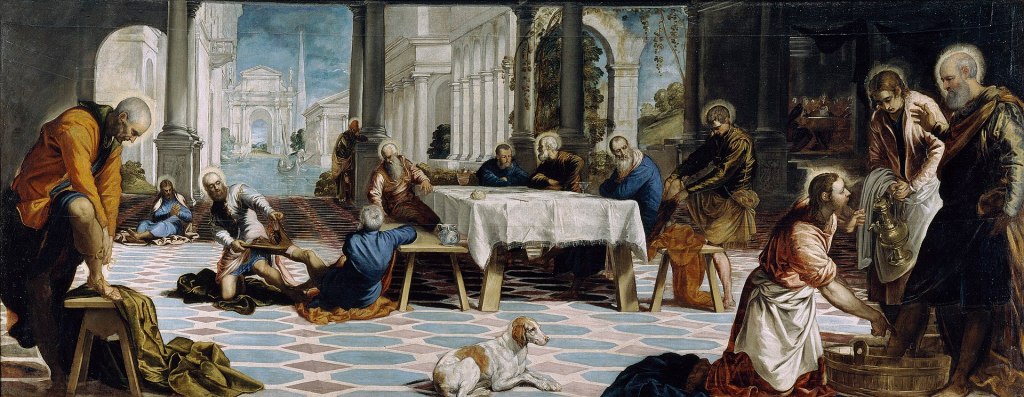
Tintoretto’s Christ Washing the Disciples’ feet
Painting description from Wikipedia: The painting was created in 1548/1549 for a church in Venice. The church of San Marcuola commissioned Christ Washing the Disciples’ Feet as a companion piece to Tintoretto’s Last Supper, which still hangs at San Marcuola. Christ and St. Peter are at the far right of the image, an unusual position as Christ was typically placed in the centre of any paintings. This is explained by its original positioning in the church on the right side of the altar. Viewing the painting from a side angle allows the perspective of the tiled floor and the gaze of the disciples towards Jesus to emphasise his status as the main subject of the painting. On the far left of the painting is Judas Iscariot, clothed in bright red and noticeably isolated from the other figures of the painting. In the middle of the work are the rest of the disciples gathered around the table that was the site of the supper. They are depicted somewhat humorously as they strive to pull off their stockings. In the background there is a portal above Jesus that opens up to a room where the last supper takes place. The opening to the left shows buildings with elaborate and fantastic architecture. The architecture is based closely on designs by Sebastiano Serlio.
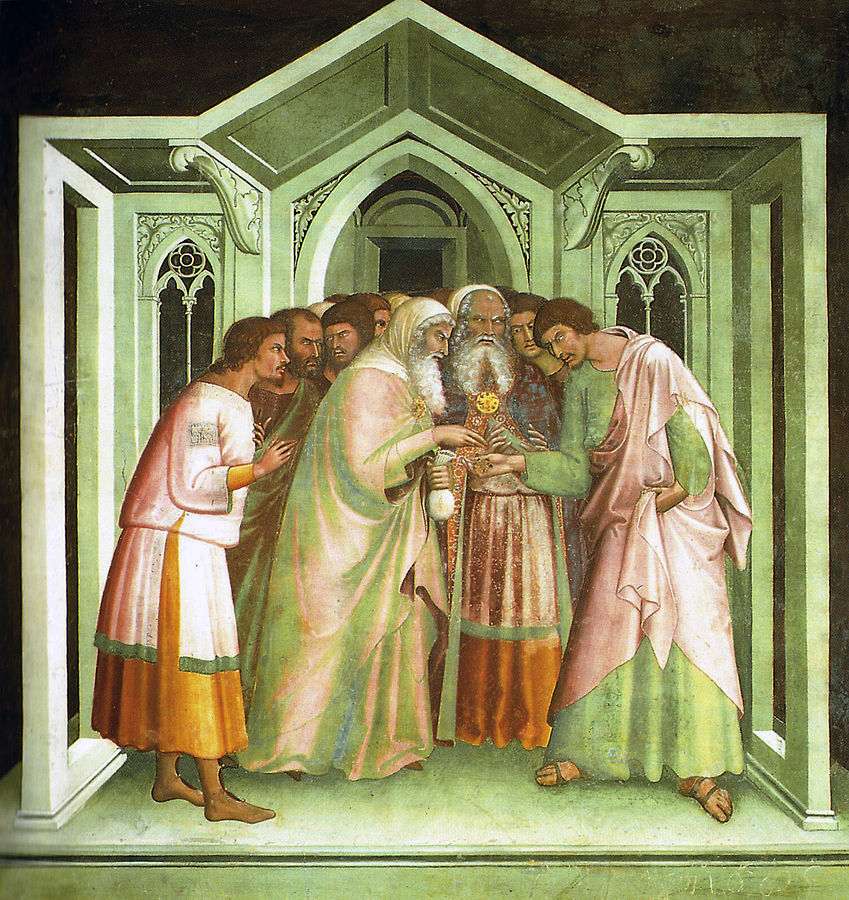
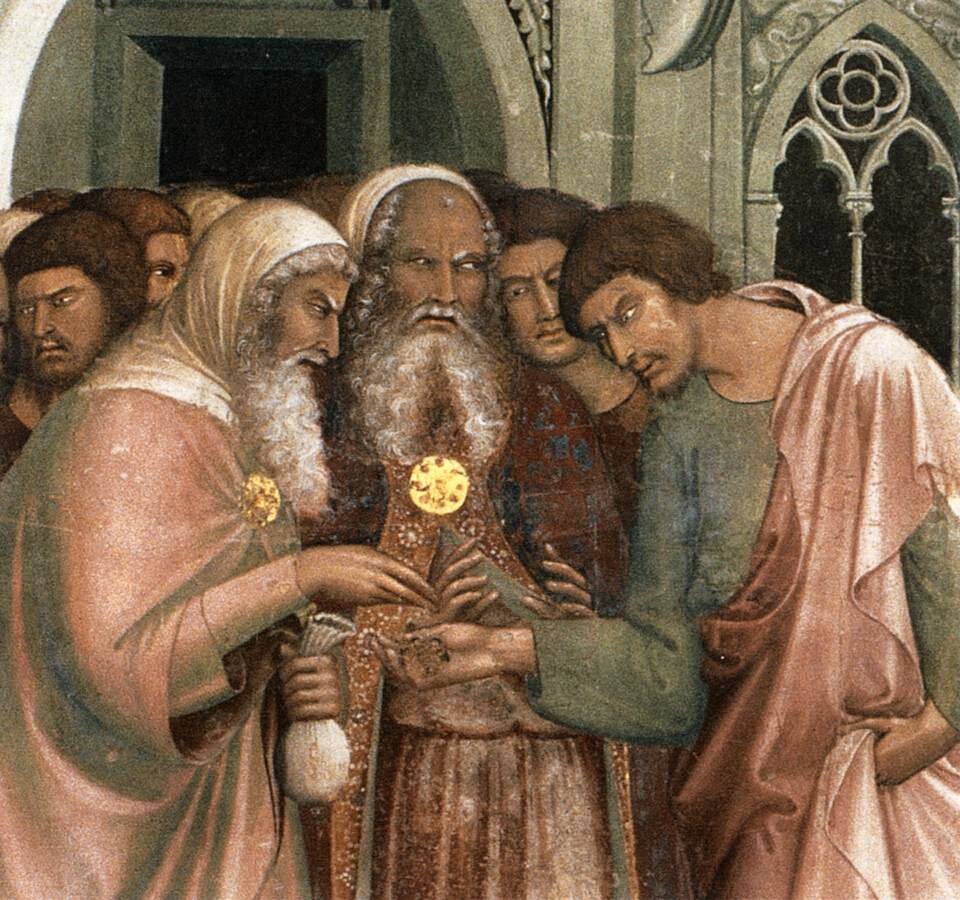
Then one of the twelve, named Judas Iscariot, went to the chief priests and said, “What are you willing to give me to betray Him to you?” And they set out for him thirty pieces of silver. And from then on he looked for a good opportunity to betray Jesus. (Matthew 26:14-16 NASB)
Lippo Memi (Italian, 1291-1356). Betrayal of Jesus (detail), c. 1340. Fresco. Collegiate Santa Maria Assunta, San Gimignano, Italy. Wikimeda CommonsDetail
How does it feel to be living in a time of obvious judgment of God? I have mixed feelings. On the one hand, it sparks a lot of mourning in me as I see families falling apart, false teachers increasing, lusts indulged, perversion everywhere. But on the other hand, what IS of God, burns more brightly. Christians who stand for truth unwaveringly are more of a joy to see. As the world sinks, the believers rise. Christians who have the Light of Christ in them are more visible, starkly different than the easy believers mixed in with true believers of former generations who clung to a veneer of Christianity for social capital’s sake, persecution makes true believers more easily seen and then God is more glorified.
If you have a church where your elders are strong, where your fellows in the pew are loving, where truth is proclaimed without compromise or without plagiarism, then you are blessed. Cling to that, the Lord who raises up teachers for His name and a multiplying local church who evangelizes. They are things of beauty today that stand against the dark.
Begging: The Place to Start I disciple some younger women online and in real life. I often get the question, how should I study the Bible? I always begin with this answer: First, pray and ask the Holy Spirit for help. It’s my standard answer because that is ground zero of the place to begin. I was pleased to see Dale Ralph Davis explain this concept so well.
“We are guilty of arrogance, not merely neglect, when we fail to beg for the Spirit’s help in the study of Scripture. We may have such arrogance even when we seem to be seeking the Spirit’s aid – I think of those times when in a light-headed tokenism we utter our slap-happy prayer ‘that the Lord would guide and direct us as we study this passage.’” Click on the link above to read the article.
G3 Ministries has published a beautiful article by Jennifer Buck on how the Lord helped her and her husband Tom in the early years of their marriage get beyond some anger and bitterness issues and make their marriage strong. Sadly, in the aftermath of its publication, some wicked people who are opposed to Tom’s candidacy for President of the SBC have used the article as a weapon to smear them. This activity has caused me to ponder very deeply the issues I wrote about in the first paragraph. Darkness and light…what the Lord is doing to glorify Himself, betrayal by professing believers (who maybe aren’t possessing believers) and so on.
When G3 enlarged its ministry one of the things they committed to doing was generating study curricula for small groups and Sunday School. Here is a new, free teaching curriculum on the Sermon on the Mount by Ryan Bush. It is a 9-lesson Bible study was written specifically for small groups, though it could certainly be adapted to fit other needs. Sermon on the Mount small group Bible Study.
At Dash House we read the following:
It may be one of the most overlooked ministries we can perform for others: to struggle on their behalf in our prayers. The idea comes from Paul’s description of Epaphras in Colossians 4:12-13: “Epaphras, who is one of you, a servant of Christ Jesus, greets you, always struggling on your behalf in his prayers, that you may stand mature and fully assured in all the will of God. For I bear him witness that he has worked hard for you and for those in Laodicea and in Hierapolis.” Struggling on Your Behalf in Prayers
I love studying about the Puritans. This summer I plan on buying the streaming version of the Puritan Documentary Plus, the documentary plus 35 short lessons on individual puritans. Here, Tony Reinke has a Puritan Study series and this link brings you to the index.
I enjoy Derek Thomas’ series going through Pilgrim’s Progress lecture series. He gives explanations of the different scenes in Bunyan’s allegory, and also biographical and cultural information for background context. This helps e understand it a lot more. The series is currently free on Ligonier. (I don’t know how long Ligonier will keep the series on the Free side of the ministry.) I’m going thru it a second time, I enjoyed it so much..
A friend is going through the book Susie: Life & Legacy of Susannah Spurgeon with her book club group, she said the book is terrific! Here is an interview with Ray Rhodes, the author.
On April 4 I posted a blog reacting to Jackie Hill Perry’s (JHP) coming out as a prophet. In a multi-tweet thread she announced that God deals with her in dreams, speaks to her, gives her information about other people for JHP’s intercession. My examination of her statements is here.
I am not all that familiar with JHP. I don’t follow her on social media nor have I listened to her raps, songs, or sermons (Yes, she is a preacher too). But I know a false teacher when I see one. Or when I hear one… preach to men or claim direct revelation from God. These are easy. You don’t need a nuanced or advanced discernment radar to know the bells are going off when a so-called Christian says that.
Her following is huge. She has 688,000 on Instagram and 211,000 on Twitter and I’m sure more on TikTok. Let’s say north of a million followers. So what she says and does matters, because numerous impressionable and undiscerning women are being impacted by her consistently unbiblical example.
When I posted about her admission that she is a prophet, that blog got a lot of views. See chart below. You can guess which hits are the days when my JHP essay dropped. People are influenced by influencers, and JHP is an influencer. My job is to praise the ones the Lord has raised up and warn people about the others. My job is to tell the truth using the gift of discernment for y local church and the wider body, to warn, admonish in love. And I mean it in love. No one is happy to see someone drift away from Jesus.
Jackie Hill Perry does not like “discernment bloggers” (I purposely used scare quotes). She certainly didn’t like that many have called her false. So, she posted an Instagram video pushing back. She did not address the scriptural issues raised by me or other discerners. Of course. She cannot: there is no scriptural basis for denying the spiritual gift of discerning of spirits, no basis for receiving direct revelation nor of scriptures allowing females to preach to men. So, JHP’s push-back was against discernment as an activity.
She raised the usual canards about discernment: It’s unloving. It’s unwarranted. It’s unbiblical. Well, I’ll just let you take a listen yourself. It is 52 seconds.
JHP: “If you follow somebody or something and literally all the content they produce is talking about other people, you don’t need these people to teach you how to spot false teaching or error.”
EP: I agree with this. When authors, bloggers, preachers, teachers etc get ‘stuck’ on one topic and that is ALL they ever “literally” produce, speak of, write about, their perspective becomes skewed. We must focus on Christ and employ the spiritual gifts for His glory and the good of the body. A skewed or myopic perspective won’t accomplish that. We should be balanced.
But while I agree with her general point, her comment is a straw man, because only a few discernment bloggers produce ONLY content that is “talking about other people.” She deliberately focused on only the fringe bloggers and lumped the bad ones in with the good ones and denied the total use of the gift of discernment. JHP says people who focus too much are not to be followed. So, opponents will find a reason to try and dismiss your warning or admonitions and then just focus on the emotional.
JHP: “You need the Spirit, you need the church, and you need your Bible.”
EP: I agree with this. However, her list is not complete. You also need the gifts of the Spirit. The Spirit dispensed gifts to believers. One of them is discerning of Spirits. All gifts that are in use today are for the edification of the body, which is the church. (1 Corinthians 12:7-10).
Now this is interesting. JHP maintains that she is a charismatic (not in those terms, but yes). She believes the gift of prophecy is in use today, and tongues, and hearing from God etc. So does she not believe that the gift of discerning of spirits is also in use? Did it go away? We don’t need believers with that gift anymore? But miracles and tongues and the rest we do need?
Or does she believe that NONE of the gifts are in use today, all we need is the Bible and the Spirit and the church?. And what does she mean by needing “the church” to discern? Are not believers with gifts the ones who make up the church?
You see when Peter in 2 Peter 3:16 wrote that the untaught and unstable distort scripture, this is one way they do it. JHP is giving us an example here. They move your eyes from scripture to emotion. They use church-y verbiage like Bible and Spirit and church. They use verses but omit the parts they dislike. There’s another example of twisting coming up in a second.
JHP: “You don’t need a constant diet of someone tearing down the body to teach you how to contend for the faith”
EP: Contending for the faith is messy. It involves a fight. Not that we are pugnacious. Not that we look for it. But if you contend for anything, it gets painful. Paul contended and in almost every city he went to there were riots. All the apostles contended, and they were killed, or exiled.
I already addressed the ‘constant diet’, but now here is a common phrase, ‘you’re tearing people down.’ Well yes and no. We love people and pray for the ones like JHP. But we also tear down. We are commanded to tear down philosophies that oppose Christ.
We tear down arguments and every presumption set up against the knowledge of God; and we take captive every thought to make it obedient to Christ. (2 Corinthians 10:5 Berean Study Bible)
We are destroying arguments and all arrogance raised against the knowledge of God, and we are taking every thought captive to the obedience of Christ, (2 Corinthians 10:5 NASB).
We’re supposed to tear down anything that opposes Jesus, any teaching that is abhorrent to Him. Wolves always agree in principle that false teaching should be rejected. But wolves always say, “It’s not me. I’m not false. You’re so unloving”.
JHP: “That’s not what Jude offered he offered the old testament to them to give them some context for how to discern false teaching in their presence.“
EP: That is exactly what Jude offered. He was soooo upset about false teaching he abandoned his original point of his letter about salvation so that he could teach them to discern.
Beloved, while I was making every effort to write you about our common salvation, I felt the necessity to write to you appealing that you contend earnestly for the faith that was once for all time handed down to the saints (Jude 1:3).
Jude is the only New Testament book whose entire focus is devoted to confronting apostasy, meaning people who have defected from the true, biblical faith. Jude gave some examples from the Old Testament about their judgment, not about ‘how to discern’. He also described in detail the immoral and unconscionable character of these false ones who were infiltrating the church. He contended, and bluntly.
JHP: guard your heart and guard your mind from those who would tempt you and disciple you into lovelessness.
EP: Jude is the only book in the Bible written by Jude. His only focus is discernment. But JHP’s standard of discernment bloggers, of which Jude is one, we should avoid Jude since “literally all the content they produce is talking about other people.”
Was Jude loveless? Did the Holy Spirit include Jude’s book in the canon as a “temptation to lovelessness”? Of course not. You see the holes in Jackie Hill Perry’s talk by now, I’m sure.
Jude continued in his book describing in detail the immoral and unconscionable character of these false ones who were infiltrating the church. He ‘talked about other people’. (And so did Paul – and by name). Jude said the false ones were:
hidden reefs (which kill ships) selfish dead wild shameful bound for hell grumblers fault-finders lusty arrogant flatterers self-aggrandizing
By JHP’s standard, isn’t that “loveless” talk?
Yes, do guard your heart and mind saturate it with truth. That way you won’t be twisted by the unstable who distort it.
Sinners never allow you to point to them. The lawyer tried to justify himself. The woman at the well tried to distract Jesus from talking of her sins by switching the conversation to worship. The Rich Young Ruler tried flattery (“Good teacher“) and arrogant knowledge (“I have kept the commandments”). A false teacher will never say, “Let me take a look at what they’re saying against me to see if there is any merit to it”. A Christian will do that. A wolf won’t. A wolf will use the Bible to justify herself, distract you from her sin, and pretend to be humble and kind. But inwardly they are ravenous. Don’t feed them.
The second Great Awakening had an impact, of this we know. I was not aware of the impact it had on the south until this week. Encyclopedia Britannica says,
Second Great Awakening: Protestant religious revival in the United States from about 1795 to 1835. During this revival, meetings were held in small towns and large cities throughout the country, and the unique frontier institution known as the camp meeting began.
The Georgia Encyclopedia explains more:
Georgia has a wealth of extant camp-meeting grounds across the state. These historic sites developed as a result of the Second Great Awakening, a series of revivals that occurred from about 1790 to 1830 and planted the values of Protestantism deep in the American character, especially in the South. This religious movement galvanized the entire nation after the American Revolution (1775-83) and by 1820 helped to form the distinct national characteristic of a revivalist society. The Second Great Awakening, often called the Great Revival, became a regional phenomenon in the South, fostering the development of three major denominations, the Baptist, Methodist, and Presbyterian churches, and creating what some have called the Bible Belt. [1].
Oh my! That’s HUGE!
Awww, it’s so quaint. And long ago. Are they still having camp-meetings?
The camp meeting, an outdoor, continuous religious service, became a fixture of Georgia’s religious life. In fact, the meetings were so popular by the 1890s that the phrase “at a Georgia camp meeting” became a trite expression the world over. At least thirty of these sites, reflecting the camp-meeting movement and exhibiting its vernacular architecture, remain active in the state into the twenty-first century.[2].
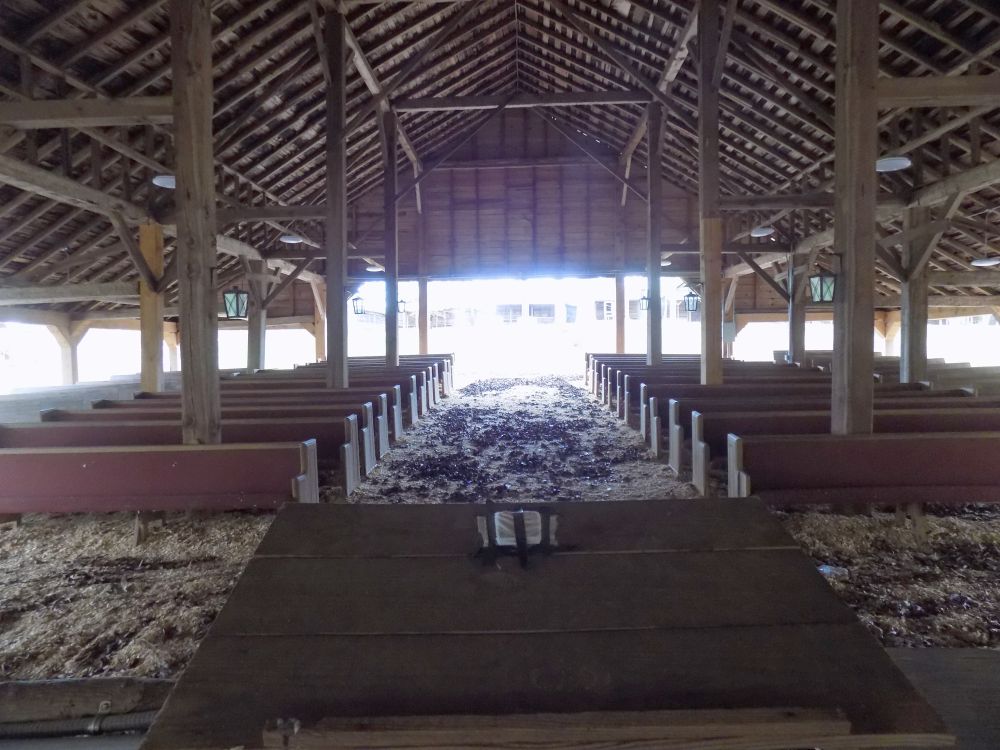
One of those Great Awakening camp meeting grounds is near me! It’s the Poplar Springs Campground. Meetings have been held there every year since founding in 1832 till now. The only exception was the 4 years of the Civil War 1861-1865. I am in awe.
The surrounding landscape is another distinguishing feature of camp-meeting grounds. Given the idea that camp meetings provided a chance for worshipers to commune with God in nature, the topography and other landscape features played a significant role in the selection of the sites. The availability of a water source and the presence of trees, or the “sacred canopy,” often determined the place and name of the retreats. Site names like Fountain, Mossy Creek, Pine Log, Rock Springs, and White Oak indicate the importance of these natural features, while such names as Flat Rock and Pleasant Hill highlight other pleasing landscape features. The founders of Poplar Springs Camp Ground in Franklin County used both water and tree type to name their location in 1832.[3].
I made a jaunt to Canon, GA to see the National Register location of three historic churches. I decided on the way back to swing by the Poplar Springs Camp-Meeting grounds. I just love the idea of them being together with like-minded Christians, under the trees, united in love for Jesus and hearing sermons and music every night. Apparently at Poplar Springs there is a bugle that announces the opening of each night’s sermons!
The historic marker alongside the road says:
Camp meetings have been held here each year from 1832, except four years during the War Between the states. The 50-acre plot, “extending one-half mile in every direction from the preacher´s stand” was purchased by from Daniel and Jacob Groover for $25 by William Hammons, John F. Wilson, George Shell, John B. Wade, Dennis Phillips, Thomas King and Rev. Nelson Osborne, Trustees. The first meeting, August 1832, was held under a brush arbor with 30 tents on the ground. Women were seated on one side of the arbor: men on the other John W. Osborne, appointed usher served at every meeting until his death in 1914.
These are my photos of the place. It’s beautiful. The ‘tents’ are actually rough cabins. The tabernacle is open air on all sides, with hand hewn beams above and wood pews below. The tabernacle AKA the Arbor, is a pole and beam construction supporting a large roof. This July will be the 191st Camp Meeting at Poplar Springs. Tugaloo Holler will play bluegrass music.
There is a monument on the grounds that states:
Poplar Springs Methodist Camp Grounds. 1832 – 1956. Athens Elberton District Methodist Church
“This memorial is erected in July 1956 by Friends of Poplar Springs Camp Grounds who feel that these grounds have constituted a shrine for the past century constantly pointing to the better life and dedicated with earnest prayer that “the faith of our father might live on“
Amen. Amen.
Many of the cabins are owned by family members passed down from one generation to another. This blogger has some great photos of the growth pencil marks on the exterior of some cabins, or the hand prints of the family members, etc. His photos are here and worth looking at. He took them in 2018.
I recommend John Owen’s works. Admittedly, his writing is dense and difficult, being 350 years old. However, there are many helps available to aid understanding of his writing, many notes and modern language updates. Here is one from Meet the Puritans. It is very much worth it to pursue a study of Owen’s monumental books.
Here is Texas Poet Kay Cude with her thoughts sprung from Owen’s work Mortification of Sin. Used with permission. Right-click to open larger in new tab







 the-end-time.org