Posted in theology

Fun with the Puritans

By Elizabeth Prata

Mayflower replica, at Plymouth Mass. EPrata photo

I love the Puritans. These are the men of the faith who followed Martin Luther into a reformation of the church. Encyclopedia Britannica defines it as-

Puritanism, a religious reform movement in the late 16th and 17th centuries that sought to “purify” the Church of England of remnants of the Roman Catholic “popery” that the Puritans claimed had been retained after the religious settlement reached early in the reign of Queen Elizabeth I. Puritans became noted in the century for a spirit of moral and religious earnestness that informed their whole way of life. (Source).

Far from being an esoteric area of study, I grew up in Rhode Island where Puritanism was all around. The puritans were real life to me. You couldn’t miss the giant statue of Roger Williams looming over Providence, which he founded, as well as the state. School field trips included visits to the Mayflower replica and Plymouth Village, a replica of the original settlement. Exiled Puritan rebel Anne Hutchinson founded Portsmouth the town next to Newport. As I read the plaques and saw the statues and visited the historical sites, I always wondered what on earth would make people leave their homeland for the sake of religion. Religion?! It floored me.

Now I know, of course, but these questions ignited my imagination and nestled a seed of religious interest that would later blossom in the timing of God.

I’d sort of been picking up bits and pieces about the Puritans as my elders would mention one, or when I came across a piece at Monergism (lots of free, edifying material there), or GraceGems (more great stuff), or Chapel Library (incredible ministry).

I read a few Puritan Paperbacks, a series of Puritan writings from Banner of Truth that present slightly modernized, lightly edited Puritan works. There’s also the Pocket Puritan series, even shorter, and a great introduction to these lions of the faith.

I enjoyed Tony Reinke’s Puritan Series, here is his blurb:

The Puritan Study was born out of two convictions. First, the faithful Puritan preachers offer much biblical wisdom to the 21st century. Secondly, the church aims to remain faithful to the expositional ministry of the Word. Without advocating an exposition that overlooks the insights of previous generations, nor placing an improper emphasis on Puritan literature over Scripture, the church needs to think about how we can complement our expositions of Scripture with the great Puritan literature. This conviction pushed me to rethink my own use of the Puritans and to re-build a Puritan library specifically suited for expositional preaching.

Reinke’s Main series posts

Part 1: The delights and pains of Puritan study
Part 2: The rules of a Puritan library
Part 3: The people of a Puritan library
Part 4: Why our effective use of the Puritans begins with our Bibles
Part 5: Print book searches
Part 6: Electronic searches
Part 7: Using the Christian Classics Ethereal Library
Part 8: To quote or not to quote?
Part 9: The strategy of building a Puritan library
Part 10: Concluding thoughts, part 1
Part 11: Concluding thoughts, part 2
Part 12: Q&A > Which Puritan should I start with?
Part 13: Photographs of the Puritan Library

I also enjoyed Derek Thomas’ lecture series Part 1 and Part 2 of Puritan John Bunyan’s Pilgrim’s Progress. I took it at Ligonier for pay but recently it came up again for free. These links are to the (currently) free series of part 1. Thomas’ soothing voice, cool accent, and calm demeanor really helped me open up the sometimes mystifying allegories and symbols Bunyan used in his tremendous work.

The City of Destruction
The Wicket Gate
The Interpreter’s House
The Cross & Sepulcher
The Hill Difficulty
The Palace Beautiful
The Valley of Humiliation
The Valley of the Shadow of Death
The Godless City: Vanity Fair
The Castle Of Giant Despair
The Delectable Mountains
The Celestial City

But my bits and bobs approach, as the British say, was good, but I wanted something more organized in my learning about the Puritans. This is where Media Gratiae came in.

I always buy myself something for Christmas (practical) and I get something for my summer break (since I don’t go on a vacation anywhere). I splurged on the Puritan streaming package from Media Gratiae. It was on sale for $50. It included the 2-hour Puritan documentary and all 35 short bios of various Puritans. I’d already bought the workbook (which is really a book) that accompanies the bios.

Each bio in the workbook has a timeline of the Puritan’s life, a famous quote, a Did You Know?, and the highlights of his legacy. Each entry ends with questions to ponder and a bibliography. It’s a great resource and easy to digest.

I am enjoying watching one of the bios each day, purposely going through slowly so as to make sure I absorb all the nuggets. Yesterday was about Matthew Henry, he of the famous Whole Commentary on the Bible. This list was presented as the principles by which he grounded his work:

  1. That religion is the one thing useful.
  2. That divine revelation is necessary to true religion.
  3. That divine revelation is not now to be found nor expected any where but in the scriptures of the Old and New Testament.
  4. That the scriptures of the Old and New Testament were purposely designed for our learning.
  5. That the holy scriptures were not only designed for our learning, but are the settled standing rule of our faith and practice.
  6. That therefore it is the duty of all Christians diligently to search the scriptures, and it is the office of ministers to guide and assist them therein.

Good stuff, eh? It’s why I like studying these men. As Reinke said we don’t study them to the exclusion of the Bible itself, but their work was important. The Lord raised them up for a reason. In fact, when The Great Ejection occurred, the time when Puritan reformers were banished, jailed, or martyred, it ended up actually being a good thing. Since these men weren’t pastoring or preaching…they wrote. It’s why we have such a body of work from them today that remained preserved.

This essay has been an attempt to spark your own curiosity for the Puritans, and to offer some solid resources in which to browse. I hope you enjoy! Do you have a favorite Puritan? Or do you enjoy another era from Church History? Let me know in the comments. 🙂
Posted in theology

Do you make your husband known at the gate?

By Elizabeth Prata

I was raised by an unbelieving feminist who taught that a woman’s calling is to be out in the world, making a name for herself. “You can do anything” it was said.

Except houswifery. THAT was definitely not part of the ‘anything’ a woman could become. No, never that.

I often wondered about this hypocritical stance, especially since housewifery seemed good. (I still wasn’t saved, but the notion of keeping a house for my husband was cozy to me). No, a woman should be in the world, marching, yelling, claiming, staking, pushing.

This was the vaunted ideal in the 1960s and ’70s:

Continue reading “Do you make your husband known at the gate?”
Posted in theology

Run Away From Temptation Island

by Elizabeth Prata

EPrata photo

Purposeful Temptation

Just the title of this new reality show is enough to tell you all the Christian needs to know: “Temptation Island”.

The TV show blurb states: “Temptation Island is an American reality dating show, in which several couples agree to live with a group of singles of the opposite sex, in order to test the strength of their relationships.”

Four unmarried but long term dating couples are separated and the 4 women live on one side of a tropical island with 12 men, and the 4 men live on the other side of the island with 12 women. The odds are stacked against them from the start.

The UK Guardian described it like this, lol: “Temptation Island, which launched on Fox TV last night, centres on four couples who test their fidelity on a steamy tropical island overrun with scantily clad singles. It is the latest example of what observers are dubbing ‘reality TV’.

The producers say the show isn’t about sex, it’s about ‘exploring the dynamics of relationships’. Apparently relationship dynamics comes with speedos and bikinis.

The show itself engendered controversy from conservatives and religious groups when it initially aired in 2001. It lasted 2 seasons and was canceled. But then it was brought back a few years later. Apparently all a TV producer needs to do is wait a few years for the society’s moral deterioration to deepen, and then re-start your morally corrupt program, and it will fit right in.

The product it is selling is lust, pride, and voyeurism. Lust for obvious reasons, pride for anyone who thinks they can withstand temptation in their own strength, and voyeurism of those watching and by extension, participating in the same sins.

The Bible tells us to FLEE sexual immorality (1 Corinthians 6:18). It also warns not to test the Lord. Yet what does the world do? Creates circumstances purposely for men and women to run *toward* sexual immorality. Then voyeuristically entices more people to participate in it by watching.

Better title for it would be ‘Dances with devils’.

but I say to you that everyone who looks at a woman with lust for her has already committed adultery with her in his heart. (Matthew 5:28).

“Don’t tempt me!”

Temptation is common to man because every person born on this planet except Jesus has a sin-nature. Sin is part of us. We have no free will to escape it. We only have a choice on which sin we will perform and to what degree. Sure, you might not be a murderer, but are you a thief? A liar? A coveter? Do you engage in what Jerry Bridges calls ‘respectable sins? Gossip at lunch? Jealousy over a friend’s vacation trip? Anger? They’re all sins. Pick your flavor.

We all have a nature that is drenched in sin, saturated through and through (the Doctrine of Depravity). Our natural moral condition is one of total inability to do anything righteous for God, and instead, we only sin. We only ever think about sinning. We only ever sin, continuously. (Genesis 6:5).

Paul explains this in Romans. Romans is relentless in showing us humans how awful we really are. Oh, we try to convince our selves that “I’m not really that bad.” Or we rationalize, “I’m not as bad as THAT guy over there.” But those rationalizations fail because we compare ourselves to other sinners. Sure, not everyone sins as bad as they could, and some sin more than others, but that’s not the point. To make the comparison we have to compare ourselves to God, who is Holy. He is the one who is sinless. He is the one who sets the standard.

In Romans 3:12 we learn that no one is good, and that no one seeks after God.

Worse, any thought not in accordance with God’s standards is sin. That is why even looking at a woman or man in lust is adultery, because sinful thoughts are still an affront to Holy God, even if you never went through with the physical act.

One Sin Feels Lonely

The Bible says to flee from sexual immorality. (1 Corinthians 6:18). Joseph fled, He turned his back on Mrs. Potiphar and ran out of the room. His reaction should have startled her conscience into repentance. But see, temptation just means one sin feels lonely. Without the object of her desire to satisfy her sin, she turned to another sin, lying.

We must not engage in anything impure, not greed or debauchery or anything unrighteous. (Ephesians 5:3). Sin is an almost alive thing, crouching at the door waiting to have you. Unsaved people are at the mercy of the tsunami of sin engulfing them, but as Christians we have a door to shut it out: the Holy Spirit indwelling us.

Here’s where it gets good

We can evacuate Temptation Island. We do not have to succumb to the charcuterie board of sins satan is serving up! 

Dr. Martyn Lloyd Jones preached,The fourth thing we go on to is something that we should consider with adoration, praise and worship, and it is this: the three Persons of the blessed Trinity took part in this plan and purpose of redemption. There can be no question at all but that the Scriptures teach that before the foundation of the world a council with respect to man took place between the three Persons of the Trinity—the Father, the Son, and the Holy Spirit. And there in that eternal council they seem very clearly to have divided up the work of redemption, so that we can describe the Father as the originator, the Son as the executor and the Holy Spirit as the One who applies what the Son has achieved.

The lifeboat has arrived to take God’s children off the island of temptations and to give us armor to battle it with! Praise God and bless Him! He rescues us from our swim in the putrid waters of sin!

God’s rescue is a perfect example of how Christianity is countercultural: it’s the opposite of the world. What a gift. He gave us to not only know what evil IS, but to give us the Spirit to help us kill the sin that remains in us and to help us resist the temptations that we DO NOT seek but do come our way.

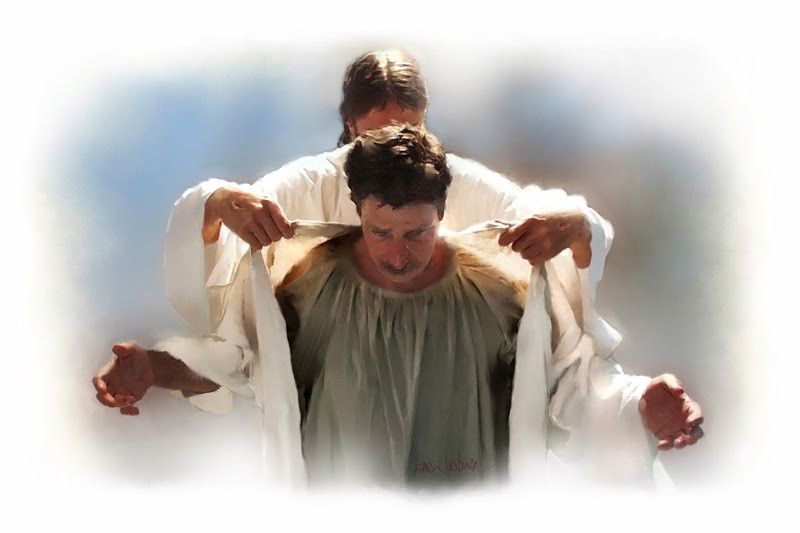
Think about the monumental gift He has given us. He regenerates sinful hearts, gave us His word to follow, gave us His Spirit to help us in killing sin. He gave us everything! We don’t HAVE TO sin. We don’t have to participate in the increasing moral deterioration of society! We can come to our Father, repentance in hand, and lay it at His feet. We are dressed in righteous robes, and given powerful aids to work out our salvation with fear and trembling. Someday we will be freed totally from even the presence of sin. What a day that will be!

Lars Justinen, “Robe of Righteousness”

Posted in theology

We don’t need to grope for words when we thank the Lord

By Elizabeth Prata

I watch the History Channel’s program “Alone”. It’s a wilderness survival competition where 10 contestants are dropped in a remote area of the world (Patagonia, Labrador), with ten allowed items of their selection, plus a ton of provided camera gear so they can film their endeavors. Whoever lasts the longest wins money. Contestants have a satellite phone to ‘tap out’ if they so desire. In addition, the producers send doctors every week to perform medical and mental health checks on the contestants. They are involuntarily pulled out of the competition if doctors feel the contestant is in irreversible health danger.

Continue reading “We don’t need to grope for words when we thank the Lord”
Posted in theology

We are saved to serve the church

By Elizabeth Prata

EPrata photo

We are saved to serve the church, and by extension, Jesus who is the Head of the Church.

When I was saved I was in my early 40s. I am an introvert, a loner, and by my 4th decade, was set in my ways. I knew instinctively that with salvation comes church. I’d never been a church-goer as an adult, and church-going was easily not part of my life in dark and Godless New England.

I dragged my feet on the issue, and I really didn’t want to go. I thought I could just watch a TV preacher and study the Bible and that would be it.

Continue reading “We are saved to serve the church”
Posted in theology

Is it time to leave the Southern Baptist Convention? And, what’s a secondary issue?

By Elizabeth Prata

Wherever the corpse is, there the vultures will gather. Does the bell toll for thee, SBC?

Introduction & Disclaimer

I am not a fan of the SBC. I’ve been member of churches who were part of the Convention. I’ve watched the denomination for some time now. I don’t like the direction they are going and I haven’t for a while. But I haven’t said much about it because ultimately it’s 1) for my pastors or elders to decide, and 2) it doesn’t affect me much in spiritual life, my ministry, or my daily routine.

This will be my only blog on the SBC Annual Meeting.

Continue reading “Is it time to leave the Southern Baptist Convention? And, what’s a secondary issue?”
Posted in theology

Tribulation Chronology

By Elizabeth Prata

There are two main parts to time immediately before Christ comes: the End Times and the Tribulation.

The end times are characterized by signs that are spoken of by Peter, Timothy, Jesus, Daniel, Isaiah, and in other books of the Bible in both the New and Old Testaments. The end time began when Jesus ascended in Acts 1:11 and will end at His return in Revelation 19:11.

The Tribulation begins when the Antichrist confirms a seven year covenant (treaty) with Israel. Daniel 9:27, Daniel 12:11. Then, a series of seven seals are opened.

The first four seals release a horseman as each are opened in turn:

White: the Antichrist, Revelation 6:2

Red: War, Revelation 6:3-4

Black: Famine, Revelation 6:5-6

Pale/Chloros: Death, Revelation 6:8

Fifth Seal: Death of Martyrs, Revelation 6:9

Sixth Seal: Great earthquake/moon as blood/sun darkened, Revelation 6:12

Seventh Seal: ushers in the next series of judgments. The Trumpets. These will be so harrowing there is silence in heaven for half an hour.

Trumpet 1: Hail and Fire burn up grass and 1/3 trees, Revelation 8:7

Trumpet 2: Blazing mountain thrown into sea, 1/3 sea creatures die, Revelation 8:8

Trumpet 3: Wormwood falls from heaven, poisoning 1/3 rivers, Revelation 8:10

Trumpet 4: Removal of 1/3 light on earth, Revelation 8:12

These judgments remove 1/3 of everything we need to live: water, vegetation, light. Thus ends the ‘easy’ part. Now God gets tough.

Trumpet 5: Scorpion-Locusts from the Abyss, five months torture from their stings, Revelation 9:1-12.

Trumpet 6: Four angels bound in Euphrates loosed and kill 1/3 mankind, Revelation 9:14

Trumpet 7: Initiates Bowl judgments. “Great” Tribulation begins. This is when satan is cast out of heaven (Revelation 12) and he becomes so angry that he tries to kill the Jews, (Revelation 12:12-13) but they flee to the wilderness (understood to be Petra in Jordan) (Revelation 12:14) and so satan turns his hate and anger and frustration to the Christians. (Revelation. 12:17)

Bowl 1: Painful sores upon those with the Mark, Revelation. 16:2

Bowl 2: Sea into blood, all seas & creatures die, Revelation. 16:3.

Bowl 3: All fresh water turns to blood, Revelation. 16:4.

Bowl 4: Sun scorches people with fire, people curse God, Revelation 16:5

Bowl 5: Antichrist’s throne & kingdom thrown into total darkness, Revelation. 16:10

Bowl 6: Euphrates dried up, enabling Kings of East to assemble armies at Armageddon, Revelation. 16:12.

Bowl 7: “It is done!” Earthquake so great every island and mountain pass away, 100lb hailstones fall upon men. Revelation. 17:21.

The Harlot of the One World Religion is destroyed and the battle of Armageddon takes place when Jesus returns with his church in victory. He reigns for 1000 years! Revelation 17,18 and 19. Praise God!

Good links to more about the chronology with commentary and explanations:

The First Half of the Tribulation
Tribulation Judgments: Are they sequential, natural, or supernatural?
Will believers suffer through the Tribulation?

Posted in theology

The Uselessness of Anxiety

By Elizabeth Prata

EPrata photo

Yesterday I posted an excerpt from a chapter from a book called GETHSEMANE—Leaves of Healing from the Garden of Grief by Newman Hall, 1891. His bio:

Christopher Newman Hall (1816-1902), born at Maidstone and known in later life as a ‘Dissenter’s Bishop’, was one of the most celebrated nineteenth century English Nonconformist divines. He was active in social causes; supporting Abraham Lincoln and abolition of slavery during the American Civil War, the Chartist cause, and arranging for influential Nonconformists to meet Gladstone. His tract Come to Jesus, first published in 1848 also contributed to his becoming a household name throughout Britain, the US and further afield, supposedly selling four million copies worldwide over his lifetime. Source Wikipedia

Continue reading “The Uselessness of Anxiety”
Posted in theology

Anxiety: solace from the Garden of Gethsemane

By Elizabeth Prata

Christopher Newman Hall (1816-1902), born at Maidstone and known in later life as a ‘Dissenter’s Bishop’, was one of the most celebrated nineteenth century English Nonconformist divines. He was active in social causes; supporting Abraham Lincoln and abolition of slavery during the American Civil War, the Chartist cause, and arranging for influential Nonconformists to meet Gladstone. His tract Come to Jesus, first published in 1848 also contributed to his becoming a household name throughout Britain, the US and further afield, supposedly selling four million copies worldwide over his lifetime. Source Wikipedia

His famous tract Come to Jesus can be found at Chapel Library and read for free.

Continue reading “Anxiety: solace from the Garden of Gethsemane”
Posted in theology

Job vs. Naomi: How do we respond when circumstances take a downturn?

By Elizabeth Prata

Even if you don’t read the Old Testament much, most believers know the story of Job and his friends. God initiated a conversation with satan, where God called Job “a blameless and upright man, fearing God and turning away from evil.” (Job 1:8). God asked satan if he had noticed that. Of course satan had, and pouted that of course Job loved God because he lived on easy street, but if satan could just get his hands on him, he’d prove that Job only loved God for what he could get out of Him. God said, OK, go, do it.

We know that the rest of chapter 1 and chapter 2 records horrific events, all against Job. Job never sinned with his lips, though. He maintained his devotion to God. Job’s faith was separate from his circumstances. He never blamed God. (Job 2:10).

Job’s friends heard about the utterly disastrous state to which Job had been reduced, and came to commiserate with him. The theology of the time, then and right up until the time of Jesus’ incarnation, was a literal you reap what you sow. If you were rich, prosperous in all things, and healthy, you were righteous. If you were sick, poor, crippled, enduring tragedy of some sort, you were being punished for sin. (Luke 13:1-5, John 9:2). They thought that outward circumstances were a reflection of inward spirituality and standing with God.

Job’s friends, after a good start of showing empathy and giving comfort in silence, then began to hammer Job with their theology, charging Job with secret sin. They kept on, and on, and on. Job got sick of it and said they were miserable comforters! (Job 16:2). But the point was, Job’s circumstances didn’t alter his faith. He loved God for who He is, not for what his life was like moment to moment.

We are also probably familiar with the story of Naomi and Ruth. Naomi was from Bethlehem in Judah. She married and had two sons. However, there was a famine in the land, so when they heard there was food in Moab, they moved there. Her husband died. The sons married Moabite women. The sons died. Naomi was left without husband or sons, and saddled with two other widows to boot. These were dire circumstances for a woman of that time. With no way to gain income or to work hard enough in the fields to support herself and her two daughters-in-law, Naomi became disconsolate.

She heard that the LORD was moving in Judah and now there was food. Naomi resolved to go back to her homeland and re-settle in Bethlehem, and urged her two daughters-in-law to go back to their parents’ home in Moab. Naomi was bitter. She was pouting because she had no husband or sons, was too old to get more sons, and actually said her lot was worse than her daughters-in-law, (who had lost their own husbands and were grieving too!) Naomi actually said “The hand of the LORD is against me.”

Ruth resolved to stay with her mother-in-law, to help and comfort the woman. When they got back to Bethlehem and people said ‘Naomi’s back!’ Naomi actually replied,

And when they had come to Bethlehem, all the city was stirred because of them, and the women said, “Is this Naomi?” But she said to them, “Do not call me Naomi; call me Mara, for the Almighty has dealt very bitterly with me. I went away full, but the LORD has brought me back empty. Why do you call me Naomi, since the LORD has testified against me and the Almighty has afflicted me?” (Ruth 1:19-21).

Naomi felt she had lost everything. She’d been hungry, widowed, and her children died. She blamed God numerous times. Her faith was bound up in her circumstances. She was the opposite of Job.

Is your faith bound up in how prosperous you are or what you’re feeling at the time? Do you praise God when things are going well but blame satan when things take a downturn? Or worse, blame God? Or is your faith steady no matter what is going on around you? That’s harder, especially if, like Job, you have friends who insinuate that your circumstances are due to judgment or sin or punishment.

Strive to be a Job when things turn “bad.” Or if you’re in a prospering season, strive to be a Ruth and encourage someone else who is having a hard time. Ruth’s constant loyalty and kindness to Naomi was a standout feature of the book of Ruth, while Job’s friends’ spiritual harangues and moral indictments were a standout feature of the book of Job.

One of the hardest things to do is praise God in joy when trouble comes. (Philippians 4:11-13). It was something Paul had to learn. But we can learn it too.