Posted in theology

Prata Potpourri: Resources on Being Ordinary

By Elizabeth Prata

Believers are ordinary. We serve an extraordinary God.

He might use us in extraordinary ways, but we’re all flawed, sinful, ordinary people. He used ordinary grandmother Lois to raise up young Timothy. He took impulsive sons of thunder James and John and made them evangelizing Apostles. He used fishermen, (Peter, Andrew) sellers of purple (Lydia), teenagers (Timothy, Jeremiah, Mary, David), murderers (Paul). He used ordinary people going about whatever they were doing at the time and transformed them into vessels of activity for His glory.

Ordinary life: painting. EPrata photo

Yet there are some who believe that we must be extraordinary in order to make an impact for the kingdom. The movement of a few years ago when the books Radical, Crazy Love, Wild at Heart came out made many people think that they were ineffective unless they made a big and splashy move for the faith. This is not true. Mary and Martha were simply hospitable. Dorcas sewed. Susannah donated. Acts 4:13 says Peter and John were uneducated and untrained.

If you, dear reader or listener, feel marginalized, helpless to DO for God, ordinary, then rejoice. Our persevering faith in ordinary lives is just as valuable to God as a martyr uttering eternally known last words. Just as important as the luminary you read about in the Bible. Just as impactful as the hero in the Bible.

They were continually devoting themselves to the apostles’ teaching and to fellowship, to the breaking of bread and to prayer. (Acts 2:42).

Ordinary life: sweeping

What the Spirit inspired Luke to write was not just the extraordinary means of glory we see occasionally in Acts, such as miracles or healings, but the ordinary means of bringing God glory by a consistently faithful church. They devoted themselves to teaching and gathering and prayer. The extraordinary events died away as the miracles ceased, but the faithful never stopped gathering, learning, and praying.

Day by day continuing with one mind in the temple, and breaking bread from house to house, they were taking their meals together with gladness and sincerity of heart, (Acts 2:46).

Ordinary life: selling. EPrata photo

Note that. ‘Day by day’. The ordinary Christian life is one of persevering in spiritual disciplines day by day, accruing spiritual interest in the bank of heaven. I’m sure your parents taught you that putting 5 dollars a week into savings eventually yields dividends. They did not teach you that putting gluts of startling amounts into your bank account in spurts yields dividends. The way to save is to be consistent over time. It’s the same with the spiritual life. Add to your account day by day.

I’m looking forward to meeting these heroes in heaven but I’m just as eager, if not more, to meet the unknowns who brought God glory with their words or their lives.

Here are a few resources to help quell any anxiety anyone might have that their life doesn’t count, just because they are not running barefoot to Bali getting shot with arrows from cannibals or leading big conferences in arenas filled with thousands of adoring fans.

Here is Michael Horton, who wrote a book called Ordinary: Sustainable Faith in a Radical, Restless World. His book blurb reads as follows:

Radical. Crazy. Transformative and restless. Every word we read these days seems to suggest there’s a “next-best-thing,” if only we would change our comfortable, compromising lives. In fact, the greatest fear most Christians have is boredom—the sense that they are missing out on the radical life Jesus promised. One thing is certain. No one wants to be “ordinary.” Far from a call to low expectations and passivity, Horton invites readers to recover their sense of joy in the ordinary.

Ordinary life: cooking. EPrata photo

If you don’t want to read the entire book, here is Michael Horton with an article on the subject of Ordinary at Ligonier: The Ordinary Christian Life

John MacArthur with a sermon called “The Ordinary Church“. Excerpt: “It was Finney who decided that religion, to be valid, had to have some kind of high impact, high energy emotional element.  It was about methods, feelings, experiences, sentimentalism, and it all trumped sound doctrine and theology.  Gradual growth, by the normal ordinary means of grace, prayer, the study of the Word, fellowship was exchanged for a radical experience, the anxious bench, and there was introduced into the evangelical world a restlessness of those looking for something extreme.

Other material that pushes back against the big, splashy, ‘change the world’ mantra are:

Memoirs of an Ordinary Pastor: The Life and Reflections of Tom Carson. D. A. Carson’s father was a pioneering church-planter and pastor in Quebec. But still, an ordinary pastor

Essay An Unremarkable Faith – “Meet Larry, a thirty-six year old Science teacher. Larry married Cathy 12 years ago. They love each other and enjoy raising their two sons. Larry’s life wouldn’t hold out much interest to the average citizen. His Facebook account doesn’t draw many friends and nobody ever leaves a comment on his blog. In fact, most people would summarize Larry’s life with one word—boring. But not Larry.

Ordinary Christian Work, essay by Tim Challies. “The questions every Christian faces at one time or another are these: Are Christian plumbers, cooks, doctors, and businessmen lesser Christians because they are not in “full-time” ministry? And what of Christian mothers and homemakers? Can they honor God even through very ordinary lives? Can we honor God through ordinary lives without tacitly promoting a dangerous kind of spiritual complacency?

Posted in theology

The Churches of Revelation

By Elizabeth Prata

In the first century, there were 7 churches Jesus caused John to write messages for. These were actual churches with actual congregations, doing and saying actual things. Jesus told apostle John, exiled at Patmos, what to write to these congregations. Jesus spoke commendations, criticisms, and instructions. Not all 7 churches were commended. Not all 7 churches were criticized. All had an instruction, though.

The church at Smyrna and the church at Philadelphia were not criticized. The church at Laodicea was not commended. The rest had both.

The churches were: Ephesus, Smyrna, Pergamos, Thyatira, Sardis, Philadelphia, Laodicea.

Can you imagine being assembled on Sunday, hearing a knock on the church door, a messenger arriving and handing a scroll to your pastor, and the pastor reads a letter from the head of the Church, Jesus Christ Himself? Jesus is very much alive and in charge of His global body of worshipers, AKA His bride. He was directly involved then, and He is directly involved now.

Each of the seven churches was not only an actual church but is also a type of church dealing with a problem mentioned in the letters. The problem is not unique to that church for that time. There are always the same kind of systemic problems many churches deal with and have been recurring throughout the centuries. Always, there is a church somewhere that is busy but not alive. Always, somewhere, is a church that is indifferent and lukewarm. On this earth, there is a collection of churches gracefully enduring suffering, or being persecuted. And so on.

Today, consider these churches, their problems, and meditate on whether you are one of the congregants causing the same problem they were criticized for. Look at the commendations and consider what you might do to contribute to a recommendation, if Jesus were to write your church a letter.

Please read Revelation 1-3, it is not hard. Those chapters offer the reader plain language and it’s not heavily symbolic. And, remember, it’s the only book of the Bible that promises twice you will be blessed for reading it.

EPrata photo

Posted in theology

Kay Cude Poetry: The Trinity

Right click the picture to see larger in new tab. Used with permission of author.

Kay Cude Author Statement:

“I [Kay Cude] was reading the July 2022-Volume 706 Banner of Truth Magazine when I came upon an article by Nick Needham, “Shapers of Christianity-Gregory of Nazianzus (AD 330-390).”

Mr. Needham begins, “The fourth century is often considered the Golden Age of the Early Church Fathers, owing to the sheer intellectual and spiritual brilliance of that century’s Christian thinkers in expounding the faith doctrinally and practically.  Among its most influential figures were the Cappadocian Fathers.”

‘”This was a group of three theologians from the Roman province of Cappadocia in Asia Minor –Basil of Caesarea, his brother Gregory of Nyssa, and his friend Gregory of Nazianzus.  Of the three Cappadocians, Gregory of Nazianzus came to be the most treasured by following generations.  Greek speaking Christians reverentially called him “Gregory the Theologian,” as if he were the first true theologian after the apostle John.  In the Greek East, the term “theologian” had special reference to the Doctrine of the Trinity.  The apostle John was held to be the first great theologian in that sense, and Gregory the second.”

As a Southern Baptist, I [Kay Cude] am insufficiently read of the early Church Fathers, but that four page article drew me into a “beginning understanding” that their unwavering dedication to stand in and teach the Doctrine of the Trinity and lead the church in rejecting and vanquishing the Arian heresy, should also be the understanding and dedication of the 21st Century’s true Body of Christ.  We also are to understand that the fullness of the Trinity is wholly divine.  And that should also compel us to stand unwaveringly against Arianism and any other demonically inspired weaponry raised against the Doctrine of Trinitarianism.

This dedication is perhaps more important than too many of the redeemed of the invisible church realize; for the bewitchment that is Arianism is once again an acceptable theology of a greater portion of the visible church.  Far too many do not believe in the Holy Trinity; and most assuredly far too many reject the second person of the Trinity, our Lord and Saviour Christ Jesus as divine and of the same full essence and nature with God the Father.

In summary, I find that the more I seek to learn and understand, the more I realize how very little I know and how very faint is my understanding of the Holy Trinity; and yet I am compelled to want to know.  And that is the excellency of the mystery of the sovereign and providential work and will in our spirits by our Father the Lord God I AM WHO I AM; that our hearts are compelled by the Holy Spirit to seek to know the Lord God I AM as He really is; and in that, to know and honor and worship the divine fullness of the Trinity and the three distinct persons, God the Father, God the Son, and God the Holy Spirit.  We must desire to have a right understanding of what is the true honoring in the true worship of the “One Deity and Power, found in the Three-in Unity.”

ORATION 40, CHAPTER 41 – GREGORY OF NAZIANZUS

I set before you the One Deity and Power, found in the Three-in-Unity,
Embracing the Three One by One, equal in essence and nature,
Neither increased nor decreased by ideas of greater or less;
In every way equal, in every way the same,
Just as the loveliness and hugeness of the heavens are one:
The infinite oneness of Three Infinite Ones,
Each of whom is God when seen individually in Himself.
As the Father is God, so is the Son,
And as the Son is God, so is the Holy Spirit;
And the Three are likewise One God when seen together.
Each is God because they are of the same essence,
And they are One God because of the single principle of Deity.
The very instant I conceive of the One,
I am enlightened by the brightness of the Three;
The very instant is differentiate them,
I am carried straight back to the One.
When I regard any One of the Three, I think of Him as the Whole;
My sight is filled to the brim,
And the greater part of what I am thinking of eludes me!
I cannot grasp the greatness of One of the Three
So as to reckon a greater greatness to the Others.
And when I see the Three together, I see only one torch,
And I cannot divide or share out the Undivided Light.

right click to open larger in new tab. Poetry by Kay Cude

Posted in theology

This body of death/This body of life

By Elizabeth Prata

For the wages of sin is death, but the gracious gift of God is eternal life in Christ Jesus our Lord. (Romans 6:23).

We all have a sin-nature. Every person born on the planet (except Jesus) has inherited the sin of their Federal Head, Adam. All humans are sinners, and therefore all people are worthy of death, according to God.

After our salvation, when we repent of our sins and trust in Jesus, we are no longer under the penalty of death. We have been transferred to the gift of eternal life. Jesus absorbed the wrath for all who would believe when He was on the cross, and more than that, HIS righteousness was imputed to us who would believe. So we no longer have the death penalty hanging over our heads. His death and resurrection cleared those who would believe back to zero on God’s books. In addition, we do not remain at zero, for we would naturally sink again. Being sinners, even forgiven sinners still sin. We have the plus of His righteousness, which launches us from zero to infinity and beyond. Thus when God looks at a believer, He sees the righteousness of His Son.

Wretched man that I am! Who will set me free from the body of this death? (Romans 7:24).

It was Jesus who delivered us from this body of death.

I have read that in the ancient days, a penalty for a murderer was to strap the dead body of the person he had killed to him. As the dead body putrefied, the corruption would seep into the convict’s pores and soon he would begin to decay as well. The dead consumed the living person’s life. Perhaps this was what Paul had in mind when he cried out for deliverance from “This body of death” in Romans 7:24.

Every person alive today has one of two types of a body ‘strapped’ in him. The unsaved person has a body of death, he IS a body of death. The saved person has a body of Life. Every genuinely saved person possesses the Holy Spirit indwelling him or her. God resides IN us!

We have a body of life strapped on us: we have two persons of the Trinity with us at all times: the Spirit IN us (indwelling) and Jesus with us never forsaking us

the Helper is the Spirit of truth, whom the world cannot receive, because it does not see Him or know Him; but you know Him because He remains with you and will be in you. (John 14:17).

The Spirit is in a believer and the Lord is with us, never to leave or forsake us. Two Persons of the Trinity are with us and in us at all times.

Therefore,

  • Knowing that we have been given deliverance from the body of death,
  • and knowing that we have been given Jesus’ righteousness,
  • and knowing that two persons of the Trinity are in and with us at every moment…

then…

Is what you’re doing right now honoring to Him? What you’re saying? What you’re watching? What you’re thinking? Just as the putrefaction of the dead body strapped to the murderer seeps in, so does the holiness of adhering to the statutes of Jesus. What pleases Him will seep into us. The Spirit holy thoughts and holy words and holy acts to expand our righteousness, further cleanse our sin nature, and wash our conscience.

It’s truly simple: sin corrupts … holiness cleanses.

EPrata photo
Posted in theology

What happens when we go outside of God’s word?

By Elizabeth Prata

The Shack. You remember that book, right? Written by William P. Young. After Young received repeated rejections, it was self-published in 2007. A year later, one million copies had been sold. It then vaulted to the top of the New York Times bestseller list, where it comfortably spent 139 weeks, or two-and-a-half years, resurging to the top ten again when the movie came out in 2017. It seems that The Shack is here to stay.

Since this book and now the movie has had such lasting power and such impact, let’s take a look behind the scenes of its origins.

Continue reading “What happens when we go outside of God’s word?”
Posted in theology

Should we look at a teacher’s lifestyle? Or only his/her doctrine?

By Elizabeth Prata

A reader took issue with me recently, saying that me pointing out things related to a teacher’s lifestyle is hitting below the belt, is wrong, and now she has to wonder at my heart motivations.

This kind of discussion often comes up when I post about a false teacher’s lifestyle. People seem to think that their lifestyle is off-limits while only comparing their doctrine is acceptable. That is what being a Berean is all about, look at doctrine only, they say. Lifestyle is off the plate and not our business.

But is it?

Continue reading “Should we look at a teacher’s lifestyle? Or only his/her doctrine?”
Posted in theology

Best of the Summer

By Elizabeth Prata

This is my last day of summer. In fact, yesterday really was. Today I have a church event for 2/3 of the day. And tomorrow is the Lord’s Day.

It was a good and relaxing time of peace and quiet. I work 190 days a year in school, spread out, but the summer is the longest break educators have. I try to put the time to Godly use, making the most of my singleness. (1 Corinthians 7:32).

I had some goals I’d set out in May at the last day of school/first day of summer. I think it’s good to set goals. Reagan Rose of Redeeming Productivity has a lot of helpful essays and podcasts teaching how to be productive, if you’re interested. My father always used to say “A body in motion tends to stay in motion, a body at rest tends to stay at rest.” (Newtons’ First Law of Thermodynamics). And boy is that true of me and my flesh! It doesn’t want to do anything. That is why I set goals. AN unmet goal drives me crazy and being driven crazy keeps me in motion.

I’ve read some books that were good, some that were bad, some that were forgettable, and some that were unforgettable. Two of them in the unforgettable category have been

From Death to Life: How Sanctification Works, by Allen S. Nelson IV. Fantastic book.

Internet Inferno: A Contemporary Warning and Reminder Regarding this Ancient Truth – “The Tongue is a Fire, the Very World of Iniquity, and is Set on Fire by Hell” James 3:6,” by Michael John Beasley. Digestible and convicting treatment on social media and the Christian.

And now this summer I add a third book in the unforgettable category: Dark Clouds, Deep Mercy: Discovering the Grace of Lament by Mark Vroegop. It’s not a surprise to anyone that times we live in are bringing much sorrow, grief, and confusion. I was asked if I had written any blogs on how to biblically lament. I hadn’t but it was a GREAT question I sought to rectify immediately. I “happened” to have Vroegop’s book on lament, so I read it and wrote a three part series. Vroegop’s book was helpful in understanding the elements of lamenting, how complaints can be OK (with a caveat), and how through grief, we can trust.

I love the Puritans and I love studying about them. At Media Gratiae (The Means of Grace) they have some wonderful documentaries, and of course essays, podcasts, and a store. For my summer gift to myself, I bought the Documentary Puritan in streaming form. It’s a 2-hour documentary, and includes 35 different, shorter lessons focusing on various Puritan man, women, and topics.

I watched 21 of the short bios, I have 15 more to go. So I didn’t quite make it through all of them but I watched 2/3 of them and found the videos edifying. I loved them. I’ll continue.

I did finish my Institute for Church leadership course at The Master’s Seminary (online). The course was Biblical Manhood and Womanhood, with John Street. Those videos were sprinkled in with the Puritan ones, so having both those goals going on at the same time seemed to be a bit much for my poor brain to take in.

Open Hearts in a Closed World (OHCW) is an online conference founded by Brooke Bartz. Over the 3 years since the conference was founded, we’ve been blessed by music from CityAlight and The Master’s University Praise Band, hosts such as Media Gratiae, the Master’s Seminary and American Gospel TV, and from teachers such as Susan Heck, Brooke Bartz, Erin Coates, and Martha Peace. That’s quite something!

The theme this year for year 3 was “Spiritual Sisterhood: Going Beyond the Facade“.

I like all the teaching from everybody on the schedule that Brooke presents to us. It’s all good. This year Martha Peace’s teaching stood out to me. It was a thoroughly enjoyable and educational time. Her video is here. It is called “Developing Godly Character.”

Our church watched the 2019 documentary American Gospel 2: Christ Crucified. It’s a PHENOMENAL documentary. The film is a masterpiece of truth, and a hugely beneficent gift to the church. SO many of us were edified, left revived with gushes to share with family and friends, convicted over our sins, unified in our understanding. THANK YOU, Director Brandon Kimber! The film’s blurb says:

“The gospel message of “Christ crucified” has always been offensive. In our culture it is common for preachers to soften the offense of the cross, and the attributes of God that are displayed in the person and work of Jesus Christ. “American Gospel: Christ Crucified” explores how the paths of post-modernism and progressive Christianity lead to a different gospel, and a god created in our own image.
“But we preach Christ Crucified, to Jews a stumbling block and to Gentiles foolishness…” (1 Cor. 1:23)”

  • We often hear the phrase, “Jesus died for our sins.” What does that mean?
  • Is the God of the Old Testament the same as the God in the New Testament?
  • Did God the Father kill Jesus?
  • Can a loving God also express wrath?
  • Why is hell necessary?”

The pacing, the graphics, the interviewees…all so fantastic. Going through those complex doctrines together is so helpful for our church and progresses us toward not only unity among ourselves (which is GREAT) but a growing love for Christ. The day we all watched that together was one of the best days of the summer.

I like to kick back after a day of writing and absorbing Godly content with some good ole TV. I like well-written, well-acted shows, with nice scenery and clean of skin, cleavage, yelling, quick cuts, (the yelling and quick cuts leaves out most cooking competitions), and no profanity. Ha. I’m looking for a unicorn.

Bu unicorns exist. Just not in America. I found three shows I love, one is Japanese and two are Korean.

Old Enough is a long-running Japanese show of many years. Netflix has acquired the latest season. Toddlers aged 3 and up are sent on their first errand alone. They’re told to go to the store to get tofu, or to bring some mandarins to a neighbor down the street or bring Daddy his lunch. At first it seems ridiculous to watch toddlers toddle off into the world alone, crossing streets, having to remember the list of things mommy told them to get (usually two or three). But it turns out that Japan’s cities are designed for pedestrians, set in small communities with small shops, where everyone knows everyone. In addition, a cadre of crew from the show surround the kids in the form of cameramen, and fake pedestrians, gardeners, electrical workers, etc. The child isn’t alone at all. It’s a lighthearted fun, cute show of about 20 minutes each episode. Rated G!

Extraordinary Attorney Woo and Hometown Cha-Cha-Cha are two Korean dramas, or K-dramas in the lingo. I liked Attorney Woo because I like lawyer shows with court cases. It’s interesting to see how Korean courts work. Woo is autistic, and it’s the best show I’ve seen that accurately depicts a life of an autistic person, with all the intentional insults, unintentional slights, marginalization, and difficulties of the autistic person’s life and also the the life of the people around her. Though the show does it subtly and is not the total focus by any means. The show is good at subtlety with developing characters during the season, too. No profanity, skin, sexual innuendo, or really anything to object to. The elderly are honored, the clothes cover, education is prized, politeness is expected…Ahhhh.

Hometown Cha-Cha-Cha is a romantic comedy (subtle comedy, not guffaw har har). A dentist resigns from her big city job in Seoul for various reasons to move to the sticks to open an dental clinic. The show presents the difficulties of changing her mindset from big city, high income, credible reputation to small town community, being involved with people not just patients, and lower reputation (Koreans apparently have a high regard for education and if you attend University you’re expected to do something huge with it). She meets a cute guy who seems to be a simple laborer and she resists on that basis, but learns there’s much more to him along the way and also about life’s priorities.

Netflix has an enormous cadre of Korean shows. You can watch them either dubbed into English or with subtitles.

I’ll Fly Away is simply the best TV show ever made in my opinion. It was SO GOOD it only lasted two seasons. (1991-1993). It stars Sam Waterston pre-Law & Order role. IMDB has the info here.

A reviewer summarized the plot: “This was a sensitive, complex series about a family struggling with the complexities of life in a small Georgia town during the Civil Rights Movement. It was ably acted by the entire cast, beautifully written. Never cloying, always intelligent.” So of course they cancelled it. It is not available on any streaming platform, but as of this writing you can see it on Youtube. The Network did allow for a concluding two hour TV movie to tie up loose ends, which was as expected, well done and satisfying. The entire series plus movie is available below, except for the 1st episode, which you can find as of this writing, below the video below.

Brooklyn Bridge is another well received, well done 1990s series that only lasted a short time Starring Marion Ross (Of Happy Days fame) and Amy Aquino, it is about a Jewish family in Brooklyn in the 1950s. The show evokes a sense of place, atmospheric and full of nostalgia, but more sensitively and realistically than Happy Days did. It’s just a plain old nice show. A Unicorn. On Youtube as well.

baba ganouj: I love making this Mediterranean dip in the air fryer. I let the eggplant cool, scrape the meat out and add lemon juice, tahini (peanut butter of I’m out), salt and blend. A hearty dip or a sandwich spread, it is one of the best things of my summer. After tomatoes!

One day I had too many grapes. So what do I do with them? I roasted them, of course! I figured out that if I roasted grapes the flavor intensifies. I topped my salmon steak with them and it added a sweet-tart flavor and juices that blended well with salmon. A new dish was born!

So that was summer. The best of! I hope you’re enjoying the warmer weather wherever you are and have an opportunity to get out and enjoy God’s green earth.

Posted in theology

From worms to stars, God made them all

Elizabeth Prata

When I want to recalibrate, or refresh, or just bask in God, one of the ways I especially like pondering Him is His creation. It’s what got me started on the path to the cross when I was a pagan. I’d traveled far and wide, in a camper van, on a sailboat, ice breaker ferry, European train, airplane, hiked, walked, biked, and motorcycled the US, Canada, South America, and Europe.

I’d seen the regularity of the tides, the beauty of the waves, clouds from above, majestic mountains, a pine cone, Amazonian jungles, eclipses, sunsets, agate, white topped mountains of marble, granite hills, flamingos, dolphins, storms… I’d think, “This didn’t just happen by chance. This all is created.”

But when the apostles Barnabas and Paul heard about it, they tore their robes and rushed out into the crowd, crying out and saying, “Men, why are you doing these things? We are also men, of the same nature as you, preaching the gospel to you, to turn from these useless things to a living God, who made the heaven and the earth and the sea, and everything that is in them. (Acts 14:14-15)

May you be blessed by the LORD, the Maker of heaven and earth. (Psalm 115:15).

The images coming back from the new James Webb telescope gives us pause. We see things no human has ever seen, we admire and we breathe out gasps at the majesty and beauty of our universe. The James Webb Space Telescope is a space telescope designed primarily to conduct infrared astronomy. As the largest optical telescope in space, its greatly improved infrared resolution and sensitivity allow it to view objects too early, distant, or faint for the Hubble Space Telescope, says the blurb about it. It is run by NASA.

Above, Two views of the Eagle Nebula’s “Pillars of Creation,” both taken by the Hubble Space Telescope. The left shows the pillars in visible light; the right image was taken in infrared light. NASA, ESA/Hubble and the Hubble Heritage Team.

Above, this image, known as “Webb’s First Deep Field,” is the first full-color image released from the next-generation James Webb Space Telescope. It is the sharpest infrared image of the distant universe ever produced, according to NASA. Space Telescope Science Institute / NASA, ESA, CSA, STScI, Webb ERO. The James Webb Space Telescope’s imagery of NGC 628 (the “Phantom Galaxy”) shows glowing dust in this citizen science image. (Image credit & caption: NASA/ESA/CSA/Judy Schmidt).

They call this the Ghost Galaxy. It looks like a wormhole. NGC 628 as seen by the James Webb Space Telescope (JWST). NASA/ESA/CSA/STSCI/JUDY SCHMIDT

God made the two great lights, the greater light to govern the day, and the lesser light to govern the night; He made the stars also. (Genesis 1:16).

Here are some down to earth photos of God’s glorious creation, photos are winners in different categories of Nature Photography seen at Insider.com

Above, Monarch butterflies land on branches at Monarch Grove Sanctuary in Pacific Grove, Calif., in 2021. Nic Coury/AP

 Peter Lindel won the overall Nature Photography award for 2020 for “A Hare’s Dream” NPY 2020/ Peter Lindel/ GDT
“Yukon gold rush.” GNPY 2020/ Axel Gomeringer/ GDT
“School of mackerel.” GNPY 2020/ Henry Jager/ GDT

Further resources

Paul and the Pagans

Award Winning Nature Photos

Posted in theology

Younger women, you’ll be older someday…

By Elizabeth Prata

EPrata photo

In Titus 2:3-5, we read about the Lord’s exhortation for different believers in various demographics. Older men, older women, younger men, younger women, and slaves (today: employees). We can interpret that as a gift of a ministry to the older woman. It’s familiar. Let me post it:

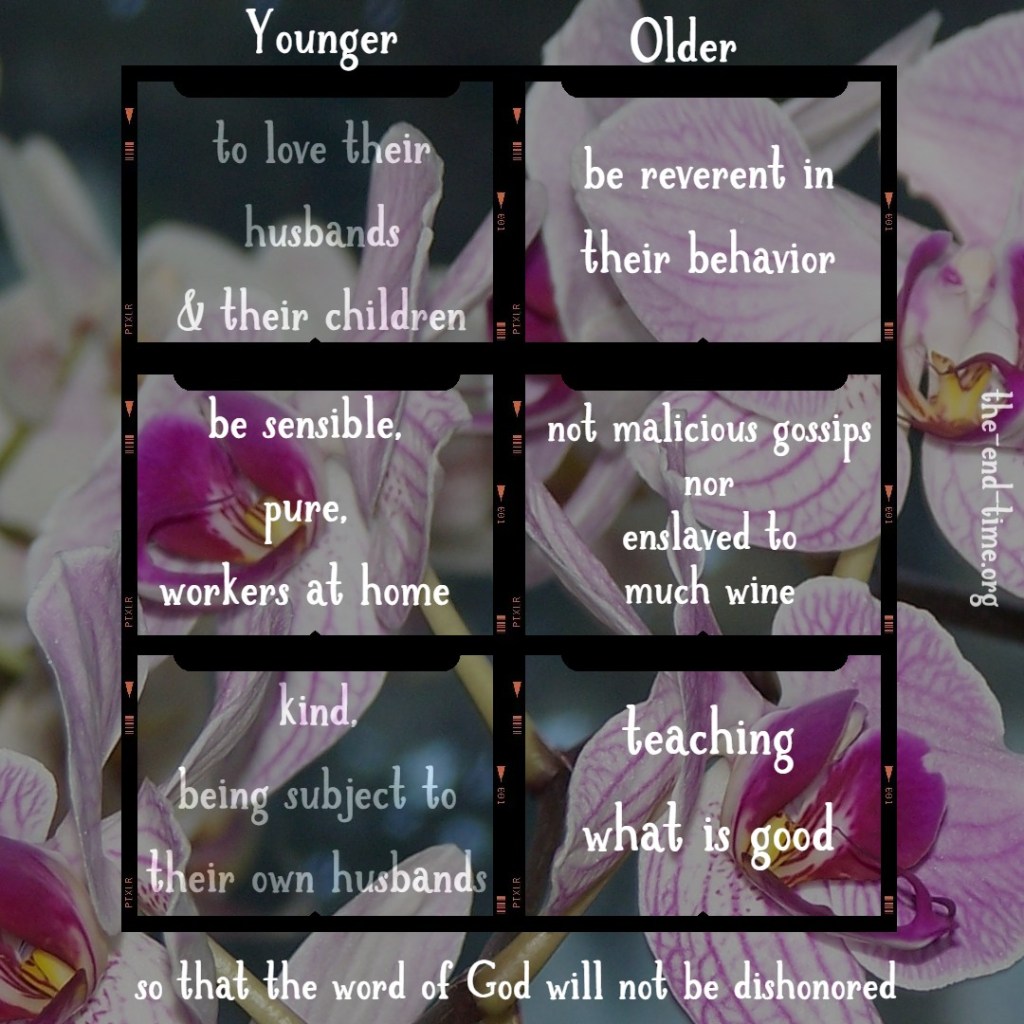
Older women likewise are to be reverent in their behavior, not malicious gossips nor enslaved to much wine, teaching what is good, so that they may encourage the young women to love their husbands, to love their children, to be sensible, pure, workers at home, kind, being subject to their own husbands, so that the word of God will not be dishonored.

But what if you’re not older yet? What do you do? You train for it. Younger women, if God grants a long life, you’ll be older someday, too. Get ready to be the older teaching the younger.

Continue reading “Younger women, you’ll be older someday…”
Posted in theology

Lament part 3: what it is; and the importance of music

By Elizabeth Prata

Lament part 1: Pain everywhere, but we often don’t know how to express it
Lament part 2: David, Job, and what about complaining?

Below: Ezra’s Lamentation

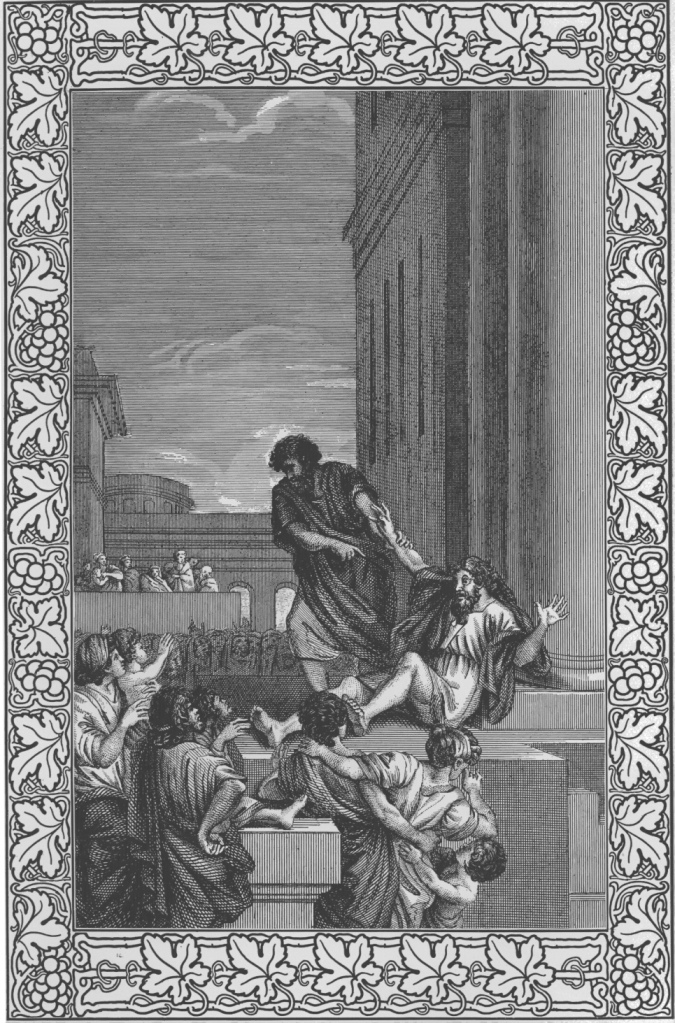
‎Deep was Ezra’s despair when on arriving within the walls of Jerusalem, after his desperate journey he discovered the condition of affairs existing there. G Euzet, Print taken from a book, copyright 1910

I’m looking at what the Bible says about lamenting, in three parts. Part 1 dealt with three biblical figures who allowed their grief to send them into depression, anger, and bitterness (Jacob, Mrs. Job, Naomi.)

In Part 2 I looked at the laments of 2 biblical figures, David and Job, and what they did right, according to God.

Today I will look at explaining more of what a lament is, and also the importance of music to help us when our deep grief turns to lamenting.

Continue reading “Lament part 3: what it is; and the importance of music”