Posted in prophecy, Uncategorized

The End is still Near, Still Sharing the Light

I can’t wait to see what you all look like when you are glorified! I can’t wait to see the glassy sea, the angels who have helped me, the face of Jesus! I can’t wait to be free from pain and shed of my sin nature. I can’t wait to be in eternity! However, I will await His timing. We all must await the number of our days to be up and His determination of when we enter glory.

For now though, the Tribulation is still to come according to the Divine schedule.

The Tribulation is prophesied to be a period where many things will happen. One of them is that the earth and heavens themselves will be wildly disrupted. Landforms disappear. Weather patterns evaporate. Orbits cease. And more.

The outline of what Jesus will be doing at that time is presented to us in Daniel 9:24. The Lord will do 6 things:

Continue reading “The End is still Near, Still Sharing the Light”

Posted in bible, king, melchizedek, priest, prophecy

The Altar is Closed Forever!

Our Pastor has arrived at a “difficult and puzzling” verse about the mysterious figure of the Priest-King Melchizedek in Genesis 13-14.

First to mention, is that I am completely proud that our pastor does not skip difficult or puzzling verses. He digs right in with studious joy, and delivers the information in a comprehensible and engaging way.

Here is the blurb for the sermon, “How can Jesus be both our great High Priest and our King? How can he be both David’s son and Lord? What does this mean for our lives? The author of Hebrews says this story is “hard to explain” and that it contains “meat for the mature” not “milk” for infants. So get ready to put on your floaties and hop into the deep end of the pool!”

SDG!

———————————————————-
Further Reading:

The End Time: Jesus as High Priest

The End Time: Melchizedek, one of the Bible’s most mysterious Characters

Let Us Reason: The Priesthood of Melchizedek

Grace To You: Bible Q&A- Who was Melchizedek?

Posted in bible, prophecy, prophetic interrogation, social justice

Prophetic interrogation, what it is and why to watch out for people using the term

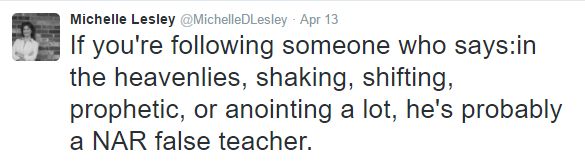
I was reading up on an organization called Sojourners. It is an organization whose focus is fighting against social injustice with some faith thrown in. In their “About us” page they used the phrase “prophetic interrogation”. I was intrigued by that. New terms popping up that have a Christian overlay to them interest me. Like this tweet from Michelle Lesley.

Here is the Sojourners blurb where they audaciously announce they they are prophetic interrogators.

Sojourners magazine and Sojourners online publication sit at the intersection of faith, politics, and culture. Our coverage goes beyond the trending headlines to uncover and explore in depth the hidden injustices in the world around us. Our call to prophetic interrogation means we seek the truth as informed by our biblical roots.

Apparently it is not enough to address obvious injustices, one must now uncover hidden injustice, too. Designating one’s organization or the people in it prophetic interrogators is audacious because they have not been called to perform prophetic interrogation. The term is an old term used to describe a rhetorical device in the Bible whereupon the ACTUAL prophets speak words to the nation Israel (or other nations as designated by God) to question them either actually or rhetorically. Here are a couple of descriptions of what the term prophetic interrogation means.

Elements of Prophetic Interpretation. 

THE INTERROGATION — while its legitimate use is to ask a question — is also used to affirm or deny with great emphasis. Affirmative interrogations usually have no or not in connection with the verb. Example. — “Is not God in the height of the heavens?” Job 22:12. Examples of a negative. — “Shall the earth be made to bring forth in one day? or shall a nation be born at once?” Isa.66:8. “Can the rush grow up without mire?” Job 8:11.

From the book Minor Prophets Part 2, by Michael H. Floyd,

Prophets would often provoke their audience with accusatory or confrontational questions (e.g., Isaiah 7:13, 22:1b, 16; Jeremiah 4:30; Ezekiel 18:2, 25, 29; cf. Psalm 50:16, 53:3), and inferential questioning would serve as one way of pursuing this rhetorical strategy (e.g., Amos 3:8; Isaiah 50:7-9). In prophetic discourse inferential questioning usually serves to foster an assessment of some claim about the nature of Yahweh’s involvement in human affairs (—-> prophecy).

I hope the reader can see why it is audacious (brash, arrogant) to designate one’s self a prophet called by God to interrogate entire nations, systems, or organizations. First, prophetic interrogation as seen in the Bible always points back to God.

Secondly, God calls prophets, one does not designation one’s self as a prophet (in NT times, a pastor). Third, the willingness to call one’s self prophetic interrogators reveals an even more symptomatic problem. I mentioned that Sojourners is a social justice organization that ‘intersects where faith, politics and culture meet’. The church is called to share the Gospel, period, not entertain politics and culture. However, social justice organizations often lose their singular focus and dilute or even do away with Gospel proclamation. See this paper published in Britain in 2005 titled, Exploring ethos? Discourses of `charity’ in the provision of emergency services for homeless peopleThe author John May compared three systems of generosity, and took a particular interest in the reasons why individuals and organisations become involved in the task of caring for, or serving, homeless people.

We Christians know that loving our neighbor is our response to the saving grace Jesus bestowed on us and our desire to nurture, help, and serve as a logical and an emotional response to that grace. Sometimes this perplexes secular people, and so the thrust of the paper was to compare charity work among “Christian caritas, secular humanism, and postsecular charity.” Mr May writes of Christians engaged in social justice,

The Christian ethical impulse to charity is most clearly displayed in the reforming zeal of evangelicals in the 19th century. Underpinned by the great evangelical revival which began at the end of the 18th century, a widespread depth of religious faith became a motivating factor for the establishment of a far-reaching charitable network, three quarters of which, according to Heasman, was evangelical Christian in nature. As Owen (1965) suggests, “So unwearied in well-doing were certain groups of Bible Christians that in the public mind the word ‘philanthropist’ became all but synonymous with ‘evangelical’, and ‘philanthropy’ was applied to the good works that appeals most to evangelical tastes” (page 93). 

…These outpourings of 19th-century Christian charity relied on an overtly evangelical underpinning of action. Charitable activity was essentially entwined with an urgency to convert people to Christian ways of living. As the impacts of the evangelical revival waned, Christian theology became increasingly liberalised, undermining the link between social welfare and salvation. [emphasis mine]

…Another, related dilemma, relates to the intersection of faith and political worldview. Some Christians view their caritas through an individualist political lens – believing that social problems result from an individual’s failures, so the emphasis is on individual conversion as a means of over-coming personal failure (Steinfels, 2001). Others see poverty as caused by unjust social, economic, and political structures and life circumstances largely beyond the control of individuals. Christian charity in this context not only provides personal strength for these individuals, but also presents a ‘prophetic interrogation’ (Wallis, 2001) of social injustice more generally.

That is the problem with organizations that focus on social injustice to the exclusion of the Gospel. The historical trend went like this:

  • serving others in social welfare as a Gospel response, conversion in mind
  • crusading for social justice to rectify the symptoms that caused the person to need the welfare in the first place
  • to speak for God in interrogating entire nations or systems as to why the injustice exists.

Each step in this trend removes the Gospel from center focus and elevates the people performing the service to exalted positions they do not warrant.

My message today: watch out for the term “prophetic interrogation.” Add it to your list of terms like anointing and the others that do not mean what the speaker thinks it means.

Posted in eschatology, prophecy, rapture, second coming, tribulation

12 Things to Know about the Antichrist, or, Why Prophecy is Important

There are niche segments of study within the theological world that are more valued than others. Discernment gets a bad name, often rightly, because many discernment writers tend to drift toward a more “censorious spirit” as Gill said in his Exposition, stating, “Censorious persons rarely have the good will of their fellow creatures” in mind. However as the pendulum tends to swing, it makes a full arc and for a while discernment receives a poor reputation in total, even while there are good discernment writers and speakers out there (Justin Peters comes to mind) mixed in with the cranks and angry ones.

Though all Christians are called to discern between right and wrong, some have been given extra discernment as a gift of the Holy Spirit (1 Corinthians 12:10). While on the one hand it’s not to be abused, it’s also not to be dismissed. (FMI on the gift of discerning of spirits, go here).

Eschatology is another area of study which also receives a poor reputation, in no thanks to many Christians themselves. Eschatology is the study of last things, AKA, prophecy, especially the period since the First Coming of Jesus Christ. Though it’s forbidden, some date-set and of course the end date at which their predictions pass with no fulfillment make a mockery of Christ’s name to unbelievers and a disappointment to the believers who were drawn in. Others who study eschatology badly simply perpetuate ridiculous theories concerning the end times. Others wrongly insist that eschatological subjects are biblically unknowable.

My blog covers three areas; discernment, prophecy and encouragement. I’ve seen the pendulum swing from side to side in each of these areas over the last 7 years of daily blogging here at The End Time. I have maintained from the beginning of my blogging life and my Christian witness in real life, that prophecy is important – because it was important to Jesus. Last days are spoken of in almost every book of the New Testament. Paul spent a good deal of time teaching it to the Thessalonians. Even as the babes in Christ that they were, Paul pulled out all the stops to ensure that these Thessalonian Christian babies knew the importance of living with a very present knowledge of Christ’s imminent return. Doing so gives us a heart for the lost, a fervency in life, and a strength to look forward beyond persecution or trouble. I refuse to marginalize prophecy as a legitimate area of study.

Here is Michael Holst stating the point of eschatology so much better than I ever did.

12 THINGS TO KNOW ABOUT THE ANTI-CHRIST
by Matthew Holst • April 01, 2016

One of the Apostle Paul’s great preoccupations in both of his letters to the church at Thessalonica is the second coming of Christ. He was not only concerned with getting the doctrine “right” but also with the great pastoral implications of such teaching. In 1 Thessalonians he writes concerning the second coming of Christ in relation to the resurrection of the dead and the gathering together of saints who are alive at that time. In 2 Thessalonians he reinforces what he had already taught at Thessalonica (2 Thess. 2:5) concerning the dangers of the last days, specifically with regard to the great apostasy in the church induced by the revelation of the Man of Lawlessness. 

Depending on your eschatological framework, your identification of the Man of Lawlessness and his activities may differ from what I wish to offer in this post. Coming to terms with the fact that there will indeed be a Man of Lawlessness plays an important role in the life of the believer as he or she eagerly waits for the day of Christ’s coming. In days of relative peace, we must ready ourselves and forthcoming generations–especially our own children–for the days of anarchic deception that will accompany the Man of Lawlessness. 

We, in the Calvinistic and Reformed church, have not done justice to the Scripture’s teaching on this matter. We often rightly respond to the “Left Behind” industry with dismay and sarcasm. In so doing, however, we have, perhaps inadvertently failed to sufficiently and soberly grasp Scripture’s teaching on this period of history which will be instrumental in bringing about a catastrophic and irreversible apostasy. Here then, are twelve biblical observations about the Man of Lawlessness (MoL) to help prepare us for that day.

For the rest of Mr Horst’s essay, go to the Alliance of Confessing Evangelicals.

I’d like to reiterate that the Rapture (when Christ calls for His Bride in the air, 1 Thessalonians 4:15-17) and the Second Coming (when His feet touch down at the Mount of Olives at the end of the Tribulation, Mt 16:27, Zechariah 14:4) are two separate events.

Posted in millennial kingdom, prophecy, satan

Must satan be released?

“New Jerusalem” EPrata photo

I love prophecy. I always have. It is glorious to read in the Bible, uplifting me even when the Prophets pronounce doom. This is because I worship a God who prophesies, and He prophesies because He is Master of all history. He Prophesies because He can. He is the only One who can. And it’s especially uplifting when the prophecy comes true, namely, in the form of the Messiah who came and died and was resurrected on the third day.


remember the former things of old;
for I am God, and there is no other;
I am God, and there is none like me,
declaring the end from the beginning
and from ancient times things not yet done,
saying, ‘My counsel shall stand,
and I will accomplish all my purpose,
(Isaiah 46:9-10, emphasis mine)

We worship a God who is that powerful. He ordains every event, every heart, every minutiae throughout the entire universe. Yet He tells us – His created creatures – what He is doing and will do.

For the Lord GOD does nothing without revealing his secret to his servants the prophets. (Amos 3:7).

but these are written, that ye may believe that Jesus is the Christ, the Son of God; and that believing ye may have life in his name. (John 20:31).

In the Word of God AKA the Bible, God has set down a progression of past and future history which we can read and study and understand. This is what is called fulfilled prophecy and unfulfilled prophecy. Prophecy remaining to be fulfilled includes (but is not limited to),

  1. The Rapture of the Church
  2. The Great Tribulation
  3. Jesus’ Second Coming to Earth
  4. Vanquishing of the Armies at Armageddon
  5. All Israel Will be Saved
  6. The Millennium Kingdom
  7. Satan Bound in the Pit during the Millennium Kingdom
  8. Satan released
  9. Great White Throne Judgment
  10. Destruction of earth and universe, New Heaven and New Earth
  11. Eternity
  12. ?
EPrata photo

What a powerful God. The word for that concept is omnipotent. Let’s get back to using proper Bible words for things, such as justification, sanctification, glorification, omniscience, omnipresence, omnipotent, transcendence, immanence, etc.

Omnipotence is an attribute of God alone. It is the quality of having all power (Psalm 115:3). He can do all things that do not conflict with His holy nature. God has the power to do anything He wants to do. However, God cannot do that which is contrary to His nature. For example, God cannot lie (Titus 1:2).

Omnipotence is referred to in Job 42:2.

I know that you can do all things and that no plan of yours can be thwarted.

As Jesus returns and protects all the recently converted Jews at Petra at the end of the Tribulation, and swings over to Armageddon and slays the collected armies, then lands on the Mount of Olives which then splits in two, Jesus subsequently sets up the kingdom on earth which will last for a thousand years.

The Millennium Kingdom is a period of time where all the promises to Israel about inhabiting their promised lands without need for fighting to keep it or to fend off attacking armies will be fulfilled. The Messiah will personally rule and reign and the world will be in peace.

The people who are alive at the end of the Tribulation will include both saved and unsaved. In order to determine who will be allowed to enter the Kingdom (saved) Jesus will gather all the nations in front of Him, and He will separate the believers from the unbelievers. This is the Sheep and Goats judgment, as explained here. (Matthew 25:32-33).

Jesus will also have an angel cast satan (and by implication, his demons) into the pit to be sealed in for 1000 years- the entire period of the Millennium Kingdom. (Revelation 20:1-2). Imagine those who are born into the Millennium Kingdom living with Jesus reigning perfectly and peacefully, and no satan or demons around to tempt them or to deceive the nations!

However, just because believers enter the Kingdom, it does not mean that their offspring will necessarily be believers. As people are born and grow up, they live on the planet under Jesus’ rule and outwardly submit, because He rules with a rod of iron. (Revelation 2:27). Inwardly they are rebelling. This is because people are still sinners with a sin-nature. Not all are glorified yet.

But Jesus knows this, and he has a plan.

Then I saw an angel coming down from heaven, holding in his hand the key to the bottomless pit and a great chain. 2And he seized the dragon, that ancient serpent, who is the devil and Satan, and bound him for a thousand years, 3and threw him into the pit, and shut it and sealed it over him, so that he might not deceive the nations any longer, until the thousand years were ended. After that he must be released for a little while. (Revelation 20:1-3, emphasis mine).

The Master’s Seminary published an essay in Spring 2014 addressing the question, why must satan be released?

As with all previous “must statements,” it is not only that Satan will be released, as seen with the future tense in Rev 20:7 (“And when the thousand years are completed, Satan will be released from his prison,”), but also Scripture plainly states that after the thousand years are over, Satan “must be released for a short time.” Chafer considered that, “No small mystery gathers around the fact that Satan is released from the abyss even for ‘a little season.’” He further refers to it as “this strange release.” Based on the normal use of “must” in other Scriptures, many scholars also mark its use in Rev 20:3. Thomas writes in regard to Satan’s release, “It is a divine necessity. . . for the dragon to be released ‘after these things.’” Swete concurs, writing in reference to the future release that “it must come; there is a necessity for it (dei).” Alford refers to the usage as “the dei of prophecy; must according to the necessity of God’s purposes.”

For it is written of satan’s final defeat:

And when the thousand years are ended, Satan will be released from his prison and will come out to deceive the nations that are at the four corners of the earth, Gog and Magog, to gather them for battle; their number is like the sand of the sea. And they marched up over the broad plain of the earth and surrounded the camp of the saints and the beloved city, but fire came down from heaven and consumed them, and the devil who had deceived them was thrown into the lake of fire and sulfur where the beast and the false prophet were, and they will be tormented day and night forever and ever. (Revelation 20:7-10).

The Master’s Seminary article continues:

In addition to the other reasons, Satan must be released to deceive the nations and bring about not only the final rebellion, but also the final deaths of all humans who reject the Messiah. Further, God’s promise “to curse the ones who curse you” actually relates to all enemies of Israel and not only to the Gentile nations. In keeping with God’s Word, God curses Satan and throws him into the lake of fire (Rev 20:10). Then when death has been abolished forever and after the Great White Throne judgment of the eternally damned (Rev 20:11–15), when all evil will have been divinely eradicated, then the new heavens and new earth—and New Jerusalem—will arrive.

And what a day that will be!

EPrata photo

Posted in jesus, Mosul, prophecy, woe

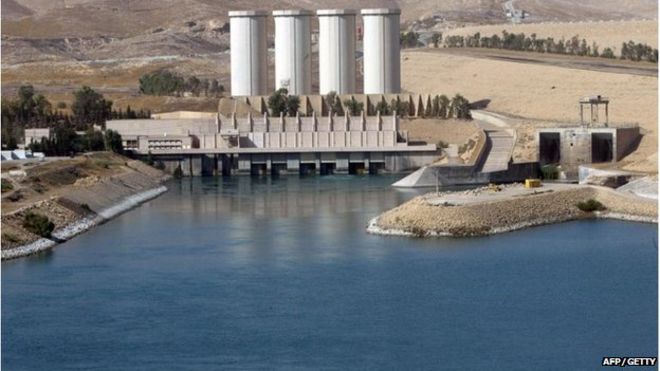
Mosul Dam at risk of catastrophic failure

Introduction & Background

BBC

A news headline caught my eye last week. It is from the UK Telegraph, and consists of a dire warning from US officials regarding the Mosul Dam.

US warns of ‘tsunami wave’ across Iraq if the Mosul Dam collapses

Iraq’s Mosul Dam faces “unprecedented” risk of a “catastrophic failure” that would unleash a wave of water which could flatten cities and kill hundreds of thousands within hours, the US has said. The American government issued an unusually stark warning of the horrors that face Iraq if the dam gives way, describing a “tsunami-like wave” that would crush nearly a third of the country.

Iraq’s power grid could be entirely knocked out and parts of major cities would be underwater for weeks like areas of New Orleans after Hurricane Katrina, the US said. The Iraqi government would be unable to direct an evacuation because Islamic State of Iraq and the Levant (Isil) still controls much of the territory near the dam and so people need to prepare to evacuate on their own, the US said.

The 2014 article from the BBC recounts the reasons why the dam is so unstable-

Instrument of war
However, since its completion in the 1980s, the dam has required regular maintenance involving injections of cement on areas of leakage. The US government has invested more than $30m (£17.9m) on monitoring and repairs, working together with Iraqi teams. The black flags of jihadist group Islamic State flew over the Mosul dam for 10 days before it was recaptured by Kurdish and Iraqi ground forces. In 2007, the then commanding general of US forces in Iraq, David Petraeus, and the then US ambassador to Iraq, Ryan Crocker, warned Iraq’s PM Nouri Maliki that the structure was highly dangerous because it was built on unstable soil foundation. 

“A catastrophic failure of Mosul dam would result in flooding along the Tigris river all the way to Baghdad,” [200 miles away] they said in a letter. “Assuming a worst-case scenario, an instantaneous failure of Mosul dam filled to its maximum operating level could result in a flood wave 20 metres (65.5ft) deep at the city of Mosul,” it said.

So the dam itself is faulty and now that the terror group ISIS has captured so much land in the surrounding area fears are they will use the dam as an instrument of war. The situation has not improved much since ISIS took over surrounding area and even had taken over the dam briefly in 2014, because, as this CNS News article from yesterday states,

The situation worsened when ISIS terrorists overran the dam and held it for several weeks in 2014. Since then, efforts to reinforce the dam’s foundations have not been adequate, partly because ISIS still controls the factory that produces concrete for the dam. (source)

Catastrophic Effects of Dam Busting

This situation brings to mind two items, First is Dam Busters and the Geneva Convention, and second is the Great Tribulation.

Familiar to many people are the battles of WWII. We all know the names of battles such as The battle of the Bulge, Bombing of Berlin, The London Blitz, and D-Day. Less familiar is Operation Chastise.

According to Wikipedia,

Prior to World War II, the British Air Ministry had identified Germany’s heavily industrialised Ruhr Valley, and especially its dams, as important strategic targets: in addition to providing hydro-electric power and pure water for steel-making, they also supplied drinking water and water for the canal transport system. The methods used to attack the dams had been carefully worked out. Calculations indicated that repeated air strikes with large bombs could be effective, but required a degree of accuracy which Bomber Command had been unable to attain in the face of enemy defences.

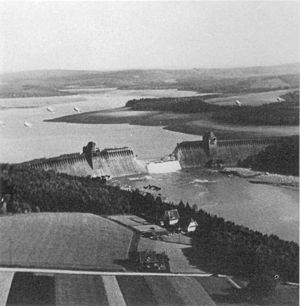
The Möhne dam the day following the attacks.
16–17 May 1943. Wikipedia

The movie “The Dam Busters” is the story of one scientist who developed a special bomb that could skip over water, avoid the torpedo nets, and then sink against the bottom of the dam in order to explode it at a sensitive point. The concept is of an earthquake bomb. Once the bomb was developed, the Operation was a success but there was heavy loss of Allied life due to the pilots having to fly so low to drop the bombs. The Operation was successful for the British both in its short-term and its long-term effects. But at what cost?

Flying Officer Frank “Jerry” Fray wrote of the experience of seeing the Valley after the dam breach-

When I was about 150 miles from the Möhne Dam, I could see the industrial haze over the Ruhr area and what appeared to be a cloud to the east. On flying closer, I saw that what had seemed to be cloud was the sun shining on the floodwaters. I looked down into the deep valley which had seemed so peaceful three days before [on an earlier reconnaissance mission] but now it was a wide torrent. The whole valley of the river was inundated with only patches of high ground and the tops of trees and church steeples showing above the flood. I was overcome by the immensity of it.

This is the same level of damage the opening articles were mentioning if the Mosul Dam in Iraq collapsed.

The destruction was so cataclysmic that it prompted a new resolution to the Geneva Convention. In 1977, Article 56 of the Protocol I amendment to the Geneva Conventions, outlawed attacks on dams “if such attack may cause the release of dangerous forces from the works or installations and consequent severe losses among the civilian population.”

ISIS, Infrastructure, and the Great Tribulation

Recently, people have been making date predictions about the start of the Great Tribulation. Some have said it will begin in March 2016, which is now. FYI, it is not going on now. The Tribulation has not begun. We know this because the church has not been removed from the earth yet, which will happen prior to the beginning of the Tribulation wrath being poured out.

Setting a specific date for the start of this worst event to ever happen on the face of the earth (Matthew 24:21) is forbidden by scripture, (Matthew 24:36, Acts 1:7), but people do it anyway. Sigh. One reason we are not to date set is that continual date setting with failure to fulfill destroys the confidence in weak Christians. That is sad. It also tarnishes the study of prophecy in general, and prophecy is extremely important.

What I find troublesome is the people who make fun of this date setting. Christian mockers mocking the event’s non-event. The Great Tribulation is no laughing matter. Jesus warned that it will be the WORST time on earth, ever. This means worse than the Flood of Genesis when every person on earth save 8 drowned. Every animal died (except on the ark). The Great Tribulation will be worse. It will be blood and anger and horror and demons abounding. It will be destruction and war and hate and brutality. It is not something to be taken lightly and certainly not to be made fun of.

One reason I mention prophecy quite often is because I want people to understand that the way things are will end. We are living on borrowed time, nationally speaking. What we see in our countries will exist no more. Infrastructure will crumble. Bridges, dams, walls, towers, will come down. Governments will l dissolve and reform to form a global tyranny. People will kill for no reason, or just because. The world’s most vulnerable – widows, children, poor, pets/animals – will be at most risk. People will simply not care one bit for their neighbor. People will be killed for a sip of water, or because they wore blue that day or they didn’t walk fast enough. The Great Tribulation literally will be hell on earth.

The dams in WWII that were busted caused so much havoc and death that the World decided not to use them as targets ever again. When the dams were busted in WWII 1,600 civilians were killed.

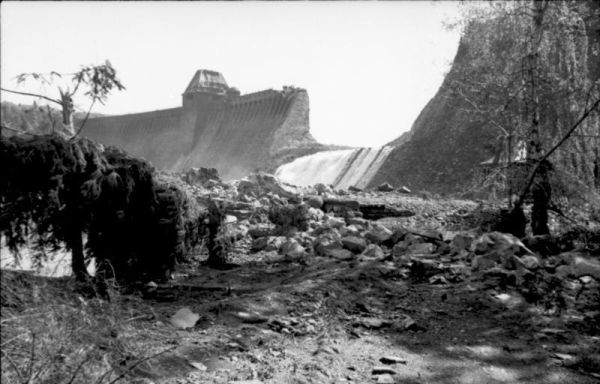
Here, the breach in the Mohne Dam’s massive wall gives way to a scene
of utter devastation as millions of gallons of water flooded into the valley
Image: Schalber, cc-sa-3.0 DE)

Prophecy authenticates the speaker, so this means ultimately God’s word is authenticated as He speaks and His prophecies come true. (Deuteronomy 13:1-3). Prophecy is supposed to quicken us and enliven us as we are ever-aware that this is not our world. We are not citizens of earth. We are citizens of heaven.

During the time of the Tribulation, do we think for one moment that some terror group won’t hesitate to destroy any dam? Any bridge? ISIS already destroys for the sake of destroying. What do we think will happen when the Restrainer has left the earth and allows man his full range of sinful impulses?

The devastation upon earth during the Tribulation will be uncountable. If the Mosul Dam is teetering on the brink of failure now, just imagine the horror of that and other catastrophic failures during the time of greatest woes ever occurring on the earth. Don’t take the Tribulation lightly and certainly, please, don’t mock even those who set dates about it. It is the second heaviest subject in the Bible, permanent wrath in hell being the worst. The Tribulation will be hell on earth and hell will have to enlarge its mouth for it to accept the many thousands at a time to enter it as will happen during the Tribulation.

Pray for souls to be saved now, during the age of grace. Be a living witness of the cause of Christ, warning of the wrath to come, in all due gravity and urgent pleading. If the Mosul Dam fails it will be like a mosquito bite compared to the devastation daily occurring during the Time of Jacob’s Trouble.

Posted in bible, husband, marriage, prophecy, wife

What marriage is really all about

The Bible begins with a marriage and ends with a marriage. The marriage motif is laced throughout scripture in progressively obvious ways. As BibleGateway explains,

“Marriage is used to describe the relationship between God and Israel in the OT and between Jesus Christ and the church in the NT. Contemplating marriage deepens understanding of God’s love for his people; examining God’s covenant love for his people similarly enriches an understanding of marriage.” (BibleGateway)

It begins in Genesis 2, where God unites Eve and Adam as one flesh. He made Eve from Adam, as a helper fit for him.

Therefore a man shall leave his father and his mother and hold fast to his wife, and they shall become one flesh. (Genesis 2:24)

As we progress through the Old Testament, we see God declare He is “married” to Israel. God’s marriage covenant with Israel is seen in Ezekiel 16:8-14, below. The covenant at Sinai was seen as a form of marriage. See also Jeremiah 31:32; Ezekiel 16:59-60.

God as Israel’s husband is also seen in Isaiah 54:5 and also Hosea 2:7; Joel 1:8.

8 “When I passed by you again and saw you, behold, you were at the age for love, and I spread the corner of my garment over you and covered your nakedness; I made my vow to you and entered into a covenant with you, declares the Lord God, and you became mine. 9 Then I bathed you with water and washed off your blood from you and anointed you with oil. 10 I clothed you also with embroidered cloth and shod you with fine leather. I wrapped you in fine linen and covered you with silk.[a] 11 And I adorned you with ornaments and put bracelets on your wrists and a chain on your neck. 12 And I put a ring on your nose and earrings in your ears and a beautiful crown on your head. 13 Thus you were adorned with gold and silver, and your clothing was of fine linen and silk and embroidered cloth. You ate fine flour and honey and oil. You grew exceedingly beautiful and advanced to royalty. 14 And your renown went forth among the nations because of your beauty, for it was perfect through the splendor that I had bestowed on you, declares the Lord God. (Ezekiel 16:8-14)

In the New Testament, we see frequent symbolism of Jesus as the Groom and the Church as His bride.

For I feel a divine jealousy for you, since I betrothed you to one husband, to present you as a pure virgin to Christ. (2 Corinthians 11:2)

The kingdom of heaven may be compared to a king who gave a wedding feast for his son, (Matthew 22:2)

The Marriage supper is likely one of the most eagerly anticipated events…by Jesus! Since before time began when names were written down, Jesus has been promised a wife, one who will adore Him and with whom He will be the groom, lovingly guiding her all the rest of eternity. The day which He knows not, the day when the Father will say, “Son, go get your Bride”, (cf Matthew 22:2) and brings His church triumphant to heaven for glorification (consummation) will be a tremendous, tremendous moment. It hardly bears mental sensibility to even imagine such an event!

We’ve seen the marriage theme in Adam and Eve, in Hosea, Ezekiel, Isaiah, Joel, and Jeremiah. In the New Testament we see the marriage theme in Matthew, 2 Corinthians, and other books, and now in Revelation.

Then came one of the seven angels who had the seven bowls full of the seven last plagues and spoke to me, saying, “Come, I will show you the Bride, the wife of the Lamb.” (Revelation 19:7)

We Christians long for the day when we are the wife, the glorified, perfected church, able to worship properly and perfectly, walking in true harmony with the Groom. As for the Bible, the marriage metaphor is sewn into the very heartbeat of scripture. It begins with a marriage, scripture showing that all marriages are the picture of Jesus and His redeemed and perfected bride, and the Bible ends with a marriage. The kingdom itself is a wedding feast!

Then came one of the seven angels who had the seven bowls full of the seven last plagues and spoke to me, saying, “Come, I will show you the Bride, the wife of the Lamb.” (Revelation 21:9)

John MacArthur explains in his commentary that in Revelation 21:9 the church is referred to as the wife because the marriage has taken place in Rev 19:7. Oh what a day that will be.

The most important thing to remember is this: earthly marriage is a picture of the Church’s marriage to Jesus. He as Head, lovingly guiding, shepherding, teaching, taking responsibility even though He never makes a problem. The Church as bride, loving her Groom, helping, submitting. Submission is a joyful following. As was stated in our sermon Sunday, a woman said regarding submission (which men are to submit also), “If submission to the Father did not ruin Jesus’ dignity I don’t suppose it will ruin mine.”

Marriage does not exist to make you happy. Being happy has nothing to do with it. I’ts to love a married life (if you’re called to it) in mutual submission, sacrificing for each other, and persevering for the long term. It is a picture of Jesus and His bide and personal happiness has nothing to do with it.  Of course, if you’re happy in your marriage, GREAT! But God did not design marriage for your personal happiness.

Since marriage on earth is a picture of Jesus and His spotless bride, then THAT is why satan works so hard to interfere with marriage. That’s why it’s under assault. It’s why feminism arose, so the wife would be rebellious. It’s why homosexuality arose, so men would not marry women and lead solid homes. And in case someone does not believe that marriage is ‘one man, one woman, forever’, think of this. When the Pharisees asked Jesus about marriage, Jesus explained it by going back to the Old testament and stood firm on Genesis 2:24, which says,

Therefore a man shall leave his father and his mother and hold fast to his wife, and they shall become one flesh.

When the Pharisees tested Jesus on marriage, Matthew 19:4-6 says, He answered, “Have you not read that he who created them from the beginning made them male and female, 5and said, ‘Therefore a man shall leave his father and his mother and hold fast to his wife, and the two shall become one flesh’? 6So they are no longer two but one flesh. What therefore God has joined together, let not man separate.”

So Jesus stood on the OT picture of marriage and that has not changed. Satan tries his best but don’t let him interfere with you wives by allowing your flesh to rise up and usurp the husband, or tempt you to a career choice that sacrifices the children.

The Bible begins with a marriage and it ends with one. Marriage is important.

PS: There are some women and men He has set aside (consecrated) for singleness. Apostle Paul calls this a gift. (1 Corinthians 7:6) For example, there will be 144,000 virgin men who will become super-evangelists during the Tribulation. Jeremiah never married, it’s probable that John the Baptist never did either. In modern times, the famous preacher John Stott never married. Neither did missionary Gladys Aylward. If God has chosen you for singleness, it is a gift and He will sustain you throughout your celibate life for the ministry or task He has consecrated you to. Take heart! You’re in good company!

Posted in barnhouse, prophecy, rapture, second coming, tribulation

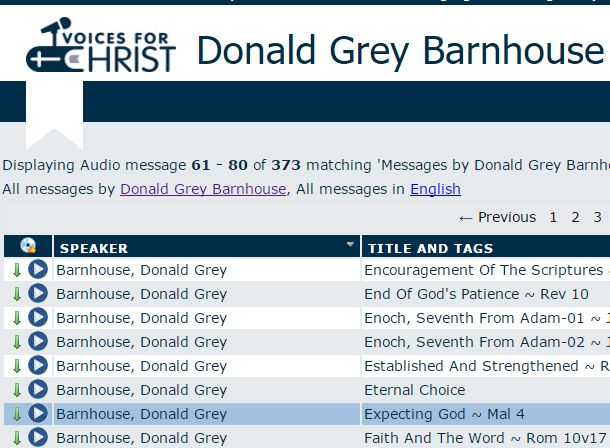
Expecting God

Dr Donald Gray Barnhouse preached a great 22 minute message called “Expecting God”. In it, he ties together prophecy from Matthew and Malachi, regarding the Tribulation and the removal of the Church prior to that Great Day of the Lord. He teaches this so clearly and concisely but so insightfully that I wanted to share.

One thing Dr Barnhouse said was that the coming of Jesus we are eagerly expecting will be in several stages. This is a notion that even recently in one particular comment stream on this blog, people have a hard time understanding. It is an obstacle which often makes them want to deny the literality of the coming 1000-Year Kingdom, AKA the Millennium Kingdom.

Just as Jesus came the first time over 33 years, Barnhouse said, His second coming will be 7 years plus 1000 years. (Tribulation plus Millennium).

I can only link to the sermon, it is not on Youtube to embed. When you go to this link, the screen shot below is what you’ll see. Just click on “Expecting God” and enjoy!

Posted in esther, heirs, herod, prophecy, salome

Of two kings, their women, and death on a platter

What the unconverted heart wants is so different from what the converted heart wants. As James Smith said in 1859, the state of the unconverted is-

They are in a state of misery. They do not enjoy the favor of God, nor taste the sweetness of his blessing. Have what they may, they are never satisfied, for their immortal nature is always craving for something higher and better. … They are in opposition to God.

As John Murray said of the converted heart,

It is the Holy Spirit working directly, efficaciously and irresistibly upon man’s heart and mind, making the man over again, and creating him anew after the image of Christ in holiness and righteousness of the truth. A revolution, a reconstruction takes place at the center of man’s moral and spiritual being: sin and pollution are dethroned in the citadel of man’s being, and righteousness takes its place. (source)

Our desires align with God’s, our desire is for hatred of sin, pursuit of holiness, our neighbor’s good, service, forgiveness, mercy, righteousness and more.

The two hearts (converted vs. unconverted) were never more starkly contrasted as in Salome and Esther’s.

Esther Before King Ahasuerus with Haman Being Sent to the Gallows,1577
(studio of) Claeissens, Anthuenis (1536-1613)

According to Mark 6:21-29 a daughter of Herodias danced before Herod and her mother Herodias at the occasion of his birthday, and in doing so gave her mother the opportunity to obtain the head of John the Baptist. Even though the New Testament accounts do not mention a name for the girl, this daughter of Herodias is often identified with Salome. According to Mark’s gospel Herodias bore a grudge against John for stating that Herod’s marriage to her was unlawful; she encouraged her daughter to demand that John be executed. (source)

and when the daughter of Herodias herself came in and danced, she pleased Herod and his dinner guests; and the king said to the girl, “Ask me for whatever you want and I will give it to you.” 23And he swore to her, “Whatever you ask of me, I will give it to you; up to half of my kingdom.” 24And she went out and said to her mother, “What shall I ask for?” And she said, “The head of John the Baptist.” 25Immediately she came in a hurry to the king and asked, saying, “I want you to give me at once the head of John the Baptist on a platter.” (Mark 6:22-25).

Deadly desire: Aubrey Beardsley’s illustration
for Wilde’s play (Getty Images) Source

Why does the unconverted heart want death on a platter? Because John the Baptist had spoken against the King’s unlawful marriage. Nobody likes it when their sin is pointed out, least of all the one with an unconverted heart. The daughter, which through history we know is named Salome, sided with her mother in wanting the burr in their side dead. Silencing the voice of God used through His people never silences the conscience though, nor does it destroy coming judgment for their sins. The sinner may gain temporary relief, but it is only temporary.

King Ahasuerus of Persia ruled from Ethiopia to Iran, over 127 districts. When he saw kind and gentle Esther standing in the court, he was pleased with her.

Then Esther approached and touched the tip of the scepter. 3And the king said to her, “What is it, Queen Esther? What is your request? It shall be given you, even to the half of my kingdom.” 4And Esther said, “If it please the king, let the king and Haman come today to a feast that I have prepared for the king.” (Esther 5:2b-4)

Both kings had asked the women in their lives what request they had and promised to fulfill it up to half their respective kingdoms. What power! What an important moment! If you were given such a powerful promise, what would you ask for? Each woman instantly knew what she wanted.

Esther famously was concerned with doing God’s will, even to the risk of her own life. She spoke up on behalf of her people, who were under threat of genocide. Esther wanted life for her people because they were God’s people, Salome wanted death to John the Baptist to silence the convicting voice. The two hearts could not be more starkly different.

Pray to the Spirit to continue softening your heart so that given an opportunity to ask a favor the King of Kings, you will ask in a way that is aligned with His will. What tragedy it was for Salome to ask for something so fleeting so as to gain temporary relief from the conviction of her sin, only to discover in the end that punishment is forever. Even more so is the tragedy when they have available the gracious and eternal relief from sin’s burden of guilt and shame through Jesus Christ- and spurn it.

“Up to half my kingdom” the promise was even more ironic. Those with a converted heart will share as co-heirs the entire kingdom, wealth beyond imagining, peace and joy and treasure of the highest kind: Jesus. (Galatians 4:7).