The Lord has plans to prosper His children. He makes continual promises that we should not fear, because He knows our needs, and He will supply them. Matthew 6:31-34 is one example. The verses say, “Do not worry then, saying, ‘What will we eat?’ or ‘What will we drink?’ or ‘What will we wear for clothing?’ For the Gentiles eagerly seek all these things; for your heavenly Father knows that you need all these things. But seek first His kingdom and His righteousness, and all these things will be added to you. So do not worry about tomorrow; for tomorrow will care for itself. Each day has enough trouble of its own.”
The People were wandering in the desert and had gotten mighty hungry. (Exodus 16) They began longing for the time of their captivity because at least then, they had bread and meat (Exodus 16:3). They began to grumble against Moses and against the LORD.
So, “Then the LORD said to Moses, “Behold, I will rain bread from heaven for you; and the people shall go out and gather a day’s portion every day, that I may test them, whether or not they will walk in My instruction.” (Exodus 16:4)
The economic situation these days has been long, hard, and painful. Many people, Christians included, have lost jobs, have faced foreclosure, and have had to undergo extreme austerity measures (voluntarily or involuntarily). Americans have been so used to prosperity that we have planned for it in the long-term with retirement accounts that we expected to remain full and fuller as time went on. We expected that after ten or twenty or thirty years that we would of course sell our houses and reap a comfortable profit. We were used to corporate loyalty and lengthy terms of employment, if not permanent ones, if we obtain tenure or have a strong union to back us. Long-term perspectives of our own personal wealth was the norm.
Yet, God said He would supply us. ‘My God will supply all your needs according to His riches in glory in Christ Jesus.’ (Philippians 4:19).
It is in Matthew 6 and it is in Exodus 16. “So do not worry about tomorrow; for tomorrow will care for itself.” and “the people shall go out and gather a day’s portion every day.” God IS supplying you, faithful one. He just may be doing it in a manna situation, a one-day supply instead of extra, like before. He sent the Israelites a one day portion delivered, on time, every time. He even made it so that their clothes did not wear out. (Deuteronomy 29:5).
The LORD told Moses that He was doing it to test them. Not that God didn’t know the outcome of the test, like He needed to learn something, but that He wanted to restrict their supply so that they would learn to more faithfully depend on Him. Is that your situation? It is my situation for sure.
Could you be undergoing a test so that you will learn to depend on Him to greater degree and be strengthened for trials?
Do not worry about what you will eat nor what you shall wear. Do not worry about tomorrow. He provides. Think of the Israelites. Think on His promises to keep us and provide for us. If you only have enough today, do not fret, for you are blessed with bread from heaven!
A ladybug traversing the concrete walkway meets up with a bird feather but keeps going despite the hindrance. EPrata photo
I am “holding fast the word of life, so that in the day of Christ I will have reason to glory because I did not run in vain nor toil in vain.” (Philippians 2:16)
Are you running well, or toiling in vain? Christian, when at the end of your life are you able to say, “I have fought the good fight, I have finished the course, I have kept the faith;”? (2 Timothy 4:7)
The journey is long and we are small, only humble servants and wretched sinners. There are obstacles and there are hindrances to our course. Some stumble when hindrances are met. “You were running well; who hindered you from obeying the truth?” (Galatians 5:7).
Keep running! Keep one step in front of the other! The time is but a vapor, so short, and what is hunger or cold or discomfort to us when we have an eternity of peace and joy to look forward to?
Martyn Lloyd Jones, a noted Welsh preacher from the mid 1900s, preached a series on holiness from 1 John. He said,
[Holiness] “is not some mystical experience that suddenly comes to us, but the outworking of the doctrine and the truth which we claim to believe.”
…”holiness is not something we are called upon to do in order that we may become something; it is something we are to do because of what we already are. . . . I am not to live a good and holy life in order that I may become a Christian; I am to live the holy life because I am a Christian.”
The first thing a Christian does to run the race well, in practical terms is:
“…that I try to separate myself from the sins which I have committed in the past; it includes that, but it goes well beyond it. It means that with the whole of my being I shun sin, I avoid it.”
Actively avoid all sins, big ones, little ones. In fact, it’s the little ones that get us. Why? Because little sins open the door to incrementalism. In the Good News Club, (evangelism for children program) we would teach the children that sin is “anything we think, say, or do that angers God.” It begins with a thought. Thinking about your favorite pub. Thinking about the next swimsuit issue of Sports Illustrated. Wondering what that secretary will be wearing today. Musing about your easy access tot he boss’s business checkbook. They’re just thoughts, right? Nothing harmful, nothing active.
But the thoughts are active. Next, you buy the swimsuit edition, you open the drawer to see if the checkbook is there, you go out of your way to see the secretary, you drive by the pub ‘to see who’s there’.
Soon the sin grabs hold and you are doing what you though you would never to. Porn, adultery, embezzlement… it all began with a thought you did not hold captive.
It’s our pride. We think ourselves capable, strong. But we are weak, pitiful, and stupid. We are sheep needing guidance every moment. Apart from Christ we can do nothing.
Run your race well. Pray, stay close to Jesus in His word, immediately banish sinful thoughts when they occur. Congregate with the saints, building them up and being built up.
Therefore, having these promises, beloved, let’s cleanse ourselves from all defilement of flesh and spirit, perfecting holiness in the fear of God. (2 Corinthians 7:1).
And we desire that each one of you demonstrate the same diligence so as to realize the full assurance of hope until the end, so that you will not be sluggish, but imitators of those who through faith and endurance inherit the promises, (Hebrews 6:11-12).
Therefore, treat the parts of your earthly body as dead to sexual immorality, impurity, passion, evil desire, and greed, which amounts to idolatry. (Colossians 3:5)
The Bible tells us that earth will pass away and then be remade. Did you even wonder what it will be like in the New Heaven and the New Earth? I do. But first, the verses:
“A New Heaven and Earth“ “But the day of the Lord will come like a thief, in which the heavens will pass away with a roar and the elements will be destroyed with intense heat, and the earth and its works will be burned up. Since all these things are to be destroyed in this way, what sort of people ought you to be in holy conduct and godliness, looking for and hastening the coming of the day of God, because of which the heavens will be destroyed by burning, and the elements will melt with intense heat!”” 2 Peter 3:12
“Then I saw a new heaven and a new earth; for the first heaven and the first earth passed away, and there is no longer any sea.” Rev 21:1
So I often wonder about whether we as resurrected saints will be allowed to watch God in His Glory renew the earth, what the new earth will be like in form, and looks, and smells, and sights, and of course about the new heaven.
“And the wolf will dwell with the lamb, And the leopard will lie down with the young goat, And the calf and the young lion and the fatling together; And a little boy will lead them. Also the cow and the bear will graze, Their young will lie down together, And the lion will eat straw like the ox. The nursing child will play by the hole of the cobra, And the weaned child will put his hand on the viper’s den. They will not hurt or destroy in all My holy mountain, For the earth will be full of the knowledge of the LORD As the waters cover the sea.” – (Is 11:6-9)
There is a proverb/curse of alleged Chinese origin, “May you live in interesting times.” The implication is that a life lived in interesting times is less desirable than one lived in peace and tranquility. To be sure, the danger and uncertainty and lack and want of these years are difficult to manage sometimes, but surely it is better to live in interesting times than uninteresting. Why? Jesus.
We could change that phrase to “May you live in prophetic times” and it would be a better application for the believer. For those who are IN the Lord, believers in Jesus and saved by His grace, we know that though difficult, the times that are more “interesting” offer more growth in sanctification than times when everything is going along peacefully.
The tremendous opportunity we have to actually watch God at work in the world in such an interesting and visible way fuels my love for Him and my amazement at His sovereignty. Yes, a life in a previous time might well have been more peaceful, but less astonishing. And the difficult times offer us the opportunity to grow in Jesus. He is the Potter. He sanctifies us and shapes us through trials and challenges. And my, what challenges these times offer. Therefore the growth in Christlikeness should be even greater than when living in uninteresting times.
In interesting times comes difficulty. These difficulties are large and small. Sin rises, people around us become more futile in their thinking (Romans 1), more immoral (2 Timothy 3:3), more impatient with us ‘Jesus freaks’.
So I agree, the times are hard. No one likes living in the era when our beloved nation America is failing, collapsing, and imploding. Instead, let’s focus on what God is doing. He is so high above us, yet He told us ages ago what He would do. And He is doing it. This is cause for praise and celebration.
What is God doing on earth? He said He would judge nations, set up kings and take them down.
“but it is God who executes judgment, putting down one and lifting up another.” (Psalm 75:11. Also see Daniel 2:21)
Imagine being in heaven where we can recount His mighty deeds from our own generation!
Keep that Psalms & Daniel verse in mind as election season approaches. A Pastor wrote: “Our vote does not determine who will be elected to serve in any political office. God ordains and appoints who will serve and for how long. … Our vote reveals our convictions and value system; what we believe.”
We can be mindful and diligent in our voting but if the outcome seems drastic or is not your preferred outcome, then just remember He is doing a work! We get to see it! And then we get to praise Him!
“A Psalm of Asaph. God takes His stand in His own congregation; He judges in the midst of the rulers.” (Psalm 82:1).
Matthew Henry explains, “Good princes and good judges, who mean well, are under Divine direction; and bad ones, who mean ill, are under Divine restraint.“
The world really does feel like it is out of control. But it isn’t. See, this verse comforts:
“We give thanks to you, O God; we give thanks, for your name is near. We recount your wondrous deeds. “At the set time that I appoint I will judge with equity. When the earth totters, and all its inhabitants, it is I who keep steady its pillars.” (Psalm 75:1-3).
The LORD will steady its pillars. May you live in interesting times! (and enjoy them!)
I wish prophecy wasn’t so manhandled and misused. I love it. It is an amazingly perfect display of God’s sovereignty, mercy, and wrath. Prophecy sparks hope that His future promises will come true, because His past promises did.
It is noteworthy that in no other religious writings in the world do we find any specific predictive prophecies like we find in the Scripture. You will find no predictive prophecies whatsoever in the writings of Buddha, Confucius, Mohammed, Lao-Tse, or Hinduism. Yet in the Scripture there are well over two thousand prophecies, most of which have already been fulfilled.
Though the Bible has been attacked at every other place, the one place where God rests His inspiration is that the things He foretells come infallibly to pass.
The Bible prophecies are altogether unexpected! I know of no one ever prophesying that any other human being would rise from the dead and ascend into heaven. That is exceedingly improbable. The chance of it happening by coincidence is incalculable. No, the Bible is not merely a book written by men; it is a book written by God through men, and the heart of its prophetic message is Jesus Christ.
Kennedy, D. J., T. Cabal (2007). Christ: The Fulfillment of Prophecy.
Truly I have spoken; truly I will bring it to pass. I have planned it, I will certainly do it. (Isaiah 46:11b)
“God is not a man, that He would lie, Nor a son of man, that He would change His mind; Has He said, and will He not do it? Or has He spoken, and will He not make it good?” (Numbers 23:19)
He has said he will never leave us, that He will comfort us, that He will provide for us, that He will bring us to His home in heaven, that He will hear our prayers, that we may approach the throne of God without fear or hesitation, that we will be blessed with the presence of Jesus all our days in eternity – and so much more!
What word in the New Testament is used only once, in Matthew 24:12?
First, the scene.
Vincent Van Gogh
The disciples had asked Jesus about the Temple, the times, and when His return would be. His answer is the longest discourse in the NT after the Sermon on the Mount, and the longest answer to any question the disciples asked. It comprises the entire chapters of Matthew 24 and goes on to Matthew 25. The response, given on the Mount of Olives and thus known as the Olivet Discourse, is about the Tribulation period. The Time of Jacob’s Trouble, when Jesus pours out His wrath on the unbelieving world, and punishes Israel for the final 7 years of time, three and a half of which are called the Great Tribulation. (Revelation 12:14, Daniel 7:25; Daniel 12:7).
Jesus lists the conditions that will be on earth during the time, synopsis of the lengthier descriptions of the judgments of Revelation 6-18, which parallel Matthew 24 and 25. Jesus said one of the conditions on earth will be:
And because lawlessness will be increased, the love of many will grow cold. (Matthew 24:12)
The “many” here means the “majority.”
Jesus means lawlessness in the spiritual sense. The Tribulation will be a time when Jesus asked if He would even find faith on the earth, so few will real believers be, (Luke 18:8) compared to the numerous population that will revel in a false religion of the global deception that the antichrist will perpetrate. The Greek synonyms for lawlessness in this verse are disobedience and sin, the end-result of a negative influence on a person’s soul.
iniquity is especially injurious to the growth of love. ~Charles Spurgeon It is an interesting metaphor, the love gone cold. We often think of love between a man and a woman or husband and wife, in romantic terms as fiery, hot, the spark between us, a fire is kindled. When love dims between unsaved people, the songsters sing of love cold as ashes, the fire is gone out, the heat is gone. Of course, the songsters and poets mean sexual love and romantic love, but it is a common metaphor, love is hot or cold.
The unusual word Jesus uses uniquely here in Matthew 24:12 is psuchó. Psucho is used this one and only time in the NT. Strong’s Concordance defines it:
originally, “to breathe out,” cf. J. Thayer) – properly, “to blow, refresh with cool air” (figuratively) “to breathe cool by blowing, to grow cold, ‘spiritual energy blighted or chilled by a malign or poisonous wind’, used only in Mt 24:12.
Here Jesus means the love of Christians will grow cold. Love will be cold for Him, and love will be cold for each other (the two greatest commandments).
What could not be accomplished by persecutors outside the Church and traitors inside, would be attempted by teachers of heresy—“Many false prophets shall rise, and shall deceive many.” They have risen in all ages! In these modern times they have risen in clouds till the air is thick with them, as with an army of devouring locusts!
These are the men who invent new doctrines and who seem to think that the religion of Jesus Christ is something that a man may twist into any form and shape that he pleases. Alas that such teachers should have any disciples! It is doubly sad that they should be able to lead astray “many.” Yet, when it so happens, let us remember that the King said that it would be so.
Is it any wonder that where such “iniquity abounds” and such lawlessness is multiplied, “the love of many shall grow cold”? If the teachers deceive the people and give them “another gospel which is not another,” it is no marvel that there is a lack of love and zeal.
Spurgeon spoke more as to the specifics of what causes love to grow cold, as the Strong’s definition interestingly shows us from this basis, “spiritual energy blighted or chilled by a malign or poisonous wind'”. Spurgeon poetically and theologically describes just how spiritual energy is blighted-
Iniquity is naturally opposed to Grace, but it is most of all injurious to the Grace of love. If sin abounds in a Church, it is little wonder if the love of many should grow cold. Young members introduced into the Church after a short time find that those whom they looked upon as being examples are walking disorderly and using lightness of speech and of behavior. Those young people cannot be very warm in love—they are led to stumble and are scandalized. Older saints who have for years held onto their way in integrity, and by Grace have kept their garments unspotted from the world, see those around them who have come into the Church who seem to be of quite another race, who can drink of the cup of Belial and of the cup of the Lord, who seem to follow Christ and the devil, too! Seeing this evil, these godly men and women gather up their garments in holy indignation and find it difficult to feel the love of purer days.
Oh, Friends, if the frost of sin rules in a Church, every tender flower is injured and nothing flourishes! Love is a sensitive plant and if it is touched by the finger of sin, it will show it. The lilies of Love’s Paradise cannot bloom amid the smoke and dust of unholiness!
I was reading the passage this week and thinking deeply about the theological definitions and implications of love gone cold (and Revelation 3:15-16 also). I was also reading the ‘Christian” headlines and noting the devastating apostasy abounding, the acceptance of gay marriage in the church, the refusal to draw doctrinal lines between believers and unbelievers, the refusal to rebuke false teachers, the refusal even to recognize them, the seeking after pornography, the ridiculous church services that are mere entertainments for the goats…and I noted finally the weather.
I could not help but notice the rapid apostasizing of “Christians” and the rapid cooling of the world. The word psucho and its definition, “to breathe cool by blowing, to grow cold” has poignant meaning.
O church, where are you? Spurgeon said that a boat is fine even when waters storm outside it. But when the waters breach and stream inside the boat, the boat is in danger. It is the same with the church. When the world stays outside, no matter how they rage and storm, the church is OK. When the pollution of sin streams inside, there is the danger. Worse is when the sailors inside the boat pull up the boat’s wooden planks, ALLOWING the icy waters to stream inside.
So you see the cycle. Love grows cold, and that is because sin abounds. If not dealt with, the icy sin’s fingers reach more hearts, and the ship of the church grows heavy and stuck in Arctic ice. Sin unaddressed allows more sin.
Listen to Spurgeon’s pleas from his sermon A Prophetic Warning, Matthew 24:12
The world is corrupt. We know this. We read our Bibles. All we have to do is look around. If we watch TV for any length of time (a minute?) we see how depraved the world is. But then the Lord peels back a layer and we see, no, it’s WORSE.
Haggai 2:10-14 – “Thus says the LORD of hosts, ‘Ask now the priests for a ruling: ‘If a man carries holy meat in the fold of his garment, and touches bread with this fold, or cooked food, wine, oil, or any other food, will it become holy?'” And the priests answered, “No.” Then Haggai said, “If one who is unclean from a corpse touches any of these, will the latter become unclean?” And the priests answered, “It will become unclean.” Then Haggai said, ” ‘So is this people. And so is this nation before Me,’ declares the LORD, ‘and so is every work of their hands; and what they offer there is unclean.”
What does this mean? Matthew Henry explains it well. “Many spoiled this good work, by going about it with unholy hearts and hands, and were likely to gain no advantage by it. The sum of these two rules of the law is, that sin is more easily learned from others than holiness. The impurity of their hearts and lives shall make the work of their hands, and all their offerings, unclean before God. The case is the same with us. When employed in any good work, we should watch over ourselves, lest we render it unclean by our corruptions.” –End Matthew Henry
In other words, if you drop a white glove in the mud, the mud doesn’t get glovey.
In this, the end time, we are warned repeatedly to avoid being deceived. Deception is the watchword of the day, along with its brothers, false teaching/prophets, and apostasy. The only sure antidote for being deceived is to stay strong in the basic foundations of our faith: daily prayer, daily Bible study, daily worship- seeking His face by remaining receptive to the Holy Spirit.
The Haggai chapters also contain a phrase the LORD uses several times:
“Thus says the LORD of hosts, “Consider your ways” (1:7).
The word consider is used repeatedly in chapter 2. In the NIV it is “give careful thought.” Considering our ways is always a good thing to do. Falling away always starts subtly, and why not? “For the serpent was more crafty than any beast of the field which the LORD God had made.” (Genesis 3:1) He’s not going to grab you and drag you screaming behind the bushes. He’ll start subtly.
Do you have some creeping corruptions that are rendering you unclean? A little mud splatter? A peek at today’s horoscope, perhaps. Hanging with friends who swear, drink, or sleep around. Have you been unable to resist passing along that great piece of gossip? That’s how it starts. And before you know it, your work is unclean. And the more we fail to “give careful thought”, the more we become unclean.
Our uncleanness, (our sin) rubs off on people very easily. The more we fail to ask Jesus to reveal our unholiness to us the more the crafty serpent subtly creeps in, telling us that our unclenness isn’t that much, or isn’t that bad.
Don’t kid yourself that you are persisting with these friends because it’s a chance to witness. The consecrated meat does not consecrate the cooked food, wine, oil, or any other food. Rather, the uncleanness prevails, every time. If you drop a white glove into the mud…the glove does not make the mud white.
Christian, “This know also, that in the last days perilous times shall come.” (II Timothy 3:1) Give careful thought to your ways, and stay clean in these perilous times!
Genesis is such an amazing book of the Bible. In re-reading Genesis 12, I was again astounded by the depth and complexity of human history and our relationship with God. Genesis 12 is the famous chapter in which God called Abram (later name changed to Abraham) and made a significant promise:
I will make you a great nation; … I will bless those who bless you. And I will curse him who curses you; And in you all the families of the earth shall be blessed.” (Gen 12:2a & 3a)
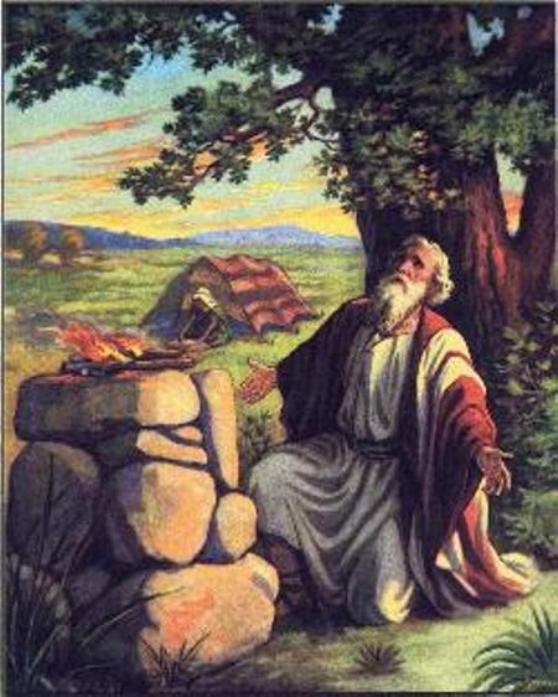
You can be sure that the promise of God is solid, and that we are seeing the curse of nations who curse Israel beginning before our eyes. In verse 7 of Genesis 12, “Then the LORD appeared to Abram,” God appeared to Abraham. In my interpretation he appeared as the Son (Jesus said in John 8:58,”Before Abraham was, I AM.” He was quoting God speaking to Moses at the burning bush in Exodus 3:14). God appeared to Abram! Think on that for a moment. The El-Shaddai, the I AM, the ALMIGHTY, appeared to a man, walked with him, spoke to him, comforted him, and commanded him. It is a shuddering thought to ponder the gravity of those moments. That gravity was not lost on Abraham, who built altars to Him all over the Land wherever he went. Abraham did not build houses for himself, he built altars to God.
Then the LORD appeared to Abram and said, “To your descendants I will give this land.” And there he built an altar to the LORD, who had appeared to him. And he moved from there to the mountain east of Bethel, and he pitched his tent with Bethel on the west and Ai on the east; there he built an altar to the LORD and called on the name of the LORD. So Abram journeyed, going on still toward the South.
Abraham built altars right away, to mark his obedience to the LORD, and to sacrifice and worship. When Abraham came back from Egypt, “to the place of the altar which he had made there at first. And there Abram called on the name of the LORD.” (Genesis 13:3-4) which is another way of saying worship and sacrifice. When Abraham and Lot had separated and Abram moved to the region of Hebron, he “built an altar there to the Lord” (Genesis 13:18).
EPrata photo
Abraham corresponded with the LORD by building altars for worship. Building an altar is an intentional, physical act. Worshiping on front of an altar is an intentional, physical act. When Abraham returned from Egypt, Abraham saw the altar he had originally made and ‘called on the name of the LORD’ in worship and thanks. In this case, the altar was a reminder of his relationship with the great I AM.
We do not need to build altars in these New Testament times, but we do need to be as dedicated and as intentional as Abraham in our relationship with God and Jesus and the Holy Spirit. You note that when Abraham and Lot separated, there was no mention of Lot building an altar to the LORD.
EPrata photo
Lot was with Abraham when Abraham got the calling from God (Genesis 12:5) and was with Abraham throughout the blessing of his peoples’ increase. Lot saw God working in his family’s life. He reaped the blessings of Abraham’s obedience. But Lot did not build an altar. And from the biblical record we see how the distance between man and God can slowly grow when we fail to consistently correspond with the LORD.
Lot crept toward Sodom, closer and closer he pitched his tent, until he was finally living inside the city with all its sin and perversity. Though the sins of the city grieved Lot greatly (2 Peter 2:6-8) Lot did not build an altar. And in the end, Lot lost his city, his possessions, his family, his wife, (“Remember Lot’s wife” Luke 17:32) and sin fell upon his daughters, who lay with their father in perverse sin.
We do not build altars … but we pray. Our part of the correspondence between ourselves and God/Jesus/Holy Spirit is maintained through prayer, corporate worship, and fellowship in the body of the believers. Is your heart an altar to I AM? Do you pray constantly? Do you worship in faith and obedience, as Abraham did? No? Remember Lot’s wife.
Sequester a place where you pray, erect a wall around the dedicated time you pray, build an altar of prayer in your life and you will be blessed by the presence of the I AM Himself!!! He is with you, lo, even to the end of the age.
It’s High Summer here in the US now. It’s vacation week for many people, and there’s a holiday coming up. I’m going to re-post some angel essays I’ve done in the past. So, it’s Angel week here on the blog!
Chris Koelle, illustrator The Angel speaking with John on Patmos
Angels figure very, very prominently in the NT. People don’t really know this, or they overlook angels in the Bible. But once you see how often they are out and about, you can’t unsee it. At the other end of the scale, some are so preoccupied with angels they nearly fall into angel worship.
Once you start studying angels, you realize how frequently they are mentioned in the New Testament. And as for the nativity story, make many appearances! So let’s get to know these incredible beings better.
Be not forgetful to entertain strangers: for thereby some have entertained angels unawares. (Hebrews 13:2 KJV)
From the Bible, we know that God created angels. (Colossians 1:16-17). We know that angels interact with humans at the behest of God. (Luke 1:26-38). They deliver messages. (Daniel 9:20-23). They fight for territory. (Daniel 10:20). They guard humans (Matthew 18:10) and report to God on the actions of children, anyway (Matt. 18:1-14) and perhaps to individually minister to adult Christians also (Hebrews 1:14).
cherubim, mosaic, Mont Sainte-Odile, Alsace, France
Angels are divided into hierarchies and troops, including both good and evil angels, and special categories such as cherubim, seraphim, and the archangel. They are invisible. (2 Kings 6:17). They look like men sometimes, (Genesis 18:1-2) and other times they look like glory (Matthew 28:2-4) and other times they look like metal and lightning (Daniel 10:5-6) and still there are other angels who look completely unusual and beyond description (Revelation 4:6-8). [For the record, with one debatable exception, angels are not biblically described as having any wings]
Surely, it is a blessing that there is a class of created being whom God uses for His glory and for our help. It is a blessing also to think that we may entertain one of them at some point in our lives!
It is not well for us to miss the opportunity of the presence, the conversation, and the prayers of the good. The influence of such guests in a family is worth more than it costs to entertain them. ~Barnes’ Notes
But do not forget, there is another class of angels. There was a rebellion in heaven, and the highest angel, one created to guard the throne itself, tried to vault himself above God and was kicked out of heaven for it. His name is Lucifer, whose title is now the devil, adversary, satan. And even though a third of the multitudes of angels lived with God, and saw His glory and knew His heart, Lucifer was apparently so convincing that they sided with him against God, and so they were kicked out too. (Revelation 12:3-4,9)
Not everything supernatural is from God! If you entertain angels unawares, it may be a good angel sent to minister to you. Or it may be a fallen angel, sent by satan to thwart you, deceive you, or hinder you. (also 1 Tim 4:1-3; 2 Cor.11:13-15) “And no wonder, for Satan himself masquerades as an angel of light. It is not surprising, then, if his servants masquerade as servants of righteousness. Their end will be what their actions deserve.” (2 Corinthians 11:14-15).
In this we must be wise as serpents and innocent as doves. Barnes’ Notes again:
If there is danger that we may sometimes receive those of an opposite character. yet it is not wise on account of such possible danger, to lose the opportunity of entertaining those whose presence would be a blessing.
If you are reading this whether you are a Christian or a non-believer, be aware that deceit comes in a guise wrapped in a beautiful package. Fallen angels would look just like the glorious angels, as stated above in the Corinthians verse. If you are a Christian, you should be praying daily to receive wisdom, and it will be given to you without reproach.
You should be in the Word daily so that you will know the truth from a lie. Without His help, you are at the mercy of an adversary who can and does ‘appear to us unawares’ and always for the purpose of destroying us!
NOT EVERYTHING SUPERNATURAL IS FROM GOD!
Angels might surround you unawares, and it surely would be a blessing to discover in the hereafter that you’d entertained a Holy Angel!
I read Isaiah 23. In it, was Isaiah’s prophecy against Tyre. Tyre was a major city on the coast, to which many ships from afar brought their goods to trade and sell. Tyre was held in high esteem by all around. (Isaiah 23:8). It had prestige and renown. Is this your exultant city whose origin is from days of old, whose feet carried her to settle far away? 8Who has purposed this against Tyre, the bestower of crowns, whose merchants were princes, whose traders were the honored of the earth? 9The LORD of hosts has purposed it, to defile the pompous pride of all glory,c to dishonor all the honored of the earth. (Isaiah 23:7-9)
When a city becomes so vaunted, the leaders of the city become proud. Hence the reason for Isaiah’s oracle against Tyre. (Isaiah 23:9). They attributed their success and fame to themselves, and not to God.
Empire State Building, view from the East River. EPrata photo
This situation reminded me of the scene in Daniel 4. King Nebuchadnezzar displayed the same problem.
and the king answered and said, “Is not this great Babylon, which I have built by my mighty power as a royal residence and for the glory of my majesty?” (Daniel 4:30).
He attributed the city of Babylon’s success and fame to himself, and not to God. For his selfish boastfulness and pride, God determined to remove the kingdom from Nebuchadnezzar for 7 years, wherein he would live among beasts as a mad person and eat the grass of the field. When 7 years was over, God restored reason to the king and also the kingdom. Nebuchadnezzar praised God for all His glory.
When we see the glittering towers of the city, its cathedrals, towers, strongholds, and castles, we tend to become proud of our accomplishment in building them. We admire the Eiffel Tower, the Statue of Liberty, the Sears Tower, the Windsor Castle, the Taj Mahal… We enlarge our sea ports and construct airports and enjoy the trade and commerce merchants willingly bring to the city.
We applaud man’s ingenuity in building these majestic buildings, we love the fame and renown these landmarks bring to the city and we become boastful inhabitants. But we forget that we have no strength of our own, and no intellect, or ability unless God grants it.
EPrata photo
Tyre was razed in 332 BC when Alexander the Great conquered it. And Babylon, we know was felled in one night as described in Jeremiah 51:8 and Daniel 5:30.
If a prophet were to prophesy today, what oracle might be spoken about New York City? Los Angeles? Paris? Beijing? Tokyo? Ezekiel 38:20 prophesies a future day when all walls will crumble to the ground. This page shows how many times God said He will destroy a city for its pride and rebellion. We know He destroyed four Cities of the Plain in one night, Sodom, Gomorrah, Admah, Zeboiim.
The end result of pride, is destruction. This is reiterated in the New Testament, in today’s reading of Matthew 11. There is a section between verses 20-24 called “Woe to Unrepentant Cities” such as Chorazin, Bethsaida, Tyre, Sidon, and Capernaum.
Pride goes before destruction, and a haughty spirit before a fall. (Proverbs 16:18). The verse applies to cities as well. The Isaiah verse we’d read yesterday is warning about this.




 the-end-time.org