Should Protestants use prayer beads? Part 1 here
 |
| Free wallpaper |
In the previous part 1, I’d laid out the history of prayer bead use. It is a practice that comes from other religions such as Islam, Hinduism, Buddhism, Catholicism, and Wicca. It has been imported to Christianity by syncretistic and now by ecumenical means. It is a self-help practice that is actually the opposite of what Jesus told us to do in prayer.
Kristen E. Vincent is a prayer bead maker and a prayer bead book author. I was struck by her article at Patheos, titled Prayer Beads: Yes, It’s OK for Protestants. In her article, she makes the case that using the bead technique is a helpful and biblical prayer tool. How? She uses Numbers 15:39. She never cites it in the article nor does she explain the verse correctly. The verse is taken out of context and applied incorrectly to today’s Christian. More on that specifically in a moment. Let’s look at the general discernment practices first.
Rule #1 for people to twist the bible when teaching, is to cite something from the Old Testament. Many people do not read the OT, they are not taught the OT, and their preacher rarely preaches from the OT. So when a person claiming authority or knowledge comes along and references something in the Old Testament, most people take it at face value. This is why it is SO important for you to read all the bible. Unfamiliarity always works against you.
Rule #2 for twisting scripture: reference that it’s in the bible, but don’t present the verse from the bible. Many people won’t look it up for themselves. They don’t know how, they don’t have the time, or they are lazy. It took me a minute or two to open to Numbers 15 and then find the verse she was talking about. At least she gave the book number. Many bible twisters don’t even to that much, making it even harder to find the verse they are talking about. Which is the point.

Rule #3 is to rip the verse from its context to make a personal application. Many, many bible teachers are doing that with the Old Testament these days. Rachel Held Evans and Beth Moore are two obvious recent offenders. Old Testament passages are either allegorized, or are directly applied to New Testament Christians. It takes study, nuance, understanding, and patience to learn the OT and which parts directly apply to us. Yes, all scripture is profitable, but there is a reason why NT Christians today eat shellfish and don’t build booths for Sukkot.
Here is an excerpt of Mrs. Vincent’s case for using prayer beads:
As the years passed and they got more and more tired of being hot and sticky and thirsty, they began to rebel. They even argued with God, saying they would be better off as slaves back in Egypt. They were beginning to think God had abandoned them.
In response, God told them to take up the fringe on their garments. Bet they didn’t see that coming! How could fringe help them in this situation? But God understood the Israelites were physical beings. Even though God had promised to be faithful and always be with them, God knew the Israelites would get so focused on being hot and miserable and forget God’s promises. God knew they needed something tangible – physical – to hold onto and remind them that God was with them. So God told them to take up fringe – a common, ordinary, everyday object – and hold onto it when they needed comfort, guidance, assurance, love.
So the upshot is that prayer beads are OK to use because:
–they’re kind of in the bible,
–the Israelites used them because they were hot
–God wanted to give them something tangible to show He loved them (as opposed to a Teddy Bear?)
Here is the actual verse:
And it shall be unto you for a fringe, that ye may look upon it, and remember all the commandments of the LORD, and do them; and that ye seek not after your own heart and your own eyes, after which ye use to go a whoring: (Numbers 15:39)
Here is what is going on in context. Context means, when you read a verse, read the entire page. Read before and after the verse. Even better, read the whole chapter. Gain an understanding from the introduction to the book of the reason for the book, its theological themes, purpose, and audience. That’s context.
The first 25 chapters of Numbers records the death of the first Israelite wilderness generation. The remainder of Numbers records the replacement of the second generation. The book, then is a transition from sin and judgement (Num 1-25) to redemption (Num 26-36). Though the Israelites grumbled and complained, God did not forsake them. He punished them, but He provided for them. In this first part of Numbers, He did so mainly by delivering commands and expecting them to keep them. When they didn’t, He punished. (Paraphrased from Introduction to the Old Testament, Dillard)
In the Law of the Tassels, God told the Israelites to look at the fringe to remember Him and His commands. This was so they could obey. If they obeyed, they would not be killed, (Numbers 15:31), like the Sabbath-breaker in the verse immediately prior to the fringe verse was, or Korah’s group of 250, immediately after, 2 verses later.
 |
| The Sabbath-Breaker Stoned, c. 1896-1902, by James Tissot |
The Numbers 15 chapter is consumed with details about unintentional sin and of presumptuous sin. As a matter of fact, since the fringe verse comes immediately after the Sabbath-breaker’s stoning, it can be said that the fringe was given so they would remember the punishment, and in so remembering, obey. So absolutely it was not because they needed a loving hug. The context is sin, judgment, and death. The fringe was not given because the Israelites were “hot and sticky.”
The author of the Prayer Beads article then dispenses with the bible and presents three secular reasons for using prayer beads.
When people use prayer beads, isn’t the focus on the beads rather than God? No. The focus is on developing and going deeper into one’s relationship with God. That’s what prayer is about. The beads are just a tool to facilitate that.
If a tangible item can help deepen my relationship with God (as opposed to faith, obedience, and the Holy Spirit) then it stands to reason that more prayer beads will help me go even deeper. Perhaps I will buy a longer prayer bead string than my pew sister has. Then I will be very pious. That is the logic the Pharisees used. See, the author did not show what happened in the end to the Israelites who “needed something tangible to help them remember”. By the end of the Age of Law, the Pharisees had lengthened their tassels to show their very, very, deep, deep relationship with God. Jesus called them out on this. He called them hypocrites.
Here is John MacArthur on the Law of the Tassels, and of taking an internal intangible and making it tangible action:
They understood that that was symbolic of having the law of God in your mind, that’s thought, and having the law of God applied in your action, that’s work, that’s living….But about 400 B.C. some Jews decided that they needed to make that internal principle of the law of God in the mind and in the behavior an external act.
Barnes Notes shows us the end of the story, a story of which Mrs Vincent only showed the beginning of. This is another discernment lesson. False teachers only show part of the story. They omit the parts that don’t fit their pet theory. Not only were the fringes ordered to help them obey so they would not be judged, at the close of the Age of Law, we see how devastatingly man takes that tangible and corrupts faith with it. Barnes:
The arrangement of the threads and knots, to which the Jews attached the greatest importance, was so adjusted as to set forth symbolically the 613 precepts of which the Law was believed to consist. In our Lord’s time the Pharisees enlarged their fringes Matthew 23:5 in order to obtain reputation for their piety.
So did the fringes keep Korah from disobeying? No. Did the fringes keep the Pharisees mindful? Hardly. Fringes with knots didn’t work.
In the second of three secular reasons we are told prayer beads are OK to use, Mrs Vincent said,
How can they help? For starters, how many of us have begun a prayer, only to realize a minute later that we’re making the grocery list instead? Feeling the beads can help you maintain your focus in prayer. How many of us have rushed through the day and forgotten to pray? Seeing the prayer beads lying on a table, we are reminded to take time to sit with God. And how about those times when we, like the Israelites, feel lost and abandoned in the wilderness places of life? We can hold onto the beads and know that God is as close as the beads in our hands.
We do not need a man-made thing to remind us of our faith. We have a new covenant, one which Peter writes about:
This is now the second letter that I am writing to you, beloved. In both of them I am stirring up your sincere mind by way of reminder, 2that you should remember the predictions of the holy prophets and the commandment of the Lord and Savior through your apostles, (2 Peter 3:1-2)
We have the scriptures to stir our memory! Peter told them their minds will be stirred by remembering the Old Testament (Prophets) and by this New Testament, (through his epistle) and the Apostles (and by extension their epistles when they were canonized). He did not say that prayer beads will help them remember. He said the scriptures will.
The third reason we are told that it is OK to use prayer beads is this:
Why are beads even necessary in prayer? After all, we Protestants have been praying just fine without them all these years. Indeed. And certainly, not everyone will want or need to use beads in prayer. But many people struggle with prayer; they don’t know what to say or how to go about it. Prayer beads can offer structure, a path, a safe place even, for prayer.
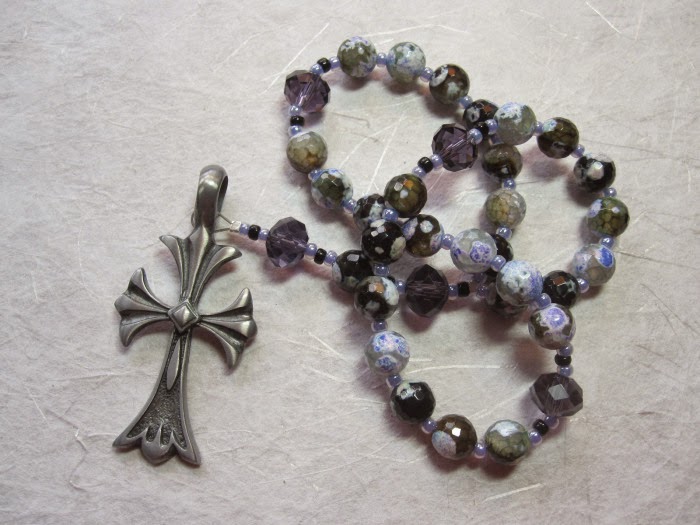 |
| Source |
First, raise your discernment when anyone introduces a new way to do things. Jesus and the Apostles set the standards for holy living, faith, and practice. Anyone who has a new and shiny idea is always going to be wrong.
Secondly, prayer beads will help us pray safely? If I send some stringed beads to the Chinese Christians, or the Iraqi or Syrian Christians, they will then have a safe place to pray? You see how ridiculous it is to apply First World terminology to the global church’s faith and practice.
Third, the ‘path’ is laid out by scripture. Even more specifically, it is laid out in the Lord’s prayer. (Matthew 6:9-13)
Last, as for struggling with prayer, I know many people do. I do sometimes. That is why we have the Holy Spirit.
But the Helper, the Holy Spirit, whom the Father will send in My name, He will teach you all things, and bring to your remembrance all that I said to you. (John 14:26)
When we struggle, the Spirit is here, inside us, to help us deepen our relationship with the Father. Not prayer beads, made by human hands. The precious Advocate will help.
Likewise the Spirit helps us in our weakness. For we do not know what to pray for as we ought, but the Spirit himself intercedes for us with groanings too deep for words. (Romans 8:26).
Are you going to look Jesus in the eye, who sent the Spirit to help us in our groanings, and say, ‘Nah. I’m good. I got my beads.’ Discernment alerts should always raise in your mind when someone tries to get you to do things in your own strength, and it takes your eyes off Jesus in the process.
 |
| Free wallpaper |
And let us not forget Jesus is our intercessor, we must have faith that our prayers reach the ears of the Father by having our High Priest intercede for us. Why would I want to perform in my own strength, with some man-made clay or glass beads, when I have Jesus and the Spirit to help me in my struggle?
A discerning commenter, praise God, said this on the site where the essay was published
Mestes • 3 days ago
Let’s all try to remain focused on the topic at hand. There are a couple problems with this blog entry: 1) We’re being told that Numbers 15 in the Bible is talking about something that it clearly is not. 2) The author of this blog entry happens to make and sell said “Prayer Beads”. This article is not a deeply theological expression of a particular viewpoint meant to edify the body of Christ or glorify God in any way. It is nothing more than an advertisement for a product. As far as the personal use of beads or notes or whatever, I’d say use whatever you want. But don’t twist scripture to say God gave fringe to Israel as a gift. That didn’t happen. Don’t imply that the use of your “Prayer Beads” will deepen or do anything to develop your relationship with God. It won’t. As far as ecumenism: It absolutely is a way of blurring lines between Christianity and Roman Catholicism. That is clearly the undertone of this article (i.e. the title and the last sentence: “Even for Protestants”) And if you’re forgetting to pray, it’s not because you don’t have “Prayer Beads”. Christians don’t “forget” to pray, as though it’s an obligation. Christians pray because it’s the lifeblood of our relationship with the God of the Bible.
——————————————-
Further Reading
What are prayer beads? Is it okay to use beads while praying?


 the-end-time.org