Posted in color run, discernment, hindu, holi, pagans

Of Church Color Runs and Hindu Holi Festivals

This week I’ve been writing about rituals and practices that Christianity has imported from pagan religions, specifically, coloring mandalas. Here is a list of these practices I’ve mentioned or written in the past months–

Prayer beads (Catholic, Buddhist)
Coloring mandalas (Buddhist, Hindu)
Bible art journaling, (Celtic, Islamic Illumination)
Labyrinths  (Catholic, goddess religions)
Circle making (Wicca, earth religions)
Contemplative prayer (Eastern religions, New Age cults)
Lectio Divina (Mystic Religions, Catholic)
Yoga (Hindu)

A freiend made me aware of another Hindu practice that is popping up in Christian activity schedules. It’s “The Color Run.” Many churches sponsor a 5K run for fun, health, or fundraising. This is great. These runs are a lot of fun and bring the community together. However, The Color Run has a specific feature added to it specifically ripped from a Hindu festival.

In “The Color Run, The Happiest 5K on the Planet”, as it dubs itself, runners are doused with colored powder at various locations during the run. The US Company describes The Color Run-

WHAT IS THE COLOR RUN?

The Color Run, also known as the Happiest 5k on the Planet, is a unique paint race that celebrates healthiness, happiness, and individuality. Now the single largest event series in the world, The Color Run has exploded since our debut event. We have more than tripled our growth, hosting more than 225 events in 35+ countries in 2015.
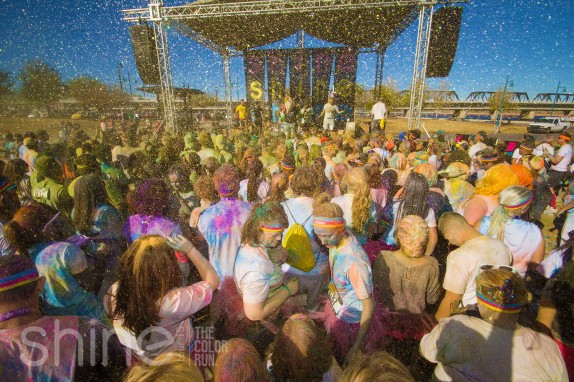
The Color Run, Tempe Arizona

Is The Color Run terrible in and of itself? Of course not. However, churches are now doing The Color Run and they should know that the Paint Race is certainly NOT “unique” as they stated. It is actually a Hindu festival and has been performed as a ritualistic celebration of victory of good over evil for two thousand years. Named Holi, the festival is

a spring celebration of love, frolic, and colours.

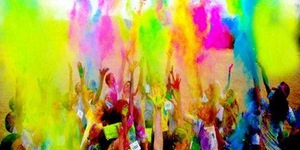
Holi celebrations start on the night before Holi with a Holika bonfire where people gather, do religious rituals in front of the bonfire, and pray that their internal evil should be destroyed as the bonfire starts. The next morning is celebrated as Rangwali Holi – a free-for-all carnival of colours. where participants play, chase and colour each other with dry powder and coloured water, with some carrying water guns and coloured water-filled balloons for their water fight.

Holi celebration at Sri Radha Krishna Temple, Utah, US. Wikipedia

Here is the explanation of why colors are used in the Holi celebration. It’s convoluted, but it gives a sense of the deep pagan origins of this ritual. In sum, Holi is short for “Holika”, the evil sister of the demon king Hiranyakashipu. The demon king began to grow arrogant, thought he was God, and ordered everyone to worship only him. There was battle between those who were loyal to demon king Hiranyakashipu and those loyal to Lord Vishnu. Hiranyakashipu’s own son was loyal to Vishnu and as a result he was cruelly tortured by Hiranyakashipu. Hiranyakashipu’s evil sister Holika tricked her nephew Prahlada into sitting on a pyre, while she was encased in a cloak that made her immune to the flames. But the cloak flew off her and onto Prahlada, and thus Holi was burned and Prahlada survived. Some other Lords and gods arrived to finish the deal and vanquish the usurper Hiranyakashipu. The next day, when the fire had cooled down, people applied ash to their foreheads. Eventually, coloured powder instead of ash came to be used to celebrate Holi.

The problem comes when churches mindlessly adopt this activity without knowing it is actually an important Hindu spring ritual. First Christian Church of Dyersburd wrote in their promotion of their “Color Run,”

How does a color run work?

All runners start out squeaky clean, decked out in white garb. During the run, color stations will be set up periodically throughout the course. At each color station, our “highly skilled” and “highly trained” paint throwers will toss paint powder on the runners going by. Note: do not slow down or stop in the color stations, as this causes a bottleneck for the runners behind you. Throughout the race, you’ll be painted several times in several colors, resulting in a highly hued, highly energized runner. Once the race is over, all participants will gather for a mass paint throwing (think Lebron James meets Rainbow Bright). Afterwards, stick around for a celebration including food & drink, music, and hundreds upon hundreds of selfies.

I am not judging anyone who has participated in a Color Run. I would hope that Churches would not adopt the Hindu celebration of Holi as a Western version of a celebration/festival/5K run. However most of the church sites that I have looked at do conclude the Color Run afterwards with food, music, dancing, and other frolics, making the Hindu Holi Fest and the Church 5K virtually indistinguishable. Please refer to the photos above of the Hindu Fest and the Church Color Run if you disagree.

I’m not against fun, but adopting a Hindu practice to have that fun is allowing the world to enter the Church. We can have our own fun as Christians, without the unnecessary layer of a pagan festival. My personal opinion is that churches should not adopt this ritual, and if they do, they should let their people know its origins so their people can make informed decisions as to whether or not to participate.

Do not worship the Lord your God in the way the pagan people worship their gods (Deuteronomy 12:4).
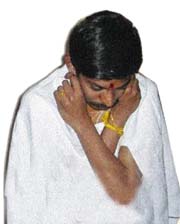
Thoppu Karanam in India
AKA ‘Super Brain Yoga’ in US

As for the practice of ripping off another culture’s practices, that is another discussion entirely. Last year when the Hindu Practice of Thoppu Karanam was ripped from Hindu Prayer Practices and re-made into American Super Brain Yoga, one Hindu man opined,

The legend behind “Thoppu Karanam” is that Lord Vishnu performed this “Thoppu Karanam” in front of Lord Ganapathi to recover his “Sudarshan Chakra” which was snatched by Ganapathi. Thus, Thoppu Karanam is performed as a prayer before Lord Ganesha by holding the hands crosswise across the chest with the fingers holding the earlobes and bending down and then getting up. 

Interestingly, the “Thoppu Karanam” has now attained international status thanks to fellow Americans who now call this as “Super Brain Yoga”. They have found through medical research that doing these special kind of sit ups while holding the opposite earlobes stimulates the brain power and increases the memory power. I hope they will not charge us while we perform Thoppu Karanam.

Satan is the most cunning and subtle animal in the Garden. (Genesis 3:1), His wiles are legendary. Ephesians 6:11 says “Put on the whole armor of God, that you may be able to stand against the wiles of the devil,” Should t we be doing our utmost not to mirror the world? Shouldn’t we be working hard to be a distinct people, and not engage in even what seems like a pagan ritual, never mind an actual pagan ritual? How many times were the Israelites warned not to delve into the pagan practices in Egypt? (Lev 18:3). Idol worship was a powerful temptation, and it still is.

The Expository Files explain:

Our English word ‘wiles’ is generally used to express deception through trickery and includes all the methods that would be part of that. It has to do with cunning or skill applied to no good purpose. The word ruse is a synonym with stress on the creation of a false impression.

Ephesians 4:14 says “so that we may no longer be children, tossed to and fro by the waves and carried about by every wind of doctrine, by human cunning, by craftiness in deceitful schemes.”

Gills reminds us of how stealthily satan brings his wiles to bear in “cunning craftiness”,

which not only suggests that their principal end in view is to deceive, but their insidious, private, and secret way of deceiving, and their expertness in it, which they have from the devil; and now the ministration of the Gospel is the best and surest guard and antidote against such fluctuations and deceptions. 

Please read the rest of the Bible.org essay above to learn more fully just how satan uses his wiles to trick us – and be sure that importing pagan rituals into Christianity is one such wile – and read how we can stand against such an enemy.

—————————————–

Further Reading:

Should a Christian participate in a ‘Color Run?’

Which is the Holi Celebration and Which is the Color Run?

© Western New Mexico University

Mumbai, India
Church Color Run

Posted in contemporary music, corinth, pagans, worship

"Is Your Church Worship More Pagan than Christian?"

Todd Pruitt wrote a great article titled, Is Your Church Worship More Pagan than Christian? It begins this way,

There is a great misunderstanding in churches of the purpose of music in Christian worship. Churches routinely advertise their “life-changing” or “dynamic” worship that will “bring you closer to God” or “change your life.” Certain worship CD’s promise that the music will “enable you to enter the presence of God.” … The problem with the flyer and with many church ads is that these kinds of promises reveal a significant theological error. Music is viewed as a means to facilitate an encounter with God; it will move us closer to God. In this schema, music becomes a means of mediation between God and man. But this idea is closer to ecstatic pagan practices than to Christian worship.

Yet in the years since then I have learned some valuable lessons. Chief among them is the realization than an emotional high is no substitute for true spirituality. paperthinhymn
Pruitt continues by explaining the theological errors of churches that use music as a mediator between the people and Jesus. Of course there are further explanations in the article. I recommend it highly. Here are a few more excerpts,

1. God’s Word is marginalized.
In many Churches and Christian gatherings it is not unusual for God’s Word to be shortchanged. Music gives people the elusive “liver quiver” while the Bible is more mundane. Pulpits have shrunk and even disappeared while bands and lighting have grown. But faith does not come from music, dynamic experiences, or supposed encounters with God. Faith is birthed through the proclamation of God’s Word (Rom 10:17).

2. Our assurance is threatened.
If we associate God’s presence with a particular experience or emotion, what happens when we no longer feel it? We search for churches whose praise band, orchestra, or pipe organ produce in us the feelings we are chasing. But the reality of God in our lives depends on the mediation of Christ not on subjective experiences.

3. Musicians are given priestly status.
When music is seen as a means to encounter God, worship leaders and musicians are vested with a priestly role. They become the ones who bring us into the presence of God rather than Jesus Christ who alone has already fulfilled that role. Understandably, when a worship leader or band doesn’t help me experience God they have failed and must be replaced. On the other hand, when we believe that they have successfully moved us into God’s presence they will attain in our minds a status that is far too high for their own good.

4. Division is increased.
If we identify a feeling as an encounter with God, and only a particular kind of music produces that feeling, then we will insist that same music be played regularly in our church or gatherings. As long as everyone else shares our taste then there is no problem. But if others depend upon a different kind of music to produce the feeling that is important to them then division is cultivated. And because we routinely classify particular feelings as encounters with God our demands for what produce those feelings become very rigid. This is why so many churches succumb to offering multiple styles of worship services. By doing so, they unwittingly sanction division and self-centeredness among the people of God.

Source

The pagan music practices to which Mr Pruitt was referring were described in several different ancient writings and modern commentaries.

The cult of Dionysus coming from the northland spread in a great wave of religious enthusiasm over Greece proper, over the island states of the Aegean, and across to the mainland of Asia Minor. At first it met with violent opposition, as the legends of Lycurgus and Pentheus prove. In those early days rarely was the god graciously received as he was, for example, by Icarus in Attica. In spite of opposition, however, the contagious enthusiasm of the wine-god spread with unusual rapidity throughout Greece. In order to restrain Bacchic excesses the city-states of Greece had no other alternative than to adopt the Cult, bring it under state patronage, and by official regulation temper its enthusiasm somewhat. At Delphi Dionysus was associated with Apollo, and there the sacred maidens went mad in the service of the two gods. In Athens he entered into civic partnership with Athena and yearly wedded the Basilinna. At Eleusis he was brought into relation with Demeter and led the march of the candidates along the Sacred Way from Athens. In Teos and Naxos he even became the paramount state deity, the “god of the city” and “protector of the most holy state.”

It was as a private cult, rather than as a state religion, however, that the worship of Dionysus made its deepest impression on both Hellenic and Hellenistic life. In the private brotherhoods, the natural emotions aroused by the cult practices were allowed free play and the guaranties offered to initiates were of a very realistic order; hence the appeal of the cult was strong, particularly to the masses and to women generally. At the beginning of Aristophanes’ comedy, Lysistrate, impatient with waiting, complains that if the women had been invited to the shrine of Bacchus “there would be no getting along for the crowd of timbrels.” Indeed, the prominence of women in the worship of Dionysus is one of the most striking features of the cult. Pagan Regeneration,  A Study of Mystery Initiations in the Graeco Roman World by Harold R. Willoughby, [1929]

Timbrels are an ancient kind of tambourine. The quote meant that if all the women were invited there would be so many clogging the streets with their tambourines, no one would be able to pass by.

The result of pagan cultic worship, especially Dionysian worship, was a frenzied scene at the temple, and a cacophony that permeated the city from on high to down low.

Menander demonstrates women’s role in pagan worship:

‘We were offering sacrifice five times a day, and seven serving women were beating cymbals around us while the rest of the women pitched high the chant (olulugia)’ (Fragment 326).

In Daniel 3:4-6, the passage is talking about King Nebuchadnezzar and his command that all peoples worship him. To that end, he had made a statue and commanded all to worship before it. In the commentary on the verses, James Burton Coffman Commentary (1992) expounds,

the Temple of Aphrodite Pan Demos, located atop the Acro Corinthus, encouraged the patronage of their one thousand sacred prostitutes by a cacophonous blast of instrumental music five times a day, signaling that, the prostitutes had changed their clothes and that another feast on the sacrifices had been made ready. In our own times, with the continued degeneration of the whole science of instrumental music into the vulgar rhythms and noisy cacophony of the current era, such later styles of instrumental music are impossible of reconciliation with any conception whatever of holy worship.

Hear hear. We have come full circle from the days of the AccroCorinth temple worshipers’ ululations and frenzied dancing, to the same today in many Charismatic and other ‘churches’. It wasn’t acceptable then and it isn’t acceptable now. In 1 Corinthians 14:33-34, Paul said,

For God is not a God of confusion but of peace. As in all the churches of the saints, for God is not a God of confusion but of peace, as in all the churches of the saints. The women are to keep silent in the churches; for they are not permitted to speak, but are to subject themselves, just as the Law also says. GotQuestions explains,

The concern of 1 Corinthians 14, and much of the epistle, is order and structure in the church. The Corinthian church was noted for the chaos and lack of order rampant in that assembly (verse 33). It is interesting that no elders or pastors are mentioned in the book, and the prophets who were there were not exercising control (see verses 29, 32, 37). Everyone in the church service was participating with whatever expression they desired, whenever they desired. As a result, those with the gift of tongues were speaking simultaneously, those with a revelation from God were shouting out randomly, and no one was concerned with interpreting what was being said, even if what was said could be heard above the din. The meetings quickly descended into chaos.

The Temple at Corinth and other places in the realm were already hotbeds of female chaos, musical cacophony, and wild dance. Women in the pagan temple were temple prostitutes. Part of their worship used music not only as a call to prostitution but as a method of working themselves up (to madness in many cases) and in a fever pitch, unite with the divine. If music did not have that capability the cult of Dionysius would not have spread so quickly and have been so well-known at Corinth as a synonym for debauchery. Christians must be vigilant about music being used to promote feelings and subjective experiences rather than to explain doctrine and praise the Savior. It all too quickly leads to chaos and worse, as Paul warned and as we see in the pagan cultic worship sessions.

Temple of Athena

Paul urged order in the church and the women to remain submissive. This would be an incredible contrast to what was happening in the immediate culture at the pagan temples, and further give Christianity its distinctive stamp.

So that was a short course in pagan worship and the influence music had on it back in the ancient days. When you read a title like Is Your Church Worship More Pagan than Christian? we can easily see that many of the chaotic, music-inflamed services at many churches, youth conferences, and revivals are indeed exactly like the pagan worship at Corinth, and are exactly what Paul railed against.

The point of the article is that when music is used ‘to bring us closer to God’, it actually separates us from God by instilling a false worship, the worship of emotional highs and subjective feelings. It often is used as an intermediary, or a vehicle, to foment a feeling of closeness with the divine,when all it is really doing is exhausting us with its constant undulations from high to low and high again.

From a youth who has lived the pagan worship and come out alive- barely:

That instead of developing depth it breeds shallowness, immaturity, and confusion. I’ve learned that worship can become the biggest draw for the church, and that worship nights will steamroll over bible studies and adult Sunday school. That a church oftentimes will pour much more resources, energy, thought and time into making a killer worship service than they will into developing deep, thoughtful, meaty, mature, theologically precise and provoking bible studies.

Don’t let that be your church. Music is not worship and it should not substitute for true spiritual depth and relationship with the real intermediary- Jesus Christ.

~~~~~~~~~~~~~~~~~~~

Further reading

How worship music destroyed me. From bitterness to blessing