Posted in Amy Carmichael, India, missionary, Tamil

"Missionary life is simply a chance to die" – Amy Carmichael

By Elizabeth Prata

I’m taking a look at some missionaries this week. It’s refreshing to the soul, I believe, to honor the memory of those who heeded the call to go to strange lands, and devote their life ministering to a strange people. Some did it well (John G. Paton) and some did it poorly (Lottie Moon). There are others who just did it – with obvious results in their life, and others who labored and didn’t have obvious results until they had passed. Some set off for the mission field but died on the way (William Whiting Borden), others spent their decades on the field and never returned home. Some died right away (John Williams and James Harris from the London Missionary Society in 1839, killed and eaten by cannibals on the island of Erromanga only minutes after going ashore). Others spent their entire life being poured out as a drink offering.

The Lord reigns, over the lives of the lost and over the lives of those He specifically commissions to bring the precious cargo of the Gospel Good News to faraway lands.

Amy Carmichael (1867-1951) was a missionary to India. Her mission was to women and children of India and she labored during the first half of the twentieth century.

She was born in Ireland to a well-to-do family, who raised her as a Christian (Presbyterian). In her Methodist boarding school as a young teenager she accepted Christ as savior. Shortly after, her family’s circumstances changed when her father died and the family’s finances were severely reduced.
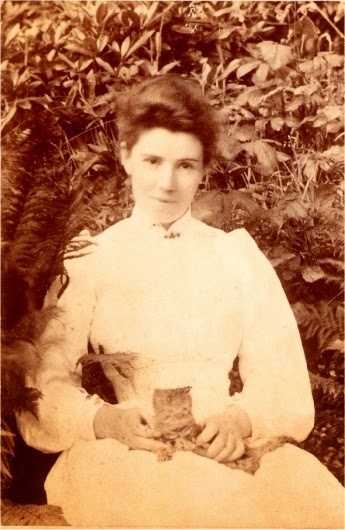
Amy Carmichael As a young woman.
From AmyCarmichael.org

Amy Carmichael As a young women.
From AmyCarmichael.org

She and her mother moved to Belfast, and Amy began visiting in the slums and saw the women there who worked in the factories…or who didn’t work at all. Women who worked in the factories wore shawls instead of hats, and were pejoratively called ‘shawlies.’ Amy’s heart went out to them, and she began a ministry for them in care and love, and fully dependent on the Lord to provide. The church crowd looked down on Amy’s ministry to the slum women and the shawlies and in fact were rather shocked.

A few years later she moved to Manchester from Belfast and formed another ministry to the young women in the factories and the slums. Amy received a call to be a missionary in Japan. However, Amy was not a well women, suffering from neuralgia. She went anyway, but the language was difficult for her. After a period of disappointment in the behavior of the missionaries there and more illness, 15 months later, Amy sailed for Ceylon and then for home, convinced that Japan was a mistake. After a lengthy recuperation, at age 28, she sailed for India.

Once again, Amy became ill, this time with dengue fever, and again, disappointed that the missionary ladies’ meetings were simply tea-drinking gossip-fests. She felt not solely disappointment this time, but despair. However, her early convictions of the Lord’s provision, sovereignty, and love sustained her, and falling to her knees in submission, Amy trusted that the Lord would not leave her desolate.

He didn’t.

Amy Carmichael with Indian children. From “Things As They Are”

Feeling led to move to the very south of India, Amy lived with a Christian missionary family and began an itinerant mission among the people of the slums, just as she had in Belfast and Manchester. Hinduism was very strong there, and with it, temple prostitution of children. Many, many girls were sold to the temples for the ritual perverted prostitution. In 1901, Amy met her destiny.

A young temple prostitute, 7 years of age, had been sold to the temple priests but repeatedly ran away. On this particular time, an older Indian woman brought the runaway to Amy, by then, known as a loving and understanding woman. The girl’s name was Preena, and as she sat in Amy’s lap and talked of the perverted rituals done to her by using the rag doll Amy had given her to demonstrate, Amy became shocked. Upset beyond words, she resolved to love these children sacrificially, and Amy’s mission became clear. She had found her place of service. It was 1901.

For the next 55 years, without furlough, Amy Carmichael rescued young children and women from temple prostitution or from being sold to the gods and goddesses. A few years later, she began rescuing boys, many of them born to the girls who had been prostituted. Once again, as in Manchester, Belfast, and Japan, some of the other missionaries looked down on Amy for loving the unlovable.


Old India, from Carmichael’s “Things As They Are”

Influenced and inspired by George Muller, Amy opened an orphanage, the Dohnavur Mission Orphanage which still ministers today. Many children were thus rescued, taught the Gospel, and loved by Amy and the staff. Soon, Amy was called Amma, which means mother in the native language. She loved sacrificially and constantly.

In addition to her mission work among the children of India, Amy was also known as a poet and a writer. In one of her books, she was so realistic about mission work that her manuscript was rejected. The editor’s note requested a rosier picture. Instead, she didn’t change a thing, but simply re-titled the manuscript, “Things As They Are” and pursued publication with renewed vigor. Of course, the book was eventually published. (You can read it here on Project Gutenberg or order through Amazon).

Even at that, within a few weeks of the publication of Things as They Are, some in England doubted its truth, and notes were sent from different parts of India seeking confirmation of the truths that Amy was sharing about life in the slums, the caste system, ritual temple prostitution, and more.

Here is one such confirmatory note, proclaiming the truths of the ‘more pessimistic’ side of missionary work.

From Rev. T. Stewart, M.A., Secretary, United Free Church Mission, Madras.

This book, Things as They Are, meets a real need—it depicts a phase of mission work of which, as a rule, very little is heard. Every missionary can tell of cases where people have been won for Christ, and mention incidents of more than passing interest. Miss Carmichael is no exception, and could tell of not a few trophies of grace. The danger is, lest in describing such incidents the impression should be given that they represent the normal state of things, the reverse being the case. The people of India are not thirsting for the Gospel, nor “calling us to deliver their land from error’s chain.” The night is still one in which the “spiritual hosts of wickedness” have to be overcome before the captive can be set free. The writer has laid all interested in the extension of the Kingdom of God under a deep debt of obligation by such a graphic and accurate picture of the difficulties that have to be faced and the obstacles to be overcome. Counterparts of the incidents recorded can be found in other parts of South India, and there are probably few missionaries engaged in vernacular work who could not illustrate some of them from their own experience.

Missionary Elisabeth Elliot and her husband Jim were greatly inspired by Carmichael. I wrote of the Elliots and their missionary work in the jungle of Papua New Guinea recently. In an Elisabeth Elliot newsletter from 2002, Elisabeth quoted Amy Carmichael’s realistic challenges of missionary work. She wrote,

“I would never urge one to come to the heathen unless he felt the burden for souls and the Master’s call, but oh! I wonder so few do. It does cost something. Satan is tenfold more of a reality to me today than he was in England, and very keenly that awful home-longing cuts through and through one sometimes—but there is a strange deep joy in being here with Jesus. “Praising helps more than anything. Sometimes the temptation is to give way and go in for a regular spell of homesickness and be of no good to anybody. Then you feel the home prayers, and they help you to begin straight off and sing, ‘Glory, glory, Hallelujah,’ and you find your cup is ready to overflow again after all.”

From her own eye-opening experience of personally reduced circumstances, to further eye-opening first-hand visits to the slums of Belfast, to the disappointments of fellow missionaries and church goers too well-to-do to help the poorest or most downtrodden, to Japan to Ceylon to England to India, which eventually brought her to Tamil region of south India, Amy Carmichael is a picture of sacrificial love and strength through God’s grace and provision. At the end of her life, Amy was bedridden for a period of years. It was at this time she flourished in writing her devotionals and poems and books. There are so many publishers have lost count even as the originals have disappeared. A standard number is that Amy wrote 35 books.

In a letter from a prospective missionary, one young woman asked Amy what it was like to be a missionary. Amy wrote back, “Missionary life is simply a chance to die.”

Amy never returned to England. She remained in India and it was there where she died in 1951. She did not want an elaborate grave nor a tombstone. Her place of bodily rest is marked simply with a birdbath the children erected, and a single word. Amma.

Of Amy Carmichael’s struggles, a very few recounted here. This short essay of a remarkable life does not include the illnesses, riots, rumors, prison threats, arsons against her, and much more. Amy better than anyone knew that missionary life many times meant death, threat of death, or near-death. The Tamils were NOT hungry for the Gospel and in fact called Amy a “soul-stealing woman.” She endured the earthly worst.

However, Amy also exemplified the spiritual best. Every day in India, Amy died to self and sacrificially cared for the country’s cast-offs, abused, neglected and poor. She endured with God’s strength and provision, and she left a legacy that inspired a new generation of missionaries. God always raises up a banner for His name, and for half a century in India, His banner was named Amy Carmichael.

~~~~~~~~~~~~~~~~~~~~~~~~~

Further Reading:

HeartCry Missionary Society: Retrospective on Amy Carmichael’s mission (downloadable .pdf)

Amy Carmichael—A Portrait of Sacrifice

Amy Carmichael: the Torchlighters episode for children

Posted in encouragement, martyr, missionary, phil masters, stan dale

Missionary Moment: 20th century Martyrs Phil Masters and Stan Dale, a story of the Yali and Kimyals

By Elizabeth Prata

in 1855 two German-born missionaries, Carl Wilhelm Ottow and Johann Gottlob Geissler, with the support of Dutch Christians, sailed for the forbidding lands of Dutch New Guinea.

After both the Dutch Indies government and the Sultan of Tidore had given permission, Ottow and Geissler left their schooner Ternate in January 1855. It was there they reportedly fell on their knees to pray and called out: “Im Namen Gottes betreten wir dieses Land” (“In God’s name do we set foot on this land”); after that they went across to the mainland to look at another site, then returned to the ship. Early in the morning of Monday, 5 February, the Ternate anchored off Manaswari to drop them off with their belongings. To this day that date is celebrated as marking the beginning of the Protestant mission in (formerly) Dutch New Guinea. (source)

One hundred years later, missionary work was still going apace in the Dutch New Guinea islands. Yet even by 1955, there were still peoples who had not even been contacted, who had not met with the outside world at all. Several missionaries resolved to correct this.

In 1968, in the same area but with a new name, now called Irian Jaya, Indonesia, two missionaries prepared to leave their mission base and penetrate the Snow Mountains. The Snow Mountains were home to one of the most feared tribes of the area, the Yali. This Stone Age tribe was heavily animistic, deeply superstitious, practiced human sacrifice, and they were cannibals. Very few men had met them and come out alive.

The two missionaries preparing to leave base were Phil Masters from America and Stan Dale from Australia, who had been working out of Korupoon for the previous 6 years. Though progress had been slow, the missionaries had seen some conversions from other tribesmen who had come to faith. For example, Masters’ work with the Kimyal (Kimjal) people had yielded some conversions in 1963 when several of the Kimyal chieftain’s sons had converted. Dale’s work with the Dani had led to conversions also. But not the Yali. They resisted, fiercely.

In this note Stan Dale wrote to his support personnel back in Australia, he said-

“Please continue to remember us in prayer. Unfortunately, there is not much interest where the visible results are small. We trust that something will happen in our areas that will bring glory to God, even though we may be unknown.”

The Yali were a short tribe of people, what we used to call pygmy. The Yali men grew to less than 5 feet, the women a bit shorter. Despite their diminutive stature, they were the most feared tribe in the mountains. They were savage and aggressive, cannibalistic toward other tribesmen not only during in war but sometimes hunting humans just for meat. After killing a person they would chop them, grind their bones and scatter the dust, in order to prevent the person from ‘returning’. As a result of their fearsome demeanor and ferocious acts, the mountain tribes rarely interacted with each other.

However, the language of the Gospel is universal, and while some tribes, like the Kimyal, had been somewhat receptive, Stan and Phil were determined to reach the Yali peoples too. In 1961 on a former trek where the Gospel had been preached to the Yalis along by Stan with fellow missionary Bruno de Leeuw, Stan had been shot with five arrows, and the duo retreated. Now Stan wanted to try again, this time Phil Masters would be his companion. The two men were propelled by an equally fierce conviction that the Yalis needed Jesus, even if at the expense of their own lives.

It was a grueling journey. The geography of the region was challenging, rugged, and isolating. Trekking was arduous. Though the native people would clamber through the dense jungle and trot barefoot up inclines in the rugged terrain, never slipping, the going was harder for the missionary men and their carriers from the Dani tribe. There was one friendly Yali with them.

As the group reached Yali territory, warriors came out of their huts, and menacingly waved their arrows. Undaunted, the group of missionaries and carriers continued. The Yali tribesman with the group observed that a sign had been given that they were to be killed. The group turned around and began trekking back. When they came upon a small, level river beach with rugged mountains towering over them, the Yali let loose a volley of arrows. Stan was hit numerous times, but amazingly, he simply stood. He tore the arrows out of his body, one by one. The volley of arrows continued and still, Stan yanked them out. The Yali became fearful, knowing these men served another God. Their volley of arrows became more intense, fearing more and more the God they served and wanting the men to die so they could quickly escape the area in case there was divine retribution.

Phil was spurred on by Stan, and the two men, who supernaturally had been withstanding an incredible onslaught, finally became too weak to pull out their arrows, and they fell. Several of the carriers were killed also. The Yali chopped the men and ate them, and scattered their ground-up bones so they could not be “resurrected,” a term they had heard before when Stan had shared the Gospel in 1961.

The LeMars Daily Sentinel, September 1968:

PHIL MASTERS REPORTED MISSING ON TREK INTO INDONESIAN JUNGLE  

Phil Masters, author of the Daily Sentinel’s Missionary Diary, is reported missing in the interior of West Irian, Indonesia. A missionary for the Regions Beyond Missionary Union, Phil and his family have spent some six years in the primitive areas of what was once the island of Dutch New Guinea. The island was taken over by Indonesia over three years ago. Mrs. Masters is the former Phyllis Wills, daughter of Mr. and Mrs. Hollis Wills, Seney. It was reported by Phil’s parents, Mr. and Mrs. Tom Masters, Mapleton, were notified Monday morning by telegram that Phil is overdue from a trek into the interior. Although all the details have not been learned, it is believed Phil and another missionary went into the jungle to visit a neighboring village and haven’t been heard from since.

MRS. MASTERS DECIDES TO STAY ON ISLAND; BODIES AREN’T FOUND

Mrs. Ron Severson, LeMars, has received a news release from the Regions Beyond Missionary Union, Philadelphia, with more information about Rev. Phil Masters. The Severson family was one of the interested in LeMars area families in the work of Phil Masters. The union reported the deaths of two of its missionaries in the eastern highlands of West Irian, former Dutch New Guinea, Wednesday, Sept. 25. The date had not been reported previously. Rev. Philip Masters and Rev. Stanley Dale were killed instantly in an ambush by hostile tribes while on an evangelistic trek between the RBMU outposts of Koruppun and Ninia, the missionary union source said.

The society is one of several mission groups working in the interior of West Irian among tribes just emerging from a stone-age culture. A phenomenal response to the message of the Gospel has been witnessed among some of those warring cannibal tribes. Notably, in the Swart Valley alone, since 1960, some 8,000 of the Dani tribe have become Christians, weapons and fetishes have been discarded and literacy has become widespread.

One of the last communications received by the home office from Mr. Dale carried this significant comment—“I have a burden for these places where the way is hard. Please continue to pray for the people of the Holuk that they may break free from their fetishes and declare themselves wholly on the Lord’s side. Please continue to remember us in prayer, for we still carry some heavy burdens that are not burdens of work.”

The Lord blessedly answered the missionaries’ prayers. The various peoples of the Seng Valley in Indonesia have been released from their shackles to a ritualistic and demonic system of fear and death. They are joyously free. Though the burdens Stan and Phil (and Bruno, and the Wilsons who are still there) carried were heavy, they were temporary. The massacred missionaries are now enjoying freedom from their earthy tent of a body and dwell in glory with Christ. The day will come when the two men, shot through with arrows and ignominiously eaten, will receive new glorified bodies and eagerly and joyously greet their brethren the Yalis in heaven. Only the Gospel of Jesus Christ can cause such warm love and dramatic transformational change.

The Lord Jesus Christ loves His people, all peoples, and He died and rose again to bring a message of light and hope to all men. He sends His Spirit to indwell men and some of those, Jesus has set them apart for missionary work to bring the Gospel message to those who are in deepest darkness.

The Korowai people of that area did not emerge into the 20th century nor had they been contacted by any Westerner until 1974. Wikipedia: “The first documented contact by Western scientists with members of a band of western Korowai (or eastern Citak) took place on March 17–18, 1974.”

We are not talking long ago times of unreached people groups. Dutch Christian missionaries immediately began living among the Korowai and the first converts came to Christianity in the late 1990s. You see that the fields are white, the need is deep. These cannibalistic, stone age tribes are still emerging into the present day.

And before the Wilsons who live there now, there was Dale and Masters, and before that Bruno de Leeuw and before that Carl Wilhelm Ottow and Johann Gottlob Geissler…and before that Apostle Paul and before that…JESUS. No matter where one extends the unbroken line of missionaries back, it always ends, or begins, with the first missionary. He left His holy habitation of pure glory to descend to depraved man, bringing the Light and the Hope of the Gospel.

Thankfully, some tribes already have emerged into the Light. Here is a wonderful video of the Kimyal people, whom Phil had worked with, rejoicing when a small plane brought to them their first Bibles in their own language. Below that, the Yali themselves commemorate the day that Bruno and Stan brought the Gospel to them in 1961, which has become their TRUE Independence Day.

The Kimyal Tribe of Papua, Indonesia celebrate the arrival of the New Testament Bible in the Kimyal language:

Youtube summary of video below:
“On May 21, 1961, Stan Dale and Bruno de Leeuw made first contact with the Yali tribe in what is now Papua, Indonesia. In the week of May 16, 2011, the Yali held the Yubileum, or Jubilee: they celebrated fifty years since the coming of the Gospel to their tribe, and fifty years of its transformational impact on their society. This video captures some of the highlights of that celebration, as well as the Holuwon Yalis’ welcome of John and Gloria Wilson and their family, who had lived among them for twenty years:”

~~~~~~~~~~~~~~~~~~~~~~~~~~~

Further Reading

Challies DVD review of The Yali Story

Elisabeth Elliot: Under the Shadow of the Almighty 

Posted in Amy Carmichael, India, missionary, Tamil

"Missionary life is simply a chance to die" – Amy Carmichael

Amy Carmichael (1867-1951) was a missionary to India, and was one of the most respected missionaries of the first half of the twentieth century.

She was born in Ireland to a well-to-do family, who raised her as a Christian (Presbyterian). In her Methodist boarding school as a young teenager she accepted Christ as savior. Shortly after, her family’s circumstances changed when her father died and the family’s finances were severely reduced.

Amy Carmichael As a young women.
From AmyCarmichael.org

She and her mother moved to Belfast, and Amy began visiting in the slums and saw the women there who worked in the factories…or who didn’t work at all. Women who worked in the factories wore shawls instead of hats, and were pejoratively called ‘shawlies.’ Amy’s heart went out to them, and she began a ministry for them in care and love, and fully dependent on the Lord to provide. The church crowd looked down on Amy’s ministry to the slum women and the shawlies and in fact were rather shocked.

A few years later she moved to Manchester from Belfast and formed another ministry to the young women in the factories and the slums. Amy received a call to be a missionary in Japan. However, Amy was not a well women, suffering from neuralgia. She went anyway, but the language was difficult for her. After a period of disappointment in the behavior of the missionaries there and more illness, 15 months later, Amy sailed for Ceylon and then for home, convinced that Japan was a mistake. After a lengthy recuperation, at age 28, she sailed for India.

Once again, Amy became ill, this time with dengue fever, and again, the missionary ladies’ meetings were simply tea-drinking gossip-fests. She felt not just disappointment this time, but despair. However, her early convictions of the Lord’s provision, sovereignty, and love sustained her, and falling to her knees in submission, Amy trusted that the Lord would not leave her desolate.

He didn’t.

Amy Carmichael with Indian children. From “Things As They Are”

Feeling led to move to the very south of India, Amy lived with a Christian missionary family and began an itinerant mission among the people of the slums, just as she had in Belfast and Manchester. Hinduism was very strong there, and with it, temple prostitution of children. Many, many girls were sold to the temples for the ritual perverted prostitution. In 1901, Amy met her destiny.

A young temple prostitute, 7 years of age, had been sold to the temple priests but repeatedly ran away. On this particular time, an older Indian woman brought the runaway to Amy, by then, known as a loving and understanding woman. The girl’s name was Preena, and as she sat in Amy’s lap and talked of the perverted rituals done to her by using the rag doll Amy had given her to demonstrate, Amy became shocked. Upset beyond words, she resolved to love these children sacrificially, and Amy’s mission became clear. She had found her place of service. It was 1901.

For the next 55 years, without furlough, Amy Carmichael rescued young children and women from temple prostitution or from being sold to the gods and goddesses. A few years later, she began rescuing boys, many of them born to the girls who had been prostituted. Once again, as in Manchester, Belfast, and Japan, some of the other missionaries looked down on Amy for loving the unlovable.

Old India, from Carmichael’s “Things As They Are”

Influenced and inspired by George Muller, Amy opened an orphanage, the Dohnavur Mission Orphanage which still ministers today. Many children were thus rescued, taught the Gospel, and loved by Amy and the staff. Soon, Amy was called Amma, which means mother in the native language. She loved sacrificially and constantly.

In addition to her mission work among the children of India, Amy was also known as a poet and a writer. In one of her books, she was so realistic about mission work that her manuscript was rejected. The editor’s note requested a rosier picture. Instead, she didn’t change a thing, but simply re-titled the manuscript, “Things As They Are” and pursued publication with renewed vigor. Of course, the book was eventually published. (You can read it here on Project Gutenberg or order through Amazon).

Even at that, within a few weeks of the publication of Things as They Are, some in England doubted its truth, and notes were sent from different parts of India conforming the truths that Amy was sharing about life in the slums, the caste system, ritual temple prostitution, and more.

Here is one such confirmatory note, proclaiming the truths of the ‘more pessimistic’ side of missionary work.

From Rev. T. Stewart, M.A., Secretary, United Free Church Mission, Madras.

This book, Things as They Are, meets a real need—it depicts a phase of mission work of which, as a rule, very little is heard. Every missionary can tell of cases where people have been won for Christ, and mention incidents of more than passing interest. Miss Carmichael is no exception, and could tell of not a few trophies of grace. The danger is, lest in describing such incidents the impression should be given that they represent the normal state of things, the reverse being the case. The people of India are not thirsting for the Gospel, nor “calling us to deliver their land from error’s chain.” The night is still one in which the “spiritual hosts of wickedness” have to be overcome before the captive can be set free. The writer has laid all interested in the extension of the Kingdom of God under a deep debt of obligation by such a graphic and accurate picture of the difficulties that have to be faced and the obstacles to be overcome. Counterparts of the incidents recorded can be found in other parts of South India, and there are probably few missionaries engaged in vernacular work who could not illustrate some of them from their own experience.

Missionary Elisabeth Elliot and her husband Jim were greatly inspired by Carmichael. I wrote of the Elliots and their missionary work in the jungle of Papua New Guinea last week. In an Elisabeth Elliot newsletter from 2002, Elisabeth quoted Amy Carmichael’s realistic challenges of missionary work. She wrote,

“I would never urge one to come to the heathen unless he felt the burden for souls and the Master’s call, but oh! I wonder so few do. It does cost something. Satan is tenfold more of a reality to me today than he was in England, and very keenly that awful home-longing cuts through and through one sometimes—but there is a strange deep joy in being here with Jesus. “Praising helps more than anything. Sometimes the temptation is to give way and go in for a regular spell of homesickness and be of no good to anybody. Then you feel the home prayers, and they help you to begin straight off and sing, ‘Glory, glory, Hallelujah,’ and you find your cup is ready to overflow again after all.”

From her own eye-opening experience of personally reduced circumstances, to further eye-opening first-hand visits to the slums of Belfast, to the disappointments of fellow missionaries and church goers too well-to-do to help the poorest or most downtrodden, to Japan to Ceylon to England to India, which eventually brought her to Tamil region of south India, Amy Carmichael is a picture of sacrificial love and strength through God’s grace and provision. At the end of her life, Amy was bedridden for a period of years. It was at this time she flourished in writing her devotionals and poems and books. There are so many publishers have lost count even as the originals have disappeared. A standard number is that Amy wrote 35 books.

In a letter from a prospective missionary, one young woman asked Amy what it was like to be a missionary. Amy wrote back, “Missionary life is simply a chance to die.”

Source

Amy never returned to England. She remained in India and it was there where she died in 1951. She did not want an elaborate grave nor a tombstone. Her place of bodily rest is marked simply with a birdbath the children erected, and a single word. Amma.

Of Amy Carmichael’s struggles, a very few recounted here. This short essay of a remarkable life does not include the illnesses, riots, rumors, prison threats, arsons against her, and much more. Amy better than anyone knew that missionary life many times meant death, threat of death, or near-death. The Tamils were NOT hungry for the Gospel and in fact called Amy a “soul-stealing woman.” She endured the earthly worst.

However, Amy also exemplified the spiritual best. Every day in India, Amy died to self and sacrificially cared for the country’s cast-offs, abused, neglected and poor. She endured with God’s strength and provision, and she left a legacy that inspired a new generation of missionaries. God always raises up a banner for His name, and for half a century in India, His banner was named Amy Carmichael.

~~~~~~~~~~~~~~~~~~~~~~~~~

Further Reading:

Amy Carmichael—A Portrait of Sacrifice

Amy Carmichael: the Torchlighters episode for children
Amy Carmichael: Facts and Extensive reading List

Posted in encouragement, martyr, missionary, phil masters, stan dale

Sunday Missionary Moment: 20th century Martyrs Phil Masters and Stan Dale, a story of the Yali and Kimyals

With the support of Dutch Christians, in 1855 two German-born missionaries, Carl Wilhelm Ottow and Johann Gottlob Geissler sailed for the forbidding lands of Dutch New Guinea.

After both the Dutch Indies government and the Sultan of Tidore had given permission, Ottow and Geissler left their schooner Ternate in January 1855. It was there they reportedly fell on their knees to pray and called out: “Im Namen Gottes betreten wir dieses Land” (“In God’s name do we set foot on this land”); after that they went across to the mainland to look at another site, then returned to the ship. Early in the morning of Monday, 5 February, the Ternate anchored off Manaswari to drop them off with their belongings. To this day that date is celebrated as marking the beginning of the Protestant mission in (formerly) Dutch New Guinea. (source)

One hundred years later, missionary work was still going apace in the DNG islands. Yet there were still peoples who had not even been contacted, who had not met with the outside world at all. In 1968, in the same area but with a new name, now called Irian Jaya, Indonesia, two missionaries prepared to leave their mission base and penetrate the Snow Mountains. The Snow Mountains were home to one of the most feared tribes of the area, the Yali. This Stone Age tribe was heavily animistic, deeply superstitious, practiced human sacrifice, and they were cannibals. Very few men had met them and come out alive.

The two missionaries preparing to leave base were Phil Masters from America and Stan Dale from Australia, who had been working out of Korupoon for the previous 6 years. Though progress had been slow, the missionaries had seen some conversions from other tribesmen who had come to faith. For example, Masters’ work with the Kimyal (Kimjal) people had yielded some conversions in 1963 when several of the Kimyal chieftain’s sons had converted. Dale’s work with the Dani had led to conversions also. But not the Yali. They resisted, fiercely.

In this note Stan Dale wrote to his support personnel back in Australia, he said-

“Please continue to remember us in prayer. Unfortunately, there is not much interest where the visible results are small. We trust that something will happen in our areas that will bring glory to God, even though we may be unknown.”

The Yali were a short tribe of people, what we used to call pygmy. The Yali men grew to less that 5 feet, the women a bit shorter. Despite their diminutive stature, they were the most feared tribe in the mountains. They were savage and aggressive, cannibalistic toward other tribesmen not only during in war but sometimes hunting humans just for meat. After killing a person they would chop them, grind their bones and scatter the dust, in order to prevent the person from ‘returning’. As a result of their fearsome demeanor and ferocious acts, the mountain tribes rarely interacted with each other.

However, the language of the Gospel is universal, and while some tribes, like the Kimyal, had been somewhat receptive, Stan and Phil were determined to reach the Yali peoples too. In 1961 on a former trek where the Gospel had been preached to the Yalis along by Stan with fellow missionary Bruno de Leeuw, Stan had been shot with five arrows, and the duo retreated. Now Stan wanted to try again, this time Phil Masters would be his companion. The two men were propelled by an equally fierce conviction that the Yalis needed Jesus, even if at the expense of their own lives.

It was a grueling journey. The geography of the region was challenging, rugged, and isolating. Trekking was arduous. Though the native people would clamber through the dense jungle and trot barefoot up inclines in the rugged terrain, never slipping, the going was harder for the missionary men and their carriers from the Dani tribe. There was one friendly Yali with them.

As the group reached Yali territory, warriors came out of their huts, and menacingly waved their arrows. Undaunted, the group of missionaries and carriers continued. The Yali tribesmen with the group observed that a sign had been given that they were to be killed. The group turned around and began trekking back. When they came upon a small, level river beach with rugged mountains towering over them, the Yali let loose a volley of arrows. Stan was hit numerous times, but amazingly, he simply stood. He tore the arrows out of his body, one by one. The volley of arrows continued and still, Stan yanked them out. The Yali became fearful, knowing these men served another God. Their volley of arrows became more intense, fearing more and more the God they served and wanting the men to die so they could quickly escape the area in case there was divine retribution.

Phil was spurred on by Stan, and the two men, who supernaturally had been withstanding an incredible onslaught, finally became too weak to pull out their arrows, and they fell. Several of the carriers were killed also. The Yali chopped the men and ate them, and scattered their ground-up bones so they could not be “resurrected,” a term they had heard before when Stan had shared the Gospel in 1961.

The LeMars Daily Sentinel, September 1968:

PHIL MASTERS REPORTED MISSING ON TREK INTO INDONESIAN JUNGLE  

Phil Masters, author of the Daily Sentinel’s Missionary Dairy, is reported missing in the interior of West Irian, Indonesia. A missionary for the Regions Beyond Missionary Union, Phil and his family have spent some six years in the primitive areas of what was once the island of Dutch New Guinea. The island was taken over by Indonesia over three years ago. Mrs. Masters is the former Phyllis Wills, daughter of Mr. and Mrs. Hollis Wills, Seney. It was reported by Phil’s parents, Mr. and Mrs. Tom Masters, Mapleton, were notified Monday morning by telegram that Phil is overdue from a trek into the interior. Although all the details have not been learned, it is believed Phil and another missionary went into the jungle to visit a neighboring village and haven’t been heard from since.

MRS. MASTERS DECIDES TO STAY ON ISLAND; BODIES AREN’T FOUND

Mrs. Ron Severson, LeMars, has received a news release from the Regions Beyond Missionary Union, Philadelphia, with more information about Rev. Phil Masters. The Severson family was one of the interested in LeMars area families in the work of Phil Masters. The union reported the deaths of two of its missionaries in the eastern highlands of West Irian, former Dutch New Guinea, Wednesday, Sept. 25. The date had not been reported previously. Rev. Philip Masters and Rev. Stanley Dale were killed instantly in an ambush by hostile tribes while on an evangelistic trek between the RBMU outposts of Koruppun and Ninia, the missionary union source said.

The society is one of several mission groups working in the interior of West Irian among tribes just emerging from a stone-age culture. A phenomenal response to the message of the Gospel has been witnessed among some of those warring cannibal tribes. Notably, in the Swart Valley alone, since 1960, some 8,000 of the Dani tribe have become Christians, weapons and fetishes have been discarded and literacy has become widespread.

One of the last communications received by the home office from Mr. Dale carried this significant comment—“I have a burden for these places where the way is hard. Please continue to pray for the people of the Holuk that they may break free from their fetishes and declare themselves wholly on the Lord’s side. Please continue to remember us in prayer, for we still carry some heavy burdens that are not burdens of work.”

The Lord blessedly answered the missionaries’ prayers. The various peoples of the Seng Valley in Indonesia have been released from their shackles to a ritualistic and demonic system of fear and death. They are joyously free. Though the burdens Stan and Phil (and Bruno, and the Wilsons who are still there) carried were heavy, they were temporary. The massacred missionaries are now enjoying freedom from their earthy tent of a body and dwell in glory with Christ. The day will come when the two men, shot through with arrows and ignominiously eaten, will eagerly and joyously greet their brethren the Yalis in heaven. Only the Gospel of Jesus Christ can cause such warm love and dramatic transformational change.

The Lord Jesus Christ loves His people, all peoples, and He died and rose again to bring a message of light and hope to all men. He sends His Spirit to indwell men and some of those, Jesus has set them  apart for missionary work to bring the Gospel message to those who are in deepest darkness.

The Korowai people of that area did not emerge into the 20th century nor had they been contacted by any Westerner until 1974. Wikipedia: “The first documented contact by Western scientists with members of a band of western Korowai (or eastern Citak) took place on March 17–18, 1974.”

We are not talking long ago times of unreached people groups. Dutch Christian missionaries immediately began living among the Korowai and the first converts came to Christianity in the late 1990s. You see that the fields are white, the need is deep. These cannibalistic, stone age tribes are still emerging into the present day.

And before the Wilsons who live there now, there was Dale and Masters, and before that Bruno de Leeuw and before that Carl Wilhelm Ottow and Johann Gottlob Geissler…and before that Apostle Paul and before that…JESUS. No matter where one extends the unbroken line of missionaries back, it always ends, or begins, with the first missionary. He left His holy habitation of pure glory to descend to depraved man, bringing the Light and the Hope of the Gospel.

Thankfully, some tribes already have emerged into the Light. Here is a wonderful video of the Kimyal people, whom Phil had worked with, rejoicing when a small plane brought to them their first bibles in their own language. Below that, the Yali themselves commemorate the day that Bruno and Stan brought the Gospel to them in 1961, which has become their TRUE Independence Day.

The Kimyal Tribe of Papua, Indonesia celebrate the arrival of the New Testament Bible in the Kimyal language:

Youtube summary:
“On May 21, 1961, Stan Dale and Bruno de Leeuw made first contact with the Yali tribe in what is now Papua, Indonesia. In the week of May 16, 2011, the Yali held the Yubileum, or Jubilee: they celebrated fifty years since the coming of the Gospel to their tribe, and fifty years of its transformational impact on their society. This video captures some of the highlights of that celebration, as well as the Holuwon Yalis’ welcome of John and Gloria Wilson and their family, who had lived among them for twenty years:”

~~~~~~~~~~~~~~~~~~~~~~~~~~~

Further Reading

Challies DVD review of The Yali Story

Elisabeth Elliot: Under the Shadow of the Almighty 

Lottie Moon: Missionary to China