Posted in apostle john, foxe's book of martyrs, martyr

Sunday Martyr Moment: Apostle John

Foxe’s Book of Martyrs. According to this summary from Christian Book Summaries,

Writing in the mid-1500s, John Foxe was living in the midst of intense religious persecution at the hands of the dominant Roman Catholic Church. In graphic detail, he offers accounts of Christians being martyred for their belief in Jesus Christ, describing how God gave them extraordinary courage and stamina to endure unthinkable torture.

From the same link, the book’s purpose was fourfold:

  • Showcase the courage of true believers who have willingly taken a stand for Jesus Christ throughout the ages, even if it meant death,
  • Demonstrate the grace of God in the lives of those martyred for their faith,
  • Expose the ruthlessness of religious and political leaders as they sought to suppress those with differing beliefs,
  • Celebrate the courage of those who risked their lives to translate the Bible into the common language of the people.

JOHN

The Apostle John, the brother of James, is credited with founding the seven churches of Revelation: Smyrna, Pergamos, Sardis, Philadelphia, Laodicea, Thyatira, and Ephesus. It was from Ephesus, it is said, that he was arrested and sent to Rome where he was cast into a large vessel filled with boiling oil that did not harm him. As a result, he was released and banished by the Emperor Domitian to the Isle of Patmos, where he wrote the book of Revelation. After being released from Patmos, he returned to Ephesus where he died about 98AD. He was the only apostle to escape a violent death.

Even with the continual persecutions and violent deaths, the Lord added to the church daily. The Church was now deeply rooted in the doctrine of the apostles and watered abundantly with the blood of the saints. She was prepared for the cruel persecutions to come.

—————–

I’ve often read that John was the only Apostle the Lord let live to a ripe old age, and the only one to escape martyrdom. Yet I often think that that in itself was a difficult end, also. John was one of the few who saw the Lord transfigured- standing atop the mountain in His glory. He was the only apostle to have seen the entire crucifixion, and was the first apostle to see the empty tomb. He saw, lived, breathed and tasted a small glimpse of glory .

Yet he lived so long…almost 70 more years after the crucifixion…he had seen his brother James die, the first apostle martyred (Acts 12:2). He had seen his family die. He had seen Mary the mother of Jesus whom he took care of, die. His friends died. He, alone, was left at the end. Having seen and tasted the glory that he knew was in front of him 70 long years prior, was made to wait the longest to come into it.

Thank you Lord for raising up such a patient and humble and long-serving servant- for your glory and our benefit. I’m so appreciative of the books he wrote: The Gospel of John, Revelation, and the epistles of John 1, 2, and 3. I know that in eternity the wait must not have seemed long, but while living so long and in such persecuting and difficult conditions, it must have felt like an eternity.
Posted in faith, Luke, martyr

Sunday Martyr Moment: Luke

Foxe’s Book of Martyrs. According to this summary from Christian Book Summaries,

Writing in the mid-1500s, John Foxe was living in the midst of intense religious persecution at the hands of the dominant Roman Catholic Church. In graphic detail, he offers accounts of Christians being martyred for their belief in Jesus Christ, describing how God gave them extraordinary courage and stamina to endure unthinkable torture.

From the same link, the book’s purpose was fourfold:

  • Showcase the courage of true believers who have willingly taken a stand for Jesus Christ throughout the ages, even if it meant death,
  • Demonstrate the grace of God in the lives of those martyred for their faith,
  • Expose the ruthlessness of religious and political leaders as they sought to suppress those with differing beliefs,
  • Celebrate the courage of those who risked their lives to translate the Bible into the common language of the people.

Luke

Luke was a Gentile, possibly a Greek. It’s not known as to when or how he was converted. He was a physician in Troas and was probably converted there by Paul, especially since it was at Troas that he attached himself to Paul’s party and started traveling with them. Notice in Acts 16:8-10, that it is at Troas he switches from “they” to “we” in his text-

“So, passing by Mysia, they went down to Troas. 9And a vision appeared to Paul in the night: a man of Macedonia was standing there, urging him and saying, “Come over to Macedonia and help us.” 10And when Paulc had seen the vision, immediately we sought to go on into Macedonia, concluding that God had called us to preach the gospel to them.”

Luke went with Paul to Philippi, but was not imprisoned with him and did not travel with him after his release. He apparently made Philippi his home and stayed for some time. It’s not until Paul’s visit to Philippi (Acts 20:5-6) about seven years later, that we again meet with Luke. From this time he again traveled with Paul and stayed with him during his journey to Jerusalem (Acts 20:6-21:18). But he disappears once more during Paul’s imprisonment at Jerusalem and Caesarea, and only shows up again when Paul starts for Rome (Acts 27:1). He then stayed with Paul through his first imprisonment (Philemon 1:24; Colossians 4:14). Many bible scholars believe Luke write his Gospel and Acts when in Rome with Paul during this time. During Paul’s second imprisonment, Luke apparently stayed nearby or with Paul, but because just before his martyrdom, Paul wrote to Timothy and said, “only Luke is with me.” (2 Timothy 4:11).

After Paul’s death, Luke apparently continued to evangelize as he had learned to do with Paul. Exactly when and how he died is unknown. One ancient source states “He served the Lord without distraction, having neither wife nor children and at the age of 84 he fell asleep in Boeatia (Place unknown), full of the Holy Spirit.” Another early source said he went to Greece to evangelize, and was there martyred by being hung from and olive tree in Athens in AD 93.

Posted in foxe's book of martyrs, martyr

Sunday Martyr Moment: Paul

Foxe’s Book of Martyrs. According to this summary from Christian Book Summaries,

Writing in the mid-1500s, John Foxe was living in the midst of intense religious persecution at the hands of the dominant Roman Catholic Church. In graphic detail, he offers accounts of Christians being martyred for their belief in Jesus Christ, describing how God gave them extraordinary courage and stamina to endure unthinkable torture.

From the same link, the book’s purpose was fourfold:

  • Showcase the courage of true believers who have willingly taken a stand for Jesus Christ throughout the ages, even if it meant death,
  • Demonstrate the grace of God in the lives of those martyred for their faith,
  • Expose the ruthlessness of religious and political leaders as they sought to suppress those with differing beliefs,
  • Celebrate the courage of those who risked their lives to translate the Bible into the common language of the people.
Paul

The Apostle Paul was imprisoned in Rome in AD 61. and there wrote his prison Epistles: Ephesians, Philippians, and Colossians. His imprisonment ended approximately three years later during the year that Rome burned, which was in May AD 64. (See Acts 28:30). During his brief freedom, Paul may have visited western and eastern Europe and Asia Minor- he also wrote the first Epistle to Timothy and his Epistle to Titus.

At first, Nero was blamed for setting fire to Rome, so to direct the blame away from himself, he blamed the Christians. As a result, a fierce persecution broke out against them. During it, Paul was arrested and put back into prison in Rome. While in prison this second time he wrote his second letter to Timothy. It was his last.

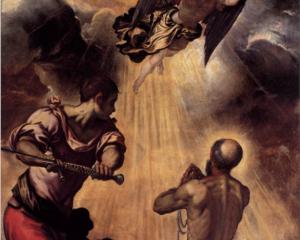
Not long after, he was judged guilty of crimes against the Emperor and condemned to death. He was taken to the execution block and beheaded. It was AD 66, just four years before Jerusalem fell.

The Martyrdom of Paul – Tintoretto, c.1556
Posted in foxe's book of martyrs, martyr

Sunday Martyr Moment: Mark and Peter

Foxe’s Book of Martyrs. According to this summary from Christian Book Summaries,

Writing in the mid-1500s, John Foxe was living in the midst of intense religious persecution at the hands of the dominant Roman Catholic Church. In graphic detail, he offers accounts of Christians being martyred for their belief in Jesus Christ, describing how God gave them extraordinary courage and stamina to endure unthinkable torture.

From the same link, the book’s purpose was fourfold:

  • Showcase the courage of true believers who have willingly taken a stand for Jesus Christ throughout the ages, even if it meant death,
  • Demonstrate the grace of God in the lives of those martyred for their faith,
  • Expose the ruthlessness of religious and political leaders as they sought to suppress those with differing beliefs,
  • Celebrate the courage of those who risked their lives to translate the Bible into the common language of the people.

Mark

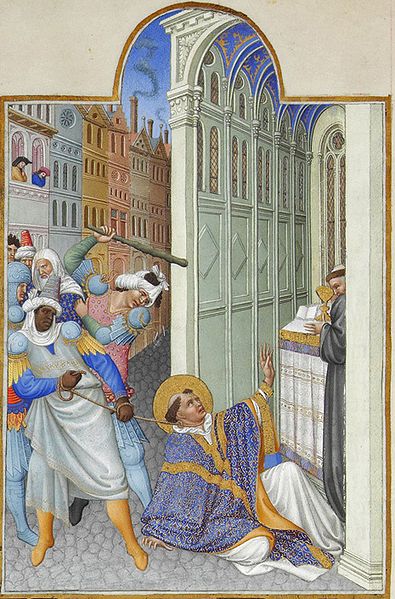
Little is known about Mark except what is written in the New Testament about him. After Paul’s mention of him in 2 Timothy 4:11, he disappears from view. Tradition says he was dragged to pieces when he spoke out against a solemn ceremony for their idol Serapis.

The martyrdom of Saint Mark.
(Musée Condé, Chantilly).

Peter

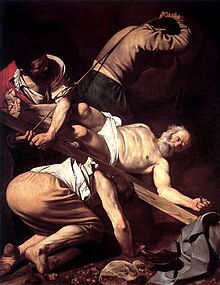
The only account we have of the martyrdom of Apostle Peter is from the early Christian writer Hegesippus. His account includes a miraculous appearance by Christ. When Peter was old (John 21:18), Nero planned to put him to death. When the disciples heard of this, they begged Peter to flee the city [said to be Rome], which he did. But when he got to the city gate, he saw Christ walking towards him. Peter fell to his knees and said “Lord, where are you going?” Christ answered, “I’ve come to be crucified again.” By this, Peer understood it was his time to suffer the death of Jesus which would glorify God. (John 21:19). So he went back to the city. After being captured and taken to his place of martyrdom, he requested that he be crucified in an upside-down position because he did not consider himself worthy to be crucified in the same position as his Lord.

 Caravaggio: painting of the 
crucifixion of Apostle Peter
 Michaelangelo: fresco of the
crucifixion of Apostle Peter
Posted in foxe's book of martyrs, martyr

Sunday Martyr Moment: Matthias and Andrew

Foxe’s Book of Martyrs. According to this summary from Christian Book Summaries,

Writing in the mid-1500s, John Foxe was living in the midst of intense religious persecution at the hands of the dominant Roman Catholic Church. In graphic detail, he offers accounts of Christians being martyred for their belief in Jesus Christ, describing how God gave them extraordinary courage and stamina to endure unthinkable torture.

From the same link, the book’s purpose was fourfold:

  • Showcase the courage of true believers who have willingly taken a stand for Jesus Christ throughout the ages, even if it meant death,
  • Demonstrate the grace of God in the lives of those martyred for their faith,
  • Expose the ruthlessness of religious and political leaders as they sought to suppress those with differing beliefs,
  • Celebrate the courage of those who risked their lives to translate the Bible into the common language of the people.
Matthias

Of whom less is known than of most of the other disciples, was elected to fill the vacant place of Judas. He was stoned at Jerusalem and then beheaded.

Andrew

Was the brother of Peter. He preached the gospel to many Asiatic nations; but on his arrival at Edessa he was taken and crucified on an X-shaped cross, which came to be known as St. Andrew’s Cross. Art: Mattia Preti – The crucifixion of St Andrew.

The flag of Scotland is an X-shaped cross. Wikipedia explains, “Use of the familiar iconography of his martyrdom, showing the apostle bound to an X-shaped cross, first appears in the Kingdom of Scotland in 1180 during the reign of William I. This image was again depicted on seals used during the late 13th century; including on one particular example used by the Guardians of Scotland, dated 1286.”

Posted in martyr

Sunday Martyr Moment

Sorry this is a day late.

Foxe’s Book of Martyrs. According to this summary from Christian Book Summaries,

Writing in the mid-1500s, John Foxe was living in the midst of intense religious persecution at the hands of the dominant Roman Catholic Church. In graphic detail, he offers accounts of Christians being martyred for their belief in Jesus Christ, describing how God gave them extraordinary courage and stamina to endure unthinkable torture.

From the same link, the book’s purpose was fourfold:

  • Showcase the courage of true believers who have willingly taken a stand for Jesus Christ throughout the ages, even if it meant death,
  • Demonstrate the grace of God in the lives of those martyred for their faith,
  • Expose the ruthlessness of religious and political leaders as they sought to suppress those with differing beliefs,
  • Celebrate the courage of those who risked their lives to translate the Bible into the common language of the people.
Matthew

Whose occupation was that of a toll-gatherer, was born at Nazareth. He wrote his gospel in Hebrew, which was afterwards translated into Greek by James the Less. The scene of his labors was Parthia, and Ethiopia, in which latter country he (tradition says) suffered martyrdom, being slain with a halberd in the city of Nadabah, A.D. 60.

A halberd is this:

Posted in christian persecution, martyr

Sunday Martyr Moment

I am reading Foxe’s Book of Martyrs. According to this summary from Christian Book Summaries,

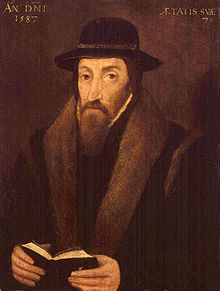
Wiki photo of John Foxe, 1517-1587

Writing in the mid-1500s, John Foxe was living in the midst of intense religious persecution at the hands of the dominant Roman Catholic Church. In graphic detail, he offers accounts of Christians being martyred for their belief in Jesus Christ, describing how God gave them extraordinary courage and stamina to endure unthinkable torture.

From the same link, the book’s purpose was fourfold:

  • Showcase the courage of true believers who have willingly taken a stand for Jesus Christ throughout the ages, even if it meant death,
  • Demonstrate the grace of God in the lives of those martyred for their faith,
  • Expose the ruthlessness of religious and political leaders as they sought to suppress those with differing beliefs,
  • Celebrate the courage of those who risked their lives to translate the Bible into the common language of the people.
 James, Timon, Parmenas, and Philip

James the son of Zebedee and Salome was the elder brother of the Apostle John. He was the first of the 12 Apostles to be martyred (Acts 12:2). His martyrdom may have been a fulfillment of what Jesus foretold about him in and his brother John (Mark 10:39).

It was ten years after the death of Stephen that the second martyrdom took place; for no sooner had Herod Agrippa been appointed governor of Judea, than, with a view to ingratiate himself with them, he raised a sharp persecution against the Christians, and determined to make an effectual blow by striking at their leaders. The account given us by an eminent primitive writer, Clemens Alexandrinus, ought not to be overlooked. As James was led to the place of martyrdom, his extraordinary courage impressed one of his captors to such a degree, that he fell on his knees before the Apostle, asked his forgiveness, and confessed he was a Christian too.

He said that James ought not to die alone, whereupon they were both beheaded.

Thus did the first apostolic martyr cheerfully and resolutely receive that cup, which he had told our Savior he was ready to drink. Two of the seven deacons, Timon and Parmenas suffered martyrdom about the same time; the one at Philippi, and the other in Macedonia. These events took place A.D. 44.

Ten years later, Apostle Philip is said to have been scourged, thrown into prison, and crucified at Hieropolis in Phyrigia.

Please pray for our brothers and sisters today enduring prison, beatings, and executions for the name of Jesus.

Posted in grace, martyr

Sunday Martyr Moment

I am reading Foxe’s Book of Martyrs. According to this summary from Christian Book Summaries,

Wiki photo of John Foxe, 1517-1587

Writing in the mid-1500s, John Foxe was living in the midst of intense religious persecution at the hands of the dominant Roman Catholic Church. In graphic detail, he offers accounts of Christians being martyred for their belief in Jesus Christ, describing how God gave them extraordinary courage and stamina to endure unthinkable torture.

From the same link, the book’s purpose was fourfold:

  • Showcase the courage of true believers who have willingly taken a stand for Jesus Christ throughout the ages, even if it meant death,
  • Demonstrate the grace of God in the lives of those martyred for their faith,
  • Expose the ruthlessness of religious and political leaders as they sought to suppress those with differing beliefs,
  • Celebrate the courage of those who risked their lives to translate the Bible into the common language of the people.

It is very affecting. I am so humbled by the descriptions of the martyrs since the earliest moments of our faith. As I go to worship on Sunday I think of them as Paul often depicted, running a race. It is a relay race and they hand the baton to the next generation, the baton being the word of the Lord as contained in the bible. The martyrs receive the Crown of Life! I can’t wait for the ceremony when they are called up front by Jesus to be acknowledged for their ultimate sacrifice, yet those who lay down their life will receive it. (Matthew 16:25)

“Blessed is the man who remains steadfast under trial, for when he has stood the test he will receive the crown of life, which God has promised to those who love him.” (James 1:12)

“Do not fear what you are about to suffer. Behold, the devil is about to throw some of you into prison, that you may be tested, and for ten days you will have tribulation. Be faithful unto death, and I will give you the crown of life.” (Revelation 2:10)

I can only read a bit at a time, because the stories of persecution are so powerfully evil, the demonstration of faith so humbling, and the grace bestowed upon martyrs so beautiful. But that’s good though, I hope it takes me a lifetime to read of the stories of my brethren.

Foxe starts with the first martyr, Stephen, and collects the martyrs’ stories into the ages. Foxe has a section on the Inquisition, and the updated book has modern martyrs also. Please stay with me on Sundays as I share stories of life and death, faith and evil, and the grace of Jesus. The book blurb says Foxe wanted us to remember the martyrs, ‘for he knew the blood of the martyrs is the seed of the church’. It is good to remember.

I’ll type out the passage from my book which is the updated version.

The second person to suffer and die for the church (after Jesus, who was not a martyr) was Stephen, whose name means ‘crown.’ (Acts 6-8).  He was martyred because of the faithful way in which he had proclaimed the Gospel to those who had killed Jesus. They became so enraged at what he sad to them that they drove him out of the city and stoned him to death. Stephen’s martyrdom came about 8 years after his Lord’s crucifixion, which would place his death in the year A.D. 35, since it was supposed that Jesus was actually born in about 6 B.C, two years before Herod the Great dies in 4 B.C. (See Matthew 2:16).

The same hate generated against Stephen apparently brought great persecution to all who professed faith in Christ as Messiah. Luke writes,

“And there arose on that day a great persecution against the church in Jerusalem, and they were all scattered throughout the regions of Judea and Samaria, except the apostles. ” (Acts 8:1b).

During that time about two thousand Christians were martyred, including Nicanor, who was one of the seven deacons appointed by the Church (Acts 6:5).

Thank you Stephen, thank you Nicanor. I will meet you, my brothers, in eternity’s New Jerusalem after the rapture.

Posted in Colosseum, cross, faith, italy, martyr

Take heart, O grieving family members!

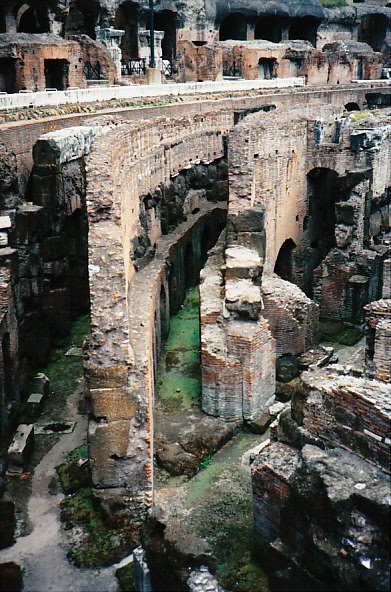
I went to Italy in the 90s several times. I always enjoyed the Colosseum. A marvel of Roman ingenuity, architecture, and history, I visited it while admiring all the qualities that make it a famous attraction. I took many photos. My favorite is this one. I had it enlarged and have had it hanging on my wall ever since:

The underground chambers were called Hypogeum and refer to the vast network of rooms, cells, tunnels and passages under the Roman Colosseum. The floor of the Colosseum was over 6 acres, so the hypogeum was easily able to accommodate a huge number of underground tunnels, passages and chambers used to house animals, stage props and slaves who worked there. It was these facts and the thrilling sight of the actual subterranean chambers that entranced me at the time.

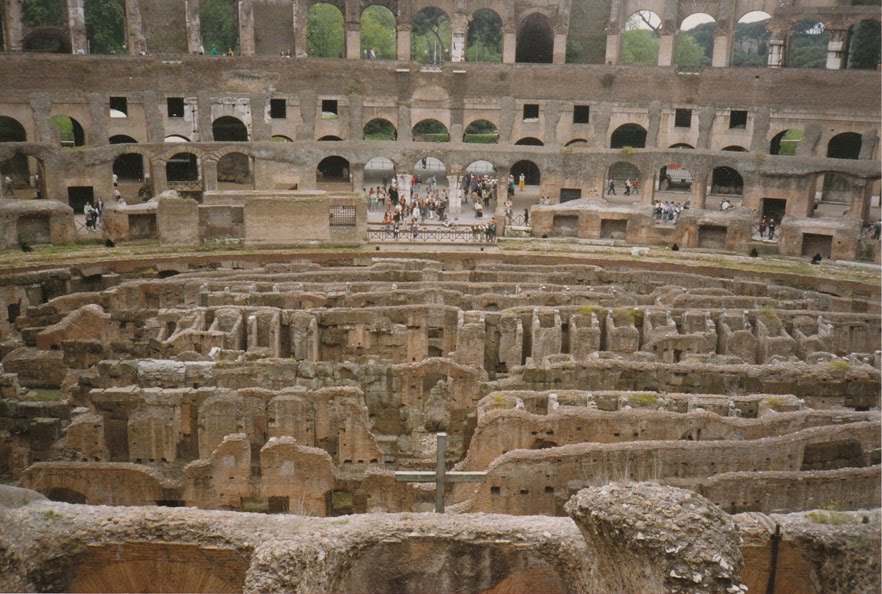
Tonight, I was sifting through mounds of photos for a photo project I am doing that is unrelated to Italy, and I came across the photo below. I have visited the Colosseum and I have viewed this photo many times, but never until tonight, the first time I looked at the picture since I’ve been saved, I noticed immediately the cross in the foreground. Immediately.

Until now, I had never even seen it. I had never seen it before this moment. Despite having visited the place and lingered there for hours, despite having taken photos from many angles, the cross was simply not in my field of spiritual vision. Why? 2 Cor 4:4 “The god of this age has blinded the minds of unbelievers, so that they cannot see the light of the gospel of the glory of Christ, who is the image of God.” My god at that time was the god of this age, and boy, was I ever blind.

I teared up looking at that simple cross amid the history of the debauchery of the late Roman age. I remembered my history: the Christians that were killed there by lions, their last moments ones of terror, feeling the crunch of the sand under their feet as they perhaps ran from sure death, seeing the lions’ claws reaching for their necks, hearing the roar of the crowd jeering as they drew their last breaths. Their sacrifice kept a nascent religion alive, so that I, wretched I, could visit the place and never even notice the emblem of Christ’s shame and glory.

It was ten years later at age 44 that I came to the cross as a repentant sinner. It was unexpected given my family history, a miracle, truly. It is a testament to the power of the Holy Spirit Who draws those to the cross those whose hearts are not hardened. I was blind, my ears were dulled, but my heart stayed open just a bit, and the truth broke through. I know that others were praying for me, they told me so later. Take hope, praying Christians, for family members and friends who are not saved. The blind DO eventually see, the deaf DO eventually hear. Prayer works. Keep praying for the lost.