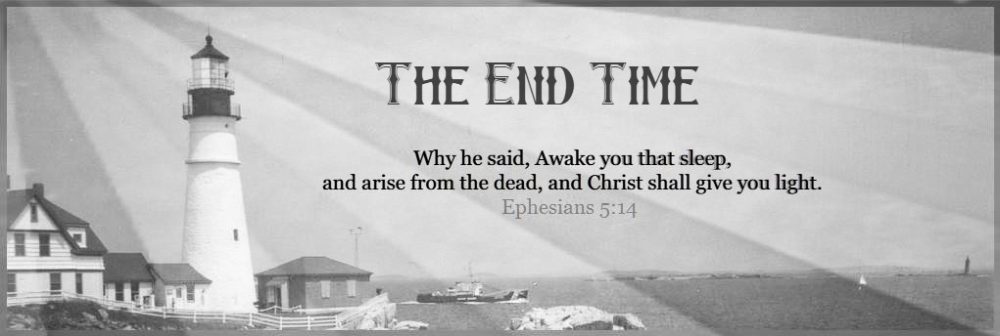
Posted in discernment, distinguishing of spirits, listening, spiritual gifts

Having "ears to hear"

One of the spiritual gifts is “discerning of spirits” (1 Corinthians 12:10 KJV). Other translations say “distinguishing between spirits” (ESV, HSB) while the NAS says “distinguishing of spirits.” They generally mean the same thing. The word distinguishing in the Greek carries with it a meaning that someone judges, a passing of a sentence, a thorough conclusion, to detect look-alikes of things that appear to be the same. This is what Charles Spurgeon meant when he said “Discernment is not knowing the difference between right and wrong. It is knowing the difference between right and almost right.”

Illustration for NC Wyeth Poem,
The Picket-Guard

To a degree, all Christians have been given an ability to discern. That comes with the Spirit who resides in us. We’re all supposed to ask for discernment, and wisdom, too. We are supposed to practice it and develop it. (Hebrews 5:14). The Spirit delivers this discernment, we don’t obtain it at seminary or by study with an elder or any man-made means. It is the Spirit ultimately Who gives us the ability to detect error and truth.

While all Christians have at least the ability to discern, some have been given a Spiritual Gift of Discernment. It means some have been given an extra dose. Picture an army. All the encamped men listen for the enemy. However, some have been stationed at the edge of the camp and are on patrol. If the enemy makes a move, it is the men on patrol who hear it first. They sound the alarm. Soon the enemy is close enough f the main army to hear it themselves. However it is the guard on patrol who hear the enemy first and earliest.

 Civil War Dictionary of terms explains the Picket Duty: “An advance outpost or guard for a large force was called a picket. Ordered to form a scattered line far in advance of the main army’s encampment, but within supporting distance, a picket guard was made up of a lieutenant, 2 sergeants, 4 corporals, and 40 privates from each regiment. Picket duty constituted the most hazardous work of infantrymen in the field. Being the first to feel any major enemy movement, they were also the first liable to be killed, wounded, or captured. And he most likely targets of snipers. Picket duty, by regulation, was rotated regularly in a regiment.

It is like that with believers who have been given discernment as a gift. We are usually the watchmen, on guard, patrolling the section of ground we have encamped by. The Lord our General has stationed us in a place, given us the ability to hear the different moves of the enemy, and we raise the cry when we hear him slithering, crouching at the door, or otherwise making a move. We also detect spies (Galatians 2:4, Jude 1:4).

I don’t often talk about my own experience, because my own experience doesn’t matter. Also, the process of discernment is a mystery even to me, who experiences it every day. However I’d like to press your patience this one time and share something personal, with a tie-in to the Mark 4:9 verse,

“And he said, “He who has ears to hear, let him hear.”

Ears of a Watchman with discernment

I’ve mentioned briefly in passing that our former pastor was let go for serial plagiarism. He had been memorizing other men’s sermons and delivering them as his own, even relating the other pastor’s personal anecdotes as if he had lived them himself. Apparently this had been going on for four years or more. I arrived at my church in January of 2012. After a few months, little things were said or done by the pastor didn’t set right with me, spiritually. I watched, prayed, and watched some more. I had an open mind. I call this phase, the “Hunh” phase, as in “Huhn, what’s up with that?” Or, “Huhn, what does that mean?” Or, “Huhn, did I see/hear what I thought I saw/heard?”

Along same summer and then fall of 2013, and my “Huhn” phase morphed into a low alarm phase. I’d leave the sermon feeling unsettled. What was happening as I listened to the sermons during this time is the crux of this essay. I’d never heard anyone speak to this process or never have seen it written about, until one comment recently by Pastor Justin Peters caught my attention. During this phase of listening to my former pastor preach, I’d have the strong sense that behind what I was hearing was…nothing. There was nothing behind the words.

WWI: “The most interesting of the special instruments
employed for the defense of Paris from aerial attack
are the “listening posts”, as shown in the illustration.
This consists of four huge horns, which gather up
the slightest sound and magnify it by means of a
microphone, so it is impossible for an
airplane to approach unheard.” Wikimedia Commons

See, when the Living God sends His Spirit to fill the words spoken from His word via a preacher or a teacher, they are heavy in my ears. It is like the words themselves are edged with neon, weightier, heavier…like there is something behind them. Alternately, when there is no Spirit carrying the words, it is like they are pale, dead, like brown leaves drifting to the ground rather than arrows piercing the heart. I can’t explain it better than that. Here is a visual.

Hearing regular words:
Hearing Spirit-filled words:

Hearing dead & empty words that are supposed to be alive:

Dead words are empty, they whisper weakly and then fall to the ground. They litter the floor of the sanctuary and flutter only when kicked while walking out the doors when the sermon is done. Jesus was explaining this to Nicodemus in John 3:8, when He likened the Spirit to wind, and said,

“The wind blows where it wishes, and you hear its sound, but you do not know where it comes from or where it goes. So it is with everyone who is born of the Spirit.”

In the 1 Corinthians 12:10 verse about distinguishing of spirits, the word is pneúma . Depending on context, it means wind. Without the word “Holy” in front of it, the word means just spirits, not The Holy Spirit. (source)

As each week progressed through the summer, fall and then winter of 2013, I’d leave church increasingly unsettled. My mind would react to the sermon by saying, “It feels empty.” “It feels canned”. “There’s nothing there.”

As Gertrude Stein famously said about Oakland CA, “There’s no there there.”

When I couldn’t shake the feeling and the unsettlement grew to prickling proportions, I decided to investigate, and by March of 2013 I’d made the discovery that each and every sermon was plagiarized. That was why the words I’d heard had no power. They were not carried by the pneuma, the Holy Spirit. They were a lie.

The tragedy of this last hour is that we have too many dead men in the pulpits giving out too many dead sermons to too many dead people. There is a strange thing that I have seen even in the fundamentalist circles: it is preaching without unction. What is unction? I hardly know what it is, but I know what it is not, or at least I know when it is not upon my own soul. Preaching without unction kills instead of giving life. The unctionless preacher is a savor of death unto death. The Word does not live unless the unction is upon the preacher. Preacher, with all thy getting, get unction.” ~Leonard Ravenhill

When the movie Heaven is Real was released, discernment minister Justin Peters was reviewing it on his radio program. (Link below). He was referring to a video interview of the father and son, Todd and Colton Burpo. Peters was describing how Colton looked and sounded when Colton was telling the interviewer of his alleged trip to heaven.

Peters was attempting to describe the lack of verve in Colton’s voice and the lack of animation on his face. Peters was saying that IF Colton had actually gone to heaven, there would be a liveliness on his face and a power behind his words. Peters was struggling to articulate the feeling of having ears that hear the pneuma power. He said, frustrated, “Where is the unction? There is nothing behind the words!”

I understand! Gratefully, I finally heard someone else say what I was also struggling to put into words.

Easton’s Bible Dictionary explains unction: “Unction- (1 John 2:20 1 John 2:27; RSV, “anointing”). Kings, prophets, and priests were anointed, in token of receiving divine grace. All believers are, in a secondary sense, what Christ was in a primary sense, “the Lord’s anointed.

All believers have an unction, or an anointing, to hear the Spirit and be moved by His power. Those of us who have received the gift of discerning of spirits perhaps have a radar that is tuned to a longer frequency, or who have a greater range and hear earlier than others.

I personally believe this is partly what Jesus meant when He said of understanding the parable in Mark 4:9, “And he said, “He who has ears to hear, let him hear.”

Jesus said it again in Mark 4:23, Matthew 11:15, Revelation 2:7, Revelation 2:11, Revelation 3:22. It is said in Deuteronomy 29:4 and Ezekiel 12:2. In the Deuteronomy verse, Moses said to Israel,

 “Yet the Lord has not given you a heart to perceive and eyes to see and ears to hear, to this very day.”

Having ears to hear is obviously important.

Pulpit Commentary on Mark 4:9 says: “He has “ears to hear” who diligently attends to the words of Christ, that he may ponder and obey them. Many heard him out of curiosity, that they might bear something new, or learned, or brilliant; not that they might lay to heart the things which they heard, and endeavor to practice them in their lives. And so it is with those who go to hear sermons on account of the fame of the preacher, and not that they may learn to amend their lives; and thus the words of Jehovah to Ezekiel (Ezekiel 33:32) are fulfilled, “And, lo, thou art unto them as a very lovely song of one that hath a pleasant voice, and can play well on an instrument: for they hear thy words, but they do them not.”
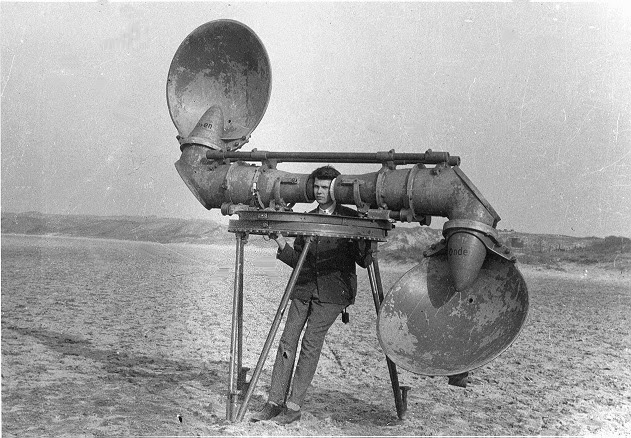
Acoustic listening devices developed for the Dutch army as part of
air defense systems research between WWI & WWII. Source

We all have ears to hear, if we are a believer. However those ears need to be kept clear (Acts 28:27, Matthew 13:15). If you do not have discernment as a gift, you still have a responsibility to practice the skill. Matthew 13:15 explains the first steps in keeping our ears open and receptive:

for this people’s heart has grown callous, their ears are dull of hearing, they have closed their eyes; or else perhaps they might perceive with their eyes, hear with their ears, understand with their heart, and should turn again; and I would heal them.”

When the heart grows callous, the eyes and the ears also dim. Keep the heart soft by continual study of the word, prayer, and repentance of personal sins.

Also, are the fruits of the spirit—love, joy, peace, longsuffering, gentleness, goodness, faith, meekness, and temperance—apparent in the words you’re hearing? If those are present they are from God. If they are not, the words are not from God.

Third, if there is no Spirit power behind their words, there will be a difference between what people say and what they do. If you hear one thing said but observe that the above fruits are not in the person’s actions, then their words are not anointed. In other words, anyone can parrot love, peace, joy, gentleness in their speech but do they demonstrate it, too? One who speaks with unction will speak and act in alignment with God’s word. One who speaks without anointing will always show themselves Spirit-less by their actions at some point. (Proverbs 5:22; Isaiah 59:12).

While it is dangerous to base our spiritual life on feelings, the fact is, we do experience things by the Spirit. If you feel something is “off” in a sermon or a teaching, if you feel that it is pale, or lacking something, it could be that it lacks the pneuma or the unction and the Spirit is alerting you to that fact. It takes much prayer and discernment to detect the difference between a personal feeling and the Spirit’s warning bell.

Even then, the alert isn’t the end, it is the beginning. My role was not just to rely on a feeling, but to prayerfully investigate. When the cold hard facts come in is when we move ahead. The guard on patrol doesn’t come running to the encamped army saying, “I think something may be out there!” Something is always out there. The guard comes to the army and says “I saw a flashlight and heard the cocking of a gun.” Facts.

While the devices posted above where man experimented with various means of amplification and acoustic listening, our spiritual listening devices are the Word and prayer. That’s all we need. Hone your listening skills and ask for increased discernment, whether or not you have the specific gift.

And don’t listen for only the words. Listen to what is behind the words.

Whoever has ears, let them hear. (Revelation 13:9)

——————————-

Further Reading

Challies reviews Expository Listening

1st Mark of a Healthy Church MEMBER: Expositional LISTENING

What is the Spiritual Gift of Discerning Spirits?

Justin Peters reviews Heaven is for Real movie (skip to 22:26-24:20 to the ‘lifeless/no unction’ incident)

Posted in listening, preaching, sermon

How to listen to a sermon: part 2 "Expository Listening".

Yesterday I’d posted a piece called How to listen to a sermon: part 1 “The mechanics of listening”. It examined the surface elements of how to listen and looked at what distracts us from listening well. Listening is a skill that needs to be practiced and honed, actively. The ultimate goal of a good listening is to be able to listen to a sermon and to the man preaching it, to the highest ability we possess.

Expository listening goes deeper. I am going to take portions from Ken Ramey’s book “Expository Listening” and present them for your consideration. His book is a handbook of biblical listening and I found it to be very helpful. The blurb on the back of the book states,

In many people’s mind, if they don’t get anything out of a sermon, it’s the preacher’s fault. But that’s only half true. The bible says that listeners must partner with the preacher so that the Word of God accomplishes its intended purpose of transforming a life.

In the first part of this two part series, I said that listening is a process. The process moves through three steps—receiving, attending, and understanding. They happen in order. Read the first part for more information on how those work and what hinders them.

In Expository Listening, AKA biblical listening, first are the visual cues that ready the mind for receiving information auditorially. There is a connection between theology and church architecture. The Christian Pundit published a tremendous series on ecclesiastical architecture and how it got to be that way, and why. In part two of their series on pulpits, we read, “because the Word is indispensable, the pulpit, as the architectural manifestation of the Word, must make its indispensability architecturally clear” (Bruggink and Droppers, 80.) Proclaimed gospel, however, has historically held and should hold primary importance in Protestant worship. Everything else in worship and the sanctuary should revolved around it and point to it.”

Visual cues both support the Word and set a stage for listening. Your ears expect something different when your eyes see a high, formal pulpit versus a stage with bright colored lights and no lectern. The Christian Pundit explains this in their  ecclesiastical architecture series, regarding pulpits,

“The pulpit was large, not only so that it was visible from all parts of the sanctuary, but also so there was space to hold the preacher’s notes, a hymn book and a copy of the Scriptures which the congregation could see. The other reason that pulpits were large was to make the minister look smaller, hiding most of the man behind this architectural manifestation of the Word. When a man preaches Christ faithfully, he himself begins to disappear in the minds of the hearers, as God and His work is magnified. Large pulpits facilitate this reality. Pulpits were the center around which every other piece of furniture in the sanctuary was arranged.”

In former times, pulpits looked like the ones below. The reason was because the Word was magnified and the man speaking it was reduced. John MacArthur on large screens in church:

I actually try to minimize myself, if I can. That’s why you will never see big screens in here, because people need to hear the Word of God, they don’t need to see my nose hairs. They don’t need to become overly familiar with every nuance of my face and my expressions, it’s not about me.”

Pulpit of the Gallus chapel in Greifensee ZH, Switzerland. Wkipedia Commons

When you go into a church, look at the pulpit. Is everything arranged so that the place where the Word emanates is promoted to primary position? How does the church elevate the word and prepare you for hearing it? Seeing a majestic pulpit tells your mind that this place takes the word seriously and this helps to prepare you in a mindset that lays the ground work for sober listening.

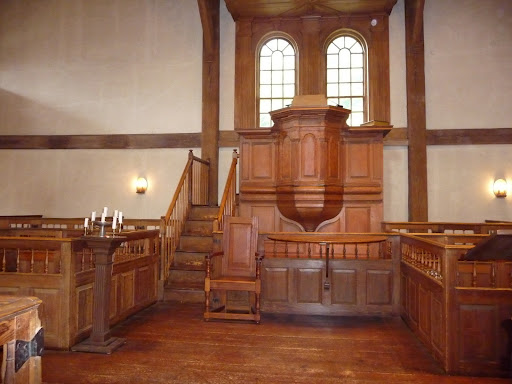
Below we have a pulpit from puritan times in at the Old Ship Meetinghouse, in Hingham Massachusetts. This architecture is similar to most early pulpits in New England- high, wooden with stairs at the side. For a fascinating story on pulpits, this one at Boston, go here, “Mystery of the Old South Meeting House Pulpit

Source
Let the wise hear and increase in learning, and the one who understands obtain guidance 
Proverbs 1:5

Think of it this way. At a concert, your ears expect something different if you’re laying on the grass at a 4th of July Concert in the Park in Central Park NY than if you were inside the Rockefeller Center listening to the Opera Aida. Don’t underestimate the setting as to how it coaches your mind to receive text.

The Christian Pundit said,

“a central pulpit makes a clear statement to any stranger walking in the door: “We have something for you to hear. It’s not what we say, it’s what God says in His Word. The pulpit looks important because what you are going to hear from it is essential for life and eternity.”

I’m not saying we all have to build high pulpits. However, today’s listener sees a man on a stage, a man dressed in torn skinny jeans and sweatshirt, one gluteal cheek perched on a wobbly stool, and a music stand, if that. We have gone from this,

To this:

Rob Bell speaking at Rick Warren’s Willow Creek Community Church

We don’t have pulpits today. Joel Osteen doggedly refused to even call his stage a pulpit when pressed by Larry King. “It’s a podium,” he said. He has no cross behind him or anywhere on stage.

So the expository listener of today has been coached via architecture (or the lack of it) to prepare for a reduced word or prepare for a heightened word before a word is even spoken.

“He who has ears to hear, let him hear.” (Matthew 11:15)

Gill’s Exposition explains the verse:

“He that hath ears to hear, let him hear. A way of speaking used by Christ, when anything serious, and of great importance, was delivered; and which required attention, and was not easily understood”

As Ken Ramey stated in his book “Expository Listening, “Those who take to heart God’s call to listen will transcend the discouraging trends in the church today.

Ramey continues in describing the sacred partnership the preacher and the listener has with each other, and the Word of God binds them. We come to church to hear a sermon, but in addition to listening, we must also heed it. Almost every book of the bible contains a reference to hearing and obeying God’s word. Mr Ramey said,

“We might systematize everything the bible teaches on the subject of listening by arranging the verses under four summary statements, or theological truths, as follows:

1. God has spoken and commands us to listen and to obey what he has said,
2. We all fail to listen and obey God and deserve to be punished by Him,
3. God grants us the ability to listen to and to obey Him by His Holy Spirit, whom we receive through Jesus Christ,
4. God promises to bless us both now and for all eternity if we listen to and obey Him.

How do we do this? We know the parable of the soils explains that there are four kinds of soils. One of them is hard packed. If you garden, then you know that for the soil to receive the seed, it must be prepared by aerating, breaking up the clods and making rows to put the seeds into. Our heart is like that hard packed soil. We need to prepare it before we listen to the seeds the preacher sends forth from the Word in a sermon.

We do this in several ways. One is, we must read and meditate on God’s word every day. Mr Ramey wrote,

Reading the Word on a daily basis will develop in you a healthy appetite for God’s Word. You can’t expect to come to church on Sunday with a hunger for God’s Word if you haven’t been feeding on it throughout the week.

We prepare to listen by praying throughout the week.

“Pray for yourself. You should pray that God would grant you an honest and good heart that would hear and accept the Word and that it will bring lasting fruit in your life, that he would make your heart receptive to the Word. … Second, you should pray for the preacher. Pray that the preacher would preach with great liberty and boldness and clarity (Eph 6:19-20; Col 4:3-4), that God’s Word would run rapidly, transforming people’s lives for His glory.”

Let us not forget about sin. In order to be good, biblical listeners, we need to confess our sin on a regular basis so that it does not form a block, a wall, or a stronghold against the implanting of the seed. James 1:21 says “Therefore put away all filthiness and rampant wickedness and receive with meekness the implanted word, which is able to save your souls.”

Here is another tip for becoming a biblical listener which you may not have expected as a tip for how to listen to a sermon. Mr Ramey suggests,

“Reduce your media intake. …  The media saturation in our society has a deadening, dulling effect on our hearts.” These conditions diminish our receptivity to hearing God’s word.

Do you prepare to listen? Just as architecturally, the pulpit is central in a sanctuary, do you orient your week with the focal point being the ministry of the Word? Is Sunday the most important part of your week? In Mr Ramey’s book “Expository Listening,” he wrote,

You should try to schedule your work activities, get-togethers and vacations around church. You should live by the principle that Sunday morning begins on Saturday night. Here are some practical suggestions on how to prioritize the Lord’s Day:
–Make it a habit to be home Saturday night
–Be careful not to do, watch, or read anything that will cause lingering distractions in your mind the next day
–Get things ready on Saturday evening to alleviate the typical Sunday morning rush
–Get a good night’s sleep so you can be sharp and energetic to worship and serve God. It’s hard to listen when you’re nodding off!

And so on. The book contains many more instructions for how to be a good, biblical listener. I recommend it.

I hope these tips on how to become a biblical listener have helped you in any way. There is so much more to receiving God’s Word than plopping down in the pew in a huff and a rush, and half listening with a closed heart. We honor God to do our part before-hand to work out our salvation in fear and trembling.

“The Gospel is not the doorway into Christianity, it is the unending, ever-expanding, always sweetening country that we will be exploring for eternity.”

———————

Further Reading

How to listen to a sermon: part 1 “The mechanics of listening”.

What is expository preaching?

What is biblical theology of worship?

Posted in abendroth, green, johnson, listening, lloyd-jones, macarthur, preachers, sermon

How to listen to a sermon: part 1 "The mechanics of listening"

Part 2 here: “Expository Listening”

As I’m sure you do, I like to listen to sermons. I listen at my laptop, while I am doing dishes or cooking, and in church. The former means I have no visuals to accompany the listening, and the latter does.

The catch is finding a good preacher who treats the scripture with respect, doesn’t promote a false doctrine, and is clear in his preaching. That is hard to do these days! Once you find some pastors like that, phew, it is easy to settle into a routine that contains your favorite few. Mine are John MacArthur, Mike Abendroth, (and also herePhil Johnson, and Don Green.

However, I have an Old Testament prophet’s heart and I LOVE to listen to good exposition on the OT texts. The problem is, pastors who preach those texts are few and far between. Pastor Johnson has a great series on the Psalms, and Dr. MacArthur has a very few on OT texts (his series on Genesis 1 is fantastic) and Pastor Green as a tiny amount, but that’s it.

Martyn Lloyd Jones was a well-known British preacher. He lived from 1899 to 1981. He preached for a long time. Recently, his recorded sermons were combined into a trust and released to the public via the internet. There are 133 sermons on the OT. There are 55 on the great biblical doctrines. There are 1,600 sermons overall. What a treasure trove! I got so excited!

This week, I listened to two of his sermons from Jeremiah and I had a hard time sticking with it. I like Jeremiah a lot, and  was truly interested in the exposition of the text. So why was my mind balking? Lloyd-Jones is an old-fashioned fire and brimstone preacher, which I love. So why was I having a hard time? You know me, I have to analyze everything.

Lloyd-Jones’s voice is upper crust, ‘veddy British’. He rolls his rrrr’s dramatically. He has a high nasal

voice, not helped by older recording equipment from the 40s, 50s, 60s that makes him sound more tinny than likely he was in real life. The vocabulary he uses is slightly different that I’m used to, and it included British words as well as simply a different phraseology than I’ve heard before. All these surface elements of the skill of listening negatively impacted my listening experience.

I thought about it for a while and I came to the conclusion that our ears settle into a comfortable rut. Just as we enjoy living in a routine, so do our ears. People’s voices are like blankets. We become used to how our pastors sound, we know their verbal tics, and go along with their vocal rhythms. Listening is an ability. It needs to be kept in good working order, the wheels of the mind greased and stretched. I was having a hard time not because of the content of Lloyd-Jones’s sermons, which are tremendous, nor because of any spiritual conviction I was experiencing, but simply because my listening ability was being stretched.

I’m sure you’ve experienced this when a guest preacher comes to your church. It takes a while for your mind to settle down and get used to hearing a new tone of voice, an new rhythm, a new way of speaking. All this stretches your listening vocabulary and listening skills. And listening is a skill.

I used to watch foreign films a lot. I don’t like dubbing so I always went for the subtitles, which never bothered me. Foreign films of course show foreign things, contain foreign ideas, use a different approach to story telling, and even the cinematography is different because of different type cameras used in the making of the film. It has been about ten years since I’ve seen a foreign film and I watched one recently. I had a hard time settling down at first because I’d lost the skill of watching them. Same goes for black and white movies, which I’ve recently gotten back into, and the same goes for silent films. I was surprised that the 2011 American/French film “The Artist” won so many Academy Awards (five) because it was a silent film. A silent film hasn’t been made nor an old one released in a long time, and many of us have lost that skill of how to watch one.

It is the same with listening. The mechanics of listening to a sermon are just as important. Keep honing your skills in listening to a wide range of good preachers. Here is a little tutorial on how to keep the mechanics of your listening skills in good shape. In another blog entry, I’ll discuss the spiritual mechanics of biblical listening.

Literacy is reading and writing, listening and speaking. It is via literacy that we create meaning in our lives. The US Air Force has a University called The Air University, or AU. In this good series on Listening Effectively, we read,

“Listening is a complex process—an integral part of the total communication process, albeit a part often ignored. This neglect results largely from two factors.”

“First, speaking and writing (the sending parts of the communication process) are highly visible, and are more easily assessed than listening and reading (the receiving parts). And reading behavior is assessed much more frequently than listening behavior; that is, we are more often tested on what we read than on what we hear. And when we are tested on material presented in a lecture, generally the lecture has been supplemented by readings.”

“Second, many of us aren’t willing to improve our listening skills. Much of this unwillingness results from our incomplete understanding of the process—and understanding the process could help show us how to improve. To understand the listening process, we must first define it.”

The essay goes on to explain that, “The process moves through the first three steps—receiving, attending,

Group of people listening to a sermon.
Coranderrk, c.1860-c.1865
source

understanding—in sequence.” Receiving is what it means, someone transmits a body of information auditorially and your ears receive it. There are many things that can impact receiving. If you’re in a car and driving, of course that impacts you because you get distracted. The speaker is still sending, you’re not receiving. Even if you are in a pew and seated comfortably, receiving can be impacted by the preacher’s speech, any impediments, his rhythm, tone, or distracting verbal tics.

My old pastor used to punctuate every half phrase with “Amen?” as in, “Paul was about to set out in his second missionary journey, amen? And then he got in the boat, amen?” etc. Like that. Drove me nuts. I’m exaggerating a bit on how frequently he said it, but it was frequent enough that it became a distraction to me rather than a pattern of speech unique to him. Sometimes I’d just count the amens rather than listen to what he was saying. That is what I mean by verbal tics. MacArthur repeats a sentence he really wants us to get. He doesn’t do it often within a sermon, but only at the introduction of a new main idea, so it doesn’t distract me. In the former case, it was distracting, in the latter, a comforting vocal blanket to my ears.

In the Air University lecture it stated that “attending” is the second part of the process of listening. Attending is hard when you’re distracted. This impacts receiving. Like I said above, I had a hard time paying attention to the content when the distraction of the amens got in the way.

The AU lecture notes that in the second part of the listening process attending, there is such a thing as–

“Selectivity of attention. We direct attention to certain things to prevent an information overload.”

And alternately, we become distracted by things when they are competing for our attention. This is why listening is active. If there arise any barriers to listening, we must mentally work to overcome them.

“Selectivity of attention explains why you “perk up” or pay attention when something familiar to you, such as your hometown or your favorite hobby, is mentioned. In fact, you may have been listening intently to a conversation when someone in a different conversation mentions your name. Immediately, the focus of your attention shifts to the conversation in which your name was mentioned.” (source)

So in listening to a sermon, you may have a favorite topic. If any preacher mentions anything about eschatology, I am all ears. If the sermon is on marriage (I’m single) I tend to want to tune out.

Strength of attention. Attention is not only selective; it possesses energy, or strength.

Attention requires effort and desire. It is possible to get lazy in listening, that is why I’m writing about listening as a skill that needs honing and practice. We make ourselves literate when we connect the new to the known. If you are listening to a preacher for the first time, you have nothing to connect the new to the known with. In other words, I understand without having to think about it that when MacArthur repeats a sentence it means he is emphasizing a point and getting ready to launch into another verbal paragraph. This barely registers with me now but it is what I am talking about when I say that listening is an active skill. When you tune in to a new preacher you won’t know his patterns and it takes a few listens to acquire them. Stick with it.

Words are verbal symbols. Yet there can exist barriers to understanding even when we all speak the same language.

Barrier : The same words mean different things to different people.

I laugh when I remember this example. When I was married, my husband and I used to talk of course. All

my degrees are in literacy and my profession is teaching. I live by words. My husband was a mathematician, his profession was databases and computer software. One time we were having a talk. We were both speaking English. We were at home and undistracted. But we were not connecting verbally. Finally, I asked him, “When you speak what does it look like in your mind?” He said, “Numbers. I think in equations. How do you think?” I answered, “I think in anecdotes.”

In the AU lecture, the professor said, “I may tell my colleague that the temperature in the office is quite comfortable. My “quite comfortable,” however, is her “uncomfortable”: 75 degrees is comfortable for me; 70 degrees is comfortable for her. The same word can mean different things to different people.”

If you listen to a new preacher it takes a while to become familiar with what he means when he says such and such.

“Barrier : Different words sometimes mean the same thing”

It took me a while after moving from the north to the south in the US that buggy meant cart, soda meant pop, and tea meant cold and sweet. I remember asking one of my kindergarteners to get the wastebasket and he literally didn’t know what I meant. I said “the trash can” and then he brought it right over.

A new preacher you’re listening to might indeed be speaking English but may be using different words in that present a barrier to understanding. With ongoing listening you absorb his meanings into your mental listening vocabulary.

Barrier : Misinterpretation of the voice. The quality, intelligibility, and variety of the voice affect the listener’s understanding. Quality refers to the overall impression the voice makes on others.

There is a preacher I listen to who has a tone that tends to become petulant, even though he is not petulant in the least. I have to work hard while listening not to be distracted by it. I love Pastor Mike Abendroth’s voice on his radio program No Compromise Radio. His voice is so soothing, he speaks slowly and clearly, there are no sound effects or distractions. In fact, when I want to be soothed, I’ll listen to him. His voice is like an oasis in the loudness of life. He makes it easy to receive, attend, and understand.

Well, that was a little lesson on the mechanics of listening. In the next essay I’ll offer some information on how to partner with the preacher via maximized listening so that the Word of God accomplishes its intended purpose. It will be geared to the theology of listening: expanding your capacity for expository listening. Meanwhile I’ll urge you all to keep the mechanics of your listening skills honed by occasionally practicing an deliberate expansion of who you listen to, and how.