Posted in encouragement, God, impressionism, painting, pointillist

God is making a Pointillist painting

We know that the church is a body, a united body of believers.

For just as the body is one and has many members, and all the members of the body, though many, are one body, so it is with Christ. (1 Corinthians 12:12)

The Holy Spirit ordains where each believer is to be and what gifts he is to have. He ordains where we are in the body so as to contribute to the good of the whole.

All these are empowered by one and the same Spirit, who apportions to each one individually as he wills (1 Corinthians 12:11)

It could be said that the Lord is painting a picture.

If you’re familiar with the Impressionist movement of art that emerged in the late 1800s in Paris, then you’re familiar with the works of Monet, Manet, Sisley, Renoir, & etc. These artists used short brush strokes to convey movement and impression, rather than precision. There was a sub-culture of the Impressionists called the Pointillists. Here is Georges Seurat’s famous pointillist painting, “Sunday Afternoon on the Island of La Grande Jatte

As the website IncredibleArt.org states,

Strictly speaking, Pointillism refers to the technique of using dots of pure color in such a way that, seen at the appropriate distance, they achieve maximum luminosity.
(source)
Georges-Pierre Seurat made this technique famous. His painting,
Sunday Afternoon on the Island of La Grande Jatte (1884-1888) is one of the most famous paintings in the world. … At left you see a closeup of Seurat’s painting. It is a closeup of the the man laying down on the lower left. Even thought he appears to be wearing white pants, as you can see, the part of the pants in the shadow just above the grass has no white in it. It’s only when you look at it from a distance that the colors blend in. Seurat spent two years on this painting. He carefully planned it out with several sketches first.

It could be said, that the earth is the canvas and the people are the points of paint He daubs precisely here and there, working toward an end.

I’ve seen pointillist paintings at museums. You look very closely and all you can see are daubs of color. Dots. If you back away to a distance, you can see the scene clearly. It’s amazing how the colors blend to make a seamless and beautiful picture.

We can think of ourselves as dots. We can’t see the whole picture, we don’t have the right perspective. God does. He puts a pink next to a blue and though all we can see is the blue next to us, we have to trust that the Great Artist is making something beautiful. Even if you don’t like the color pink, you know and trust that the Artist’s purposeful placement of it next to you will make the picture as a whole perfect when it is complete.

Just like heaven.

Posted in adding to scripture, God, taking away from scripture, the word

Adding to or taking away from scripture

Plus minus icon, Wiki cc

Did you know if you add to scripture you’re cursed? Equally, if you take away from scripture you’re cursed.

We’re often familiar with false preachers like Joel Osteen, who take away from scripture on a regular basis. Preachers like Osteen and others fail to preach the whole counsel of God, deeming some parts of the Gospel less important than others. They say, “It’s not my calling to preach sin.” Below is just one link among many that confirms Osteen’s stance that preaching the whole message of God is not necessary.

Osteen believes homosexuality is a sin, but won’t preach on it.

Here is Osteen quoted in another article from Christianity Today:
Host Katie Couric suggested that the popular minister does not “spend a lot of time in (his) sermons talking about good and evil, sin and redemption. It is a very overall positive message.” She asked, “Why don’t you give people more of a moral template?”

Osteen insisted that he does, but “in a positive way.”

Joel Osteen, photo flickr from yourfaithchurch


“There’s enough pushing people down in life already,” he added. “When they come to my church, or our meetings, I want them to be lifted up. I want them to know that God’s good, that they can move forward, that they can break an addiction, that they can become who God’s created them to be.

But the bible says,

You shall not add to the word which I command you, nor take anything from it” (Deuteronomy 4:2, also Deuteronomy 12:32). The reason God is so adamant on this is because “The entirety of Your word is truth” (Psalms 119:160).

In Revelation is says the same.

For I testify unto every man that heareth the words of the prophecy of this Book, If any man shall add unto these things, God shall add unto him the plagues that are written in this Book: And if any man shall take away from the words of the Book of this prophecy, God shall take away his part out of the Book of Life, and out of the holy city, and from the things which are written in this Book.” (Revelation 22:18-19).

Adding to the word of God is just as fearful for the person adding as it is for the person taking away. He is God! And this is His word! Far be it for us to change it or delete parts or dishonor it in any way. What you think of the Word is what you think of Jesus. (John 1:1-5).
Do not add to his words, or he will rebuke you and prove you a liar. Proverbs 30:6

We are tempted toward both tendencies, adding and deleting. Obviously, satan is maniacally gleeful if he can get God’s children to do either. See how it went for the first person in the bible to add to His word, Eve.

We may eat of the fruit of the trees in the garden, but God said, ‘You shall not eat of the fruit of the tree that is in the midst of the garden, neither shall you touch it, lest you die.” (Genesis 3:2b-3).

That is not what God said. In Genesis 2:16-17 it records what God actually said,

And the Lord God commanded the man, “You are free to eat from any tree in the garden; but you must not eat from the tree of the knowledge of good and evil, for when you eat from it you will certainly die.”

The ‘no eating from this tree’ rule is the one and only Law God gave the man at the time when there were only two human beings. And thus we can see how we humans can and do easily mess things up.

Today we have a plethora of both issues happening today, adding to and taking from. Not only are there a scourge of preachers who deem various parts of the Word unnecessary to preach, but we have so many more who add to them by claiming to have had visions and audible commands from on high.

The people who say they have heard from God are adding to His word. I want you to understand something. Every preacher, teacher, or prophecy speaker who says he has heard from the Lord and is teaching what He supposedly said, is adding to His word. They are therefore cursed. Every one. Joyce Meyer, cursed. Jesse DuPlantis, cursed. Mark Driscoll, cursed. Beth Moore is cursed. Sarah Young, cursed. Each one of these I’ve mentioned and so many more have added to His word and thus are going to have plagues added to them. They will be proved liars.

Yes this is harsh, but it is biblical. I want us to think about what it means when God says not to add to His word nor take away from it. We read the word but it is not abstract. There is a now, today, boots on the ground application.

When Beth Moore says Jesus visited her and told her to teach that “My bride is paralyzed by unbelief” and to “teach it as often as I give you utterance to say it” she added to God’s word. Therefore, she is a liar. THAT is what it means.

When Joel Osteen says it is not his calling to preach sin, he is directly contradicting the very first public ministry words of Jesus, who said, Repent. (Matthew 4:17). Joel Osteen takes away from God’s word, thus is going to be proved a liar and is due for a rebuke. THAT is what it means.

I hear people make excuses for false teachers, overlooking their added words or subtracted words, and say, “But they love Jesus so much!” They make excuses. Eve perhaps was trying to be helpful when she added to the word, by saying we may not eat of the fruit, nor touch it. But once you add to it, the adding to takes on a life of its own and it gets added to more and more. The Pharisees were initially perhaps trying to be obedient, and added a law here and a law there, until there were 613 extra laws God never spoke, and His word was buried so deep in religiosity that it was hard to find Him at all.

No, seeming external motivations don’t matter. What matters is what they say or don’t say, and whether it matches up with the word we’re called to believe, hide in our hearts, and preach.

Finally, husbands, where are you? Let’s go back to Genesis, where we were when this essay began. Adam was with Eve when the serpent seduced her. (Gen 3:16-17). Eve wasn’t even created yet when God told Adam the Law. It was his responsibility as the head of the household to tell her about God’s law and to shepherd her within it. Yet when Eve told the serpent that we may not touch the fruit, is any correction on Adam’s part recorded? No. He was with her and not only don’t we see a correction on his part, he allowed her to take the fruit. It is the husband’s responsibility to look out for his bride, as Jesus watches over His Bride. It’s why scripture records the first sin coming through the man, and not the woman (though the woman is not excused, she was cursed for disobeying too). Sin came through Adam. (Hosea 6:7, Romans 5:12, 5:14, 1 Corinthians 15:22).

And here is the point of the essay: please have a high view of the word. Understanding the importance of not adding to it or taking away from it is essential, but also important is recognizing when someone today is doing those things. I’m not talking about a young wet behind the ears preacher who may say a thing or two that doesn’t set well. I’m talking about a teacher’s willful subtraction of parts of the bible due to pride, preference or rebellion. I’m talking about people adding to His word by claiming to have had conversations with God. God is looking for those who have a high view of His word. Why?

You have magnified your word above all your name. (Psalm 138:2)

Why would we even want to add to or take away from that which He himself has magnified?

~~~~~~~~~~~~~~~~~~~~~~~~~~
Further Reading

The bible says in several places not to add to or take away from His word

 Hands Off the Word of God

 “It Is Finished!” Jesus Does Not Need Your Help 

Posted in God, hope

The God of Hope

May the God of hope fill you with all joy and peace in believing, so that by the power of the Holy Spirit you may abound in hope.
(Romans 15:13)

You know, the times are so bad so many places, we all just need to remember the HOPE. Not just any hope, “THE Hope.” All of God’s promises and works poured into and poured through the Amen, Jesus Christ. Look at the Romans verse, Paul used hope twice. Once to describe God as the God of Hope and once to pray we abound in hope.

Octavius Winslow wrote in 1870, “The present title of God, the “God of hope,” is peculiarly expressive and endearing to the believing mind. His title as the God of love, has especially to do with our present. His title, as the “God of hope,” has to do with our future life. … Extinguish hope in the human heart, and you have enthroned grim despair, like a demon of darkness, upon the soul. Life has lost its sweetness, the creature its attraction, the world its charm, and all the future of the soul is shrouded in midnight gloom. My reader, are your circumstances trying? are your resources lessening? are clouds gathering? and do you find yourself tempted to succumb to despondency and despair? There is hope for you in God! All other sources and gleams of hope may have expired, but God is the “God of hope,” and in His power and love, in His word and faithfulness, you may hope, even against hope. Take heart, then, and look up.

This verse earlier in the book of Romans, chapter 8:24-25, made me smile: Paul was saying we eagerly await our adoption as sons of God, the redemption of our bodies, and-

For in this hope we were saved. Now hope that is seen is not hope. For who hopes for what he sees? But if we hope for what we do not see, we wait for it with patience.

With incredible logic the Spirit formed the thought into Paul’s mind and with impeccable recall Paul wrote the wonderful truism, ‘who hopes for what he sees?’ Matthew Henry lived in the 1600s, he wrote of this verse,

The sufferings of the saints strike no deeper than the things of time, last no longer than the present time, are light afflictions, and but for a moment. How vastly different are the sentence of the word and the sentiment of the world, concerning the sufferings of this present time!”

“Yet this deplorable state of the creation is in hope. God will deliver it from thus being held in

bondage to man’s depravity. The miseries of the human race, through their own and each other’s wickedness, declare that the world is not always to continue as it is. Our having received the first-fruits of the Spirit, quickens our desires, encourages our hopes, and raises our expectations.”

“Believers have been brought into a state of safety; but their comfort consists rather in hope than in enjoyment. From this hope they cannot be turned by the vain expectation of finding satisfaction in the things of time and sense. We need patience, our way is rough and long; but He that shall come, will come, though he seems to tarry.

We have hope because He is the God of Hope!

Posted in adopted son, beth moore, book review, God, jesus, Michael

Book Review: "Things Pondered," Beth Moore’s story of adopting a boy and giving him back

Beth Moore published a book in 2004 called, Things Pondered: From the Heart of a Lesser Woman. It is a book of vignettes and poetry, recollections and descriptions of the various events in Beth Moore’s life from young womanhood as a bride through early days of her marriage, becoming a mother, and her adopted son. This book review pertains to the kindle version. Moore’s words from the book are in italics.

~Beth Moore & Privacy~

For all of Beth Moore’s outward seeming openness, her frequent discussions about herself, her thoughts, trials, self-esteem issues, sexual molestation, motherhood, and hysterectomy, she rarely if ever speaks of the fact that she adopted a son at his age of 4 and then at age 11 gave him back to the birth mother.

Her public persona is one which creates a (false) sense of intimacy with women, of being open and transparent. Her books and conferences strive to create an atmosphere of a slumber party, sharing secrets, and giggling over the love of our Groom Jesus. But when it comes time to be transparent in one-on-one situations, Moore is quite zipped up. Moore is “closely protected by assistants who allow very few media interviews. After several interview requests from CT, her assistants allocated one hour to discuss her latest book and ask a few questions about her personal life. Each question had to be submitted and approved beforehand, I was told, or Moore would not do the interview. Follow-up interview requests were declined. I was permitted to see the ground level of her ministry, where workers package and ship study materials. But Moore’s third-floor office, where she writes in the company of her dog, was off limits.” (Christianity Today)

There is some curiosity from people regarding the little-known topic of the son Moore adopted, named Michael. Though Things Pondered is about other events in Moore’ life too, the bulk of it is about Michael, and so will this review.

~Mary~

The title of the book refers to Mary’s thoughts when the angel told her she would bear a Son. (Luke 2:19). Moore speculates on what Mary was thinking, the nuts and bolts of Mary’s ponderings. Such speculations are not good and not bad. It all depends on the point of view from which they make the speculation. Moore is a contemplative navel gazer who talks about herself constantly and thus her p.o.v. stems from herself. Therefore the thoughts she imagines Mary to be thinking were also about herself. To wit:

In that moment a host of memories must have been dancing in her head. The angel’s appearance. His words. Her flight to the hill country of Judea. Elizabeth’s greeting. Their late-night conversations. The first time she saw her tummy was rounding. Joseph’s face when he saw her. The way she felt when he believed. The whispers of neighbors, the doubts of her parents. The first time she felt the baby move inside her. The dread of the long trip. The reality of being full-term, bouncing on the back of a beast. The first pain. The fear of having no place to birth a child. The horror of the nursery. The way it looked. The way it smelled. …The following is my response to her worthy example.”

Except, that in reading the things Moore believes Mary was pondering, you would never know Mary was bearing the Son of God.

Here is the same verse with a mature preacher of the word also speculating on what Mary was pondering. Please compare.

It [verse 19] takes us into the heart of Mary. It says, “But Mary treasured up all these things, pondering them in her heart.” This is just mulling them over, contemplating them deeply. She went much deeper, believe me, than the amazed people in verse 18. I mean, this is just…this is just beyond comprehension. Here is a 13- or 14-year old girl, she’s looking into a feed trough and she’s seeing there a baby that’s come out of her womb. She’s never known a man. This baby was conceived and born without ever knowing a man. This baby is the Son of the Most High God. This baby is the rightful heir to the throne of David. This baby is the Savior of the world. This baby is the anointed Messiah. This baby is God, the Lord.

I mean, it’s all so mind-boggling in the common world of human beings. Mary must have wondered, you know, when is He going to start saying profound, theological things? Tomorrow? Is He going to do miracles? What’s going to happen here? What am I to expect out of this child? Will I have a normal relationship with this child that a mother has to a baby? Will I nurse this child as mothers do? Will I raise this child as mothers do? What will this child be like? And when will He enter into His glory? When will He take His Kingdom? When will that all happen? And how am I going to be a mother to a child that is God? She must have wondered all those kinds of things. Must have wondered even about discipline, setting an example. How do you set an example for God? I mean, anything that would come into a mother’s mind must have come into her mind. She just pondered it. She just thought deeply about it. And she thought deeply about God’s redemptive purpose and how God had promised a Savior and a Savior had finally come.” (source)

Moore instills self-ponderings in Mary. They are self-focused. Dr MacArthur’s are Jesus-centered. So if Moore is following “Mary’s worthy example” as she stated the purpose of the book to be, you see the focus of the book is off-kilter already.

~Michael~

In Things Pondered, Moore says she and her husband wanted a son but several years passed and they assumed they were not going to receive one. Then on February 14, 1990 the Lord answered their prayer and her husband “gave the gift of a boy” for Valentine’s Day.

In her 2005 memoir, Feathers from My Nest, Moore said her husband saw “urgent needs of a certain little boy that “could really use a home.” … We were oblivious, I had nothing but romance in my eyes. Happily ever afters. Utter certainty that love will conquer all.

I searched for clarity in the book and got none. On one page Moore said Michael was “orphaned”, on the next she said that his birth parents “gave up on each other and on him”, and that the “marriage of his second guardians collapsed”. After 7 years, Moore says the mother (Anne) “resurfaced,” even though she was “a close family member“, “strongly desiring” her son back. However, there was no mention of any legal proceeding nor any custody battle, even though she consistently said in the book that they had adopted him. Chapter 3 is called “The Adoption.” On page 54 Moore said she sat in a restaurant with Anne and after assurances that this was what Anne wanted, Moore said that Anne “granted him to us.”

Moore says his birth mother was “a close relative” named Anne. No other details, but later in the book Moore said that “I didn’t love him like an aunt… I loved him like a mother.” Perhaps the boy is her sister’s son.

Very early on Moore says the family saw the emergence of Michael’s angry behavior. She said she “envisioned the adoption to be a glorious romance” but was instead the family became increasingly traumatized by his “fits of violence and anger”. There were many school disciplinary hearings, and many nights Moore and her husband were at a loss on how to deal with him. In his 4 short years prior to being adopted by the Moores, she wrote he was continuously abandoned, abused, neglected, and had Child Protective Services intervening on a rotating basis. When Michael entered the Moore home at age 4, it wasn’t long before they knew they had a long haul on their hands. Fear of abandonment again raised its head while during the day he refused to cry, laugh, or love. Yet at night he insisted on falling asleep by holding Moore’s head and chanting “Mommy please don’t leave me.” Finally Moore said they were “stretched to the point of ripping”.

Screen shot from “Things Pondered” by Beth Moore

It’s more than unsettling to see a woman who had committed to adopt a boy but then lay down conditions for his continued residence, which if not adhered to would result in giving him back. More unsettling still is that Moore set the condition very early on in Michael’s tenure. Most unsettling to me is the way she phrased it- “he refuses to be helped,” putting the onus onto the boy.

Here is a similar real-life case from a couple of months ago. Please compare.

“Ohio Couple, Give Back Adopted Son After 9 Years “
An Ohio couple who authorities say returned their 9-year-old adopted son to the county after raising him since infancy have been charged with abandoning the child…the parents said the boy has aggressive behaviors and would not agree to get help….County Prosecutor Michael Gmoser said Thursday that he doesn’t usually seek indictments in misdemeanor cases but views this as “reckless” abandonment. “When you are the parent and you recklessly abandon a child or children, there are criminal consequences,” Gmoser said. “These children don’t have a return-to-sender stamp emblazoned on their forehead.” … “If your 9-year-old needs help, you get him help,” Olivas told the newspaper. “It is not a question of a 9-year-old wanting it or not.

In the book, Moore explains in the next scene that her husband convinced her to let Michael stay. A short while later Moore was complaining in her book again. She said Michael “needed more than they had.” She asked “Why hadn’t God given him to parents who really knew what they were doing? Who didn’t have such demanding lives already? Who didn’t have other children?

They decided to stick with it and just and love him. They kept him for 7 additional years and his behavior slowly but inconstantly improved. Cut to years later-

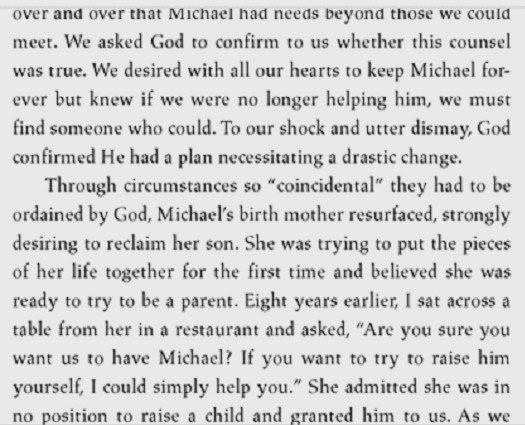
Screen shot from “Things Pondered” by Beth Moore

It is hard to gain a settled clarity as to the what the author is saying, when one reads a sentence that says they knew they needed to find someone else, not them, to help Michael, and in the next sentence that “to their shock and utter dismay, God confirmed” that Michael needed to go.

If you add up the timing, when Moore says Michael’s alarming behaviors surfaced he was approaching pre-adolescence. If he was “granted” to the Moores at age 4 and they returned him 7 years later at age 11, then the approaching preadolescence must mean age 10. He was at most 10 when he evidenced behaviors that alarmed them.

She wrote this book ten years ago, but Moore refuses to add to the narrative or be any more open than she already has been. Though Moore has famously been open and clear about other situations in her life that are equally as emotionally difficult to discuss, such as her self-esteem issues, her sexual molestation and her hysterectomy, Moore adamantly refuses to discuss with any clarity or detail about the Michael issue. In her book published a year later titled Feathers from My Nest, Moore said the adoption engendered “complexities of circumstance and emotions like nothing I have ever known” (unlike sexual molestation?) and that she is “fiercely and unapologetically private about it” but she “could not possibly write about my children without writing about all my children…even one who was only “mine for a season.

So there is another internal inconsistency that fails to clarify the situation and instead muddies it further. ‘I’m private about Michael but I could not possibly NOT write about him.’

Other statements in Things Pondered don’t add up. For example, was Michael orphaned as stated on page 27? Or abandoned as stated on page 35 and 41? Did the mother “strongly desire” her child returned, or did she demand “custody”? Was it a legal “adoption” as stated on page 29 or private matter of a family temporarily taking in one of their own as described on page 54?

Moore’s whole book, and subsequent responses to inquiries about him could be reduced to an easy one paragraph with clear language and Christian transparency: “My sister Anne couldn’t handle being a mother so I agreed to raise her son as my own. Seven years later Anne got her life together and wanted Michael back. With a mixture of sadness and relief, we gave him up. To this day we still aren’t sure if it was the right decision.”

See how easy it is to be transparent and clear?

How did it all turn out? Moore said Michael is now a tattoo artist covered in tattoos and that she is very, very proud of him.

Moore’s penchant to be overly dramatic in her live studies carries over to Things Pondered. Kim at Upward Call blog said this of Moore and I agree,

My personal reaction to Moore may not be the same as others. She is overly emotional and dramatic. I find that tedious. I don’t want tear-jerking stories. I want the Word of God. I don’t want forced allegorizations; I want to know God more. Her style, I’m told, is quite dynamic. I listened to a few of her broadcasts. I don’t care for her “dynamic” style. I am immediately on guard with speakers who rely on their dynamism. Let’s say Moore goes through a personal trial and she loses her edge. Let’s say she becomes rather mild and sedate. What will she be relying on then?

One of the best speakers I have ever heard is S. Lewis Johnson. He spoke with such a calm, quiet, authoritative tone and manner. I learn so much from him. A bible study should NOT rest on the strength of the speaker; it ought to rest with the strength of how God’s Word is presented and explained. When we rely on style alone, it becomes a matter of taking the Scripture and adjusting it to make us look more dynamic.

The same is true of Things Pondered. From the opening explanation I was disappointed. Moore’s perspective of Mary’s ponderings unfortunately showed the shallowness and earthliness of Moore’s own ponderings. Her hyper-drama, the soaring language of forced dynamism, the promise of transparency but ultimately the muddiness of the issue of her son, I was hoping to learn more about the adoption issue and like all of Beth Moore’s material, simply came away with less understanding and more questions.

In conclusion, the book is not something I enjoyed. Moore’s foundational perspective I’d described, being from herself about herself, to herself, is circular. It ultimately excludes Jesus. And if you don’t believe Moore is not Jesus-focused, a simple look at the numbers will tell you. In Things Pondered, she mentions Jesus 8 times. She mentions God 117. My recommendation is to ponder no further and read a better memoir.

Tim Challies reviewed and recommends the following books for women:

Glimpses of Grace by Gloria Furman
The big question Furman explores is simply this: How does the gospel change the way a woman lives out her calling as a homemaker?

Fierce Women by Kimberly Wagner. Wagner’s concern is for women to embrace their “fierce” qualities and to use them for God’s glory instead of for destructive ends.

Desperate by Sally Clarkson & Sarah Mae – This one is written especially for the mother of young children.

Women’s Ministry in the Local Church by Ligon Duncan, Susan Hunt – Duncan and Hunt focus specifically on the unique opportunities women have to serve in the life of the local church.

One popular book for women [Challies] does not recommend is Created To Be His Help Meet by Debi Pearl.

Challies recommends you get to know these women (biographies):

Lady Jane Grey by Faith Cook. Here is the short, tragic life of Lady Jane Grey.

John & Betty Stam by Vance Christie. Christian martyrs who sparked a great resurgence of missionary fervor.
Posted in creation grace, God, weather

Creation grace: Winter air

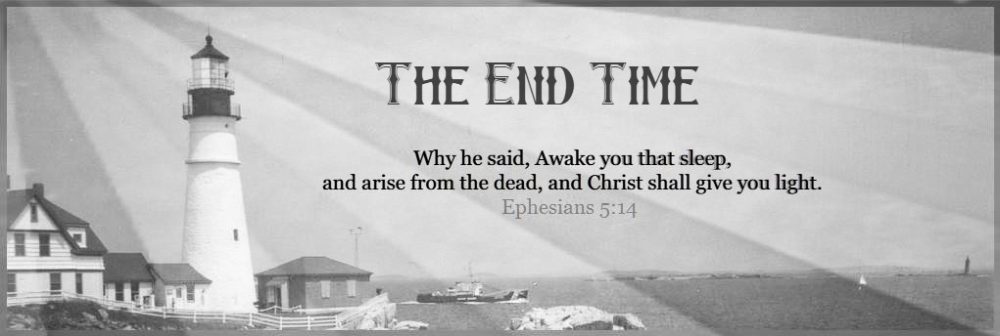
This is a photo I took of a Maine lake, frozen over in winter. The red square in the middle is an ice shanty on the frozen water. The houses on the right are on shore. The white streak across the pine trees along the shore is an air inversion. Normally, warmer air is closer to earth with the colder air aloft. In a temperature inversion, the warmer air is on top of the colder air and is pressing the cold air down.

From its chamber comes the whirlwind,
and cold from the scattering winds.
By the breath of God ice is given, and the broad waters are frozen fast.
He loads the thick cloud with moisture;
(Job 37:9-11a)
Posted in God, miracle, power

Feeding the 5000 is an incredible miracle

John 6:1-14,

After this Jesus went away to the other side of the Sea of Galilee, which is the Sea of Tiberias. And a large crowd was following him, because they saw the signs that he was doing on the sick. Jesus went up on the mountain, and there he sat down with his disciples. Now the Passover, the feast of the Jews, was at hand. Lifting up his eyes, then, and seeing that a large crowd was coming toward him, Jesus said to Philip, “Where are we to buy bread, so that these people may eat?” He said this to test him, for he himself knew what he would do. Philip answered him, “Two hundred denarii would not buy enough bread for each of them to get a little.” One of his disciples, Andrew, Simon Peter’s brother, said to him, “There is a boy here who has five barley loaves and two fish, but what are they for so many?” Jesus said, “Have the people sit down.” Now there was much grass in the place. So the men sat down, about five thousand in number. Jesus then took the loaves, and when he had given thanks, he distributed them to those who were seated. So also the fish, as much as they wanted. And when they had eaten their fill, he told his disciples, “Gather up the leftover fragments, that nothing may be lost.” So they gathered them up and filled twelve baskets with fragments from the five barley loaves left by those who had eaten. When the people saw the sign that he had done, they said, “This is indeed the Prophet who is to come into the world!”

Annie Vallotton drawings _Good news bible

I listened to John MacArthur’s latest sermon, True and False Disciples, which is an expounding on part of the above verses (and also part this sermon, from Nov 24th).

He said that the feeding the multitudes is an incredible, incredible miracle. 5,000 men were there which means women were there and children, heightening the tally to about 20,000 to 2,000 people on the hillside. Jesus brought food out of thin air, created it on the spot. It was not cursed b the ground nor by man. It was heavenly food, literally, which is probably the reason for the little detail they got as much food as they anted. It was probably so good they ate and ate until they were filled to busting.

It was incredible for another reason- every person participated in it. They didn’t just see it, or hear about it but took part in the miracle by eating of the food.

Here is a little scientific fact. In the sermon, Dr MacArthur quoted a scientist (sorry, I didn’t catch the name even though I listened several times, transcript will be up soon.) The science question is, if 20,000-25,000 people each ate half a pound of food, how much energy would it take to convert that into mass?

It’s Einstein’s famous equation, E = mc2.

Answer: It’d take all the electrical power on earth working at 100% output, 100% of the time, for 4 years, to create the energy to create that meal.

Jesus did it without breaking a sweat. Do you see why it’s such an incredible miracle? Now, get this:

He created the sun by His voice (John 1:3, Genesis 1:14). The sun consumes 600 millions of matter per second, generating enough energy in 1 sec to supply all US energy needs for 13 BILLION years. And God simply said, “Let there be lights in the expanse of the heavens to separate the day from the night.” And there was.

Posted in creation, God, sunset

What is it about sunsets?

Sunset, Comer, GA. EPrata photo

A friend of mine said that she loves sunsets. She and her gal friends, when they have an annual get-together at the beach, chase sunsets. They love the beauty and color and vibrancy and uniqueness of each one.

That got me thinking about sunsets. In October of this year I had put up a few of my favorite sunset photos. I used to travel quite a bit, and enjoyed sunsets in many places and in many climes. One place we used to enjoy sunsets was Naples Florida. Naples is on the west coast of FL and almost as far south as far as you can go on the peninsula. The city overlooks the Gulf of Mexico.

When you have a city on a west coast overlooking the water, it sets up a great view for seeing sunsets (and the green flash). People used to gather at the beach just before sunset. As the day waned and sunset drew near, the atmosphere at the beach changed from boisterous family fun, wheels of gulls, and screeches of children, to a quiet slapping of shutting folding chairs, towels snapping as they’re shook out, and slow footprints in the sand drifting away from the beach and back to the car.

Sunset, Danielsville, GA. EPrata photo

Then the sunset chasers arrived. Clusters of folks would stand around, or sometimes sit, and watch the changing colors in the sky. The place would become quiet. Eyes would gravitate to the shore, and voices would become whispers, almost reverential, so as not to break the spell. The sun bedecked itself in glorious colors as it neared the horizon, and the hues became almost otherworldly. Voices were all silent now with eyes full of wonder tracking the orb’s descent. As the sun sunk below the blue gulf, and the skies turned blue and purple itself, sunset watchers would sigh, and slowly fold their chairs and drift to their cars.

What is it about a sunset that evoked such reverence and attention from seekers, many of whom didn’t even believe in God? It wasn’t a movie or a show or a musical or a circus…it was a sunset. What is it about sunsets?

Sunrise, Comer, GA. EPrata photo

so that those who dwell at the ends of the earth are in awe at your signs. You make the going out of the morning and the evening to shout for joy. ~Psalm 65:8

An old-time pastor named Charles E. Jefferson pondered the meaning of the sunset in his sermon with that title.

How many sunsets have you seen during this last week, this last month, this last year? How many have you seen in the last ten years, the last twenty, the last thirty? I do not ask how many have you glanced at, but how many have you gazed upon, paid attention to, pondered? On how many have you held your mind long enough for it to become impressed, for an influence to be diffused through your heart, for a discipline to be exercised upon your spirit? How many sunsets stand out vivid and glorious on the walls of your memory? How many of you can say, that the glory of setting suns is an appreciable factor in the development of your emotional and spiritual life?

Charles E. Jefferson (1860-1937)
Sunset, Colbert, GA. EPrata photo

The purpose of my sermon is to awaken in you the sense of condemnation, the consciousness of sin because of your neglect of this great feast of the Lord. I would have you think of the sunset as a means of grace. Have you ever counted up the means of grace? How long is your list? What have you included? Public worship? Yes. Bible reading? Yes. Prayer? Yes. Is that all? Have you not put down the sunset? That is a means of grace. By all means, put that down. It is a sacrament. It is the visible sign of an invisible grace. It is a symbol for mediating God’s grace to your heart. Put it down in the list of the means of grace; include it, also, in your list of sacraments. Reckon it a page in -your Bible. It is certainly a word ‘of the Lord.’ It is not a word of man. Man cannot speak after that fashion. There are some things- which God allows man to assist Him in making. If God wants a potato or a turnip, a cucumber or a squash, He allows man to help Him in producing it. If God wants a flower-bed or a lawn He allows man to collaborate with Him. But there are some things in which man can have no part. When God makes a sunset He says to man: “Now, please step aside; I want to do all this by Myself. You cannot in any way assist Me. This work is completely beyond you. I, alone, can produce a work like this.

The bible says that all peoples from all nations, tribes, and tongues, have been made plainly aware of the attributes of our God the Holy Creator.

Nacreous clouds at Sunset, EPrata photo

For what can be known about God is plain to them, because God has shown it to them. For his invisible attributes, namely, his eternal power and divine nature, have been clearly perceived, ever since the creation of the world, in the things that have been made. So they are without excuse. (Romans 1:19-20).

The sunset is a miracle, a sign, and a wonder. Pastor Jefferson continues,

What a mystery it is that a thing so resplendently beautiful should be made of vibrations, and dust-particles and the movements of vapour. By reflection and refraction, and radiation and absorption, every dust particle obeying one law, and every vibration obeying another law, and every air-current obeying still another law, this stupendous miracle comes to pass.”

Consider the sunset. Consider the God who ordained it. Exult in the daily joy we have to worship His works and His creative power.