Posted in discernment, false, Lent, pride, ritual

Why do I want man to put ashes on my forehead when God will mark my forehead later? No Lent for me!

I’m not for Lent. It has a pagan foundation and is perpetuated by the false Catholic religion. It’s associated with golden calf-Mardi Gras and Pharisaical rituals. In addition it is contrary to the Gospel. I know some say that Lent for them is just a personal time of preparation for the upcoming Resurrection Sunday AKA Easter. But personal preparation is also called for in advance of the Lord’s Table (1 Corinthians 11:28) and to some extent every time we prepare for Sunday worship. (Ezra 7:10, Romans 12:1). Actually we’re supposed to pick up our cross daily, so why set aside a special time once a year for self-examination, obedience, and repentance? Why do we make a display of preparing for just as sacred as an event so publicly? Why smear our faces with ashes and mourn when we have overcome the world, have His peace and have been given His joy?
 
Beware of practicing your righteousness before other people in order to be seen by them, for then you will have no reward from your Father who is in heaven.” (Matthew 6:1)

labeled for reuse. Cardinal Dolan on Ash Wednesday speaking to reporters

But when you fast, anoint your head and wash your face, that your fasting may not be seen by others but by your Father who is in secret. And your Father who sees in secret will reward you. (Matthew 6:17-18). [underline mine]

Further, the activity of placing a mark on our forehead looked at thorough a biblical lens… The bible shows that the false prophet places a mark on the hand or forehead of those who follow the antichrist. (Revelation 13:16). These will be doomed forever. The Whore of Babylon has a secret name written on her forehead. (Revelation 17:5). Who wants to be associated with THAT?

On the positive side, during the Tribulation, angels mark the foreheads of those who serve Jesus (Revelation 7:3, Revelation 14:1). Finally, gloriously, “They will see his face, and his name will be on their foreheads.” (Revelation 22:4). The name of Christ will be upon our foreheads, placed there by angels at the behest of God, or by God Himself, so why do I want man to put any mark on my forehead? Can somebody explain that to me? Anyone? Anyone?? No thanks. I’ll wait for God to do it.

Wikipedia CC

I know the pride of my heart. I know that participating in public displays of external worship activities will only go to my head and I’ll end up promoting my own sanctity done on my own steam. No thanks, I don’t need any help in substituting works for grace. Maybe others can withstand the temptation. I know I can’t and I don’t even want to tread one inch over there. Here are some people who feel the same but have expressed it much more eloquently. The first one is by a woman named Amanda-

Counting it all Joy: A Vent About Lent
And here’s where I may be upsetting to the more theologically-minded, but it really isn’t first and foremost about a principle for me. Or a confession. It’s about me thinking this is contrary to the GOSPEL.

John MacArthur on Lent’s beginnings and how it is nowadays an abuse for sinning as much as possible-
Another vent about Lent:
Some even more religious souls feel that you sort of have to work your way up to resurrection Sunday, and so they celebrate what has become known as Lent. Forty days of eating no meat and, supposedly, expressing penitence for sin. I suppose its, in most cases, hypocritical, since penitence for sin is not accomplished by some self-directed abstinence or some self-motivated plea toward God, and its hypocrisy is also seen, I think, in the fact that before Lent, people tend to really pile up the sinning since they have to do without for a while…

In fact, there are two words that come to mind when you think of the pre-Lenten season. One is the term Mardi Gras, and the other is carnival. In our country, we’re familiar with Mardi Gras. In other parts of the world, they celebrate carnival. It is a time of unbridled sinning, of drunkenness, rioting, sexual misbehavior, getting ready for penitence…in view of Easter. In fact, Mardi Gras comes from two French words. If you know French, you know that the French word Mardi means Tuesday, and gras means fat. Fat Tuesday is the last day before Lent, and you better get fat now, because you’re gonna go without for a while. Carnival comes from words that we’re familiar with. Carne, we know from chili con carne, means meat. Val, we know from high school days when somebody was the valedictorian and gave a farewell speech, means farewell. Carnival means farewell to meat. So you have a big party before you get spiritual just to make sure you don’t miss anything; and then you hope against hope that it’ll all turn out in the end if you’re penitent enough and abstain from enough, maybe someday God will raise you up.

By the way, as a footnote, Lent is not from the Bible. There is no such thing in the Bible. It comes from the mystery religions of the cults of Babylon and was connected with the supposed killing of Baal by a wild boar; and for forty days and forty nights, the priestesses and the followers of Baal mourned his death until, supposedly, he rose from the dead on the 40th day, and that is where Lent came from, and it has been superimposed on Christianity…

Annnnd, this too, from Jeremy Walker,

This Lent I am giving up….reticence
Whether or not it is a vestige of the Emerging/Emergent appetite for a range of ‘spiritualities’ or an enthusiasm for an over-ripe liturgical renewal, I cannot say, but I wonder if it is in part a matter of distance both of time and space. This alleged ‘recovery’ of Lent and Easter is not actually a matter of historical sensitivity and an inheritance regained but of historical unawareness and an inheritance lost. Whether or not it is the high-grade muppetry of entire churches being urged to tattoo one of the stations of the cross on some part of their anatomy, or some gore-drenched re-enactment of the unrepeatable sacrifice, or some spotlit image-fest in which a total insensitivity to physical representations of the Christ – the image of the invisible God – is displayed, or some be-robed priest-figure half a step away from incense and obeisance, it does not come from Scripture and it does not belong in Christ’s church.

So that is my thought on Lent. Why is it making a comeback into Protestant churches? Here are two essays discussing Lent.

What is the meaning of Lent?

What is Lent?

Posted in false, hearing God, jesus calling, sarah young

Amazon’s best sellers of the year: Even Slate gets it about Sarah Young…

Slate presents “Amazon’s Best-Selling Books of 2013, and What They Tell Us About America

Even Slate gets it about Sarah Young’s seller, Jesus Calling

We’re desperate for guidance from Jesus, 
even if it’s just an author named Sarah Young pretending to be Jesus.

And yes, Jesus Calling IS Amazon’s number five best selling book of the year. Not in Christian Books. All books. Now I will go off to a corner somewhere and cry.

~~~~~~~~~~~~~~~~~~~

Further Reading

Sarah Young, was it really Jesus Calling, or someone else?

Jesus Calling review, and why ‘hearing’ God is a bad thing

Reaction to the book “A Christian Rebuttal to Sarah Young’s ‘Jesus Calling'”

Posted in discernment, false, praydreaming

The latest Catholic craze: praydreaming, and discerning why it is false

Today I woke up and read a devotional a friend and pastor wrote on his Facebook page. It was filled with gratitude. It reminded me that it is refreshing to read of gratitude and to be grateful all the day long. The main thing that jumped out at me though was his phrase “pray for wholesome desires.” That hit me.

Not that I haven’t been praying along those lines, but the succinctness of the phrase was tremendous. It brought clarity to my mind of good desires and bad desires. It was a wonderful thing to meditate on. And meditate I did. No, I didn’t go ‘OHM’ in front of lit candles, I turned to the bible. When you want to read about proper desires and how to slay the old man, where else are you going to go but to the Psalms and Romans? I did a word search on the word desire, I read widely about desires in context, and I prayed. Then I wrote a response to the initial devotional, and it appears here:

Praying for Wholesome Desires

In the midst of that, a blog commenter wanted to know what I thought about the blending of New Age and Roman Catholicism into the world’s prophesied final religion. I researched about the RCC Mystics, and put together a long response. It got me thinking about Catholicism and its patron saints, mysticism and how mysticism really points the person back to one’s self, the opposite of what praying for wholesome desires does. I did some more thinking on good desires vs. evil desires.

As I finished both the blog entry and the long comment back to the commenter, I started to web surf. Immediately I saw an essay from AmericanCatholic.org by Mark E. Thibodeaux, S.J., “a spiritual director, retreat director, high school teacher and Jesuit priest. He holds a Master of Divinity from Weston Jesuit School of Theology in Cambridge, Massachusetts. He is the author of Armchair Mystic: Easing Into Contemplative Prayer“. The essay is called,

Praydreaming: Key to Discernment

Praydreaming? And what does that have to do with discernment? It sounds New Age. It seems like Mysticism.

It turns out that praydreaming is the exact opposite of what I had been researching and thinking of all morning. THAT is how the Spirit works. He is amazing!

Now I will write about “praydreaming”. I am writing this to you so that when you hear of this practice, and you will, just like you have by now heard of contemplative prayer, you will know what it really means.

The blog entry I wrote earlier today is an examination of how our internal desires are bad. When we read in the bible the word desires, it is usually spoken of in a negative way. Our heart’s desires are only bad and bring us into judgment. (Ecclesiastes 11:9).

As depraved people we have no hope of changing our desires to good ones that will please the Lord. The only hope we have is first salvation, and then, sanctification. We aid the Spirit in His sanctifying work by relying on HIM and HIS desires for us. We ask Him to instill in us wholesome desires and the strength to resist our own evil ones. This is what it means to be conformed to His likeness. (Romans 8:29). We are gradually transformed by the renewing of our minds and the rejection of being conformed to the pattern of this world (Romans 8:22) with all its evil desires.

Praydreaming is the opposite. The. Exact. Opposite. In this way, it is a component of a successful false religion (Catholicism) because it turns our mind and heart from Jesus back to the sinful desires of our own selves. It offers the false notion that our desires are good and we can instill them into our selves by ourselves by searching deep within ourselves. This lie forms the basis of every false doctrine. To be clear: avoid praydreaming like the gangrenous infection that it is. (2 Timothy 2:16-17). Here is why-

Praydreaming comes from St. Ignatius of Loyola, a Catholic priest in the 1500s and a religious leader during the Counter-Reformation. The counter-reformation was the push-back to the rejection of the Pope’s absolute authority that Martin Luther and others began in the reformation. Loyola’s devotion to the Catholic Church was characterized by absolute obedience to the Pope. Ignatius was a Catholic’s Catholic. The article in American Catholic about praydreaming explains Loyola’s teaching on praydreaming and it begins like this:

“We Christians don’t just decide things, we discern them. That is, we do our best to figure out what God is calling us to in every situation. We do our best to say yes to that divine invitation. But how do we discern God’s will for us? That’s the tricky part.”

1. Catholics are not Christians.
2. We do decide things.
3. God’s will for us is not tricky to discern. Discernment comes from being in His word, not from any other source, because no other source can be trusted. Within the first sentence he sets up a straw man.

But look how the article goes on.

[Loyola’s] insight was this: “Good discernment consists of prayerfully pondering the great desires that well up in my daydreams.”

See how already the Catholic pushes upon us the notion that discerning what is good and what is evil comes back to ourselves? And that what we spontaneously think of in our hearts is worthy? It is a false path he is leading you down. Good discernment prayerfully ponders the WORD, not our desires. The article continues:

“Are desires good or bad? Many spiritual writers of Ignatius’ day spoke of desires as obstacles to God’s will. One solution was to suppress one’s desires—to eliminate them whenever possible. Ignatius, on the other hand, held the radical notion that God dwells in the desires of a good person.”

Good people do not exist. “There is no one good, no, not one.” (Romans 3:10, Mark 10:18).

The article continues, “Not only are desires not evil, but they are one of God’s primary instruments of communicating his will to his children. God enflames the heart with holy desires, and with attraction toward a life of greater divine praise and service. Ignatius did not seek to squash desires, but rather sought to tap into the deepest desires of the heart, trusting that it is God who has placed them there.”

The primary way God communicates His will is the Word who is Jesus Christ. The primary way He communicates to us is the bible, that is where we find His will. It is written down in the bible. Blindly trusting that any particular desire we have comes from God- whatever it is- is a false notion. Satan inflames our hearts with desires, too.

“For it is from within, out of a person’s heart, that evil thoughts come–sexual immorality, theft, murder…” (Mark 7:21)

Now look how the author redefines what evil desires ARE.

“A teenager may want badly to have sexual relations with a girlfriend or boyfriend. Spouses may become sexually attracted to people outside of their marriage. Are these evil desires? No, they are merely disordered desires. Why do any of these people want intimate sexual relations? Because each craves oneness with another—each is created by God, for the experience of unity.”

By his definition, a priest’s desire to have sex with an altar boy is not evil, merely disordered.

Yet those are evil desires- they are fornication. They’re evil because they do not honor Jesus. The lust of the heart breaks a commandment and that is evil. (Matthew 5:28, Exodus 20:17). Colossians 3:5 says to put to death what is evil in us, and sexual immorality is one of those evil desires. What’s more, it is idolatry! “Put to death therefore what is earthly in you: sexual immorality, impurity, passion, evil desire, and covetousness, which is idolatry.”

Nowhere does it say that all desires are good but some are disordered, to just discern the desire under the desire, and praydream it! The bible is clear in describing what evil desires are, because it lists them. Then we read commands to slay these desires, not coddle them by peeking under them to find more and granting them light of day in God’s name.

Anything that does not honor Jesus is evil. There is good, and there is evil. It is an old trick to call evil good and good evil. Isaiah spoke of this in Isaiah 5:20-

“Woe to those who call evil good
and good evil,
who put darkness for light
and light for darkness,
who put bitter for sweet
and sweet for bitter!”

Pulpit Commentary explains, “This is the fourth woe. There are persons who gloss over evil deeds and evil habits by fair-sounding names, who call cowardice caution, and rashness courage, niggardliness thrift, and wasteful profusion generosity. The same men are apt also to call good evil; they brand prudence with the name of cunning, call meekness want of proper spirit, sincerity rudeness, and firmness obstinacy. This deadness to moral distinctions is the sign of deep moral corruption, and fully deserves to have a special “woe” pronounced against it.”

Doesn’t that say it all? The Catholic essay about praydreaming promotes a deadness to moral distinctions, and woe will be upon him. In the article, after giving a couple more examples of how what is clearly sin is not really sin, the article continues,

“We fall into sin when we are ignorant of the desires beneath the desires. Consider this way of understanding personal sin: We sin, not because we are in touch with our desires but precisely because we are not in touch with them! This is one of Ignatius’ most profound insights.”

Well he is right- now it is getting tricky. According to praydreaming methods promoted by Loyola, first, I have to discern my desires. Then I have to discern whether the desire is holy by mulling it over within myself. Then if it is unholy I have to discern the desire underneath that desire. How do I do all this? Via praydreaming, as we read next.

“How, then, do I tap into these great desires? I daydream, that’s how! I fantasize about great and beautiful futures. I let God dream in me and I sit in silent awe and wonder as these holy dreams come to life before the eyes and ears of my soul. Now that’s a different approach to prayer than most of us know. But that’s what St. Ignatius taught.”

He goes on at length in a teaching manner of how to praydream, by giving many different examples of life scenarios. I don’t recommend you read it because it will cause confusion and there is no profit in learning how to praydream. The author unwittingly reveals that Loyola’s method always brings a person back to themselves. The phrase “my dreams” occurs a lot. The upshot is, it is a method for dreaming what you want to do in the flesh and using God as a method of permission to accomplish them.

Finally, he says that when you praydream and discern properly what decision to make, a sweet inner peace will be “the telltale sign” that it is the right decision.

I have warned against a so-called ‘inner peace’ as a tell-tale sign before. There is a difference between confidence in God and an inner peace. Often, I have to do things that are outside my comfort zone, or are difficult, and I have a lot of angst about it. Feeling a sweet inner peace for me often means that I am making a wrong decision, because the calm feeling leads me to my own comfort zone which exists inside the circle of my own desires. Though sometimes I do have an inner peace, I do not have a sweet inner peace about many things I must do, but I do them anyway because I am a slave to Christ and I know that He is with me to help during the hard times.

As an example, do we think that any of the martyrs as they were led to their doom, had what Loyola says is a feeling of “sweetly, lightly, gently, as a drop of water that enters a sponge”? Tradition says that Peter’s wife was crucified before his eyes. Do we suppose that Peter’s decision to remain true to Jesus at that moment gave soul his gentle drops of water on his heart? Even Paul agonized over doing the right thing, and asked that the thorn in his side be taken from him because it was painful. Paul certainly felt peace, and he certainly felt angst, but neither of those feelings are a telltale sign of proper discernment for any given decision he made.

Beware of relying on feelings as the sole arbiter of discernment. Our feelings usually lead us falsely.

Even at the end of the article as the author explains how Ignatius urges the person to pray for confirmation of their decision, the method once again points the person to their own selves.

“Once we feel that we have reached a point of decision, Ignatius suggests we place that decision before God and await his confirmation. How will this confirmation come? In the same way that our initial discernment came. It will be through pondering the stirrings of our heart as we begin to take the first tentative steps toward our new option.”

The stirrings of our hart is the sign that I have made a right decision? But the bible says, “The heart is deceitful above all things, and desperately sick; who can understand it?” (Jeremiah 17:9).

Not once is the authority of scripture mentioned. Not once was the Catholic person urged to consult the word to see what it has to say implicitly or explicitly about a situation.

However, we born-again believers must believe in sola scriptura, the doctrine that “sola Scriptura has to do with the sufficiency of Scripture as our supreme authority in all spiritual matters. Sola Scriptura simply means that all truth necessary for our salvation and spiritual life is taught either explicitly or implicitly in Scripture. … it means that everything necessary, everything binding on our consciences, and everything God requires of us is given to us in Scripture.” (Scripture, Tradition, and Rome“)

Discernment comes by knowing the word of God from the bible alone, and obeying it. Jesus is called the Word, and He is The Word of God. (John 1:1, Revelation 19:13). We discern it by reading the word of God and by submitting to that as our sole authority. Not daydreams, not desires, not feelings, not the heart. We are called to be holy, in fact, to be patterned after Jesus who is Holy (1 Peter 1:15). If we can’t imagine that Jesus had a certain desire, then it is an evil desire.

There is a famine in the land and is it because of methods like praydreaming that we are hungry. Rev. Matt Slick writes,

“Spiritual discernment is lacking in the Christian community. Though there are faithful pastors and Christians who take the word of God seriously, there is an increasing number of Christians who are abandoning the clarity and commands of Scripture and substituting political correctness, feelings, and tolerance for biblical truth and its sometimes difficult revelations. They want to make Christianity more palatable so that the gospel offends no one, but they fail to realize that the gospel that offends no one is not the gospel of the Bible. Though we are not to purposely offend, in the name of truth offenses will come and we are not to shy away from them.”

“So, what do we do to develop better spiritual discernment? First and foremost, you must be born again (John 3:3; 2 Cor. 5:17) so that you may have the mind of Christ (1 Cor. 2:16). Second, you must study the Word of God and believe it. Third, you need to develop a proper biblical theology that includes the sovereignty and holiness of God found in both the person of Christ and in the Bible. Proper theology is the bedrock of discernment.”

Posted in false, pope

Reprise: The ‘Gospel’ According to Rome

Nathan Busenitz serves on the pastoral staff of Grace Church and teaches theology at The Master’s Seminary in Los Angeles. He is part of the team of writers at The Cripplegate. Today he wrote,

“With a new pope elected, the eyes of the world are on the Roman Catholic Church. No doubt many evangelicals find themselves confused as to the critical differences between the biblical gospel and the gospel according to Rome. Hence today’s post-“

And he goes on to outline in five bullet points the major doctrinal differences, using Roman Catholic primary sources as quotes. He also presents the biblical case. The essay is short, clear and undeniably convicting.

He concludes:

“Before evangelicals rush headlong to enthusiastically embrace the new pope (pretending as if the Reformation never happened), they should stop and remember the fact that the Roman Catholic Church teaches a gospel that is utterly incompatible with the biblical gospel of grace. In the same way that Paul denounced the false teachings of the Judaizers (Gal. 1:6-9), the gospel according to Rome deserves unhesitating words of condemnation. That means that those who promote Rome’s false gospel, including the new pope, ought to be confronted for their part in the propagation of damning error.”

I encourage you to read more at their blog.

Posted in false, pharisees

Children of hell and sons of heaven, part 1

I was reading Matthew the other day and I read Matthew 23 with a new eye. A verse jumped out at me. Don’t you love when that happens? Then the verse that jumps out stays in my mind and heart for a long time, rolling around like a holy marble.

Here is the verse:

“But woe to you, scribes and Pharisees, hypocrites! For you shut the kingdom of heaven in people’s faces. For you neither enter yourselves nor allow those who would enter to go in. Woe to you, scribes and Pharisees, hypocrites! For you travel across sea and land to make a single proselyte, and when he becomes a proselyte, you make him twice as much a child of hell as yourselves.” (Matthew 23:13-15).

Then the next day I received something in the mail that was really good. I was humbled by it and touched by it, and I began thinking about the global church body.

Since then, I’ve been pondering three things- pastors, elders, and leaders of the faith that shut the door of heaven in people’s faces (Matthew 23:13); second, children of hell that emerge from a false system Matthew 23:15), and third, what it means to be a child of God in the global body. (1 Corinthians 12:12). Children of hell vs. sons of God.

So the contrast of the children of hell and the sons of God will be the main point in two blog essays, one today and one tomorrow. Today, leaders who shut the door of heaven in peoples’ faces and the children of hell they make after themselves.

When the scribes and Pharisees arrested Jesus, Jesus endured six trials. Usually, as today, a person endures one. There were procedures for the trial, and as we saw with Paul, opportunity for appeal. Depending on the charge, a person could be arrested and tried in front of the High Priest and Sanhedrin, or arrested and tried in front of the Romans. Jesus was charged with blasphemy, so He went before the High Priest & Sanhedrin. He was also charged with sedition, so He went before the Romans (Pilate).

But because the charges against Him were illegitimate, Jesus went before the Jews three times and the Romans three times and then had one final appeal before both groups simultaneously.

The first time, they dragged Jesus away to stand in front of Annas. However, Annas wasn’t the High Priest at the time. Annas had been pressured to step aside due to becoming too powerful. Annas was sort of like the Godfather, taking a cut of all the Temple money exchange action and the sales of the beasts for worship. (more here). He didn’t have the position, but he had the power. So Jesus was dragged to Annas first.

“Not only were the moneychangers robbing the people, but history records that excessive prices were being charged by those who were selling animals used in Temple sacrifice. For example, according to Leviticus 12:6-8, after an Israelite woman had given birth, she was to bring a sacrifice to the temple, preferably a sheep. But if she was poor, she could take two doves or two pigeons for the sacrifice, since birds were much less expensive, one for a burnt offering and one for a sin offering. The Jewish Mishna states that because of greed, the market for birds rose so much that not even the poorer woman of the community could afford them.”

The price for two birds had risen to one gold zuz. (I don’t know the exchange rate, but that sounds like a lot…). The Mishna gives this account in Kritut 1:7:

“If a woman had given birth five times during her life . . . after she brings a single sacrifice, she will be able to eat sanctified foods once again. But she is still under oath to bring four more. It eventually came to pass that the cost of two birds rose dramatically to one gold zuz. Rabban Shimon ben Gamaliel declared: “I pledge that before I go to bed this very night, the price of birds will fall!” He headed straight to the courtyard and instructed the people to obey the following regulation: “After giving birth five times, a woman . . . needs to bring just one sacrificial offering to cover all five births . . . That very day, the price of birds plummeted to one quarter of a silver zuz.” (source)

It was a struggle to keep the prices low. The greedy priests would take advantage of the travelers who brought an animal for sacrifice by fallaciously declaring it unfit, or with blemish, and order them to buy another animal at the temple grounds for an exorbitant price. If the Jews who brought money had Gentile coins, it meant the coin had a pagan image on it and were told they had to exchange the money for clean Jewish money. Of course, the exchange rates were sky-high.

“Even many of the high priests during the first century seemed to have given up their love of God for the love of money. Most notably the High Priest whom Jesus was brought before, Annas, along with his five sons who succeeded him to that position. The Temple sacrifice during their reigns can best be summed up by the words “The Marketplace of the family of Annas.” (Or in other translations, “The Bazaars of Annas”).

“The historian Josephus sheds some light on the actions of one member of this family, Annas the younger, the man who had James (the writer of he book of James in the Bible) stoned to death. Josephus states:
“The high priest, Annas, (after he had been relieved from his office) to some degree, was respected and feared by the citizens, but in a bad way; for he loved to hoard money. He became good friends with Albinus, and of the newly installed high priest. He did so by offering them bribes; he also had wicked servants, who associated with the most vilest sort of characters, and went to the thrashing-floors, and took the tithes that belonged to the priests by force, and beat anyone who would not give these tithes to them. So the other high priests that followed him as well as his servants acted likewise, without anyone being able to stop them; so that some of the priests, those who were old and were being supported with those tithes, died for lack of food.” A matter of fact, Jewish history records that these High priests who walked the temple courts during the first century, were despised by the majority of the people for their brutality and hunger for money.” (source)

Remember, Jesus cleansed the temple twice, once at the start of His ministry and once at the end. He called His holy ground a den of thieves, and this struck directly at the power and money structure Annas had so carefully accumulated. The hatred Annas had for Jesus was vicious. And we see the reaction of the Savior to the thievery and greed of Annas in Matthew 23 because He pronounced woes upon them all.

The actual High Priest at the time of Jesus’s trial was son-in-law Caiaphas. But the first trial was in the wee hours of the morning, at Annas’s house. Since Annas wasn’t even High Priest he had no authority to bring charges. The house was an illegitimate place for a trial. There were no witnesses nor was the time of day remotely legitimate. The whole thing was a sham. These people were a sham, and the Jews knew it.

Annas, Caiaphas and their ilk for generations had shut the door of heaven in people’s faces by behaving in these and other grossly selfish and carnal ways. They sought the best seats at the banquet table (Matthew 23:6). They hogged the most prominent seats in the synagogue. They colluded in murder plots against Jesus. (Mark 3:6). Not even life was sacred to them, and least of all the Sinless One’s life who came to bring them life!

In that way, they shut the door of heaven against the people.

Can you imagine the people, laboring under the onerous Laws, struggling to come up with a gold zuz to pay for two pigeons? Knowing they were going to get ripped off as they crossed the temple grounds to go and try to find some peaceful place to worship? Imagine what you feel like after only suspecting once like you got ripped off. You get angry and if you’re not careful you get bitter. These people knew it and they knew there was nothing they could do about it. It would happen again and again, year after year. So some just gave up, like the widow and her two cents.

“Jesus has cleansed the temple. He has said it is a cave of robbers. It is a false religious system and these people are devouring widows’ houses. Then in the sequence, He’s done with that speech, He’s exhausted, it’s been a long wearying day of interactions and teaching. He sits down in the Court of the Women, opposite the Treasury and it says, “He looked up,” which meant that He was looking down, that’s an exegetical key there, you can’t look up unless you were looking down…” So He looks up and He sees people coming by and putting their money in the system, just dumping their money in the receptacles that they had set up in that corrupt thing and He sees a widow come by and she puts two coins in, the only two she had, to go home and die. And He turns to His disciples and says, ‘This temple is coming down, not one stone upon another.’” And the point is this, any system that devours widows and takes their last two cents is corrupt, is coming down…. The desolation is still going on today, folks. And I think that last little moment when He saw that system eating the very last two pennies of that widow, He said, “That’s it.” So I say to you, “Woe to you prosperity preachers who take the widow’s money to buy your ten-thousand-dollar a night hotel room and your hundred-thousand dollar a month jet. Jesus feels about your system just like He felt about that. (source)

Others didn’t give up like the widow did, but instead joined the corrupt system. They became sons of hell, figuring, “they’re doing it, why not me? I want some action, too…” For example, we know the tax collectors took more than their share. Zacchaeus by grace of God was saved after an encounter with Jesus, and declared he would give back to all his ill-gotten gain four-fold. (Luke 19:1-10).

However, we see the ultimate example of the legacy of the greedy Pharisees making sons of hell twice as bad as they are, in the crowd that called for Jesus’s death. (Luke 23:18-21).

This bunch of people who had received grace, food, healing, and teaching, who followed Jesus and clamored for Him every day, crowds pressing close, now called for His death at the first opportunity. Children of hell indeed.

I began with the verse and I’ll end with it:

“But woe to you, scribes and Pharisees, hypocrites! For you shut the kingdom of heaven in people’s faces. For you neither enter yourselves nor allow those who would enter to go in. Woe to you, scribes and Pharisees, hypocrites! For you travel across sea and land to make a single proselyte, and when he becomes a proselyte, you make him twice as much a child of hell as yourselves.” (Matthew 23:13-15).”

What are our Pharisees making? Hell for themselves and children of hell to follow them. They fly on private jets and quit their church to go on book tours and drink champagne and rip off the wounded and sick. They boast that they’ll throw brethren under the bus if they don’t conform to the pastor’s vision. They make promises that won’t come true and ascribe to the Holy Spirit the things the devil is doing.

These emergent, prosperity preaching, seeker hispter pastors are making people into children of hell. The children of hell are despondent, in despair, looking for hope in an open door to heaven, but all they are getting is ripped off as the Pharisees make merchandise of them and exploit them with false words and then they shut the door of heaven in their face.

No wonder Jesus condemned them with woes!

Tomorrow, the beauty of the global body, unbesmirched and glowing by the glory of Jesus!

Posted in false, history channel, the bible

Why I am not watching The History Channel’s "The Bible", part 2. It sows error and confusion

I believe the contending for the faith over the History Channel’s presentation of the miniseries “The Bible” is a pitched one. I have almost never received the number of views on one essay as I have on part one and in such a short time too. Christian blogger Mike Ratliff said the same. Further, Mr Ratliff said the following, with which I agree:

“… As I stated in an earlier comment referring back to this post, I haven’t experienced such a strong level of dark spiritual warfare protecting some stronghold of darkness in quite some time. Our enemy has obviously staked quite a bit into this…”

Why? Why is this such a battle to get people to see the error and corruption in this film?Look how bad it is, as Ratliff describes,

“I’ve watched extended previews of it Kim that are not available on TV. It is comparable to taking a man-centered version of the Bible and watering it down even further to make it entertainment. I believe the Bible calls that removing the offense of the Cross since the purpose of our Lord’s incarnation, which is the Atonement, is totally submerged into the “Change the World” view that Rick Warren and those who emulate him teach. Paul rejoiced when others preached Christ, but that’s not what this is since the gospel they preach is “another gospel” and the Jesus they preach is “another Jesus.”…

In the film “The Bible”, the bible is mishandled, period. It removes sin, the cross, the need for the cross, changes verses, inserts events, takes liberties, and puts man at the center of a feel-good social Gospel. Anything that is this grossly man-centered is bad, a different gospel, and to be avoided. But let me give just a few examples of how the producers and writers and paid ‘Christian’ consultants have put forward a Gnostic gospel of man to the dilution of the Gospel of Jesus Christ.

Remember, in the Gnostic series I had written a few months ago, the Gnostic will always seek to change the emphasis of the gospel away from the work of Jesus to the worth of man. Always.

An early example is Noah. As he tried to comfort his family on the ark, we listen to the voice-over tell us something that is simply not true. We hear the reason for the flood was: “Wrong choices, wrong decisions, that’s why this [the flood] is happening.”

In the pre-flood world according to the movie “The Bible”, man didn’t sin but simply made mistakes. An entire world was drowned because some people made a bad choice? The bible says, “The Lord saw that the wickedness of man was great in the earth, and that every intention of the thoughts of his heart was only evil continually.” They diminish the rebellion of sinful man against Holy God by making it sound like someone picked sauerkraut for their hot dog instead of ketchup. God didn’t send the flood because of an “oops.” He sent it because He determined to wipe out man due to his continual evil. (Genesis 6:7).

The truth is, after the fall, all humans born on earth were born with a total sin-nature. In the Gnostic world they tell us that we still have the capacity to do right by simply deciding to make good choices and avoiding bad decisions. Without faith in Jesus and His indwelling Holy Spirit, we don’t have that capacity. We see this incapacity and total sin-nature right away, when the son of Adam and Eve, Cain, became a murderer. (Genesis 4:8). We see it when David says, “Behold, I was brought forth in iniquity, and in sin my mother conceived me.” (Psalm 51:5). And again, Solomon knows, “Indeed, there is not a righteous man on earth who continually does good and who never sins” (Ecclesiastes 7:20). It has nothing to do with man’s choices but all to do with man’s evil.

Next: When we hear in the film that God ‘cleansed the land’ by sending the flood, it shifts the emphasis away from man’s sin to the oopsies he did. If I poured out milk onto the floor, the analogy would be that in the real bible I would own up to spilling the milk (man is culpable for his actions.) In the film version of The Bible, God just cleansed the land, so the focus becomes the mess and the mop that wipes up the mess, not the man who made it. It changes from focus on the sin of the sinner to the consequence of his sin, which, after all, was just a little dirt to be cleaned up. Just by saying ‘cleansed’ it removes man’s participation in the reason for the flood. But look at what the real bible has to say–

“for all flesh had corrupted their way on the earth. And God said to Noah, “I have determined to make an end of all flesh, for the earth is filled with violence through them. Behold, I will destroy them with the earth.” (Genesis 6:12b-13)

In another example, in the film series “The Bible,” we hear the narrator say after the flood: “it was a new beginning for Noah’s descendants & a chance to restore the relationship between God and humanity.”

They would have you believe that the restoration and reconciliation between Holy God and sinful man was up to Noah and his progeny. There was no mention of God’s promise of a Messiah to redeem us. According to “The Bible” filmmaker’s Gnosticism, it is up to man to make that reconciliation. A Gnostic always changes the emphasis away from the work of Jesus to the worth of man. Always.

In another example, we hear the narrator say the “Covenant between Abraham and God.” The covenant was not between man first and God second. The covenant wasn’t even between God and man, it was between God and God because it was an unconditional promise of a sovereign God to sinful man, who simply received it.

The truth of that covenant is, “This unconditional covenant, first made to Abraham in Genesis 12:1-3, promised God’s blessing upon Abraham, to make his name great and to make his progeny into a great nation. The covenant also promised blessing to those who blessed Abraham and cursing to those who cursed him. Further, God vowed to bless the entire world through Abraham’s seed. Circumcision was the sign that Abraham believed the covenant (Romans 4:11). The fulfillment of this covenant is seen in the history of Abraham’s descendants and in the creation of the nation of Israel. The worldwide blessing came through Jesus Christ, who was of Abraham’s family line.” (source “The Covenants of the Bible“).

But when it came time to mention the covenant, “The Bible” writers put man first and made it sound like man cut a deal with God and God capitulated. That is a Gnostic tactic.

Then there is what Mike Ratliff mentioned, the “Change the World” theology. This is most troublesome.

When Peter is called; he is told that he “will change the world.”

When Paul is converted and baptized, he is told the reason for his baptism is so he may “change the world in [Jesus’] name.”

When the man playing Jesus emerges out of the water, he says he is going to “change the world.”

This ‘change the world’ theology’ is a repeated message in the film and one that the Gnostic loves. Why? They love it for two reasons. First, because it is man-centered. Who is going to change the world? Man. Jesus is a footnote in this world-changing. It elevates man’s worth above the work of Jesus, something the Gnostic always likes to do. A Gnostic loves himself more than God, who is enemy to Him. And second because it focuses on this world and all the temptations that the Gnostic offers and wants.

Ratliff said,

The scene that sealed this for me was in Peter’s boat after Jesus had him catch all those fish after he had fished all night and caught nothing. The stuff that went on in that scene is found nowhere in Scripture. Instead of Peter saying, “Depart from me Lord for I am a sinful man!” he asked Jesus what he is going to do if he follows him. Jesus replied, “Change the world!”

I have news for you. This world is going to melt. (Matthew 24:35). It is a temporary world. The SOULS on this world are eternal. Yet the ‘change the world’ mentality is simply another name for social gospel, and social gospelers say that the kingdom of God is to be realized by social improvement. They would have you believe this is why Jesus came. It is a different gospel, and if it is a different gospel, it is false. (2 Corinthians 11:4; Galatians 1:8; Mark 7:9).

The encroachment of the Social Gospel is a tactic and a barometer at the same time. Dr. Paul Hiebert was a Doctor of Missiology at Trinity Evangelical Divinity School, and missionary for 6 years under the Mennonite Brethren Board of Missions. Art Azurdia explained in a lecture on the series, Drive By Discernment,

“Hiebert said that the first generation of Mennonites were a people preoccupied with the Gospel and concerned with some social responsibility. The second generation of Mennonites assumed the Gospel, and became increasingly absorbed with social responsibility. The third generation of Mennonites abandoned the Gospel and was consequently altogether was completely preoccupied with social responsibility. Preoccupied. Assumed. Abandoned.”

Over the last century, theological liberals were increasingly defined by the social gospel accompanied by their view of the kingdom. To the liberals the “kingdom was not future or otherworldly, but ‘here and now.’ ” (source)

We want to do good for others but the reason we are called to the Kingdom by grace to go out is not to change the world. Often, that is the result. But the reason we go is to proclaim the Good News of Jesus Christ.

I heard one of the pastors I listen to say that if there is an adjective in front of “Gospel” it is not the real Gospel. We see this split between Gospel and social gospel in David Platt’s book Radical.

“A similar voice is David Platt’s and his book Radical. Platt offers better balance than Chan but still propagates a two-tiered gospel composed of the true gospel of redemption and the social gospel. While Platt is careful to elevate the true gospel, the social gospel of feeding the hungry and giving to the poor is the primary focus of the book and accounts for its popularity. He writes, “As we meet needs on earth, we are proclaiming a gospel that transforms lives for eternity.” The author does not advocate the social agenda as opposed to true evangelism, as mentioned above, but he does say that caring for the poor is evidence of salvation. As a matter of fact “rich people who neglect the poor are not the people of God.” However, when we turn to the New Testament, we find that, while Christians are to be loving and generous to all people, they are never told to attempt to remedy the consequences of the sin of unbelieving humanity through social action. Instead, they are instructed to meet the needs of brothers and sisters in Christ, something Platt admits in a footnote (p. 225). In fact, the church is never commissioned to rectify injustices by dealing with the symptoms of sins but to “radically” uproot sin itself through the gospel.” (source)

Do you see how insidious The Bible series is and its evil ‘change the world’ gospel? It shifts the emphasis away from the work of Jesus on the cross to the worth of man, so that he may boast. “Look what I did! I changed the world!”

No…that was Jesus, our beloved and holy Savior.

The Bible miniseries on The History Channel is not worth your time or energy. The Lord is too Good, too Pure, too Precious to waste even a moment on the darkness and corruption of that show. I am personally convinced that the show is a pivot point in the deepening apostasy of the church. The show sows error, confusion, and corruption.

Like Chris Rosebrough said, lol, don’t watch the movie, the book is so much better!

~~~~~~~~~~~~~~~

 Part one here

Posted in false, passion 2013, slavery

Do the Passion 2013 members know who the real slaves are?

By Elizabeth Prata

The first problem I see with the Passion Conference is the social issue of slavery that the conference set the kids upon. It is a global cultural ill that existed at least since Abraham’s time and exists today. The conference leaders choose a cultural ill to ask the youth attendees to work toward. Last year and this year the social problem they have focused the kids on is sex trafficking and slavery in the world. They raised over three million dollars to donate to various partner groups. Here is the link to Passion 2013’s campaign “Freedom.”

I’d said in another post that doing good is good, but that ending slavery is an unrealistic goal. I’d said that Jesus could have ended poverty or slavery, but He didn’t. Revelation 18 shows us that in the Tribulation there will be a healthy slave trade in men and their souls that Jesus Himself stops at the very end. So this campaign will fail, because just by looking a the Bible we can see its futility.

That is not to say we don’t try. But the focus is all wrong. I’ll explain why in just a minute. Now I want to bring up the second issue that has been niggling at me. Adult attendees are not allowed. They are banned. They are not allowed to attend Passion conferences. Here is what the Passion website says [FYI Update- the conference still holds the same policy in 2023, FAQ page says except for the leader, other adults attending with youth for the 2024 conference are not allowed]

CAN PEOPLE OVER 25 ATTEND PASSION 2013?
If you are 26 years of age or older, you may only register to attend Passion 2013 as the leader of a group of students attending the conference or as a Door Holder. Leaders must have a ticket to attend. If you are a leader, we ask that you come with your students. Otherwise, we will need thousands of Door Holders to serve over the days of the conference. If you would like to serve, please fill out a Door Holder application here.

HOW MUCH OF THE CONFERENCE WILL I BE ABLE TO ATTEND?
Serving at a Passion conference does not allow for much participation in the conference itself. Please come willing to serve and fully aware that there may not be time to attend the conference at all.

For all the speakers’ talk of “community” the Passion conferences, they do much to divide it. They forbid parents, senior pastors, elders, and elder siblings from attending with the youth. Church community is a community of people from all ages. Yet I hear so much from the Passion people about “this generation.” There is so much emphasis on “this generation” that for all the world it looks like they are being separated from the herd. Read Titus 2.

We are instructed in the Bible that pastors, teachers and elders teach the young and that children must obey their parents. Now it is true that Youth Pastors attend with their flock, and that the youths attending are not children, but are of college age, but I maintain that any religious endeavor that specifically takes time to split the generations and deliver messages to youth only is not a good thing.

This conference does much to divide the church by capitalizing on a natural youthful zeal and diverts their attention from quiet submission in service to a local church. This co-opting of their zeal to solve a cultural or social ill is not biblical.

Youths haven’t had time or seasoning to determine what their spiritual gifts even are, let along set them on fire to spend money and energy in using them in what are vain attempts to solve an unsolvable social issue. Young adults of aged 18 -25 (the demographic of the Passion conferences), have not served in church long enough to have become seasoned by the Holy Spirit. They may not even know what their spiritual gift is. Even if they have a mere few years of service under their belt and have settled on their gift in ministry, they have not learned self-control in diverse circumstances yet. Frankly, they are too young to be ambassadors for Christ – absent senior oversight.

As to the issue of stamping out slavery in the world, here is what John MacArthur has to say about Slavery

Although slavery is not uniformly condemned in either the Old or New Testaments, the sincere application of New Testament truths has repeatedly led to the elimination of its abusive tendencies. Where Christ’s love is lived in the power of His Spirit, unjust barriers and relationships are inevitably broken down. As the Roman empire disintegrated and eventually collapsed, the brutal, abused system of slavery collapsed with it—due in great measure to the influence of Christianity. … New Testament teaching does not focus on reforming and re structuring human systems, which are never the root cause of human problems. The issue is always the heart of man—which when wicked will corrupt the best of systems and when righteous will improve the worst. If men’s sinful hearts are not changed, they will find ways to oppress others regardless of whether or not there is actual slavery.

In Titus 2, Paul speaks about each of the generations that labor in the home church, and he issues exhortations to Titus as pastor on what each generation’s responsibility is. The responsibility is not to split the generations and to give the youth a charge separate from the elders outside their home church. It is to labor lovingly in quiet service within the bounds of their revealed spiritual gift. The young learning from the elder so that the young can learn submission and how to control their youthful zeal in appropriate ways with a proper model and parental oversight. That is how the church is set up.

I said above that I’d share why the focus of the slavery issue at Passion 2013 is wrong. There are not millions of slaves in the world. There are billions. Eight billion to be exact. Every person on this planet is a slave to Christ, or a slave to satan. If we are converted and saved by His grace, we are slaves to His righteousness, (Romans 6:18). If we are not saved, then we are in bondage to the devil. (Romans 6:16). The focus which the Passion people set the youth toward is all wrong because as MacArthur said above, the first priority of each Christian is to set humans free from satanic bondage. Cultural ills are solved through Christ’s love, not Passion conference money.

Just imagine of 60,000 youth were taught the powerful Gospel truthfully, and were set forth with focused zeal to evangelize in the real Jesus’s name back in their home spheres!

“For many Christians today, as throughout church history, the most important and fertile field for evangelism is the place where they work. That is their mission field. As in almost no other place, unbelievers have the opportunity to observe believers in day by day situations and activities. They see whether the believer is patient or impatient, kind or uncaring, selfless or selfish, honest or dishonest, clean or vulgar in his talk. They have the opportunity to see how well the Christian lives up to the faith he professes and the principles of the Scripture he claims to hold dear.” (Source)

The upshot is that there is a cumulative negative effect. No, giving money to a cause is not bad. Attending a conference is not bad. Being a volunteer and serving is not bad. But in my opinion, Passion 2013’s cumulative effect is bad. Look at it this way: the attendees were drawn to a large event with the tantalizing enticement of rock music, separated from senior pastors, elders, and parents for several days, drenched in a fishbowl of adrenaline fueled zeal, given half-truths to feed on, told by adored celebrity musicians and pastors they were a special generation, diverted their focus from service in church or campus to solving a global problem, encouraged to sacrifice their money, and turned back to their home churches or campuses as new leaven.

Let’s pray that the more kids than not, released back to home churches after Passion 2013, learn who the real slaves are: themselves, to Christ, and their unsaved community members, to satan.

Posted in discernment, false, jesus, passion 2013

Part 3: Discerning a Gnostic conference called "Passion 2013," conclusion

I have been blogging a discernment series on what was taught at the Passion 2013 conference held in Atlanta this January. There was a star studded Christian lineup of speakers and singers at the conference. Unfortunately, that did not guarantee that the Word was handled correctly. Much was taught that was heretical. What was not overtly heretical was implicitly denigrating of preaching, the bible, and church as an organization. I had done an examination of the lead singer for Jesus Culture in part 1, and looked at what Louie Giglio said in part 2. Those links are below. All was balanced against what the bible says.

In this part I’ll present a bare bones synopsis of what Judah Smith said, and then conclude lower down.

Judah Smith talked with the kids at Passion 2013. It is all the rage these days to pooh-pooh doctrine. To mock religion. William Young did it in The Shack, writing,

–the dusty old King James Bible
–church attendance is “religious conditioning”
–“Images of family devotions from his childhood came spilling into his mind, not exactly good memories
–“God’s voice had been reduced to paper, and even that paper had to be moderated and deciphered by the proper authorities and intellect”

The cumulative effect of these subtle denigrations of what Jesus holds dear have an effect. In this piece, Smith is talking about Genesis 1, “Let us make man in our image.” He denigrated traditional Christianity, too. He said–

“For those of you who are not scholars, you are wondering who’s “Us” and who’s “Our”? God, I know this is awkward, but who are you talking to? I suppose you could create an alter-ego, but really, who are you talking to, God? … For those of you who are so scholarly and have been around church forever, you say, [he makes his voice a sing-song nasal so the mocking quality would become evident] “Clearly that is a a reference to the triune Godhead.” For the rest of us that watch NFL games and have a real life, it’s a bit [garbled].”

There are several messages here just in this short snippet, and none have anything to do with proper biblical understanding or preaching. Smith taught 60,000 kids that–

–If you’ve ‘been around church forever’ you’re not a respected elder. You’re outdated deadwood.
–Proper study is not to be desired or you risk being branded a “scholar”. In my day they were called disciples.
–Studying the bible and going to church means you don’t have a ‘real life’.
–It is cool to mock the brethren

He also said,

–Without community our world will not see God
–Trusting leadership is not easy (reminds me of the secular revolutionary mantra from hippie 1960s ‘don’t trust anyone over 30’)
–Going to a local place where people know you is not easy (he rarely says “church”)
–Jesus is building something. He is not just here just to individually save people.

Parents, is that what you want your child learning? That leaders are hard to trust and church isn’t real life? That is what these people are teaching. Before sending your child off to a conference that calls itself Christian, look into the people who are going to be filling your child’s mind. Those who claim Jesus may not be all that sterling of a role model as you would want.

Overall, I took away that what was taught to the young adults at Passion 2013 was that visions are normal and to be expected. If you’re not having visions and hearing God’s voice speaking to you personally, something is wrong with you. Topically addressing the scripture in a skeleton context while filling the rest of the time with personal anecdotes and description of ecstatic experience is a sermon. What we experience in ecstatic mode is to be preferred to diligent study of the word. In other words, the bible is OK, but visions are better. The world’s social ills can be fixed with zeal and money. Plus, fixing the world’s social ills with zeal and money should be the purpose of my life. A real faith includes volume, excitement, drama, and surfing from one high encounter with God to the next.

You might remember I talked about the time when David Platt’s book Radical came out. Christians all over the place got on the bandwagon and decided that their plain-jane faith was unremarkable and they needed an adrenaline shot of daring and a radical change to prove to God that they’re really a Christian who means it. Let’s contrast the fancy lights and high volume indoctrinaton of charismatic faith preached at Passion 2013 with this-

An Unremarkable Faith
By Tommy Clayton, Tuesday, January 04, 2011

Meet Larry, a thirty-six year old Science teacher. Larry married Cathy 12 years ago. They love each other and enjoy raising their two sons. Larry’s life wouldn’t hold out much interest to the average citizen. His Facebook account doesn’t draw many friends and nobody ever leaves a comment on his blog. In fact, most people would summarize Larry’s life with one word—boring. But not Larry. Teaching osmosis to junior high students, playing Uno with his kids, and working in the yard with Cathy is paradise to him. But the real love of his life is Jesus. Larry’s a Christian. He’s been walking with the Lord for more than 20 years.

Larry’s Christian friends all employ the same word to describe their companion—faithful. He’s faithful to his local church where he’s been teaching Sunday School for nearly a decade. He’s never ignored a legitimate financial need within the body of Christ. He gives sacrificially, but secretly. Larry devotes himself to his wife and family, lovingly shepherding them through every season of life with the Scriptures. He’s faithful to his job and fellow colleagues. He’s managed to share Christ with nearly every junior-high teacher at Oakwood Academy. And although they mock Larry behind his back, all the teachers respect him. It won’t shock you to know Larry pays his taxes and never misses an opportunity to serve his community. Larry’s life commends the gospel. He’s faithful, but he’s unremarkable. Or, is he?

If you’re bored with Larry’s Christianity, it’s probably because you’ve been influenced by a very different idea of the Christian life. Larry’s not radical, or wild at heart—not in the sense of taking careless risks, jeopardizing the stability of his family, or pursuing a life of adventure. You could say Larry is quite content with his station in life, a station given him by God. He aspires to live a quiet and peaceable life in all godliness and dignity. Sound familiar?

There’s a stubborn and influential voice within evangelicalism that seems to despise simple yet unremarkable faithfulness. Pastor Tom Lyon acknowledges that when he writes, “The value of a humble and unassuming life seems to have been eclipsed by this upwardly mobile ‘dare to be a Daniel’ brand of Christianity which elevates ambition above maturity and has seated the stable but unremarkable believer in coach class. Something is wrong here.”[1]

Lyon went on to describe what he called the unremarkable Christian: “His aspirations, his thirst for notoriety, his estimate of greatness have all been changed. His horizon has come closer to home. He finds in the Bible no call to be outstanding. He is not without ambition, but his dreams have nothing to do with rising above his fellows. Unless pressed, he prefers anonymity to attention. He is steady. Steadied by grace. And one of the most amazing things about grace is how it works this even disposition.”

That’s not an endorsement for ministerial mediocrity or a call to settle for small, lifeless pursuits. On the contrary, it’s is a plea for excellence—but excellence according to Scripture. A humble, Spirit-filled pursuit of greatness should characterize every Christian’s efforts in ministry, but remember that greatness in God’s kingdom is unappealing to the world, unremarkable. How does the world view your life? John MacArthur writes:

“Christians are to be known for their quiet demeanor, not for making disturbances. Unbelievers should see us as quiet, loyal, diligent, virtuous people…To promote a tranquil and quiet life, believers must pursue godliness and dignity…Godliness can refer to a proper attitude; dignity to proper behavior. Thus believers are to be marked by a commitment to morality; holy motives must result in holy behavior. Both contribute to the tranquility and quietness of our lives.”[2]

Here’s a thought to ponder as you go your way. Had you befriended Larry, how might you react to his faithful, yet unremarkable life? Would you advise him to venture out further, take a radical risk for the kingdom and leave behind the quiet, mundane confinements of his Norman Rockwell life? Or would you commend Larry for how he’s living, giving God glory for such a faithful yet unremarkable Christian? Remember, the handful of so-called radical, risk-taking Christians stand on the backs of men like Larry. They are only able to take their risks because the Larry’s of this world won’t, and Larry wouldn’t have it any other way.

~~~~~~~~~~~~~~~~~~~~~~~

Who wants a boring faith like that when you can have a vision and tell it to adoring crowds and dance in the footlights? Who wants to study the word, attend church, and serve when you can stamp out sex trafficking in your lifetime or reach an entire generation to bring fame to Jesus? Which brand of Christianity do you want your child to embrace? The vision casting kundalini-dancing, tromping the world kind of faith that eschews doctrine as dry and church as old hat? Or the faithful, dignified, pure, quiet kind of faith that Jesus brought us- and died for?

Don’t hesitate in your answer, because just as the debt clock swings inexorably upward every second, so does  the count of another youth lost to satan. Every second that goes by where that good kind of faith is not taught- or corrected- is a second where the tentacles of hyper-Charismatic ecstasy and cultural ambition will remain in your child like a poison. And just like the kids in secular world were taught in 1960- don’t trust anyone over 30, the Christian youth of today are being taught, don’t trust any pastor over 30. These youth of today will be the pastors of tomorrow. Uncorrected, this trend will doom our faith to a dwindled few, unless we pray battle prayer, and contend for these kids, bringing them back to a knowledge of what TRUE passion for Christ really is.

““““““““““
Part 1: Jesus Culture and Kim Walker-Smith
Part 2: Louie Giglio

Posted in discernment, false, glittering generality, louie giglio, passion 2013

Part 2: Discerning a Gnostic conference called "Passion 2013," Louie Giglio

Louie Giglio is a 54 year old pastor of Pastor of Passion City Church in the Atlanta area which he founded in 2008. Prior to that Giglio was a pastor at Andy Stanley’s North Point Church for 13 years, itself an emergent-leaning church with a mystical bent. He is Speaker/Founder of the Passion Movement. The Passion Movement is most publicly seen in the large conferences held at the first of each year and is so named after the year. Passion 2013 just concluded this week in Atlanta, Georgia. The Atlanta paper reported that 60,000 youths attended.

Mr Giglio’s main ministry began in and continues to be aimed at Christian youth- especially college aged students through young adult.

More than 170,000 people from more than 130 countries watched part of the Passion 2013 conference online. His “Laminin” sermon has attracted over 3 million views on Youtube. If you would like another take on the Giglio laminin sermon, I point you to the essay Laminin and the Cross at the science-oriented website Answers in Genesis, where we are specifically cautioned against looking for signs in the world OR in science via Mr Giglio’s laminin doctrine.

This blogger had this to say about the Inadequacies of Evidentialism (i.e. ‘Laminin proof’):

And though I would imagine his ministry has been a blessing to many folks over the years, he is one of those type of speakers who will sensationalize Christian “evidences,” like the laminin molecule, in order to make God appear to be really cool and neat-o. But this misappropriation of Christian evidence has some hidden dangers that will undo your credibility as a messenger for God.

First, it capitulates to the culture, particularly the teen culture who already think being a Christian is “squaresville.” Though there is good intentions with the attempt to show that believing in Jesus doesn’t make a person an “L7,” what happens when smug and surly Devon goes home after one of these Giglio conferences where he opines on the shape of the laminin molecule, does an internet search only to discover that Giglio exaggerated his proof? All that shows is Christians can lie.

Secondly, the illustration merely trivializes the Gospel. Honestly, does the laminin molecule have to look like a cross in order for God to be a perfect creator? How does a cross shaped molecule help God out exactly? How does it make God more real? Isn’t the fact that there is a complex, self-replicating molecule to begin with proof enough for God’s hand in all of life?

I agree.

So the statistics show us that Pastor Giglio is popular and has influence. The facts show that his most famous sermon is a bit off-center and exaggerated, with a wrong emphasis. With such numbers it behooves us to take a look at what he is preaching to these multitudes of youth, many of whom reside in my own state of Georgia.

The Passion 2013 website says “At the heart of it all, Passion exists to see a generation stake their lives on what matters most. For us, that’s the fame of the One who rescues and restores, and the privilege we have to fully leverage our lives by amplifying His name in everything we do.”

This is something I have read frequently that Giglio and the people associated with Giglio say. It is that what they do is for the fame of Jesus. On the surface it looks like bringing fame to Jesus is a good thing. But words matter. I say again, words matter. Jesus doesn’t need fame. He had fame. (Luke 4:14). Fame is fleeting and fame is fickle. We do not need to bring Him fame.What we bring Jesus is glory.

Puritan Thomas Watson wrote in his sermon, “Man’s Chief End is to Glorify God“,

The glorifying of God, 1 Pet. 4:11. “That God in all things may be glorified.” The glory of God is a silver thread which must run through all our actions. l Cor. 10:31. “Whether therefore ye eat or drink, or whatsoever ye do, do all to the glory of God.” Everything works to some end in things natural and artificial; now, man being a rational creature, must propose some end to himself, and that should be, that he may lift up God in the world. He had better lose his life than the end of his living. The great truth asserted is that the end of every man’s living should be to glorify God. Glorifying God has respect to all the persons in the Trinity; it respects God the Father who gave us life; God the Son, who lost his life for us; and God the Holy Ghost, who produces a new life in us; we must bring glory to the whole Trinity.

Jesus does not need us to bring Him fame.

To continue, Mr Giglio has gone the way of people who teach, preach and expect to hear divine audible voices directly telling them what to do specifically and in individual circumstances. And not that they can expect this voice just once, but often. At last year’s Passion 2012 conference, Mr Giglio said, “How many of you heard the voice of God speak specifically, clearly, directly, and personally, to you? Can you just put a hand up? I’d like you to share it. Can you put a hand up for a minute?” … “God spoke to me.” Don’t let the voice of the darkness, tell you that you are not worth that God would not speak to you. Don’t let him tell you, you don’t matter. God spoke to you.”

He teaches youth that it is normative to hear God, and worse, the flip side of his teaching is that if you do NOT hear God, there is something wrong with you. Apparently Mr Giglio has full confidence in his ability to detect the Voice. At a conference in GA in March 2012, Mr Giglio was interviewed by his friend Andy Stanley. Mr Giglio said, “The upside to planting a church at 50 years old – You care less about what other people think. You have more confidence in your ability to hear from Jesus.”

The ability to hear His voice- through the scripture and no other place- comes from the Holy Spirit. Not ourselves.

That was a short overview. Now to the Passion 2013 conference.

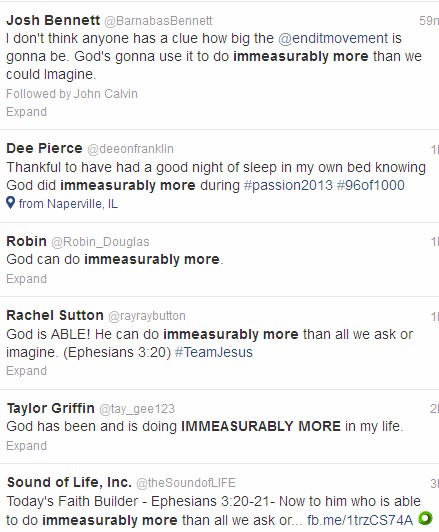
I was struck by the catch-phrases Mr Giglio used throughout his session one teaching. He kept saying God is “the God who does of immeasurably more” and that phrase was a main tenet of the talk. I hesitate to say it was a sermon.

By definition if you have more of something you have to already have had a quantity to measure against. That’s how you know you got more. But Mr Giglio never defined what he meant by this term. He didn’t define it from scripture or use it in context . (It was from Ephesians 3:20). It was not concrete, it was nebulous. More than what? If I don’t get more, am I doing it wrong?

What you find when you listen to scripture twisters, is that they unhitch a verse, or worse, a partial verse, from its context. They then use these well known phrases in their talks so they can sound godly but deny its power. It is a technique that politicians and propagandists use and it is called the tactic of the Glittering Generality.

“Glittering generalities are emotionally appealing words so closely associated with highly-valued concepts and beliefs that they carry conviction without supporting information or reason. Such highly-valued concepts attract general approval and acclaim. Their appeal is to emotions such as love of country and home, and desire for peace, freedom, glory, and honor. They ask for approval without examination of the reason. They are typically used by politicians and propagandists. … A glittering generality has two qualities- it is vague and it has positive connotations. … [they] are terms with which people all over the world have powerful associations, and they may have trouble disagreeing with them. However, these words are highly abstract and ambiguous, and meaningful differences exist regarding what they actually mean or should mean in the real world.”

George Orwell described such words at length in his essay “Politics and the English Language.” He said these words and phrases, “are strictly meaningless, in the sense that they not only do not point to any discoverable object”. When used by a preacher unhitching the meaning of the scripture from context, it also unhitches it from pointing to the discoverable object, in this case, Jesus. Orwell continued, ” Words of this kind are often used in a consciously dishonest way. That is, the person who uses them has his own private definition, but allows his hearer to think he means something quite different.”

When politicians use glittering generalities they do so to appeal to the widest audience possible without causing an offense to as few people as possible. Emergent/Mystical preachers do the same, and in his session one talk, Mr Giglio and his immeasurably more not only was a hit, the phrase is taking on a life of its own on Twitter.

The key is that without precisely dividing the word as preachers are supposed to do, which would include a specific application of the meaning of this phrase from Ephesians in context, we now have thousands of kids running all around believing God will do immeasurably more in their lives, each having a different definition about what that is. Some might believe is it more finances. Others, more health. Others, to stamp out a social ill, still others may hope to receive immeasurably more visions. Politicians and propagandists have made use of the glittering generality for years but now it seems, they must make room for the Southern preacher. I literally lost count of how many times Giglio said it.

In the same session, Mr Giglio discussed his ministry and the impetus for it. It is that millions of young adults “don’t have a clue as to why they’re on this planet.” Again as with any Gnostic doctrine, the emphasis is always shifted away from Jesus toward the human. I would be happier if he had said he had a burden for young people because “they don’t know Jesus”. But in emphasizing their purposelessness in preparing to solve their problem as to why they are on this planet, scriptures can be done away with in the movement toward works. And make no mistake, works is the mantra of the Passion conferences.

The focus this year as last year is to eradicate the sex trade in the world. The focus these youths had been set toward was not to correctly proclaim the Jesus of the bible but to solve a cultural ill. Three million dollars was called for and the day after the conference closed, over three million dollars was gotten.

Of all the world’s ills, child abuse and the sex trade, especially in children, make me fall down in horror. No one more than me would love to eradicate it. I am not saying that trying to do good is bad.

But the reason Christians are on the earth is to proclaim Jesus. Jesus could have eradicated poverty. He could have stopped slavery. He didn’t He said “the poor will always be among us.” (Matthew 26:11). And apparently Mr Giglio had not read Revelation 18:13, where in the future a healthy slave trade is part of the going economy of the world and is taken down by Jesus Himself. We are not here to solve the world’s problems.

The slavery is a symptom. The root cause is our sin. Do they not believe that when the Restrainer is taken out of the way, and sin is allowed to burst through in all its evil, that when the wars of the Tribulation occur, that the parties will be adhering to the Geneva convention? No, every person on the losing side of every war in the Tribulation will become a slave.

The goal today is to preach Christ crucified so that millions can be saved before the judgment comes.

Continuing, in his talk, Mr Giglio did say that he had directly heard from Jesus and that he had received “confirmation” that the conference was to be about solely the person of Jesus Christ, and that he and his wife “wanted to inspire a generation to cash in little dreams and to make the focus of their life’s goal to make Jesus known in their generation.”

First, any get-together of Christians should solely be about the person of Jesus Christ. One does not need direct revelation from Jesus to tell a person that. I included Mr Giglio’s age up above for a reason. If this was a new preacher or a young preacher perhaps these statements could be forgiven as youthful immaturity. But Mr Giglio is 54 years of age and finished bible college 25 years ago. He should already know that the purpose of conferences is to put Jesus at the center. And as for making Jesus known to a generation…that is in the bible too. All he needs to do is cite the verse. (Mark 16:15). But instead Mr Giglio went on for 20 minutes about his personal vision where he got this information. So it ends up being about Giglio, not Jesus- exactly the opposite of what he said he wanted it to be about.

He had said way back at the beginning to open to Ezekiel 37, but there was a long intervening period of time when he talked about himself. When he did preach the valley of dry bones, he allegorized it, as many emergent/Gnostic preachers do. He talked a lot about our “foolishness” and did not use the word sin. (OK, once.) Beth Moore does that when she preaches our ‘pits’. Joel Osteen fails completely to make mention that we sin, only infrequently alluding to our “mistakes.” See? Words matter. We have three of the nation’s most popular preachers choosing not to use the hard word ‘sin’. So you see the trajectory.

Substituting the doctrinal words for less loaded ones is a common tactic. Making fuzzy the hard words is a favored tactic because the person wants to please and not divide. It is a way to make hard doctrines sound ticklish to itching ears. (2 Timothy 4:3). Below, Giglio is softening the doctrines and making mush out of the rightly divided word. Giglio continued in his talk–

“Many of us came to the door in captivity. We got to the dome but we came in captivity, we didn’t come free and clear. Something has a grip on us. When you trace that back there could be events and circumstances, for sure, but at the end of the day it is because of our foolishness that we forget what God is. And that’s what his people did. They were dragged of into captivity into foreign lands. God intervened. He sent a voice.”

That makes no sense. Then Giglio read from Ezekiel 36:24-27.

“I will take you from the nations and gather you from all the countries and bring you into your own land. I will sprinkle clean water on you, and you shall be clean from all your uncleannesses, and from all your idols I will cleanse you. And I will give you a new heart, and a new spirit I will put within you. And I will remove the heart of stone from your flesh and give you a heart of flesh. And I will put my Spirit within you, and cause you to walk in my statutes and be careful to obey my rules…”

But he stopped short of where God said they shall live in His land. God was speaking of a definite time and place and a promise given to the Israelites. Not the Gentiles. If we are to see the promises given to the Gentiles we turn to the New Testament and it is better preached from there. Many preachers these days allegorize and spiritualize the events in the Old Testament and make incorrect application to the church of today. The verse ends with this, which shows it is not for us but for the Jews–

You shall dwell in the land that I gave to your fathers, and you shall be my people, and I will be your God. And I will deliver you from all your uncleannesses. And I will summon the grain and make it abundant and lay no famine upon you. I will make the fruit of the tree and the increase of the field abundant, that you may never again suffer the disgrace of famine among the nations. 31Then you will remember your evil ways, and your deeds that were not good, and you will loathe yourselves for your iniquities and your abominations. It is not for your sake that I will act, declares the Lord God; let that be known to you. Be ashamed and confounded for your ways, O house of Israel.”

Far be it for a Emergent/Gnostic preacher to say that we are evil and that God is ashamed of us. When was the last time you heard any preacher of stature preach that?

He resumed his talk by saying, “That’s what God does. When God sends a voice, that voice announces that God wants to come, and when God wants to come, God wants to breathe, and when God breathes, He breathes on hard-hearted people, on stone-hearted people, and He takes out of us the hardness and he puts into us beating living life. And that’s the Gospel.”

That is not the Gospel. Anyone there who heard that would not understand one thing about what Giglio said, because it wasn’t scripture. THIS is the Gospel–

“Now, brothers and sisters, I want to remind you of the gospel I preached to you, which you received and on which you have taken your stand. By this gospel you are saved, if you hold firmly to the word I preached to you. Otherwise, you have believed in vain. For what I received I passed on to you as of first importance: that Christ died for our sins according to the Scriptures, that he was buried, that he was raised on the third day according to the Scriptures” (1 Corinthians 15:1-4).

The Gospel according to Giglio is that ‘I was foolish so God breathed on me’.

Other perplexing phrases from the opening session at Passion 2013 by Louie Giglio:

–Jesus rocks into the moment and the disciples are all in a wad.
–God was breathing into the vision
–That verse was birthed in us
–It all has to do with the voice. I heard a voice intervening into foolishness.
–Worship is when we give God His breath back

None of that makes any sense. God is not the author of confusion. (1 Corinthians 14:33). If the word is being handled rightly, it will always make sense.

In his final prayer, Giglio prayed:

–Do you think your dreams can live? (It is not about my dreams, it is about God’s will)
–God believes in you (remember the Gnostic shifts the emphasis from the work of the Shepherd to the worth of the sheep)
–Can your memories be restored? (what does that have to do with anything?)
–Lord, come and speak (Giglio teaches that audible hearing of God’s voice is the norm. It isn’t)

Other concerning items from Mr Giglio of late outside this year’s Passion 2013 are that last year he invited John Piper and Beth Moore to perform and lead the audience at Passion 2012 in the pagan/Mystical practice Lectio Divina. Lectio Divina is a clear attack on the sufficiency of scripture. It is a pagan Roman Catholic practice and is to be avoided. Church Leaders blog covers this concerning event well, and at the end asks some excellent questions to Mr Giglio.

Mr Giglio has been aligning more with Prosperity Gospel preacher Joel Osteen, preaching at Lakewood in May 2012.

In closing, I have a warning and an encouragement. The warning is that any pastor can drift. Any Christian can drift. As any car driver, boat owner, pilot, or farmer knows, one moment of inattention can cause you to get off course. Unless that course is corrected, you wind up over time far from your intended destination. Christian life is a series of immediate course corrections. We do this by repenting, praying, and constantly reading the bible. Attend a local church so that you can be accountable and so you can hear the word of God rightly preached.

But if that course correction is allowed to fester, like a disease, it grows in you. The disease makes the person sicker and sicker. In Christian life, one unconfessed sin, one time we adhered to a false doctrine, can cause others to immediately come in. Satan wants to capture you into a snare, and false teaching is the way to do it. If Mr Giglio began well, he is not finishing well. He is drifting.

Undiscerning Christians tend to take take snapshots and stop there. If they find that their one time investigative results into a particular preacher or teacher was doctrinally sound, they take a mental snapshot and stay with that assessment forever. But the Christian should be armed with a sounding line. That is the line which sailors of old threw out constantly to see how deep the bottom was. When the depth got too shallow, they sounded the alarm and changed direction. Without throwing out the sounding line, they would run aground and maybe sink. But constant vigilance allowed them to always know how deep they were in it, and whether they were navigating safe waters.

Christians need to be like that. If they ever only threw out the line once they would not have an up-to-date data on how deep or shallow the waters were of someone’s preaching. Mr Giglio needs to take the measure of the shallow waters he is navigating. He needs to get back deeply into the word. The encouraging thing is that he, and any person who follows teachings of his or like his, will be forgiven if they repent. Jesus told the church at Pergamum who were holding to a false teaching to repent (Revelation 2:15-16.) To the church at Thyatyra Jesus told them He gave much time to repent of their false prophesying. (Revelation 2:21). To the church at Ephesus who forsook their first love, He called out to them to repent. (Revelation 2:5). That is how Good Jesus is. But with each church in need of repentance there also came a warning of judgment if they failed to set aside their undoctrinal ways. That is how holy Jesus is.

~~~~~~~~~~~~~~~~~~~~~~~~~~~~

Part 1: Jesus Culture and Kim Walker-Smith
Part 3: Conclusion


Posted in discernment, false, gnostic, heresy, jesus culture, kim walker smith, passion 2013

Part 1- Discerning a Gnostic conference called "Passion 2013," Jesus Culture and Kim Walker-Smith

A major ‘Christian’ conference at the Georgia Dome was just concluded this week. It was called Passion 2013 and 60,000 youths attended.

Joining founder and leader Louie Giglio at the conference were the band Jesus Culture, Judah Smith, Chris Tomlin, Lecrae, Francis Chan, John Piper and Beth Moore, plus several other speakers and singers.

As with any large “movement”, or sellout venue that says it features Jesus as its centerpiece, we wish to rejoice. Our hearts want revival. We want to see many come to know Jesus to the salvation of their souls. We love to praise Him in large numbers. But being a discerning Berean, I know that the bible says that the end time will be rife with false movements, false Jesuses being proclaimed and that they will not endure sound doctrine and will heap up teachers to themselves who tell them what they want to hear. So where does Passion 2013 stand in terms of doctrinal purity, safe  absorption of its proclamations and general joy in corporate praise?

Sorely lacking.

The alert-meter is off the charts on this one and I am sad to say that from the many hours I’ve invested in listening to what came out of it I have more tears than applause. I will write a series of blog entries addressing some of the major speakers and singers doctrines. I do this so that we can be warned and so that we can begin a rescue operation toward those whom we know who attended or who are influenced by these people. I do this because I love the Jesus of the bible as He has revealed Himself- not as the one experienced by others in visions and signs. I do this because I love my brothers and sisters and do not want to see them stumble over this obstruction satan has put in their way.

Which Jesus was preached at Passion 2013? Let’s find out by looking at what its participants said at the conference and prior in other venues. So who are these people? Let’s begin by looking at a band called “Jesus Culture”

Source Do Not Be Surprised via Twitter/Giglio

In my first essay reacting to what was taught at Passion 2013, I want to take a look at Jesus Culture’s lead singer, Kim Walker-Smith. After that in subsequent entries I’ll look at Louie Giglio and Judah Smith before concluding.

Kim Walker-Smith [Notice her hyphenated name, and read Genesis 2:24] is a part of the Jesus Culture Band. She is part of a home church called Bethel Church in Redding CA. Smith is a worship leader and/or a “worship pastor” at that same church, which teaches heresies. On her church page she is listed as as “a passionate worship leader with an anointing to bring an entire generation into an encounter with God.” I’m impressed. The Apostles didn’t even have such an anointing.

At a conference called ‘Awakening 2011’ Smith shared with the audience a vision she said she had. It was an experience of cuddling with Jesus, and God was nearby too. She said her vision buoyed her and she lives off it, explaining, “I live off of the encounter … until the next one.” Yet the bible says “It is written, “‘Man shall not live by bread alone, but by every word that comes from the mouth of God.’” (Matthew 4:4). This means we don’t live just in the flesh and for the flesh (having adrenaline rushed encounters) but we live by His word.

The problem that comes from living from encounter to encounter is three-fold: first, we live by His word as the bible commands, not by experiences. Second, human nature requires ever bigger rushes. The last one has to be topped. It is the Law of Diminishing returns for an adrenaline junkie. Adrenaline junkies seek encounters or experiences in which a high is produced by epinephrine released by the adrenal gland. It produces a fight-or-flight response (one which Ms Smith admits she felt during each of the encounters she described). The problem is that each ‘high’ has to be succeeded by one with more oomph in order to achieve the same effect. It seems like it would be an upward spiral but it is really a downward one. Third, what happens when the encounters stop? They do and they will. After each high, there is a low. What will sustain her faith then? If you live by the word, it will never pass away. (Matthew 24:35).

Here is a bit of what Mrs Smith said regarding her encounter with Jesus and God:

“This is not a normal thing for me, to have these encounters.” But then later she said “I live off of the encounter … until the next one.” We know from the bible that several righteous men encountered Jesus as He is glorified, but they are few. Few. Isaiah, Ezekiel, Paul, and John were lifted up and saw Him in heaven. Of those four, three were allowed to relate a small bit of what they saw and Paul was commanded not to speak of it at all. Peter saw a transfigured Christ on earth, Paul encountered Jesus on the road to Damascus and Moses encountered God atop Mt Sinai.

In comparing her experience with the ones above from the bible, the two experiences are dramatically different. I’ll summarize what Mrs Walker-Smith has said in her video testimony. Then we will compare her experience to those who experienced God from the bible’s record:

In her vision, she said she saw Jesus and God behind Him. God beckoned for her to come closer. When she did, two questions popped into her mind that she wanted to ask Jesus. One was “How much do you love me, and the other was “What were you thinking when you created me?”

In answering her question as to how much Jesus loved her, Smith said he started stretching out his arms, and it looked like Stretch Armstrong, the superhero cartoon character “whose arms and legs could stretch out like spaghetti noodles. And He’s laughing hysterically.”

A person entering the presence of God and Jesus would become immediately insensate & insensible. But Mrs Smith remained conscious enough in her own flesh to ask Jesus to ‘tell me about me.’ Then she likens him to a cartoon character, and says he laughed hysterically. Hysterical laughter is out-of-control laughter, and Jesus is never out of control.

The bible tells us that if you were one of the FEW men to have seen heaven while still alive that what you see is unlawful to express. (2 Corinthians 12:4). But if directed to tell, the visionary must use many symbols and metaphors to try and get the point across because the scene is so incomprehensible. The writer uses exalted metaphors to convey the inexpressible beauty and holiness of the scene. The writers did not use everyday toys and cartoon characters to convey the scene, in no way is that appropriate. The metaphors themselves that John or Ezekiel used for example were ‘hair white like wool, eyes like a flame, feet like bronze’, (Revelation 1) ‘a brightness all around Him…like a bow in the sky.’ (Ezekiel 1:27-28).

After Daniel’s visions of the Ancient of Days, he became “distressed, alarmed and dismayed.” (Daniel 7:15). That sounds bad enough, but the Hebrew says the word alarmed means active suffering and piercing grief. (Strong’s). Yet in Mrs Smith’s visions she giggled like a schoolgirl and cuddled in Jesus’ arms while God roamed around nearby.

Mrs Smith said that she had wanted to ask Jesus two questions but in that first vision had only asked one. She continued in her sharing of her now second vision in which the unasked question was answered: “What were you thinking when you made me”. She said that a few months later she was watching the sun come up early in the morning. “I like to watch the sun come up, which is a miracle in itself … because I am not a morning person.” Oh wait, I thought she was going to praise the creator.

“Again, I felt the presence of the Lord, and I felt like He wanted me to ask that question. Jesus is like, ‘Please, please ask me that question.’ And again he said, ‘Please, please ask me that question.”

The scene she describes here is of a begging Jesus. It continues:

Smith said she’s now standing with Jesus. In front of her is God the father. Jesus’s got a table, and He reaches into His body and clutches his heart and rips a chunk off His heart and throws it on the table… he fashions her out of a clay or play-dough like substance, puts her into a ballerina music box where she begins dancing, and then Jesus begins shouting “who hooooo” while running around with his arms up, continually going around, “woo hoo!” in circles, running around a bunch of times. Smith said he looked like a jack in the box.

“Then I’m in the palm of the Father’s hand…and I see His heart and the outline of his heart and the outline is the chunk he ripped out and he slides me into His heart like a puzzle piece and it’s a perfect fit. Smith said Jesus told her, “I made you because you make me happy.”

A few days ago, I wrote about the Therapeutic Gospel. I noted how the Gnostic changes the emphasis of the Gospel from the work of Jesus to our own worth. I’d said:

The Therapeutic Gospel does something else that’s devastating. It leads us to believe that it is our worth that motivates God’s action to save us. The thinking is, Jesus came to save us because we are so valuable to God. … A good example comes from comparing two parables.
Pastor Wax compares the subtle shift in a counterfeit Gospel from being Christ-centered to man-centered, by comparing the parable of the sheep as they are presented in Luke and in the false Gospel of Thomas. Here is the Gospel of Luke:

“What man of you, having a hundred sheep, if he has lost one of them, does not leave the ninety-nine in the open country, and go after the one that is lost, until he finds it? And when he has found it, he lays it on his shoulders, rejoicing. And when he comes home, he calls together his friends and his neighbors, saying to them, ‘Rejoice with me, for I have found my sheep that was lost.’ Just so, I tell you, there will be more joy in heaven over one sinner who repents than over ninety-nine righteous persons who need no repentance. (Luke 15:4-7)

The other is from the non-canonical, false Gospel of Thomas.

“Jesus said, “The kingdom is like a shepherd who had a hundred sheep. One of them, the largest, went astray. He left the ninety-nine sheep and looked for that one until he found it. When he had gone to such trouble, he said to the sheep, ‘I care for you more than the ninety-nine.'” (FALSE, NON-CANONICAL “Gospel of Thomas”)

What has happened here, said Pr. Wax, is that in the counterfeit Gnostic gospel the point of the parable in the counterfeit is about the worth of the sheep, instead of the work of the Shepherd.

Jesus did not create us because it made Him happy. He made humans so as to bring HIM glory. (Romans 11:36). Do you see the exact Gnostic emphasis that is present in the Gnostic Gospel of Thomas is also in Smith’s vision? It was the worth of Kim Walker-Smith that caused Jesus to make her? And in so doing brought Jesus a measure of happiness he had not had before?

This is not possible. It does not line up with the scriptures and if it does not line up with scripture, it is false.

In looking at the biblical record of people who were lifted to heaven or saw Jesus glorified, we compare their reactions with Kim Walker-Smith’s. For example, Isaiah-

Isaiah said, “And I said: “Woe is me! For I am lost; for I am a man of unclean lips, and I dwell in the midst of a people of unclean lips; for my eyes have seen the King, the Lord of hosts!” (Isaiah 6:5)

“Such was the appearance of the likeness of the glory of the Lord. And when I saw it, I fell on my face, and I heard the voice of one speaking.” (Ezekiel 1:28b)

“When I saw him, I fell at his feet as though dead.” (Revelation 1:17). The Greek word “dead” in that verse means literally ‘one that has breathed his last, lifeless‘.

The point is, when men encounter the Christ in all His glory, you become insensate with fear and dumb in the face of His holiness. Even the ones who encountered Him in human form prior to His appearing (Hagar, Jacob, for ex.) were relieved they did not drop down dead. After Hagar’s encounter with Him, she asked (in the Hebrew), “Have I even remained alive here after seeing Him?” Of Jacob, it is written, “So Jacob called the place Peniel, saying, “It is because I saw God face to face, and yet my life was spared.” (Genesis 32:30)

Just seeing His light, never mind His glorified holy body, caused Paul to fall straight to the ground (Acts 9:3). In Exodus 34:30 the people saw the shining visage of Moses of the glory of God reflected on his face and they were so afraid that Moses had to put a veil over it. The bible consistently records that the first and only reaction of these people who had direct and indirect encounters with God were that they were: a. terrified and b. struck dumb as if dead. So what are we to think of Mrs Smith’s encounter where she cuddled, talked about herself and learned that Jesus wasn’t happy before He made her?

It varies completely from all biblical records of anyone who directly or indirectly encountered the holiness of God. Therefore is it only logical to conclude that her visions are false.

We have become so inured to the notion of sin and by contrast His holiness, that we accept a ridiculous story such as Mrs Smith’s as inspiring or uplifting.

The problem with destructive heresies are that many are brought secretly. 2 Peter 2:1 says

“But false prophets also arose among the people, just as there will be false teachers among you, who will secretly bring in destructive heresies, even denying the Master who bought them, bringing upon themselves swift destruction.”

Mrs Smith isn’t saying outright that “I deny the Master.” That is not how false teachers work. Don’t expect the most subtle creature in the garden to cause his minions to outright deny the Master. How she does it is that in her vision description, she is denying the Master by telling us that we can expect encounters like these and that we live off them. She is denying the Master because He is the Word, not the experience– but she exalts the experience and not the Word. The word confirms the word, (2 Timothy 3:16) the experience does not confirm the word. (2 Peter 1:19). If in that verse Peter wouldn’t even use his experience to confirm a truth nor would Paul (2 Corinthians 12:6) then what are we to say of Mrs Smith? Everything she does and says implicitly and explicitly denies the sufficiency of Scripture- and that denies the Master.

Additionally, the heresies she holds in her heart are secret because of 2 Timothy 3:5. Outwardly the Jesus Culture songs appear to have a form of godliness via their lyrics, but they deny God’s power by being sung from a heart that does not rest on the knowledge of this same Jesus we know through His word. If you hadn’t googled about her and watched this testimony of her vision, you would think that the song I linked to above, “Where you go I’ll go” was good. Its outward form of godliness seems OK but inwardly there is a ravenous wolf waiting to spring. That wolf is the exaltation of personal experience as a validation of the word to the exclusion of the word itself by the person who wrote it and sings it. The filter of flesh that the song comes from has been polluted with leaven.

Jesus said, “But the things that come out of the mouth come from the heart, and these make a man ‘unclean.’ (Matthew 15:18)

In 2011 John MacArthur preached about the Modern Blasphemy of the Holy Spirit. He was not referring specifically to Smith and Jesus Culture, and their songs but was in general preaching against the incorrect attribution of things of satan to the Spirit. There are too many false visions and signs plaguing the church today.

MacArthur said

“…and mostly this comes in the professing church from Pentecostals and Charismatics who feel they have free license to abuse the Holy Spirit and even blaspheme His holy name. And they do it constantly. How do they do it? By attributing to the Holy Spirit words that He didn’t say, deeds that He didn’t do, and experiences that He didn’t produce, attributing to the Holy Spirit that which is not the work of the Holy Spirit. Endless human experiences, emotional experiences, bizarre experiences and demonic experiences are said to come from the Holy Spirit…visions, revelations, voices from heaven, messages from the Spirit through transcendental means, dreams, speaking in tongues, prophecies, out of body experiences, trips to heaven, anointings, miracles. All false, all lies, all deceptions attributed falsely to the Holy Spirit.”

Satan is alive and well and the work of Satan is being attributed to the Holy Spirit, that is a serious blasphemy just as attributing to Satan the work of the Holy Spirit is a serious blasphemy.”

The tongue corrupts the whole person.

“The tongue also is a fire, a world of evil among the parts of the body. It corrupts the whole person, sets the whole course of his life on fire, and is itself set on fire by hell.” (James 3:6)

Like any invasive species, the invasion is first undetectable (secretly brought in). For example, zebra mussels. The invasive species may attach to a large container ship which appears mighty and powerful but undetected the mussel colony grows and eventually the prop and the rudder will be frozen in a mass of mussels as solid as cement.

Before you know it, your pipe or prop is clogged and the water will not flow. If the living water does not flow, the machine or the organism it’s attached to dies.

Paul used the metaphor of gangrene, and Jesus used the example of leaven spoiling the whole loaf and the tares choking out the wheat. In all cases, the invading organism chokes off the life supply of the home organism and the home organism dies.

Are you getting my theme? Untreated false leaven brings death.

That is what accepting a song does that’s written from a heart that obviously does not understand who Jesus is. It may seem innocuous to the church body but it is in actuality brought by an invading organism bent on your destruction. It is not just a song like a tare is not just a tare.

The heartbreak is that people like the folks in Jesus Culture are probably not cackling vultures twirling their mustaches like Snidely Whiplash in back rooms and applauding their satanic success. They may not even know they are bringing destructive heresies. They are like the container ship that under its waterline had some zebra mussels clinging to it, unbenownst to them. “Human beings who pro­mote paganism, the occult, and various other ungodly and immoral movements and programs are but the dupes of Satan and his demons. They are trapped by their sins and weaknesses into unwittingly helping to fulfill his schemes.” (source)

But if they go too far down this path, extricating them will be a hard go. They will be trapped. Here is what you need to do, as do I:

“Brothers, if anyone is caught in any transgression, you who are spiritual should restore him in a spirit of gentleness. Keep watch on yourself, lest you too be tempted. Bear one another’s burdens, and so fulfill the law of Christ.” (Galatians 6:1-3)

On a personal note, I found this entire exercise difficult. I watched hours of the conference at Passion, read reactions to it and  listened to interviews. It is hard to see so many of our children being drawn away. It physically hurts. My laptop is covered in tears. I take no glee in bringing this message out. All those youths and youth pastors and speakers and bands need rescuing. They need to be rescued, cared for back in the doctrinally sanitary hospital of their home church, but the sanitation of each home church is increasingly compromised these days. I fear for those kids and I mourn the blasphemies done to the Spirit when calling the devil’s work His work.

I look at the photo above of the 60,000 in attendance and I faint at the knowledge at how insidiously satan has infiltrated poisonous leaven into our churches via the youth. Each youth and youth pastor and person attending carries back to their home church (if they have one) a tiny zebra mussel nestled in their bilge, waiting to multiply and then choke the flow of water through the veins of the church.

I plan a few more blog entries reacting to the Passion 2013 conference. One will focus on Louie Giglio. Another on Judah Smith and also be a summary conclusion. Pray that eyes will be opened to the heresies and blasphemies being done to our precious Jesus and in the name of the Holy Spirit. Jesus is more powerful than satan and His Holy Spirit destroys strongholds! Pray, people!

“For though we walk in the flesh, we are not waging war according to the flesh. For the weapons of our warfare are not of the flesh but have divine power to destroy strongholds. We destroy arguments and every lofty opinion raised against the knowledge of God, and take every thought captive to obey Christ, being ready to punish every disobedience, when your obedience is complete.” (2 Corinthians 10:3-6)

~~~~~~~~~~~~~~~~~~~~~~

Part 2: Discerning a Gnostic conference called “Passion 2013,” Louie Giglio 
Part 3: Conclusion