Posted in encouragement, God, hannah, polygamy, thunder

Hannah who loved and Peninnah who thundered

Hannah and Peninnah…two women married to the same man (Elkanah) all living in the same house. This never really goes very well- and in Hannah and Peninnah’s case we shall see that it didn’t. The Hebrew word tsarah means ‘one who vexes’ and its synonym is ‘a rival wife’.

Polygamy was started by Lamech, son of Methuselah and father to Noah. The world was so corrupt in Genesis 4 that Lamech’s two wives, Adah and Zillah I’m sure were a bundle of envies and jealousies too. We know that Rachel was jealous of her sister Leah (Genesis 30:1). Two or more wives for one man at the same time is not God’s will.

In Hannah’s case we read that indeed Peninnah was torturing Hannah because Hannah had not produced a child. In the days of the Hebrews, it was tantamount to keep the race going and to keep it ethnically pure. Hannah had failed at what women were supposed to do, bear progeny. What Hannah did not know is that God closed her womb. (1 Samuel 1:5). God had a purpose in mind. Anyway, Peninnah had been successful at giving Elkanah an heir, and she never let Hannah forget it.

He had two wives. The name of the one was Hannah, and the name of the other, Peninnah. And Peninnah had children, but Hannah had no children. (1 Samuel 1:2)

Hannah was barren, for the LORD had closed her womb. CC photo

Now see this:

And her rival used to provoke her grievously to irritate her, because the Lord had closed her womb. So it went on year by year. As often as she went up to the house of the Lord, she used to provoke her. Therefore Hannah wept and would not eat. (1 Samuel 1:6-7)

Look at the words provoke, grievously, and irritate. The word for ‘irritate’ is a denominative verb from raam meaning thunder, or roar). Remember this. Peninnah ‘thundered’. It seems there was a lot of sinning on Peninnah’s part and it certainly must have been a stress for Hannah to live under those conditions.

It’s like, but worse than when you go to Thanksgiving at your mother-in-law’s house, and you know your cousin will be there, and she always lobs those loaded barbs at you.

“That’s a nice outfit, for the selections available in your size.”

“Your daughter seems to be doing well at her piano lessons, though Julliard is obviously out of the question.”

“Now that we’re moving to our new house, be sure to visit us, it won’t be as cramped as when we come to your house.”

“It’s so nice you’re not embarrassed driving a big car in these days of expensive gas.”

The Thanksgiving meal seems like it’ll go on forever with all the provocations coming out her mouth. All you want to do after ten minutes is throw the gravy at her. Hannah’s provocations were worse because they were intentional with malice. Peninnah was loud and proud about her provocations. They struck at Hannah’s very womanhood, and raison d’etre of a woman in those days. They cast salt on a wound, for what woman who wants children isn’t mournful when she doesn’t have them. Peninnah heaping salt on the wound was just insensitive and hard-hearted. Peninnah must have made life very hard for Hannah. This went on every day, “year by year.

Alma-Tadem, Unconscious Rivals 1893

As we see how upset Hannah was-

Therefore Hannah wept and would not eat. (1 Samuel 1:7b)
She was deeply distressed and prayed to the Lord and wept bitterly. (1 Samuel 1:10)

But Hannah had a choice.

–She could succumb to Peninnah’s level and lob some barbs back,
–She could become demanding like Rachel did in the face of Leah’s fruitful child-bearing,

When Rachel saw that she bore Jacob no children, she envied her sister. She said to Jacob, “Give me children, or I shall die!” (Genesis 30:1).

Note Jacob’s response to Rachel in the next verse, “Jacob’s anger was kindled against Rachel, and he said, “Am I in the place of God, who has withheld from you the fruit of the womb?” (Genesis 30:2)

Becoming demanding and angry and petulant only perpetuates anger and strife in the home. Elkanah remained loving and supportive of his wife Hannah. Hannah gave Elkanah no cause to kindle his anger against her.

Elkanah loved Hannah so much. 1 Samuel 1:5 says “But to Hannah he gave a double portion, because he loved her, though the LORD had closed her womb.”

Elkanah was publicly showing his love for Hannah by giving her the best portion, double, to illustrate to one and all that though she bore no children, he loved her anyway, and loved her best. Would he have loved her if she had succumbed to bitterness and rivalry with Peninnah, trading barbs and making more strife in the home? Hard to say. But Hannah’s attitude of obedience the LORD and love for her husband went a long way to maintaining a loving relationship with both her husband and her God.

So Hannah did not succumb to the temptation to rival Peninnah back. Instead, she did what she did,

–seek the LORD,
–remain humble,
–love her husband

Ultimately the LORD rewarded Hannah, not Peninnah. Though Peninnah was given children first, and after a while Hannah was too, Hannah’s child became Samuel, the great prophet of God and Judge of Israel.

But Hannah’s patience, self-control and intercession prevailed and she became the mother of Samuel who was “more than a prophet” Source

Hannah’s patience, forbearance, loving and submissive attitude is pleasing to God. God heard Hannah’s prayer and answered it.

Hannah prayed a beautiful prayer of thanks to the LORD. It is long and sensitive and humble. In verse 10, you note Hannah said the following:

The adversaries of the LORD shall be broken to pieces; against them he will thunder in heaven. The LORD will judge the ends of the earth; he will give strength to his king and exalt the horn of his anointed.” (1 Samuel 2:10)

Remember above, Peninnah thundered against her rival, Hannah? Well, all the while God thundered against Peninnah from heaven! Yes, the word ‘thunder’ in Penninah’s verse and in Hannah’s thanksgiving verse are the same, raam.
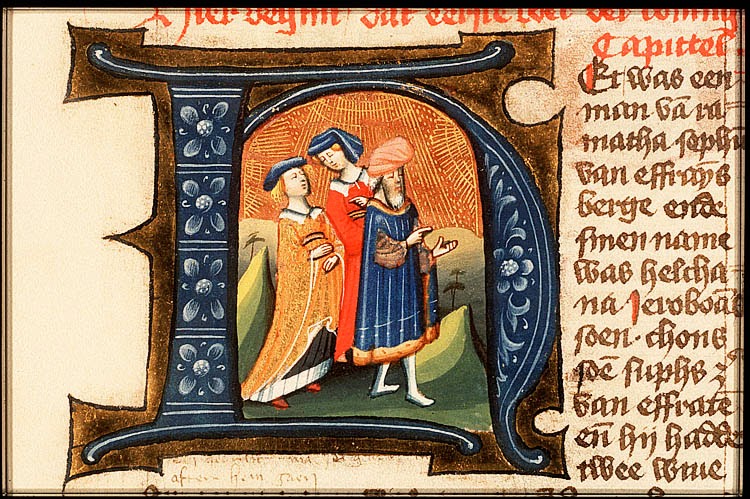
Illuminated manuscript of Elkanah and his two wives, c.1430

Whatever you are going through, God knows, He hears, He sees, and He remembers. He thunders at our rivals in heaven. Our job is to remain submissive to His will, be loving to our family and friends and even our rivals. We should pray like Hannah did. Whether we pray bitterly or we pray joyfully like Hannah did, she prayed honestly. She poured herself out before the LORD and sought Him at all times.

Stay strong! In Hannah’s case she was strong in devotion to God. She continued to love her God, her husband, and her life. She was unhappy, but the more she was unhappy, the more she sought God. It’s hard to stay loving when you’re sad, heartbroken, and bitter. But Hannah remained consistent in her attitude. That’s strong.

O, take heart! Your rival will come to naught, our God hears! He thunders against our enemies, He loves His children.

For the director of music. A psalm of David. The king rejoices in your strength, LORD. How great is his joy in the victories you give! (Psalm 21:1)


Posted in Aaron, encouragement, grace, high priest, mercy

Aaron: thoughts and scriptures

I am studying Aaron. The first High Priest. Melchizedek. Jesus the last High Priest. Lots of questions come up in my mind.

Aaron was Moses’ brother, older by three years. Their sister was Miriam who was older than both. It was Aaron who spoke for Moses, (Exodus 4:15-16) and it was Aaron whom God used as the vehicle for several of the miracles before of Pharaoh.

It was Aaron who was the deputy in charge when Moses went up Mount Sinai to speak with God and receive the ten commandments. It was Aaron whose rod budded to signify once for all God had chosen Aaron and his tribe. (Numbers 17:8)

As I study, I wonder, when Moses went up the mountain and was gone so long, why did Aaron cave to the demands of the Israelites and build a Golden Calf? (Exodus 32:1-6). Why was he the one to actually collect the gold earrings and other items? Why was he proactive in inviting them to the feast? Most of all, though 3000 who participated in it were killed, why wasn’t Aaron punished?

And then I was thinking about the Miriam incident. Despite being chosen to support her brother, and revered as a poet and a prophetess for her people, (Exodus 15:20, 21), Miriam got jealous- and so did Aaron. She AND Aaron grumbled, saying,

Has the Lord indeed spoken only through Moses? Has he not spoken through us also?” (Numbers 12:2).

This happened after the Golden Calf incident so I’d have thought Aaron would be chastened for good, not having been killed with the other wrongdoers. But Miriam came to him complaining. Her name is listed first. And though Aaron’s words are not recorded, there is the “we” aspect of it. “Miriam and Aaron spake against Moses” (Numbers 12:1).

So I’m thinking, was Aaron the kind of man that a person would feel comfortable complaining to? Why was Aaron so receptive? Yet again, God didn’t punish Aaron but punished Miriam. If the disobedience in the Garden against God was held against Adam because he was the head of the house & knew better, why wasn’t Aaron punished because he was high priest and presumably head of the house over Miriam as her brother? (I think Miriam is unmarried but I could be wrong on that). Yet Aaron escaped punishment, or even rebuke, for a second time.

He didn’t make it into the Promised Land, but God said that was because of Aaron’s and Moses’ sin at Meribah with the waters.

So I’m going, “huh”. Very interesting! My take-aways at this early stage are,

–God will have mercy upon whom He will have mercy
–Don’t grumble against God
–Don’t grumble against God-appointed leaders
–Don’t be the kind of person people feel comfortable approaching to grumble to

Epilogue:

Do you know why God spared Aaron’s life at the Golden Calf incident? Deuteronomy 9:20 has the reason. Moses said,

And the Lord was so angry with Aaron that he was ready to destroy him. And I prayed for Aaron also at the same time.

PRAYER. The grace of God was delivered upon a rebellious man, whom a righteous man (Ez 14:14) prayed for. PRAYER! Do not neglect it! God’s grace is incredible. He has mercy upon whom He will have mercy, but the prayers of a righteous man DO avail much. (James 5:16). Pray!

~~~~~~~~~~~~~~~~

Further reading

All the men of the bible: Aaron

Miriam: Leading Lady of the Exodus

Posted in color, encouragement

Color in heaven: follow up

EPrata photo

I wrote an essay on the subject of the color green in heaven. Green as in green pastures, green things to eat the Lord gave us in Genesis 1:29, green in emerald (like the emerald rainbow surrounding the throne and in the foundation of the new city), etc.

I was thinking about “green.”

I pondered the beauty of the green in Ireland. The hues there are so different than the green pastures here, and if it is that beautiful in ‘The Emerald Isle’, how much more beautiful will it be in heaven? I’d posted a short quote from Randy Alcorn from his book Heaven, and in the quote he quoted himself from Dominion. It’s encouraging to think of what is ahead of us.

In response to my essay, a commenter gave me this really interesting comment. I had never thought of this but isn’t this absolutely true:

Elizabeth, Thanks so much for this blog! Did you ever think about how all our colors on earth are dependent on our light sources–the sun, incandescent or fluorescent bulbs, . . . But in our eternal home, according to Rev. 22:5, “They will not need the light of a lamp or the light of the sun, for the Lord God will give them light.” Think about what effect that will have on colors! An infinitely superior LIGHT SOURCE creating colors beyond our earthly imaginations!

Wow! I had never thought of that! The light source is all-important in the range of colors we are able to see. Colors look like they do because of the source and type of light hitting the retina. The ranges of Ultraviolet light and Infrared light are much wider than we are currently able to see. Once the Light Source is pure (Jesus) and we see through His pure and holy light, imagine what we will be able to view, including new colors!

EPrata photo

You see, you probably already know this, so pardon me if I’m repeating myself, the brain and the eye, specifically the retina and the fovea, translate light into colors. Color actually originates in light. It bounces to the object and then to our eye. What we are seeing is actually the reflection off the bounce, and the color reflected to us is only as good as the original light source.

That’s why paint helpers at Sherwin-Williams tell new homeowners to paint a swatch on their wall and look at it at different times of day. The brightness and angle of the light will make the color appear different at each time.

Imagine when we are glorified and the full spectrum of light is now reflecting the purest, most holy and good light there can be! What will we see THEN?! So. Many. Colors.

It’s gonna be GREAT!

~~~~~~~~~~~~~~~~~~~~
FMI:

“How the Eye Sees Color”

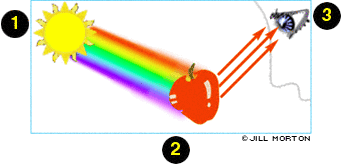
Color originates in light. Sunlight, as we perceive it, is colorless. In reality, a rainbow is testimony to the fact that all the colors of the spectrum are present in white light. As illustrated in the diagram below, light goes from the source (the sun) to the object (the apple), and finally to the detector (the eye and brain).

1. All the “invisible” colors of sunlight shine on the apple.

2. The surface of a red apple absorbs all the colored light rays, except for those corresponding to red, and reflects this color to the human eye.

3. The eye receives the reflected red light and sends a message to the brain.

The most technically accurate definition of color is:
“Color is the visual effect that is caused by the spectral composition of the light emitted, transmitted, or reflected by objects.”

~~~~~~~~~~~~~~~~~~~~

Impossible Colors

Train yourself to see impossible colors

How many colors are really in a rainbow?

Posted in encouragement, entertainment, faith, raising izzie

Movie Review: Raising Izzie

I watched a movie last night that readers might enjoy as a family. (Not the younger kids). It is called “Raising Izzie

It is about two orphaned girls aged 14 and 10, who are struggling to live on their own in an apartment their dying mother set up for them. It was only a matter of time of course, before they were found out. A year later, a caring teacher of the older girl becomes suspicious when she compares parent signatures on a school paper.

The teacher’s back story is that she wants children, and she and her husband have been trying for a while and haven’t had the desired result. This causes stress on the relationship and their strong faith is tested.

What is obvious to the viewer is that God is building a family between the two parties.

Issues explored:

–The teacher and her husband are black and the two girls are white. Can they make a family? Can family include adopting older kids? Can it be interracial?

–God’s people helping the orphan, what is our responsibility? (There were discussions of what should they do, call DFACS? The Police? Take the girls in?)

–The father says he wants children but the wife worries that underneath he is more committed to their child-free lifestyle.

–The wife wants children but begins to resent God for the lack

–The older girl is resentful she has to raise Izzie and is angry at God for failing to answer her prayer to cure her mother of cancer. (It is stated that the girls’ father had died just before Izzie was born)

Pros:

I REALLY liked the faith seen throughout, not heavy handed or preachy but living it out. When the husband and wife begin to have an argument in the car, he pulls over and prays.

The husband prayed to Jesus, and in Jesus name. That was good.

He supports his wife, not in a doormat way but in a strong, head of the family way.

The dead mother is seen in flashbacks as a caring, involved mother.

Izzie is cute as a button and in a natural way, not a movie way.

Many mentions of God throughout the movie

Is God real? How can we know? Realistic discussions and people having normal thoughts/doubts.

Godly patience is seen throughout and kind words are exalted above bitter words.

The husband is the Godly leader of his home. He is seen to be honoring his wife in many ways.

They go to church. In one of the only arguments in the movie, the teenager and the wife decide on Sunday morning they refuse to go to church. The wife yells, “I’m tired of all this! I’m sick of God!” The husband replies “That’s when you need Him the most!”

Cons:

In a certain scene the teacher says she had seen and spoken with the girls’ dead mother. (ghost). I can’t say more or it will be a spoiler.

Faith is strengthened only when God performs a miracle. It is still a movie after all. Sigh. It has the climactic moment of “God I’m praying and this is your last chance to show me you’re real or I won’t believe any more”.

At least, during the movie there were several discussions about what we hope for from God and what faith is. The teenager was crumbling in her faith because God didn’t do what she expected…but on the plus side, the husband had several discussions with her (and his wife) that God has ways higher than our ways and His will be done- sometimes unexpectedly. The movie still ended with the concept of “miracle = God is real = faith”

But knowing this, discussions could be had with your kids, “How would you have felt if the ending had been different? How can faith be strengthened in cases where adversity tests it? Isn’t God always working? Do we rely on miracles to prove God is real? Why or why not? How does God work in our lives?”

———————————–

I didn’t hear any profanity…once the teacher was in a low cut garment, but it was her pajamas after all. … Her church dress showed a bit of cleavage. That’s it.

The movie is set in the Atlanta suburbs. Rockmond Dunbar, Vanessa Williams starring. It had good production values. It was released in 2012. It can be seen on Amazon Prime, Hulu Plus, and is free on Youtube. It is a good family movie.

In a personal opinion, I especially enjoyed Mr Dunbar’s acting. I would happily look for him in other films or television programs.

Oh, and get the tissues. You’ll need them.

Posted in color, emerald rainbow, encouragement, green, jesus

Heaven and the color green

Remains of the 12th-century Trim Castle in County Meath,
the largest Norman castle in Ireland

They call Ireland “The Emerald Isle” for its deep green, undulating countryside. The island nation was first nicknamed the Emerald Isle sometime around 1780 in a poem by William Drennan called “When Erin First Rose.” Here is the first stanza
By

When Erin first rose from the dark swelling flood,
God bless’d the green island and saw it was good;
The em’rald of Europe, it sparkled and shone,
In the ring of the world the most precious stone. …

I’ve never been to Ireland but I’ve been to Scotland and the north of England. The green hills of Scotland were tremendously vibrant. Perhaps it was the quality of the northern sunrays bouncing off the grass, or the mystery of travel exhilarating my emotions, but it seemed to be to be a quality of green like no other place I’d ever been. The green there calms the eye, soothes the soul, envelops the body is its aura.

One of my favorite verses in the bible is in Revelation.

And he who sat there had the appearance of jasper and carnelian, and around the throne was a rainbow that had the appearance of an emerald. (Revelation 4:3)

Green Pastures, river Severn at Caersws, Rod Trevaskus, CC

I love that emerald rainbow. When I pray I envision Jesus sitting on the throne, accepting prayer, listening, and the emerald rainbow all around Him.

I wonder what the color green will look like, up there. The bible says-

But, as it is written, “What no eye has seen, nor ear heard, nor the heart of man imagined, what God has prepared for those who love him”—(1 Corinthians 2:9)

I suppose even the color green as we know it will be startlingly different. There will be precious stones in the foundations of the city walls, including emerald-

The foundations of the city walls were decorated with every kind of precious stone. The first foundation was jasper, the second sapphire, the third agate, the fourth emerald, (Revelation 21:19)

Benbulbin Mountain, County Sligo, Ireland. Public Domain

Dictionaries – Easton’s Bible Dictionary – Emerald

Heb. nophek (Exodus 28:18; 39:11); i.e., the “glowing stone”, … a precious stone in the breastplate of the high priest. It is mentioned (Revelation 21:19) as one of the foundations of the New Jerusalem. The name given to this stone in the New Testament Greek is smaragdos, which means “live coal.”

Lucifer walked among the precious stones in heaven, including emeralds. (Ez 28:14). They adorned him.

You were in Eden, the garden of God; every precious stone was your covering, sardius, topaz, and diamond, beryl, onyx, and jasper, sapphire, emerald, and carbuncle; and crafted in gold were your settings and your engravings. On the day that you were created they were prepared. (Ezekiel 28:13)

The breastplate of the High Priest was adorned with precious stones, four rows of three stones each.

the second row shall be turquoise, lapis lazuli and emerald;(Exodus 28:17)

Public Domain. Green Pasture, Ireland

Originally, God gave to man every green plant for food. (Genesis 1:30) When judgment came, God sent locusts to eat every green thing. (Exodus 10:15). Green is often used in the bible to represent clean growth, and goodness. (Psalm 52:8, Proverbs 11:28)

I suppose the most famous mention of green in the bible is Psalm 23

The Lord Is My Shepherd
A Psalm of David.

1 The Lord is my shepherd; I shall not want.
2 He makes me lie down in green pastures.
He leads me beside still waters.
3 He restores my soul.
He leads me in paths of righteousness
for his name’s sake

Randy Alcorn, who specializes in the study of heaven, wrote the non-fiction book called Heaven, and the fiction book Dominion. In Heaven, Alcorn said,

In the same way that the New Earth will be refashioned and still be a true Earth, with continuity to the old, the new cosmic heavens will likewise be the old renewed. In my novel Dominion I try to depict this in a scene in which Jesus takes a woman who has died to a new world:

Eventually they arrived on a world more beautiful than Dani could fathom—cascading waterfalls, rainbows of a hundred colors, mountain peaks five times higher than any on earth. Oceans with blue-green water, and waves crashing upon rocks the Page 4
size of mountains. Grassy meadows, fields of multicolored flowers—colors she had never seen before. This place seemed somehow familiar to her, yet how could it, since it was like nothing she’d ever seen? Still, she felt profoundly at home.

I believe this also. I think there will be the color green in the New Earth. Only better. Different, but the same. What will the emerald green of heaven look like? If the photos above are so beautiful, what awaits? An emerald sparkles. Green pastures are restful. The described emerald rainbow around the throne must be incredible. Yet, even then, the bible says we cannot imagine what awaits us.

No eye has seen, until we go home, that is! Then thanks to the blessed Savior atoning for our sin, and having prepared a place for us, we WILL see. What a day that will be.

Posted in conversation, encouragement, john bunyan, pilgrim's progress, salvation

We all have a pulpit. How do we use it?

I read an interesting list of points an author made about John Bunyan’s conversion. John Bunyan was the writer of Pilgrim’s Progress, a book many say is the greatest book ever written, apart from the bible. It is without doubt a literary masterpiece. It has stood the test of time since its publication in 1678. It is regarded as one of the most significant works of religious English literature in history. And the man who wrote it was raised as an atheist.

In Geoff Thomas’ essay titled “John Bunyan,” Mr Thomas wrote,

“John Bunyan had no family influences encouraging him to become a Christian. … In June 1644 when he was 16 his mother passed away and four weeks later his sister died. Eight weeks after his mother’s death his father remarried and in 8 months his wife gave birth to a boy whom his Royalist father named ‘Charles’. Four months earlier John had left home and had joined the Parliamentary Army fighting against King Charles. There was little affection between son and father. How then did John Bunyan become a Christian? There were ten factors which all played their part, great and small:”

One of these factors caught my attention-

Bunyan was stirred by the godly conversation of Christians.
He would work in Bedford and eat his bread with some Christian women who tailored their conversation for his ears. They talked of their own sin, the new birth, and the love of Christ. Bunyan listened intently and later wrote, ‘They spoke as if joy was making them speak. They were to me as if they had found a new world,’ and he often sought them out and sat with them.

‘they tailored their conversation for his ears.’ How important it is, to speak of Jesus in truth for known hearers and unknown hearers! The women must have seen the Spirit working in Bunyan, and they made a choice to and selflessly not speak of the carnal or mundane or the personal, but of the joy of His grace!

They were living this:

Let your speech always be gracious, seasoned with salt, so that you may know how you ought to answer each person. (Colossians 4:6)

Gill’s Exposition says,

“let grace be the subject matter of your speech and conversation. When saints meet together they should converse with each other about the work of grace upon their souls, how it was begun, and how it has been carried on, and in what case it now is; they should talk of the great things and wonders of grace, which God has done for them, which would be both comfortable and edifying to them, and make for the glory of the grace of God”

Jason L. Sanders wrote this week,

Preachers Aren’t The Only Ones With Pulpits

Parents carry a pulpit with them. And from it, thousands of times a day, we preach a sermon to our kids. Whether the sermon is a good one or a bad one, we can be sure of this one thing.

Whether we are preachers exhorting in church, parents teaching our children, or two simple Puritan Christian ladies serving lunch to an obviously tortured soul, we have the privilege and the responsibility to speak ‘as if joy was making us speak.’

What glory it brings the Lord when we intentionally speak of the riches of His grace. Hearers known and unknown to us, Christian and perishing, listen to us and our Spirit-carried words,

For we are a fragrance of Christ to God among those who are being saved and among those who are perishing; to the one an aroma from death to death, to the other an aroma from life to life. (2 Corinthians 2:16)

For John Bunyan, the ladies’ words were the aroma of life to life (‘he often sought them out and sat with them‘). Therefore season your conversation with love, joy, and salt, and watch with admiration and joy where He carries your words. For we all have a pulpit.

For from him and through him and to him are all things. To him be glory forever. Amen. (Romans 11:36)

Posted in elijah, encouragement, God, hagar, tender

Tender moments in the bible

There are so many powerful moments in the bible. Where does one begin? Genesis 1, God creates everything, are verses that are awesome to ponder. The resurrection, when Jesus emerged from the tomb alive. God is all-powerful.

There are thunderous moments too. When Mt Sinai trembles, when God was in the earthquake, when He split the ground under Korah and closed it back up again. God is to be feared.

But there are tender moments too. The God of thunder and wrath and all-power is so tender!! I’m not one of these who believes the wrathful God is the Old Testament turned into the sensitive (“boyfriend”) Jesus of the New Testament. Read Revelation and you see it is the same God of wrath and anger against unrighteousness and sin. In the Old Testament (as well as the New), there are very tender moments which show us our Holy God is everything. He is simply everything good- including tenderness.

In Genesis 21:15-19, slave girl Hagar had been misused by Sarah (and Abraham). She and her son Ismael ran away to the wilderness, and there, thirsty, alone, and weak, they prepared to die.

When the water in the skin was gone, she put the child under one of the bushes. 16Then she went and sat down opposite him a good way off, about the distance of a bowshot, for she said, “Let me not look on the death of the child.” And as she sat opposite him, she lifted up her voice and wept. And God heard the voice of the boy, and the angel of God called to Hagar from heaven and said to her, “What troubles you, Hagar? Fear not, for God has heard the voice of the boy where he is. Up! Lift up the boy, and hold him fast with your hand, for I will make him into a great nation.” Then God opened her eyes, and she saw a well of water. And she went and filled the skin with water and gave the boy a drink.

“God heard“, “The Angel of God” [Jesus] called to her from heaven. He assured her. He made promises to her. He opened her eyes so she could drink. What direct, intimate ministration from Holy God in heaven!

In 1 Kings 19:4-8, we see tender ministrations again. Poor Elijah, downcast, alone, and fearing for his life. He, like Hagar, ran to the desert and wanted to die.

Elijah in the wilderness, by Washington Allston, 1817

 But did God let Elijah stay that way? No

Ferdinandus Bol, 1660, Elijah Fed By An Angel

But he himself went a day’s journey into the wilderness and came and sat down under a broom tree. And he asked that he might die, saying, “It is enough; now, O Lord, take away my life, for I am no better than my fathers.” And he lay down and slept under a broom tree. And behold, an angel touched him and said to him, “Arise and eat.” And he looked, and behold, there was at his head a cake baked on hot stones and a jar of water. And he ate and drank and lay down again. And the angel of the Lord came again a second time and touched him and said, “Arise and eat, for the journey is too great for you.” And he arose and ate and drank, and went in the strength of that food forty days and forty nights to Horeb, the mount of God.

The angel touched Elijah! He had prepared food for Elijah! He comforted Elijah, and gave him direction and hope. God is so good to us. He does that for us today.

In Matthew 4 we read that Jesus was in the desert 40 days and nights, alone, fasting, and tempted by satan. At the end of the trial, it says in Matthew 4:11,

“Then the devil left him, and behold, angels came and were ministering to him.”

One might say, ‘Well, of course God would send angels to minister to His Son!’ but perhaps the ministering angels who ministered to Jesus are also some of the same ones who minister to us? Just think on it! Overall, it is to His glory that he is so involved with His people, that ministration is a regular part of His interaction with us!

His ministration with sinful man began at the Garden after the Fall. He personally covered Adam and Eve

Genesis 3:21 says, “And the Lord God made for Adam and for his wife garments of skins and clothed them.”

The God who had just made the Universe, and upholds it by power of His will and His voice, personally made garments for his rebellious children, and wrapped them. I picture a child throwing a tantrum, and saying all sorts of things to his father, including, “No! I don’t wanna! I hate you!” But after the storm is over and the timeout is finished, the father gives the boy a bath, wipes his tear-stained face, and wraps him in a towel. He holds him close to herself, his sniffles diminishing as the very heartbeat of the one who created him him and feeds him and cares for him saturates the boy’s heart and mind, and eventually his brow unfurrows and his face becomes angelic, and he drifts off to sleep, still in his father’s arms.

That is our God. Holy and Fearful, but a caring Father, holding us in His arms until the storm passes by and our rebellion subsides. He is tender. One day, there will be no more tantrums, and no more rebellion. We will love our Father perfectly and completely, just as He loves us now. What a day that will be.

Posted in encouragement, jesus, prophecy, veil

Rahab’s scarlet thread

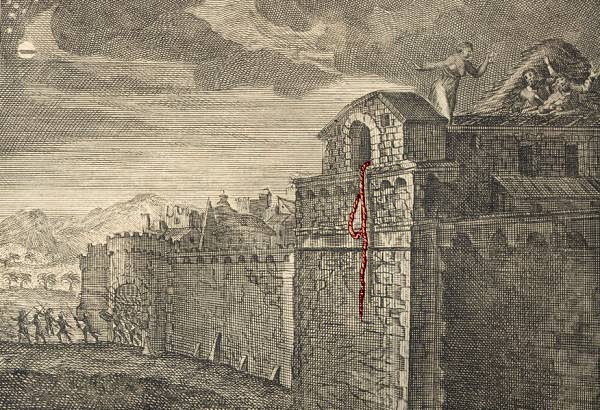
“Behold, when we come into the land, thou shalt bind this line of scarlet thread in the window which thou didst let us down by: and thou shalt gather unto thee into the house thy father, and thy mother, and thy brethren, and all thy father’s household. Then if anyone goes out of the doors of your house into the street, his blood shall be on his own head, and we shall be guiltless. But if a hand is laid on anyone who is with you in the house, his blood shall be on our head.” (Joshua 2:18-19)

Gill’s Exposition explains the scarlet thread: “so the scarlet thread was an emblem of the blood of Christ, by which salvation is; redemption and all the blessings of grace are through it; justification, remission of sin, reconciliation, and atonement, and safety, and protection from avenging justice, and wrath to come, are only by it“… more at end

You may hear Christians speak of the “Scarlet Thread.” This is a shorthand reference not only to the literal verse literally reporting on Rahab’s scarlet thread, but to the fact that the blood of Jesus and His plan for Redemption runs through all the bible from Genesis to Revelation. The bible is about the atonement from beginning to end, and it’s about the One who accomplished that atonement, Jesus. There is no “Old Testament God of Wrath” and a “New Testament God of Love.” There is no God vs. Jesus. There are no two halves, one fulfilled and one marginalized. The scarlet thread runs through the entire bible.

Here is an example from the bible about the scarlet thread. God told Hosea His prophet to tell the Israelites this pronouncement of judgment,

The high places of Aven, the sin of Israel,
shall be destroyed.
Thorn and thistle shall grow up
on their altars,
and they shall say to the mountains, “Cover us,”
and to the hills, “Fall on us.”
~Hosea 10:8

For those who believe that God is outdated and so is the Old Testament, or for those who believe it’s not necessary or study the Old Testament, or for those who believe that the OT has no bearing on our lives today in this modern world, here is Jesus on His way to Calvary referring back to that exact Hosea prophecy and also prophecies in Hosea 9:11, 14, (Give them, O LORD— what will you give? Give them a miscarrying womb and dry breasts. … Ephraim’s glory will fly away like a bird– no birth, no pregnancy, no conception.”)

“And there followed him a great multitude of the people and of women who were mourning and lamenting for him. But turning to them Jesus said, “Daughters of Jerusalem, do not weep for me, but weep for yourselves and for your children. For behold, the days are coming when they will say, ‘Blessed are the barren and the wombs that never bore and the breasts that never nursed!’ 30Then they will begin to say to the mountains, ‘Fall on us,’ and to the hills, ‘Cover us.’ “
(Luke 23:27-30)

And once again the scarlet thread progresses in its weaving truth to men as we reach Revelation, where once again the Hosea prophecy of the past, the Jesus mention at the midpoint, and the reference is made again, this time to the future:

“Then the kings of the earth, the princes, the generals, the rich, the mighty, and everyone else, both slave and free, hid in caves and among the rocks of the mountains.
They called to the mountains and the rocks, “Fall on us and hide us from the face of him who sits on the throne and from the wrath of the Lamb!”
(Revelation 6:15-16)

Back to Gill’s again on Rahab’s Scarlet thread as metaphor in Joshua 2:

and thou shall bring thy father, and thy mother, and thy brethren, and all thy father’s household home unto thee; into her house, where the scarlet thread was bound, and where only they would be safe, as the Israelites were in the houses where the blood of the paschal lamb was sprinkled, Exodus 12:23; and so they are safe, and they only, who are under the blood of sprinkling, and partake of the virtue of it.

Praise the Lord for the fact the scarlet thread exists! With it we are covered, safe, and dwelling in the House…’where ONLY they would be safe’! The beauty, wonder, mystery, and truth of God’s word is always inspiring and convicting. Jesus’ blood runs throughout the entire word, for He IS the Word.

Posted in encouragement, love, puppy

Happy Puppy

I watched this happy video of a puppy waiting for his boy to return home from school. I’d planned to put it on my other blog as a happy little pick-me-up. But it’s almost impossible for me to see anything and not make a spiritual application, lol. So here it is. First, the happy puppy:

Awww!! So cute! Here is the question I ask us all, myself included. Are we a puppy? Do we show obvious and generous and committed love to people? Do we rush to pick up their burdens? Are we excited to see them? To the point of eagerly waiting?

Just sayin’

“Beloved, let us love one another, for love is from God, and whoever loves has been born of God and knows God.” (1 John 4:7)

“They were continually devoting themselves to the apostles’ teaching and to fellowship, to the breaking of bread and to prayer. (Acts 2:42).

“Bear one another’s burdens, and so fulfill the law of Christ.” (Galatians 6:2)

“For I long to see you, that I may impart unto you some spiritual gift, to the end ye may be established;” (Romans 1:11)

Posted in encouragement, God, israel, old testament, repentance

Repentance is more than just "turning".

As one reads through Hosea, particularly chapter 7, it is amazing the number of metaphors God uses to show Israel’s perfidy. They were separated from their God and Protector through their own actions. God hadn’t gone anywhere, Israel had. They needed to repent and turn to Him.

However there is turning and there is turning. God was angry that Israel turned to idols. They turned to Egypt. They turned to Assyria. They turned to themselves, in their own beds crying and wailing. (“They do not cry to me from the heart, but they wail upon their beds”; Hosea 7:14) They turned a lot. They didn’t turn the right way.

They turn, but not upward,  (Hosea 7:16a)

Turn upward!

Judas turned. In the KJV of Matthew 27:3 it says, “Then Judas, which had betrayed him, when he saw that he was condemned, repented himself, and brought again the thirty pieces of silver to the chief priests and elders,”

Did Judas repent? No. He turned, he felt grief, he refused to look at his sin… but he didn’t turn upward.

Easton’s Bible Dictionary says there are several words for repent used in the bible. In the case of Judas the verb is “metamelomai is used of a change of mind, such as to produce regret or even remorse on account of sin, but not necessarily a change of heart. This word is used with reference to the repentance of Judas (Matt. 27:3).

The other word for repentance according to Easton’s is “Metanoeo, meaning to change one’s mind and purpose, as the result of after knowledge. This verb, with (3) the cognate noun metanoia, is used of true repentance, a change of mind and purpose and life, to which remission of sin is promised.”

In Judas’ case, his turning was not upward.

In your grief over sin, in your restlessness in finding peace, in your agitation, turn, not from one worldly thing to another, but upward!

The lessons of Hosea 7 are many. One is, that God is looking down upon His elect. He is looking. Look upward! See Him! Our holy Savior as High Priest is looking at us, loving us, calling to us to repent. Repentance is a matter of turning, but turning in the right direction, and it is having a right heart condition. Judas’ heart wasn’t right. Ephraim’s heart wasn’t right. They cried but it wasn’t from the heart. Judas cried, but it wasn’t from the heart. If you cry over your sins, is it from the heart? If you turn from your sin, is it in the right direction? We have learned that a horizontal turning is not the right direction because the only thing in our horizontal field of vision is the world. The world doesn’t forgive. God in heaven forgives. Upward is the right direction and having the right heart attitude is important too.

because, if you confess with your mouth that Jesus is Lord and believe in your heart that God raised him from the dead, you will be saved. 10For with the heart one believes and is justified, and with the mouth one confesses and is saved.” (Romans 10:9).