Create in me a clean heart, O God, And renew a steadfast spirit within me. Do not cast me away from Your presence And do not take Your Holy Spirit from me. Restore to me the joy of Your salvation And sustain me with a willing spirit. Then I will teach transgressors Your ways, And sinners will be converted to You. (Psalm 51:10-13)
His is a magnificent statement of repentance. No wonder God called David a man after His own heart. (Acts 13:22).
You notice that David’s contrition and petition for restoration didn’t include restoring a kingdom to him, or his fortress or his armor or his lands. He did not ask for material things. He wanted the ‘joy of God’s salvation’ – spiritual things. David wanted the spiritual joy of a right relationship with His God.
I often ponder the joy of my salvation. I don’t want to lose that wonder and awe of the miracle of a purified mind and a clean heart. Maybe it’s because I came to the Lord in my 40s, and I remember so well the feeling of moral confusion, impurity, and guilt. One thing I enjoy about salvation is the release of my mind from having to work so hard to justify my sin. Or the efforts of my heart to hide it. Or the difficulty in having my conscience making valiant efforts to tamp down the morally questionable things I said and did.
A willing spirit that finds joy in knowing and obeying our Savior is a release that can only come from Jesus. It’s a gift to us, borne on His blood and His cross. In gratitude, David said he would teach others the ways of God so that sinners would be converted. He is passing along the gift he himself thirsts for and treasures.
Worship Jesus and Jesus alone. Worship this same Jesus as God revealed Him to the world.
Do not worship Prophets, past or present.
“And Peter said to Jesus, “Lord, it is good that we are here. If you wish, I will make three tents here, one for you and one for Moses and one for Elijah.”” He was still speaking when, behold, a bright cloud overshadowed them, and a voice from the cloud said, “This is my beloved Son, with whom I am well pleased; listen to him.” (Matthew 17:4-5).
Jesus stopped Peter from making three tabernacles. It is acceptable to worship ONLY Jesus. This is such a strong truth that the Spirit stopped Peter from proclaiming worship of Moses and Elijah while he was still saying it.
Do not worship Angels.
“I, John, am the one who heard and saw these things. And when I heard and saw them, I fell down to worship at the feet of the angel who showed them to me, but he said to me, “You must not do that! I am a fellow servant with you and your brothers the prophets, and with those who keep the words of this book. Worship God.” (Revelation 22:8-9).
Again we read, ‘Worship God.’ Angels are fellow servants with us of the Most High God.
Do not worship men.
“And when the crowds saw what Paul had done, they lifted up their voices, saying in Lycaonian, “The gods have come down to us in the likeness of men!” Barnabas they called Zeus, and Paul, Hermes, because he was the chief speaker. And the priest of Zeus, whose temple was at the entrance to the city, brought oxen and garlands to the gates and wanted to offer sacrifice with the crowds. But when the apostles Barnabas and Paul heard of it, they tore their garments and rushed out into the crowd, crying out, “Men, why are you doing these things? We also are men, of like nature with you, and we bring you good news, that you should turn from these vain things to a living God, who made the heaven and the earth and the sea and all that is in them.” (Acts 14:11-15).
In these apostate times it’s easy to become depressed at all the false teaching, the turning aside of beloved friends, the wolves coming out of the woodwork. God promised this, He said it would happen and it is.
But His promises of faithfulness are just as sterling and perfect, too. There is a verse I love. It is John 10:35-
If he called them gods to whom the word of God came—and Scripture cannot be broken—
The verse is part of a longer conversation between Jesus and the Pharisees, but let’s focus on the fragment inserted into the verse: scripture can’t be broken.
In today’s world, everything breaks. I have a Weber Showcase & Fixture Co. turn of the last century Banker’s Chair. It is heavy oak, with a steampunk mounting and swivel that would hold a tank. It is well made. Only in the last year did it break. The threads stripped enough so the chair won’t stay high at the table for me to use it. In the beginning of the 20th century and the century before, they made things to last.
Now, everything’s broken. We have broken marriages, broken homes, disposable toasters, throw away watches. Your TV breaks? Buy another. Dishes are no longer carefully handed down from generation to generation, when they break, just go to Target and buy some more.
Scripture CANNOT be broken. It will never be broken. Pulpit Commentary says of the John 10:35 verse,
cannot he broken; loosed, destroyed. A fine testimony to the confidence which our Lord exercised in the Holy Scripture. He was accustomed to educe principles of life from its inward structure, from its concealed framework, from its underlying verities.
There is one other point I think we ought to notice. And that’s that little statement, “And the Scripture cannot be broken,” in John 10 verse 35. That gives us some idea of our Lord’s view of the word of God. The Scripture cannot be broken. It is of indefectible authority. It cannot fail and the things that it teaches cannot fail either. All of the designs and purposes of the word of God shall be accomplished, just as all of the designs and purposes of the Son of God shall be accomplished. The Scripture cannot be broken. That’s striking isn’t it?
What joy to see our Savior model complete trust and rest in His Father’s word. We do the same. We know that though false religions will come, and wolves and destroyers; so will peace, fulfillment of all the scriptures, and everlasting promises of the Lord our God.
The scripture cannot be broken. In wrapping ourselves in the scriptures, we cannot be broken either. No matter how upsetting, no matter how concerning, no matter how terrible things get, all the promises God said would happen will happen- including His working things to the good, our coming hope and joy, the Banquet, Jesus with us in person, eternal perfect worship. All of it. Because…scripture cannot be broken.
The selection of music in churches is important and is not based simply on preferences. Do not pooh-pooh the music by marginalizing it to a second tier of concerns and assigning it as simply a “preference.” Music is doctrine, sacred music is unique to the redeemed because it is our response to His redeeming work, and it is either reflective of the culture or it is reflective of the worshipful heart.
First, let’s talk about what music in church is NOT. These are taken from John MacArthur’s sermon “Is Music Worship?” based on the verses at Ephesians 5:18-20.
Music is not worship. Music is a means to express worship, but it is not worship.
Secondly, a misconception is that music motivates worship, music induces worship. That’s not true either. … [T]he motive for all of our songs is not a sound, it’s a truth.
Another misconception is that when people have trouble worshiping, music will create worship, music will create the mood for worship. Worship is not a mood experience.
What true worship IS, is-
a permanent attitude. John 4, “We worship in spirit and truth.” That’s who we are. … The music of the redeemed is different. We live in a different world. We are citizens of a different kingdom. The music of the redeemed is alien to the music of the world. The music of the redeemed is reflective of that which is most lofty, most elevated, most exalted, most noble: the truth of God – it never changes. So our music doesn’t ride the culture. Music doesn’t ride the culture among the redeemed, it simply reveals the truth, and the truth never changes. (Source)
I encourage you to listen to the sermon. The explanation about music and its place in worship among the redeemed is stupendously explained, especially when you arrive at the powerful ending.
Meanwhile, I’d read missionary Gladys Aylward’s autobiography and was struck by something described at the end of the book. The following is my retelling of Aylward’s event.
Unsplash photo, free to use
There is a great story in China Missionary Gladys Aylward’s autobiographical book “The Little Woman.” This occurred in the mid-1930s. She is trying to escape the invading Japanese, because they had put a price on her head. So she walked in a direction no Chinese went, over some mountains where the map was blank. She was with one other missionary. At dusk, seeing no human, no town, no habitation at all, they were debating whether to go back. The man told Aylward to sit on this nearby stump and he would go ahead a bit and see what’s what. Alone, Gladys began to sing hymns.
Soon the man came back and said, no luck. They might freeze out there or if they go back they might be killed. Just then a Lama (Buddhist Monk) came up. He said, come with me, we will take you to our lamastery. No people were EVER invited into a lamastery. But the duo believed it was an ordained appointment. I mean, what were the odds, right? So they went. They were led up the side of the mountain high up to a lamastery carved into the rock. They were greeted happily and warmly and fed and made comfortable.
She asked the head Lama the next day why they had been so cordially welcomed to such a private and mysterious place. Lama said that 7 years ago they brought to town their licorice that they pick and sell. They heard a lone man in the square saying that there is a God who loves them and salvation is free, if they believe- come to this building tonight to hear more. They were astounded that such a doctrine existed. There is a God? He loves? They accepted the tract the man was handing out, simply the verse at John 3:16 and the address, nothing more.
For five years they sought to learn more but were unable. Every time they went to town to sell their licorice they asked everyone about where to find “the God who loves.” No one else could tell them. Then one day a man was there and he did say yes, go to the China Inland Mission over there and they will tell you. A Mission house had been established.
They went to the Mission house and received New Testament Bibles and tracts, which they brought back to the lamastery and read eagerly. They delighted in the notion that there was a “God who loves” but there was much in the book they did not understand. Still, they read, and they came to the verse where Christ had said of his apostles, “Go ye into all the world and preach the Gospel.” And the monks believed that one day a person would come and preach to them them, because it said so in the book.
And three years later when they heard singing, they knew the person had come, because as the Monk said, “Only people who know God will sing.” And the person was Gladys and her companion. They rejoiced, knowing they were about to learn more. So she and the other missionary told all the monks about Jesus and then they left the next day, not knowing if the lamas were saved or became saved, but trusting that some would, sometime.
~~~~~~~~~~~~~~~~~~~~~~
I had never thought about it before, but no other major religion really sings. Of course anything other than biblical Christianity is a false religion. You get chants, but no hymns. No singing. On that cold, dusky night, Gladys was recognized by Buddhists because she sang. Our music IS unique and we are eternally identified with it. It is not simply a preference. Toward the end of his sermon, John MacArthur said this:
And by the way, Christians are the only religion that sing. Muslims don’t sing, Buddhists don’t sing, Hindus don’t sing. They don’t sing. Some chant in a minor key; Christians sing. But when the Reformation came, music was reintroduced to the church; and you sing a hymn written by Martin Luther who launched the Reformation: A Mighty Fortress is our God. Five-hundred years after that, we’re still singing that hymn.
We sing because we have been redeemed. We sing a new song, one that the world does not hear. We sing because-
He brought me up out of the pit of destruction, out of the miry clay, and He set my feet upon a rock making my footsteps firm. He put a new song in my mouth, a song of praise to our God; many will see and fear and will trust in the Lord. (Psalm 40:2-3)
Because the times are so hard and the world is so dark, I’ve been posting some short essays on worship. Just worship. It’s a way to remind me, and anyone, that “Man’s chief end is to glorify God, and to enjoy Him for ever” says the Westminster Shorter Catechism. Let’s just find ways every day to enjoy God!
I like natural history. It’s God’s creation. I like thinking about how He has created everything from nothing with just a word. I see the intricacy of His creatures and flora and fauna and I’m just amazed.
I walked across my apartment parking lot yesterday when I got home from school. The frigid weather had turned to 68 degrees and it was warm and humid. Halfway across I heard what sounded like a frog. Frogs! I thought it’s way too early for frogs! There is a pond next door butt the sound was coming from high up in the trees on the onterside of the road in the woods.
I went inside and searched for “bird that sounds like a frog” and came up with Hooded Merganser.
But reading natural history books is a two-edged sword. Most are written from a secular point of view, and at some point the constant lies within such books begins to grate, and I abandon them.
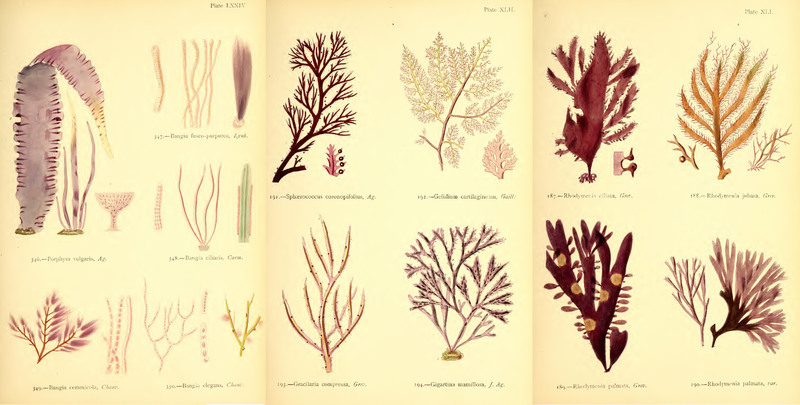
One of the natural history books mentioned in the Atlas Obscura article was a seaweed journal by Margaret Gatty. Atlas Obscura wrote of her,
One of the best known and most dedicated of these so-called seaweeders was Margaret Gatty, a children’s book author who took up the hobby while convalescing in Hastings, on Britain’s southeast coast, in 1848. Gatty’s crowning work of algology, British Sea-Weeds, is an exhaustive compilation of local seaweeds, fully described and illustrated in 86 colored plates.
I did not know there was a whole field of study called ‘algology’. These are selected plates of her seaweed drawings,
Selected plates from Margaret Gatty’s “British Sea-Weeds.” BIODIVERSITY HERITAGE LIBRARY/PUBLIC DOMAIN
I love those colored plates from natural history books from the 1800s. I owned two rare books,
A popular history of the mollusca : comprising a familiar account of their classification, instincts and habits and of the growth and distinguishing characters of their shells, by Mary Roberts, 1851; and
Popular British conchology. A familiar history of the molluscs inhabiting the British Isles, By George Brettingham Sowerby, 1854.
I love the hand colored plates of the plants or animals they carefully drew. I also have several books by Harvard University paleontologist Stephen Jay Gould (secular guy, sigh). There’s French poet-philosopher Paul Valery in his engaging meditation on the aesthetics of the seashell, as Amazon describes his work. Anne Morrow Lindbergh’s musings on shells in her famous Gift from the Sea. And so many other books. I guess now that I’m thinking of listing them, my library contains quite a few natural history books. Rachel Carson, Farley Mowat, John Hay, Abbot & Dance…
In 1664 John Evelyn, diarist, country gentleman, and commissioner at the court of Charles II, produced his monumental book on trees: Sylva, or a Discourse of Forest Trees. It was a seventeenth-century best seller. Evelyn was a true son of the Renaissance. His book is learned and witty and practical and passionate all by turns. No later book on trees has ever had such an impact on the British public.
Hmmm, maybe that’s why the Monty Python comedy troupe mentioned THE LARCH so often…
I love trees. Maybe I’ll get that book.
As much as I love reading about the creation from scientists of various kinds, there’s nothing like reading the Bible, God’s actual account of His world. As poetic as Lindbergh was, as witty as John Evelyn was, as precise as Sowerby or Roberts was, the thrill of reading about the creation from God Himself never fails to thrill me. As familiar as these verses are, they still ignite a reverent awe at His power:
In the beginning, God created the heavens and the earth. 2The earth was without form and void, and darkness was over the face of the deep. And the Spirit of God was hovering over the face of the waters.
3And God said, “Let there be light,” and there was light. 4And God saw that the light was good. And God separated the light from the darkness. 5God called the light Day, and the darkness he called Night. And there was evening and there was morning, the first day.
6And God said, “Let there be an expanse in the midst of the waters, and let it separate the waters from the waters.” 7And God made the expanse and separated the waters that were under the expanse from the waters that were above the expanse. And it was so. 8And God called the expanse Heaven. And there was evening and there was morning, the second day. (Genesis 1:1-8)
Nature displays God’s glory. The best place to read about that is His word, what He, Himself, has declared.
Let the heavens rejoice, let the earth be glad; let the sea resound, and all that is in it. Let the fields be jubilant, and everything in them; let all the trees of the forest sing for joy. (Psalm 96:11-12)
We are glad because as Job 12:10 says,
In his hand is the life of every creature and the breath of all mankind.
Is there any better place to be, if you’re saved? In His hand? Is there any worse place to be, if you’re not saved?
It is a fearful thing to fall into the hands of the living God. (Hebrews 10:31)
Read of His creation. The essays, poems, philosophies of the secular writers and scientists is fine, also good are Natural History books on the Bible such as The Scripture Alphabet of Animals by Mrs. Harriet N. Cook, 1842; The Plants of the Bible by John Hutton Balfour, 1885. But the originator of it all is the one to be worshiped and the best place to do that is read of Him in His word-
Do you not know? Have you not heard? The Everlasting God, the Lord, the Creator of the ends of the earth Does not become weary or tired. His understanding is inscrutable. (Isaiah 40:28)
This is an excerpt from David McIntyre’s The Hidden Life of Prayer, chapter 6. This book, written in 1913, is available for free online, as well as for purchase in regular book or Kindle form.
—-Begin book excerpt—–
The prayer of faith, like some plant rooted in a fruitful soil, draws its virtue from a disposition which has been brought into conformity with the mind of Christ.
1. It is subject to the Divine will-“This is the confidence that we have in Him, that, if we ask anything according to His will, He heareth us” (1 John 5:14).
2. It is restrained within the interest of Christ-“Whatsoever ye shall ask in My name, that will I do, that the Father may be glorified in the Son” (John 14:13).
3. It is instructed in the truth-“If ye abide in Me, and My words abide in you, ye shall ask what ye will, and it shall be done unto you” (John 15:7).
4. It is energized by the Spirit-“Able to do exceeding abundantly above all that we ask or think, according to the power that worketh in us” (Eph. 3:20).
5. It is interwoven with love and mercy-“And when ye stand praying, forgive, if ye have ought against any; that your Father also which is in heaven may forgive you your trespasses” (Mark 11:25).
6. It is accompanied with obedience-“Whatsoever we ask, we receive of Him, because we keep His commandments, and do those things that are pleasing in His sight” (1 John 3:22).
7. It is so earnest that it will not accept denial-“Ask, and it shall be given you; seek, and ye shall find; knock, and it shall be opened unto you” (Luke 11:9).
8. It goes out to look for, and to hasten its answer “The supplication of a righteous man availeth much in its working” (James 5:16, RV).34
—-End book excerpt—–
Pray for your pastors or elders. Pray for your family Pray for your unsaved family. Pray for your political leaders. Pray for the world, for God’s will to be done, for His return. Pray for everything! But pray. It is an act of worship, acknowledging God is sovereign over all things, beginning with your will and soul.
Overcome one day with meeting with Jesus in His word, I wrote this poem. We are not led by emotions, that’s emotionalism. See link below for more on that.
But we are emotional people. We feel. When we respond to what we have learned about Jesus from His word, when we are awed by His majesty, humbled by His power, overcome with lowliness in love for His heights, we’re having an emotional response and it’s OK.
To all my sisters who have lost a loved one and are facing the first New Year alone…
To all my sisters who have spoken up for the pure doctrine of Jesus Christ in Bible study and have been kicked out because of it…
To all my sisters who have approached their pastor with concerns of false teaching and have been spiritually abused instead of comforted…or even heard…
To all my sisters who are struggling to be a good Christian wife with a non-believing husband…or an apathetic husband…
To all my sisters who have a spouse deployed overseas this year…
To my lonely and hurting and grief-stricken and saddened sisters. You’re not alone.
Casting all your anxieties on him, because he cares for you. (1 Peter 5:7)
Bear one another’s burdens, and so fulfill the law of Christ. (Galatians 6:2) Therefore encourage one another and build one another up, just as you are doing. (1 Thessalonians 5:11)
This section of verses that show Jesus’ life are focused on His attributes & earthly ministry. We’ve seen Him as servant, teacher, shepherd, intercessor, and healer. We looked at His attributes of omniscience, His authority, and now His sinlessness.
He came from glory where righteousness reigns. He descended to an earth that’s cursed where every single human is depraved, thoroughly drenched with a sin nature. He lived among us, sinlessly and perfectly fulfilling the Father’s commands for righteous living. He did this at every moment in every way. Not one blot, not one thought, not one act of anything less than perfection.
For this, He was reviled, mocked, hated, and killed.
In what sense did Jesus become “sin on our behalf”? Does that phrase mean that Jesus literally became a sinner on the cross? …
Based on the above passages, we can safely determine what 2 Corinthians 5:21 does not mean. It cannot mean that Jesus became unrighteous, or that He became a sinner, or that He took on a sin nature, or that He literally embodied sin. … So, then what does it mean? This brings us to our third point. … 3. The best way to understand Paul’s statement (that Jesus became sin on our behalf) is in terms of imputation. Our sin was imputed to Christ, such that He became a substitutionary sacrifice or sin offering for all who would believe in Him.
On the cross, Jesus took our sin upon Himself and purchased our salvation. We have “been justified by his blood” (Romans 5:9), and part of that justification is an imputation of His own righteousness. Paul puts it this way: “For our sake [God] made [Jesus] to be sin who knew no sin, so that in him we might become the righteousness of God” (2 Corinthians 5:21). Jesus is righteous by virtue of His very nature—He is the Son of God. By God’s grace, “through faith in Jesus Christ,” that righteousness is given “to all who believe” (Romans 3:22). That’s imputation: the giving of Christ’s righteousness to sinners.
Ligonier: Jesus’ Sinless Life Jesus lived a representative life. Jesus lived a sinless life, and it was, therefore, a life of representative sinlessness. Our Lord’s obedience stands in the place of His people’s sin. His law-keeping is counted as the law-keeping of those who have faith in Him.
We have been through a section of verses that show Jesus’ life in His earthly ministry. We’ve seen Him as servant, teacher, shepherd, intercessor, and healer.
Now we look at His attributes. Today- Omniscience.
CARM.org: Definition of omniscience Omniscience is an attribute of God alone. It is the quality of having all knowledge (Isaiah 40:14). God knows all things possible as well as actual because He has ordained whatsoever will come to pass according to the counsel of His will (Eph. 1:11). He does not need to experience something to know about it completely.
Ligonier: Scripture and the Two Natures of Christ The historic Christian understanding of the person of Christ is that He is one person who possesses two natures: a divine nature and a human nature. Each nature retains its unique properties, and the two natures remain distinct, though inseparably united in Christ’s person. Thus, according to His divine nature, as the second person of the Trinity, the Son of God is omniscient, omnipotent, and so forth. According to His human nature, the incarnate Christ needs to eat food to survive, grows in knowledge, and so forth.
GotQuestions: What does it mean that Jesus is omniscient? Despite the condescension of the Son of God to empty Himself and make Himself nothing (Philippians 2:7), His omniscience is clearly seen in the New Testament writings. The first prayer of the apostles in Acts 1:24, “Lord, you know everyone’s heart,” implies Jesus’ omniscience, which is necessary if He is to be able to receive petitions and intercede at God’s right hand.







 the-end-time.org