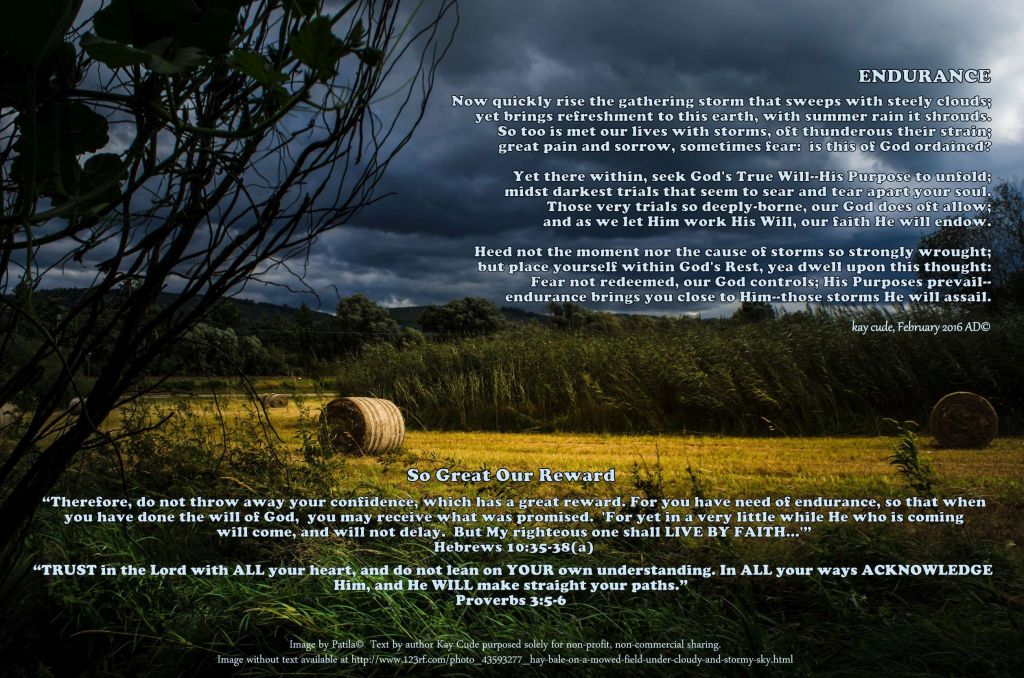
Kay Cude poetry: used with permission

Kay Cude poetry: used with permission

In the desert, cacti and thorn bushes mean business. Often, there are impenetrable thickets of rough bushes with spiky thorns that hurt even if you catch a glancing blow. Some cacti don’t even wait for a glancing blow but eject their little hairs to hurl at you as the wind of your passage awakens them. Desert thorns means business.
It wasn’t always that way. When the earth was created and the Garden of Eden planted nothing inside the Garden would hurt man as he passed. Which was good, because he was naked and not ashamed. Soft plants, beauteous flowers, stately trees, and mild animals dotted the landscape.
Then sin entered the world through one man, Adam, and because he listened to the voice of his wife, the ground became cursed. In some places today, the landscape even hurts to look at it.
After the Fall, thorns sprung up everywhere. Thorns hurt, thorns are negative, thorns are because of sin.
And to Adam he said,
“Because you have listened to the voice of your wife
and have eaten of the tree
of which I commanded you,
‘You shall not eat of it,’
cursed is the ground because of you;
in pain you shall eat of it all the days of your life;
18thorns and thistles it shall bring forth for you;
(Genesis 3:17-18)
Anytime there was a curse thereafter, thorns are frequently mentioned as part of the curse. (Nu 33:55; Jos 23:12-13; Isa 5:5-6; 7:23-25; 55:8-13; Jer 12:13; Hos 9:6). Jesus used the symbols of “thorns” in his teaching in a negative sense (Matt. 7:16; Mark 4:7, 18; Heb. 6:8).
Thorns came in with sin, and were part of the curse that was the product of sin, Gen. 3:18. Therefore Christ, being made a curse for us, and dying to remove the curse from us, felt the pain and smart of those thorns, nay, and binds them as a crown to him (Job 31:36); for his sufferings for us were his glory. Matthew Henry’s commentary on the whole Bible: complete and unabridged in one volume.
![]() |
| Source Logos Bible Software |
Ye shall go out with joy, and be led forth with peace: the mountains and the hills shall break forth before you into singing, and all the trees of the field shall clap their hands. Instead of the thorn shall come up the fir tree, and instead of the brier shall come up the myrtle tree: and it shall be to the LORD for a name, for an everlasting sign that shall not be cut off.’ (Isaiah 55: 12-13)
Trees ‘clapping their hands’ is indicative of the fact that creation will no longer groan (Romans 8:22) but be glad.
In the crown of thorns placed upon His head, it was not only a mocking activity performed by pagans, but symbolic of the Lamb caught in the thorn thicket when Abraham was about to sacrifice Isaac. It is symbolic of the curse of sin that Jesus took upon Himself, so that we may escape it through Him.
![]() |
| EPrata photo |
When you see that crown of thorns, and you think about the mockery and pain Jesus endured on our behalf, think about Him the spotless Lamb taking upon Himself the sins you and I do daily.
The Roman soldiers unknowingly took an object of the curse and fashioned it into a crown for the one who would deliver us from that curse. “Christ redeemed us from the curse of the law by becoming a curse for us—for it is written, ‘Cursed is everyone who is hanged on a tree’” (Galatians 3:13). (source)
What a tremendous, loving, wonderful Savior we have in Jesus Christ.
——————————–
Further Reading
Can you imagine the Wal-Mart floral department offering a bouquet of thorns? Does the Garden Center ever advertise Acacia thorn bushes? Do carpenters choose two-by-fours made of thorn wood? Except for our botanist friends, few people find thorns captivating. They are not beautiful. And they don’t seem very useful, though they do burn extremely well. The negative associations of thorns are what make their appearance in the Bible so intriguing, for God weaves these very thorns into the revelation of His grace. He gives them a star role in the unfolding drama of His judgment and unbelievable mercy.
In the original Eden you didn’t have to have cultivated planned crops, and you didn’t have any weeds. You had the natural flourishing of the earth producing all manner of food without crops, as we know them, that now produce flour and from that we make bread and there was no siach, no weeds which grow profusely now. And it also mentions in chapter 2 verse 5 that the rain contributes to that as we well know. Take a vacant piece of dirt, do nothing to it, just wait and let it rain and you will have a flourishing field full of weeds.
What is the meaning and significance of the crown of thorns?
After Jesus’ sham trials and subsequent flogging, and before He was crucified, the Roman soldiers “twisted together a crown of thorns and set it on His head. They put a staff in His right hand and knelt in front of Him and mocked Him. ‘Hail, king of the Jews!’ they said” (Matthew 27:29; see also John 19:2-5). While a crown of thorns would be exceedingly painful, the crown of thorns was more about mockery than it was about pain.
Do not be surprised, brothers, that the world hates you. (1 John 3:13).
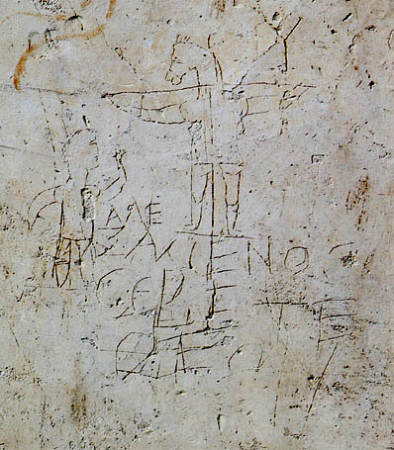
The Alexamenos graffito is a piece of Roman graffiti scratched in plaster on the wall of a room near the Palatine Hill in Rome, which has now been removed and is in the Palatine Hill Museum. It may be the earliest surviving depiction of Jesus, and if so is the earliest known pictorial representation of the Crucifixion of Jesus, together with an engraved gem. It is hard to date but has been estimated to have been made c. 200. The image seems to show a young man worshipping a crucified, donkey-headed figure. The Greek inscription reads something like, “Alexamenos worships [his] God.” The graffito was apparently meant to mock Alexamenos, a Christian. (Wikipedia)
![]() |
| A tracing of the drawing. |
![]() |
| The original drawing |
If the world hates you, keep in mind that it hated me first. (John 15:18)
If you are being mocked, scoffed at, humiliated, take heart. Christians always have been. This is because those who do not believe cannot think right.
If you are enduring the modern equivalent of graffiti, say, an inter-office email that you have stumbled upon, a crass doodle of you on a napkin left behind in the lunchroom, an overheard conversation scoffing at your faith, do not be troubled.
For the word of the cross is folly to those who are perishing, but to us who are being saved it is the power of God. (1 Corinthians 1:18)
You stand in a long and noble line of those who were scoffed at, including the worshipful Alexamenos, a long-dead, unknown person who loved Christ enough to stand up for Him by kneeling to worship in a crass culture that hated righteousness and truth. Like our culture now. Some things never change! You are never stronger than when you are kneeling at His feet.
Persevere!
Jesus said I AM seven times. Satan said “I will” five times. There is a big difference between I AM and I will.
Jesus said,
In Isaiah 14:14-15 it is said of satan,
How art thou fallen from heaven, O Lucifer, son of the morning! how art thou cut down to the ground, which didst weaken the nations! For thou hast said in thine heart,
Yet thou shalt be brought down to hell, to the sides of the pit. (Isaiah 14:14-15)
Jesus declared himself I AM out loud, before many, Satan wished, quietly in his heart. Jesus declares the reality, Satan declares his individual desire. Jesus is eternally I AM, satan was created and began to generate ambition later.
Jesus was, and is, and is to come (Revelation 1:8) and what He purposes will come to pass (Isaiah 46:10. Satan WILL NEVER, EVER, EVER HAVE ANY OF HIS WISHES, HOPES, AMBITIONS, GOALS, OR PURPOSES ULTIMATELY COME TO PASS. (Revelation 20:10).
Jesus did it all, He paid it all, it is finished.
Friends, remember, satan is a defeated foe. He is active, but moot. He is around, but vanquished. Those of us in Christ are victorious through Christ’s eternal act of submission, crucifixion, and resurrection, His love, and His will.
Satan says he will, but GOD DID.
And the four living creatures, each of them with six wings, are full of eyes all around and within, and day and night they never cease to say,
“Holy, holy, holy, is the Lord God Almighty,
who was and is and is to come!”
9And whenever the living creatures give glory and honor and thanks to him who is seated on the throne, who lives forever and ever, 10the twenty-four elders fall down before him who is seated on the throne and worship him who lives forever and ever. They cast their crowns before the throne, saying,
11“Worthy are you, our Lord and God,
to receive glory and honor and power,
for you created all things,
and by your will they existed and were created.” (Revelation 4:8-11)
From my Devotional this morning:
“As you pray this passage, consider that you are joining your voice to the voices of the mighty heavenly beings. You are taking up the words to the songs of heaven. Bless God in union with these spiritual powers.”
Did you ever stop to consider that when you pray in worship to God you are joining your voice to a mighty, heavenly throng in heaven? Jesus said He would not leave us alone, and He sent the Comforter who is the Holy Spirit. When you pray, you are not alone, either, but part of a chorus of beings and peoples who are doing the same, blessing God for Himself and Who He is.
Whether on earth or in heaven, praise to the Lord God Almighty is constant. Join your voice today to the song of praise for our Blessed Savior.
There are so many attributes of Jesus Christ than we can praise and ponder. One of them is His kingliness.
He is King of Kings and Lord of Lords. (Revelation 19:16). God has given Jesus all authority in heaven and in earth (Matthew 28:18), therefore He is above all authorities anywhere that can possibly be imagined. He is High and exalted on His throne and He is KING.
On earth few of us have actually been in the presence of a King or Queen. There are relatively few royals on earth, compared to number of the population of the plebeians like us.
If one is favored enough to visit a royal, there is strict protocol. ABC News reminds us, regarding a visit with Queen Elizabeth II-
There is a long list of protocols that guides one’s behavior in the presence of Her Majesty and even though the president and the first lady are not required to abide by all of them, there are certain formalities they do have to follow.
There is the “no-touch” rule…
Wait until the Queen extends her hand to shake it
No gripping her hand or tightly pumping it
No hugs, no kiss on the cheek, no touching the shoulder
Refer to the Queen as “Your Majesty” initially then “ma’am” subsequently
Bow upon being introduced
Do not turn your back to the Queen
Wear conservative clothing with not much flesh showing
And so much more.
I remember the HBO mini-series John Adams. It was an excellent series, showing the life of our second President from a fiery attorney in his youth through to old age, in other words, most of his political life.
There came the moment when the Americans had won the Revolutionary war. Adams had been given the privilege and responsibility as diplomat to begin relations with The United Kingdom as national co-equals. He was to meet with the King. The moment was fraught with tension for two reasons. He had all of the future of America resting on his shoulders in how he approached the Monarch these next few moments. Would the United Kingdom be an enemy or an ally?
The second reason was protocol. Here was a scrappy lawyer born in 1735 in British America, (Quincy MA), and was American through and through, about to meet the most powerful man in the world, King George III. Americans had not been known to stand on formality and protocol, and Adams had been strongly tutored for this meeting. Bow three times, once upon entering, once when halfway to the ‘Royal Presence’ and a third time as you enter the ‘Royal Presence’. Avert your eyes until standing before the ‘Royal Presence’. Wear suitable clothing, “something more British.” Unsuitable clothing has been the undoing of many an Ambassador, we learn.
See how it went, at the link. It’s an extremely memorable cinematic moment and an incredible piece of acting, as well as a visible punctuation for my point. I can’t embed, HBO has disabled it.
There have always been strict protocols when meeting royalty. In Esther 4:11 we read,
All the king’s servants and the people of the king’s provinces know that if any man or woman goes to the king inside the inner court without being called, there is but one law—to be put to death, except the one to whom the king holds out the golden scepter so that he may live. But as for me, I have not been called to come in to the king these thirty days.
This scene is described in Esther 5:1. The King is holding his scepter.
On the third day Esther put on her royal robes and stood in the inner court of the king’s palace, in front of the king’s quarters, while the king was sitting on his royal throne inside the throne room opposite the entrance to the palace.
![]() |
| Wikipedia |
Thrones were always higher, set upon a dais in order to visibly indicate the lower position of the person approaching the Royal Presence. This is a photo of Napoleon’s throne. Pharaoh is described as sitting on a throne in Exodus 11:5; Exodus 12:29.
Solomon wrote,
Do not claim honor in the presence of the king, And do not stand in the place of great men; 7For it is better that it be said to you, “Come up here,” Than for you to be placed lower in the presence of the prince, Whom your eyes have seen.
And yet, another aspect of the uniqueness of Jesus continues. He sits upon His throne, the highest of the high and lifted up (Isaiah 6:1) and yet we may approach!
Let us then with confidence draw near to the throne of grace, that we may receive mercy and find grace to help in time of need. (Hebrews 4:16)
In him and through faith in him we may approach God with freedom and confidence. (Ephesians 3:12).
Must we dress in a certain way? Must we wait to be introduced or summoned? Must we bow in sequential order as we reach certain spots in the throne room? Must we avert our eyes until He speaks? No! No! No! No!
Our Lord Jesus is said to be the Mediator between God and man. Now, observe, that the office of mediator implies at once that he should be approachable. ~Spurgeon
He is Lord of Lords and King of Kings and yet He has told us we may approach Him with petitions large and small! He is tremendous. Every time we pray we approach Him. He is a God who sees (El Roi Genesis 16:14) and a God who hears!
In 1920 Frank Boreham wrote a book titled “A bunch of everlasting; or, Texts that made history“. His book contains biographies of famous Christians who came to the saving grace of salvation as the light of one particular verse broke upon their hearts. John Bunyan met Jesus through this verse in John 6:37,
All that the Father giveth me shall come to me; and him that cometh to me I will in no wise cast out.
From Boreham’s text we read,
In his pitiful distress, there broke upon the soul of John Bunyan a vision of the infinite approach-ability of Jesus. John Bunyan’s text-verse was a revelation to him of this approach-ability.
‘This scripture did most sweetly visit my soul; and him that Cometh to me, I will in no wise cast out.” Oh ! the comfort that I had from his word, in no wise! As who should say, “By no means, for nothing whatever he hath done. ‘Him that cometh I will in no wise cast out!’ Like the gate that swings open on hearing the magic ‘sesame’; Like the walls that fell at Jericho when the blast of the trumpets arose; the wall round Bunyan’s mountain fell with a crash before that great and golden word. ‘Him that cometh to Me I will in no wise cast out!’ The barriers had vanished! The way was open!
Christ is approachable. Praise Him! Approach today, with no worries of what you must say or how you must look. He will in no wise cast you out. How sweet is this knowledge.
————————–
Further Reading
Spurgeon sermon- The Approachableness of Jesus
Frank Boreham, A Bunch of Everlastings, online text
Wikipedia entry about John Bunyan
Etiquette: How to Address a King or Queen
A friend sent me a link to a video where the scale of the universe is compared. We start with human size and drill down to the smallest known length/size, which is a string of String Theory.
NOVA – Official Website | A Sense of Scale: String Theory says of a string,
The strings of string theory are unimaginably small. Your average string, if it exists, is about 10-33 centimeters long. That’s a millionth of a billionth of a billionth of a billionth of a centimeter. If an atom were magnified to the size of the solar system, a string would be the size of a tree.
Then the scale increases to compare larger objects, and ends with both the known universe’s size and the estimated universe’s size.
It is estimated that the diameter of the observable universe is about 28.5 gigaparsecs (93 billion light-years, 8.8×1026 metres or 5.5×10²³ miles), putting the edge of the observable universe at about 46.5 billion light-years away. (Source)
God is bigger than all that.
The reason the video is fascinating is because of the comparison. It makes more sense to compare objects to determine relative size. If I’d have written “The observable universe is 28.5 gigaparsecs” you’d have gone, “hunh?!” But seeing the sizes of known things and pondering their sizes is easier and more productive when you have a known to latch an unknown onto.
Now, when I was a non-saved person, I’d have eagerly learned these facts about the scale of the universe. It is mystifying and wondrous to see the sizes of these things, a string to a neutrino to a DNA strand to a molecule to… and so on. But just knowing the facts for the sake of knowing them is self-glorifying.
The key for the saved person is making the comparison. God is not only bigger than all that, He MADE all that. In six days. There’s the difference.
When we compare everything to Christ things begin to assume a supernatural element which awes and fascinates.
When Paul preached to the Gentiles, he always began with creation. Gentiles didn’t know or care about the Hebrew scriptures, but every Gentile who walked the earth knew that an earth existed. Who made it? In Acts 14:14-15, the Gentiles thought Paul and Barnabas were gods. Paul told them in Lystra:
Men, why are you doing these things? We also are men, of like nature with you, and we bring you good news, that you should turn from these vain things to a living God, who made the heaven and the earth and the sea and all that is in them.
In Athens, Paul said,
For as I passed along and observed the objects of your worship, I found also an altar with this inscription, ‘To the unknown god.’ What therefore you worship as unknown, this I proclaim to you. 24The God who made the world and everything in it, being Lord of heaven and earth, does not live in temples made by man, 25nor is he served by human hands, as though he needed anything, since he himself gives to all mankind life and breath and everything. (Acts 17:23-25)
It is so sweet to meditate on creation balanced against the immensity of the fact that our God made it. And His attributes are just as immense, infinite, actually. His love and mercy and omniscience and power and grace…
At the 2003 Ligonier Conference, John MacArthur spoke on “The Myth of Influence”. His assigned topic was to speak on the myth that the Gospel advances on the back of public favor. In other words, that we can somehow influence people into the Kingdom of God if we hide the more unpalatable aspects of the Gospel, if we as a church try to look like the world, if we can stylize our churches in order to minimize resistance, if we make the church going experience comfortable for the non-believer, if we try to be cool they will see that Jesus is cool and then repent. There is only one way to enter the kingdom and it is through the gate of the Gospel.
The Gospel doesn’t advance on the back of public favor, it advances on the back of the Holy Spirit despite public hostility.
Of course this is a myth.
At the beginning his two-par message, Dr MacArthur said that he had endured many battles in his decades as a pastor and teacher. He’s defended the inerrancy of the Bible, battled over the authority of the word of God, battled over the deity of Jesus Christ, battles over the doctrine of the Holy Spirit, battled over paradigms over sanctification. Those were to be expected in the life of a pastor-teacher.
He said,
What I didn’t expect was to spend most of my ministry life battling to rescue the Gospel from evangelicals. That has really been a shock to me. It’s seemingly getting worse all the time as the Gospel sinks below the radar.
Serious worship disappears along with the public ordinances. Biblical, theological exposition of scripture vanishes. Transcendence and profundity are exchanged for mimicking shallow, worldly worship styles. Church discipline disappears, holiness is non-existent, and sin is normalized. The myth is that somehow this is going to get people into the kingdom.
For the word of the cross is folly to those who are perishing, but to us who are being saved it is the power of God. (1 Corinthians 1:18)
Think about that deeply for a moment. The word of the cross IS the power of God. For those of us being saved, the word of the cross is THE POWER OF GOD. Alternately, for those who are perishing, it is folly. Of course the Gospel will be rejected, condemned, dismissed. It is folly to those who are perishing. But for those whom God has ordained salvation, it is power.
Gill’s Exposition makes a distinction between the doctrine of the Christian’s cross, which we are to pick up and follow, and the cross here intended. It is —
of the cross of Christ, the doctrine of salvation by a crucified Christ; or the doctrine of peace and reconciliation by the blood of his cross, and of righteousness, pardon, atonement, and satisfaction by the offering up of himself upon it as a sacrifice for sin,
It is interesting to read Acts 28:22, where we see that even in Christianity’s heyday, the Christian message was reviled. Paul had appealed to Rome to hear his case, and the local leaders were gathered to hear Paul’s argument. They opened the proceedings by saying:
But we desire to hear from you what your views are, for with regard to this sect we know that everywhere it is spoken against.
There is always refreshment to get bask to the original doctrines, to ponder the power and grace of the atonement, to meditate upon the unique Person of Jesus Christ. I pray you and I be not ashamed of this word of the cross today.
If you would care to listen to the entire message, here it is. There’s a part two as well.
This past weekend’s latest ‘snowmageddon’ blizzard, this time, affecting Washington DC, elicited a slew of photos showing the dedicated soldiers protecting the Tomb of the Unknown Soldier at Arlington Cemetery.
The photos were made doubly interesting to me because this November at school, I listened to a speaker who explained the amount of work that must go into training the military personnel who guard the tomb. It’s incredible.
The man is called “The Tomb Guard”. His training begins with a look at the stats. First of all being the Tomb Guard is “an extremely demanding and humbling experience.” Selection for the Tomb Guard begins from the 3rd U.S. Infantry Regiment, called “The Old Guard”, which selects personnel based on “certain intangible traits, and with requirements for height and weight, physical fitness, aptitude scores, and conduct.”
Their mission: The regiment’s mission is to conduct memorial affairs to honor fallen comrades and ceremonies and special events to represent the U.S. Army, communicating its story to United States citizens and the world. (source)
If I remember correctly, though the candidate volunteers for the duty, about 97% of trainees flunk out or opt out of the rigorous cycle of training. The Tomb uniform standards are of the highest and strictest in nature, and are different than that of the Old Guard and regular Army. It takes about five hours alone just to prepare the uniform. The Tomb Guard trainee endures an extremely intense cycle.
…consisting of a series of five exhaustive tests over six to twelve months. The tests focus on outside performance (Changing of the Guard, and “Walking the Mat” 1), uniform preparation, and knowledge. Outside performance tests on weapons manual, ceremonial steps, cadence, military bearing, and orders. Uniform preparation tests on Tomb uniform standards 2 for the Army Dress Blues, Shoes “Spits”, glasses, and brass and metals. Knowledge tests on 35 pages of information on the history of the Tomb and ANC, for which the trainee must recite verbatim – including punctuation.
The tests are progressive, demanding quantifiable improvement and demonstrated performance. If the trainee completes the training cycle and passes the tests, they will be able to flawlessly conduct seven different types of ceremonies, to meet the highest standards of uniform preparation, and recite 35 pages of information without error. (source)
And of course you have seen the photos of the Guard out in all weather.
![]() |
| Source |
Every athlete exercises self-control in all things. They do it to receive a perishable wreath, but we an imperishable. So I do not run aimlessly; I do not box as one beating the air. But I discipline my body and keep it under control, lest after preaching to others I myself should be disqualified. (1 Corinthians 9:25-27)
![]() |
| Source |
If you look into the requirements to become a tomb guard, it’s amazing and incredible. Seeing the dedication and commitment of the Guards, It made me think of us as Christian Soldiers.
We are soldiers you see. We are in a war, and we must display the same preparation, diligence, and vigilance as the Tomb Guards. Can we recite 35 pages of the Bible without error? The Tomb Guards dedicate themselves to a higher cause (representing our nation and protecting the actual and the symbolical Tomb) with TOTAL commitment. The thing is, their 100% focus and attention cannot be sustained in his own strength. A typical tour of duty lasts a year on average, then most step down.
However we have the Holy Spirit in us. He is eternal, He is all-power, He is all-strength. The Spirit’s 100% focus of pointing to Christ never wanes or falters. IN HIM, we can prepare. IN HIM we can maintain diligence. IN HIM we can be vigilant in protecting the deposit.
Blessed is the man who remains steadfast under trial, for when he has stood the test he will receive the crown of life, which God has promised to those who love him. (James 1:12)
And let us not grow weary of doing good, for in due season we will reap, if we do not give up. (Galatians 6:9)
Praying at all times in the Spirit, with all prayer and supplication. To that end keep alert with all perseverance, making supplication for all the saints, (Ephesians 6:18)
On social media during the recent blizzard, there were many news outlets posting and publishing photos such as the ones above. We are all admiring of the physical AND mental posture of such men- straight as an arrow, 100% focus on the task at hand. If it is possible to apply one’s self with such resolve to a secular task in the flesh, impervious to even weather, then what are the possibilities for the Christian in the Spirit who chooses to train, guard, and maintain vigilance in the spiritual war? Endless, infinite, lavishly innumerable!
There is heavenly power available to us in the Spirit to be soldiers as the ones depicted above. We are moved by the photos showing dedication seemingly beyond human capacity. How much more moving it is, then, for new Christians, veteran Christians, and secular people, to see the power of God demonstrated in the ever-vigilant and focused soldier of God, guarding the blessedly empty tomb?
But they who wait for the LORD shall renew their strength; they shall mount up with wings like eagles; they shall run and not be weary; they shall walk and not faint. (Isaiah 40:31)
The tomb we guard is empty and the Occupant is alive! He is in us, empowering us to remain focused on the task at hand- proclaiming Jesus, training in righteousness, vigilantly pointing to Christ, sharing His message. The Tomb Guard’s vigilance is to promote the message of the United States which is represented in him. The Christian’s mission on this earth is the message of Jesus Christ as salvific Messiah will become known and is represented in us. We have the Holy Spirit to empower us in this eternally glorious task.
But you will receive power when the Holy Spirit comes upon you. And you will be my witnesses, telling people about me everywhere – in Jerusalem, throughout Judea, in Samaria, and to the ends of the earth. (Acts 1:8)
——————————–
The selection of music in churches is important and is not based simply on preferences. Do not pooh-pooh the music by marginalizing it to a second tier of concerns and assigning it as simply a “preference.” Music is doctrine, sacred music is unique to the redeemed because it is our response to His redeeming work, and it is either reflective of the culture or it is reflective of the worshipful heart.
![]() |
| EPrata photo |
First, let’s talk about what music in church is NOT. These are taken from John MacArthur’s recent sermon “Is Music Worship?” based on the verses at Ephesians 5:18-20.
What true worship IS, is-
a permanent attitude. John 4, “We worship in spirit and truth.” That’s who we are. … The music of the redeemed is different. We live in a different world. We are citizens of a different kingdom. The music of the redeemed is alien to the music of the world. The music of the redeemed is reflective of that which is most lofty, most elevated, most exalted, most noble: the truth of God – it never changes. So our music doesn’t ride the culture. Music doesn’t ride the culture among the redeemed, it simply reveals the truth, and the truth never changes. (Source)
I encourage you to listen to the sermon. The explanation about music and its place in worship among the redeemed is stupendously explained, especially when you arrive at the powerful ending.
Meanwhile, I’d read Gladys Aylward’s autobiography and was struck by something described at the end of the book. The following is my retelling of Aylward’s event.
![]() |
| Unsplash photo- free to use |
There is a great story in China Missionary Gladys Aylward’s autobiographical book “The Little Woman.” This occurred in the mid-1930s. She is trying to escape the invading Japanese, because they had put a price on her head. So she walked in a direction no Chinese went, over some mountains where the map was blank. She was with one other missionary. At dusk, seeing no human, no town, no habitation at all, they were debating whether to go back. The man told Aylward to sit on this nearby stump and he would go ahead a bit and see what’s what. Alone, Gladys began to sing hymns.
Soon the man came back and said, no luck. They might freeze out there or if they go back they might be killed. Just then a Lama (Buddhist Monk) came up. He said, come with me, we will take you to our lamastery. No people were EVER invited into a lamastery. But the duo believed it was an ordained appointment. I mean, what were the odds, right? So they went. They were led up the side of the mountain high up to a lamastery carved into the rock. They were greeted happily and warmly and fed and made comfortable.
She asked the head Lama the next day why they had been so cordially welcomed to such a private and mysterious place. Lama said that 7 years ago they brought to town their licorice that they pick and sell. They heard a lone man in the square saying that there is a God who loves them and salvation is free, if they believe- come to this building tonight to hear more. They were astounded that such a doctrine existed. There is a God? He loves? They accepted the tract the man was handing out, simply the verse at John 3:16 and the address, nothing more.
For five years they sought to learn more but were unable. Every time they went to town to sell their licorice they asked everyone about where to find “the God who loves.” No one else could tell them. Then one day a man was there and he did say yes, go to the China Inland Mission over there and they will tell you. A Mission house had been established.
They went to the Mission house and received New Testament bibles and tracts, which they brought back to the lamastery and read eagerly. They delighted in the notion that there was a “God who loves” but there was much in the book they did not understand. Still, they read, and they came to the verse where Christ had said of his apostles, “Go ye into all the world and preach the Gospel.” And the monks believed that one day a person would come and preach to them them, because it said so in the book.
And three years later when they heard singing, they knew the person had come, because as the Monk said, “Only people who know God will sing.” And the person was Gladys and her companion. They rejoiced, knowing they were about to learn more. So she and the other missionary told all the monks about Jesus and then they left the next day, not knowing if the lamas were saved or became saved, but trusting that some would, sometime.
I had never thought about it before, but no other major religion really sings. Of course anything other than biblical Christianity is a false religion. In these false religions, there are chants, but no hymns. No singing. On that cold, dusky night, Gladys was recognized by Buddhists because she sang. Our music IS unique and we are eternally identified with it. It is not simply a preference. Toward the end of his sermon, John MacArthur said this:
And by the way, Christians are the only religion that sing. Muslims don’t sing, Buddhists don’t sing, Hindus don’t sing. They don’t sing. Some chant in a minor key; Christians sing. But when the Reformation came, music was reintroduced to the church; and you sing a hymn written by Martin Luther who launched the Reformation: A Mighty Fortress is our God. Five-hundred years after that, we’re still singing that hymn.
We sing because we have been redeemed. We sing a new song, one that the world does not hear. We sing because-
He brought me up out of the pit of destruction, out of the miry clay, and He set my feet upon a rock making my footsteps firm. He put a new song in my mouth, a song of praise to our God; many will see and fear and will trust in the Lord. (Psalm 40:2-3)