We sang Christ the Sure and Steady Anchor at church yesterday. I love the marine references in the Bible, and as I sang I thought about anchors.
I lived by the water growing up and most of my adult life, mainly the ocean. Some years were spent on a lake. I loved it.
The ocean has moods, a personality, mystery, and power. Who doesn’t love a day at the beach? Even better, who doesn’t love a day ON the water? When we got a chance, we got on a boat. After a while, we had a boat. LOL, back in the day, a bunch of teenagers zooming around the bay on a 20 foot Boston Whaler wasn’t unusual.
We grew up knowing how to use our knees to ride the waves, could look at the rocks to spot the state of the tide, knew how to anchor, dock or throttle up to reach plane. We kept a weather eye on the clouds, watched the whitecaps, and had a grand time.
Despite having such familiarity with the water, and were so comfortable on it, we knew its dangers. On Narragansett Bay there was a navigational hazard called “boiler awash”.
It is a shallow patch of water near Hope Island near Prudence Island. A Navy tug sank there and its boiler, being tall, presented a hazard to the keels of boats passing over it. To make the shallow water issue worse, its boilers came to just under the surface of the water at low tide. It was a hazard all right. We always gave it a wide berth.
As an adult, I lived on a sailing yacht for two years and we sailed from Maine to Florida, crossed the Gulf Stream, and went on to the central Bahamas. We returned with the weather following the same route. Our route took us on almost every coastal river, sound, bay, and canal along the entire eastern seaboard as well as the Atlantic ocean waters off it.
Because we lived on the boat and were no longer teenagers messing around near shore, we well knew the hazards. Our VHF radio was full of calls from mariners in distress, the squawk of the marine weather station, and calls from the Coast Guard to alert to hazards (container awash, drifting and disabled boat, etc). Sailing in New England meant having intimate knowledge of reefs, shoals and rocks, and sailing in Florida meant having intimate knowledge of drunken fools, wannabe mariners and rich guy weekend warriors. In between, we learned to respect the fishermen, shrimpers, oystermen, and all the others trying to make a living.
We quickly acclimated to the water living and became respectful of the hazards. When you are underway, you are always on guard, even if it’s familiar water. Always, every second. Because any second, anything could happen, and since your boat was both your home and your transportation as well as your life, well, if it required being vigilant, that is what you did.
That is why, when the anchor was set and the engine turned off, you breathed a special sigh of relief. Oh, anything could still happen, but the ratcheting down of the vigilance was considerable. As long as the anchor held, you were all set. We just had to trust that it would hold.
I remember feeling a wonderful sense of relief when the day’s run was ended and we anchored. The engine turned off and all we could hear were the sounds of the birds and the waves. We were still, secure, and finished for the day.
When we’d traveled a thousand nautical miles were under our keel over the dark and murky waters, wondering ‘what’s down there?’ when we got to The Bahamas, the waters were clear to the bottom! We could SEE the anchor! We could determine if it was set or not, It was such a comfort after all those miles of trusting but not seeing the anchor, now to SEE it with our eyes. Our faith had become sight.
Our anchor 20 feet below, we could see it even at night! EPrata photo
In Bible days there were only three ways to travel. You got there by walking, riding an animal, or boat. Paul traveled a lot and because of that, he was on a boat a lot. He used many marine references in his letters, examples that the people of the era would know well and understand immediately. Here are a few examples Paul and the other Apostles used:
But let him ask in faith, with no doubting, for the one who doubts is like a wave of the sea that is driven and tossed by the wind. (James 1:6)
…tossed to and fro by the waves and carried about by every wind of doctrine (Ephesians 4:14)
These are hidden reefs at your love feasts, as they feast with you without fear, shepherds feeding themselves; waterless clouds, swept along by winds (Jude 1:12)
holding faith and a good conscience. By rejecting this, some have made shipwreck of their faith, (1 Timothy 1:19)
Therefore we must pay much closer attention to what we have heard, lest we drift away from it. (Hebrews 2:1)
The interesting thing about that last one is that the drifting away in the Greek literally means from God’s anchor.
Strong’s explains, to “drift away from,”pararrhyéō, only occurs in Hebrews 2:1 where it refers to going spiritually adrift – “sinning by slipping away (from God’s anchor)”. It means to “lapse” into spiritual defeat, describing how we slowly move away from our moorings in Christ.”
Friends, stay moored to Christ. He is our anchor. One day, ourfaith will become sight and we will see Him as He is.
Though our journey is tense, and long, imagine the sweet relief we will feel when we get there! When all storms are over, and there are no more hidden reefs. The empty clouds deceive us no more, and our friends and family’s spiritual shipwrecks (so hard to watch!) are but a distant memory gentle Christ wipes from our mind. The sweetness and rest awaiting us beside the glassy sea is unimaginably wondrous. Rest in that assurance 🙂
Here is “Christ the Sure and Steady Anchor” performed by Matt Papa, Matt Boswell, Keith & Kristyn Getty-
Keep praying for your friends and family. The LORD and His Word is stronger than all circumstances, bigger than any sin, the healer of hearts, and the slayer of fortresses.
I traveled to Italy a few times back in the 1990s. I visited a lot of ancient stone and granite buildings, cathedrals, and monuments. It always amazed me to see the sunken middle step. Where millions of footsteps had trod over millennia, the stone had work away! Stone seems so strong, like it will never be worn out or dented. But with enough persistent pressure and use, the stoniest of stones will wear down.
inside steps of the Tower of Pisa
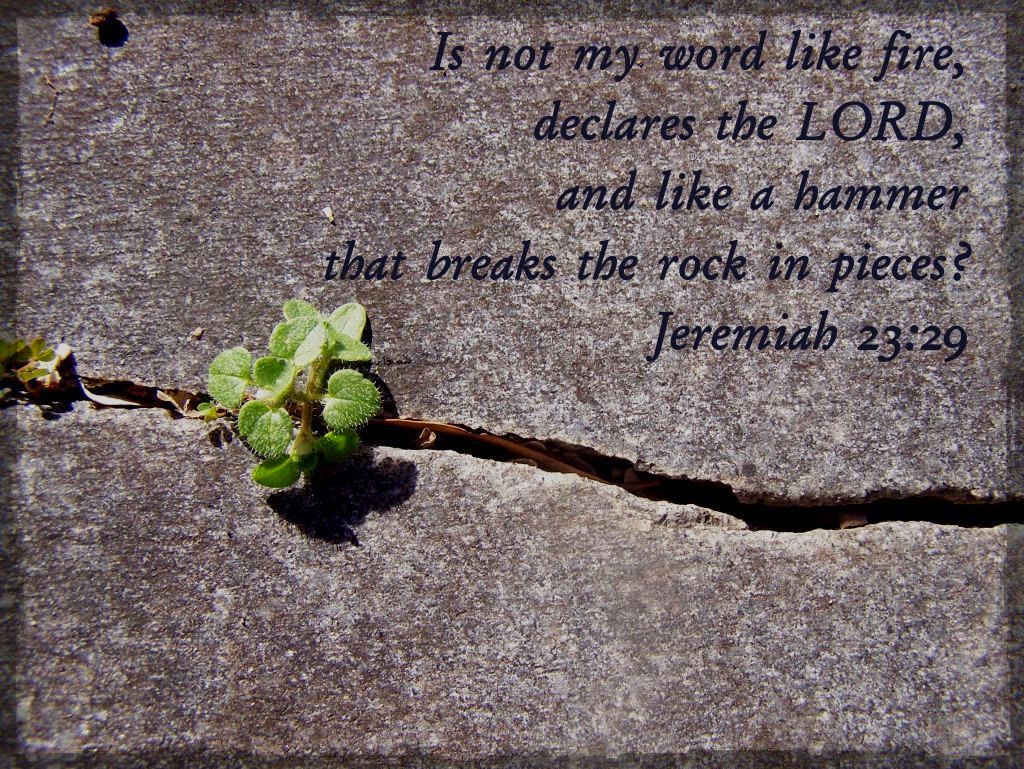
Whether God works slowly in a person’s life or quickly, His word will wear away the seemingly strongest of guards around the heart. If your family, work acquaintance, or friend isn’t saved, God’s word IS like fire, a hammer, and a sword. It will pierce the strongest of stoutly sinning hearts. Don’t give up speaking truth and praying.
I am the vine; you are the branches. Whoever abides in me and I in him, he it is that bears much fruit, for apart from me you can do nothing. (John 15:5)
We’ve been having the usual summer storms- thunder, lightning, rain, and wind. In some of these, people were without power. Many tree limbs came down.
There was a branch in my yard that came down. It was a biggish limb, torn right off from a large tree in the back yard. I’d planned to take a photo of it to illustrate the verse, but the yard was cleaned up before I came home from work. So I found this branch in the pasture instead.
Look at it. The limb is dead, that kind of dead, rusty brown that pine trees turn when they are good and dead. It is no longer connected to the tree. That limb can stay on the ground there as long as it wants but it will never do anything except lay there and get dead-er. It will not grow longer. It will not spring pine needles, It will not bear pine cones. It will not house birds. It will not shade worms. It will only lie there, dead.
It is apart from the tree.
Do not be apart from the vine. Jesus is the vine, providing life-flowing sustenance, strength, power. We can do nothing apart from Jesus. In Him is our only salvation, our only way toward holiness, our only blessing. Stay connected to the Vine. Let prayer, obedience, the Word of God rule your life. Abide in Him. If you do, you will flourish.
Are you one of a partly hidden minority in the body of Christ who has felt led by the Lord to remain single and celibate for all your days? I’m not talking about unbiblical vows of celibacy like the false Roman Catholic Church forces on its priests and nuns. I’m wondering if you are one of the blessed recipients of what apostle Paul called a gift of singleness.
Though marriage is the norm for most people, and it is indeed an institution created by God, and it is a picture of our coming union with Christ, marriage is not given to everyone. Never mind that the average person on earth is single for a good portion of their lives. Americans now spend more years of their adult lives unmarried than married.
The trend toward spending more time single is not specific to the United States. Across 192 countries, people who, by age 30, had always been single, increased from 15% in the 1970s to 24% in the 1990s. The increase was greater for developed countries: In the 1990s, 38% of the women and 57% of the men reached the end of their 20s without ever marrying (World Fertility Report, 2003). Source: Single Women Fact Sheet
These demographics are reflected in the average church congregation. Yet ministry and interpersonal attitudes have not kept up, and some permanently single people feel marginalized or overlooked.
In part one I introduced these and other facts. In part 2 & 3 I looked at specific verses and passages that address marriage, singleness, celibacy, and eunuchs (old and modern-day). In this part I’ll look at the impact that single people have made for the kingdom. I’m not focusing on the status of temporarily single people who will marry at some point. I am looking at those people who are beneficiaries of the God-given gift of singleness, a status designed purposely by God for His glory through His use of these individuals. (1 Corinthians 7:6-7).
I admire married people with children who labor in the church. I can’t imagine their exhaustion, the time it takes to raise children, and still have time to study that Sunday School lesson he will be teaching, or her volunteer work in the nursery, or their ministry to the community hungry…and remain diligent in personal Bible study and family devotions. Phew! There seems not to be enough hours in the day. Jesus designed it so that a majority of people will at some point in their lives marry and most of these will likely have children. Their focus is naturally on their family lives. And naturally, their interests are divided. (1 Corinthians 7:33, 35).
We know of famous married couples in the Bible, Adam and Eve, Ruth and Boaz, Jezebel and Ahab, Abram and Sarai, Jacob and Rachel/Jacob and Leah, David and Michal/David and Bathsheba, Solomon and all his wives, Mary and Joseph, Zacharias and Elisabeth, Priscilla and Aquila, Ananias and Sapphira…In each case God ordained for the person a spouse and in each case their marriage as recorded in scripture became something the Lord used for His glory and our instruction.
However, remember, marriage is not an institution that will last forever. In his exposition of 1 Corinthians 7:25-40, S. Lewis Johnson said,
The central thought of the apostle is that celibacy is desirable; it’s not demanded. Why? … Well, from reading the passage here and from knowing the things that our Lord had said with which the apostle was familiar, evidently for him he thinks of marriage as a temporary covenant for the propagation of the human race. But the relation to the Lord is an eternal relation — relationship.
And so in the light of that, what he seems to be suggesting to us is that we, as believers, should remember that we are heading to an eternal destiny in the presence of the Lord. … He wants to focus our attention upon the fact that we are on our way to eternity. And this is temporary. And we are to spend ourselves during this temporary period of time in seeking the Lord and ministering as believers for him in the society of which we are apart. I gather that that’s what — that’s why Paul says the things that he says when he says, “Marriage is good. It’s alright to marry, but it’s better to give yourself holy to the Lord.” And now he is going to talk about why it is so.
The unmarried man or women does not have divided interests and can focus solely on pleasing the Lord. (1 Corinthians 7:32, 34b). Let’s look at some people in the Bible who were specifically and notably single, devoting all time and energy to ministering to Him. First will be people from the Old and New Testaments we know were single, and then a list of others we can say might have been or were probably single.
Jeremiah, by Michaelangelo
Jeremiah
A prophet of the Lord and author of the book of Jeremiah and Lamentations, Jeremiah never married or had children.
The word of the Lord came to me: 2“You shall not take a wife, nor shall you have sons or daughters in this place. (Jeremiah 16:1-2)
The LORD said He was planning to still the voice of the bride and bridegroom, and plagues and hardship were going to come upon the land. Gill’s Commentary explains Jeremiah’s single status,
Thou shall not take thee a wife,…. Not because it was unlawful; for it was lawful for prophets to marry, and they did; but because it was not advisable, on account of the calamities and distresses which were coming upon the nation; which would be more bearable by him alone, than if he had a wife, which would increase his care, concern, and sorrow.
Apostle Paul alludes to the times also as a reason not to marry. (1 Corinthians 7:26). Sometimes God ordains singleness not to test a person in endurance or deny a person a pleasure, but to spare a person grief in coming calamity.
Anna
St. Anna the Prophetess by Rembrandt Van Rijn
Here is a woman who lived in apostate times, the worst of times. Her generation had drifted fully from the Old Testament law and lived under the oppressive and false rule of Pharisaical law, as we know from the many admonitions and warnings Jesus gave to the Pharisees, and Paul’s initial terrorism against the early Christians. God had been silent 400 years, since the close of the Old Testament canon in Malachi in approximately 430BC. The last chapter of Malachi is short, but contains a warning about the Day of the LORD, a warning to follow the Law given to Moses, and this, the last words Israel heard said to them by God–
“Behold, I will send you Elijah the prophet before the great and awesome day of the Lord comes. And he will turn the hearts of fathers to their children and the hearts of children to their fathers, lest I come and strike the land with a decree of utter destruction.” (Malachi 4:5-6)
Malachi’s warning was not without cause. The Jewish people were mistreating their wives, marrying pagans and not tithing, and the priests were neglecting the temple and not teaching the people the ways of God. In short, the Jews were not honoring God. (Source)
Things only worsened as 400 years ground on. Yet there were a few that remained pure in heart and pleasing to the LORD. In approximately 27-29BC, Jesus was born and was presented at the Temple according to the Law. Anna was there.
And there was a prophetess, Anna the daughter of Phanuel, of the tribe of Asher. She was advanced in years and had lived with her husband seven years after her marriage, and then as a widow to the age of eighty-four. She never left the temple, serving night and day with fastings and prayers. At that very moment she came up and began giving thanks to God, and continued to speak of Him to all those who were looking for the redemption of Jerusalem. (Luke 2:36-38).
A widow can know what it is to face a long, lonely and cheerless life, and a solitude made more acute because of the remembrance of happier days. But it was not so with Anna. When as a young, motherless wife, God withdrew from her the earthly love she rejoiced in, she did not bury her hope in a grave. In the place of what God took, He gave her more of Himself, and she became devoted to Him who had promised to be as a Husband to the widow, and through her long widowhood was unwearying in devotion to Him. She “trusted in God,” and her hoary head was a crown of glory (Proverbs 16:31). Repose of soul was hers for eighty-five years because the one thing she desired was to have God’s house as her dwelling place all the days of her life. Source.
Paul
Paul writing his epistles. Valentin de Boulogne
In 1 Corinthians 7:6 Paul declared he himself had the gift of celibacy, so we know that he was not at that time married. Had he ever been married? We don’t know for sure. At some point, if Paul had been married, his wife either had died or was not in the picture. Paul’s tremendous conversion showed that the redemption available in only Jesus Christ is not beyond even the “chief of sinners”, a murderer and terrorist of His people. (1 Timothy 1:15).
In his life lived and in the strength of Christ, Paul founded churches all over the region in his three missionary journeys, pastored them, discipled young men for the future labor in Christ, contended for the faith alongside many men and women, ‘redeemed’ a slave and reconciled him with his master, and wrote Romans, 1 and 2 Corinthians, Galatians, Philippians, 1 and 2 Thessalonians, Philemon, Ephesians, Colossians, 1 and 2 Timothy and Titus.
From conceited, legalistic terrorist, Paul became a humble, powerful witness for the glory of Christ.
Mary/Martha/Lazarus
This sibling trio were single. They were used mightily of Jesus. In His Incarnation He lodged with them, all three of whom He loved. (John 11:5). He used Lazarus to show the glory of God, Martha illustrated her “love and piety alike found adequate and satisfying expression at all times in the ordinary kindly offices of hospitality and domestic service” according to Lockyer, and Mary loved to sit at her Lord’s feet and absorb heavenly truths.
Philip’s four unmarried daughters
These women (Acts 21:8-9) prophesied.
Philip’s household included four virgin daughters who were prophetesses. That Luke describes them as virgins suggests that they may have been set aside by God for special ministry (cf. 1 Cor 7:34).
(Source: MacArthur Commentary on Acts).
Apocalypse of Lorvao.
The 144,000 Revelation 7:1-8 and Revelation 14:1-5 records that the Lord reserves 144,000 virgins and will supernaturally seal them from harm during the judgments of the Tribulation, in order to use them for His glory. They will evangelize the world during the Tribulation. Multitudes and myriad come to faith in Jesus Christ during this time, thanks to the supernatural energizing of these unmarried singles.
We, in the Christian church, perhaps in our day are not giving proper credit to those who, by the grace of God, have given themselves to a celibate or single life. The unmarried woman, for example, and the unmarried man who have given themselves to service for the Lord and have eschewed marriage; we should give them credit for what they have done. ~S. Lewis Johnson, Marriage Counsel III
Lydia
This woman ran a profitable business and had a home large enough to accommodate the entire missionary team. (Acts 16:14, 15, Acts 16:40). No husband is mentioned in association with ‘Lydia’s business’ and ‘Lydia’s household’ so it was likely she was single via widowhood. She provided a safe haven for Paul and his mission team time and again, in loving hospitality so they could rest and recover. Her home is where Paul and Silas went after being released from prison, and it was there the brethren received solace and encouragement. Baumgarten says,
“This assembly of believers in the house of Lydia was the first church that had been founded in Europe”.
Of Marriage and singleness in general, S. Lewis Johnson remarked,
I never quite understand why married people who have the comforts of home often speak in a disparaging and unkind way of unmarried people. It should be that if marriage is so delightful, that married people would speak in a very tenderness and — tender and sympathetic way of people who have not married. But instead of that, they speak sometimes in such a contentious way. I never like to hear people say, “Oh she’s just an old maid’ or “he is just an old bachelor.” Wait a minute! He whom you so designate may be glorifying the Lord in a way he could not have done if he were the head of a household and she of whom you speak, may be one who is rendering wonderful service to God and humanity. I repeat, some of most devoted Christians I have ever know have been unmarried men and women who gave themselves holy to the work of the Lord Jesus Christ. All honor to them. I agree with that. ~S. Lewis Johnson, Marriage Counsel III
In modern times we can point to many people who chose to remain unmarried for the sake of the kingdom, like Pastor John Stott, for example, who was single all 90 years of his life and served the Lord actively as pastor for 65 of them. Some chose to stay unmarried after the death of a spouse, Rachel Saint, for example. MacArthur says of Mrs Saint,
Rachel Saint served as a single missionary among the Auca Indians of Ecuador for many years without companionship. She poured out her life and her love to the indians and found great blessing and fulfillment. (source)
Many of the missionaries who have gone out from the shores of the United States have been women missionaries who’ve gone out, spent their lives in heathen lands and the jungles, and in the countries where things are not nearly so nice as the United States of America, and have been responsible for many, many people having an opportunity to hear the Gospel of the Lord Jesus Christ. I’ve known of some who have gone to Mexico, translated the language of tribes themselves and then written the Bible for them, so to speak, translated it, and made it possible for people to have the Bible in their own language. What a marvelous ministry. And when you remember that we are here just a short time and eternity is fairly long, you can see what a marvelous choice has been made by some people to not be entangled in marriage.
Whether God has destined a mate for you, or has consecrated you to Himself as an unmarried/single earlier than eternity, His glory always shines through His people when we submit all to Him. Whether married or unmarried, single temporarily or permanently, we are His children, loved perfectly and endowed with His Spirit to do His work. We have all been gifted, and when we look upon each other, we should not see married or single, at odds in misunderstanding or apprehension, but equally gifted individuals co-laboring for Christ’s name and His glory.
While some singles are waiting impatiently for God to change their circumstance, other singles are not walking in a fog of depression but joyfully serve from His gift.
Singleness in the church today. Singleness in the Body Christ is for His glory. Though there is a rightly heavy focus on married couples in preaching, ministering, and fellowship life, there are single people in the church. We know this by the data the Census and the Christian church demographics. Yet as the number of singles in the church increases, churches are grappling with how to effectively minister to this demographic of the family of Christ.
Many single people report that they feel left out, overlooked, or worse, are treated as second-class citizens in church life.
This is part two of a series on being single in today’s Christian church. I’d said in part one that we can drill down even further into examining what the Bible has to say about being single. In my view, there are two branches of singles. Some people are single because they are going through a life phase in God’s timing where marriage hasn’t happened for them yet, or they were married and are now widows or widowers, perhaps to marry again. I’m not discussing these singles, these precious folks who trust that God will provide a mate for them. The other type of single today are men and women Jesus calls and ordains as single permanently. It’s the divinely ordained singles I’ll discuss. These are modern-day ‘eunuchs’, as Matthew 19:12 illustrates. The Bible directly teaches the gift of singleness, the status whereupon Jesus is forming people for His glory who will never marry, or if they were married, will never marry again. Rarely does preaching, ministry, or church fellowship reflect this biblical reality.
EPrata photo
In this part I’ll look at what the scriptures have to say generally about singleness. In part 3 I’ll look at specifically named single individuals in the Bible and their work for the glory of Jesus.
In dividing singles into the two branches, the temporarily single as a phase of life and the sovereignly ordained single as a permanent status, it allows churches to edify each by uniquely focusing on their special gift or need. Teaching about the gift of singleness also honors the Word of God as we preach or teach about this segment of our family demographic from scripture. The Bible specifically addresses the ordained single- but these verses seem to be invisible in today’s preaching and as a result, these folks are often invisible also.
But this demographic certainly was not invisible in the Bible! Yet with article titles like these, –Why So Many Singles? –Surviving Church as a Single –Are Singles the Lepers of Today?
Is it any wonder many permanent singles wonder where and how to minister to the Body and honor Jesus in church?
I’ve always felt encouraged by how singleness is addressed from the pulpit. I hear how, being single, I have the opportunity to love and serve God in a way that’s undivided and different from how I can do it when I’m married. But things get a little more challenging in the foyer. It’s there I hear things like, “So, have you started dating anyone?” Or, “Whatever happened with you and that guy?” Or, “You’re so great. I can’t believe you’re not married!” These questions, though well-meaning, can come across as invalidating my singleness or as insinuating that the only goal of singleness is to end it.
John Stott, famously single to the end
The entire chapter of 1 Corinthians 7 focuses on marriage, singleness, lust, celibacy, and the duties of each person whether married at the time or not. Above all, one should understand that some people today in the body of Christ have been gifted with singleness. God has given a gift to the person and by extension to His Son’s Body.
Acknowledging this is paramount, an important step in puncturing church conceptions about permanent singles. Not to say some singles are better than anyone else, but simply to say that their lifestyle has been given them by Holy God and that ministering through this gift will bring blessing to His body of believers that seems uncommon today.
The great preacher John Stott was single for 90 years. His period in office was 1945–2010. He was interviewed specifically about singleness, in this article appearing just after his death in 2011.
We must never exalt singleness (as some early church fathers did, notably Tertullian) as if it were a higher and holier vocation than marriage. We must reject the ascetic tradition which disparages sex as legalized lust, and marriage as legalized fornication. No, no. Sex is the good gift of a good Creator, and marriage is his own institution.
If marriage is good, singleness is also good. It’s an example of the balance of Scripture that, although Genesis 2:18 indicates that it is good to marry, 1 Corinthians 7:1 (in answer to a question posed by the Corinthians) says that “it is good for a man not to marry.” So both the married and the single states are “good”; neither is in itself better or worse than the other.
We know marriage is a gift from God. In 1 Corinthians 7:6-7, Paul specifically addresses singleness as a gift for some.
Now as a concession, not a command, I say this. I wish that all were as I myself am. But each has his own gift from God, one of one kind and one of another.
John MacArthur said in his commentary on 1 Corinthians 7:6-7,
His comments were not meant as a command for every believer to be married. Marriage was instituted by God and is the norm for man-woman relationships, and it is a great blessing to mankind. But it is not required for believers or anyone else. His point was, if you are single, that is good, if you are married or get married, stay married and retain normal marital relations for that is of God. Spirituality is not determined by marital status.
This biblical truth is countered and overshadowed by “Christian” writers who unfortunately have much influence, especially over young women. Mommy bloggers like eventual apostate Glennon Melton who claim to be a ‘truth teller and hope spreader’ wrote in her oddly titled (and now deleted) essay “Ways to Secure your Happyish Ever After“,
“Marriage is still the best chance we have to become evolved, loving people.”
Of course it is not true, as we see in the scripture above. Sadly, Melton’s insinuation is not uncommon, that if one is not married, one cannot become “evolved” or be loving in he same way the lucky marrieds can. Yet it is the Spirit Who grows us (if that is what is meant by ‘evolved’). Further, it is the Spirit Who delivers the spiritual fruit of love. (Ephesians 5:9, Galatians 5:22). Marriage is a God-given institution but it is not the marriage itself that grows a Christian into maturity. MacArthur commentary continues,
The attitude among Christians today about singleness, however, is often like that of the Jewish tradition in Paul’s day. It is looked upon as a second class condition. “Not so,” says the apostle. If singleness is God’s gift to a person, it is God’s will for that person to accept and exercise the gift. If that person is submissive to God, he can live in singleness all his life in perfect contentment and happiness.
Though this article still makes the assumption that all singles are going to be married, I can forgive it because many singles ARE going to be married. However for the permanent single, there is good advice for you here too— Desiring God: Single, Satisfied, and Sent: Mission for the Not-Yet Married
Life does not begin at marriage. Life begins in the exact moment when we submit ourselves to Christ and make Him Lord, when the Holy Spirit comes to dwell within us and take residence within us.
Look carefully then how you walk, not as unwise but as wise, 16 making the best use of the time, because the days are evil.
Of this passage in context, Matthew Henry said,
“These verses contain a caution against all manner of uncleanness, with proper remedies and arguments proposed: some further cautions are added, and other duties recommended.”
One of the cautions is that the days are evil, so we redeem the time. If we do, we are wise. Henry further comments on the part about redeeming the time,
It follows, redeeming the time (v. 16), literally, buying the opportunity. It is a metaphor taken from merchants and traders who diligently observe and improve the seasons for merchandise and trade. It is a great part of Christian wisdom to redeem the time. Good Christians must be good stewards of their time, and take care to improve it to the best of purposes, by watching against temptations, by doing good while it is in the power of their hands, and by filling it up with proper work—one special preservative from sin. Our time is a talent given us by God for some good end, and it is misspent and lost when it is not employed according to his design. If we have lost our time heretofore, we must endeavour to redeem it by doubling our diligence in doing our duty for the future.
The Bible Exposition Commentary by Warren Wiersbe says of the Ephesian 5:15-16 verses,
It is a mark of wisdom (v. 15). Only a fool drifts with the wind and tide. A wise man marks out his course, sets his sails, and guides the rudder until he reaches his destination. When a man wants to build a house, he first draws his plans so he knows what he is doing. Yet, how many Christians plan their days so that they use their opportunities wisely? True, we cannot know what a day may bring forth (James 4:13–17). But it is also true that a planned life can better deal with unexpected events. Someone said, “When the pilot does not know what port he is heading for, no wind is the right wind.” Life is short (v. 16a). “Buying up the opportunity—taking advantage of it.”
An old Chinese adage says, “Opportunity has a forelock so you can seize it when you meet it. Once it is past, you cannot seize it again.” Our English word opportunity comes from the Latin and means “toward the port.” It suggests a ship taking advantage of the wind and tide to arrive safely in the harbor. The brevity of life is a strong argument for making the best use of the opportunities God gives us.
I ask Jesus to expand the time for me, to help me make use of the time, and to convict me when I fail to be “wise.” He always hears that prayer, because it belies a heart that wants to glorify Him more, and not less. If I can glorify Him one minute more each day, even one minute, by purposeful prayer, or conduct, or Bible study, then that is a beautiful thing.
EPrata artwork, paper collage, scanned, & digitally altered
My father died in 2014. He was 81. He had never said “I love you” to his daughter.
Now he never will.
It’s a truth that doesn’t get any easier the older one gets. It’s actually harder to get used to the longer one drifts in time away from his death date, not easier.
He was a hard working man. He was a gifted raconteur. He was a wealthy man. He was a lot of things. But a father? Not so much. His ignoring of his kids as they grew, his intermittent but frequent abandonment of them as adults, his final, legal disownment of them as he aged all were stunning betrayals in the lives of three children, with untold consequences.
Every daughter can tell a different story about her father. Some stories are good, some are bad. Some are neutral. Some are bitter and some are sweet. Fathers, dear reader, have an effect.
There is a short film called The Father Effect. It is good.
The producer of this movie lost his own father to suicide when he was a boy. As he stated in the movie’s Mission page, the resulting film is his attempt
to educate, equip, & encourage men to be the dads God created them to be
Many of the people with whom I am connected through media and in real life have great parents who they honor and feel blessed to have grown up under. Others have disappointing stories they share, either freely or privately. Whatever the case with you, you know fathers have an effect on you for life. I worry for the fatherless who don’t have the solace of Jesus. For those among you who have had a less than blessed childhood, but are now safely home under Jesus’ wings, you know you have a REAL father. Jesus will love you forever, never abandon you, and is in fact, perfect. What a blessing this is. He is not only as Prophet, Priest, and King, but friend, brother, and Father.
The Encouraging Dads Project was an idea that came out of John’s experience in making The Father Effect Movie. As John talked to dads from all walks of life, he heard heartbreaking stories about how dads feel beat up, discouraged, and frustrated with their lives as dads. John was moved to do something to help encourage and inspire dads and The Encouraging Dads Project was born.
Take some time to encourage your Dad. Encourage a dad. Encourage a man who was a dad to you. Encouragement is free, and only takes a few moments. Send a letter, make a phone call, send a text, make a date to take him out for coffee. Tell him how special he is to you.
Dads, do the same for your daughters. If some time has gone by since you talked to her, take a moment to let her know how much she means to you, how proud of her you are, that you love her. My dad in all probability never confessed and repented and probably died outside of Christ. It was a sudden hit in a car crash. Boom. Gone.
He and I will not meet again, and I’m sorrowful for that. Eternity will go on and I will be loved perfectly by many fathers, and THE Father. I will forget the former troubling things, including Dad. He will remember everything, forever. If there is sorrow over your relationship with your dad, if you are on opposite sides of the salvation fence, let that fact weigh on you, and as the men in The Father Effect say, forgive.
Caption: “Our purpose in making this film is to create an awareness in fathers about the significant impact their words and actions have on their children and to help them become better fathers.”
And everyone who has left houses or brothers or sisters or father or mother or children or lands, for my name’s sake, will receive a hundredfold and will inherit eternal life. (Matthew 19:29).
in 1855 two German-born missionaries, Carl Wilhelm Ottow and Johann Gottlob Geissler, with the support of Dutch Christians, sailed for the forbidding lands of Dutch New Guinea.
After both the Dutch Indies government and the Sultan of Tidore had given permission, Ottow and Geissler left their schooner Ternate in January 1855. It was there they reportedly fell on their knees to pray and called out: “Im Namen Gottes betreten wir dieses Land” (“In God’s name do we set foot on this land”); after that they went across to the mainland to look at another site, then returned to the ship. Early in the morning of Monday, 5 February, the Ternate anchored off Manaswari to drop them off with their belongings. To this day that date is celebrated as marking the beginning of the Protestant mission in (formerly) Dutch New Guinea. (source)
One hundred years later, missionary work was still going apace in the Dutch New Guinea islands. Yet even by 1955, there were still peoples who had not even been contacted, who had not met with the outside world at all. Several missionaries resolved to correct this.
In 1968, in the same area but with a new name, now called Irian Jaya, Indonesia, two missionaries prepared to leave their mission base and penetrate the Snow Mountains. The Snow Mountains were home to one of the most feared tribes of the area, the Yali. This Stone Age tribe was heavily animistic, deeply superstitious, practiced human sacrifice, and they were cannibals. Very few men had met them and come out alive.
The two missionaries preparing to leave base were Phil Masters from America and Stan Dale from Australia, who had been working out of Korupoon for the previous 6 years. Though progress had been slow, the missionaries had seen some conversions from other tribesmen who had come to faith. For example, Masters’ work with the Kimyal (Kimjal) people had yielded some conversions in 1963 when several of the Kimyal chieftain’s sons had converted. Dale’s work with the Dani had led to conversions also. But not the Yali. They resisted, fiercely.
In this note Stan Dale wrote to his support personnel back in Australia, he said-
“Please continue to remember us in prayer. Unfortunately, there is not much interest where the visible results are small. We trust that something will happen in our areas that will bring glory to God, even though we may be unknown.”
The Yali were a short tribe of people, what we used to call pygmy. The Yali men grew to less than 5 feet, the women a bit shorter. Despite their diminutive stature, they were the most feared tribe in the mountains. They were savage and aggressive, cannibalistic toward other tribesmen not only during in war but sometimes hunting humans just for meat. After killing a person they would chop them, grind their bones and scatter the dust, in order to prevent the person from ‘returning’. As a result of their fearsome demeanor and ferocious acts, the mountain tribes rarely interacted with each other.
However, the language of the Gospel is universal, and while some tribes, like the Kimyal, had been somewhat receptive, Stan and Phil were determined to reach the Yali peoples too. In 1961 on a former trek where the Gospel had been preached to the Yalis along by Stan with fellow missionary Bruno de Leeuw, Stan had been shot with five arrows, and the duo retreated. Now Stan wanted to try again, this time Phil Masters would be his companion. The two men were propelled by an equally fierce conviction that the Yalis needed Jesus, even if at the expense of their own lives.
It was a grueling journey. The geography of the region was challenging, rugged, and isolating. Trekking was arduous. Though the native people would clamber through the dense jungle and trot barefoot up inclines in the rugged terrain, never slipping, the going was harder for the missionary men and their carriers from the Dani tribe. There was one friendly Yali with them.
As the group reached Yali territory, warriors came out of their huts, and menacingly waved their arrows. Undaunted, the group of missionaries and carriers continued. The Yali tribesman with the group observed that a sign had been given that they were to be killed. The group turned around and began trekking back. When they came upon a small, level river beach with rugged mountains towering over them, the Yali let loose a volley of arrows. Stan was hit numerous times, but amazingly, he simply stood. He tore the arrows out of his body, one by one. The volley of arrows continued and still, Stan yanked them out. The Yali became fearful, knowing these men served another God. Their volley of arrows became more intense, fearing more and more the God they served and wanting the men to die so they could quickly escape the area in case there was divine retribution.
Phil was spurred on by Stan, and the two men, who supernaturally had been withstanding an incredible onslaught, finally became too weak to pull out their arrows, and they fell. Several of the carriers were killed also. The Yali chopped the men and ate them, and scattered their ground-up bones so they could not be “resurrected,” a term they had heard before when Stan had shared the Gospel in 1961.
Phil Masters, author of the Daily Sentinel’s Missionary Diary, is reported missing in the interior of West Irian, Indonesia. A missionary for the Regions Beyond Missionary Union, Phil and his family have spent some six years in the primitive areas of what was once the island of Dutch New Guinea. The island was taken over by Indonesia over three years ago. Mrs. Masters is the former Phyllis Wills, daughter of Mr. and Mrs. Hollis Wills, Seney. It was reported by Phil’s parents, Mr. and Mrs. Tom Masters, Mapleton, were notified Monday morning by telegram that Phil is overdue from a trek into the interior. Although all the details have not been learned, it is believed Phil and another missionary went into the jungle to visit a neighboring village and haven’t been heard from since.
Mrs. Ron Severson, LeMars, has received a news release from the Regions Beyond Missionary Union, Philadelphia, with more information about Rev. Phil Masters. The Severson family was one of the interested in LeMars area families in the work of Phil Masters. The union reported the deaths of two of its missionaries in the eastern highlands of West Irian, former Dutch New Guinea, Wednesday, Sept. 25. The date had not been reported previously. Rev. Philip Masters and Rev. Stanley Dale were killed instantly in an ambush by hostile tribes while on an evangelistic trek between the RBMU outposts of Koruppun and Ninia, the missionary union source said.
The society is one of several mission groups working in the interior of West Irian among tribes just emerging from a stone-age culture. A phenomenal response to the message of the Gospel has been witnessed among some of those warring cannibal tribes. Notably, in the Swart Valley alone, since 1960, some 8,000 of the Dani tribe have become Christians, weapons and fetishes have been discarded and literacy has become widespread.
One of the last communications received by the home office from Mr. Dale carried this significant comment—“I have a burden for these places where the way is hard. Please continue to pray for the people of the Holuk that they may break free from their fetishes and declare themselves wholly on the Lord’s side. Please continue to remember us in prayer, for we still carry some heavy burdens that are not burdens of work.”
The Lord blessedly answered the missionaries’ prayers. The various peoples of the Seng Valley in Indonesia have been released from their shackles to a ritualistic and demonic system of fear and death. They are joyously free. Though the burdens Stan and Phil (and Bruno, and the Wilsons who are still there) carried were heavy, they were temporary. The massacred missionaries are now enjoying freedom from their earthy tent of a body and dwell in glory with Christ. The day will come when the two men, shot through with arrows and ignominiously eaten, will receive new glorified bodies and eagerly and joyously greet their brethren the Yalis in heaven. Only the Gospel of Jesus Christ can cause such warm love and dramatic transformational change.
The Lord Jesus Christ loves His people, all peoples, and He died and rose again to bring a message of light and hope to all men. He sends His Spirit to indwell men and some of those, Jesus has set them apart for missionary work to bring the Gospel message to those who are in deepest darkness.
The Korowai people of that area did not emerge into the 20th century nor had they been contacted by any Westerner until 1974. Wikipedia: “The first documented contact by Western scientists with members of a band of western Korowai (or eastern Citak) took place on March 17–18, 1974.”
We are not talking long ago times of unreached people groups. Dutch Christian missionaries immediately began living among the Korowai and the first converts came to Christianity in the late 1990s. You see that the fields are white, the need is deep. These cannibalistic, stone age tribes are still emerging into the present day.
And before the Wilsons who live there now, there was Dale and Masters, and before that Bruno de Leeuw and before that Carl Wilhelm Ottow and Johann Gottlob Geissler…and before that Apostle Paul and before that…JESUS. No matter where one extends the unbroken line of missionaries back, it always ends, or begins, with the first missionary. He left His holy habitation of pure glory to descend to depraved man, bringing the Light and the Hope of the Gospel.
Thankfully, some tribes already have emerged into the Light. Here is a wonderful video of the Kimyal people, whom Phil had worked with, rejoicing when a small plane brought to them their first Bibles in their own language. Below that, the Yali themselves commemorate the day that Bruno and Stan brought the Gospel to them in 1961, which has become their TRUE Independence Day.
The Kimyal Tribe of Papua, Indonesia celebrate the arrival of the New Testament Bible in the Kimyal language:
Youtube summary of video below: “On May 21, 1961, Stan Dale and Bruno de Leeuw made first contact with the Yali tribe in what is now Papua, Indonesia. In the week of May 16, 2011, the Yali held the Yubileum, or Jubilee: they celebrated fifty years since the coming of the Gospel to their tribe, and fifty years of its transformational impact on their society. This video captures some of the highlights of that celebration, as well as the Holuwon Yalis’ welcome of John and Gloria Wilson and their family, who had lived among them for twenty years:”
This week I’m posting a few essays about cities. Yesterday I wrote about “The Pride of Cities.” Today let’s learn about the biblical Cities of Refuge.
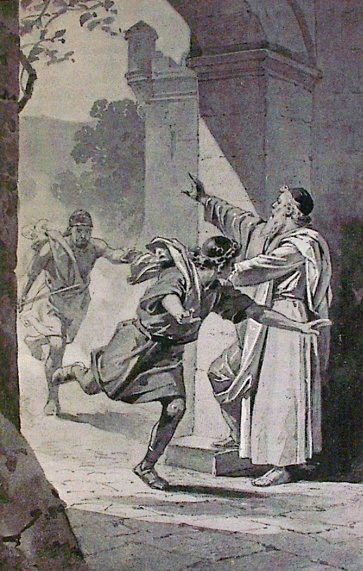
Left, Illustrator of Charles Foster, The Story of the Bible, 1884, “City of Refuge”.
Asylum. Sanctuary Cities. Manslaughter. Innocent. These are judicial terms that are not new, the men of Bible times knew them and we know these terms today.
Our God is a God of justice. He knows what is in a man, and it’s sin. He knows we hate and that we murder. Murder happened early on in human history, when Cain slew Abel in Genesis 4. And sin was only introduced in Chapter 3.
He knows that when blood is shed, blood must pay. Therefore, God made it possible for wrongful shedding of human blood to be avenged. In the Old Testament, the nearest relative of the wrongfully killed person had legal standing to hunt the murderer down and kill him with no repercussions to himself. (Numbers 35:19, 21, Deuteronomy 19:12).
Numbers 35:19, The blood avenger himself shall put the murderer to death; he shall put him to death when he meets him.
Numbers 35:21, or if he struck him down with his hand in enmity, and as a result he died, the one who struck him shall surely be put to death; he is a murderer; the blood avenger shall put the murderer to death when he meets him.
Deuteronomy 19:12, then the elders of his city shall send and take him from there and give him over into the hand of the avenger of blood, that he may die.
However, there are times when blood is shed accidentally, or unknowingly. This person is called a “Manslayer” as opposed to the aforementioned ‘murderer’. If a man accidentally killed another man, God made a way for that person to be able to flee to a City of Refuge, so called in the Bible, and hurl himself upon the judicial investigation of the priests or elders of that city. Here’s how Charles Spurgeon explains it:
You will remember that when the children of Israel were settled in Canaan, God ordained that they should set apart certain cities to be called the Cities of Refuge, that to these the man-slayer might flee for security. If he killed another unawares, and had no malice aforethought, he might flee at once to the City of Refuge; and if he could enter its gates before the avenger of blood should overtake him, he would be secure.
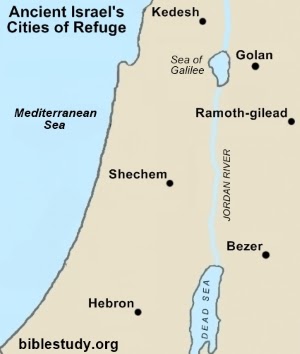
Cities of Refuge were carefully selected at strategic locations so that no person living in the Land would have to run far to access it. They were equally spread out. A person anywhere in the Land could reach them in a day or less. The Cities of Refuge were open to strangers, too.
Cities of Refuge (source Smith’s Bible Dictionary) were six Levitical cities specially chosen for refuge to the involuntary homicide until released from banishment by the death of the high priest. (Numbers 35:6,13,15; Joshua 20:2,7,9) There were three on each side of Jordan.
Shechem, in Mount Ephraim. (Joshua 21:21; 1 Chronicles 6:67; 2 Chronicles 10:1)
Hebron, in Judah. (Joshua 21:13; 2 Samuel 5:5; 1 Chronicles 6:55; 29:27; 2 Chronicles 11:10)
On the east side of Jordan –
Bezer in the Wilderness, in the tribe of Reuben, in the plains of Moab. (4:43; Joshua 20:8; 21:36).
Ramoth-Gilead, in the tribe of Gad. (4:43; Joshua 21:38; 1 Kings 22:3)
Goolan in Bashan, in the half-tribe of Manasseh. (4:43; Joshua 21:27; 1 Chronicles 6:71)
What you had to do, if, say you were chopping wood and your axe head flew off and killed the man next to you, is run to the city. Upon arrival, you would have to tell the elders what happened. You’d have to make it there before the ‘avenger of blood’, usually the nearest next of kin to the dead man, gets you and kills you.
The elders would provide you a place to stay and food, until they met to discuss your case.
If the case is adjudicated as accidental, you would be allowed to remain in the city of refuge freely until the High Priest died. After that you could go home. If you left the city of refuge prior to the death of the High Priest, the avenger of blood could perform the death penalty without penalty to himself.
I find all this amazing, that God provided opportunities for justice in these cases. What I find even more fascinating is just how seriously the Israelites took the cities of refuge.
These cities of refuge were a fact, real cities with real roads leading up to them. The roads leading up to it would need to be maintained. They erected signs at intervals so that the fleeing man-slayer would know where to go. They maintained the signs regularly also. Spurgeon again from the same link as above:
We are told by the rabbis that once in the year, or oftener, the magistrates of the district were accustomed to survey the high roads which led to these cities. They carefully gathered up all the stones, and took the greatest possible precautions that there should be no stumbling-blocks in the way which might cause the poor fugitive to fall, or might by any means impede him in his hasty course. We hear, moreover, and we believe the tradition to be grounded in fact, that all along the road there were hand-posts with the word “Refuge” written very legibly upon them, so that when the fugitive came to a crossroad, he might not need to question for a single moment which was the way of escape; but seeing the well-known word “Refuge,” he kept on his breathless and headlong course until he had entered the suburb of the City of Refuge, and he was then at once completely safe. Spurgeon
It’s true about the roads and the signs, not just tradition. This is from the Jewish Encyclopedia, written after Spurgeon preached that message:
Corresponding to the care for the proper location of these cities were the other ordinances referring to them. The roads leading to them were marked by sign-posts at the crossroads, with the inscription “Miḳlaṭ” (Refuge); the roads were very broad—32 ells, twice the regulation width—smooth and level, in order that the fugitive might not be hindered in any way (Sifre l.c.; Tosef. l.c. 5; Mak. 10b; B. B. 100b). The cities chosen must be neither too small nor too large: in the former case a scarcity of food might arise, and the refugee might consequently be forced to leave his Asylum and imperil himself; in the latter case the crowds of strangers would make it easy for the avenger of blood to enter undetected. There were other measures of precaution in favor of the refugee. Dealing in weapons or implements of the chase was forbidden in the cities of refuge. Furthermore they had to be situated in a populous district, so that a violent attack by the avenger of blood might be repelled, if necessary. Jewish Encyclopedia, 1906
God is incredible the way He set up society in those days. I look forward to the real, actual Millennial Kingdom, the 1000 year kingdom when God fulfills His promises to Israel and we live with Him on earth- Jesus as King and David ruling as under-King.
Meanwhile, the spiritual lesson is this: though there are sanctuary cities on earth today, there is one city to which every person on earth should flee. Or sins are high crimes against a Most Holy God. We all deserve the death penalty. However, if we flee to Jesus the High Priest, we may throw ourselves at His feet and plead His blood to cover our sins. If we repent and trust Him as Savior, He will forgive the crime and we will escape the penalty- which is death.
And since Jesus as High Priest never dies, we will live without fear of death forever.
Grace is a concept. But it’s not just a concept. Grace is a gift, but it’s not just a gift. Grace is a force. Think about how powerful grace is. Think about its power as it exists in Jesus, as it is delivered to the saints, its common state as it covers the world, and its special state as it enlivens the saints to do our work.
Here is an excerpt about grace from a sermon from John MacArthur called, Strength Perfected in Weakness, looking at this verse: 2 Corinthians 12:7-10.
or because of these surpassingly great revelations. Therefore, in order to keep me from becoming conceited, I was given a thorn in my flesh, a messenger of Satan, to torment me. 8 Three times I pleaded with the Lord to take it away from me. 9 But he said to me, “My grace is sufficient for you, for my power is made perfect in weakness.” Therefore I will boast all the more gladly about my weaknesses, so that Christ’s power may rest on me. 10 That is why, for Christ’s sake, I delight in weaknesses, in insults, in hardships, in persecutions, in difficulties. For when I am weak, then I am strong.
In speaking of the linchpin part of the passage, ‘my grace is sufficient for you’, MacArthur said,
But grace is not just an inert sort of concept; it is a force, it is a power. It is a power that transforms us. It is a power that awakens us from sleep. It is a power that gives us life in the midst of death. It is a power that is dynamic enough to transform us from the kingdom of darkness to the kingdom of God’s dear Son. It is the power that saves us. It is the power that keeps us, the power that enables us, the power that sanctifies us, and the power that one day will glorify us. You have to look at grace as a force, a divine force that God pours out into the lives of His people at all points to grant them all that they need to be all that He desires.
Grace is a gift. Grace is a state. and… Grace is a POWER.















 the-end-time.org