Posted in encouragement, Uncategorized

Love week essay #2: What did Apostle John mean when he wrote ‘God is love’?

Christians know Jesus and thus, they know His love. But many people don’t understand His love, biblically.

Others who aren’t saved, if they know nothing else in the Bible, they know the verse “God is love” from 1 John 4:8…which they use to reject any discussion of sin, wrath, or judgment, half the Gospel. But unsaved people can’t love (in a Christ-like, God-honoring way). (1 John 4:8)

So what does Apostle John mean when he writes ‘God is love’?

Here is a reposted essay from the blog at Grace To You explaining the verse.

The Nature of God’s Love: John MacArthur on God’s Love Defined Biblically

“God is love” (1 John 4:8).

That’s a transcendent thought that finds its ultimate expression in the cross of Christ. The most famous verse in the Bible confirms that God’s love was the motive for sending Christ: “For God so loved the world . . .” (John 3:16).

But God’s love didn’t first appear two thousand years ago—that’s where it climaxed. The truth is that all of history bears the undeniable marks of God’s loving nature. From Genesis to Revelation, His great love is displayed on multiple levels and in countless glorious ways. In fact, His unchanging love is older than time itself.

God’s Love Before Time

John MacArthur points out that right from the beginning—in fact, before the beginning—God’s love was the driving force that set the scene for His creation:

In eternity past, within the perfect fellowship of the Trinity, God the Father purposed, as a love gift to His Son, to redeem a people who would honor and glorify the Son (cf. John 6:39; 17:9–15). Thus, though God existed in perfect Trinitarian solitude, He created a race of beings out of which He would love and redeem those who would in turn love Him forever. [1]

It’s overwhelming to consider that God’s plan of redemption originated in eternity past and that His predestined strategy is fueled by His great love (Ephesians 1:4–5).

God’s Love in Creation

God’s love is also on display in the perfect world He created for us. The creation account repeatedly features the phrase, “and God saw that it was good” (Genesis 1:10, 18, 21, 25; cf. 1:4, 31). And in His immense love, He created mankind as the capstone of His very good creation (Genesis 1:27–28). That theme continues throughout Scripture. The earth is full of God’s lovingkindness (Psalm 119:64). “The Lord is good to all, and His mercies are over all His works” (Psalm 145:9). “He did not leave Himself without witness, in that He did good and gave you rains from heaven and fruitful seasons, satisfying your hearts with food and gladness” (Acts 14:17).

But there was a greater purpose behind God’s creative work. He did not create the world as the main attraction, but as the theater where His redemptive plan would take place and His love would be put on display. Even the corrupting blight of sin on God’s creation is integral to the display of His love: His redeeming love would forever remain hidden without sinners to redeem.

God’s Love in Humanity 

Furthermore, God’s love is also evident in the fact that He created people rather than robots. God is all powerful, all knowing, and perfectly capable of creating a race of creatures to do His bidding. But He is also relational and created man to reciprocate His love.

He designed sinners to know and love Him by an act of their wills (cf. John 7:17–18), though not apart from the work of His Spirit (cf. John 1:12–13; Ephesians 2:5; Titus 3:5). God’s greatest commandment is that people love Him with all their heart, soul, mind, and strength (Mark 12:29–30). [2]

What a privilege it is that we, as sinners, can actually enter into and enjoy a loving relationship with our Creator as His responsive creatures. God is under no obligation to reconcile with His rebellious subjects, but He is “rich in mercy, because of His great love with which He loved us” (Ephesians 2:4). His love is the means by which we can willfully love Him—“We love, because He first loved us” (1 John 4:19).
Is God’s Love Inconsistent?

But what about those who don’t love God? Is His love exclusive to Christians? Or does God love everyone equally? For many, those questions are vexing, as they wrestle with the theological implications of God’s love.

We recently brought those questions to John MacArthur. You can see what he had to say in the following video:

There is a universal aspect to God’s love. This general love of God for all people is most evident in the fact that He delays His wrath upon unrepentant sinners (Genesis 15:16; Acts 17:30–31; Romans 3:25). And while God’s saving love is exclusively bestowed on His elect, He powerfully displays His love for the whole world by offering the gospel to all people (Matthew 28:19).

But that general love of God is temporary—it extends no further than the Day of Judgment. By contrast, God’s saving love is exclusively and eternally lavished on those who believe. It is a love so glorious that the apostle Paul could scarcely contain his superlatives when describing it:

God, being rich in mercy, because of His great love with which He loved us, even when we were dead in our transgressions, made us alive together with Christ (by grace you have been saved), and raised us up with Him, and seated us with Him in the heavenly places in Christ Jesus, so that in the ages to come He might show the surpassing riches of His grace in kindness toward us in Christ Jesus. (Ephesians 2:4–7)

God is love. But His love is manifest in different ways over time, and bestowed according to His redemptive purposes. It’s a blessing to all men, but a comfort for only His elect.

love week #2 photo

————————————————–

This Grace to You article originally appeared here. Copyright 2007, Grace to You. All rights reserved. Used by permission.

Posted in encouragement, Uncategorized

Love Week #1: Psalm 136, “for His steadfast love endures forever”

I was listening to RefNet.fm (Ligonier’s 24-hour Christian station) and Psalm 136 was read aloud. The recurring phrase “for His steadfast love endures forever” seeped into my soul and covered it like a balm. The whole Psalm was refreshing in its praise of God. I pray you have an opportunity to find an audio of the Psalm and hear it. Though it was not sung as it originally was, spoken aloud it had a ring of love and truth that was not otherwise impactful to me as I’d read it myself in the past.  I dug deeper and looked into the origin of the Psalm and found these study notes. I pray you are refreshed and encouraged as you read them sometime yourself.

Psalm 135-136, from John MacArthur Study Bible Notes.

These two Psalms complete the “Great Hallal.” The composer and occasion of Ps. 135 are unknown but likely postexhilic. Psalm 135:15-20 is strikingly similar to 115:4-11.

Psalm 135

I. Call to Praise (135:1-2)
II. Causes for Praise (135:3-18)

  1. God’s Character (135:3)
  2. God’s Choice of Jacob (135:4)
  3. God’s Sovereignty in Creation (135:5-7)
  4. God’s Deliverance of Israel (135:8-12)
  5. God’s Unique Nature (135:13-18)

III. Concluding praise (135:19-21)

Psalm 136

This Psalm, extremely similar to Psalm 135, closes the “Great Hallal*.” Unique to all the Psalms, Ps. 136 uses the antiphonal* refrain “for His steadfast love endures forever” after each stanza, perhaps spoken by the people in responsive worship. Author and occasion remains unknown.

I. Call to Praise (136:1-3)
II. Causes for Praise (136:4-22).

  1. God’s Creation (136: 4-9)
  2. God’s Deliverance (136: 10-15)
  3. God’s Care and Gift (136:16-22)

III. Concluding Praise (136:23-26).

*antiphonal = of music, especially church music, or a section of a church liturgy) sung, recited, or played alternately by two groups.

*Hallal = praise, hallelujah

Posted in encouragement, Uncategorized

He is powerful and loving

This short encouragement first appeared on The End Time in March, 2011

~~~~~~~~~~~~~~~~~~~~~~~~~~~

Who can understand a power so great the earth trembles at a mere glance, yet is also gentle enough to wipe our tears from our face? THAT is our God. Never forget that.

“He looketh on the earth, and it trembleth: he toucheth the hills, and they smoke.” (Psalm 104:32)

“He will swallow up death in victory; and the Lord GOD will wipe away tears from off all faces; and the rebuke of his people shall he take away from off all the earth: for the LORD hath spoken” (Isaiah 25:8)

“And God shall wipe away all tears from their eyes; and there shall be no more death, neither sorrow, nor crying, neither shall there be any more pain: for the former things are passed away.” (Revelation 21:4)

majesty 4 verse
EPrata photo
Posted in encouragement, Uncategorized

Gadara & Sychar: A Tale of Two Towns

A Tale of Two Towns

Gadara, where Jesus healed a demoniac

When the herdsmen saw what had happened, they fled and told it in the city and in the country. 35 Then people went out to see what had happened, and they came to Jesus and found the man from whom the demons had gone, sitting at the feet of Jesus, clothed and in his right mind, and they were afraid. 36 And those who had seen it told them how the demon-possessed man had been healed. 37 Then all the people of the surrounding country of the Gerasenes asked him to depart from them, for they were seized with great fear. (Luke 8:34-37).

Sychar, where Jesus met a woman at the well

Many Samaritans from that town believed in him because of the woman’s testimony, “He told me all that I ever did.” 40 So when the Samaritans came to him, they asked him to stay with them, and he stayed there two days. 41 And many more believed because of his word. 42 They said to the woman, “It is no longer because of what you said that we believe, for we have heard for ourselves, and we know that this is indeed the Savior of the world.” (John 4:39-42).

In one town, they saw Jesus perform a miracle, delivering the man from his legion of demons. Jesus demonstrated his sovereignty over creation, including the demons in the spiritual realm. The people saw, and rejected.

In another town, one woman’s testimony, a well-known immoral woman, seemed to have been changed. Her shame was gone, or at least diminished in the face of the incredible news that this man who told her all she ever (shamefully) did (but seemed to love her anyway), could be the Christ.

Things to ponder:

1. Just because they witnessed a miracle does not mean that belief always follows. Some believed because of the signs (John 2:11, John 2:23, John 11:45). Others saw signs and miracles and did not believe (John 11:46).

2. Far from being dry, dusty, and unnecessary, doctrine leads one to faith and repentance. Doctrine is the act of teaching or that which is taught. “Doctrine is teaching imparted by an authoritative source.” (GotQuestions). Like the Bereans who consulted the word after hearing Paul, the townsmen of Sychar were open to hearing Jesus teach. They listened and heard. “And many more believed because of his word”.

3. Some in the same crowd or the same room or in the same family believe, and others don’t. That’s the way it always has been and always will be. Some wonder why that is when we all have free will. Our will isn’t as free as one thinks it is. Our will is a slave to sin, it’s bound. Belief comes when Jesus opens ears and eyes to see and repent, gives a spirit of repentance. He intervenes from outside of earth, outside of ourselves, from heaven and breaks the binding of our soul to sin by giving us the Holy Spirit. There is nothing in us that can awaken our dead soul. Picture Lazarus dead in grave cloths, awakened by the sovereign call of Jesus. That was a picture of God’s sovereign election of individuals to save whom He decided in eternity past to save, before history began. Did Lazarus have free will? Only to remain dead.

The Reformed view of election, known as unconditional election, means that God does not foresee an action or condition on our part that induces Him to save us. Rather, election rests on God’s sovereign decision to save whomever He is pleased to save. (Source: Ligonier, Tulip & Reformed Theology: Unconditional Election)

Two towns, Gadara and Sychar. Two individuals in the same family, the unconverted and the saved. One rejects and departs, one repents and believes. Continue to pray for those in unbelief.

no-yes

Posted in encouragement, Uncategorized

Bible Reading Plan thoughts: Lavish Love

loveIn our Bible Reading plan today we are progressing through Romans. We are to read today chapters 5-6. Romans, a book that a famous pastor had said he thought is the greatest philosophical treatise of any kind ever written down anywhere. (Sorry, I forget which pastor said it). Romans certainly is demanding, and the thoughts I have about the first few chapters, especially the interplay between the Law & Grace, are immature and unformed. I dare not offer anything of my own because I don’t think it would be of value.

But except for this: Romans 5:5

and hope does not put us to shame, because God’s love has been poured into our hearts through the Holy Spirit who has been given to us.

I love the visual picture here, God’s love is a liquid poured out, gushing, lavishly splashing into our hearts. And that love is the Holy Spirit Himself, who is God. He is said to be almost the forgotten member of the Trinity. The Holy Spirit is introduced in this epistle. And here he is shown to be a full member of the Triune God and a token of God’s love for His people lavishly given to us.

Before salvation: Enmity. War. Rebellion. Struggle. Uncertainty.
After salvation: PEACE

Preacher S. Lewis Johnson said of this passage

So the apostle’s argument is this. We were enemies. When we were enemies, when we hated God, when we did not want him to minister to us, he came to us, and through the alluring power of the Holy Spirit, he wrought within us, in his own mysterious way, a change of our wills, a change of our disposition, so that the thing that we did not want we ultimately came to want. We, who hated him, by the work of the Holy Spirit, were reconciled as the Holy Spirit brought to us the saving work of the Lord Jesus Christ on the cross. As he says, “When we were enemies, we were reconciled to God through the death of his Son.”

The Holy Spirit’s part in this is that He draws us to Jesus, and He dwells in our hearts to sanctify us, each one of us, throughout our post-salvation lives. What joy.

~~~~~~~~~~~~~~~~~~~~~~~~~~~~~~

Further reading

John MacArthur, article The Ministry of the Holy Spirit

GotQuestions: What does the Holy Spirit do?

Posted in encouragement, Uncategorized

Ladies, no job is too menial and no sphere is too small to make a huge difference

There are a great number of young ladies who are in college, or who have just finished college, or are just beginning work-life, marriage, or children. They’re starting out. As a 56-year-old woman myself, (thirty years older than most of them!), I keep forgetting that they have grown up in the faith under a completely different paradigm than many other women of my age. They have seen years and even decades of forward-living women in the faith (most of them false) who claim that a woman can (only) make a difference in the name of Jesus if she is stamping out the global sex trade … or setting up social justice programs in Africa … or speaking to mega-audiences and selling buckets of popular studies and books … or being a global voice challenging pastors, men, and God for our seeming lack of impactful opportunities and therefore our alleged inability to make a difference. The world presents these female Christian lifestyles as normal. They’re not.

Of course there is nothing wrong with speaking to large audiences of women or writing books or helping the poor in Africa or giving aid to victims of the sex trade. The difficulty is that these attitudes and endeavors have become so endemic that many young women coming up think that unless you’re doing “A Big Thing,” then God isn’t pleased with your measly attempts for His name. Or, that you have no hope of making an impact for His name at all.

First of all, the women I linked to above are considered false teachers. Their stepping out into the world to stridently proclaim and stride and strut is not the Godly way of woman anyway.

God planted you where you are. If you are sensing a call to missions, then definitely follow that call after deliberation with elders and prayer. But for the vast majority of us women, our Christian lives will be solely contained in one geographic and unremarkable location, doing a menial-to-barely interesting job, perhaps marrying, and then perhaps having children. No globetrotting, sex-slave stamping, social justice righting, adoring audiences for us. We live obscure lives with little reach.

But wait. That’s not true. We might not have a great reach, but the Gospel goes out from every direction from every corner of the world, from women just like you and me. That Gospel turned the world upside down, and it still turns hearts upside down – and inside out. It still changes lives. It still makes a tremendous impact. Everywhere, even in Nowheresville.

Here are three examples:

Christian mothers:

“[I]n 1 Timothy 2:15, where Paul says, “[Women] shall be saved in childbearing, if they continue in faith and love and holiness with sobriety.” For most women, their greatest impact on society comes from raising godly children. If a women is godly and if God chooses to give her children whom she raises in the nurture and admonition of the Lord, she will have a profound influence on a new generation. Men may have the outward, overt leadership, but women have just as great an influence.”

Where would we be without Mrs Spurgeon, Charles’ mom. Monica, (actual spelling, Monnica) St Augustine’s mom- who prayed for her wayward son for years. Widow Anna Maria Moon raising 7 children on her own, Lottie’s mother. And so on! It’s not complicated. Raise the children.

What if you’re not a mother? Some women aren’t. Some women never become mothers. What then? Can we ladies make a difference for the Lord? Oh, yes!

John Bunyan wrote in his spiritual autobiography, Grace Abounding to the Chief of Sinners

But, poor wretch as I was, I was all this while ignorant of Jesus Christ, and going about to establish my own righteousness; and had perished therein, had not God, in mercy, showed me more of my state of nature.

But upon a day, the good providence of God did cast me to Bedford, to work on my calling; and in one of the streets of that town, I came where there were three or four poor women sitting at a door in the sun, and talking about the things of God. Being now willing to hear them discourse, I drew near to hear what they said, for I was now a brisk talker also myself in the matters of religion.

Now I may say, I heard, but I understood not; for they were far above, out of my reach, for their talk was about a new birth, the work of God on their hearts, also how they were convinced of their miserable state by nature; they talked how God had visited their souls with His love in the Lord Jesus, and with what words and promises they had been refreshed, comforted, and supported against the temptations of the devil. Moreover, they reasoned of the suggestions and temptations of Satan in particular; and told to each other by which they had been afflicted, and how they were borne up under his assaults. They also discoursed of their own wretchedness of heart, of their unbelief; and did contemn, slight, and abhor their own righteousness, as filthy and insufficient to do them any good.
And methought they spake as if joy did make them speak; they spake with such pleasantness of Scripture language, and with such appearance of grace in all they said, that they were to me as if they had found a new world…

At this I felt my own heart began to shake, as mistrusting my condition to be naught; for I saw that in all my thoughts about religion and salvation, the new birth did never enter into my mind, neither knew I the comfort of the Word and promise, nor the deceitfulness and treachery of my own wicked heart

Four women having a Godly conversation in a doorway … became part of the conversion story of the man who wrote the most lasting and beloved Christian work in history. Bunyan’s Pilgrim’s Progress has never been out of print. Think of what an influence that book has had on millions of people in the last 400 years! Never underestimate the impact a Gospel-driven public conversation can have. It’s not complicated. Talk about the biblical Jesus with love and passion.

But what if you’re not a wife, not a mother, and you work in a menial, out of the way job? Can you as a woman have an impact there? Yes! In 1-2 Thessalonians by Gregory K. Beale we read-

One well-known theologian recounts how the diligent work of a so-called ordinary office worker led to his conversion. An executive at a London corporation would often pass by an office where several typists worked before the computer era. The executive noted that one particular woman was more diligent in the way she typed, working faster and taking fewer breaks than the others. After a few weeks, he asked a friend at work why she was so unusually industrious. The friend responded, “Oh, that’s Mildred. She is a Christian.” The executive pondered this and after a few more weeks asked the typist herself why she worked in such an indefatigable manner. She responded, “I’m a Christian, and I serve Christ. I work heartily for Him, no merely for my human boss.” The conversation led to the executive investigating the faith further and eventually becoming a Christian. A few years later, he was speaking at his church about his conversation, and someone in the church became a Christian through his address. The person has now became a prominent theologian and enjoys talking about the typist as an illustration of the faith of Christians as it is expressed through “ordinary” work in every walk of life is vital for the witness of the Gospel”

There is nothing too menial. Is what you’re doing more menial than Christ leaving glory as King and living and working as an obscure carpenter for thirty years? Is what you’re doing (or me) more menial than Jesus washing the disciples’ feet? Paul was a brilliant, learned, famous lawyer, but post conversion he was an itinerant tentmaker. Our ordinary, menial, mundane work can be a glorious witness of the Gospel when it’s joyfully and properly expressed through whatever work we have been called to do. It’s not complicated. Work hard and display a strong ethic.

We work for a human boss, but ultimately we labor for Jesus. Therefore as is said in the Traeger and Gilbert book The Gospel at Work, one of the key themes of The Gospel at Work is that “who you work for is more important than what you do.”

Ladies, you can make Jesus’ name known in whatever sphere you dwell and whatever stage of life you’re in. Our work ethic and our Godly conversations will be noticed. In heaven we might be surprised at all the things we said and did that we didn’t know influenced some person who saw the Christ-likeness in us. No sphere is too small and no job is too menial. You can make a difference.

800px-Eugène_Boudin_-_Washerwomen_by_the_River_-_Google_Art_Project
Eugène Boudin – Washerwomen by the River

Laveuses sur la rivière (Washerwomen on the river) is an early Lumière brother film produced in 1897. This film depicts women washing clothing along the riverbank.


Posted in encouragement, Uncategorized

Bible Reading Plan thoughts: Our tender God?

Our Bible Reading Plan today brings us to Psalm 3-5. I was struck by this scene-

O LORD, how many are my foes!
Many are rising against me;
many are saying of my soul,
“There is no salvation for him in God.” Selah

But you, O LORD, are a shield about me,
my glory, and the lifter of my head.
I cried aloud to the LORD,
and he answered me from his holy hill. Selah
(Psalm 3:1-4)

David is running from Absalom, his son, who wanted to kill David. How heartbreaking when your own child seeks to murder you! Absalom had undermined David and sought to usurp David from the throne and take it over. At a tipping point, David feared for his life and fled Jerusalem. He composed this Psalm.

David was dejected and depressed. He was surrounded by enemies which were Absalom’s allies. David couldn’t trust anyone. But David had God. David notes that he has God’s protection as a shield, His glory, and His tenderness.

God’s tenderness?

David has enough of a relationship with Jehovah that David could express it in terms this intimate- God cares for each of His people so much that He veritably lifts our head. He lifts us out of our despondency. God- the lifter of my head.

the one who lifts up my head: A lifted head signaled confidence and pride (27:6), while a lowered head signaled defeat and disgrace (Judg 8:28). Barry, J. D.,  Faithlife Study Bible (Ps 3:3).

When we’re despondent and depressed, our head is down. Our shoulders slump. Our countenance is low. In Genesis 4:5b when God rejected Cain’s offering, it says,

So Cain was very angry, and his face was downcast
down

What the verse made me think of is when a toddler is upset and crying and sad. You go to them and you wrap them in your arms, and you want to talk to them, but they’re looking down or away. You take your hand and cup their chin and you raise their face to yours. We are a lifter of heads to our children, and so, God is lifter of heads to His children- us.

He is tender. Matthew Henry explains how God lifts our head:

Joy and deliverance: “Thou art the lifter up of my head; thou wilt lift up my head out of my troubles, and restore me to my dignity again, in due time; or, at least, thou wilt lift up my head under my troubles, so that I shall not droop nor be discouraged, nor shall my spirits fail.”

If, in the worst of times, God’s people can lift up their heads with joy, knowing that all shall work for good to them, they will own it is God that is the lifter up of their head, that gives them both cause to rejoice and hearts to rejoice.  ~Matthew Henry’s commentary on the whole Bible: complete and unabridged in one volume.

up

Posted in encouragement, Uncategorized

Bible Reading Plan thoughts: The Women in the Genealogy

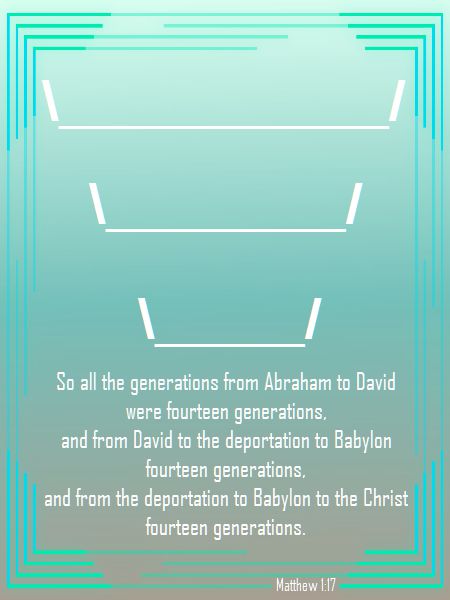
In our Bible Reading Plan we come to Matthew 1-2 today. Don’t hate the genealogy. Don’t skip the genealogy. Since we are told that all scripture is breathed out by God and profitable for teaching, for reproof, for correction, and for training in righteousness, that the man of God may be complete, equipped for every good work, (2 Timothy 3:16-17), it means that the genealogies are also instructive. Here are a couple of thoughts that came to my mind as I read it.

1. Women are mentioned. In a society so patriarchal as to render the women invisible, the feminists say, here are some women added to the holiest of genealogies, the line of Christ.

2. The particular women mentioned by name. In Matthew 1:3, we read: “Judah the father of Perez and Zerah by Tamar” verse 5 has both: “Salmon the father of Boaz by Rahab”, verse “Boaz the father of Obed by Ruth”, and verse 6b has “And David was the father of Solomon by the wife of Uriah”.

These women are outcasts, as John MacArthur’s commentary calls them. Tamar was a Canaanite daughter-in-law of Judah who dressed as a prostitute to trick Judah for various convoluted Old Testament reasons. As the Commentary concludes her story, “God’s grace fell on all three of these undeserving persons, including a desperate and deceptive Gentile harlot.”

Rahab was a Gentile and a professional prostitute. However, she feared God and protected the spies when they came to Jericho. As a result, God rained down grace by including her in the Messianic line, making her the mother of Boaz, King David’s great-grandfather.

Ruth was also a Gentile. She was a Moabite and a former pagan, who had no legal right to marry an Israelite, but God’s grace swept her into the family of Israel and into the Royal line through Boaz and she became David’s grandmother.

3. And David was the father of Solomon by the wife of Uriah. Did you catch that? Bathsheba is mentioned, but not named. That jumped out at me.

Tamar, Rahab, Ruth, and later, Mary are mentioned by name. Not this one. Of course we know she is Bathsheba, who bathed naked on the rooftop under the lascivious eyes of David. Incited, David contrived a way to put Bathsheba’s husband Uriah at the front lines, David committed adultery with Bathsheba, Uriah was killed at the front lines, David took Bathsheba for his wife, and then the son from this illicit union died in infancy. Their second son was Solomon. But God’s grace was sufficient to keep ‘the wife of Uriah’ in the royal line and she became ancestor to the Messiah.

The genealogy of Jesus Christ is immeasurably more than a list of ancient names; it is even more than a list of Jesus’ forebears. It is a beautiful testimony to God’s grace  and to the ministry of His Son, Jesus Christ, the friend of sinners… If He has called sinners by grace to be His forefather,s should we be surprised when He calls them by grace to be his descendants? The King presented here is truly the King of grace! ~John MacArthur

Don’t skip the genealogies. 🙂

generations


matthew 1 verse1

Posted in encouragement, Uncategorized

Today’s Bible Reading thoughts, Psalm 1:3

A verse from our Bible reading for today:

psalm 1 wed verse
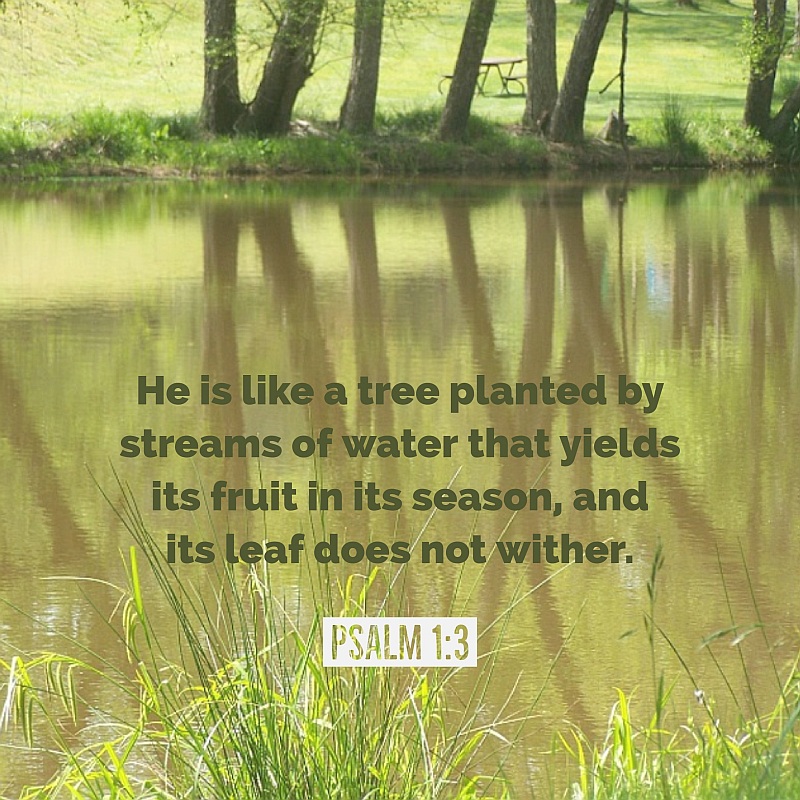
He is like a tree
planted by streams of water
that yields its fruit in its season,
and its leaf does not wither.
(Psalm 1:3)

In the ’90s I traveled a lot. I kept a travel journal most places I traveled to. One adventure was on an ice-breaking ferry/transport ship in Canada. We we started at Rimouski and went all the way along Quebec’s lower North Shore (of the St. Lawrence River) to Blanc Sablon, a city at the border of Labrador. On the early part of the journey when we departed from Sept-Iles, I wrote,

Got up at 5am to see departure. Whales and birds galore. The shore line is interesting, large rocks smoothed over by the tides. Rock ledges poke through the stands of trees lining the shore. How do the trees’ roots grasp in the 2 inches of soil?

I am not agricultural at all, but even a neophyte can muse upon the physics of it. It’s intuitive.

As for what was sown on rocky ground, this is the one who hears the word and immediately receives it with joy, yet he has no root in himself, but endures for a while, and when tribulation or persecution arises on account of the word, immediately he falls away. (Matthew 13:20-21).

That is what made Jesus’ metaphors so excellent.

fallen tree
The verse in the Psalm above refers to the rootedness of a tree that is planted where it can be fed by good soil and good water. Such a tree does not fall away. It bears fruit.

Where does a believer get his rootedness from? By planting him or herself in the Life of Christ, drinking and feeding on His word. By living and growing in obedience and submission to His commands. Those who fall away were never planted in Him to begin with. They had no confidence in Him, in comparison to their own sin and wretchedness. They were only joyful for a time because their consciences were temporarily salved. But unless one is truly repented, that joy will fade at the first hardship and there will be no streams to drink from for nourishment. They fall.

Barnes Notes on the Psalm-

A description of the happiness or prosperity of the man who thus avoids the way of sinners, and who delights in the law of God, now follows. This is presented in the form of a very beautiful image – a tree planted where its roots would have abundance of water.
Planted by the rivers of water – It is not a tree that springs up spontaneously, but one that is set out in a favorable place, and that is cultivated with care.

God cultivates us by the Spirit, but we shepherd our salvation too. Drink deeply from the word, obey and submit with grace without grumbling. Pray earnestly for all things, and praise the One who planted you. May you bear fruit in your time.

psalm 1 wed verse

Posted in encouragement, Uncategorized

A year end thank you for all that Grace To You has done for me

A letter I wrote to GTY regarding thanks for the radio ministry. The ministry means SO MUCH to me.

Dear Grace To You,

I want to take a moment to share how God used John’s radio broadcast in my spiritual life.

I was saved at age 44. Before salvation, I spent my life as all sinners do, for myself, rebelling against God. New England is a dark place, and an adult can go a lifetime and not run into anything Christian, or a Bible, or a preacher. I was ignorant of anything related to Jesus. I was certainly ignorant of my own sin, except for the conscience that pricked me.

me with abby one copy1
Camping in FL. 20 years ago, I didn’t know Jesus.

My husband and I liked to travel and we decided to take a long cross-country camping trip in our pop-up camper. We listened to the radio all along the way. We enjoyed talk radio and searched for programs that would help us pass the time as we drove. As we entered the southern part of the United States, we inevitably came across the radio dial of typical southern preachers with their funny accent and pulpit pounding exposition, yelling “JAY-sus! We’d laugh and tee hee about those silly Jesus people. And then we’d hurriedly change the dial.

Whenever we came across John’s Grace To You broadcast, and the introduction music soon became familiar as his program was on many stations, his voice was different. It was logical, soothing. The content of what he was saying intrigued me, as much as it repulsed me. My conscience was pricked even more. I always lingered a bit, listening. But then my husband would change the dial away from the “Jesus stuff” as we called it, I’d feel both relieved that the spiritual pressure was gone but curious for more, too. I didn’t understand this push-pull.

Five years later, the Lord saved me. The internet offered a wealth of sermons, devotionals, and biblical instruction. But which one to pick? Then one day I heard that music. “I know that music!” I said. I heard John’s voice. “I know that guy!” I said. And now that I was saved, the content of what John was saying made sense. More than that, the content of what he was saying inspired me, illuminated my mind, and soothed me. I quickly devoured sermon after sermon. Having no church baggage to unlearn, John’s sermons went straight into my soul. He taught the Doctrine of Justification, and moved to the Doctrine of Election.

Six years after that, I listened live as John finished preaching through the New Testament. It was a historic moment. Even more personally for me, it was a poignant moment. Before I was even saved, God had used John to spark my conscience as a sinner curiously repulsed by the ‘Jesus stuff’ he was preaching, through to salvation, to growth by the Spirit, to burgeoning maturity and becoming a Titus 3 church woman to the younger ladies. God used John through it all. He is still using John in my spiritual life as I read many of his books and still listen to the wonderful sermons.

chisos mountains
Camping in Texas. One day in the future, I’d hear the GTY music and my mind and soul would light up

God used John to preload me in readiness for the moment I would in His timing, come into the kingdom and begin learning the glories of God. John’s familiar voice, the familiar music, led me by His grace to this solid ministry upon which God laid the foundation of my growth.

Thank you John MacArthur and all of you at Grace To You. I praise God for the men He has raised up.

~~~~~~~~~~~~~~~~~~~~~~~~

But Jesus answered them, “My Father is working until now, and I am working.” (John 5:17)

God is always working in the lives of those who He will eventually call into His kingdom, and continues working in our lives after that, forever and ever.