Posted in encouragement, Uncategorized

A simple reminder about hope

Blessed be the God and Father of our Lord Jesus Christ! According to his great mercy, he has caused us to be born again to a living hope through the resurrection of Jesus Christ from the dead, (1 Peter 1:3)

Well that says a lot! Each phrase is an encouragement. I’m focusing on living hope this morning. Our living hope is not a dead hope. It is not surmise, speculation, or empty ‘what if’. It is a living hope because we are IN Christ and He is living and *He* is our Hope.

Gill’s Commentary says

Saints are both begotten again to the grace of hope, and to the glory which that grace is waiting for”. Our hope is because of Christ, it is in Christ and it is Christ. It is a living hope

hope

Posted in encouragement, Uncategorized

The Pilgrim’s Progress, John Bunyan, and Helpful Resources

Pilgrim's_Progress_2I really love this book. I’ve read it once, picked through it several times, and now I’m listening to Derek Thomas lecture on it at Ligonier.org’s Daily Video. (1st lecture in the series here).
There is a part 2 to Pilgrim’s Progress that Thomas urges us to read, as both parts are meant to be a coherent whole. I had not known that.

Pilgrim’s Progress was written by John Bunyan while he was in prison for 12 years for preaching the Gospel. Wilkipedia has a bio of the man, more at link

John Bunyan (unknown birth date, baptised on November 30, 1628 – August 31, 1688) was an English writer and Puritan preacher best remembered as the author of the Christian allegory The Pilgrim’s Progress. In addition to The Pilgrim’s Progress, Bunyan wrote nearly sixty titles, many of them expanded sermons.

He also penned the world’s first recognized visual theology, the Mapp Shewing Order and Causes of Salvation & Damnation“. Tim Challies updated the Map to modern graphical styles, though let it be said I enjoy the original, with its angels and dragons and soaring language. Challies said of the maps,

In a pair of side-by-side timelines he traced the salvation of the believer (or the elect) and the damnation of the unbeliever (or the reprobate). …

Let me start you with a hint: Begin on the left side and read through circles one to 25 as a big, long sentence. When that’s complete, do the same for the other side. Finally, go back to read the verses and additional information. I think you will find, as I did, that the first sentence is terrible and chilling while the second is beautiful and encouraging. Whatever you do, linger. Bunyan has a lot to teach us through this infographic.

Here’s a link to Bunyan’s original (and IMO, better) map. Bunyan’s spiritual autobiography, Grace Abounding to the Chief of Sinners, is also a wonderful book. You can find a free text version online here. Or here in .pdf form, which you can download and then send to your Kindle via Kindle email attached as a file and it will be installed on your device.

Since Bunyan is so well known for Pilgrim’s Progress, few people know he wrote so many other books.

Anyway back to the book Pilgrim’s Progress. Why is this book important?

Leland Ryken said in a foreword at Desiring God about the 2 books(s) The Pilgrim’s Progress parts 1 & 2,

The book that became known to posterity as The Pilgrim’s Progress is a Christian classic whose importance is impossible to overstate. For more than two centuries after its first publication, The Pilgrim’s Progress ranked just behind the King James Bible as the most important book in evangelical Protestant households. Te book has been translated into some two hundred languages, including eighty in Africa. Any book that has achieved such popularity has a very large claim to our attention. Facts of Publication The Pilgrim’s Progress actually has two publication dates, corresponding to the two books that comprise it. The first book was published in 1678 and bore the title The Pilgrim’s Progress: From This World to That Which Is to Come, Delivered Under the Similitude of a Dream. It tells the story of the spiritual journey of the protagonist named Christian from the City of Destruction to the Celestial City (meaning heaven).

Book II was published six years later as part of an old artistic tradition known as a “companion piece.” It tells the story of the same journey, this time undertaken by Christian’s wife, Christiana, and their four sons.

The hard part for me when reading Pilgrim’s Progress is not the 350-year-old language. Though, if the language presents a difficulty, there are free updated, modern language versions available, both for free online and in hard copy.

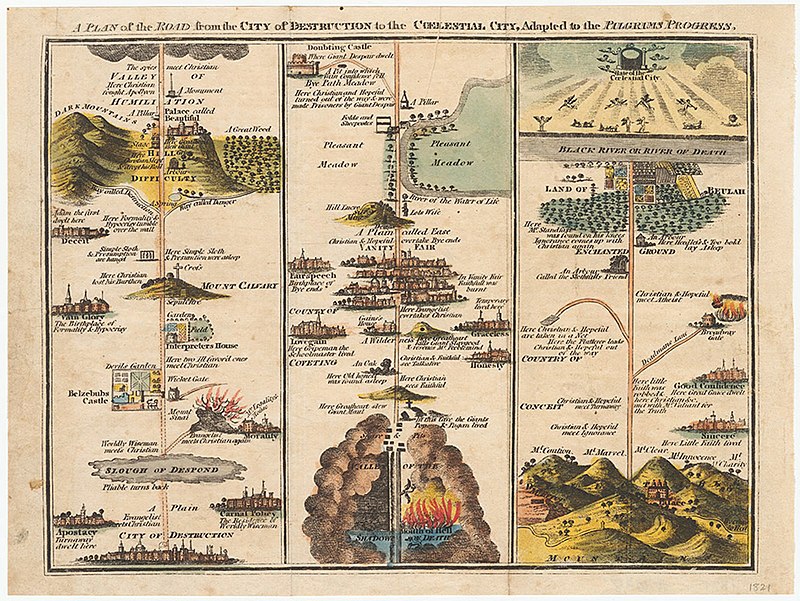
800px-John_Bunyan,_The_Road_From_the_City_of_Destruction_to_the_Celestial_City_1821_Cornell_CUL_PJM_1038_01

A Plan of the Road From the City of Destruction to the Celestial City, Adapted to The Pilgrim’s Progress, 1821. Public Domain

What I find hard is the abstractness of it, because I’m very literal. I do not understand allegory or symbols in literature.

Pilgrim’s Progress is an allegory. An allegory is a literary device. Here is allegory defined

Allegory is a figure of speech in which abstract ideas and principles are described in terms of characters, figures, and events. It can be employed in prose and poetry to tell a story, with a purpose of teaching or explaining an idea or a principle. The objective of its use is to teach some kind of a moral lesson.

Difference Between Allegory and Symbolism
Although an allegory uses symbols, it is different from symbolism. An allegory is a complete narrative that involves characters and events that stand for an abstract idea or event. A symbol, on the other hand, is an object that stands for another object, giving it a particular meaning. Unlike allegory, symbolism does not tell a story.

I enjoyed Ligonier Theologian Derek Thomas in these free 23-minute lectures explaining Pilgrim’s Progress, both parts one and two. I found them extremely helpful in understanding the book. In addition to explaining the allegories and what they (likely) stood for, Thomas folded in Puritan history and culture of Bunyan’s day and set the context for how Bunyan thought and what was happening in his life as he wrote the book. This information gives depth and nuance to understanding it.

The City of Destruction
The Wicket Gate
The Interpreter’s House
The Cross & the Sepulcher
The Hill Difficulty
The Palace Beautiful
The Valley of Humiliation
The Valley of the Shadow of Death
The Godless City: Vanity Fair
The Castle of Giant Despair
The Delectable Mountains
The Celestial City

Another resource for this marvelous book is Notes & Commentary, Guide to Pilgrim’s Progress by Ken Puls.

An additional resource is Mt Zion Chapel Library, Pilgrim’s Progress for Everyone

I hope you enjoy the resources and would consider reading The Pilgrim’s Progress.

Posted in encouragement, Uncategorized

“O that there were a mediator between us!”

For He is not a man as I am that I may answer Him, That we may go to court together. There is no umpire [daysman] between us, Who may lay his hand upon us both. Let Him remove His rod from me, And let not dread of Him terrify me.” (Job 9:32-34).

Job is thought to be one of the oldest written books of the Bible, and its events some of the oldest as well, its events occurring possibly pre-Exodus during the patriarchal age. Possibly 2000BC.

We know Job was a righteous man (Job 1:1, 1:8, Ezekiel 14:14). He abhorred sin. He mediated for his family in priestly functions, He devoted himself to the one True God. He knew Yahweh, and Job knew enough to be terrified.

Job is complaining that though he knows the depravity of his sin, God is so far above man and so terrifying that Job wished there was an arbiter, or an umpire, between them to advocate for him in God’s holy court. Yet who could that be? A mere man might be a good arbiter for Job but no mere man can stand before God. So, who? Who can lay his hand on both man and God?

We know that it was God’s providential plan to send Jesus, the God-Man. The cross is that bridge which re-unites man and God after the dreadful separation that occurred in the Garden. It is Jesus who lays His hand on both man, and God. Amen!

Jesus was fully man, but not an ordinary man. He had to live a sinless life so that His sacrifice at Calvary would be perfect, his blood shedding for man in obedience to God. He did so. He fulfilled it all and it was finished at the cross.

They laid His body in a borrowed tomb. It lay there scarred and wrapped and alone in the dark. Then on resurrection morning, He arose! It is finished, and there He comes, ascending back to glory, having fulfilled ALL.

daysman—“mediator,” or “umpire”; the imposition of whose hand expresses power to adjudicate between the persons. There might be one on a level with Job, the one party; but Job knew of none on a level with the Almighty, the other party (1 Sa 2:25). We Christians know of such a Mediator (not, however, in the sense of umpire on a level with both)—the God-man, Christ Jesus (1 Ti 2:5).

Jamieson, R., Fausset, A. R., & Brown, D. (1997). Commentary Critical and Explanatory on the Whole Bible (Vol. 1, p. 318). Oak Harbor, WA: Logos Research Systems, Inc.

God. Let us not make ourselves equal with God, but always eye him as infinitely above us. [2.] That there was no arbitrator or umpire to adjust the differences between him and God and to determine the controversy (v. 33): Neither is there any days-man between us. This complaint that there was not is in effect a wish that there were, and so the Septuagint reads it: O that there were a mediator between us! Job would gladly refer the matter, but no creature was capable of being a referee, and therefore he must even refer it still to God himself and resolve to acquiesce in his judgment.

Our Lord Jesus is the blessed days-man, who has mediated between heaven and earth, has laid his hand upon us both; to him the Father has committed all judgment, and we must. But this matter was not then brought to so clear a light as it is now by the gospel, which leaves no room for such a complaint as this.

Henry, M. (1994). Matthew Henry’s commentary on the whole Bible: complete and unabridged in one volume (p. 675). Peabody: Hendrickson.

Praise God for His Gospel, His mediator, His plan! Praise God that He resurrected Jesus from the dead, forevermore to be our Savior. For He is no longer in the tomb, He is alive, He is not there, He has risen!

risen easter

Posted in encouragement, Uncategorized

He will not let the Holy One see corruption

Therefore he says also in another psalm, “‘You will not let your Holy One see corruption.'”  (Acts 13:35).

Oh, to think of His precious body, broken, speared, beaten, nailed… wrapped in a shroud and and now laid in a grave!

Chris Powers of Full of Eyes ministry (fullofeyes.com) drew this wonderful illustration today:

Joseph took The Body and wrapped it in a clean linen shroud and laid it in his own new tomb… (Matthew 27:59-60).

I can’t fathom what grief the disciples felt as the death happened and the precious body was brought to Joseph’s tomb…and the rock slid shut. How alone they must have felt! How perplexed and upset. Their lives must have seemed devoid of meaning. After all, Peter said to Jesus when Jesus had asked “Are you going to leave me too?” and Peter uttered his words, “Where would we go? You have the words of life”. Now the Word of life was dead. Or it seemed so. Where would they go? What would give their life meaning, now?

They must grieve for a few more agonizing hours, before all would become clear.

However, the wondrous Father will not let Jesus molder in the tomb. Jesus rose before that could ever happen! Oh, the joy of Sunday!

Our Savior lives!!

Good Friday the most evil day in all of history. Saturday the most grief-stricken day in all of history. Sunday the most joyous day in all of history!

Posted in encouragement, Uncategorized

Praises to God for Spring and Beauty

It’s been a long spring here in north Georgia, but a very cold one. That’s OK, the forsythia, crocuses, robins, dogwood, buds, and grass are all growing pleasantly nonetheless.

I hope this fine spring time has offered you beautiful glimpses of God’s creative intellect and His wonderful power. We always enjoy the march of the seasons. “He appointed the moon for seasons: the sun knoweth his going down.” (Psalm 104:19, KJV). Wherever we are in the world, we see and understand the times and seasons. We look for the robin, the crocus, the ladyslipper. The orderliness and consistency of the seasons since His ordination of them is a comfort. Yet even in Jeremiah 8:7 it is said of the seasons, meaning HIS season, “Yes, the stork in the heaven knows her appointed times; and the turtle and the crane and the swallow observe the time of their coming; but my people know not the judgment of the LORD.”

In the natural history of Israel, Barnes notes explains,

“Jeremiah appeals to the obedience which migratory birds render to the law of their natures. The “stork” arrives about March 21, and after a six weeks’ halt departs for the north of Europe. It takes its flight by day, at a vast height in the air (“in the heaven”). The appearance of the “turtle-dove” is one of the pleasant signs of the approach of spring.”

Spring is a time of renewal, refreshing, and new life. There is a bird who builds a nest in my living room windowsill, and soon enough, babies will come along. They chirp so cute, they grow bigger, and then one day they will be gone, and a strange silence will come over the living room.

Is it wonderful to contemplate that the LORD knows the comings and goings of each bird in the world?

Are not two sparrows sold for a penny? And not one of them will fall to the ground apart from your Father. (Matthew 10:29).

How much more does He care for His own children. How great that He upholds the march of seasons, their orderliness and beauty. The unfurling of a bud, the flowering of a leaf, the business of the insects feasting on the pollen and nectar. How much more should we enjoy His creation, praising Him for all He is and all He does to maintain this beautiful world for His children.


Posted in encouragement, Uncategorized

Imagine the dawn chorus in heaven!

This article was first published on The End Time in September 2012.

I love the pre-dawn. It is quiet and cool and dark but the light is coming, and already is.

I live in an area which is fairly rural, and there is not much traffic. Though I live on a major artery in the county, there isn’t enough traffic even during the day to really bother me. However, in the pre-dawn, there is none at all. I can hear from afar off the dogs bark, cows moo, occasional owl screech, an early rooster…

At about 6 am there is always one bird. From out of the darkness, suddenly, there will be a happy series of chirps. He is loud, and the sound is joyous to me. Not to anthropomorphize too much, but the bird really does sound happy. The piercing, lengthy call sounds like he is waking up his brethren. Perhaps it is an ovenbird.

After the first bird goes first, then in a few moments the dawn chorus begins. The dawn chorus is a worldwide event. At Cornell, they wrote, “The dawn chorus is one of the most conspicuous vocal behaviors of birds, and one of the least understood. Near sunrise, birds often sing more loudly and vigorously than they do at other times of the day.”

I like to think they are thanking their Creator. He knows them, and I like to think they know their Creator back. God says, “I know all the fowls of the mountains: and the wild beasts of the field are mine.” (Psalms 50:11). We know that all creation groaneth in travail until now, (Romans 8:22). They groan…do they sing in joy as well?

Birds suffer for man’s sin, (Genesis 6:7; Jeremiah 12:4; Ezekiel 38:20;Hosea 4:3). The bible says they flee away when calamity comes as well. (Jeremiah 4:25; Jeremiah 9:10)

Yet they sing:

10You make springs gush forth in the valleys;
they flow between the hills;
11 they give drink to every beast of the field;
the wild donkeys quench their thirst.
12 Beside them the birds of the heavens dwell;
they sing among the branches.
13 From your lofty abode you water the mountains;
the earth is satisfied with the fruit of your work. (Psalm 104:10-13)

Imagine the ‘dawn chorus’ in heaven! Birds will sing all the time because there is no dusk and no dawn, only day! (1 John 1:5, Revelation 21:25).

I believe that in heaven when He brings His bride to her place and presents our dwelling place to us, our rooms will not have screens on the windows. Because why would they? No biting insects or animals will creep in and harass us. All creation will be reconciled to its Creator and there will be no reason to have bars or screens to keep things out, or in. Maybe a bird will swoop in to my room and sing in joy at the perfection of the Creator and gladness to be part of it, and I will join. Together we are all groaning now, but the Day will come when we will all sing in joyous praise to the One who made us. Birds too.

In the meantime, I’ll enjoy the first bird each morning, knowing that before the day’s groaning begins, there is joy in creation among the created.

you lookin at me

Posted in encouragement, Uncategorized

Even more than the watchmen of the night!

My soul waits for the Lord more than watchmen for the morning, more than watchmen for the morning. (Psalm 130:6)

In this Psalm, the Psalmist is comparing his wait for the LORD to a watchman in the night. The Psalmist is waiting on the light, or fruition, but it is his very soul waits. For what or for whom? The LORD Himself.

Being a watchman in the deep night is lonely. Time itself seems to drag.

I am witness to the darkness before the dawn myself. I lived on a sailboat with my husband for two years, making sea journeys overnight offshore through day and night and a day and a night. Standing watch through the night, being out in the weather, alone on the sea, makes one desperately appreciate the light. All you do is stand, and watch. You watch the dark, you look at the sky, which is also dark if it’s covered in clouds. One is insignificant against the yawning, grasping dark surrounding you on all sides. You stand, and look, and wait.

The 3:00am watch is dark, cold, and seemingly endless. Time seems to expand into an eternity of nothingness and blackest of black coal. When one glimpses the first glimmer of a change from blackest coal sky to indigo then blue then the pink and golds of sunrise, the heart lifts and one feels that one has emerged from an endless tunnel in which one’s very soul had been swallowed.

This is the allusion the Psalmist is making here in the Psalm. He is watching and waiting for the sunrise of glory to come, eager for it, even more than those watchmen who wait in the night through the deepest dark!

We, sisters, should live in hope of His coming. The greatest burst of light at dawn dispelling the deep black of life here on earth will not compare to His return in glory. Eager expectation should be our attitude. Our very soul to its depths should long for our Groom. Redemption is coming!

sunrise 2 verse

Posted in encouragement, Uncategorized

New mercies every day

The steadfast love of the Lord never ceases;
his mercies never come to an end;
they are new every morning;
great is your faithfulness.
Lamentations 3:22-23

I was thinking about that this morning…as many mornings as there are, the Lord’s mercies are new every day. Any fresh day that comes, His mercies are new to go along with it. Such a sign of His infinity and everlasting-ness. That is so good because I need His mercy every day!

I think of the humble tax collector, But the tax collector, standing far off, would not even lift up his eyes to heaven, but beat his breast, saying, ‘God, be merciful to me, a sinner!’ (Luke 18:13)

Jesus said that man went home justified, as opposed to the Pharisee who pridefully listed all his accomplisments for God. I need to remember the Tax Collector’s humility and position before our Great God.

I’m praising Him for His infinite mercy and the days upon days we as His children are privileged to experience it.

Mercy is at the heart of redemptive ministry. Mercy is to extend to all without regard for race, or status, or gender, or age. And mercy is to be offered patiently toward those who are ignorant in unbelief. And by the way, Micah 7:18, “God delights in mercy.” And He’ll delight in you if you are a merciful Christian. John MacArthur, sermon, A Mission of Mercy

The Trinitarian God of the Father-Son-Holy Spirit is highly exalted. May He be blessed and praised.

Lk18
Source: https://biblia.com/verseoftheday/image/Lk18.13-14
Posted in encouragement, Uncategorized

Still Speaking

Amon, Asherah, Bel, Dagon, Molech, Artemis, Zeus, Ganesh, Mot, Pele, Gok Tengri, Tekkeitsertok, Auseklis…

These are false gods. Every culture from Inuit to Polynesian, European to Mongolian, has created a god of their own making. There are many more false gods than just those few listed.

Yahweh the True and Only God created man and gave him imagination. Sadly, using his God-given imagination, man rejects Yahweh and formulates gods of his own creation. The creature creates gods, how absurd. Yet these gods abound.

These gods do not speak.

The idols of the nations are silver and gold, the work of human hands. They have mouths, but do not speak; they have eyes, but do not see; they have ears, but do not hear, nor is there any breath in their mouths. (Psalm 135:15-17).

They have never spoken, and they never will. These gods do not exist.

God is the only God. He is the only deity who speaks! More than that, He is an involved God. He listens and He hears. See below, the rapidity with which He responds at times!

He was still speaking when, behold, a bright cloud overshadowed them, and a voice from the cloud said, “This is my beloved Son, with whom I am well pleased; listen to him.” (Matthew 17:5).

Mt17

While I was speaking in prayer, the man Gabriel, whom I had seen in the vision at the first, came to me in swift flight at the time of the evening sacrifice. (Daniel 9:21)

While Peter was still speaking these words, the Holy Spirit fell upon all those who were listening to the message. (Acts 10:44).

While the word was in the king’s mouth, a voice came from heaven, saying, ‘King Nebuchadnezzar, to you it is declared: sovereignty has been removed from you, (Daniel 4:31).

It will also come to pass that before they call, I will answer; and while they are still speaking, I will hear. (Isaiah 65:24).

What a great God we have, who is so involved with us. He hears, He listens, and in His timing He even responds while still speaking! While. Still. Speaking.

Our glorious God is involved, compassionate, and interested in His people. Praise Him in thanks.

Posted in encouragement, Uncategorized

Don’t leave the Baby in the manger or the Man on the cross

When Christmas comes around, everyone loves the thought of the baby in the manger. The story is so precious, and the swaddling cloths, and the animals milling around, and the Shepherds who came to see…

So cute!

But not cute.

This Grace To You essay brings the point home.

What do you think about when you see a nativity scene? We might recognize the baby in the manger as God in flesh. But seeing Christ as a helpless and vulnerable infant can delude us into thinking that the humility of the incarnation was not isolated to His physical form—that somehow, His deity was also diminished.
And it’s easy to read the birth narratives in the gospel accounts without gaining a full sense of Christ’s eternal glory and supremacy. Those attributes figure more prominently at the end of His earthly sojourn rather than the beginning.

Where can we see that glory and supremacy? Is it on the cross? The Man-God hung on that tree, He was perfect in every way yet absorbing all God’s wrath for sin, separated from His eternal father for agonizing hours. He was the suffering servant, bleeding and wounded and humble, and scorned and rejected. He hung there…

But He is not still there.

We look to Jesus when we want to praise or seek comfort, and we often think of the cross. The cross is the symbol of death, new life, eternity. We respect the cross as the execution method of what Jesus suffered for us in obedience to the Father. The cross is everything to us, but it is not all.

Because Jesus rose.

So the bloody, unrecognizable fleshly Man is not still on the cross. He is in heaven, robed majestically, at the right hand of the Father, ministering as KING OF THE UNIVERSE!

12Then I turned to see the voice that was speaking to me, and on turning I saw seven golden lampstands, 13and in the midst of the lampstands one like a son of man, clothed with a long robe and with a golden sash around his chest. 14The hairs of his head were white, like white wool, like snow. His eyes were like a flame of fire, 15his feet were like burnished bronze, refined in a furnace, and his voice was like the roar of many waters. 16In his right hand he held seven stars, from his mouth came a sharp two-edged sword, and his face was like the sun shining in full strength. (Revelation 1:12-16)

Don’t leave the baby in the manger or the man upon the cross. When you think of Jesus daily, remember Him as He is now.

cloud