Posted in encouragement, theology

God will take care of us

By Elizabeth Prata

I spent a lot of time outside yesterday watching the birds. There is an Eastern Phoebe nest under the awning at the patio, a Carolina wren nest in the underhang, and another wren nest at the other side of the lawn in the big birdhouse.

I watched the mom of that one go back and forth incessantly, bringing food to her babies. I’d hear the baby’s racket inside the birdhouse and I’d know that the mom was back with another bug. She always swooped around looking for a tasty insect and was never disappointed. She always had enough to feed her babies.

providence

The mama would fly off, and soon return with a bug, but not fly directly to the birdhouse. She would pause in a nearby branch, presumably to ensure that no predators were nearby. Then she’d quickly light on the birdhouse. I wanted to snap a photo of this process. I soon learned I did not have to keep my eyes glued to the birdhouse because when the mom landed, the inside of the house would erupt with chirps, lol. and I’d hear the racket. Chirp! Chirp! Chirp!

The Lord takes care of them. They have food. Jesus was hungry often, (Mark 11:12, Mt 12:1), but God feeds the birds. Jesus had no place to lay His head but the birds have a nest.

And Jesus said to him, “Foxes have holes, and birds of the air have nests, but the Son of Man has nowhere to lay his head.” (Matthew 8:20).

How He takes care of us! Not only meeting our physical needs but interceding for us in heaven and in prayer! We are so blessed to have been given the grace to repent. And being in Him, we are secure in knowledge that He will provide what He knows we need.

flower
God clothes the grass with wildflowers

26 Look at the birds of the air: they neither sow nor reap nor gather into barns, and yet your heavenly Father feeds them. Are you not of more value than they? 27 And which of you by being anxious can add a single hour to his span of life? 28 And why are you anxious about clothing? Consider the lilies of the field, how they grow: they neither toil nor spin, 29 yet I tell you, even Solomon in all his glory was not arrayed like one of these. 30 But if God so clothes the grass of the field, which today is alive and tomorrow is thrown into the oven, will he not much more clothe you, O you of little faith? 31 Therefore do not be anxious, saying, ‘What shall we eat?’ or ‘What shall we drink?’ or ‘What shall we wear?’ 32 For the Gentiles seek after all these things, and your heavenly Father knows that you need them all. 33 But seek first the kingdom of God and his righteousness, and all these things will be added to you.

34 “Therefore do not be anxious about tomorrow, for tomorrow will be anxious for itself. Sufficient for the day is its own trouble. (Matthew 6:26-34)

yellow bird

Posted in encouragement, theology

The Power of Positive Communication, plus an extra for free

By Elizabeth Prata

When I was a Newspaper Editor/Publisher, I wrote an editorial every week. An Editorial is the Editor’s thoughts on some civic event or issue reported on in the paper. The Editorial gives readers a personal perspective about the issue that the Editor feels is of relevance to the community. It is an opinion about the issue as opposed to the factual reporting on the issue.

Long ago, I wrote an editorial about the Town Council and Town Committees. Continue reading “The Power of Positive Communication, plus an extra for free”

Posted in encouragement, theology

His word is flawless

By Elizabeth Prata

Every word of God is flawless; He is a shield to those who take refuge in Him. (Proverbs 30:5)

I look around my apartment, nothing is flawless. The house has settled and the kitchen cabinets are a little crooked. The dining table has a crack. Even my new book has a typo. The kitty bed has uneven seams. Nothing in this life is flawless. Flawless means perfect. Is there anything here perfect? No. Continue reading “His word is flawless”

Posted in encouragement, theology

Spurgeon’s Psalm 75 encouragement: The Terrible Commotion

By Elizabeth Prata

Encouragement from Charles Spurgeon from the Psalms. This is Psalm 75:1-3,

We give thanks to you, O God;
we give thanks, for your name is near.
We recount your wondrous deeds.

“At the set time that I appoint
I will judge with equity.
When the earth totters, and all its inhabitants,
it is I who keep steady its pillars.” Selah Continue reading “Spurgeon’s Psalm 75 encouragement: The Terrible Commotion”

Posted in encouragement, theology

A grateful heart will remain unshaken

By Elizabeth Prata

gratitude verse 4

Where I stand as this lockdown continues: I stand on the Rock of all creation, because the mercy of Jesus has saved me. Gratitude fills my heart and my life with the blessings He has delivered to me, first fruit of which is that precious salvation. He Who is the fount from which all beneficence flows, in His mercy accepted my piteous cries for forgiveness and smiled upon my soul, bringing light and peace. Continue reading “A grateful heart will remain unshaken”

Posted in encouragement, theology

Spiritually thriving amid the biggest spectacle of all

By Elizabeth Prata

blog
Everything feels like an off-kilter carnival

We love spectacles.

As a kid growing up, the thing to do was pile into some relative’s car (the one who had the hugest station wagon), throw a bunch of sleeping bags and blankets in the back, a bunch of cousins too, and head to the Drive-In. The Drive-In was an outdoor theater where you pull up in your car next to a pole with a speaker on it, clip the speaker to the half open car window and enjoy a movie on a 50′ screen. There was a snack shack centrally located to get your popcorn and Coke, and rest rooms somewhere out there too. The steam from all our breathing fogged up the windows and mosquitoes infested the car inside. Since the summer’s late sunset meant the movie had to start late, we usually fell asleep. But the novelty was the screen. It was huge! What a spectacle that was! Continue reading “Spiritually thriving amid the biggest spectacle of all”

Posted in encouragement, theology

Grace IS Amazing

By Elizabeth Prata

palm sunday

My favorite doctrines are Grace, followed by Providence.

Grace that is extended by our loving God is shocking and amazing and wonderful. I was saved later in life and I remember what it felt like to live a sinful life in rebellion against God. It was confusing and upsetting, most of the time.

I read a lot, and enjoyed historical books and the world’s myths. As I read books, all the world’s made-up gods were capricious or unloving or dismissive of humans. That seemed right to me. Even when I read of the Founding Fathers and learned about their deism, that god also seemed right to me. The deist god created everything – including humans – but then retreated from humankind’s affairs and let us wind down of our own accord.

Grace given by a loving God was foreign to me and unthinkable. Because that would mean He was involved with humans, lovingly. Weird.

But that and only that God is the one true God.

He came in the form of a baby who grew to be a man-God, teaching and loving and performing miracles. He died for our sins and absorbed the wrath of God on our behalf.

Amazing Grace! how sweet the sound
It was not a sweet sound to me then, but it is now.

That saved a wretch like me
I used to close my mouth if I happened to be at a Church service, like at Christmas, and this hymn came on. I wasn’t a wretch!, I’d utter. And close my mouth, refusing to say the lyrics.

I once was lost, but now am found
I didn’t know I was lost and I didn’t know I needed to be found.

Was blind but now I see
I didn’t know I was blind. Revelation 3:17 applies here:
For you say, I am rich, I have prospered, and I need nothing, not realizing that you are wretched, pitiable, poor, blind, and naked.

That the Lord of All would stoop to save a wretch like me, covered in mud and dwelling with the pigs, like the Prodigal, is amazing. That He would walk into Jerusalem, knowing the cries of Hosannah! would turn bloody and hateful a week later. That He went toward his kangaroo trials, his scourging, and his death, even death upon a cross, to save filthy sinners, is amazing. What grace!

Thank you Lord, for your grace!! How wonderful that even when we’ve been there 10,000 years, we’ve no less days to sing God’s praise than when we first begun. An eternity praising You is not enough, but what grace that I am able to do so in the first place.

Was blind but now I see…

Not by works of righteousness which we have done, but according to his mercy he saved us, by the washing of regeneration, and renewing of the Holy Ghost; Which he shed on us abundantly through Jesus Christ our Saviour; That being justified by his grace, we should be made heirs according to the hope of eternal life. (Titus 3:5-7)

Posted in encouragement, theology

Psalm 8 encouragement

By Elizabeth Prata*

I’m very grateful to Jesus for all He does for me, undeserving as I am. The more I read His word, pray, and watch the Spirit’s work in me and the world, the more I am in awe of His holy Being. And David’s question is a good one. I ask it too, “what is man that you are mindful of him, and the son of man that you care for him?” Indeed?! Who am I? Yet He saves us, provides for us, teaches us, loves us, and so much more, despite our faltering and ridiculous fumbles. O Lord, you are loving! How wonderful will be the day when all will know your majestic name in all the earth!

LORD, our Lord,

how majestic is your name in all the earth!

You have set your glory above the heavens.

Out of the mouth of babies and infants,

you have established strength because of your foes,

to still the enemy and the avenger.

When I look at your heavens, the work of your fingers,

the moon and the stars, which you have set in place,

what is man that you are mindful of him,

and the son of man that you care for him?

Yet you have made him a little lower than the heavenly beings

and crowned him with glory and honor.

You have given him dominion over the works of your hands;

you have put all things under his feet,

all sheep and oxen,

and also the beasts of the field,

the birds of the heavens, and the fish of the sea,

whatever passes along the paths of the seas.

O LORD, our Lord,

how majestic is your name in all the earth!

Psalm 8

*This essay first appeared on The End Time in June 2012

Posted in encouragement, theology

Helpful Christian resources on anxiety & depression

By Elizabeth Prata

How are you coping, my sisters? This is going on a while longer than we would like or hope, right? We received word yesterday from our Governor here in Georgia that school is closed for the rest of the year. Many people had an emotional reaction to that news, including me, so I wrote the essay The Grief of an Unsaid Goodbye, and then escaped to my bed for the night.

I am reminded of Elijah, one moment victorious and bold, the next, running in fear and depressed,  laying down to die. Continue reading “Helpful Christian resources on anxiety & depression”

Posted in encouragement, theology

Tips for reading the Old Testament

By Elizabeth Prata

The extra time at home for many of us during this pandemic quarantine period is allowing for a more stress free, mind uncluttered, time to read the Bible. You night be venturing into uncharted waters, trying some of the books of the Old Testament for the first time. If you are, good for you! The foundations set in Genesis 1-11 are thrilling. The ‘severe compassion’ seen in Nahum is incredible, and who doesn’t love that big fish story of Jonah?

But admittedly, there are books of the Old Testament that are difficult to read for a variety of reasons. The constant woes and judgments of Jeremiah are emotionally hard to take. They were for Jeremiah, who cried fountains of tears until his eyes could produce no more, and then he wrote Lamentations! The prophetical denseness of Obadiah or Daniel are hard to follow, or the history of various nations and their old names in Chronicles makes for a lot of looking up in the atlas.

The Old Testament is filled with books of various genres. Though the Bible is one book, it contains many different genres of writing styles. There are books of prophecy, poetry, history, wisdom literature, and Law. If you’ve ever read the novel Moby-Dick, you know that that book contains switches from one genre to another. The Old Testament (and the New) are like that. So when you read an OT book of poetry like the Psalms there will be more imagery, a prophetical book will have more  symbolism. History is straight history, though sometimes the timeline jumps around. You have to prepare your mind to read differently in different books. More on that below.

The Old Testament overview: (source Ligonier)

Genesis (the history of Creation, the fall, and God’s covenantal dealings with the patriarchs)
Exodus (the history of Israel’s liberation and formation as a nation)
Joshua (the history of the military conquest of the Promised Land)
Judges (Israel’s transition from a tribal federation to a monarchy)
1 Samuel (Israel’s emerging monarchy under Saul and David)
2 Samuel (David’s reign)
1 Kings (Solomon and the divided kingdom)
2 Kings (the fall of Israel)
Ezra (the Israelites’ return from exile)
Nehemiah (the restoration of Jerusalem)
Amos and Hosea (examples of minor prophets)
Jeremiah (an example of a major prophet)
Ecclesiastes (Wisdom Literature)
Psalms and Proverbs (Hebrew poetry)

Here are the OT books divided by genre. This split-up is generally accepted. The Major vs. Minor prophets are not due to importance, but length.
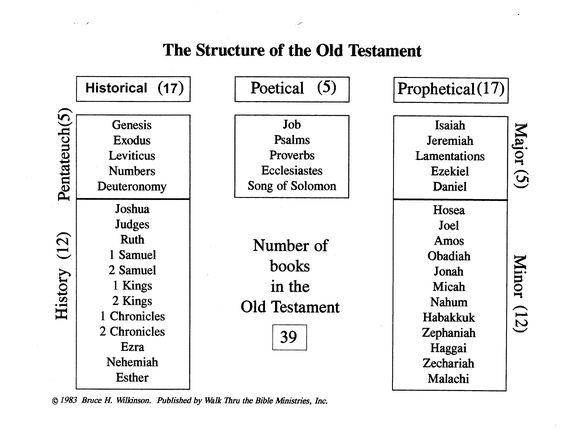
books

Why is reading the Old Testament hard(er)?

First, because many churches today don’t preach from it. Congregants aren’t familiar with it.

Why does unfamiliarity of the text matter?

Ah, here’s where I explain about the mind and its ability to receive new genres or new types of information. It’s not your imagination and it’s not your lack of mental ability that sometimes people find reading the Old Testament a bit harder than the New. If you’ve ever tried to read a non-fiction book on a new subject, and you’re reading along and understanding the words themselves but can’t figure out the topic? Like, if you’ve picked up a biology book or a natural history book and you can parse each word but nothing is making sense overall?

It’s because we don’t have prior knowledge. Prior knowledge refers to all the knowledge of the world we have so far, cataloged in our memories.

Picture your brain like a bank of file cabinets. When you absorb something, your brain puts it in the file cabinet set up for that topic. There, the information you’ve just absorbed connects to information that’s already there. It’s like a ball of velcro floating through your brain, coming to settle and attach to other velcro balls in that file cabinet.

Comprehension, or understanding a text, involves constructing a relationship between what we already know about a topic and what is in the text. So your understanding, or comprehension, of a topic grows as you add more velcro balls to it. Picture a model of a molecule:

molecule

So comprehension involves drawing on prior knowledge, linking the new knowledge to the known, and classifying and organizing your new information.

Several things impact your ability to process new information. One is called concept density. When as a first or second grader and you read a lot of fiction books, there was a rhythm to it that you were familiar with. It began with once upon a time, introduced characters, presented a problem, worked through the problem, and resolved, usually with ‘happily ever after’ or some familiar ending. Reading fiction was like putting on an old blanket.

When you transitioned in 3rd grade to reading non-fiction, the rhythm, or schema, changed. There was no rhythm! Instead, you were given a lot of concepts right away, with no context. Something like, the subject of the Explorers in social studies, Magellan, Columbus, Drake, de Gama, Hudson, Vespucci…all at once and in short order. It was concept dense. Reading unfamiliar, concept dense texts is like wearing a hair shirt!

Add to that you were given lots of new vocabulary, all at once. Circumnavigate, passage, voyage, navigate, expedition, maroon, fleet, scurvy… phew. It’s a lot. With all the new information and all the unknown vocabulary, you have nothing to ‘hang your hat’ on so to speak. All this new information is floating in your brain as a velcro ball but it has no place to attach.

Talking about vocabulary and concept density, how about this example:

“There’s a bear in a plain wrapper doing flip-flops around the 77 and passing out green stamps.”

You likely know each word in that sentence individually, but as a whole? It doesn’t make sense. You understand how to read it mechanically but you can’t create meaning out of it unless you have prior knowledge of CB radios (concept) and trucker lingo (vocab).

That sentence means that there is a policeman in a plain car on Rt 77 driving up and down passing out tickets.

So is there hope for reading the Old Testament? Or the New, if you’re completely new to Christianity? Yes and for one huge reason.

The Holy Spirit. It’s His ministry of Illuminating the Bible to our minds. Here is the definition of illumination. (Please read this great article for what illumination is, and is not.)

Illumination is that ministry of the Holy Spirit whereby He develops in the believer a clearer understanding of, a stronger certainty in, a deeper love for, and a greater obedience to the meaning of the text of Scripture. Source

The Holy Spirit makes the Bible clear to us. Not perfectly, and it’s hard work, but the LORD didn’t inspire the scriptures and then trick us by making it too hard to understand. Mary was a young teenaged peasant girl who understood the Old Testament’s presentation of us as sinners and her need for a coming savior. (Luke 1:46).

The Reformers rebutted the Roman Catholic’s assertion that lay people couldn’t understand the Bible, saying “the Bible was clear enough for all believers to study and understand (the doctrine of the perspicuity of Scripture), and that the Holy Spirit was given equally to all who are born of God (the doctrine of the priesthood of all believers”). source.

There are two new vocabulary words for new concepts for you: Illumination and Perspicuity.

Here is an example of John the revelator attempting to put into words something completely new, in relating what he was seeing in the  apocalyptic vision in the Book of Revelation. In this first set he makes a direct comparison that readers will understand because they can connect the new to the known. We all know what trumpets, furnaces, and emeralds are like:

a loud voice like a trumpet
The hair of His head was white like wool, as white as snow
His eyes were like a blazing fire
His feet were like polished bronze refined in a furnace
His voice was like the roar of many waters.
His face was like the sun shining at its brightest.
The One seated there looked like jasper and carnelian
a rainbow that gleamed like an emerald encircled the throne

In this second set, he tries to make a direct comparison but struggles, saying instead ‘something like’ because what he was trying to comprehend was SO out of the realm. Still, connecting the new to the known is possible, even with things in the Bible that are nearly incomprehensible:

And before the throne was something like a sea of glass, as clear as crystal
And I heard what sounded like a voice from among the four living creatures, saying…
something like a great mountain burning with fire was thrown into the sea.
And the locusts looked like horses prepared for battle, with something like crowns of gold on their heads
And I saw something like a sea of glass mixed with fire

Tips:

What you can do is, read the Old Testament! Pray before you begin, for help from the illuminating ministry of the Holy Spirit. Then just read. If you don’t understand, that is OK. If you ever lived or adventured where there is a lot of snow, you know the first time you walk through thigh-high snow it’s hard. You’re cutting the trail. The second time you benefit from the broken trail and it is easier.

That’s how it is with reading unfamiliar texts. You have to start somewhere, sometime. Cut the path. The things you don’t understand the first time you will gain a bit more clarity on the second, and so on. The more you tread the path, the more you will find your non-comprehension turning to comprehension.

Reading the Old Testament or even the New Testament is hard. It takes work. The Holy Spirit’s illuminating ministry doesn’t drop huge swathes of clarity to your mind as we sit there and go ‘Ohmmm’. We participate in our relationship with Christ by being diligent and studying the scriptures. Even Peter said there are things in the scriptures that are hard to understand. (2 Peter 3:16.) We won’t attain perfection but the sanctification process drives us ever forward in weaving a tapestry of understanding.

What to read? I’d suggest starting with Ruth or Jonah. Both are short and straightforward. Neither require a lot of knowledge of of history. Jonah can be paired with Nahum, which is the second part of the prophecy of Jonah, or, ‘what happened after’. If you read Ruth and the first 11 chapters of Luke you may see the similarities of the types being presented. Pairing some books is one way of connecting new to the known.

The entire Bible is inspired for our education, correction, and advancement of sanctification. All of it is profitable. (2 Timothy 3:16-17). So, go for it! Just read, plunge in and wade in the waters of truth and refreshment!