Posted in discernment, Uncategorized

Discernment lesson: how secular writers of Biblical material manipulate your emotions

Filmmakers are always looking for fodder to make their productions and of late they have discovered the narratives in the Bible. Since the people writing and producing these movies and shows are not saved, of course they get it wrong. This is because In their case the god of this world has blinded the minds of the unbelievers, to keep them from seeing the light of the gospel of the glory of Christ, who is the image of God. (2 Corinthians 4:4).

In the recent series The Bible, there came a moment when Shadrach, Meshach, and Abednego were faced with a decision. Would they bow to a false god statue, or would they stand for Yahweh, thus losing their lives (as Nebuchadnezzar had aid those who disobey his decree to bow will die, Daniel 3:6).

It’s a dramatic moment when you see it in full visual force. Look, here is the clip:

It is not so dramatic when you hear it though. First, read what the men really said, from the real Bible. It is all from Daniel 3. That’s the first part of the lesson- always compare to scripture.

Shadrach, Meshach, and Abednego answered and said to the king, “O Nebuchadnezzar, we have no need to answer you in this matter. 17If this be so, our God whom we serve is able to deliver us from the burning fiery furnace, and he will deliver us out of your hand, O king. 18But if not, be it known to you, O king, that we will not serve your gods or worship the golden image that you have set up.”

The pagan man always seeks to elevate man and diminish God. See how the writers put very different words in the mouths of the three men when they answered to King Nebuchadnezzar.

[Azariah] With all our hearts we follow you. We seek your presence. With all my heart I follow you. I fear you. I seek your presence. Lord hear my cry, though death entangle me, though the anguish of the grave consumes me, do not ignore my tears, I’m overcome by sorrow. I call upon the name of the Lord. Lord save me! Hear my prayer, oh Lord. Hear my cry.

The prayer of the men were self-centered, not God centered. There is a big difference between ‘I will not serve your gods’ and ‘Lord, I seek your presence!’ In the Bible the men accepted the consequence of their fate, because as long as glory was being given to honor God they were satisfied. The TV show could not be more opposite to the actual statement the men made in the real Bible.  That’s the second part of the lesson. Once you compare what you’ve read or heard to scripture, test  it to see if it gives glory to God only and aligns with His character.

God decided to manifest a miracle in the fire and He saved the men. In the TV show, since the men had prayed to be saved, when they were saved, it looked like it was their own prayer that saved them rather than the sovereignty and power of God.

In the TV show, when the men were delivered from the fire, they emerged declaring “God is with us! People of Judah, rise!” Again, ‘me’-centered.

In the real Bible, honor to God in the highest was given by Nebuchadnezzar.

The hair of their heads was not singed, their cloaks were not harmed, and no smell of fire had come upon them. 28 Nebuchadnezzar answered and said, “Blessed be the God of Shadrach, Meshach, and Abednego, who has sent his angel and delivered his servants, who trusted in him, and set aside[f] the king’s command, and yielded up their bodies rather than serve and worship any god except their own God. 29 Therefore I make a decree: Any people, nation, or language that speaks anything against the God of Shadrach, Meshach, and Abednego shall be torn limb from limb, and their houses laid in ruins, for there is no other god who is able to rescue in this way.” (Daniel 3:27b-29)

I mention this because the scene where the men do not bow, and the scene where the men are delivered in the furnace are well done and moving. In between, though, when the people speak, it is not with Bible words and a humble God-centeredness.

The point here is, do not let emotion cloud your judgment when you absorb non-biblical material. You will most likely be emotionally manipulated when you read a book written by a non-Christian, (The Shack was well done and emotionally engaging for the first 70 pages) or a movie. The scenes in The Bible are moving and close enough to the Bible, but close enough is not good enough. Be wary of letting emotion override the truth with any material you watch or read. Besides, the real word of God is emotional enough!

Posted in discernment, Uncategorized

God’s sovereignty in providence: Esther and Jael

God is sovereign of the entire universe. He plans what he plans and He does what he pleases.

Our God is in the heavens; he does all that he pleases. (Psalm 115:3).

It’s admittedly hard to understand how God can and does orchestrate all events at once, constantly, over the earth and throughout the stars, so that His plans providentially combine in perfect harmony to enact His will. But He is God and we’re not supposed to understand it! It is also hard to understand how our personal decisions are still personal but also are part of His will and plan and the outcome is predetermined. That our decisions are our own yet are part of a pre-ordained plan that all leads to the cross and beyond is a tension our finite minds can’t comprehend. It is a joy to ponder them though, because in so doing, we come up against God’s power, omniscience, and will.

Here are two things to consider when looking at God’s providence and will, with our decisions and will.

Esther

The book of Esther was not written by Esther but it is about Esther, her Hebrew name was Hadassah. She lived during the time of King Ahasuerus of Persia, also known as King Xerxes. Through a series of providential events, Esther wound up as Queen to Ahasuerus and also was put in a position to save her people. However the saving of her people was at dire risk to her own life. She was discussing what to do with her uncle Mordecai, and Mordecai famously said,

“For if you keep silent at this time, relief and deliverance will rise for the Jews from another place, but you and your father’s house will perish. And who knows whether you have not come to the kingdom for such a time as this?” (Esther 4:14).

Esther could make her own decision. She could risk her life and go in to the King, or she could stay in the harem and not go to the King. Mordecai knew God’s character well enough to know that His promise to keep a remnant of His people alive would indeed happen, whether Esther decided to participate at this particular moment or not. God would keep His promise no matter what Esther decided. The choice was hers. Esther decided to go in and speak to the King even though he had not called for her (usually this meant death). We know the rest, Esther’s action revealed to the King the evil deeds of Haman and Haman was killed instead of the Jews.

Jael

Jael was the wife of Heber the Kenite. Sisera had been cruelly oppressing the Hebrews for 20 years. The people cried out. Deborah was civic leader at that time, prophesying and judging. She sent for Barak, the military leader and told him to go take care of the problem. Barak could freely decide what to do. He could go or he could not go, the choice was his. He said he would not go unless Deborah came with him. (Judges 4:8). His answer was in effect, no. Deborah replied that she would go with Barak, but it would be an embarrassment to him because God would deliver Sisera into the hands of a woman, and Barak would not get the military glory for the victory.

Barak freely made his choice, but now the outcome would occur from another quarter, just as Mordecai had said it would if Esther decided against her action.

Into the story enters Jael. After Barak routed Sisera’s army, Sisera fled. Sisera aimed toward the tent of Heber the Kenite. Sisera knew there was peace between Jabin the king of Hazor (Sisera’s King) and the house of Heber the Kenite. Heber had separated from the Kenites and was settled far from the action. Sisera ran, believing he was safe to go toward the area where there was no fighting and where there was peace between the parties. Normally he would be right, especially since hospitality customs were so strong in protecting those who are invited into the tent. However in this providential case, Sisera was wrong. Jael invited Sisera into the tent, gave him drink, and covered him as he fell asleep.

Note that Sisera fell asleep. He had a hard day of fighting, but even though his life was in peril he felt comfortable enough where he let down his guard and fall asleep. Women in those days were responsible for pitching the tents and so Jael was strong enough and familiar enough with how to efficiently hammer a tent peg into the ground. As Sisera slept, she drove a tent peg into his temple and pinned his head to the ground. The verse succinctly states, “So he died.” (Judges 4:21b).

And behold, as Barak was pursuing Sisera, Jael went out to meet him and said to him, “Come, and I will show you the man whom you are seeking.” So he went in to her tent, and there lay Sisera dead, with the tent peg in his temple. 23So on that day God subdued Jabin the king of Canaan before the people of Israel
. (Judges 4:22-23).

Barak had kind of said “I will go” but not really. Placing conditions on your obedience isn’t really obedience to God. I like how the verse says God subdued Jabin.

Whether Esther went in or didn’t go in, God would deliver the Jews from Haman. Whether Barak went to battle or didn’t go to battle, God would deliver the Jews from King Jabin and Commander Sisera. Both Esther and Barak freely decided on a course of action. Yet both outcomes occurred at the providential hand of God.

God is amazing.

Anonymous.
Jael and Sisera
pen drawing  — c. 1440 – 1450
Museum Herzog Anton Ulrich Museum, Braunschweig. The name of the drafter is not known. He is thought to be someone close to Van Eyck and his workshop. Source: Art and the Bible

Posted in discernment, Uncategorized

The Herd Mentality v. Self-Control

My grandparents were born in around 1900. The emigrated to the US in their 20s and soon after had accumulated enough money to buy a car. They liked to drive. However they were not so great with directions. When my grandfather didn’t know in what direction to go, my grandmother would helpfully advise, “Follow him. He looks like he knows where he’s going.”

Have you heard of the phrase, ‘herd mentality’? Wikipedia explains it,

Herd mentality, or mob mentality, describes how people are influenced by their peers to adopt certain behaviors.

Or this definition from The Royal Society-

Herding can be defined as the phenomenon of individuals deciding to follow others and imitating group behaviours rather than deciding independently and atomistically on the basis of their own, private information. Article- Herding, social influence and economic decision-making

We see the follow-the-crowd mentality in stock markets and even in home design trends.

Sociologists researched this phenomenon at Leeds University.

Researchers at Leeds University performed a group experiments where volunteers were told to randomly walk around a large hall without talking to each other. A select few were then given more detailed instructions on where to walk. The scientists discovered that people end up blindly following one or two instructed people who appear to know where they’re going. The results of this experiments showed that it only takes 5% of confident looking and instructed people to influence the direction of the 95% of people in the crowd and the 200 volunteers did this without even realizing it. (Source)

Herd mentality is real. Following a crowd in home decor trends is not a dangerous activity, but other follow-the-crowd activities are.

Parents often worry about their teenager falling in with the wrong crowd. That’s because they know how impressionable youths can be and how easily they can be led to certain behavior through peer pressure. It’s one reason I object so strongly to the exclusion of parents or other adults from the youth-oriented Passion conferences. This is a conference where tens of thousands of youths congregate for allegedly spiritual purposes, to receive instruction, and to engage in social justice activities. This last is helped along by the organizers having stationed many ATMs throughout the venue so the youths will donate money to social justice causes. And they do. Of course, donating to charities is not bad, but arming teenagers with credit cards, separating them from their parents, and inoculating them with incessant sermons preaching about donating to social causes, means it’s easy to induce the desired behavior from your captive subjects.

However, the herd mentality phenomenon is not restricted to youths, as the example above from Leeds University shows. Here is an example from the Bible which shows, in my opinion, just how easily led the heart and mind can be. In this example, we see how easily adults can fall prey to blindly following a crowd.

So the city was filled with the confusion, and they rushed together into the theater, dragging with them Gaius and Aristarchus, Macedonians who were Paul’s companions in travel. 30But when Paul wished to go in among the crowd, the disciples would not let him. 31And even some of the Asiarchs, who were friends of his, sent to him and were urging him not to venture into the theater. 32Now some cried out one thing, some another, for the assembly was in confusion, and most of them did not know why they had come together.  (Acts 19:29-32).

The scene is Ephesus, and Paul is preaching. Ephesus was a wealthy city with numerous guilds such as coppersmiths and silversmiths. The smiths were engaged in a monetarily healthy trade in making false idols to the local deity, Artemis. Demetrius, a silversmith, had quickly seen the effect Paul’s preaching had had on the city’s new converts. They no longer bought idols of silver, and his income was affected. This could not stand. Demetrius incited a riot. The city-folk streamed into the amphitheater.

One reason I love the scriptures the way they are written is the Holy Spirit-inspired details. If you read the entire passage in context, It’s pretty dramatic. The scene is vivid. Picture any B-movie from the 1950s where the villagers are storming the castle with pitchforks. The crowd is unruly, loud,angry, and dangerous. They were also intent on making their point and the adrenaline rush of fury and tumult carried them along. But then you see the few words at the tail end of verse 32, lol.

most of them did not know why they had come together

MOST of them
did NOT know why
they were THERE

Not a few of them, not that some of them, MOST of the people did NOT know why they were headed up the hill and sitting at the local colosseum yelling their heads off.

I’m reminded of this past week’s Women March on Washington where thousands of feminists streamed to the capitol to demand nebulous ‘rights’. However, when Christian reporters and theologians who were there interviewed several women and asked them why they came, the women didn’t know. It reminded me of the riot in Ephesus all over again.

If you read to verse 34, it says But when they recognized that he was a Jew, for about two hours they all cried out with one voice, “Great is Artemis of the Ephesians!”

I’m sure you’ve ever been to a high school pep rally or a sports event. The crowd stomps the bleachers and sings ‘We will rock you’, we are the champions’ etc. We have Queen to thank for his everlasting rally cry. Listen, if you will, to the first 35 seconds or so.

I avoid loud gatherings as an adult, but in high school pep rally assemblies were compulsory. I vividly remember the reverberations of the bleachers, the stomping, how quickly the first stomp grew to a unified sound that morphed into the song. It went on for a while, maybe a few minutes. But it didn’t last long. It’s hard for a crowd to remain vigorous in its unified efforts and soon the effort fall apart into distinct voices and scattered stomps, then ended.

In Ephesus, they cried out with one voice for two hours. Just imagine if the entire football stadium was singing ‘We will rock you’ for two hours, solid.

We see another mob mentality moment in Genesis 19:4-11. The scene is Sodom and the place is Lot’s house. The mob surrounded the house where the two angels dwelt and pressed so hard against the door that the angels struck them blind, but they still groped for the door.

Imagine the scene just prior to this, though. The news that two handsome men – strangers – were at Lot’s house spread through the city like wildfire. The verse says that men from all quarters of the city came to Lot’s house. The news spread and it ignited feet. Soon the men were like pillaging villagers ready to storm the castle, or in this case, Lot’s door. An entire population rushed there, yelling, demanding, just as the people did in Ephesus.

I think these examples of herd mentality (and also the example of the angry mob that stoned Stephen in Acts 7) show just how sinful we are. Even after salvation, the tendency to follow the crowd is still present in the heart and mind, because we are still sinners and not glorified yet. I believe this is why so many passages and verses advise wisdom and self-control. I think it’s especially important when a church is considering leaders for their local body. Anyone who consistently engages in self-controlled, measured actions based on wisdom and not an unreasoning follow-the-crowd mentality is definitely leader material.

But the fruit of the Spirit is love, joy, peace, patience, kindness, goodness, faithfulness, gentleness, and self-control. (Galatians 5:22-23).

Strong’s Concordance says of the word self-control here-

egkráteia (1466)  – properly, dominion within, i.e. “self-control” – proceeding out from within oneself, but not by oneself.
For the believer, 1466 /egkráteia (“self-control, Spirit-control”) can only be accomplished by the power of the Lord. Accordingly, 1466 /egkráteia (“true mastery from within”) is explicitly called a fruit of the Holy Spirit (Gal 5:23).

Paul talked about this exact kind of self-control to Felix in Acts 24:25. Peter talked about self-control in 2 Peter 1:5-6,

For this very reason, make every effort to add to your faith virtue; and to virtue, knowledge; and to knowledge, self-control; and to self-control, perseverance; and to perseverance, godliness; 

It’s easy to follow a crowd. All too easy. It’s hard to withstand the stream of thousands of people headed in one direction. It takes self-control to stop either actually or metaphorically as you’re buffeted by people all around you headed in a certain direction and you’re not at all sure you want to go. It takes strength to stand quietly for a moment and think, assess, and pray for wisdom. It is very hard NOT to follow the crowd.

But always remember that self-control is a fruit of the Spirit. Though we have the sinful tendency in us to easily become unreasoning animals and follow whatever crowd is doing, we have the Holy Spirit. Self-control proceeds out from within us, but is not by us. It’s Him. All him. When we rely on the Spirit to induce in us the control we need, Jesus receives glory.

Posted in discernment, Uncategorized

“God’s not in control” says Baptist theologian

The excerpt below is not a Babylon Bee article. [Babylon Bee is a satirical Christian online spoof publication). My response to the title of the article, “Theologian says God not in control”, is that if a theologian says God is not in control, he is not a theologian. Also, if God is not in control, He is not God.

And he is before all things, and in him all things hold together. (Colossians 1:17)
Many are the plans in the mind of a man, but it is the purpose of the Lord that will stand. (Proverbs 19:21).

Below is an excerpt from the aforementioned article, then my thoughts follow. The article is based on a new book, Scandalous Providence: The Jesus Story of the Compassion of God, written by long-term professor E. Frank Tupper. Tupper was one of the founding faculty members of the School of Divinity at the Baptist educational institution of Wake Forest, also had taught for many years prior to that in Southern Theological Seminary. He has been teaching for 42 years. He has also been privately struggling with the concept of God’s providence and sovereignty since 1965, when his father died. He later struggled with it again, when his wife Betty was fatally diagnosed with cancer.

Theologian says God not in control

Tupper’s study and experience led him to reject platitudes on suffering such as “God is in control” or “everything happens for a reason.” “I do not believe that God is in control of everything that happens in our world,” he said. “Indeed, I would argue that God controls very, very little of what happens in our world.” Tupper said part of his own struggle has been understanding why God does not act in human life today with the same kind of power and purpose as the mighty acts described in Scripture. “Why does God not act today the way the biblical traditions present God to us, particularly in the New Testament?” he asked. “Why does God not act? Because the resources are not available to God to act.”

In an interview with the Homebrewed Christian Tripp Fullerregarding Tupper’s same book about providence, Tupper said that there have been two historic responses to God’s Providence,

The 2 leading lines for interpreting Providence was ‘well, we do not understand why this has happened’ or, ‘In some sense this is the will of God and we must accept it.’ I rejected both those ideas. Betty Tupper’s experience of suffering with cancer and dying, and the enormous impact it had on my family gave me the courage to say, “I’m going to write and interpret providence in a way that is consistent with my understanding and my faith and I will accept the opposition and the challenges that I’ll experience.” HomeBrewed Christianity podcast 

In his book Scandalous Providence, Tupper categorically rejects the classic verse on Providence, Romans 8:28, that all things work together for the good of those who love God. Tupper says,

No. [Romans 8:28] does not mean: Paul does not mean that God predetermines everything that happens. Not everything that occurs is the design and intention of God.

The main leading line throughout history for the faithful believers in interpreting God’s providence is to, ahem, trust Him. Esther did. The entire book of Esther is an object lesson in trusting His promises when circumstances on the ground clearly are going in the opposite direction. Also, Job. Job trusted God through it all, even when his own wife said he should curse God and die. Shadrach, Meshach and Abednego trusted His promise despite the threat of imminent death. They were providentially delivered, though the men acknowledged that God’s control was such that He might not choose to deliver them. God chose not to deliver Tupper’s father nor his wife, but that does not mean He isn’t in control. However, to Tupper, it does.

What Tupper is really saying here about providence and trust is that, ‘I had an experience that I did not like, therefore I will reinterpret the God of the Bible according to my own desires and understandings, based on my own experiences and not the promises of God as revealed in scripture.’

You can read about Tupper’s book on many different websites. It’s actually not a new book, but a massively updated version of an older one he’d written. As I said, he has been struggling with trusting God through difficult circumstances for a long time.

For this next section of the essay I want to offer insights on two important topics that Tupper’s interpretation of Providence raises. These are issues you should know about because they are so pervasive and because his influence as Seminary professor and molder of young minds is so strong.

1. Open Theism (in Arminian context)
2. Narrative Theology (morphing to to personal experiences)


Open Theism.

Open Theism | Internet Encyclopedia of Philosophy

Open Theism is the thesis that, because God loves us and desires that we freely choose to reciprocate His love, He has made His knowledge of, and plans for, the future conditional upon our actions. [Ed note- more extreme version-]Though omniscient, God does not know what we will freely do in the future.

Classic Arminian, free will theology is basically Open Theism. We choose God, He reacts. The logical conclusion of a theology where we can choose to overcome our own thoroughly depraved heart (Genesis 6:5) by our own decision and not God’s supernatural ordination, is a theology where God is not in control. The first casualty in Arminian/Open Theism is the sovereignty of God. And if God is not Sovereign, the doctrine of Providence falls, too.

Speaking of narratives, it’s popular today to use the fact of Jesus’ storytelling through parables to excuse what is known as narrative theology.

Here is the definition of narrative theology, a wonky theology to begin with, before Tupper further corrupted it by showing his readers how to create a theology based on experience:

Narrative Theology.

Narrative theology

Narrative theology was a late 20th century theological development which supported the idea that the Church’s use of the Bible should focus on a narrative presentation of the faith, rather than on the development of a systematic theology. The Christian faith is thus also to be interpreted by the Christian community, and not by outside scholars or explorers. Narrative theology is typically done by those known as post-liberals.

Tupper’s book relies on narratives within the Bible to offer laypeople access to theology, which he calls “lay theology”. He says he uses narrative theology as a mechanism to communicate the fundamental concerns of scripture to the lay people. As with any mechanism, satan will use it and bring it forward even from its good foundations to foundations made from darkness and poison. So it is with narrative theology. In Tupper’s book, he strays from the straightforward interpretation of parables, (theology) to using parables as an excuse to narrate Jesus’ story, (a liberal stance) to using people’s stories as a narrative to explain Jesus. (a ridiculous stance, but inevitable if adopting narrative theology.)

As with any doctrinal error, there comes a point where its profound error becomes its fatal flaw. If we interpret evil through the lens of our own experiences and worse, construct a narrative to explain it, the skewed vision of who God is becomes fatally wounding.

Why am I going on about what may seem to you to be an obscure theologian, (but isn’t) who in no way impacts your life? Because I want you to understand something. This man has been teaching generations of young people the “truths” of God for 42 years. His journey away from the sovereignty and goodness of God’s toleration of evil means Tupper has also led impressionable youths away from it too. Many seminaries and Christian colleges today are bastions of doubt and unfaith. And I’m talking about the Professors.

God is in control of everything. Solomon says this in Proverbs 16:33,

The lot is cast into the lap, but its every decision is from the LORD.

This means that, we can throw the dice and we can use that as a basis for deduction, but God who sovereign over all things, even controls the roll of the dice. (Alistair Begg)

Here are some resources to help understand God’s sovereignty even in tolerating evil, death, and tragedy.

The Truth about Evil
How can a good and powerful God tolerate all the evil in the world?

In Tupper’s interview with the Homebrewed Christian, Tupper mentioned about God being love (so why does He accept evil and hate in the world…). The verse from 1 John 4:8 which says in its second part that God is love, is explained in this 90-second video from the WWUTT Pastor, Gabe Hughes.

From Ligonier, we find a list of essays dealing with the question Is God in Control?
When pain, suffering, and natural disasters occur, how can we know that God is really in control? Is He really sovereign over all things, including evil?

GotQuestions on narrative theology: Narrative theology is the idea that Christian theology’s use of the Bible should focus on a narrative representation of the faith rather than the development of a set of propositions reasoned from the Scriptures themselves or what is commonly called a “systematic theology.”

Posted in discernment, Uncategorized

Franklin Graham’s unwise comment about rain

Pastor Gabe Hughes at WWUTT (When We Understand The Text) had a 90-second video response to Franklin Graham’s unwise comment at the Inauguration of Donald Trump.

Here is a screen shot:

Here is WWUTT’s 90-second video. (All their videos are 90 seconds, check them out!)

As noted in the video, the rain that fell in Genesis was a judgment on all the people of the earth (except for the 8 faithful in Noah’s family). Also as noted in the video, Jesus said in Matthew 5:45 that rain falls on the just and the unjust.

God raises up leaders and He takes them down. (Daniel 2:21, Psalm 75:7). Just because President Trump won the election does not necessarily mean God is blessing him or America. God could be judging America by raising up President Trump. The same could apply to ex-President Obama. We don’t know what was in God’s mind when He raised those men up. We do not know why He allowed President Harrison to lead for only 30 days while He has allowed Queen Elizabeth II to reign for 23,725 days.

In order to state that rain is a sign of blessing at any particular moment, one would have to be able to interpret the omen. God used the Prophets of old as a sign to the people. When Moses threw down his staff and it turned into a snake, it was a sign (omen) and Pharaoh understood it as a sign. He did not interpret it correctly, of course, since he had his own wizards standing by who performed the same sign. Pharaoh interpreted that Moses’ God was as not powerful as his false god and that Pharaoh could continue to resist God with no harm, no foul. He was wrong.

And that’s the problem with interpreting omens. Without a Prophet having heard directly from God, those who are claiming that rain occurring at any given moment means this or that are in fact claiming to know the mind of God. And that is presumptuous. Here is what the Bible says about interpreting omens, excerpt from GotQuestions:

These portents occurred in the Bible, usually through God’s prophets, when it served God’s purpose. However, the Bible expressly forbids divination of any kind: “Let no one be found among you who . . . interprets omens. . . . Anyone who does these things is detestable to the Lord” (Deuteronomy 18:10–12). We do not live by superstition, and we should not be searching for good or evil omens. Our understanding of the spiritual world does not come through the occult. God has given us the ultimate sign of His goodness, love, and grace in Jesus Christ (1 John 4:9). The Bible is our source for spiritual insight (2 Peter 1:19–21).

It is a shame, and it is unwise that Mr Graham said this. It’s unwise not only for his own soul but because he said it while standing on a platform in which his words would be broadcast globally. If one wanted to give the world a lesson on interpreting the mind of God by divination, one could not have chosen a better moment.

I’ve written before that Graham’s partnering with Catholics at his Crusades is also indicative of a heart that does not understand what the Bible says to do and not to do. (for example, do not interpret omens as already discussed, in the case of partnering with Catholics, do not be unequally yoked, 2 Corinthians 6:14).

May the Lord in His mercy send a spirit of repentance onto Mr Graham, and dispense mercy meanwhile.

——————————–

Further Reading

2016: Franklin said on his Facebook page in response to Tim Kaine’s hope that the Catholic Church would change its stance against same-sex marriage to accepting one, that

I appreciate the Catholic Church remaining very strong on moral issues through the years, and I pray they will be immovable on the teachings of the Bible.

2014: Franklin Graham part of “a new evangelization” partnering with Catholics, Graham’s Three Rivers Festival hosts Catholic Bishop Zubik

Bishop David Zubik was the Catholic representative, and he was invited to give the opening prayer. Worse, seekers were encouraged to come to the Catholic church for counseling, since they were ‘right next door.’

Posted in discernment, Uncategorized

Christian books: It’s not “just fiction”

I love to read. With the New Year and all the ‘Reading Challenges’ that emerge as people make decisions at the start of the year, I’d decided to go back to reading for pleasure. This is an activity that had fallen by the wayside as I got busier, and my eyes grew more tired at night. Aging. It’s not for sissies, lol.

I also decided to read the books that were on my own shelves to start with, rather than going out to buy a bunch of new books. Shop my own shelves, so to speak! So as I’d picked up that novel or this novel I’d had on my shelf since before salvation, and began to read them, I became dissatisfied. Sadly, the secular novels of today, even the literary ones, contain things my sanctifying soul objects to. Especially if there is profanity or blasphemy.

Are Christian books safer? Well, no. Take the book The Shack, for instance. This was a runaway bestseller back in 2007-2008 and onward. It was sold in Christian bookstores as a Christian book. Its author, William P. Young, wrote about a man who was staggering under heavy grief due to the kidnapping and death of his little daughter, which had happened in a derelict shack. One day the man received a handwritten note in his mailbox, with no stamp or postage, requesting his presence…in the shack. It turned out to have been an invitation from God. Curious, the man goes to the shack, where he also ‘meets’ Jesus and the Holy Spirit in addition to being greeted by ‘God.’ It turns out that according to the author’s presentation of the Trinity, God is a woman, as is the Holy Spirit. The book goes on to present discussions between the persons of the Trinity and the man, regarding sin, evil, salvation, judgment, and other doctrines. The book teaches that sin is its own judgment, that hell exists to purge away unbelief (not punish for sin), that there is universal reconciliation, and other aberrant, non-biblical doctrines.

Many credible leaders in the faith negatively reviewed the book. I reviewed it negatively also. A common rebuttal to our negative view of the book was, “Lighten up. It’s only fiction!” Or, “It’s only a novel!”

Dear reader, novels teach an author’s point of view, either subtly or overtly. It’s no different for Christian novels. Novels with Christian themes use narrative to teach. We must all be Bereans and check to see that these things in the ‘Christian’ book are so, in whatever form the doctrines are coming to us. Doctrine is taught in songs, poems, sermons, lessons, theological books…and fiction.

Below are three essays regarding Christian fiction and theology that flesh out these issues.

Dr. R. Albert Mohler Jr. serves as president of The Southern Baptist Theological Seminary. In this first essay I’m linking to, Albert Mohler offers thoughts on the missing art of evangelical discernment as encapsulated by evangelical response to The Shack. The massive popularity of the book meant that Christians were accepting of, or at least overlooking, the heretical doctrines The Shack espoused. Fiction or not, false doctrine is gangrenous, (2 Timothy 2:17) and spreads infection to all who come into contact with it. Infection is no respecter of literary genres.

Though The Shack was published 10 years ago, it is still evidencing strong sales, sure to be spurred by the imminent release of the movie of the same name. Dr Mohler wrote,

Even as Wayne Jacobson and others complain of those who identify heresy within The Shack, the fact is that the Christian church has explicitly identified these teachings as just that — heresy. The obvious question is this: How is it that so many evangelical Christians seem to be drawn not only to this story, but to the theology presented in the narrative — a theology at so many points in conflict with evangelical convictions?

[Professor Timothy Beal of Case Western University] then asks: “What are these progressive theological ideas doing in this evangelical pulp-fiction phenomenon?” He answers: “Unbeknownst to most of us, they have been present on the liberal margins of evangelical thought for decades.” Now, he explains, The Shack has introduced and popularized these liberal concepts even among mainstream evangelicals.

So we see that Christian fiction is deliberately used to bring heretical ideas to the masses and worse, popularize them. Christian reader, beware! It’s not “just fiction”!

In this linked essay, Samuel D. James muses on the current state of Christian Publishing, where adult coloring books and bubble-gum devotionals litter the top ten, and wonders why there is a gap between the thought-provoking content we regularly read on social media and blogs, versus the tripe we’re exposed to in hard copy publishing.

As I look out on the confessional evangelical writing scene, I see a lot of good, even in places where I’d find much to disagree with. There is quite a bit of thoughtful, meaningful commentary out there right now. So when I see a list like this, I can’t help but wonder: Where’s the disconnect? Why am I seeing such a stark difference between the content I inhabit on a daily basis and the content that the average Christian is consuming at bestselling rates? I don’t have an answer for that.

There are a few things I do know:

The space right now for creative Christian writers is enormous. There is a real material need in American Christian culture for literary talent. We can’t talk to teenage and twentysomething believers about using their gifts for the good of the body of Christ and only point them toward vocational ministry or the mission field. Christian art matters (it always has), and it requires Christian artists. They won’t grow out of the ground; they have to be cultivated, encouraged, identified, and supported.

Hear hear. Where are the new authors? People who might have written acceptable fiction twenty years ago are not only growing older but many of them are growing more liberal (Max Lucado…Ted Dekker…etc) Where are the young credible, solid authors coming up? Many of those older authors have taught their own family and their offspring are now writing books, such as Max Lucado’s daughter Jenna, and Beth Moore’s daughter Melissa. This is even a more important question because the twenty-somethings of today have been raised entirely in a liberal, prosperity, market-driven church growth model with sermonettes passing for deep theological thought and 7-11 praise songs that pass for hymns.

Jesus noted the pattern when sinful doctrine is allowed to remain for periods of time in teaching, the next generation adopts it.

But I have this against you, that you tolerate that woman Jezebel, who calls herself a prophetess and is teaching and seducing my servants to practice sexual immorality and to eat food sacrificed to idols. 21 I gave her time to repent, but she refuses to repent of her sexual immorality. 22 Behold, I will throw her onto a sickbed, and those who commit adultery with her I will throw into great tribulation, unless they repent of her works, 23 and I will strike her children dead. (Rev 2:20-23a).

Christian reader, keep your eye out for good new authors, and buy their books and encourage them personally by offering good reviews on Amazon or even directly through their social media or email (if published).

I recommend reading the remainder of Mr James’ article, also. He has several additional bullet point thoughts on the matter that are worth your time.

Here is the third article for your consideration, 12 Fiction Books That Will Shape Your Theology

I am mentioning this article not for the list, which may or may not contain books that are healthy ‘eating’ for the Christian, but for the fact that the author writes that it’s a given that Christian fiction shapes theology.

When we think about the role of reading in our spiritual formation, we generally think of non-fiction books that help us understand scripture and theology, but fiction powerfully shapes the ways in which we think faithfully about God and the world. Here is some of the best fiction that has been most formative in my own theology.

Here Albert Mohler states, that Christian books, specifically The Shack, are in fact sustained theological arguments.

In evaluating the book, it must be kept in mind that The Shack is a work of fiction. But it is also a sustained theological argument, and this simply cannot be denied. Any number of notable novels and works of literature have contained aberrant theology, and even heresy. The crucial question is whether the aberrant doctrines are features of the story or the message of the work. When it comes to The Shack, the really troubling fact is that so many readers are drawn to the theological message of the book, and fail to see how it conflicts with the Bible at so many crucial points.

What is meant here is, is the heretical message simply a mechanism to propel the narrative, as in an

example of a character who believes something unorthodox but eventually is saved from his sinful devotion to an aberrant theology, or is the aberrant message THE point of the book?  One of my favorite books of all time is Elmer Gantry by Sinclair Lewis. It tells the story of a false convert who rose to fame and celebrity pastor status, all the while not being a believer in any sense. The message of the book was to illustrate how this can happen, not promote that hypocrisy is to be accepted. The sustained theological argument of Elmer Gantry is that hypocrisy is bad, while the sustained theological argument in The Shack is that God does not punish sin and everyone will eventually be reconciled to God.

Friends, do not accept the argument that “it’s just fiction!” Unorthodox theologies come to us in song, poems, art, sermons, movies, and books. We must be Bereans and test every theological argument that we absorb. If this sounds like a lot of work, it is. Paul repeatedly advised his readers to be vigilant. (For example, 1 Corinthians 16:13). We are on a battlefield in a war, and we don’t only hear the cannons booming, but we must be alert for snipers, too. When it comes to accepting things not of the Lord, it all matters. A sniper is not “just a sniper,” and Christian books are never “just fiction.”

——————————————-

Further Reading

The Gospel Coalition, Christian Reading List for 4th-5th grade (other grades and reading levels at link)

Pilgrim’s Progress: (free online)

Pilgrim’s Progress is a great work of Christian literature. Originally composed in the 17th century, this spiritual allegory has entertained and delighted innumerous readers for over 300 years. Part I tells of “Christian” and his journey to “Celestial City;” Part II tells of the journey of Christian’s wife Christiana and their children to Celestial City. The two parts work together as a unified whole, which describes and depicts the believer’s life and struggles. Indeed, given the easy style of the book, readers of all ages can understand the spiritual significance of the depictions in the story. However, Pilgrim’s Progress does not simply instruct readers with spiritual allegories; it entertains them as well, through Bunyan’s creative story telling. Enjoyable and spiritually instructive, Pilgrim’s Progress is highly recommended.

Pilgrim’s Progress at Amazon for purchase

Posted in discernment, Uncategorized

Miracle Max explains Arminianism v. Calvinism

“With all dead, there’s only one thing you can do. Go through his pockets and look for loose change.”

LOL. For those who might not know, Miracle Max is a fictional character in the movie The Princess Bride. Of course, the movie was an entertainment fairy tale move, not a theological treatise. But Max’s words summed up a critical difference in the two actual approaches to salvation.

The Arminian believes we are slightly alive, and that in some corner of the heart, we can at some point in life choose salvation.

The person who understands the Doctrines of Grace knows that divine grace is the only catalyst for salvation, and that we have nothing to do with it. God saves us. As a matter of fact, He chose every person He decided He was going to save before the foundation of the world. (Ephesians 2:1-6).

There’s a big difference between Mostly Dead (Arminianism) and All Dead (Calvinism). Miracle Max, you are very wise!

Posted in discernment, Uncategorized

Mail Call 4: Why do some women discern false teachers and others accept false teachers?

Q. A reader asked how can she understand that Beth Moore and Joyce Meyer and other false teachers like them go dramatically outside of Scripture, while other women don’t?

A. The Holy Spirit is giving discernment. Discernment is a skill. You as a believer pray, study, read, and work the scriptures through your mental capacities and reactions. Like any skill, it grows muscular through use. Other women who don’t use it, are weak. They are the ones who get captured, laden down by many sins. The Bible says “For among them are those who creep into households and capture weak women, burdened with sins and led astray by various passions,” (2 Timothy 3:6.)

It is a process. If you abort the process at the start, and do not read scripture and study it and allow it to divide marrow from bone (Hebrew 4:12), then we have these ladies who are laden down. They are unable to endure sound doctrine because the sin in them prevents clear thinking. Then they seek a false teacher to suit their passions so the sin in them won’t collide so harshly with the sound doctrine of the Bible. Last, they begin heaping these teachers up. There is a flavor of a false teacher for every flavor of sin. Beth Moore offers psychology and self esteem, also emotionalism. Joyce Meyer offers health-wealth. Christine Caine offers social justice. IF:Gathering women offer a faux-discipleship/fellowship.

Discernment begins with prayer, study, and repentant worship. The discerning ones can spot and resist these false teachers because they are not laden with sins and seeking fulfillment though them by following a teacher who promotes one’s pet sin.

This is my take on it. Other thoughts and verses welcome. As always, check the Bible and test what is written her and anywhere. 🙂

Posted in discernment, Uncategorized

Are all doctrines equal? Or are some primary and others secondary?

As I’m going through the online lessons at Ligonier Connect, the second lesson in the course “Principles of Biblical Interpretation” opens with the teacher, RC Sproul, asking his audience if, after sharing an interpretation of scripture with a person they have ever been confronted with the rejoinder “That’s your interpretation!” Sometimes the person means to give a subtle (or not so subtle) rejoinder that really means, ‘You’re wrong!’ Most often it can mean that the person believes that there are multiple ways to interpret a specific verse or passage of scripture.

There aren’t.

Did you know that the Author of the Bible intended only ONE meaning for each and every passage of Scripture? There is only one way to interpret it and be correct. There are multiple ways to apply the verse, but only one meaning the Author intended.

For example, we know that God is three-in-one. If a person says “I interpret 1 John 5:7-8 as God being three persons in one Being” and the other person says, “No, I interpret that verse as God being only one being but three personalities at any given time,” one of these people would be wrong. One person says you should be baptized by sprinkling and another says you should be baptized by immersion, one of those people are going to be wrong because they are opposite actions. One person says the rapture will come before the Tribulation and the next person says that the rapture will come after the tribulation…well one of those is wrong. They are not both right. Contradictions mutually exclude each other.

Scripture cannot contradict itself.

Sproul said,

The right of private interpretation carries with it the responsibility of correct interpretation. Our interpretation must always be monitored and compared to the collective wisdom of others.

Now, knowing that there is only one correct interpretation of scripture puts more light on the Author than it does on the interpreter, hopefully. We know He intended one meaning. But He is God, and we are not. Because we are sinful human beings, we must approach the interpretation of the scriptures humbly. We use a systematic theology, not Bible Dip, do not strip away the context, we’re not helter skelter or haphazard about it. As noted above, the privilege of being given God’s word comes with it a responsibility to interpret it correctly.

Relying on the collective wisdom of others is also a good idea. God raised up men and women in previous generations who taught, wrote, and interpreted in ways that have remained and remained for a reason. Their works come to us in these newer generations. This is important- it’s not ‘cheating’ to use commentaries or theological tomes of yore that add to our wisdom. We don’t use them to the exclusion of the Bible, but as a supporting method. Secondly, since we do rely on the collective wisdom of others in learning the historic faith, we do not go after the lone outlier who says “I have a new way!’ Or, “I cracked a code no one has ever noticed before!” When the canon closed, so did the availability to interpret wildly new things from it that very from the historical faith.

But even if we or an angel from heaven should preach to you a gospel contrary to the one we preached to you, let him be accursed. (Galatians 1:8).

Thirdly, there are some doctrines with which we must have a settled conviction and do not compromise. These are known as the primary essentials. They are primary because they are salvific. They are essential because the Bible declares them so. Scripture on this point must be interpreted and held dearly among those of the truth faith. These foundational tenets comprise the historical faith.

Other, secondary matters (non-salvific) interpreted differently between two people don’t have to mean that one breaks fellowship over them. If one says baptism is sprinkling and the other says baptism is immersion, well, what they are both saying is they agree that the Bible does present an ordinance of baptism. That much is clear. They just differ on how.

Here is a good link explaining primary essential doctrines. They both are to Christian Apologetics and Research Ministry, (CARM). This first one is a visual doctrine grid. This one is to an essay explaining each essential doctrine and why they are essential.

Alternately, back when he was a PyroManiac, Phil Johnson wrote about why the distinction between essential and peripheral is doctrines so crucial. He wrote again on how the Bible itself teaches us how to distinguish between primary and peripheral doctrines. Pastor Johnson concluded his essay by saying,

I’m as eager to see evangelical unity as I am to attack ecumenical compromise. But in order to keep the two straight, it is crucial to have clear biblical reasons for treating various doctrines as either fundamental or secondary.

Hence, this post and the links to good resources on the subject.

Happy studying 🙂

Posted in discernment, Uncategorized

9Marks’ Church Mailbag, a great example of “keeping watch on yourself” AKA Practical Theology

Watch your life and doctrine closely. Persevere in them, because if you do, you will save both yourself and your hearers. (1 Timothy 4:16, NIV)

Keep a close watch on yourself and on the teaching. Persist in this, for by so doing you will save both yourself and your hearers. (1 Timothy 4:16, ESV)

Paul advised young pastor Timothy to do two things. Paul said to watch yourself, and watch your doctrine. People usually focus on one to the exclusion of the other. It’s both of these that make the pastor, and by extension, the Christian. When I share a discernment lesson here on the blog about a teacher I’m concerned with or encouraged by, I always say to watch what they say (doctrine) and watch what they do (life). Barnes’ Notes says of the verse,

Take heed unto thyself – This may be understood as relating to everything of a personal nature that would qualify him for his work. It may be applied to personal piety; to health; to manners; to habits of living; to temper; to the ruling purposes; to the contact with others. In relation to personal religion, a minister should take heed:

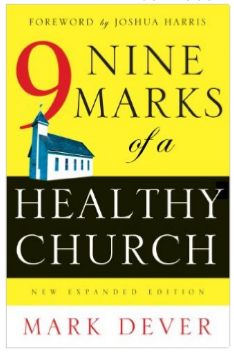
I’m encouraged by the men at 9Marks. I like the 9Marks organization. 9Marks was founded by Washington DC pastor Mark Dever in the late 1990s, and has grown to include Jonathan Leeman, and a host of other writers and leaders who contribute to the ministry. I’ve bought and read several of the books Dever has authored, including the original, 9Marks of a Healthy Church. Their own mission statement reads,

9Marks exists to equip church leaders with a biblical vision and practical resources for displaying God’s glory to the nations through healthy churches. To that end, we want to see churches characterized by these nine marks of health:

The 9 Marks of a Healthy Church
I. Preaching
II. Biblical Theology
III. The Gospel
IV. Conversion
V. Evangelism
VI. Membership
VII. Discipline
VIII. Discipleship
IX. Leadership

John Samson of Reformation Theology wrote in 2009 of 9Marks, that the ministry promotes,

a biblical model for the church actually looks like, building on the foundation of the Gospel. As the book title would suggest, Dr. Dever outlines nine distinctive features of a church that is seeking to conform itself to a biblical pattern for church life and ministry.

If you go to their page, each of the 9Marks is clickable and each one is described on a biblical basis. My own newly planted church was founded based on these marks from the 9Marks’ organization. I like what 9Marks says and I like what they do.

As 9Marks has grown, they began to answer questions that have been submitted to them from the public about church life. I enjoy reading these questions and the answers from 9Marks, for a variety of reasons.

The questions that arise- the ones they publish anyway- are based on scripture. As Paul noted in the verse at the beginning, there’s doctrine, and then there’s living out the doctrine. This interplay between what is written in the Word and how to apply it in life, is always challenging, interesting, thrilling, and open to a variety of interpretations, lol.

The 9Marks people answer these life-doctrine questions from the public according to their best interpretations of scripture. They do so in a way that educates not only according to doctrine, but according to “our life” as Paul had advised. The content of their answers is edifying. The tone of their answers (as far as one can detect on the cold impersonal internet), is also edifying.

Please enjoy the current and previous 7 Mailbag answers and hopefully you will see what I mean and concur. They educate as to doctrine and as to life. Watch both.

Mailbag #47: Applying Paul’s “Able to Teach” Qualification; Confidentiality between Pastors and Members?

Mailbag #46: Tricky Membership Question about Immigration; Pastoring a Church with Lots of Divorcees

Mailbag #45: Transgender Pronouns & Marrying an Egalitarian Couple

Mailbag #44: Applying “Husband of One Wife”; Leaving the Church but Attending Bible Study; Women Voting in the Church

Mailbag #43: Relationship to Excommunicated Members; Baptism & the Developmentally Disabled

Mailbag #42: Hypocritical Church Discipline; Pre-Marital Counseling for Two Unbelievers?

Mailbag #41: When the Church Votes “No” on a Clear Discipline Case; The Biblical Case of “Lay Elders”

Mailbag #40: Too High a Standard for Church Membership; Where Are Churches Commanded to Gather Weekly

—————————————-
Further Reading

Tim Challies’ Book review of 9Marks of a Healthy Church

9Marks Bookstore