We’re commanded in many places in scripture to pray. We have the duty of continual communion with Him. And yet, so often we don’t pray as we ought. Why is this?
Photo by Ben White on Unsplash
It seems so easy. Praying isn’t as hard as spreading asphalt in Nevada on a summer day. It isn’t battling a five-alarm fire in the canyons. It isn’t helping your mother with Alzheimer’s. All you do is sit in your air conditioned space, put your hands together, and speak to Jesus, our friend.
But is that all prayer is? No.
David McIntyre in his 1913 book, The Hidden Life of Prayer (free online) explains why praying is so hard sometimes. He tells why we do not do it as we ought. The Hidden Life of Prayer was one of the books that Tim Challies selected for his program “Reading Through the Classics.” Challies wrote,
McIntyre was a Scottish preacher who succeeded Andrew Bonar as minister in Finnieston and later served as principal of the Bible Training Institute in Glasgow from 1913 to 1938. His book was first published in 1913.
McIntyre is insightful when he writes this,
Our Lord takes it for granted that His people will pray. And indeed in Scripture generally the outward obligation of prayer is implied rather than asserted. Moved by a divinely-implanted instinct, our natures cry out for God, for the living God. And however this instinct may be crushed by sin, it awakes to power in the consciousness of redemption.
And yet, instinctive as is our dependence upon God, no duty is more earnestly impressed upon us in Scripture than the duty of continual communion with Him. The main reason for this unceasing insistence is the arduousness of prayer. In its nature it is a laborious undertaking, and in our endeavor to maintain the spirit of prayer we are called to wrestle against principalities and powers of darkness.
We know that we do not wrestle with others, but with powers and principalities of the air. And who is the prince of the power of the air? Satan. (Ephesians 6:12, Ephesians 2:2). But to put the two concepts together as one of the reasons prayer is so arduous, we have a powerful truth.
And lest we think that even if we had an easy life with no problems, or can slack off due to our tight communion with God, McIntyre wrote this about Jesus:
And this one who sought retirement with so much solitude was the Son of God, having no sin to confess, no shortcoming to deplore, no unbelief to subdue, no languor of love to overcome. Nor are we to imagine that His prayers were merely peaceful meditations, or rapturous acts of communion. They were strenuous and warlike, from that hour in the wilderness when angels came to minister to the prostrate Man of Sorrows, on to that awful “agony” in which His sweat was, as it were, great drops of blood. His prayers were sacrifices, offered up with strong crying and tears.
“Prayer is the key of heaven; the Spirit helps faith to turn this key.” ~Thomas Watson.
The National Atmospheric and Oceanographic Administration, AKA NOAA, advised yesterday that an ‘extreme’ geomagnetic storm was gong to hit the US last night. They issued a rare severe geomagnetic storm warning of ‘G5’ (highest) when a solar outburst reached Earth on Friday. The effects include glowing lights in the northern sky, colors of ethereal and jaw dropping beauty.
My friends here in Georgia are excited. Northern Lights are rarely seen this far south! Indeed, as I awoke this morning many of them had posted photographs of the Lights in the sky. One social media account posted seeing them as far south as Key Largo, Florida!
I’ve seen the northern lights three times in my life, two times in Maine and once in Canada.
In ME, it was a cold late fall night, I was driving home late from Graduate class, when in the sky a curtain of red started waving. I was mesmerized.
Another time in ME I was standing on a hill in a blueberry barren. The Aurora was green and I heard electrical sounds (which they said I was crazy but turns out 5% of Auroras have buzzing or hissing accompanying it. It’s the ions crackling, or something).
In Canada I was on an ice breaker ferry coming into port. A man kept speaking in French and gesturing to the north, so I looked and suddenly the sky split open with color. I can never get over the curtain waving. The northern lights are AMAZING. This morning, my Christian friends who posted photographs also posted verses praising God the creator.
In Romans 1, the famous passage in which Paul under the inspiration of the Holy Spirit describes the pagans’ reaction to experiencing the God of Creation, begins in verse 18.
For the wrath of God is revealed from heaven against all ungodliness and unrighteousness of men, who by their unrighteousness suppress the truth. For what can be known about God is plain to them, because God has shown it to them. For his invisible attributes, namely, his eternal power and divine nature, have been clearly perceived, ever since the creation of the world, in the things that have been made. So they are without excuse. (Romans 1:18-20)
How does this play out, exactly? How are His invisible attributes seen and known? How is it that what can be known about God is made plain to people whose minds are darkened?
I was watching a very excellent documentary called “Antarctica: A Year On Ice”. It follows the people who live and work through a year’s cycle at the various scientific stations on the most remote and brutal continent on the planet. The continent is staffed with about 1100 people at various international stations up and down the Antarctic coast. The largest is the United States’ McMurdo Station. In most documentaries, they show the scientists working. Penguins, climate change, volcanic action, geology…but this documentary features the people who staff the stations in support of the scientists’ work.
The documentary features the many hundreds of regular people who both work there during the summer, and who “winter over.” They man the store, staff the fire station, fix tractors, cook the meals, wash the dishes, take inventory of all the equipment, etc. When the last plane out at the end of summer leaves, they stay. Thus, the wintering over experience is unique to only a few individuals each year, as the full swell of 1100 during summer dwindles to only about 200 souls spread out among 30 scientific stations during winter in the Antarctic.
Living where there is no hope of departure for 6 months, in brutally cold and windy conditions, in darkness as the sun disappears below the horizon, with only a few dozen people around you…is something that only a few are allowed to experience.
Screen shot from “Antarctica: A Year On Ice”. Aurora Australis
Interestingly most of the people who “winter over” in the Antarctic love it. The landscape under the moon has a stark and glowing beauty. There is an astounding resplendence in the sky that only a few people are privileged ever to see. The stars, planets, Milky Way, moon, and of course the Southern Lights (Aurora Australis) dance across the sky in majestic processions, all the time, for there is no sun to hide their glories.
Now here comes the Romans 1 passage lived out among a Gentile. One of the workers described her experience seeing all this for the first time. As the Aurora Australis glowed above her, she was overcome. Here is what she said:
I was out on the sea ice, and all of a sudden comes rolling these waves and waves of green like fairy dust. Giant curtains of fairy dust, just kind of undulating over me. It filled the whole sky and moved in waves across the sky. And I thought this is either what it looks like when aliens are about to abduct you…lol, because this is the green stuff coming down and you feel like you can reach up and touch it. Or if you are a person who believes in heaven, maybe this is what you see in heaven. I’m not sure.
But it was really an emotional, life-changing experience for me. I found myself, not believing I’d done it, when I’d figured out where my body position was, I was actually on my knees crying. That’s how beautiful it was to me.
She sounds like every other person who had an encounter with the Living God. She didn’t directly meet the Living God like John, Paul, Isaiah, or Ezekiel did, but she experienced His power through His creation. When you do, you grope for words. You fall on your face. She have a mental reaction and a physical reaction. In her interview, she stuttered for words and then just cried.
First, you notice she described her experience in supernatural terms. It was either aliens, and in context it was clear she was joking, or it was God (“heaven”). Here she was more serious. The blinded mind does see and know of the Living God when they perceive His qualities through His creation, and her description was exhibit A in this process.
She lives and works with scientists in a place that only exists to perpetuate science and to discover scientific reasons for the way the planet is and how it works. All her conversations with people on McMurdo are founded from that basis. That is why they are there in the first place. Yet when she encountered the creation power of the Living God, her first thought was heaven. She did not say “Wow the Big Bang all those billions of years ago manifested itself in perfectly organized ions that traveled over millions of miles in a beautiful display!” She said “heaven” … and who lives in heaven? God.
Secondly, you notice her physical reaction. She was so overwhelmed with glory of His creative power she became insensate. She didn’t know if she was ‘in the body or out of her body’. She had to ‘come to’ and when she did, noticed she had fallen to her knees. Do we fall on our knees when we detect a scientific principle at work? Are we so awed by the process of pasteurization that we cry tears of joy on our knees? Maybe Louis Pasteur did, but anyone else? No.
I know a man in Christ who fourteen years ago was caught up to the third heaven—whether in the body or out of the body I do not know, God knows. (2 Corinthians 12:2)
Such was the appearance of the likeness of the glory of the Lord. And when I saw it, I fell on my face, and I heard the voice of one speaking. (Ezekiel 1:28b)
screen shot from the documentary. McMurdo station under southern lights
In the Bible men and women fell down when they experienced the direct glory and power of the LORD. Peter fell to his knees when Jesus brought all the fish to the boat, for example. Isaiah fell down in his vision seeing the heavenly throne room. However, people also fell down when they encountered the near-glory of God, experiencing the things sent from heaven. John fell down at the angel’s feet. Cornelius fell down at Peter’s feet. Saul Saul, he fell down when the light from heaven shone around him. The difference as the Romans verse reminds us, is that we are not to worship the creation, not angels nor light nor other men, which are all created. We are not to worship southern lights or the sun or birds of the air nor creeping things.
But those who encounter a direct power from God through the creation react. This reaction is from a conscience which knows what they are seeing is from God and that He exists. This is what the Romans verses mean.
When Apostle Paul witnessed, he always began in the synagogue when giving the Gospel to Jews, reasoning from the scriptures. (Acts 17:2-3). With the Gentiles though, he always started with creation. He did this with the Lycaonians (Acts 14:6, 15) and the Greeks (Acts 17:22–31). Paul started with Creation and God’s attribute as Creator, and he exhorted Gentile listeners to see what can be seen in nature as the evidence for this.
Now I am speaking to you Gentiles. Inasmuch then as I am an apostle to the Gentiles, I magnify my ministry. (Romans 11:13)
That is because they know the truth. They know God has created all, but they suppress it. Knowing but suppressing, understanding but denying, is an ongoing mental and emotional struggle inside each and every Gentile. It takes energy to suppress the truth that manifests itself in unwanted forms, such as falling to one’s knees, becoming insensate, or crying. The question is, what will they do with the information afterwards?
That’s where we as Christians can bring some more pressure to bear on their internal emotional and physical tension. We are witnesses to the God of creation. Before I was saved I lived unplugged close to the land and on the sea, experiencing the natural world in many ways. It became obvious to me that there IS a God. Nothing of what I was seeing in His creation could have come about through haphazard bangs and solar wind and evolution. So, I knew God is real because I was seeing His invisible attributes. But that is where I became stuck. What now? What does it mean? Who is this God and what does He want from me?
That is where we can be effective in sharing the next step for the questioning pagan. That next step is sharing knowledge of Jesus, sin, and judgment. Paul used but switched their concept of the God of creation to the God of intimate, loving involvement in their lives, a God who demands holiness but provided the way to achieve the holiness that we could not. That is what the pagans need to know.
If people would simply stop accepting at face value the proclamations of celebrity pastors and lady ‘Bible’ teachers, that they are Christians, the faith would be stronger.
When a megapastor, such as the types like Mr Furtick, Mr Driscoll, or Mr Stanley, or a lady ‘Bible’ teacher like Beth Moore or Jennie Allen or Joyce Meyer teach something that isn’t in the Bible, or otherwise make an outrageous statement, the thinking goes something like this:
“What?! How could Pastor So-and-So say that? He says s/he’s a Christian, so how can s/he not know that isn’t the truth?! Since s/he says they are a Christian, we have to find out what s/he really meant. It must be a mistake, or s/he said it because s/he must be temporarily under the influence of NyQuil. Of course s/he is a Christian (because Pastor So-and-So says he is) and Christians would know better than to teach that.”
Complex rhetorical pretzel-logic ensues.
You know, most people who say they’re saved, are not saved. Am I pessimistic? Am I “judging the heart”? Am I “judging their motives”? No. Jesus said that many go on the broad way to destruction and few find the way to salvation. (Matthew 7:14). Jesus followed that statement immediately in the next verse, saying
Watch out for false prophets. They come to you in sheep’s clothing, but inwardly they are ferocious wolves. (Matthew 7:15). Further on we read the devastating verses in Matthew 7:21-23 where many are unveiled to not have been a Christian all along. Jesus says ‘Depart from me, yu worker of iniquity, I never knew you.’
In the New Testament ‘false prophets’ are pastors, a word we’re more familiar with today. Or they are teachers.
If someone in real life says to me that they are saved, I don’t dismiss their statement, of course. But I do not accept it at face value, either. I listen to testimony, I watch for fruit, I reserve comment or opinion on their self-proclamation until I see one way or another which way their wind blows. That takes time.
But if someone is a pastor or teacher at the highest levels with a following or influence, and thus a body of work to examine and compare to the Bible (Acts 17:11), and they say something incontrovertibly against a foundational doctrine, (like when Billy Graham says we can go to heaven without knowing Jesus; or the wild abuses against the Spirit of Benny Hinn or Joyce Meyer, or the greed with which a Joel Osteen bows to Mammon), then it’s understood in my mind that someone with the Holy Spirit in them would never teach that or behave that way. Ever.
There are some simple items to help people begin to understand whether to call someone a brother. Here are a few-
1. True believers will understand, confess, and defend the true Gospel of Jesus Christ. (See Corinthians 15:1-5.)
2. Actual Christians will discerningly spot counterfeit gospels and conclusively reject all of them. (See Galatians 1:6-9).
3. Believers, while not morally perfect until glorification, will care about holiness and will strive to live according to God’s commands. If pointed out to be teaching falsity or to be in sin, they will hasten to correct (See I Corinthians 6:9-11).
Remember, the Holy Spirit indwells a true believer. He will not allow decades of falsity to spew from the pastor’s or teacher’s mouth. He will not allow decades of behavioral abuse to continue. If an actual believer teaching something falls into sin, after a short while it will be resolved through repentance, or even in the case of the Corinthians they were disciplined with sickness or even death for abusing the Lord’s Table, or the Thyatirans who followed metaphorical Jezebel, Jesus threatened to kill them. The Spirit’s ministry is to point to Jesus, not allow falsity from one of His sheep to confuse the unwary and pollute the faith. We must see Jesus with clear eyes. Many, believe it or not, do not profess the true Jesus, but sadly, many do not know that the foundation of their faith is sand and not the Rock. (see Matthew 7:21-23).
How goes the Gospel in the world at the end of the twentieth century? There is no way of getting full or accurate statistics (though there are many useful attempts). One can only make educated guesses. Mine is that the vast majority—maybe 90 percent—of professing Christendom does not profess Christianity. Or rather, it does not understand the Christianity it professes.
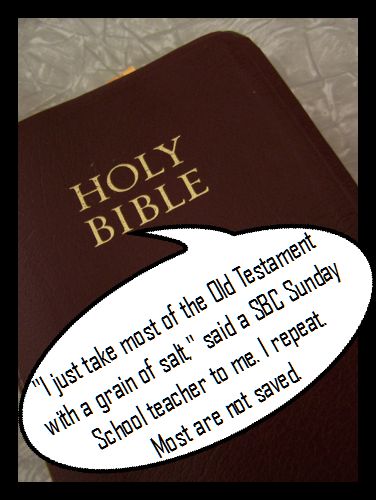
Most of the people who profess Christ do not believe the essential doctrines that set one apart as a regenerated, saved Christian. I have seen this up close. A Southern Baptist Convention Sunday School Teacher/Director laughingly said to me once, “Oh, I just take most of the Old Testament with a grain of salt.”
Here is John MacArthur with an essay on “What kind of things do and do not prove the genuineness of saving faith?” Do not be caught by the conditions observed in a person that do not prove OR disprove genuine saving faith, such as: Visible Morality, Intellectual Knowledge, Religious Involvement, Active Ministry, Conviction of Sin, The Feeling of Assurance, A Time of Decision. Then MacArthur continues in showing Nine conditions that DO prove genuine saving faith. Here is the link.
Ever since the beginning of my walk with the Lord, I have been concerned with the notion of false professions, false Christians, and polluted faith. I work at not contributing to the problem by examining myself, confessing sin when necessary, and keeping my eyes on “This Same Jesus” who departed in Acts 1:11 and will return the same way.
I dread the day when Matthew 7:21-23 comes true, when many (hopefully not me!) will be unmasked as false believers and sent to hell. However, that will be one way that Jesus’ glory will be shown to be even more glorious than we ever could imagine. These things must be pondered.
You know how some people jokingly say he or she ‘broke the internet’? Well, Anne Hutchinson broke the colony.
History hasn’t been that balanced to Puritan wife Anne Hutchinson. She is either portrayed as an religiously oppressed early feminist denied her identity, or a screeching harridan who deserved what she got. She has been called a heroine, an American Jezebel, an instrument of satan, poison, and a great imposter (the negative ones were all from Massachusetts Governor John Winthrop).
Of course the truth is somewhere in the middle.
This is the fourth entry in my Puritan Wife series. I’d written:
Sometimes we think of our historical brethren as backward or uneducated, but in fact Puritan Massachusetts was populated with highly literate people, and that included the women, unusual for the time. The 1600s was an era when women were mainly quiet at home, revered, but out of the public eye. We only know of Anne Bradstreet because her brother-in-law copied her poems and published them in London without her knowing. We only know of Margaret Winthrop because her letters between her and her husband were preserved. And we know of Anne Hutchinson because of the trial transcripts! The two years she stirred up controversy reverberate to this day, I am not kidding.
In her religious outworkings and domestic life, Hutchinson was loud and active. An intelligent, complex, wayward mother of 15 children, she was tried and banished from the Massachusetts Bay Colony. Exiled at age 47 in 1638 and left with nowhere to go, she traipsed to Rhode Island where she was welcomed by that colony’s founder, the also-exiled Roger Williams.
That was the end of the end of the Antinomian controversy but not the end of Anne Hutchinson.
Anne was born Anne Marbury in 1591 in Alford, England. Her father was an Anglican cleric. Being literate himself and a teacher, he educated Anne to the fullest.
The family moved to London and lived there a while, but when Anne married childhood friend William Hutchinson she moved back to Alford. There, they enjoyed John Cotton’s sermons. Cotton was an outstanding theologian and a dynamic preacher, a combination not often found. Cotton was extremely well thought of.
Cotton was an Anglican preacher who had served for 20 years by the time the Hutchinsons met up with him. He peached much on grace in justification as well as the usual works being the fruit of it. Anne liked the grace part.
He believed the Church needed reforms, such as divesting itself of ritual and ceremony, but did not want to separate from it. He wanted to change it from within, or, “purify” it. Hence the moniker Puritans. As time went on, though, his consistent attitude against the framework of the Anglican church and his continual speaking against it eventually exceeded the leniency his overseers gave him, and pressure forced him out. He sailed for Massachusetts in 1633.
Devastated, Anne prompted her husband to follow Cotton. In 1634, the Hutchinsons packed up their 14 children and decided to follow Cotton to the new Colony that had been established just 13 years prior.
The Hutchinsons and William’s brother-in-law, John Wheelwright, were quickly accepted into the life of the colony. Anne was a midwife, and she met and discipled many women on her normal rounds. Being articulate and a deep thinker, many women sought her commentary on the Bible. Anne soon began holding weekly meetings for women at her home, repeating and commenting on Cotton’s sermons.
So far, so good. A woman ministering to her fellow sisters in body and soul is what the Bible tells us ladies to do. (Titus 2:3-4). Mothering in midwifery and ministering spiritually to sisters in the colony is a good thing.
However, it wasn’t long before Hutchinson expanded the discussions of the week’s sermon into her own exposition on them. Notoriety and interest caused men to attend her meetings, which were ever-expanding. Anne’s commentary was insightful, but a woman leading men in preaching and teaching, even in the privacy of a home, is a dangerous endeavor spiritually. (1 Timothy 2:12). The tendency to usurp is great, and that is what Anne did when she taught and preached to men. Some say that up to 60 people flooded her home to listen to Anne’s opinions and expositions. And it was definitely Anne they came for, not her husband John. (the sin of passive Adam, Genesis 3:6).
Does sin ever only get worse? Yes. Eventually, Anne did not restrict her home meetings’ topics solely to dissecting/discussing her pastor’s sermons, she strayed into dissecting other ministers’ sermons, too, usually negatively. Believing only she and her small circle of supporters were the only ones in the right, she criticized heavily, violating Titus 2:3 not to be slanders and Colossians 4:6 to let your conversation be gracious.
Remember, these were emigrants defying death in England for their views, defying death aboard the ships that brought them, surviving the first winters of privation and starvation. The one thing they needed was trust in their leaders’ stances and that is the very thing Anne destroyed.
More men began showing up, women too. Her ‘talks’ gravitated to mainly criticism of everyone else besides her favorite, John Cotton. She began to call names, and impugn character.
A soothing tongue is a tree of life, But perversion in it crushes the spirit. (Proverbs 15:4)
She hinted that some were antichrists and not saved. She said that these other pastors were preaching a covenant of works, while the only true pastor, Cotton, was preaching rightly, the covenant of grace. Anne over-focused on grace and was against Law. She was an antinomian.
Definition Antinomian: Anti means against, nomos is law. It’s “relating to the view that Christians are released by grace from the obligation of observing the moral law.” Oxford Dictionary
In looking at the two sides of the theological debate, it seems to me that both sides were right and both sides were wrong. Anne thought that the Holy Spirit indwelled, which is true, but, she taught that a person could live as they pleased under grace because assurance of salvation was known to the individual, therefore no external moral proof was necessary to evidence justification. Anne took this as far as it could go- where Cotton had been careful to link the Spirit with the Word, Anne decided that the mystical union with the Spirit was so close, one did not need the word, and could rely on “immediate revelations” from Him.
John Winthrop’s reply to a person receiving personal revelation from God was that it is “the most desperate enthusiasm in the world.”
Several of the named pastors naturally took a dim view of her preaching, and there was a meeting held to discuss what to do. John Winthrop, the Governor and spiritual leader of the Puritans at that time, was equally, if not more angered. Anne refused to listen.
And the sin deepened. Soon Hutchinson began to encourage women to rise up and walk out of sermons that preached doctrines with which she did not agree. Walking out is a disdainful, rebellious act. Elders deserved double honor. (1 Timothy 5:17). But many women did it. Men too.
The meetings continued, only growing in number. Anne’s dissections of others’ sermons, were not God-glorifying nor encouraging to pastors. Nor did they focus on educating the attendees and enlighten them as to Jesus as Savior. Nor did they prompt the people to good works and moral restraint. They were simply to point out the pastor’s errors and to cement her own position which she believed to be righteous. Think of the worst discernment ministries running today, who lack love, and who never lift up but only tear down, and that was the situation between 1636-1638 with Anne.
Anne was spurred on by people who should know better. A male admirer put it this way-
“I’ll bring you to a woman who preaches better gospel than any of your black-coats who have been at the ninnyversity, a woman of another kind of spirit who has had many revelations of things to come….I had rather such a one who speaks from the mere notion of the Spirit without any study at all than any of your learned scholars.” (Source)
See how personal revelations take a person AWAY from the word of God as it did this admirer?
Left, the statue of Hutchinson on the Massachusetts State House at 24 Beacon Street, Boston, MA. Still so controversial 375 years after death, and almost 100 years after the statue was commissioned, the original recipient, the Public Library, refused it and the Legislature ignored it for 2 years. It was finally installed in 2005. Story here: A heretic’s overdue honor
And Anne’s sin just deepened and deepened. It wasn’t long before Hutchinson began spouting personal revelations and prophecies. The apex of this was at her trial for sedition and heresy. Anne’s behavior had spawned a schism, had encouraged women to rebel, and caused a region-wide argument on the finer points of works v. grace. It also exiled her brother-in-law, John Wheelwright. It damaged Cotton’s reputation for years to come. The colony itself was suffering over this to the point of collapse. Winthrop’s “city on a hill” was only after a few years mired in petty bickering and politically unstable, caused by Anne. She had to be stopped.
Hutchinson was put on trial, after various attempts to get her to stop, recant, and repent. Hutchinson held firm. In her trial, she bested every single man in a theological debate, including Winthrop, who never forgave her, as we’ll see later.
It might have gone her way, except at the last, she overstepped, and claimed that God Himself had told her these things, and worse, that He told her He put a curse on them all. The initial charge of sedition was not met with a preponderance of evidence, due to her skill in theological combat. However when Hutchinson insisted God spoke to her personally, she was charged with blasphemy and exiled. In the spring, she moved to nearby Rhode Island and founded Portsmouth. Her husband and many of her children were already there.
Anne Hutchinson is noted as “a woman of conscience who yielded to no authority”, as quoted in this book about fellow Puritan preacher William Wentworth. Today’s feminists laud Hutchinson’s stance, but Christians know that is not the way. Of course we yield to authority.
Hutchinson rebelled against the scriptures, namely 1 Timothy 2:12 by teaching men. She and was unconcerned and unrepentant about it. She also failed to submit to her leaders, as Hebrews 13:17 says to do. Open and constant criticism of your leaders by disparaging them and encouraging walk-outs, is sin. (Also 1 Thessalonians 5:12, 1 Corinthians 16:16). Anne seems to have been unconcerned about the rift she was causing, and the word submit didn’t seem to be in her vocabulary. When she knew she was causing a problem, she did not repent, but persisted. This violated Romans 12:16, as she did not live in harmony with one another and failed to be humble. See also 1 Peter 3:8.
Above, John Cotton by John Smibert
How many Proverbs did Anne Hutchinson violate? She was not the meek, kind, quiet woman Proverbs calls us to be. She did not tend to her house (Proverbs 14:1). She was contentious, quarrelsome, and loud. She was overly proud of her own theological positions AND her ability to not only express them but to defend them.
The woman of folly is boisterous, She is naive and knows nothing. (Proverbs 9:13).
Men are supposed to lead the household. John Winthrop wrote of Anne’s husband William,
a man of very mild temper and weak parts, and wholly guided by his wife,
Anne’s positive influence could have been great. She was mother of 15 children, many of them boys. Her insights and strong theological knowledge could have raised up a new generation of founding fathers for our nation. If Anne had remained in her mid-wifery and women’s Bible study sphere, and tended to her home, who knows what might have come of it.
As it was, there were a few positives from the negatives of the Anne Hutchinson Antinomian controversy. Winthrop sought a colonial confederation to unite the colonies. The men banded together and established Harvard College, initially a seminary to train up the generation of men, as this quote indicates,
To provide a bulwark against remnants of Hutchinson’s free-grace theology, just two weeks after she was banished the General Court of Massachusetts finally released funds in November 1637 to establish the “College at Newtowne” (renamed Harvard in 1639)
Third, it spurred Roger Williams to deepen his conviction that there should be a “wall of separation” between church and state. Hutchinson was tried as a seditionist and a heretic, and eventually convicted of blasphemy. Williams thought that-
the magistrate should not punish religious infractions—that the civil authority should not be the same as the ecclesiastical authority. The second idea—that people should have freedom of opinion on religious matters—he called “soul-liberty.” It is one of the foundations for the religion clauses of the First Amendment to the United States Constitution. Williams’ use of the phrase “wall of separation” in describing his preferred relationship between religion and other matters is credited as the first use of that phrase, and Thomas Jefferson’s source in later writing of the wall of separation between church and state in a letter to the Danbury Baptist Association in 1802.
In addition, the controversy illuminated the fact that there was no perfect uniformity of doctrine among the men, which caught the leading Puritans off-guard. Winthrop thought that “The society must not only function as a unit, but in order to do so, must remain narrowly exclusive in content.” (Emery Battis, Saints and Sectaries). Whether this is ever possible, only God knows…
Debating whether to bring Anne to trial and during the trial, it became clear that there was no uniformity of content.
Banishment from Mass. Bay Colony. Wikimedia. It took 6 days to walk to RI
Hutchinson was not the only bad actor in this debacle. John Winthrop behaved badly too. (Among others). Anne was in her mid-forties when the trial occurred. She was either pregnant during the trial or shortly after. She emigrated to Rhode Island the spring after the trial ended and shortly afterward, gave birth. The issue from the birth was not a baby but what is believed to have been a hydatidiform mole, or molar pregnancy. It was a mass of tumors, not a baby. Knowing what would happen if it became publicly known, the Hutchinsons had it quickly and secretly buried. However, Winthrop heard about it, sought the grave, got it exhumed, and used the tragedy as ‘proof’ that his stance was right. He wrote of it widely: ‘see how the wisdom of God fitted this judgment to her sin every way, for look—as she had vented misshapen opinions, so she must bring forth deformed monsters.” Not cool.
This to me, is a total lack of charity and speaks ill of his own character.
Yet, William Coddington quoted a friend reminiscing about the controversy: “We were in a heate, and chafed, and were all of us to blame. In our strife, we had forgotten we were brethren.“
Later, when it appeared that Massachusetts was set to annex Rhode Island (it never happened), fearing reprisals, Anne and her children (her husband had passed away by then) moved out of Winthrop’s reach and into New York, the Netherlands’ territory. A year later, Anne and all but one of her children were killed in an Indian massacre. Many New England pastors wrote gloating reports of her death. Winthrop called her upon her death “An American Jezebel.”
Anne Hutchinson was an amazing colonialist who had much to offer the colony and her church. Unfortunately, she went outside the bounds of the ordained spheres for a woman and she caused upset, schism, and was a negative role model that reverberates 387 years later!! There’s no doubt though, she was formidable and earned a place in American history. As a wife, though, the more negative Proverbs speak of her and women like her than do the positive ones.
Unlike the positive example of Anne Bradstreet and Margaret Winthrop, whose excellence as wives and contributors to their family and community are noted to this day, Anne Hutchinson is the anti-wife whose contentious spirit and pride caused much harm to all those around her.
Be peaceable, And the Lord’s servant must not be quarrelsome but kind to everyone, able to teach, patiently enduring evil, (2 Timothy 2:24)
———————————————–
A few resources I used for background, sources for you too-
I love to read. With the New Year and all the ‘Reading Challenges’ that emerged in January as people make decisions back at the start of the year, I’d decided to go back to reading for pleasure. This is an activity that had fallen by the wayside as I got busier, and my eyes grew more tired at night. Aging. It’s not for sissies, lol.
EPrata photo
I do need more often to shop my own shelves rather than buying more books! But I’m weak, lol. If I am of a mind to read fiction, I usually stick with the same novelists I’d read before (Grisham, Charles Martin, Will Thomas, and the like). When I find one author I like I tend to read more of their books, because the first one was ‘safe’ so I figure subsequent works have a higher likelihood of being be ‘safe’ too.
A while ago I had read The Rain, a self-published work by Chris Skates and Dan Tankersley. It is a fictionalized recounting of the Biblical Flood. There is a lot of ink in the Bible about the lead-up to the flood, the flood itself, and the aftermath. The authors didn’t have a lot of holes to fill. But still, dialog must be constructed, extra-biblical characters created, and some gaps must be filled by imagination. I thought they did a great job. I enjoyed the book.
That’s why I was disappointed in their sequel, The Tower. To be sure, there is little ink in the Bible about the Tower of Babel. Only 245 words, I’ve heard. So the authors had to invent more. Theirs IS a book of fiction. So I get it. I am not quibbling about filling gaps in a fictionalized biblical story.
But two things bothered me about the book. Full disclosure: I read very little of it. First, the modern language. In The Rain, the dialog, while imagined, was of a tone that seemed old timey. It wasn’t stilted, but the authors kept modern words and idioms out of the characters’ conversations. They didn’t put idioms into the characters’ mouths that a person would say today. As a reader visualizing any scene in The Rain, I could picture the characters saying what they said.
In The Tower, the idioms, words, tone, and language were very modern. It was jarring. As an author, what you want to do is create a bubble for the reader to relax into. It’s a delicate bubble, but if you can hold the reader’s attention, they will descend into your world and stay IN the bubble. You don’t want to jar the reader out of your constructed reverie and become distracted. A distracted reader stops reading. This is what I learned in journalism class. You do not want to do anything to break that bubble.
Turris Babel from Athanasius Kircher, source wikipedia
In addition to modern language in The Tower that jogged me out of the bubble I was trying to stay inside of, the authors needed an editor. Badly. It was a self-published book as mentioned, and often than means not employing a skilled or professional editor, or even a copy editor. Copy editors check copy for wrong words, punctuation, mechanical errors in the text.
The authors used wrong words several times in the few pages I read. For example, gig for did. Site for sight, twice. Ugh. There is nothing that gets me more irritated than wrong homophones, unless it’s spelling errors. So this book had issues with the text itself. That, combined with the issues of language, meant I couldn’t read in relaxed fashion, I kept being booted out of 2300BC. I quit reading won’t pick the book up again.
If you would like information on the Tower of Babel from a credible Bible-based ministry, here is Answers in Genesis’ answer to the question, “When was the Tower of Babel Built?“
Some people object to fictionalizing stories from the Bible. Can we fictionalize biblical stories by recounting them and filling in gaps with our own imagined characters or situations? Hmmm, yes and no.
The most important point is, have you read enough of the Bible, OT and NT, to be familiar with what SHOULD be presented in a work of fiction based on a biblical story? If you’re reading a fiction book about Rachel, have you first read and are familiar with the actual Rachel of the Old Testament? If not, then you are at risk of accepting the author’s version of a true biblical person.
I thought The Rain did a good job of sticking to the biblical concepts. Though I personally have not read The Chronicles of Narnia, people tell me CS Lewis did a credible job with creating a biblical allegory that mirrored biblical concepts. As did John Bunyan in The Pilgrim’s Progress. The television series The Chosen did not do a good job of gap-filling, but twisted the Bible to suit man’s desire to diminish Jesus and hide attributes He has which make man uncomfortable.
The problem with fictionalizing, or making plausible leaps where the Bible is silent, is that very thing- our flesh gets in the way.
And our flesh has an agenda. So does satan.
So in a way, Christian fiction books are the most unsafe books of all. Take the book The Shack, for instance. This was a runaway bestseller back in 2007-2008 and onward. It was sold in Christian bookstores as a Christian book. Its author, William Paul Young, wrote about a man who was staggering under heavy grief due to the kidnapping and death of his little daughter, her death had occurred in a derelict shack.
One day the man received a handwritten note in his mailbox to go to the same shack. Reluctant but curious, he goes, and there he ‘meets’ Jesus and the Holy Spirit in addition to being greeted by ‘God.’ It turns out that according to Young’s presentation of the Trinity, God is a woman, as is the Holy Spirit. The book goes on to present discussions between the persons of the Trinity and the man, regarding sin, evil, salvation, judgment, and other doctrines. The book teaches that sin is its own judgment and there is no other, that hell exists to purge away unbelief (not punish for sin), that there is universal reconciliation, among other aberrant, non-biblical doctrines.
Many credible leaders in the faith negatively reviewed the book. I reviewed it negatively also. A common rebuttal to our negative view of the book was, “Lighten up. It’s only fiction!” Or, “It’s only a novel!”
Dear reader, novels teach an author’s point of view, either subtly or overtly. It’s no different for Christian novels. Novels with Christian themes use narrative to teach. We must all be Bereans and check to see that these things in the ‘Christian’ book are so, in whatever form the doctrines are coming to us. Doctrine is taught in songs, poems, sermons, lessons, theological books…and fiction.
Dr. R. Albert Mohler Jr. serves as president of The Southern Baptist Theological Seminary. Dr. Mohler offers thoughts on the missing art of evangelical discernment as encapsulated by evangelical response to The Shack. He wrote:
“In evaluating the book, it must be kept in mind that The Shack is a work of fiction. But it is also a sustained theological argument, and this simply cannot be denied. Any number of notable novels and works of literature have contained aberrant theology, and even heresy. The crucial question is whether the aberrant doctrines are features of the story or the message of the work. When it comes to The Shack, the really troubling fact is that so many readers are drawn to the theological message of the book, and fail to see how it conflicts with the Bible at so many crucial points.” [underline mine]
EPrata photo
In that article, we see that Christian fiction is deliberately used to bring heretical ideas to the masses and worse, popularize them. Christian reader, beware! It’s not “just fiction”! Simply because a book is listed as Christian fiction does not mean we can let down our guard. We need to put up higher guards!
“When we think about the role of reading in our spiritual formation, we generally think of non-fiction books that help us understand scripture and theology, but fiction powerfully shapes the ways in which we think faithfully about God and the world.” C. Christopher Smith
Fiction is storytelling. Christian fiction walks a thin line between green pastures of heaven and boiling hot lava, in that the story an author is telling is based on the Bible but the Bible is not fiction. It’s history; true, and real. It’s dangerous to tinker with God’s word, yet stories must be told. CS Lewis did it well with Screwtape Letters and Bunyan with Pilgrim’s Progress. William Paul Young did it badly with The Shack, Dallas Jenkins with The Chosen.
Be discerning. The worst Christian fiction often popularizes heresy. The best Christian fiction prompts a reader to run to the Bible to absorb more truth. It also glorifies God.
Dr. Mohler said that even Christian fiction is a work of sustained theological argument. Let’s compare two books to see how this fleshes out: Elmer Gantry and The Shack.
One of my favorite books is Elmer Gantry by Sinclair Lewis. It tells the story of a false convert who rose to fame and celebrity pastor status, all the while not being a believer in any sense. The Bible tells us that this will happen, it’s a biblical concept. The message of the book was to illustrate how this can happen, not to promote that hypocrisy is to be accepted. The sustained theological argument of Elmer Gantry is that hypocrisy happens in religion and it is always bad. It wasn’t promoting hypocrisy or apostasy as good. Meanwhile, the sustained theological argument in The Shack is that God does not punish sin and everyone will eventually be reconciled to God.
We must be Bereans and test every theological argument that we absorb. If this sounds like a lot of work, it is. Paul repeatedly advised his readers to be vigilant. (For example, 1 Corinthians 16:13). We are on a battlefield in a war, and we don’t only hear the cannons booming, but we must be alert for snipers, too. When it comes to accepting things not of the Lord, it all matters. Christian books are never “just fiction.”
I used to study King Arthur, chivalry, armor, and heraldry. I think the Age of Chivalry was fascinating.
Getty Art website explains, “Chivalry first developed as a code of honor that emphasized bravery, loyalty, and generosity for knights at war in the 11th and 12th centuries. By the later Middle Ages illuminated manuscripts had helped establish chivalry as a system of values that permeated almost every aspect of aristocratic culture.“
During this age, chain mail was common until plate armor became more popular. Popular because it protected the knight or soldier better. Chain mail was then often worn underneath the plate armor.
Armor requited constant upkeep. It needed polishing (usually the squire’s job). Its attachments needed mending. The knight could not gain weight, the metal didn’t stretch or grow with him! And it was expensive, so acquiring another suit of armor at the drop of a hat (in just the right size) for purchase was unlikely, and obtaining one as booty even more unlikely.
You know the paragraph at the end of Ephesians, right?
The Spiritual Armor section from chapter 6. Here it is in case you’re not familiar-
The Whole Armor of God
10Finally, be strong in the Lord and in the strength of his might. 11Put on the whole armor of God, that you may be able to stand against the schemes of the devil. 12For we do not wrestle against flesh and blood, but against the rulers, against the authorities, against the cosmic powers over this present darkness, against the spiritual forces of evil in the heavenly places. 13Therefore take up the whole armor of God, that you may be able to withstand in the evil day, and having done all, to stand firm. 14Stand therefore, having fastened on the belt of truth, and having put on the breastplate of righteousness, 15and, as shoes for your feet, having put on the readiness given by the gospel of peace. 16In all circumstances take up the shield of faith, with which you can extinguish all the flaming darts of the evil one; 17and take the helmet of salvation, and the sword of the Spirit, which is the word of God, 18praying at all times in the Spirit, with all prayer and supplication. To that end, keep alert with all perseverance, making supplication for all the saints, 19and also for me, that words may be given to me in opening my mouth boldly to proclaim the mystery of the gospel, 20for which I am an ambassador in chains, that I may declare it boldly, as I ought to speak.
**The Spiritual Armor section has usually been taught that we, the believer, possess various pieces of armor which we put on (as verse 11 says). Each piece corresponds to a different aspect of the believer’s life. It is not solely defensive. Spiritual warfare is actually offensive, too.
In the verse above, Paul is admonishing the Corinthians for over-valuing tongues (glossolalia). The church was entranced by the ‘show’ of tongues and interpretation of tongues. They had become unduly entranced by this next ‘shiny new thing’ (kind of like a mega-pastor with a fog machine or a boy with a new slingshot).
Pulpit Commentary says-
The Christian should always be childlike (Matthew 11:25; Matthew 19:4), but never childish (1 Corinthians 13:11; Ephesians 4:14).
Good advice. To often in this day and age, pastors leave one fad to leap on the next so as to appear relevant. Surfing from Jabez Rugs to Daniel Fasts, Courageous Resolutions to Love Dares, Promise Keepers to Beth Moore bracelets, Be Still meditations to Labyrinths, Seeker Sensitive to Emergent, tongues to healings, it often leaves out the most important: JESUS.
Pastor Phil Johnson speaks harshly about the Flaws of a Fad Driven Church. A Charismatic fascination with tongues had swerved the Corinthian Church from its underpinnings and caused all sorts of divisive issues.
Going further, Gill’s Exposition says,
The apostle here has chiefly reference to the gift of speaking with tongues, these Corinthians were so desirous of; which when they had it, was only to talk like children; and for them to prefer it to other gifts, which were more useful and beneficial, discovered their judgment to be but the judgment of children; and if they desired this, and made use of it for ostentation, it showed a childish vanity, from which the apostle here dissuades.
Matthew Henry says –
Children are apt to be struck with novelty and strange appearances. They are taken with an outward show, without enquiring into the true nature and worth of things. Do not you act like them, and prefer noise and show to worth and substance; show a greater ripeness of judgment, and act a more manly part; be like children in nothing but an innocent and inoffensive disposition. A double rebuke is couched in this passage, both of their pride upon account of their gifts, and their arrogance and haughtiness towards each other, and the contests and quarrels proceeding from them.
Note, Christians should be harmless and inoffensive as children, void of all guile and malice; but should have wisdom and knowledge that are ripe and mature. They should not be unskilful in the word of righteousness (Heb. 5:13), though they should be unskilful in all the arts of mischief.
In today’s cluttered world, there are many things that compete for attention. In the Church it is the same. Fads, things that seem good or even biblical, are simply stumbling blocks. It’s hard to understand how a Spiritual Gift could be one of those stumbling blocks, but this simply proves that satan can make hay out of anything. He made a piece of fruit Eve saw every day look so good that Eve was drooling over it and with her husband caused the downfall of man! Disobedience can come anywhere at anytime.
The childish mischief is complicated but the solution is simple. Jesus. Stay in your word, stay praying, stay streamlined in your quiet time. Strip away the clutter, lay aside every weight, focus on the Holy One.
Our church has a healthy demographic of college kids and young marrieds. Some time ago I was watching an Instagram video story a young friend posted of a bunch of the youths in high spirits romping around the college campus at midnight, then heading to a local store for sodas, laughing and pushing and giggling.
I smiled, remembering my own hi-jinks and clean fun- road trips and loud laughter and silly fun. Ahhh, youth.
Those kind of memories are satisfying because that is how youths act, college or no. They’re boisterous, they’re lively, they’re carefree, they’re happy.
Kim Shay at The Upward Call blog published a good essay about older women not being a trope. (In TV or Movies a trope is a common overused theme or device). In many TV shows, the older women is depicted as silly, or a gossip, or a busybody. Think Hyacinth Bucket (Bou-quet) or the sanctimonious Church Lady of Saturday Night Live by Dana Carvey. Or Mrs Bridgette McCarthy on Father Brown, a church secretary, gossip, and often at odds with and acerbic toward other characters.
Shay’s essay was a look at how older women should act according to Bible verses that command reverence and sober-mindedness.
I’m an older woman now. I’m almost 64 years of age. I have completely white hair, overweight, a lumbering stiff walk, and oh my achin’ back. All the things that come with old age, including sagging skin, age spots, and general droopiness.
Not me. But sort of me.
I remember being a teen at a friends’ house listening to the latest music laying upside down, college road trips, my car stuffed with gangly youths, a young adult with my posse playing bar trivia…it was yesterday. Ladies, age creeps up on silent cat feet (with apologies to Carl Sandburg). The boisterous hi-jinks no longer suit. If I were to gadabout at midnight with pals, they’d lock me up for being crazy. Why? That’s not how older women act.
We line the wall at dances sitting in folding chairs, purses firmly atop lap. We tut-tut at the beauty and litheness of the young ones sailing by. We cook and serve the meals with a knowing nod and quiet hospitable satisfaction. We accept collect calls from grandkids at midnight when the car breaks down on the way home from hi-jinks. We rearrange the potlucks on the sagging table, they form the cleanup swat team afterwards. I say, we. I’m a we now.
I know some of these are a writing trope in themselves, but they are tropes because they are true.
Kim Shay wrote: “My husband once asked me with regard to the women who have spoken at my church’s women’s conferences: “Why is the speaker always young and beautiful instead of old and plain?”
I was noticing that, too. So many of the speakers at conferences now are younger women. Do younger women have something to say? Yes, but so do older women. And the elder females have been at it longer.
So since we have been at it longer what do we say about how to conduct ourselves? Well, whatever the Bible says we are to act.
Before I get into the nuts and bolts of biblical behavioral standards, I’ll mention that whenever I discuss behavioral standards, particularly applied to false teachers, these comments receive the most negative feedback of all the kinds of comments I make online. People hate to be reminded that the Bible endlessly outlines behavioral standards of any kind. There are general calls for certain kinds of good behavior, there are specific calls for individual demographics, and there is a reminder that we will be judged on how we behaved as well as what we believed.
In one set of verses we read about how we are to act, and the reason for it-
as servants of God we commend ourselves in every way: by great endurance, in afflictions, hardships, calamities, 5 beatings, imprisonments, riots, labors, sleepless nights, hunger; 6 by purity, knowledge, patience, kindness, the Holy Spirit, genuine love; 7 by truthful speech, (2 Corinthians 6:4-7a)
Why?
“so that no fault may be found with our ministry” (2 Corinthians 6:3b).
But what specifically of elder women? If we are married to a overseer, act in ways that aid him in keeping order in the household. (1 Timothy 3:4). If married to a deacon, the same, (1 Timothy 3:12. Additionally, deacon’s wives must be dignified, not slanderers, but sober-minded, faithful in all things. (1 Timothy 3:11). I am assuming that wives of pastors and deacons aren’t entirely youthful because the qualifications for pastors are not to be recent converts (1 Timothy 3:6) and to have built up a good reputation- which takes time. (1 Timothy 3:7).
If we are a widow, Paul in 1 Timothy 5 described real widows as: “Now she who is a widow indeed and who has been left alone, has fixed her hope on God and continues in entreaties and prayers night and day.” Which reminds me of Anna at the temple in Luke 2.
A widow could be put on the list for church aid if she had behaved in the following way-
A widow is to be put on the list only if she is not less than sixty years old, having been the wife of one man, 10having a reputation for good works; and if she has brought up children, if she has shown hospitality to strangers, if she has washed the saints’ feet, if she has assisted those in distress, and if she has devoted herself to every good work.
An elder married woman is not to be contentious, as Syntyche and Euodia were. (Philippians 4:2). Titus 2 is the famous verse that outlines how older women are to act-
Older women likewise are to be reverent in behavior, not slanderers or slaves to much wine. They are to teach what is good, and so train the young women to love their husbands and children, to be self-controlled, pure, working at home, kind, and submissive to their own husbands, that the word of God may not be reviled.
Reverent in behavior. Self-controlled. Kind. These are not hard to understand and not unreasonable to ask. When I write about behavioral standards other women rush to scream and rant, but really, what is there to rant against? They want to lose control? Be irreverent? Unkind?
Anyway, the Bible outlines behavioral standards for all ages. As I pass through the aging eras and enter the golden gate of elder womanhood, I’ll try to be mindful of how the Bible expects me to behave, so as not to discredit the ministry. Plus, in the Lord’s grace, I’ll try not to be a trope!
Further Reading
This makes a nice companion piece. Jared Wilson, that whippersnapper at age 49, not only muses on growing old, but provides some helpful tips to grow old gracefully.
I found it interesting because much of women’s ministry teaching comes from this kind of study. The Grandmother of word studies is Beth Moore. Her proteges are following suit and her proteges’ proteges, third generation Bible teachers for women, are following suit also.
I attended a BM Living Proof “study” in North Carolina years ago. I had begun going to church regularly only a few years prior. So I was a newbie to church and to the faith. I was totally new to discernment. Most of my earliesty blogging had to do more with prophecy than discernment or encouragement.
I re-read the discernment essays I had written back then regarding Moore’s teaching and I am proud of the Holy Spirit because I think they hold up over time. I believe I was on the money with my concerns to a degree that only the Holy Spirit can take credit because, as I said, I was new and fairly unlearned. I had written a review about my concern with how Moore approaches a teaching she said she constructs for delivery at Living Proof.
She explained how she arrives at the lessons she teaches on her tour. She said that when she prays the Holy Spirit will deliver a word to her. [This is an extrabiblical, Mystical practice] In the case for the teaching in Charlotte, it had been “Hold Fast.” In the case of her next tour in Columbia, it will be “Prepare.” She then creates an acrostic of teaching points that begin with each letter in the main word. In that long-ago Living Proof conference I attended ours was –
His affection is set upon us Only He is your praise Loving Him awakens your true heart Doing His will does us good Fleeing to Him means fleeing with Him Any tighter embrace will also replace Satan wants what we have The Lord is your life
Looks kind of OK, doesn’t it? I won’t explain each of the eight mantras point by point, but share with you some of what troubled me most. I think word studies are good, and I like when teachers look into the Greek or the Hebrew meaning. This manner of exegetical study, finding all the words that relate to a subject and building a lesson out of it is fraught with danger. You lose the context of each passage you are extracting the word from. If you cross OT to NT that context gets more complicated because you have to research whether the word used in a context was meant only for the Jews in the Old Covenant or can be extrapolated into the New Covenant for the Gentiles. Getting meaning from the Hebrew-to-Greek is also problematic for a layman.
This approach also means that you wind up using a LOT of verses in one study and that tends to feel cobbled together and superficial. Rick Warren does this constantly and he has been called out for it. You can’t really explain to full depth each verse so you simply refer to them, and there winds up being a lot of different points. It gets unfocused, really fast.
What is Hermeneutics? from Ligonier, “the art science of biblical interpretation” … more at link
Moore had said that she found every ‘hold fast’ in the Bible, OT or NT, and she put together a lesson from that. A lot of people in the audience were so impressed with her mention of the Greek word for this or the Hebrew word for that. Even at my naïve state years ago, ripping out a word from its context and matching it to other words it may seem like, wasn’t a good approach. Context is everything.
The Master’s Seminary article explains in detail just why students should not absorb lessons from teachers who crafted lessons based on these kinds of word studies, nor should teachers create lessons based on studies of these kinds. Below are two short excerpts from the short version of their article. If you want to go deeper into the whys and wherefores, there is a fuller, lengthier version of the same article, here.
When it comes to studying Scripture, word studies are popular, easily obtained from available resources and an easy way to procure sermon content. However, word studies are also subject to radical extrapolations and erroneous applications. It is not always possible to strike exegetical gold by extracting a word from the text for close examination. Word studies alone will not suffice. Indeed, over-occupation with word studies can be a sign of laziness and ignorance involved in much of what passes for biblical exposition in our times.
Study of the words alone will not present us with a consistent interpretation or theology. This is one of the misleading aspects of theological dictionaries/wordbooks. One learns far more about obedience/disobedience or sacrifice and sin from the full statement of a passage like 1 Sam 15:22–23 than he will from word studies of key terms like “sacrifice,” “obey,” or “sin” in the text.
The most important thing about studying the Bible is actually reading the Bible. Too many people spend too much time warming up first. Getting the right chair, the cup of coffee, the notebook, the pen, the devotional, the book about how to read the Bible … all fussing over the preparations and never digging into the main event.
Be a good Bible student. And watch out for shallow word study teachers. Just because they mention “Greek” or “Hebrew” doesn’t necessarily mean they’ve delved deeply. Many times it means the opposite.
Recommended resources:
Hermeneutics: her·me·neu·tics- ˌhərməˈn(y)o͞odiks/ noun. The branch of knowledge that deals with interpretation, especially of the Bible or literary texts.
Short book: How to Eat Your Bible: A Simple Approach to Learning and Loving the Word of God by Nate Pickowicz
We hear a lot about the big moves of the Holy Spirit. We see Youtube clips of young millennials falling to the floor, or standing with arms upstretched in front of smoke filled stages, pulsing lights, glitter, laughing and sobbing. Afterward they smile tiredly, saying “The Holy Spirit really moved!” Or, “The Holy Spirit really showed up!”
As an aside, I dislike that phrase, ‘The Holy Spirit showed up.’ It’s crass. It’s akin to attending a funeral and saying to the bereaved, “So your wife croaked, eh?’ The Holy Spirit doesn’t ‘show up.’ He isn’t hailing a taxi running late, throwing a scarf around his neck while jumping out of the cab and huffing into the church. The Spirit doesn’t ‘show up’. The Holy Spirit governs the universe.
To the main point regarding big moves of the Spirit. Successive years of successive generations of younger church-goers have twisted Hebrews 11:1’s statement of what faith is:
Now faith is the substance of things hoped for, the evidence of things not seen.
Into –
Now faith is the substance of things we’ve come to tangibly possess, the evidence of things seen and experienced.
There are some, and these are generally the most uneducated, who expect to experience remarkable dreams or to behold singular visions. Others we have met with, who suppose that in order to being saved they must feel some very peculiar physical sensation. Now you must not look for this. You must not put physical contortions or sensations as a test before the Lord, and say you will not believe in Him otherwise.
You seek what is quite unnecessary. What do you want a sign for? You want, you say, a token of God’s love. What token of God’s love to you can ever be wanted, now that He has given His only-begotten Son, first to live on earth, and then to die in pains extreme, the just for the unjust, “that whosoever believeth in Him should not perish, but have everlasting life”! I blush for you, that you should ask any token of God’s love while Jesus Christ is before you…
I must tell you what is more, you are acting the part of an idolater. What does an idolater do? He says, “I cannot believe in an unseen God; I must have a golden calf or an image, that I can see with my eyes and touch with my hand.” You say just the same. You cannot believe God’s naked word, you demand something you can feel, something you can see. Sheer idolatry.
And when the people were gathered thick together, he began to say, This is an evil generation: they seek a sign... (Luke 11:29-30)
You might feel an overwhelming sense of joy, or peace, or well-being, or love for Jesus at times. These emotional times can occur when prayer is answered, providence is seen, worship is genuine, or Bible reading has deepened your view of the Savior. Strong emotion is good and appropriate. But to rely on such moments as proof of the Spirit’s presence casts a vain hope upon the shores of the Rock which stands above all. Your sure faith is in Him and His word that reveals Him.
Depending on signs is seeking a golden calf of experience over faith.
If you’re looking for a move of the Spirit, a miracle, sign, or wonder, there are many that we can name which exalt Jesus. Unsaved men are helpless and unable to come to God unless the Spirit draws them. (John 6:44). He saves by grace. Any new believer is a miracle, because they cannot save themselves. Sanctification is a miracle of God, because only by the Spirit can we resist sin and grow in His likeness. Providence is a miracle of God because He sustains the universe by the power of His word every minute, and He ordains every event that happens to all 8 billion people on earth at every second.
Stop looking for glitter dust falling from the ceiling, for personal prophecies, and visible signs when we already have the redemptive, sanctifying, providential work of the Lord occurring all over the world every second.
For all those true believers who love the Lord, the promise is a wonderful promise. … I think it’s time in the church of the Lord Jesus Christ to give honor to the Holy Spirit, to worship Him, to love Him, to ascribe to Him the glory that He is due and to stop the nonsense that brings dishonor on His holy name.












 the-end-time.org