Posted in discernment, Uncategorized

Practical magic’s resurgence

The NY Times published an article titled The modern charm of practical magic. I found it interesting for many different reasons. I was not saved by grace of the Lord Jesus until I was 42 years old. I spent all of my adulthood prior to the salvation moment, searching for the magic key to the magic in life, the unexplainable, explained. I dabbled in lots of different kinds of magic. Ouija boards, Kirlian aura photography, dreamcatchers, sage burning, Reiki, astral projection, summoning spirits & spirit guides, clairvoyance…

We all want to know what’s on the other side. We do enjoy peeking behind the veil, knowing the unknowable. Because, the unsaved person knows there is a higher power. (Romans 1:19-20). They just deny Who it is. ‘Oh it can’t be God. It must be runes…solstice…labyrinths…”

The NYT article says that they notice more than ever, people seeking answers through magic,

You may have noticed it at work. Perhaps your co-worker has ornamented her cubicle with rose quartz crystals? Has a friend uploaded an I Ching app onto his phone? Or maybe your boyfriend blamed his failure to respond to your text messages on Mercury being in retrograde? 

Why magic, and why now? The lack of religious faith so prevalent in our age is an anomaly in history. Magic, which usually does not demand faith in a particular deity, or the sometimes exclusionary imperatives of organized religion, allows people to access a sense of the miraculous on the level of the quotidian.

The article concedes the yearning for a higher power but subtly warns against it actually being God,

There is relief to be found in simply accepting a higher order, in letting go, but what of appeals to reason? Is it not important to disbelieve things that aren’t real? Might faith in the healing powers of a vibratory sound bath lead the next day to outlandish conspiracy theories?

I liked this NY Times article, for many reasons but mainly for its use of my favorite word, quotidian. Where else are you going to read an essay where the author uses such a fancy word which means mundane?

The Christian is bombarded with practical magic all the time. Did you know that? The fads are part of the devilish worming into your home of these magical activities. Labyrinths, Breath prayer, mantras, prayer beads, Mandala coloring books, the false gospel of telling you your words have power, drawing prayer circles, horoscopes, seeking the Presence (which is actually summoning spirits)…and more, are just different kinds of old magic that satan is using to take your eyes off Jesus.

Beware of the charm of practical magic, brethren. The warning is not just for unbelievers, but for believers. Satan insinuates practical magic into our lives under the guise of it being Christian, but it never is. We have the answers. We have the mind of Christ. (1 Corinthians 2:16). Our answers are in the all-sufficient Bible. We do not need additional practices that promise to deliver information, (but never does), or promises to give added insight (but won’t) or gives a special closeness to Jesus (but never does).

Here are some resources about the dangers of Christian magic:

Desiring God:Jesus vs. the Occult

Critical Issues Commentary: Contemporary Christian Divination

GotQuestions: What does the Bible say abut Divination?

Posted in discernment, Uncategorized

Why does the LORD allow false prophets?

One question I’m asked a lot is “Why does the Lord allow false teachers?” I ask myself that question a lot! Another question related to it is, “Why do false teachers prosper?” We’re not alone in asking this. Job, Jeremiah, and David all asked the same thing. (Job 21:7, Jeremiah 12:1, Psalm 94:3). You and I are in good company!  I think of Joyce Meyer and Joel Osteen and other false teachers especially on the African continent, who live high off the hog and rake in millions of dollars, and it grieves me to see the sheep led astray and the false teachers enjoying a comfortable life filled with amenities, acclaim, and comfort. So…why?? Continue reading “Why does the LORD allow false prophets?”

Posted in discernment, Uncategorized

Why we must oppose false teachers: They shut heaven’s door in people’s faces

In the sermon The Characteristics of False Spiritual Leaders, Part 1, John MacArthur said,

There have always been and there always will be in this world false spiritual leaders who pretend to represent God, but in fact do not represent God. The Old Testament talks about them, identifies them, and warns people to stay away from them. The New Testament does the same. In fact, Moses was in conflict with them in Egypt. Jeremiah was fighting with them in Judah. Ezekiel faced them and called them foolish prophets that followed their own spirit and have seen nothing. Our Lord warned of them as false Christ’s and false prophets who shall show great signs and wonders. The apostle Paul struggled against them as preachers of another gospel in Galatians Chapter 1, and purveyors of the doctrine of demons he called them in writing to Timothy.

Continue reading “Why we must oppose false teachers: They shut heaven’s door in people’s faces”

Posted in discernment, Uncategorized

Book Review: Memoirs of a Medieval Woman (Margery Kempe)

In doing my New Year reading challenge, my first book was one called Memoirs of a Medieval Woman, written by historian Louise Collis.

The medieval woman in question was Margery Kempe. Margery was born around 1373 and died sometime after 1438. She was a wife, daughter of a noted mayor, then a mystic, pilgrim, and finally, through her autobiography which she dictated, a commenter on medieval mores and religion. She had become a Catholic Mystic during the time of the rise of Wycliffe and his followers, the Lollards. She was a contemporary of another noted female mystic, Julian of Norwich.

The Freelance History Writer has a synopsis of the book at
her page here

Hers is an interesting book on socioeconomic, cultural, and religious insights. The Book of Margery Kempe is considered to the first autobiography in the English language. It’s also written in middle English and is nearly incomprehensible.

That’s where Collis comes in. She writes about Margery in her book Memoirs of a Medieval Woman, and uses a healthy sprinkling of Margery’s original words, but fills in the background with historical contexts and explanations. Collis never intrudes on Margery’s voice, but Collis’ writing enhances the contextual picture we get of Margery as she goes about her extraordinary life during a turbulent political and religious time.

Though there are many aspects from which we can jump off in delving into Margery’s life, I was struck by the religious contexts. Margery lived in The Late Middle Ages (c. 1301–1500). Wikipedia synopsizes the period thus,

Around 1300, centuries of prosperity and growth in Europe came to a halt. A series of famines and plagues, including the Great Famine of 1315–1317 and the Black Death, reduced the population to around half of what it was before the calamities. Along with depopulation came social unrest and endemic warfare. France and England experienced serious peasant uprisings, such as the Jacquerie and the Peasants’ Revolt, as well as over a century of intermittent conflict in the Hundred Years’ War. To add to the many problems of the period, the unity of the Catholic Church was shattered by the Western Schism. Collectively these events are sometimes called the Crisis of the Late Middle Ages.

Frustration with the Roman Catholic Church, empty pocketbooks, demands for excessive tithes and indulgences to Rome, the rise of the Lollards (Wycliffe followers), the Church’s reaction by burning them at the stake, the Council of Constance, all formed the dominating religious landscape in which Margery lived.

As for the Council of Constance, this was a pivotal moment in Catholic church history. Jan Hus was a forerunner to Wycliffe and both men are considered the first, early reformers of the Church prior to Martin Luther. Hus had preached against the excesses of Rome and had used Wycliffe’s writings from the pulpit. These incendiary preachings came at a time during Margery’s life when the great Papal schism occurred. There were three popes at one time and the church was under heavy attack, splintered and staggering under its corruption and lack of direction. The Council of Constance was the RCC’s answer to this attack on its power. Remember, the Roman Catholic Church was a governmental authority, not just ecclesiastical. Kings and Popes were in league.

The Council of Constance is the 15th century ecumenical council recognized by the Roman Catholic Church, held from 1414 to 1418. The council ended the Western Schism, by deposing or accepting the resignation of the remaining papal claimants and electing Pope Martin V.  The Council also condemned Jan Hus as a heretic and facilitated his execution by the civil authority. source

Against that backdrop, we read in Collis’ book some reasons why Mystics had become so popular,

The king used the church as a way of paying the civil service. As [ecclesiastical] incumbents were often ambassadors, ministers, or secretaries, deputies had to be found to look after the souls theoretically in their care. Perhaps, in some cases, the deputies were good and conscientious servants, but such a system made the church seem even more distant, wrapped away in a huge organization, far from everyday needs. 

Under these circumstances, the late medieval mystics on the one hand, and the Lollards on the other, became very popular. They brought God close to the individual. One could communicate with Him directly. He would listen to one’s troubles in a sympathetic manner. Advice could be obtained, the tedious and often incomprehensible rituals of the church could be by-passed. Private devotions became a habit amongst many of the new middle class, to which Margery belonged. Such people were accustomed to rely on their own judgment in the business world. 

There had always been a place in the church for the hermit or anchorite. [Anchorites remained in their cells, studying and praying. They spoke only through a window. Hermits came out to preach and were often responsible for the upkeep of a bridge or a piece of road.] Anyone could apply to be enclosed. Their prayers brought them near to God. Sometimes they could foretell the future, or heal diseases. They could guide their disciples toward those visions which were a foretaste of paradise. Their doctrine was personal and emotional. One must adore God  with all the strength of one’s being and meditate steadily on the Passion, that example of Christ’s love of man. By means of assiduous prayer, fasting and contemplation, some reached a stage where they heard strange melodies played, as it were, in heaven by the angels. Others felt an extraordinary warmth, as of divine fire, suffuse them. Others wept uncontrollably. 

A few, who were capable of further progress, despised these outward symptoms as mere irrelevance. For God had whispered to them in words they tried afterwards to understand and never quite explained. They only knew they had somehow stumbled on a transcendent happiness. [pp. 24-25]

If the descriptions of the Mystics’ experiences of hearing voices & whispers, singing, and feeling a warmth running through their body sound familiar, it is because the modern day mystics such as Sarah Young (author of Jesus Calling) et al have said they experienced those exact things too. Satan does not vary his schemes, though a solid Christian is aware of them. (2 Corinthians 2:11).

The RCC had become so remote and distant, so cold and demanding, so corrupt and perverse, that the people didn’t equate the Church with divine solace or a relationship with Jesus at all. They still desired a personal relationship with God, though, because it is in man to worship…something. (Ecclesiastes 3:11).

In Collis’ explanation of the people’s medieval search for God, we read there were those who were interested in Wycliffe’s approach, and there were those who were Mystics or who followed Mystics. As the Bible says, there are the two paths, one leading to perdition and punishment, and the other to Jesus and eternal peace. We can see how the Lord prepared the ground to receive Wycliffe and Hus’ appeals to read the Bible directly in order to know God. We can also see why Mystics (and anchorites and hermits) had become so popular. They filled the roles of fellowship and wisdom the people needed, as wrong-headed as these all were. The Mystics offered a personal religion so different from the incomprehensible rituals and coldness of the Church. It’s no wonder people were drawn to them.

In Margery’s case, pride and vanity had been her besetting sins prior to her demonically led mystical life. In her book she at times mused that she hoped she would become more famous than Julian of Norwich or as well-regarded as a Mystic who had lived in an earlier time, Bridgit of Sweden. She was obsessed with accumulating relics. Relics were the religious items sold at holy sites which purported to be, for example, a splinter from the true cross, John the Baptist’s true finger, a brick from the true home in which Mary lied, Jesus’ actual blood, and so on.

Margery exuded enough holiness to the authorities to have received their blessing and support. She was tried several times for heresy but always found innocent. However, the lay-people were split. Some said she was demon-possessed, others admired her seeming sincerity. And she was sincere, but sincerely misguided. Her fits of crying and constant blunt exhortations to all hearers to straighten up their lives and live right, grated. She was evicted from her traveling group on pilgrimage many times yet these evictions never altered her unteachable spirit to become more introspective.

The Lollards on the other hand were well-regarded by the people. They preached the word, lived simply and honestly, and went about on the true pilgrimage with all love and appeals to win people to Christ. Margery Kempe was definitely a force to be reckoned with. She was loud, noisy, rebellious to the true Christ, intrepid, fearless, and most likely totally shocked when she died at a healthy old age (unusual for medieval times) and faced the true Christ.

Aside from learning of the ripe ground onto which Wycliffe and Hus’ blood spilled in their effort to bring God’s word to the people, I learned just how persevering the devil is in getting someone to believe they are truly saved and then gets them to move mountains. Margery was an anti-Lydia, and anti-Dorcas. She accomplished much for satan’s kingdom, turning the lives of all she encountered upside down. If we who have the Spirit in us were half as single-minded and dedicated to the true cause as Margery was to her false cause, we would all turn our worlds upside down.

Memoirs of a Medieval Woman: recommended

Posted in discernment, Uncategorized

The problem with evil is its beauty. Part 2

In part 1, I began with a reminder that evil exists. This reminder is necessary nowadays due to the increasing penchant of people to deny the fundamentals of the faith.

I also established that though we are all evil pre-salvation, there are degrees of evil within people that are more deadly than others. Not everyone is as bad as they could be, but some people are. These essays are about how not to be deluded if you unfortunately encounter one of these more evil people.

I ended the previous essay by showing that two of the most beautiful living organisms in the world are also beautiful, the very deadly water hemlock plant, and the deadly but beautiful cone snail. Oftentimes it is the most beautiful that is the most deadly.

In this essay, we will discuss specifically how evil comes in a beautiful package, and then end with a final warning not to be deceived.

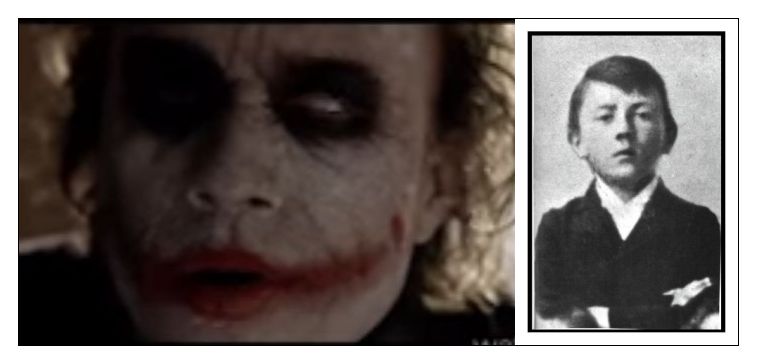
The world wants you to think that evil is only the malevolently grinning jack-o-lantern on the left. However, it is actually the handsome and charismatic serial killer on the right. (Ted Bundy)

In this post-modern society with saturating images coming at us 24 hours a day and 7 days a week, we’re told by image-makers that evil looks like a Joker with smeared makeup, like a Jason with a hockey mask, or bloody axes with screaming teenagers in the background. Satan is the universe’s most subtle creature and he knows that’s just too easy.

Evil is actually not a cartoon character on the left but the gentle, wannabe artist Adolph Hitler on the right.

Left, cartoon character evil Joker. Right, all too real Adolph Hitler as a boy

In fact, evil is the soft-spoken, meek priest who molests your children. Evil is the diligent and organized masterful orator named Adolph Hitler who secretly hates Jews and will burn them in ovens. Evil is not the cartoon character Cruella De Ville, but the Countess Elizabeth Bathory, who was beautiful, of the nobility, but history’s worst female murderer.

Countess Elizabeth Báthory de Ecsed (August 1560 – 21 August 1614) was a Hungarian noblewoman and alleged serial killer from the Báthory family of nobility in the Kingdom of Hungary. She has been labelled by Guinness World Records as the most prolific female murderer, though the precise number of her victims is debated. Báthory and four collaborators were accused of torturing and killing hundreds of young women between 1585 and 1609. The highest number of victims cited during Báthory’s trial was 650. Wikipedia

Genesis 6:5 says that The Lord saw that the wickedness of man was great in the earth, and that every intention of the thoughts of his heart was only evil continually.

So by this we know that all non-saved people are evil. However, does it surprise you when I say that some people are working in league with satan more closely than others? That all have sinned, but there are degrees of sin? And if there are degrees of sin, there are degrees of sinner? As is stated in this Ligonier essay,

It’s clear that we have different degrees of sin when we consider the warnings of Scripture. There are at least twenty-two references in the New Testament to degrees of rewards that are given to the saints in heaven. There are different levels, different rewards, and different roles in heaven. The Bible warns us against adding to the severity of our judgment. Jesus said to Pontius Pilate, “He who delivered me over to you has the greater sin” (John 19:11). Jesus measures and evaluates guilt, and with the greater guilt and greater responsibility comes the greater judgment. It’s a motif that permeates the New Testament. RC Sproul, Are There Degrees of Sin?

These are the personality-disordered narcissists, sociopaths, and psychopaths of the society. In no case that I know of do these evil people approach us with ragged clothes smelling of sulfur and gripping a bloody axe. In no case that I know of does an evil woman wearing a Dalmatian coat and smoking an elongated cigarette cruelly cackle to your face, thus alerting you to her evil. These more evil people will always appear as kind, beautiful, and helpful. They will appear never to hurt a fly and will tell you with all apparent sincerity that they want the best for you.

These more evil people are people with no conscience. These are the people who actually revel in the chaos they create, and they do it on purpose. These are the people who never murder, never cheat on their wives or husbands, never seem to do a harmful thing. Yet these are the people who make absolutely no attempt to apologize, reach agreement, be conciliatory, strive for peaceable harmony, or anything close to the normal relationship currency we’re used to. They lie, manipulate, gaslight, control, and they do it all with a smile.

They will seem to be kind, but they will not be. If unfortunately encountering one of these people, we will ask ourselves,

‘Did my friend just lie to me, again? Can’t be, probably a mistake.’
‘Their actions show that they hate children, but that can’t be, I must be mistaken.’
‘They don’t seem to even care that they are causing chaos and upset in our marriage. Can’t be, I am likely be wrong on this.’

It’s not a communication error, it’s not your fault, it’s not just a mistake that can be cleared up. It’s that the person is evil. Though we strive to give people the benefit of the doubt, and we should, some people are just plain evil. Fact. They won’t murder you, but they like to hurt you in just as evil ways, in the sweetest manner possible. Not just once, but every day, as a life goal.

Though I don’t normally seek wisdom regarding the human condition from Psychology, in the case of extremely evil people, the following 16 key behavioral characteristics that define psychopathy may prove helpful. We infrequently encounter evil in daily life in the fuller force I’m speaking of here, and our minds always will want to reject that that is what’s happening.

From Psychology Today, we read that Hervey Cleckley’s clinical profiles of How to Spot a Psychopath include:

  • Superficial charm and good intelligence
  • Absence of delusions and other signs of irrational thinking
  • Absence of nervousness or neurotic manifestations
  • Unreliability
  • Untruthfulness and insincerity
  • Lack of remorse and shame
  • Inadequately motivated antisocial behavior
  • Poor judgment and failure to learn by experience
  • Pathologic egocentricity and incapacity for love
  • General poverty in major affective reactions
  • Specific loss of insight
  • Unresponsiveness in general interpersonal relations
  • Fantastic and uninviting behavior with alcohol and sometimes without
  • Suicide threats rarely carried out
  • Sex life impersonal, trivial, and poorly integrated
  • Failure to follow any life plan

In my life I’ve encountered incompetent boobs, maniacal windbags, effective liars, grande cheats, and unrepentant adulterers. I myself was an unrepentant sinner for 42 years prior to salvation. Those sins can be dealt with in a different way than the purer evil of the psychopath, sociopath, and disordered narcissist can. In addition to being a sinner and encountering sinners every day, I have also unfortunately encountered a couple of psychopaths. These evil people are rarer but they do exist. I read a good book a many years ago called The Sociopath Next Door. In that book, author Dr. Martha Stout offers helpful advice. Even though I am not an expert on these more evil people, I optimistically tend to disagree with her statistic that 1-in-24 people are sociopaths. At least, I hope not! Dr. Stout writes,

How do we recognize the remorseless? One of their chief characteristics is a kind of glow or charisma that makes sociopaths more charming or interesting than the other people around them. They’re more spontaneous, more intense, more complex, or even sexier than everyone else, making them tricky to identify and leaving us easily seduced.

Their masquerade is helped by their personal charm, beauty, winsomeness, and intelligence. Years ago, when I came across one, it took me a long time to settle on the fact that their evil was in fact evil. By then a lot of damage was done.

But enough of personal comment and psychological theories. What does the Bible have to say about evil? It does come in a beautiful package. Don’t be lulled by Hollywood’s depiction of it and don’t be fooled if you unfortunately meet up with this kind of beautiful and deadly evil

The most evil person in the universe is also the most beautiful. It is said in of Lucifer through the lament in Ezekiel 28:12 that:

You had the seal of perfection, Full of wisdom and perfect in beauty.

Satan masquerades as an angel of light. (2 Corinthians 11:14).

Light is beautiful, light is good. But the key word is masquerade. You must be able to see what is under the light and not be fooled by appearances.

So it is no surprise if his servants, also, disguise themselves as servants of righteousness. Their end will correspond to their deeds. (2 Corinthians 11:15.)

Here, the servants of which the Bible speaks are not only satan’s unholy angels who followed him into rebellion but also people falsely claiming to be followers of Jesus, but who aren’t. They disguise themselves as servants of righteousness, too.

The 2 Corinthians 11:15 verse

Suggests these servants, who may be the false apostles, actually serve Satan and stand as a threat to the Church (compare 2 Corinthians 11:13). Source, Faithlife Study Bible

These evil ones are disguised. The key words in the two verses for the purpose of this essay are that satan masquerades, and his henchmen (and women) disguise themselves. What they disguise themselves with are beauty, kindness, intelligence, righteousness, and light. Too often, people are reluctant to peer under the mask. Even more frequently when they do peer, they deny what they plainly see. That’s in defiance of what the Bible says to do. “For we are not unaware of satan’s schemes so that he would get an advantage over us.” (2 Corinthians 2:11). Don’t be unaware, lest satan outwit you and gain an advantage.

We are reminded again that Jesus warned in Matthew 7:15 that these especially evil ones will come in sheep’s clothing. They won’t appear to you in rags, or bloody tatters like the movies show, but in fluffy, pretty, white sheep’s clothing. Why are they especially evil? Because they do this under cover of Jesus’ name. Unsaved people are just sinners, evil in what they do but they cannot help it. (1 Cor 5:12). These especially evil ones I’m talking of come in the name of Jesus and use His name to perform their deeds. And they do it beautifully. Because they’re sociopaths. Charming, beautiful, and kind.

Satan made his evil look good and delightful, didn’t he?

So when the woman saw that the tree was good for food, and that it was a delight to the eyes…(Genesis 3:6a).

When I was in Europe, I never saw an ugly Catholic cathedral.

Milan Duomo. EPrata photo
Pisa, ‘Piazza Del Miracoli’ plaza of miracles, so named
because of the architectural beauty of the structures
built by genius and capabilities of man. EPrata photo

I am sure that the Asherah poles were beautiful too. They were hewn and carved idols, mentioned often in the Old Testament.

Sociopaths are remorseless and cannot love anyone except themselves. They have no conscience. They do not operate in the interpersonal the same way we do, in good faith, love, kindness, and repentance. Even sinners try to be good in their own way and attempt acts of kindness from a motivation to have a successful interpersonal relationship.

We seek peace, the especially evil one seeks chaos. We love harmony, they love destruction. They are accomplished at reaching their goals and they do it with a smile and a kind word. They kill joy, they annihilate faithfulness, they reject goodness. They do it all in beauty, and often, under the name of Jesus.

But God is beautiful too. So are his people. It takes diligence and discernment to detect the difference between the beautiful sociopath’s evil and the beautiful sister who’s simply stumbling. Between the psychopath’s gorgeousness and the sinner who just does what he does because he doesn’t know better.

Ultimately, God is Good and He will remove forever from His presence all evil and the people who bring evil. Pity the evil person and pray for their deliverance but do not tolerate their evil. Resist it. Rejoice that their evil deeds will be recompensed. Evil has a purpose, if merely to sharpen the Christian or greatly glorify God – and everything in between.

John Frame said in his book Apologetics to the Glory of God,

We cannot always understand why God has chosen evil events to accomplish these good purposes. We do know that God never foreordains an evil event without a good purpose (Rom. 8:28). There may be other reasons than the ones we have mentioned, either to be found in Scripture or to remain locked up in God’s own mind. We know that God has a reason for everything he does. Everything he does reflects his wisdom. But he is under no obligation to give us his reasons. 

Nevertheless, as we see evil used for good again and again in Scripture, can we not accept in faith that those evils which are yet unexplained also have a purpose in the depths of God’s mind? Again, we do not have a complete theoretical answer to the problem of evil. What we do have is a strong encouragement to trust God even amid unexplained suffering. Indeed, the encouragement is so strong that one would be foolish not to accept it.

Thus, the beautiful but deadly flower water hemlock, the gorgeous and intricately barbed cone shell, the charismatic serial killer, the remorseless but kindly-acting sociopath in your circle, all have their purpose. Do not deny that evil exists, do not forget that it comes in a beautiful package, do not avoid acknowledging it if it appears, but always remember, that all things work to your good and the glory of God. The psychopath with no conscience will be seared in hell forever, and we will be dining with the King of Kings and Lord of Lords in joy and peace. Let his remorselessness be eternal. Let our gratitude be forever.

————————————————

Further Reading:

GotQuestions:

 “What does the Bible say about a person who is a sociopath / psychopath?”

Answer: The terms sociopath and psychopath do not appear in the Bible. However, the Bible does mention behaviors that are characteristic of those that today are described by the nearly synonymous terms sociopathic and psychopathic.

In today’s criminal and psychological literature, a sociopath or psychopath is identified as one who is characterized by extreme self-centeredness and immaturity, shallow emotions (including reduced fear, a lack of empathy and remorse, low tolerance for stress, and little response to positive motivations), cold-heartedness, superficial charm, irresponsibility, impulsivity, criminality, a parasitic lifestyle and a desire to manipulate others. A psychopath is one who compulsively performs criminally selfish acts with no apparent conscience or concern about the welfare of his victims.

The Bible identifies such sociopathic and psychopathic behavior as among the severest moral and spiritual effects of man’s fall into sin. Jesus described such sins as arising from evil hearts (Mark 7:20–23). The apostle Paul identified godlessness as the root of such a deadly heart (Romans 1:28–32). The sociopathic heart produces the worst characteristics of sinful man’s nature (Romans 8:5–8), the worst effects of both genetic and environmental moral degradation. Early in human history, God wiped out all but eight people because of such universally incorrigible behavior (Genesis 6:5–13). Deuteronomy 21:18–21 prescribes for the Old Testament nation of Israel the legal consequence of such behavior: execution by stoning. Apparently, such behavior was considered by God to be so disruptive and damaging to the family and to society, so contrary to the character of the people that bore His name and supposedly reflected His image, as to be intolerable.

The New Testament does not offer specifics on civic dealing with these serious problems. Its teachings about morality and immorality of every kind, and its hopeful appeals and invitations to repentance, conversion, and transformed life in Christ, certainly apply to a psychopath as to any sinner. Paul, describing conduct that included sociopathic characteristics, wrote to one congregation of believers in Jesus Christ, “Such were some of you” (1 Corinthians 6:9–11, emphasis added). God is able to rescue and restore to righteousness the most corrupt heart. See Ephesians 4:24; Colossians 3:1–17; Romans 7; Romans 8:1–17 and 28–30.

Posted in discernment, Uncategorized

The problem with evil is, its beauty. Part 1

One of the problems with evil is that too often we have a disconnect between what we understand about evil in theory and what we see in real life. This two-part essay is about how to spot evil in real life, and includes warnings not to be lulled by the beauty of the vehicle bringing it.

First, let us be clear about the underlying premise. Evil exists. The Bible declares that evil exists. We must say that out loud because we live in the post-modern age. The faith is riddled with a skewed perspective that God is love, but that He is only love (and not holiness, wrath, or justice.) To listen to some, one would think that the faith is populated by people hand-holding along candyland stepping stones amid rainbows and unicorns. But the faith is a bloody, constant battle to vanquish evil, including the evil in ourselves. Evil’s lifelong effort is to besmirch, blot, and destroy the goodness of God. It’s to supplant God. Ours is a lifelong effort to overcome evil, to work to expand God’s kingdom, and to give glory to the Goodness of His Name.

We also remind ourselves that evil exists in order to rebut the skewed definition of the word tolerance in today’s faith. Sin is evil. Yet we’re told that tolerance means to accept one’s sin without remark. Like this on a Facebook Community Board:

In the old days that statement would mean that a person is looking for a church filled with saints who strive to be holy (nice), who do not judge one’s past as a sinner because they recognize they are sinners too (non-judgmental) and is populated with an inter-generational demographic because the Bible gives commands that apply to every age group, and the Spirit installs people in local churches from all ages in order to edify each other (young couples).

Nowadays that statement has come to mean the person would be looking for like-minded liberal people (nice) who won’t enact church discipline, preach against sin, or warn me about my attitude (non-judgmental), with young couples (because I select my church based on a ‘shopper’ mentality’ and not by leading of the Holy Spirit, or doctrine, or truth).

To rebut the modern culture, we must constantly remind ourselves of the basics. Today the basic reminder is … evil exists. Here are just a few verses from God’s word regarding evil.

And lead us not into temptation, but deliver us from evil. (Matthew 6:13)

We are told that fearing the Lord begins with hating the evil that he hates.

To fear the Lord is to hate evil; I hate pride and arrogance, evil behavior and perverse speech. (Proverbs 8:13)

We are told to turn away from evil.

Turn away from evil and do good; seek peace and pursue it. (Psalm 34:14)

We are told how to struggle against it.

For our struggle is not against flesh and blood, but against the rulers, against the authorities, against the powers of this dark world and against the spiritual forces of evil in the heavenly realms.
(Ephesians 6:12).

We read in Romans 12:21,

Do not be overcome by evil, but overcome evil with good.

Evil exists. It’s not the occasional Hitler or Stalin. Evil haunts the Christian every day. The Bible gives clear instructions about how to deal with it.

We know all this. We read the Bible and any sensible Christian understands what evil is, the hazards that it poses and the need to resist, struggle, and overcome it. However that is not the problem. The problem is applying the Bible’s verses to life. This is especially hard to do it seems, when it comes to acknowledging that evil is in one’s midst. In our minds, evil is historical (Hitler). Evil is ‘out there’ (Chicago. Cambodia. The city. The country. Elsewhere…). But evil can be and is in your church. Your family. Your circle of friends. Your co-workers. It’s here and it’s everywhere.

Evil is beautiful.

Water hemlock is the deadliest plant in North America. Yet, so beautiful! Do not be deceived!

So pretty! So deadly! Source Alderleaf Wilderness College

Water hemlock is the most violently toxic plant that grows in North America. Only a small amount of the toxic substance in the plant is needed to produce poisoning in livestock or in humans. Livestock usually show signs of poisoning 15 minutes to 6 hours after they eat the plant; they may die within 15 minutes to 2 hours after signs appear. Cicutoxin is a severe convulsant and most animals die as a result of the asphyxia and cardiovascular collapse that occurs during the convulsions. Source: USDA

The cone snail is so pretty! But so deadly!

The bright colors and patterns of cone snails are attractive to the eye, and therefore people sometimes pick up the live animals and hold them in their hand for a while. This is risky, because the snail often fires its harpoon in these situations. In the case of the larger species of cone snail, the harpoon is sometimes capable of penetrating the skin, even through gloves or wetsuits. The sting of many of the smallest cone species may be no worse than that of a bee or hornet sting, but in the case of a few of the larger tropical fish-eating species, especially Conus geographus, Conus tulipa and Conus striatus, a sting can sometimes have fatal consequences. Source Wikipedia

Because we all sin, we’re all evil. (Genesis 6:5). As RC Sproul said,

When I sin, I choose my will over the will of God Almighty. By implication I’m essentially saying that I’m more intelligent, wise, righteous, and powerful than God Himself.” ~RC Sproul

That’s evil. But today I note that there is a special kind of evil that revels in the chaos it foments. It’s purposeful, gleeful, and in a league with satan that goes deeper than the stumbling Christian or the unknowing pagan. Often it’s in the midst of the most benign of situations, the most gentle of churches, the kindest-seeming of people.

When we encounter this deeper kind of evil, our minds want to suppress the truth of it. So, what does that kind of evil look like? More in part 2.

beauty-charm-verse

Posted in discernment, Uncategorized

How fast does satan propagate false doctrines? THIS fast

Three years ago I published an essay discussing the new female-founded, social justice, discipling  organization called “IF:Gathering”. Jennie Allen , founder, decided to start a discipling organization which Allen revealed was based on a command from a voice from the sky. Her words.

Allen, along with Lindsey Nobles and several other women, started this ‘movement,’ as they describe it, to gather women for purposes of discussing their feelings about the Bible. This is accomplished outside of the auspices of the local church. Several participating IF:Leaders admit they actually abandoned their own ongoing church ministries to do form this non-church organization and focus on the global movement they hoped to incite. Their intentions are full of self-stated hubris. They plan to ‘disciple a generation’. They intend to ‘heal the nations’. They will ‘reconcile the world’. They will ‘unleash the next generation of women to live out their purpose’. And so on. You can read about my concerns with the IF movement here, and here.

IF was born from a direct revelation given by a voice in the sky to Jennie Allen sometime in 2007. The movement perpetuates twisted hermeneutics, unbiblical lifestyles, social justice, and a warped view of the Gospel that is based on doubt. That’s the synopsis of concerns regarding IF:Gathering. That it is unhealthy is to say the least. Please read the previous essays for scriptural foundations supporting these concerns.

Today I want to shift focus and show you in pictures just how quickly satan propagates his false doctrines and unbiblical lifestyles.

The first IF:Gathering was held in February 2014. At this writing, exactly three years have passed since then. The movement has indeed caught on. Its activity is mostly hidden. If you haven’t heard about IF that’s because the gatherings are announced via social media and many of them are private. This activity is all going on out of sight for the most part (aside from the annual convention). Three years ago I’d posted a shocking map that showed how many of these public and private gatherings were taking place all around us. Here is the map showing IF:Gatherings three years ago when it began.

By 2017, the gathering’s teachings have spread worldwide. Look how many gatherings are held locally now:

Map from IF:Local, 2/2017
Global map from IF:Local page

From Paraguay to Nova Scotia, from Rwanda to Thailand, From Australia to Denmark, there are IF:locals everywhere. It is a global force by now and it didn’t take satan long to do it.

This fact should primarily remind us that women are vulnerable to satan’s wiles. IF is a female movement through and through. The IF:Locals that are held are mainly held in homes, not churches. Many of them are private parties, so accountability and oversight is very much more difficult to ensure.

For among them are those who creep into households and capture weak women, burdened with sins and led astray by various passions, (2 Timothy 3:6)

 The sad fact of the IF:map fact should also bring to mind the verse where Paul tells us how fast false doctrine spreads. Paul said that false teachings are like gangrene. Gangrene is a fast-spreading condition that occurs when healthy body tissue dies because the disease obstructs blood to it! How apt as a metaphor for the healthy body of the church and its lifeblood from Jesus obstructed and infected by false teachings and teachers!!

But avoid irreverent babble, for it will lead people into more and more ungodliness, and their talk will spread like gangrene. (2 Timothy 2:16-17a).

Do you see the progression? There IS a progression.

Irreverent babble…
leads people into more and more ungodliness…
the talk spreads like gangrene…
gangrene infects even the healthy tissue.

As Barnes’ Notes explains of the effects of gangrene:

will spread over and consume the healthful parts. It will not merely destroy the parts immediately affected, but will extend into the surrounding healthy parts and destroy them also.

I know that some people find discernment work distasteful. They do not see the necessity of one of the important activities of how we defend the faith. I consider the importance of defending the faith by both exalting Jesus AND naming false doctrines and teachers. They do not like to name false teachers, they do not emphasize exercising the skill, or they simply overlook rooting it out, hoping it will go away. Many pastors never even preach on the importance of discernment from the pulpit, or if they do, they make aw shucks apologies. And sadly, many others do not practice it themselves.

I’ve seen many false doctrines and movements come and take root. I know you have too. However, in my experience, (which granted, isn’t lengthy, just 14 years in the faith), I have never seen a doctrine, movement, or pseudo-Christian ‘celebrity’ culture embed itself so fast. Whether that speaks to the low levels of discernment, the bloated pseudo-church, or the lateness of the times, the fact that it’s aimed at women, (or all of the above) I do not know. But this thing is wildfire and it is growing faster even than Charismania or prosperity Gospel. Its tentacles have gone deep.

Notably, in 2012, Pastor Jim Murphy of First Baptist Church of Johnson City, NY found to his dismay how quickly satan’s tentacles embedded themselves into his church when he overlooked some areas he knew he should address but simply hadn’t. Eventually he preached a powerful message to his congregation that took himself to task, and them too. He asked their forgiveness. Then he said,

Now is the time for clarity. No more messing around. No more experimentation. No more dabbling into these dangerous practices. Now is the time for clarity and that clarity comes through discernment: this ability to think Biblically. The ability to read a book and see what it is saying aside from the warm fuzzy you got from it. Discernment takes time and it takes work and shame on you for not taking the time and effort. Shame on you.

In that sermon, Pastor Murphy said that satan’s tentacles had spread so fast and deep, he was saddened and shocked. He took on the guilt himself, saying that he knew the Sunday School and the Church Library held some off-ideas but he didn’t address it because he was so busy and wrongly handed off total responsibility to underlings. He was wrong to do that he said, because false doctrine does not come in only at the pulpit. It comes in the small groups, the library, the women’s ministry. It takes vigilance to combat it.

Please listen to the sermon, it is so good and encouraging!

We see by the map that false doctrine comes through the para-church groups, gatherings, and conventions/conferences your women are participating in. Men, satan targeted Eve. It spreads fast. Don’t think for a moment that satan isn’t working through every means he can to get to your people. Stay strong.

I appeal to you, brothers, to watch out for those who cause divisions and create obstacles contrary to the doctrine that you have been taught; avoid them. (Romans 16:17)

—————————————-

Further reading

Essay: The Five Tests of False Doctrine (Challies)

Essay: False Teachers and Deadly Doctrines(Challies)

Sermon: How to treat false teachers part 1(J. MacArthur)

Sermon: How to treat false teachers part 2(J. MacArthur)

Essay: The Danger in Women’s Ministries (Aimee Byrd)

Posted in discernment, Uncategorized

If:Gathering: more information, including video claiming direct revelation

By Elizabeth Prata

Three years ago I had an inquiry from a sister in the faith about the women of She Reads Truth and the IF:Gathering. In looking at these two organizations, which feature overlap of the ladies who participate in them, I discovered they adhere to a too-forward lifestyle, and teach an aberrant theology that’s unhealthy for women. A series resulted.

Three years later, the IF:Gathering and its women have only embedded themselves deeper into the faith and are tainting even more women with their brand of liberal theology, shaky hermeneutics, usurping lifestyles, and their idol of social justice.

Last week I received two additional, separate inquiries from women who sent me material showing why they were concerned over the IF:Gathering women. I decided to post about this para-church/social justice/liberal organization once again. I am adding new information.

jennie1
WATCH 2-min video here (my other blog)

or below-

The title “IF:Gathering” comes from their motto, “If God is real, then what?” The purpose statement on their IRS forms is to equip women by having them share their feelings about Bible passages posted online. I’m not joking. Here’s their IRS tax form statement of purpose: (click to enlarge)

Did you notice the ‘like-hearted‘ community? The faith is not about feelings, but about what we know about Jesus. Like-minded.

In any case, these women teach other women, usually younger, based on a foundational question that doubts God’s existence. Their entire activity is one of simply hedging bets.

The ‘gathering’ part is actually brilliant. They purport to disciple women in gatherings at homes and other locales, sometimes churches. They know where to gather through social media, which is employed in a major way. That’s why their embeddedness and vigorous activity is hidden from view and thus their danger is not readily seen. There aren’t posters, advertisements, billboards, pamphlets. etc. There’s texts, social media whispers, person-to-person promotion, all of it done in a way that is more subterranean than any other generation’s activity.

IF:Gatherings are ongoing in living rooms and lawns by the thousands. There are A LOT OF GATHERINGS. Look. This map is three years old and their gatherings are only increasing in number:

The idea to disciple women is a good one. However, that is an activity that the church is responsible for. These gatherings take place outside of the auspices of the local church and its pastoral authority.

The gatherings were born from the mind of a young woman named Jennie Allen. At the first Gathering, she revealed that she had heard God whisper to her, and after a few years decided to step out from her church to enact this so-called God-whispered “vision to gather, equip, and unleash women to live out God’s calling on their lives.” She further wrote that she-

“together with a team of friends, formally established IF:Gathering. … Some of the first friends to believe in her vision put aside their own individual ministries to leverage their collective influence for the glory of God and the good of His Church.” (Source, source).

So they abandoned their local ministries to go online for the good of the global church? Exactly wrong. Here is Jennie Allen claiming direct revelation from God as the catalyst for IF.

Video is here, 2 min

They abandoned their ongoing locally accountable ministries, to follow a young woman who’d heard a whisper, in order to establish Bible studies about a God they doubted existed, in order to equip women to discuss feelings about the Bible, enact social justice, reconcile the world, heal the nations, and disciple a generation. Hmmm. I’m not being satirical. All the previous verbiage is from their own statements.

I live in a rural county in Georgia with a population of about 27,000 people spread through five towns in an area of over 286 square miles. My town itself is small, about 1,113 people, and it’s the largest town in the county. And this month there are not one, but two IF gatherings in my town. IF is everywhere, pastors, leaders, and ladies!

From the IF pastor’s packet: (speaking of the years 2013-2015)

In the first two years, our gatherings have reached more than a million women in 50 countries worldwide.

Rather than re-hash the information I’d first published three years ago, I’ll simply offer some new information. First I’ll list some bullet points of concern. Then I’ll post lists of speakers who are involved with IF. Lots of links throughout.

Basic concerns with IF:Gathering:

Founded on Direct Revelation: Founder Jennie Allen said she heard a whisper from God telling her to start a discipleship group. (source, also see above). Direct revelation is hazardous to one’s soul. If you test a direct, audible command from God against the Bible and it’s there, you do not need the audible command. If it is not there, it’s a lie and you don’t need it anyway.

Doubting God: The premise itself is based on study of a God those gathered doubt exist. IF God is real? Doubt is not noble. The Bible says doubt is a destroyer of life. (James 1:5-8).

Lack of male oversight and involvement: Jennie’s husband Zac says he provides theological oversight, but he is listed as working only 10 hours per week at the 501(c) 3 non-profit, and the only other males on the Governing Board are Larry Cotton, who is listed as working 1/hour week and Treasurer Jonathan Harper, who is also listed as a 1-hour a week. The 40-hour/weeks are put in by Jennie and Lindsey. It’s Jennie’s baby, she is listed as Principal Officer on the tax forms. It’s led by Lindsey Nobles who’s listed as CEO. In fact it operates as a para-church organization with little local accountability and pastoral oversight.

IF:Gathering IRS tax return year ending 2015. Source Guidestar

The IF:Gathering’s premise is flawed and so are its goals. Again, from their IRS form, it states that their goals are to foment a ‘global movement’ that ‘promotes healing around the world’. Is that what the Bible says women are to do? Unleash movements? These women are mothers. With children at home. The Bible tells us what we are to do: raise the kids, support the husband. Did even Jesus come to promote healing around the world? And just what IS “healing”, anyway? More on that just below.

Goals are postmodern and extra-biblical: As Tim Challies said, the words reconciliation and healing have a different meaning to the postmodernist liberal than they do to the Christian fundamentalist:

“…perverts the Biblical meaning of “reconciliation.” The Bible does not use this word arbitrarily, but speaks of the reconciliation of man to God and how this can be accomplished. It speaks of redemption! Salvation! Our ministry of reconciliation is not relational healing of myself to my neighbor (right and good as that may be), but the far more important relational healing of a sinful man to a holy God.

The ‘reconciliation’ the IF-ladies mean is the latter, promoting relational healing. Hence their emphasis on feelings and their activity of social justice.

Very good critique from Lighthouse Trails on IF:Gathering. Please read.

Emergent IF: Gathering Conference Coming to a Town Near You (Coming For Your Daughters and Granddaughters)!


Who is involved with IF?

Ann Voskamp. Does she even know how to use the English language anymore? Below is a recent tweet. I thought teachers were supposed to be ‘able to teach’. (2 Timothy 2:24). Being able to teach presumes a facility with the language so as to communicate truths in a way that will edify the hearer. Voskamp’s gone beyond #babble all the way to to #Babel.

The remaining list of IF speakers and participants was sent to me by a concerned sister, which I appreciate. I am familiar with many of the women, and I’m unfamiliar with several. I’ve used the links sent to me and also added links and statements from their own bios where applicable. As always, do your diligence and research yourself.

Jenny Yang (self-described “visionary who works on behalf of refugees as the Vice President of Advocacy & Policy at World Relief.” AKA social justice).

Ann Voskamp (concern, concern, concern, concern)

Lysa Terkeurst (concern, concern, concern, concern)

Jeanne Stevens: self-described teacher who urges women to “take any opportunity to encourage people to live boldly from the fullest part of themselves”. Rather than die to self and live in the strength of the Spirit?  Jeanne is also a Female Pastor -Co-Pastor of Soul City Church with her husband.

Jennie Allen (concern, concern, concern, concern)

B. David Smith: (“B. David loves helping people cultivate their artistic potential and use their gifts, voice, and lifestyle to create God encounters”. What does that even mean?)

Tann Smith (Singer at Andy Stanley’s North Point Church. Need I say more.)

Angie Smith (“Her greatest passion is to make the Bible feel accessible and relevant”. Again with feeling the Bible and not studying/knowing/believing)

Roce Anog (“helps people who don’t speak the majority language to express their worship to God with the use of music, art, dance, storytelling, and food”. So she helps people learn about God through dancing and food? Nope. 1 Corinthians 8 has something to say about that.)

Amena Brown (poetess, which is cool. vision-caster, not cool. Friend to Louie Giglio and Passion conference. Uncool.)

Jo Saxton (Female Pastor. A director of yet another ‘movement’ whose goal is “to CHANGE the world by putting DISCIPLESHIP and MISSION back into the hands of everyday people.” Emphasis theirs. I guess ordinary people haven’t been living and dying for the Gospel these last 2000 years.

Keisha Polonio (helps leaders of Tampa’s microchurches)

Bianca Olthoff (author, Bible teacher)

Christy Nockels (singer)

Shelley Giglio (wife of Louie Giglio)

Esther Havens (photographer)

Lindsey Nobles (CEO & strategist of IF:Gathering)

Shauna Niequist:  (Congratulated Jen Hatmaker for affirming homosexuality,  other concerns)

Ellie Holcomb (singer)

Andrews Lage (singer)

Latasha Morrison (“justice fighter, a bridge builder and a champion of people. Through the work of her non-profit Be the Bridge, she is fostering healthy dialogue around the topic of race.” Just like Lydia, Esther, Mary and the Proverbs 31 woman. Oh wait.)

Kate Merrick (writer)

Rebekah Lyons (wife of Gabe Lyons)

Vivian Mabuni (Campus Crusade for Christ worker)

Britt Merrick (pastor, surfer, founder of Reality Churches (multi-campus)

IF God is real, then what? IF:Gathering
Hath God said? Satan, Genesis 3:3

I hope any of this information helps you. IF gatherings are occurring every day in living rooms and lawns near you. No town is too small, too rural, too citified or too sophisticated to host an IF:table. The brand of Christianity the women promote is far from the Bible’s due to their emphasis on social causes, feminist living (i.e, gallivanting off to Africa while the kids languish at home), doubting God, and discussing their feelings. I pray you protect your daughters and granddaughters from any and all IF activities.

Posted in discernment, Uncategorized

Mail Call #5: My friend is following a false teacher

Mail call is a big deal (at least it was on M*A*S*H)

We love Jesus and we’re so encouraged when a new Christian or a friend who is older but growing obviously develop fruit of the Spirit. However we also grieve when friends or new Christians go the other direction and begin to stray. One way they stray is by following false teachers. I can’t describe the heartache when I see friends post quotes from false teachers, or when they gush about a Bible ‘study’ that was written by someone who is not to be consumed. It hurts. We are all one body and we want the best for our brethren. False teachers are not the best. They are the worst.

What can we do when we see a friend beginning to be drawn away? They buy the false teacher’s books, they talk about what they ‘learned’ from the false teacher, they start attending a small group of this false teacher’s studies… what can we do?

First, remember we are to be wise as serpents and harmless as doves. (Matthew 19:16). In this case, it means we are wise to the schemes of satan. One of his schemes is to send false teachers. We are aware of the danger they pose and we do not minimize it nor ignore it.

But in dealing with our friend we are to be harmless, innocent, kind, and gentle. Harmlessness does not mean gullibility, but it does mean tact.

When Jesus told the Twelve to be as wise as serpents and harmless as doves, He laid down a general principle about the technique of kingdom work. As we take the gospel to a hostile world, we must be wise (avoiding the snares set for us), and we must be innocent (serving the Lord blamelessly). Jesus was not suggesting that we stoop to deception but that we should model some of the serpent’s famous shrewdness in a positive way. Wisdom does not equal dishonesty, and innocence does not equal gullibility.

Nineteenth-century pastor Charles Simeon provides a wonderful comment on the serpent and dove imagery: “Now the wisdom of the one and the harmlessness of the other are very desirable to be combined in the Christian character; because it is by such an union only that the Christian will be enabled to cope successfully with his more powerful enemies” (Horae Homileticae: Matthew, Vol. 11, London: Holdsworth and Ball, p. 318).  

In Matthew 10:16, Jesus taught us how to optimize our gospel-spreading opportunities. Successful Christian living requires that we strike the optimal balance between the dove and the serpent. We should strive to be gentle without being pushovers, and we must be sacrificial without being taken advantage of. (Source GotQuestions)

With that basis, I’d like to offer a few ideas. These are by no means exhaustive. Please comment below with your own success stories of how to engage a friend who is following a false teacher.

I like to ask questions. I ask them in a friendly way what they are getting out of it, or why they enjoy the teacher, or what the study is showing them. If the particular teacher has demonstrated unrepentant disobedience, I might ask them about it and ask if that changes their view of what and how the teacher is teaching them. For example, Christine Caine functions as a self-stated ordained pastor and teaches women that it is OK to step into leadership roles reserved for men. You could ask your friend what she thinks of this. Your friend’s answer could illuminate the direction in which your discussion could go.

If she is unaware that there are some roles reserved for men and others for women, you could explain this to her from the Bible. If she disagrees, then you know from whence her attraction to Caine or the certain teacher is coming from. If she was simply unaware and now agrees, then she’ll likely go away from false teachers who teach opposite to what the Bible says regarding roles, and you have won your sister.

Brothers, if anyone is caught in any transgression, you who are spiritual should restore him in a spirit of gentleness. Keep watch on yourself, lest you too be tempted. (Galatians 6:1).

If the friend is open to these initial probes, I ask if I might share how the false teacher strays from the Word. It is one thing to warn, but it’s more helpful to show how to think about the Word of God and how to compare what a teacher is teaching to the Bible than it is just to say “She’s false.”

For example, Beth Moore relies on personal visions and revelations, and you could show your friend about the canon, why it’s closed, and the true meaning of Paul really meant when he admonished not to despise prophesying. (1 Thessalonians 5:20-21).

It is also good to offer alternatives. Nature abhors a vacuum. The person presumably wants to study the word, and if they desire to study it in Spirit and in truth (John 4:24) then they will want the better option. God knows how to give good gifts.

If you, then, though you are evil, know how to give good gifts to your children, how much more will your Father in heaven give good gifts to those who ask him! (Matthew 7:11)

So then I ask if they are open to receiving some solid material written by good Bible teachers. I accumulate books and CDs and booklets and pamphlets and links, and cache them in my bookcase set aside for the purpose of givine them away when the appropriate moment comes. When the time comes, I just give them the book/essay/CD etc. If I just suggest to them to go buy or acquire a certain resource, they will likely not do it. Sometimes they do. But not usually. I put the material in their hand (or electronic message box) and I have it on hand so I can do it quickly.

We are a discipling body. Christianity is not solitary. Lambs always have a mama sheep nearby. Be involved with the weaker ones, the new ones, the strong ones. Everyone. You could invite the friend to study with you (and your wife if you are a male leader or elder speaking to a woman) or invite him or her come to a group you’re involved with. Personal discipleship and establishing a trusting relationship works wonders.

Pray. Of course this is the best solution, the Spirit knows.

praying at all times in the Spirit, with all prayer and supplication. To that end, keep alert with all perseverance, making supplication for all the saints, (Ephesians 6:18).

Asking the Lord to deliver a sister from the clutches of a false teacher is a wonderful supplication.

~~~~~~~~~~~~~~~~~~~~~

Some resources that might help–

Here is the Gospel Coalition’s essay 7 marks of a false teacher

Here is John MacArthur’s sermon How to treat a false teacher part 1

Here is 9Marks with How I Select and Schedule Discipling Relationships

Another Christian sister who answered the same question way better than I did! Help! My friend follows false teachers

Posted in discernment, Uncategorized

Andy Stanley, Billy Graham, and the Bible on the virgin birth

Andy Stanley, megachurch pastor and son of noted pastor Charles Stanley, said of the virgin birth, this past December,

A lot of people just don’t believe it. And I understand that. Maybe the thought is, ‘Hey, maybe they had to come up with some myth about Jesus to give him street cred, you know, later on.’ Maybe that’s where that came from.

It’s interesting, because Matthew gives us a version of the birth of Christ, Luke does, but Mark and John – they don’t even mention it. A lot has been made of that….

You’ve heard me say some version of this a million times, so this will be old if you’ve been around for a while. But see, if somebody can predict their own death and then their own resurrection, I’m not all that concerned about how they got into the world.

I was not surprised that Andy Stanley said what he said about the virgin birth. Though S. Lewis Johnson reminds us that the miracle was the conception, the birth itself was bloody, messy, and like every other birth in history. After I heard him preach it, I never thought about the virgin birth the same way again!

In any case, Andy Stanley continues to deny our fundamental doctrines (I’ve kept track and there are may doctrines he denies). The way his church treats worship tells us this, too. Just last month he had go-go dancers as part of the singing.

It is not possible either to deny the virgin birth yet accept Christ as holy, sinless deity. When Stanley made his statement, there was quite rightly a hullabaloo over it. However, Stanley is not the first pastor claiming to be conservative who denies the virgin birth as necessary to the faith. Billy Graham also denies the necessity of belief in the virgin birth. Yet there is no hullabaloo over Graham’s denial but only excuses made for his ‘misstatements.’

In my thorough study of Graham, which encompassed listening to sermons from 1949 through to the 1980s, reading several of his books, reading books about him, listening to interviews, and reading two dissertations looking at the evolution of his theology over Graham’s 50 active years, the conclusion is clear to me. In 1993 Graham said to Time Magazine (as codified in Ken Garfield’s book Billy Graham, a Life in Pictures, of the virgin birth specifically,

Graham has said that the virgin birth of Christ is NOT an essential part of the Christian faith. In an interview with a United Church of Canada publication in 1966 (“Billy Graham Answers 26 Provocative Questions,” United Church Observer, July 1, 1966), Graham gave the following reply to a question about the virgin birth of Christ: 

Q. Do you think a literal belief in the Virgin birth — not just as a symbol of the incarnation or of Christ’s divinity — as an historic event is necessary for personal salvation?
A. While I most certainly believe that Jesus Christ was born of a virgin, I do not find anywhere in the New Testament that this particular belief is necessary for personal salvation.

Graham denied the necessity of the virgin birth not just once but several times in different decades. Graham’s response was a classic example of his penchant for doubletalk. Is there any other kind of salvation, besides the personal? Is there global salvation? Impersonal salvation?

And if we use his silly statement as the basis, “I don’t find anywhere in the New Testament” …we can also say “I don’t find anywhere in the New Testament any specific reference to the Trinity” so therefore “belief in the Trinity is not necessary to personal salvation”.

If Christ be not the virgin-born Son of God, He could not be our Savior. To reject the doctrine of the Virgin Birth is to reject the only Sinless Savior that God has provided for sinners.

Of course Graham’s denial of Jesus as the exclusive way to God, as seen in his adoption of the wider mercy approach, was articulated clearly and affirmed with questioning, at Robert Schuller’s Crystal Cathedral interview in 1997, displays Graham’s saddest denial of all.

As mentioned above, Stanley is not the first impostor to preach that believing the virgin conception is unnecessary as a part of the fundamental beliefs for the faith, Graham got there long before Stanley did.

There are five fundamentals of the faith which are essential for Christianity-

1.      The Deity of our Lord Jesus Christ (John 1:1; John 20:28; Hebrews 1:8-9).
2.      The Virgin Birth (Isaiah 7:14; Matthew 1:23; Luke 1:27).
3.      The Blood Atonement (Acts 20:28; Romans 3:25, 5:9; Ephesians 1:7; Hebrews 9:12-14).
4.      The Bodily Resurrection (Luke 24:36-46; 1 Corinthians 15:1-4, 15:14-15).
5.      The inerrancy of the scriptures themselves (Psalms 12:6-7; Romans 15:4; 2 Timothy 3:16-17; 2 Peter 1:20).

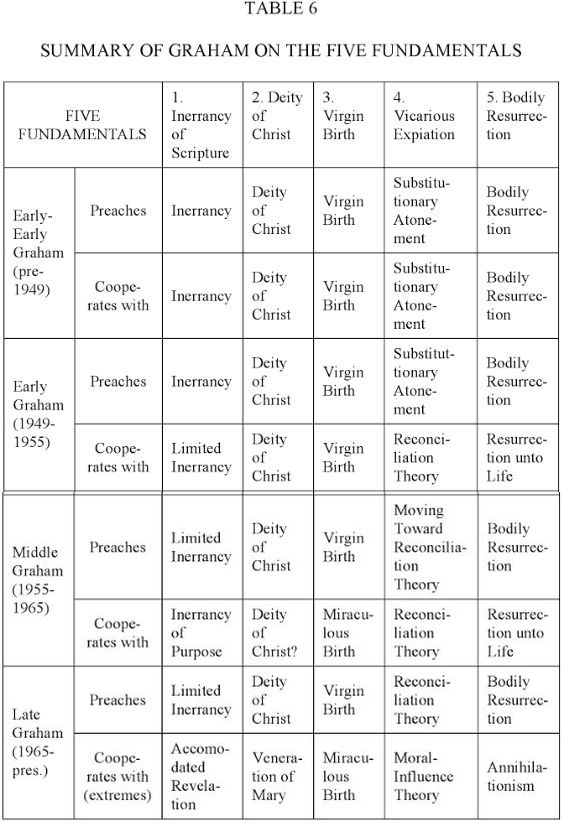
Below is a VERY general look at Thomas P. Johnston’s Examining Billy Graham’s Theology of Evangelism, (p. 379) Graham’s four phases of Graham’s life and Graham’s evolution of the five fundamental doctrines.


The fact is, Jesus told us wolves will come in sheep’s clothing. This means they will appear as friendly and soft-spoken. They will seem to adhere to the Bible’s truths, but they are inside ravenous for your soul. Wolves subtly deny God, just as satan did in the Garden. An excellent example of this subtlety is Graham’s statement “I do not find anywhere in the New Testament that this particular belief is necessary for personal salvation. Be wary, friends. Even popular pastors can be wolves. As a matter of fact, especially popular pastors can be wolves.

GotQuestions: Why is the Virgin Birth so Important?

Jesus was not born in sin; that is, He had no sin nature (Hebrews 7:26). It would seem that the sin nature is passed down from generation to generation through the father (Romans 5:12, 17, 19). The Virgin Birth circumvented the transmission of the sin nature and allowed the eternal God to become a perfect man.

Ligonier: Must Christians believe in the Virgin Birth?

Christians must face the fact that a denial of the virgin birth is a denial of Jesus as the Christ


Grace To You: Why the Virgin Birth is Essential

The virgin birth is an underlying assumption in everything the Bible says about Jesus. To throw out the virgin birth is to reject Christ’s deity, the accuracy and authority of Scripture, and a host of other related doctrines central to the Christian faith. No issue is more important than the virgin birth to our understanding of who Jesus is.