Posted in bible, forgiveness, God, joseph, sovereign

Blame Game

Do you blame others? Try to dodge responsibility for your actions by blaming others? Are you full of excuses? I spent four decades on the planet as an unsaved person, I had honed blame-shifting to near perfection. I could rationalize away the worst sins. “What you did caused me to…” or “Despite what YOU did, I rose above…”

The mark of a spiritually mature person is one who not only accepts responsibility without excuses but seeks to give God glory and thinks of the other person first. Let’s look at three examples from the Bible.

The immediate blame-game that comes to mind are Adam and Eve. It’s disappointing that their first response was one of blaming each other. So much for Adam being a leader, he threw Eve under the bus at the first obstacle. God is asking Adam and Eve what they have done, since they knew they were naked and were hiding from God.

He said, “Who told you that you were naked? Have you eaten of the tree of which I commanded you not to eat?” The man said, “The woman whom you gave to be with me, she gave me fruit of the tree, and I ate.” Then the LORD God said to the woman, “What is this that you have done?” The woman said, “The serpent deceived me, and I ate.” (Genesis 3:11-13)

Neither of them were spiritually mature. But perhaps we can give them a slight break, neither of them had encountered sin before.

Let’s look at Cain and Abel. Cain worked the ground, and Abel was a shepherd (the first one in the Bible?). We know that God accepted Abel’s sacrifice over Cain’s.

In the course of time Cain brought to the LORD an offering of the fruit of the ground, and Abel also brought of the firstborn of his flock and of their fat portions. And the LORD had regard for Abel and his offering, but for Cain and his offering he had no regard. So Cain was very angry, and his face fell. (Genesis 4:4-5)

Cain killed his brother Abel. When God asked Cain about it, Cain deflected his responsibility and denied knowing anything of Abel’s whereabouts. Eve had to be talking into her sin, but Cain couldn’t be talked out of it. Not even by God. Cain remained angry and surly towards God. (Genesis 4:9).

Joseph is the third example. You remember, he was the youngest at the time of Jacob’s sons, and the firstborn of Jacob’s favorite wife, Rachel. Joseph’s older brothers were jealous of Joseph, and conspired to kill Joseph, but then at the last minute decided to profit from their scheme and sold Joseph into slavery in Egypt. That was the last the brothers saw of Joseph until they were facing death in a very severe famine, and traveled to Egypt to buy grain. After a period of time and testing, Joseph revealed who he was to his brothers.

So Joseph said to his brothers, “Come near to me, please.” And they came near. And he said, “I am your brother, Joseph, whom you sold into Egypt. And now do not be distressed or angry with yourselves because you sold me here, for God sent me before you to preserve life. (Genesis 45:4-5).

Of anyone who had reason to blame, it was Joseph. He had been an innocent party of his brother’s sins, and Joseph had suffered terribly for it. Adam, Eve, and Cain were overtly choosing wrong, and blamed others for their acts. Joseph chose right, and ever blamed anyone. Abandoned by his brothers, betrayed by them at a horrific level, (conspiracy of fratricide), falsely accused, being put in jail, attempted rape by Potiphar’s wife, Joseph had reason more than practically anyone in the Bible to blame his brothers.

He could have said,

“Look what you did, and God is repaying you, but I will forgive you!”
“You mocked me when I dreamed of you bowing down to me, and yet here you are, bowing down to me!”
“Don’t you know I hold your life in my hands?”

But Joseph didn’t. First of all Joseph praised God for His providential hand. Recognizing God’s sovereignty is always the best place to start. Then Joseph reassured the brothers, saying they should not be distressed by their act. Joseph sought their good, and removed opportunity for self-blame by emphatically showing he did not blame them. He was seeking the brothers’ good.

That’s what spiritually mature people do. They seek the good of the other person and ignore opportunities to lord it over them.

But Jesus called them to Himself and said, “You know that the rulers of the Gentiles lord it over them, and their great men exercise authority over them. 26″It is not this way among you, but whoever wishes to become great among you shall be your servant, (Matthew 20:25)

In this great text, Jesus was teaching the disciples that the style of greatness and leadership for believers is different. Gentile leaders dominate in dictatorial fashion, using carnal power and authority, Believers are to do the opposite, they lead by being servants and giving themselves away for others, as Jesus did.

A mark of spiritual authority is to accept responsibility for our sins, and if we are the innocent party, to love the sinner and seek their good without lording it over.

I pray the Lord continues His work of reforming me from the inside out, growing me in maturity and to have the strength to humbly repent when I’m wrong; and to love others with a servant attitude who may have harmed me, always pointing to Christ as the one who is sovereign over all.

Posted in beth moore, bible, false teacher, truth

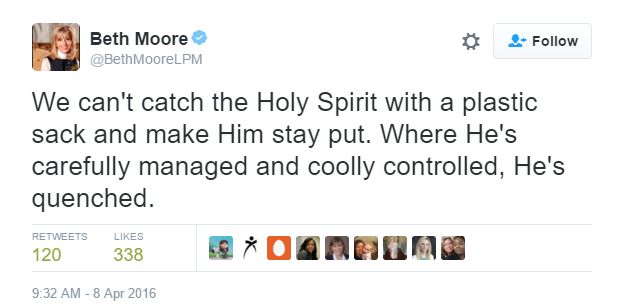
In which Beth Moore says something unbiblical. Again

Do you ladies see the internal inconsistency in this? You “can’t catch the Spirit & make stay Him put” but you CAN catch Him & control Him. On the surface, false teachers’ doctrine always sounds Christian-y, but upon digging only slightly deeper, it falls apart. That’s because it’s cotton candy, all clouds and no water. (Jude 1:12).

Ladies, dig deeper. Don’t accept what teachers say at face value. Examine the Scriptures to see if these things are so. (Acts 17:11). In this particular case, John 3:8 would apply here-

“The wind blows where it wishes, and you hear its sound, but you do not know where it comes from or where it goes. So it is with everyone who is born of the Spirit.”

The Bible Knowledge Commentary says of John 3:8,

“This verse contains a wordplay which cannot be adequately expressed in English. The Greek word pneuma means both wind and Spirit. The work of the Spirit (pneuma) is invisible and mysterious like the blowing of the wind (pneuma). Man controls neither.”

What is really sad to me is how many people retweeted it and ‘liked’ it within just a couple of hours of Moore having published the tweet. The bane of Twitter. Correct theology takes time and care to explain, exceeding Twitter’s 140 characters. But wrong theology can fit neatly into a 140 character limit, and they propagate like the weeds they are.

Posted in bible, feminism, gender roles, social justice, Sojourner Magazine, usurper

‘Down with Patriarchy! Up with women pastors!’ Sojourner’s video about women pastors making a splash

Someone sent me a video that is making a very big hit online. The news article about it said that within 24 hours, the video had garnered 1 million views. “The video has struck a nerve” the article explained. What is this big, splashy, video?

It is from an organization called Sojourners. Sojourners has the latest news and commentary on faith, politics, and culture, their tagline says. Sojourners is a website/social media outlet/movement aiming to transform the world. That is actually their slogan, “Building a Movement to Transform the World.” So this should tell you something about the organization’s mission and overall focus. Their focus is not on Jesus, but what the world thinks about Jesus. Or should think about Jesus. Or should think about the world. Or something.

Anyway, they are all about “social justice” and one glaring injustice, according to Sojourners, is that there is a glass ceiling in the church and women need to break it. It is a 2000 year old trend that just needs to be smashed. Right now. Women’s “sacred worth” isn’t being taken seriously, because they are continually being denied opportunity to serve at the top. They should be allowed to lead, the thrust of the message goes, because it’s 2016, after all.

Their video is very clever and funny. Since they focus on culture, and right now the biggest culture war is the one regarding gender and gender roles, the video is a satirical push-back on why women should not be pastors. They took the usual old excuses which had been used to deny women places of authority in the culture, and applied them to the church, and reversed the roles. So when women used to hear “Their time of the month makes them hysterical and emotional,” Sojourners took that excuse and applied it to men…in the church…as a satirical look at why women have been denied opportunities to lead.

Scholer’s basis is that men and women are equal despite their gender, but the Bible asserts that men and women are equal through their gender. There’s a difference.
However, their video, in addition to being clever and well-done and therefore attractive to those without biblical understanding, is founded on some old work they dug up from Fuller Seminary’s recently deceased Professor, Dr David Scholer. Dr Scholer was a biblical feminist. For 36 years at four seminaries he taught that women should lead, explaining that a careful reading of the gospels and letters of Paul demands full inclusion of women in church leadership. So says his In Memoriam notice.

As a side note, one can immediately see how the liberal theologians do damage to the faith. The video and its main thrust having been founded on a seminary professor’s work, lends it additional credibility. “Look! A Seminary Professor thinks women should be ordained! It must be true!” Never mind that Fuller Seminary jumped the shark years ago. John MacArthur writes a short piece on Fuller’s slide into ultra-liberalism, here, but as far as most people are concerned, a seminary is a seminary.

I read Scholer’s paper on women leading in the church, female ordination etc, and it is very well-written and makes a great argument. An unbiblical argument to be sure, but a solid and credible argument using logic with scripture interwoven throughout, that would be difficult for the lay person to refute. If you read it, you might think, ‘Hey, they make great points, maybe I ought to rethink this.’ No. No you shouldn’t. If you watch the video, you might say, ‘This is funny and true, I like it. Maybe I ought to rethink this.’ No. No you shouldn’t.

And so Sojourners, wading into the culture wars over gender roles, produced “7 Reasons Men should not be Pastors.”

“Can women really lead in the church?” We still hear this question in our churches, often coupled with silly, irrational, or demeaning thinking. Would we put up with the same excuses for excluding men from leadership?

The video’s introduction above from Sojourners is devilishly excellent. Just as satan did, the issue is phrased in the form of a question, and inverted too, just as satan did. God had told Adam “You are free to eat from any tree in the garden; but you must not eat from the tree of the knowledge of good and evil, for when you eat from it you will certainly die.” (Genesis 2:16).

Yet satan reversed that command, asking the woman, “Did God really say, ‘You must not eat from any tree in the garden’?” (Genesis 3:1) [emphasis mine]

The Sojourner query, can women really lead in the church, is phrased to insinuate doubt, form a negative, and lead the willingly deluded to the poisonous water from which they will soon drink, as the next line states. The reasons women can’t lead in the church are “silly and irrational”. Not biblical. A neat blame-shifting trick.

Dr Scholer’s 1983 paper stated,

Modern debates over the ordination of women often miss the crucial and basic issues of the holistic concept of the ministry of the Church reflected in the New Testament. Of course, no person should be ordained or given any responsibilities of ministry within the Church because of gender or for the sake of a “point.” On the other hand, we have affirmed in the Church that no person, called and gifted by God, should be denied any role of ministry or leadership in the Church because of one’s gender. 

The phrasing here is that no one should be denied any role of ministry or leadership… Well, of course no one should be denied the opportunity to minister in the church. It’s what we’re all called to do. But attaching the word leadership with ministry is disingenuous, because though all are called to minister, not all are called to lead. Not even all men are called to lead. But the insinuation here is that ministry IS leadership and vice-versa.

Secondly, the video posits the old canard that gender distinction is a bad thing. There are two distinct genders (though it seems not for long) and because they are distinct this is bad. It is the feminist and liberal theologian’s duty to equalize the two genders into mutually indistinguishable humans with interchangeable roles.

Scholer’s basis is that men and women are equal despite their gender, but the Bible asserts that men and women are equal through their gender. There’s a difference.

The Bible shows that first, man needed woman. The need is real and it exists because men and women complement each other. After man had named and examined all the animals there was no mate suitable for him. He was still alone. It is not good for man to be alone, and so God made woman.

However hard the feminists try, man will always have been made first (1 Timothy 2:13), and man began a relationship with God first and man received his instructions and duties first. Women are cursed with feminism (Genesis 3:16). It is a curse, instilled in us is a desire to rule over our husbands, to want to usurp the natural order of things. At the root, what feminists are attempting to do is reverse the order of creation. Yet they also cannot reverse the fact that God gave man dominion over the earth and a command to work the garden and keep it. It is man who has authority. (Genesis 1:26). He has been given this authority in the home and in the church.

This is not to say that man-woman-children-animals is a top-down hierarchy where women have no say, no worth, and no work to do. In Christianity, submission is a mutual submission, a joyful following of each other and of Jesus. (Ephesians 5:22-33). Each gender has their own role, created exactly for them by an omniscient God who knows what is best.

Women should thank God that “patriarchy is alive and well in the church” as I read in one of the video’s comments. The Head of the Church is a Man-God who has a Father to whom even He submits. Of course, they satirically and they THINK cleverly puncture the excuses for excluding women from leadership in a precious video they’re so proud of, but avoid the one excuse that truly excludes women from leadership- Father God’s prohibition.

The Ultimate Patriarchy is real, and thank God for that. Jesus came to earth as a God-Man, not a goddess, not a god-woman, and not a hermaphrodite. Jesus is a Man, under whom all authority in the universe rests. God Himself, though He is a spirit, is referred to as Father.

So the video is worldly clever, but the Bible says “Woe to those who are wise in their own eyes, and shrewd in their own sight!” (Isaiah 5:21). Ladies, don’t be swayed by a clever video promoting a coyly precious false doctrine. See the resources below which explain from the Bible in a true and not a twisted way as Scholer did, why women’s roles are prescribed, defined, and permanent. Even in 2016.

Resources:

Should women be pastors and elders?

In a social climate of complete equality in all things, the Biblical teaching of only allowing men to be pastors and elders is not popular. Many feminist organizations denounce this position as antiquated and chauvinistic. In addition, many Christian churches have adopted the “politically correct” social standard and have allowed women pastors and elders in the church. But the question remains, is this Biblical? The Bible’s answer to this question is, “No, women are not to be pastors and elders.” Many may not like that answer, but it is, I believe, an accurate representation of the Biblical standard. First of all, women are under-appreciated and under-utilized in the church. There are many gifted women who might very well do a better job at preaching and teaching than many men. However, it isn’t gifting that is the issue. It is God’s order and calling. What does the Bible say?

Response to Dr John Jefferson Davis’ advocacy for female ordination

One of reasons for male-only ordained leadership is the indisputable fact that Jesus Christ appointed only males to the office of apostle. The importance of this observation is often dismissed as being demanded by the social conventions of Jesus’ time, which supposedly left our Lord with no other possible approach.  The idea is suggested that if Jesus were to start the church today, He would of course include women as apostles.  But a little reflection on this will give us pause.

Can a woman be a pastor or a preacher?

There is perhaps no more hotly debated issue in the church today than the issue of women serving as pastors/preachers. As a result, it is very important to not see this issue as men versus women. There are women who believe women should not serve as pastors and that the Bible places restrictions on the ministry of women, and there are men who believe women can serve as preachers and that there are no restrictions on women in ministry. This is not an issue of chauvinism or discrimination. It is an issue of biblical interpretation.

Women pastors – what does the Bible say?

The only way to have a productive dialogue on the women pastors issue is to discuss it biblically. Yes, undeniably, there are men whose views on the issue are clouded by chauvinism. At the same time, there are men and women on both sides of the discussion. So, it should never be assumed that one holds a particular view due to latent chauvinism. The issue should be decided based on what the Bible teaches, not on who can make the strongest ad hominem attack.

Posted in bible, reading, sanctification

Meditating on God’s Word

Let my meditation be pleasing to Him; As for me, I shall be glad in the LORD. (Psalm 104:34)

Thomas Brooks offers an excellent description of Biblical meditation…

Remember that it is not hasty reading—but serious meditation on holy and heavenly truths, which makes them prove sweet and profitable to the soul. It is not the mere touching of the flower by the bee which gathers honey (cp Ps 19:10-note; Ps 119:103-note)—but her abiding for a time on the flower which draws out the sweet. It is not he who reads most, but he who meditates most—who will prove to be the choicest, sweetest, wisest and strongest Christian.”

I’ve read oftentimes that meditating on God’s word is similar to chewing on cud. Not having an agricultural background, I researched exactly how cows digest their nutrients when they graze grass.

What is cud, and why do cattle chew it?

Have you ever noticed that when you see a cow it always seems to be chewing something? The reason is because cows must chew their food twice in order to digest it properly. Cows spend nearly eight hours out of every day chewing their cud. This plus normal chewing of food can total upwards of 40,000 jaw movements per day. 

Cattle are ruminant animals, this mean their stomach contains four compartments:
1. Rumen
2. Reticulum
3. Omasum
4. Abomasum 

Cows have one stomach with four different compartments. 

When a cow first takes a bite, it chews just enough to moisten the food. Once swallowed, the food goes into the first section, the rumen, where it mixes with other acidic digestive liquids and is softened. The softened food is called cud, small balls of food. 

Next, the rumen muscles send the cud back up to the cow’s mouth, where it is re-chewed and swallowed again, this time going to the Omasum section of stomach in order to squeeze out all of the moisture. 

Finally, the food enters the last part, Abomasum of the stomach where it mixes with digestive juices and makes its way to the intestine to be completely digested.

To “chew” on the Bible, we must first read it. I’m always surprised at the number of professing Christians who simply don’t directly read the Good Book. Secondly, when I meditate on God’s word, this is what I tend to do. It may not work like this for you but I find it’s easier to ask questions.

Why is this word here? What does it mean in the original language? What kind of writing is this, Law, Narrative, Poetry, Prophecy? What is the symbolism Agricultural? Cultural? Symbolical? Eschatological? An Idiom?

For example, we read many times in the Bible that they will be “going in and coming out”. (Psalm 121:8, Ezekiel 37:28). Barnes Notes (as well as other commenters) tell us that this is a common Hebrew expression meaning

The Lord shall preserve thou going out and thy coming in – Preserve thee in going out and coming in; in going from thy dwelling, and returning to it; in going from home and coming back; that is, everywhere, and at all times.

Who is the audience here? What do the parallel verses say? What does it make me think of? How does this inform me of God’s attributes?

Like that.

You may write some thoughts in a journal. You may want to discuss the verse or passage or chapter in your small group, or one-on-one with a friend or elder. However you meditate, as the saying goes, just do it.

Some people find that they are distracted during the day and forget the morning’s devotion or the day’s quiet time quickly. Here is where the very present help in the Holy Spirit aids us. He brings these things to mind, He keeps our mind focused on God. He reveals the attributes of Jesus. If you pray and ask for wisdom from reading and learning the verses, He will give it. One of His ministries is to draw us closer to the Lord. We do this through His word. (Ephesians 2:18, 1 John 3:24)

The Spirit sanctifies us through His word. When we meditate upon it, we aid the sanctification process. Ask the Spirit to apply the word you’re meditating upon to your heart and mind’s sanctification to the good of your soul. (John 17:17, Ephesians 5:26, Psalm 119:9-12, James 1:21)

He Guides into all truth. When we meditate upon the Word, the Spirit uses that clay of the Word as a Potter uses the lump of clay to form it into a new creation.

When I meditate upon the Word I find it helpful to mention it during the day, even at work. I might say, “I’m reading Genesis 40 and this morning I read about Potiphar’s wife. Where it says in Genesis 39:12 that Joseph fled the wife and left his coat behind…Man, Joseph and his coats, two times his coats were used against him.” This does several things. It gets the Word into public for any hearers nearby. It helps me process what I’ve read by talking about it out loud. And it helps wash the person you’re talking to when you use the verse, and last, they might have an insight to share back. I like sanctifying conversations.

However you meditate, I encourage you to do it. The process enlarges our heart, solidifies biblical world views in us, sanctifies us, and keeps our focus on Jesus.

“Cud” you do it? 😉

Posted in bible, husband, marriage, prophecy, wife

What marriage is really all about

The Bible begins with a marriage and ends with a marriage. The marriage motif is laced throughout scripture in progressively obvious ways. As BibleGateway explains,

“Marriage is used to describe the relationship between God and Israel in the OT and between Jesus Christ and the church in the NT. Contemplating marriage deepens understanding of God’s love for his people; examining God’s covenant love for his people similarly enriches an understanding of marriage.” (BibleGateway)

It begins in Genesis 2, where God unites Eve and Adam as one flesh. He made Eve from Adam, as a helper fit for him.

Therefore a man shall leave his father and his mother and hold fast to his wife, and they shall become one flesh. (Genesis 2:24)

As we progress through the Old Testament, we see God declare He is “married” to Israel. God’s marriage covenant with Israel is seen in Ezekiel 16:8-14, below. The covenant at Sinai was seen as a form of marriage. See also Jeremiah 31:32; Ezekiel 16:59-60.

God as Israel’s husband is also seen in Isaiah 54:5 and also Hosea 2:7; Joel 1:8.

8 “When I passed by you again and saw you, behold, you were at the age for love, and I spread the corner of my garment over you and covered your nakedness; I made my vow to you and entered into a covenant with you, declares the Lord God, and you became mine. 9 Then I bathed you with water and washed off your blood from you and anointed you with oil. 10 I clothed you also with embroidered cloth and shod you with fine leather. I wrapped you in fine linen and covered you with silk.[a] 11 And I adorned you with ornaments and put bracelets on your wrists and a chain on your neck. 12 And I put a ring on your nose and earrings in your ears and a beautiful crown on your head. 13 Thus you were adorned with gold and silver, and your clothing was of fine linen and silk and embroidered cloth. You ate fine flour and honey and oil. You grew exceedingly beautiful and advanced to royalty. 14 And your renown went forth among the nations because of your beauty, for it was perfect through the splendor that I had bestowed on you, declares the Lord God. (Ezekiel 16:8-14)

In the New Testament, we see frequent symbolism of Jesus as the Groom and the Church as His bride.

For I feel a divine jealousy for you, since I betrothed you to one husband, to present you as a pure virgin to Christ. (2 Corinthians 11:2)

The kingdom of heaven may be compared to a king who gave a wedding feast for his son, (Matthew 22:2)

The Marriage supper is likely one of the most eagerly anticipated events…by Jesus! Since before time began when names were written down, Jesus has been promised a wife, one who will adore Him and with whom He will be the groom, lovingly guiding her all the rest of eternity. The day which He knows not, the day when the Father will say, “Son, go get your Bride”, (cf Matthew 22:2) and brings His church triumphant to heaven for glorification (consummation) will be a tremendous, tremendous moment. It hardly bears mental sensibility to even imagine such an event!

We’ve seen the marriage theme in Adam and Eve, in Hosea, Ezekiel, Isaiah, Joel, and Jeremiah. In the New Testament we see the marriage theme in Matthew, 2 Corinthians, and other books, and now in Revelation.

Then came one of the seven angels who had the seven bowls full of the seven last plagues and spoke to me, saying, “Come, I will show you the Bride, the wife of the Lamb.” (Revelation 19:7)

We Christians long for the day when we are the wife, the glorified, perfected church, able to worship properly and perfectly, walking in true harmony with the Groom. As for the Bible, the marriage metaphor is sewn into the very heartbeat of scripture. It begins with a marriage, scripture showing that all marriages are the picture of Jesus and His redeemed and perfected bride, and the Bible ends with a marriage. The kingdom itself is a wedding feast!

Then came one of the seven angels who had the seven bowls full of the seven last plagues and spoke to me, saying, “Come, I will show you the Bride, the wife of the Lamb.” (Revelation 21:9)

John MacArthur explains in his commentary that in Revelation 21:9 the church is referred to as the wife because the marriage has taken place in Rev 19:7. Oh what a day that will be.

The most important thing to remember is this: earthly marriage is a picture of the Church’s marriage to Jesus. He as Head, lovingly guiding, shepherding, teaching, taking responsibility even though He never makes a problem. The Church as bride, loving her Groom, helping, submitting. Submission is a joyful following. As was stated in our sermon Sunday, a woman said regarding submission (which men are to submit also), “If submission to the Father did not ruin Jesus’ dignity I don’t suppose it will ruin mine.”

Marriage does not exist to make you happy. Being happy has nothing to do with it. I’ts to love a married life (if you’re called to it) in mutual submission, sacrificing for each other, and persevering for the long term. It is a picture of Jesus and His bide and personal happiness has nothing to do with it.  Of course, if you’re happy in your marriage, GREAT! But God did not design marriage for your personal happiness.

Since marriage on earth is a picture of Jesus and His spotless bride, then THAT is why satan works so hard to interfere with marriage. That’s why it’s under assault. It’s why feminism arose, so the wife would be rebellious. It’s why homosexuality arose, so men would not marry women and lead solid homes. And in case someone does not believe that marriage is ‘one man, one woman, forever’, think of this. When the Pharisees asked Jesus about marriage, Jesus explained it by going back to the Old testament and stood firm on Genesis 2:24, which says,

Therefore a man shall leave his father and his mother and hold fast to his wife, and they shall become one flesh.

When the Pharisees tested Jesus on marriage, Matthew 19:4-6 says, He answered, “Have you not read that he who created them from the beginning made them male and female, 5and said, ‘Therefore a man shall leave his father and his mother and hold fast to his wife, and the two shall become one flesh’? 6So they are no longer two but one flesh. What therefore God has joined together, let not man separate.”

So Jesus stood on the OT picture of marriage and that has not changed. Satan tries his best but don’t let him interfere with you wives by allowing your flesh to rise up and usurp the husband, or tempt you to a career choice that sacrifices the children.

The Bible begins with a marriage and it ends with one. Marriage is important.

PS: There are some women and men He has set aside (consecrated) for singleness. Apostle Paul calls this a gift. (1 Corinthians 7:6) For example, there will be 144,000 virgin men who will become super-evangelists during the Tribulation. Jeremiah never married, it’s probable that John the Baptist never did either. In modern times, the famous preacher John Stott never married. Neither did missionary Gladys Aylward. If God has chosen you for singleness, it is a gift and He will sustain you throughout your celibate life for the ministry or task He has consecrated you to. Take heart! You’re in good company!

Posted in bible, discernment, weaker vessel, women

Are you a weak woman, or are you a weak woman?

The Bible says some women are weak, and it is meant in a bad way. The Bible also says Christians are to be weak, but it’s meant in a good way. Let’s look at the two ways.

Weak in a bad way

Silly, weak woman!


For among them are those who creep into households and capture weak women, burdened with sins and led astray by various passions (2 Timothy 3:6)

The Greek word for weak here is gunaikarion, a contemptuous term meaning a silly, foolish, little woman.

Jamieson, Fausset, & Brown Commentary says,

laden with sins—(Is 1:4); applying to the “silly women” whose consciences are burdened with sins, and so are a ready prey to the false teachers who promise ease of conscience if they will follow them. A bad conscience leads easily to shipwreck of faith (1 Ti 1:19).

Matthew Henry’s Whole Commentary on the Bible says of these women:

A foolish head and a filthy heart make persons, especially women, an easy prey to seducers.

John MacArthur Commentary says,

 Weak in virtue and knowledge of the truth. and weighed down with spiritual and emotional guilt over their sins, these women were easy prey for the deceitful false teachers.

Weak in a good way

Weak woman is strong. She prays and relies on Jesus.

For the sake of Christ, then, I am content with weaknesses, insults, hardships, persecutions, and calamities. For when I am weak, then I am strong. (2 Corinthians 12:10).

Gill’s Explains it this way:

for when I am weak, then am I strong; when he was attended with all the above mentioned infirmities, when laden with reproaches, surrounded with necessities, followed with persecutions, and brought into the utmost straits and difficulties, and was most sensible of his weakness in himself to bear and go through all these things; then was he upheld by the divine arm, and strengthened by the power of Christ; so that he was not only able to sustain the conflict, but became more than a conqueror, and even to triumph in the midst of these adversities;

The difference is that silly weak women are loaded down with unrepented-of sin, which clouds their mind and they fall prey to untruth. Weak women who rely on the glorious Divine Arm to lift them are wise, strong, and in His power. They know the truth and see Him clearly. They possess virtue and radiate calm wisdom.

So. Are you a weak woman or are you a weak woman?

Posted in al mohler, bible, discernment, doctrine, don green, false teachers

Discernment cannot survive without doctrine, and where there is doctrine, we need discernment

In 2007 a novel called “The Shack” by William P. Young was published. It is a novel about a father experiencing grief over the kidnap and murder of his 7-year-old daughter. He receives a personal invitation from “God” to meet at the very place where his daughter was killed, a shack in the nearby woods.

The book swept Christianity, with near unanimous affirmation that this was a sensitive and heart-shaking book that revealed Christ as a loving Father. “It changed lives” we heard over and over. But that was wrong, it didn’t change lives. What The Shack did was change our theology.

Is this old news? Perhaps, but I find it helpful to go back sometimes and review the situation. Satan is subtle and he works incrementally. He chips a flake off the wall here and scoops a teaspoon of sand under the wall there and moves the theological touchdown line a foot and then another foot. If he can’t move it a foot satan will move it an inch. He is patient and invested for the long term.

Such incremental declines are initially hard to spot, which is why the Lord gave the Church believers with discernment. We can spot those inches and teaspoons. Therefore it is helpful to go back to already-identified discernment markers and stand on them and look ahead to where we are now and the decline becomes more obvious to those who are new in the faith or who do not possess as much discernment.

The 1963 movie The Great Escape is a good metaphor to use as an illustration of satan’s incremental work. The setting was a Luftwaffe-run prisoner-of-war camp during World War II housing imprisoned US and UK airmen. The POW camp was famous for two escapes. The prisoners dug tunnels inch by inch and subtly scattered the sand from their trouser pockets as they casually walked around the compound topside. It took a while, digging quietly, undermining the camp’s holding power, secretly scattering the sand sometimes a few teaspoons at a time. Over time though, the tunnels were built and the wall was breached. FMI here is a synopsis of the incident.

In 2009, Dr Albert Mohler, President of The Southern Baptist Theological Seminary, wrote an essay responding directly to The Shack’s onslaught, titled, The Shack- The Missing Art of Evangelical Discernment. He first put to bed the claim of Shack-supporters that “its just a novel” and doesn’t have anything real to do with Christian theology. Of course the book does. Mohler wrote,

In evaluating the book, it must be kept in mind that The Shack is a work of fiction. But it is also a sustained theological argument, and this simply cannot be denied. Any number of notable novels and works of literature have contained aberrant theology, and even heresy. The crucial question is whether the aberrant doctrines are features of the story or the message of the work. When it comes to The Shack, the really troubling fact is that so many readers are drawn to the theological message of the book, and fail to see how it conflicts with the Bible at so many crucial points.

Dear Sisters, many novels containing a heavy theological message are merely a disguise for the author’s agenda. In author Young’s case, it was his universalism. Just because a book is a novel doesn’t necessarily mean it is theologically neutral, or even safe. Be wary.

Dr Mohler concluded his 2010 article with this devastating prediction,

The Shack is a wake-up call for evangelical Christianity. An assessment like that offered by Timothy Beal is telling. The popularity of this book among evangelicals can only be explained by a lack of basic theological knowledge among us — a failure even to understand the Gospel of Christ. The tragedy that evangelicals have lost the art of biblical discernment must be traced to a disastrous loss of biblical knowledge. Discernment cannot survive without doctrine.

EPrata photo

He turned out to be correct. Discernment as a regular practice among Christians seems to be at an all-time low, that is, until tomorrow, when it will be lower still. The onslaught didn’t begin nor did it end with The Shack, but only continued briskly apace. Discernment is not just for those having been given the Gift of Discernment, but should be practiced and sought by every Christian. It’s actually a command! (1 Thessalonians 5:21).

A diamond may look to have no flaws at first glance, but if we were to bring it to a jeweler, an appraiser someone who is trained to inspect it. He then takes out his magnifying glass to see how it was cut and find the flaws and imperfections. They have been trained to recognize what is not right. Thus a full examination is the safest course for a believer. Only those who are not teaching or practicing Christianity will object to being tested by the word. Darkness will always run from the light, never light from darkness. Source: (Let Us Reason)

Though the general situation today among the visible church seems bleak, in this sermon Pastor Don Green of Truth Community Church outlines how to develop Biblical Discernment. In this sermon, Green was preaching on the text from 1 John 4:1–6,

Beloved, do not believe every spirit, but test the spirits to see whether they are from God, for many false prophets have gone out into the world. 2 By this you know the Spirit of God: every spirit that confesses that Jesus Christ has come in the flesh is from God, 3 and every spirit that does not confess Jesus is not from God. This is the spirit of the antichrist, which you heard was coming and now is in the world already. 4 Little children, you are from God and have overcome them, for he who is in you is greater than he who is in the world. 5 They are from the world; therefore they speak from the world, and the world listens to them. 6 We are from God. Whoever knows God listens to us; whoever is not from God does not listen to us. By this we know the Spirit of truth and the spirit of error.

Here in this recent essay Pastor Green gives us the Tests for Discernment, stating that the Bible gives us several tests for discerning true and false teachers. As for the sermon above, I took notes. Here are my notes from Pastor Green’s sermon:

There are four basic premises to understand before we begin,

1. Discernment is a command. (Romans 12:9, 1 Thessalonians 5:21, 1 Corinthians 14:29, 1 John 4:1).
2. God has given us the means to discern. The Holy Spirit helps us, (2 Timothy 3:16–17; Ephesians 6:10–19), and we exercise our discernment muscles. (Heb 5:13-14).
3. Understand that not everyone who claims to speak for God, does.
4. The false teachers do not “mean well”. They are trying to deceive you! (1 John 2:26)

There are three discernment tests the 1 John 4 text outlines. The tests are easily understood, being on the surface of scripture, but the challenge is not so much understanding them, but applying them. The absolute key to discernment is to overcome your natural human impulse to make excuses for them and to say “No! I’m called to test the spirits and this teacher doesn’t pass the test and their teaching isn’t from God.” Any Bible teacher should welcome scrutiny in life and in their doctrine. A teacher who says touch not God’s anointed is a person attempting to escape scrutiny. If they say “Touch not God’s anointed!” then run.

So, how can one tell the true from the false? How does the Bible advise how to examine a teacher?

1. Examine their manner of life. Do they live an ungodly lifestyle, or have an unloving disposition?
2. Examine their view of Christ. Because their teaching about Christ is an acid test of whether they speak for God or not. (1 John 4:2-3).
3. Examine their view of scripture and look at their submission to apostolic teaching, and not just lip service affirmation.

False teachers are not innocent teachers who are mistaken. False teachers give voice to demonic teaching. They are a mouthpiece for satan. This is not to be underestimated. It is the spirit of antichrist, and is full opposition to Christ and His kingdom.

Of course I recommend the entire sermon.

Discernment is critical for every Christian to practice. Yes the Gift of Discernment is given to some (1 Corinthians 12:10) but those who are mature and have long practiced discernment find they wield the sword of truth pretty well, too. (Hebrews 5:14).

Our Lord Jesus Christ is worth the practice. He is unique, glorious, and His doctrines are worth protecting. You can do your part by praying for wisdom, reading the Word diligently, and worshiping under a solid pastor. We do this until Jesus comes again.

—————————–

Further reading

Al Mohler updated his older article on biblical illiteracy, a few weeks ago.

The Scandal of Biblical Illiteracy: It’s Our Problem

MacArthur: What is biblical discernment and why is it important? 

Challies: The Discipline of Biblical Discernment

Posted in bible, doctrine, reformed, total depravity, total inability, tulip

Depravity is child’s play

As a child I was often silent or a girl of few words. I was an observer. At recess if it was outdoors I’d stand under the tree on the side of the playground and watch. If it was indoors I’d read and covertly watch. I’d do the same in High School, observe, observe, observe- trying to figure out…people.

The overarching conclusion I came to, no matter my age, is that “people are mean.”

Did I grow up in the Chicago Projects or Fort Apache the Bronx where I saw unspeakable things? No. Did I grow up abused or abandoned so that my perspective has now been permanently tainted? No. I grew up in the wealthiest town in my state with two parents for most of my childhood and all the creature comforts one could want, plus wealthy extras like luxury vehicles, boats, a pool, country club, extended vacations, and occasionally, a maid. My perspective should have been the opposite.

So how, at a tender age, did I come to the conclusion that people are mean? By simply watching them, what they do, how they speak, and how they treat each other, over and over and over. The pattern is clear. People are mean.

Now, if you are in the camp that believes “people are mostly good!” or even “people are mostly good, deep down…” you hold the opposite view of the years of my observations and more importantly, the opposite view of what God’s word tells us people are like. No, people aren’t mostly good. People are mean. Here are just a few verses which remind us of our true nature and our true relationship with God.

Jeremiah 17:9, Psalm 51:5, Psalm 58:3, Ephesians 2:1-5, Romans 3:10-11, John 3:19, 1 Corinthians 2:14, Romans 1:18, Proverbs 14:12, 1 Corinthians 1:18, Romans 8:7.

I’m all grown up now but I’m still an observer. I am a teacher’s aide (AKA para-professional). I spend my work day in classrooms and on playgrounds and in cafeterias watching children. Did you ever notice children playing puppets? They start out all nice and good, and the puppets are doing normal things, but the “play” almost instantly descends into one puppet biting the head off another, or the puppets fighting. If boys are playing dinosaurs, it won’t take long before one dinosaur bites the head off something whether it’s another dinosaur or a toy soldier or the other kid’s finger. Though many children are sweet or nice or kind, their sin-nature eventually reveals itself.

The Doctrine of “Total Depravity” is one that people who think we’re mostly good, or even partly good, find odious. Total depravity is a misnomer in that one way people who lack knowledge of it interpret it to mean that all people are completely depraved all the time. That isn’t what total depravity means. It means,

The effect of the fall upon man is that sin has extended to every part of his personality — his thinking, his emotions, and his will. Not necessarily that he is intensely sinful, but that sin has extended to his entire being. (source)

A better term is “Total Inability.” This means that because our sin nature has extended to all part of us in everr nook and cranny, this fact prevents us from being able to respond to the things of God on our own, in any way. Of course, this doctrine is at “total” odds against Arminianism, which its adherents claim we are able to “choose God”. Of course that’s “total” absurdity. Read this short essay by R. C. Sproul to see why. Or see this below from a different source,

The unregenerate (unsaved) man is dead in his sins (Romans 5:12). Without the power of the Holy Spirit, the natural man is blind and deaf to the message of the gospel (Mark 4:11f). This is why Total Depravity has also been called “Total Inability.” The man without a knowledge of God will never come to this knowledge without God’s making him alive through Christ (Ephesians 2:1-5). (source)

Just watch kids, you’ll see. The simplicity of the child’s faith is on display but equally is their wicked heart quickly seen. The miracle and wonder is that while we were still sinners, Jesus loved us.

but God shows his love for us in that while we were still sinners, Christ died for us. (Romans 5:8).

That while our hearts were darkened and we followed evil and reveled in it, Jesus died for us.

He was delivered over to death for our sins and was raised to life for our justification. (Romans 4:25)

He knows we are totally unable to “choose Christ” or “decide for Jesus” so He made a way. He declared us justified, He gave us a new heart, and He sent the Spirit to conform us to Him. We were totally unable. Yet HE IS TOTALLY ABLE. And He is all we need.

Posted in bible, discipline, reading

Of Reading Plans and Audio Bibles

EPrata photo

This essay will be more if a “fireside chat” than a theological exploration.

I’ve never done a formal “bible reading plan” as you see commonly discussed every January. I just read through a book of the Bible and see where it takes me. But I thought perhaps it might be a good idea this time to formalize my study instead of it being loose and organic as it has been.

I chose to do the Robert Murray M’Cheyne Bible reading plan, and use the audio option. I don’t listen to audio books, I don’t like them. But for some reason I decided to try listening to the Bible (Max McLean reading) and my hunch was right- it brings another aspect to the text. For the texts meant to be heard, such as Peter’s great sermon, or Paul’s sermons, or the legal arguments in Romans, hearing them spoken brings a layer of understanding I’d missed previously. What a joy to hear these sermons and passages read aloud, it ignites a different area of my mind. And no doubt, hearing the names and places in Genesis and Nehemiah spoken correctly is a joy (and a relief).

However the downside is, I don’t feel as though my depth of connection to the text is really there as it has been. I do read along, my eyes going over the text as McLean speaks it, but it’s not the same as when I read it myself. I feel that listening is actually more shallow than the way I used to do it. I gave it a month, and I’ll give it more time to decide if this is working for me. It’s maybe that I just don’t like change.

I’m not impervious to trends and tradition and peer pressure. I see all the hoopla on social media in late December and early January about “which Bible reading plan are you using” and all the posts about the choices and all the Facebook talk about how good these plans are. I think to myself, ‘Should I do one of these? Am I “doing it wrong”? Is there a more rigorous way to go about it? Can I be honoring Jesus further by studying better?’

In the end, I think it’s good to try different ways to read the Bible, such as this plan or that one, or audio v. reading, Kindle vs book, personal reading v. an organized plan. I think it’s good to ask one’s self occasionally if I could be doing better. Slacking is always a problem. The flesh battles with the soul and rebels against the things of Christ, (1 Peter 2:11) so an occasional shake-up won’t harm anything if it’s to ensure that I am still focused on Christ and involved in His word to His glory.

slacker cat. EPrata photo

It’s good to “check in” with yourself to see how things are going, look back over the past year or years to see if your sanctification has leveled off or deepened or weakened, and try to identify the causes. It’s good to be active and proactive about one’s study. The goal of course is to know Christ better, so attempting different levels through the scripture to determine differing measures of successfully engaging with it is OK.

The problem would arise if I sensed that my depth of study was shallower in using a certain Reading Plan and settled for shallow. We always strive to go deeper, know more of Christ, pray for wisdom and insight, pray for the Spirit’s leading on how to use the knowledge gained. Never settle. Strive, press on-

Not that I have already obtained this or am already perfect, but I press on to make it my own, because Christ Jesus has made me his own. (Philippians 3:12)

Posted in 90 minutes in heaven, bible, heaven tourism, truth

Heaven Tourism: Compare Don Piper’s heaven scene with Apostle John’s

I’d written a few days ago that heaven tourism books are bad. The ‘heaven tourism’ phrase refers to the increasing bunch of people who have a vision and claim to have visited heaven, been shown or told things, and ‘came back’ to write a book about it. Or go on the speaking circuit.

No one has visited heaven except He who has come down from heaven, Jesus. (John 3:13). Aside from a very few individuals such as Ezekiel and Isaiah, John and Paul (who incidentally said it was unlawful to speak of the inexpressible things he’d seen (2 Corinthians 12:2-4) heaven currently remains a closed port of call unless one has died in Christ, and even then, at present it remains a one-way trip.

Yet Don Piper claims to have gone there for an hour and a half and came back to write a whole book about it. This is what Don Piper said he saw first thing:

In my next moment of awareness, I was standing in heaven. Joy pulsated through me as I looked around, and at that moment I became aware of a large crowd of people. They stood in front of a brilliant, ornate gate. I have no idea how far away they were; such things as distance didn’t matter. As the crowd rushed toward me, I didn’t see Jesus, but I did see people I had known. (90 Minutes in Heaven, p. 26-27)

John the Apostle went to heaven. He was in the spirit in the Lord’s day. He heard a voice. This is the first thing He saw:

Then I turned to see the voice that was speaking to me, and on turning I saw seven golden lampstands, 13and in the midst of the lampstands one like a son of man, clothed with a long robe and with a golden sash around his chest. 14The hairs of his head were white, like white wool, like snow. His eyes were like a flame of fire, 15his feet were like burnished bronze, refined in a furnace, and his voice was like the roar of many waters. 16In his right hand he held seven stars, from his mouth came a sharp two-edged sword, and his face was like the sun shining in full strength. 17When I saw him, I fell at his feet as though dead.

Don Piper noticed right away that his great-grandmother Hattie’s teeth were white. (p. 34). That is a huge contrast to what John saw and how he behaved according to the scripture above.

Who are you going to believe? Paul, who actually went to heaven, whether in the body or the spirit he did not know, God knows, but who said that to be absent from the body is to be present with the Lord? Or Don Piper who wrote that to be absent from the body is to be present with Great-granny Hattie?

Be very skeptical of people who claim to have visited heaven or some dimension where Jesus is. Beth Moore claims it, Don Piper, Kim Walker-Smith of Jesus Culture band, Colton Burpo, Jesse DuPlantis, and many others. Yet have any of the people who died and were resurrected in the Bible apart from Jesus described anything they saw? Lazarus, Peter’s Mother-in-Law? The sleepy youth who fell out the window? No.

John MacArthur wrote at Answers in Genesis:

Four biblical authors had visions of heaven—not near-death experiences. Isaiah and Ezekiel (Old Testament prophets) and Paul and John (New Testament apostles) all had such visions. Two other biblical figures—Micaiah and Stephen—got glimpses of heaven, but what they saw is merely mentioned, not described (2 Chronicles 18:18; Acts 7:55).
Only three of these men later wrote about what they saw—and the details they gave were comparatively sparse (Isaiah 6:1–4; Ezekiel 1, 10; Revelation 4–6). All of them focused properly on God’s glory. 

They also mentioned their own fear and shame in the presence of such glory. They had nothing to say about the mundane features that are so prominent in modern tales about heaven (things like picnics, games, juvenile attractions, familiar faces, odd conversations, and so on). Paul gave no actual description of heaven but simply said what he saw would be unlawful to utter. In short, the biblical descriptions of heaven could hardly be any more different from today’s fanciful stories about heaven.

Avoid such fanciful stories and focus on what is written for our edification: the holy word of God contained in the 66 books of the Bible. Any and all references or descriptions of heaven in that Book are true and are all that we need to know about heaven for the present time.