Posted in beth moore, false teachers

New Gospel vs. Old Gospel and Paul’s warning to Timothy

Beth Moore preaches Beth Moore. Her studies and talks and tv show are solely about her. This is what a brother in the faith said yesterday, Chris Rosebrough, not about Beth Moore specifically but about the scourge of falsity penetrating the church these days:

“The old gospel is about humble, contrite and repentant faith. The new gospel is about audacious faith.”

“The old gospel is about repentance & forgiveness of sins by Christ’s blood. The new gospel is about behavior modification & the cross is not needed.”

“The old gospel was about our need for an imputed righteousness; the new gospel is about satisfying our craving for significance.”

“The old gospel regenerates sinners born dead in trespasses & sin. The new gospel improves the lives of people who are “basically good”.

“The old gospel was about penal substitution. The new gospel is about life coaching.”

“The old gospel was about sin; the new gospel is about meeting felt needs.”

“The old gospel was about an offended God; the new gospel is about a wounded and victimized humanity.”

Balanced against the old foundational doctrines like that, you can see easily that Beth Moore preaches a new Gospel.

The Word is pure and true. Jesus said that false teachers would come, that doctrines of demons would enter, that they would not stand for sound doctrine but want tickled ears and heap up teachers who preach it. Etc. His word is true and though it is devastating to see the impact of these false teachings, it is satisfying to rely on God’s word when it is proved true over and over again, even in a negative way like this issue is.

If you are not at a good church now, I can recommend some good and biblical preachers online.

John MacArthur
Don Green
Phil Johnson

Steve Lawson
Paul Washer
Justin Peters: “A call for discernment, a biblical critique of the Word-Faith movement”

They are also all over YouTube too. You can trust these preachers in how they handle the word. But don’t believe me, listen for yourself and be a Berean 🙂

Here is a wonderful preaching on The Dangers of Apostasy by Steve Lawson. I really enjoy Pastor Lawson’s preaching, I’ve listened to much of what is available online and then I listened to it over again! Here he delves into the verses from 2 Timothy 3:1-5,

“This know also, that in the last days perilous times shall come. For men shall be lovers of their own selves, covetous, boasters, proud, blasphemers, disobedient to parents, unthankful, unholy, Without natural affection, trucebreakers, false accusers, incontinent, fierce, despisers of those that are good, Traitors, heady, highminded, lovers of pleasures more than lovers of God; Having a form of godliness, but denying the power thereof: from such turn away.”

Pastor Lawson explains that the conditions Paul warns Timothy about in the the last days are not just societal conditions, but conditions of apostasy that will be present in the church. A must listen

The aggressive rise in falsity we detect in our church tells me that Jesus will soon come. O come Lord Jesus!!
http://platform.twitter.com/widgets.jshttp://www.facebook.com/widgets/like.php?href=http://the-end-time.blogspot.com/2012/02/new-gospel-vs-old-gospel-and-pauls.html

http://s7.addthis.com/js/250/addthis_widget.js#pubid=xa-4df8df7d18b59150

Posted in beth moore, false teachers

Beth Moore says God lifted her into another dimension & showed her the church through Jesus’s eyes

This portion of the “teaching” I’m discussing in this essay is a minute long. Her “teaching” in its entirety is longer, about 4 min. The original video I’d included which the transcription is from, has been deleted by Moore. Most copies of it I have been able to find online are marked “not available.” I found that I had downloaded a copy from someone on Youtube who included some verses along with an inter-title caption. His video started a few seconds after the original one, so that is why there are a few sentences of a transcription that don’t appear on the video.

Transcription: “… to beg to differ with people that are ten times smarter than I am. But I want to say to you I see something different than that. I see God doing something huge in the body of Christ. I do not know why I have had the privilege to get to travel around, see one church after another…one group of believers after another, interdenominationally, all over this country, but I have gotten to see something that I think is huge. And I’ll also suggest to you I am not the only one. And tonight I’m going to do my absolute best to illustrate to you something that God showed me out on that back porch. He put a picture…I’ve explained to you before I am a very visual person…so He speaks to me very often of putting a picture in my head. And it was as if I was raised up looking down on a community, as I saw the church in that particular dimension- certainly not all dimensions, not even in many, but in what we will discuss tonight, the church, as Jesus sees it, in a particular dimension.”

Do you know how crazy this sounds? Do you know how wrong this is? Do you know the danger you are in if you believe her?

I had seen that clip of her saying Jesus took her up and showed her the world in HIS dimension a few days ago. I was impacted greatly by it: horrified, aghast, astounded would be words to describe my thoughts and feelings when I heard that from Mrs Moore… and days later I am still feeling that way.

She literally said that God somehow mentally or emotionally or spiritually (Whether it was in the body or out of the body I do not know) took her into a dimension above the world to show her how Jesus sees His bride, effectively saying she was seeing thru Jesus eyes. Didn’t satan do that to Jesus, take Him up and show to Him all the world’s kingdoms? (Mt 4:8) Didn’t the Lord lift up Paul and show Him things, but which no man is permitted to tell? (2 Cor 12:4). Apparently women are, though. Is Mrs Moore more special than Paul? Has God changed His mind on permissions since then? The only conclusion I can make is that God changed His mind on the lifting up and the telling, or it is satan showing her these things. You can guess which one of these two I believe.

The rampant problem of Christians who teach and preach that personal visitations from God are the normative experience are actually chipping away at the foundational truths from the bible which is the ONLY revelation now. (Hebrews 1:1-2)

Yes, God can do what He wants, and He can give revelation, but is He behind personal visitations and whispers and visions? That is the question. I believe the answer is no. He has said that currently He wants us to know Him through Jesus, who is the Word and His word is found in the bible. I go back to Hebrews 1, and also Revelation 22;18,”warn everyone who hears the words of the prophecy of this book: If anyone adds anything to them, God will add to him the plagues described in this book.” Revelation is the last book and with that admonishment, the canon closed. There is no new “seeing thru Jesus eyes” to be gained. It is all in the bible.

What Mrs Moore is saying is that God gave her a special revelation that is apart from the bible and subsequently she is here to teach us about it.

If we accept that we have authoritative word from the bible, PLUS Mrs Moore’s visions, PLUS Bill Hybels’ whispers, PLUS Colton Burpo’s visit to heaven, PLUS Mary K Baker’s visit to hell…where does it end? I say to one and all it ended at Revelation 22. You can read about it more here at MacArthur’s site, “Does God still give revelation?

The canon of scripture is closed. I do not believe Jesus is continuing to give authoritative revelation, and certainly none that we accept as a “teaching” about His church

From GotQuestions about the canon:
“The acquisition of knowledge regarding such things as the true nature of God, the origin of the universe and life, the purpose and meaning of life, the wonders of salvation, and future events (including the destiny of mankind) are beyond the natural observational and scientific capacity of mankind. The already-delivered Word of God, valued and personally applied by Christians for centuries, is sufficient to explain to us everything we need to know of Christ (John 5:18; Acts 18:28; Galatians 3:22; 2 Timothy 3:15) and to teach us, correct us, and instruct us into all righteousness (2 Timothy 3:16).”

I reject Mrs Moore’s claims of being raised up to see the church in another dimension as Jesus sees it.

We don’t need to listen to individuals who say they have had a vision of being lifted up into His dimension, when Jesus came into OUR dimension to tell us, all of us. I’m grieved daily that people increasingly show us by their acceptance of heaping up these teachers who tickle the ears that His intrusion into our dimension was not enough. Now we must go to His, and come back and tell. This is what I mean by the current belief in the bible’s insufficiency. God does have a vision for His church and that vision is contained in the bible. Listening to one person’s extra-biblical revelations about what God showed her and her alone, and through Jesus’s eyes no less, is dangerous in the extreme.

I see these things being said from people within what was once a conservative denomination, and I see and hear others even in churches around me here in GA saying similar, and I wonder, ‘have they all gone mad??’ but the answer is yes, I fear. It is as though as the Lord lifts His hand in ending the Church Age, the delusion that will come upon the whole world is infiltrating even now (2 Thessalonians 2:9-12).
http://platform.twitter.com/widgets.jshttp://www.facebook.com/widgets/like.php?href=http://the-end-time.blogspot.com/2011/12/beth-moore-says-god-lifted-her-into.html

http://s7.addthis.com/js/250/addthis_widget.js#pubid=xa-4df8df7d18b59150

Posted in beth moore, billy graham, false prophets

Discernment lesson: the curse of popularity, Beth Moore, and Billy Graham

Did you know that the Lord curses religious popularity? He does. It is in Luke 6, where Jesus pronounces blessings and woes upon various groups of people. One of them that He pronounces woe upon are popular people and He urges the audience to remember the false prophets of old. Jesus says, “Woe unto you, when all men shall speak well of you! for so did their fathers to the false prophets.” (Luke 6:26). Woe is the strongest possible curse. In the Greek, it is a grief or a cursed denunciation upon a person. Coming from the King of the Universe, the curse of popularity bears paying attention to.

Now, on earth, people seek popularity. There is nothing wrong with being a popular person in your job or in your class or in your family. It means you’re likable. But used in a religious context, if you are a popular teacher or pastor, watch out!

Barnes Notes explains of the verse: “When all men shall speak well of you – When they shall praise or applaud you. The people of the world will not praise or applaud “my” doctrine; they are “opposed” to it, and therefore, if they speak well of “you” and of “your teachings,” it is proof that you do not teach the true doctrine.”

Still not convinced? Jesus said in John 15:19 “If you were of the world, the world would love its own. Yet because you are not of the world, but I chose you out of the world, therefore the world hates you.”

Matthew Henry commentary explains of the Luke popularity verse: “Woe unto you; that is, it would be a bad sign that you were not faithful to your trust, and to the souls of men, if you preached so as that nobody would be disgusted; for your business is to tell people of their faults, and, if you do that as you ought, you will get that ill will which never speaks well.”

Popularity is no guarantee of truth. In one of the Beth Moore exposés I had written, I noted in the comments section, “As to the wide acceptance of teachers, and authors, and others by the majority of mainstream Christianity today, well the first red flag to me is when the world begins to embrace a popular Christian. This is in opposition to what Jesus teaches in John 15:18-19. I’m always skeptical of wildly popular Christian personalities. Being wildly popular these days is almost a sign that falsity exists. People do not stand for sound doctrine, period. “The time will come when they [the people in the church] will not endure [tolerate] sound doctrine; but wanting to have their ears tickled, they will accumulate for themselves teachers in accordance to their own desires; and will turn away their ears from the truth, and will turn aside to myths” (2 Timothy 4:3-4). If there is a wildly popular, lucrative book, DVD, and speaking tour, sellout crowds, AND it is based on strict truth and nothing but the truth, show it to me and then knock me over with a feather.”

Pastor-teacher John MacArthur explains of the Luke verse, “And then the fourth is the curse of popularity. In verse 26, “Woe to you when all men speak well of you, for in the same way their fathers used to treat the false prophets.” And Scripture is pretty clear what happens to false prophets, and those who join with them and affirm them. Oh, you want everybody to speak well of you, huh? You…you’ve designed a religion that causes people to speak well of you. That’s a sign of being cursed. When everybody likes your approach to religion, you’re in serious trouble. When you can invent a kind of religion that offends nobody, that’s a serious indicator you’re not in the Kingdom.”

In late 2010, Christianity Today published a lengthy article about bible teacher Beth Moore. They opened the article saying, “Homespun, savvy, and with a relentless focus on Jesus, Beth Moore has become the most popular Bible teacher in America.”

Uh-oh. If I was the most popular bible teacher in America I’d want to get a spiritual check-up, pronto.

Let’s take a look at a reverse example of popular bible teachers, Jeremiah. Jeremiah lived a righteous life yet he was hated by all for proclaiming the Truth.

“Alas, my mother, that you gave me birth, a man with whom the whole land strives and contends! I have neither lent nor borrowed, yet everyone curses me.” (Jeremiah 15:10).

The more the Word is preached truthfully, the more it will be hated.  The more the Word is preached untruthfully, the more it will be loved. Preaching the true message does not attract believers, it convicts them. It rebukes them. It provokes them.Why? “For the word of God is living and active. Sharper than any double-edged sword, it penetrates even to dividing soul and spirit, joints and marrow; it judges the thoughts and attitudes of the heart.” (Hebrews 4:12)

That Beth Moore is SO popular is an indicator from the Lord’s own word that there is not truth being proclaimed. That’s Beth Moore, now on to Billy Graham.

Here is a link to the transcript from the 1997 interview with Robert Schuller with Billy Graham on his view of wider mercy. The Wider Mercy view is the idea that man in his depraved state can find God, do God’s will, live a righteous life to please God and then go to heaven when he dies. It is a view in which the Lord is going to include everybody in heaven, no matter if they have called on the name of Jesus to be saved or not. Billy Graham believes in the wider mercy view. I wrote about it three weeks ago, here.

It is a view he has held since at least 1997 and likely since 1960 when Graham wrote about it in his Decisions Magazine. Billy Graham believes that a person never calling on the Lord Jesus Christ and outside the body of Christ will go to heaven because he lived a good life?? That is not what the bible says.

Acts 4:12 Neither is there salvation in any other: for there is none other name under heaven given among men, whereby we must be saved.

Just in case we think, oh, that must be a fluke, Billy Graham doesn’t really believe that people of other faiths will inherit salvation? Right? Right? Well in 2005 he said the same thing on Larry King. It is by faith in Jesus alone that we are saved. “That if thou shalt confess with thy mouth the Lord Jesus, and shalt believe in thine heart that God hath raised him from the dead, thou shalt be saved.” Romans 10:9

Failure to speak of the wrath is to fail to alert people what they are being saved FROM:
“Much more then, being now justified by his blood, we shall be saved from wrath through him.” (Romans 5:9)

It is sad that the “greatest evangelist of our time” Mr Graham believes the opposite of the Gospel, believes a different gospel, and thus it means he is false and should not be listened to. But it explains why he is so popular, beloved and famous. Here is a headline from an article from two days ago when Mr Graham turned 93: “Billy Graham, America’s most famous preacher, turns 93“. Wikipedia states, “Graham’s visibility and popularity extended into the secular world. He created his own pavilion for the 1964 New York World’s Fair. He appeared as a guest on a 1969 Woody Allen television special, where he joined the comedian in a witty exchange on theological matters. During the Cold War, Graham became the first evangelist of note to speak behind the Iron Curtain, addressing large crowds in countries throughout Eastern Europe and in the Soviet Union…”

Wow, a preacher so popular he is confidante to presidents, his fame extends into the secular world, his religious influence penetrates the communist/atheist iron curtain. Really? Not wow, but “Woe!”

It is sad to discover that a favored person whom we study under, read books by, or take courses of, is false. But they are out there, many, and more often that not, a famous person WILL be false- Luke 6:26 says so. The more popular someone is the more likely it is that they will be preaching a false Gospel. It is WOE to be universally liked!

Secular popularity of “Christian evangelicals” and teachers, should make us skeptical, yet Rev. Graham and other popular teachers such as Beth Moore are universally liked. How can this be so, when Jesus said that if they hated Him they will hate them also? In Billy Graham’s case, now we know why he is universally liked. He brings a different Gospel.

It’s crushing to know that Graham and Moore, and Osteen and Meyer, and so many other popular ones have woe unto them, when all men shall speak well of them. People who love sin hate the messenger who exposes it. If you are not hated, you are not exposing sin. In journalism they say “If you’re not drawing flak, you’re not over the target.” Are you over the target? If you are, there will be turbulence, turmoil, and plenty of shots at you. Billy Graham and Beth Moore are sadly not over the target. But as long as they draw breath we can pray for them that they should see the light, even after so long a time. THAT is the truth of God’s mercy!
http://platform.twitter.com/widgets.jshttp://www.facebook.com/widgets/like.php?href=http://the-end-time.blogspot.com/2011/11/discernment-lesson-curse-of-popularity.html

http://s7.addthis.com/js/250/addthis_widget.js#pubid=xa-4df8df7d18b59150

Posted in beth moore, end of days. prophecy, false christians, sin, when godly people do ungodly things

Conclusion: How do Christian authors end up channeling spirits and producing books from them? Pride

Part one: Making no distinction between Victorian channeling writers of yore and today’s Christian authors
Part two: Walsch, Young, and Beth Moore: ungodly channelers all

Part 3: Walsch, Young, and Beth Moore: ungodly channelers all (Part 3)

I hope that the thoughts expressed here these last three essays have offered you food for thought and an area of discernment to look for when digesting ‘Christian’ books. I’ve spent the first two essays showing you how a person can wind up being used by the other side, and the third essay illustrating potential reasons why. Now in this conclusion I want to speak of pride.

Pride in my opinion is the the root cause of sin. Satan fell due to pride. What happened to Satan? Ezekiel recorded “Your heart became proud on account of your beauty, and you corrupted your wisdom because of your splendor” (Ezekiel 28:17). Isaiah explains that satan fell because he thought he was better than God. Isaiah 14: 12-15 states — “How art thou fallen from heaven, O Lucifer, son of the morning! how art thou cut down to the ground, which didst weaken the nations! For thou hast said in thine heart, I will ascend into heaven, I will exalt my throne above the stars of God: I will sit also upon the mount of the congregation, in the sides of the north: I will ascend above the heights of the clouds; I will be like the most High. Yet thou shalt be brought down to hell, to the sides of the pit.”

“An high look, and a proud heart, and the plowing of the wicked, is sin.” (Proverbs 21:4)

I want to bring your attention to two statements from writers I’ve been showing you, Beth Moore and Neale Donald Walsch. They are really blasphemous, in my opinion, and need to be examined thoughtfully against what the bible says.

Neale Donald Walsch has said: “In the spring of 1992…an extraordinary phenomenon occurred in my life. God began talking with you. Through me.”

Let’s pull that apart for a minute. God is speaking to the world through Walsch. However, the bible says, “In the past God spoke to our forefathers through the prophets at many times and in various ways, but in these last days he has spoken to us by his Son,” (Hebrews 1:1a). “Has spoken” is an ongoing past tense. So now one must decide whether God is speaking only through Jesus in the Word, or is He speaking to the world through Jesus AND Walsch, or is He speaking only through Walsch. If you decide that God can speak to the world through Jesus AND Walsch, that means Walsch is elevated to a position of equality with Jesus. If you believe God is speaking to the world through Walsch alone, it means God has supplanted Jesus as the verbalizer of the faith. In some way, you must reconcile what Walsch has said with the Hebrews verse.

“Therefore everyone who hears these words of mine and puts them into practice is like a wise man who built his house on the rock.” (Mt 7:24)

If you accept that God is speaking through Walsch, then do we place our house on the rock of Walsch’s words?

Jesus said, “Heaven and earth will pass away, but my words will never pass away.” (Mark 13:31) So does that mean that Walsch’s words will not pass away, either?

We can go on here, but I think by now you see the extreme pridefulness of what Walsch has said, and that it cannot be reconciled with the Word. Therefore avoid the books Conversations with God.

In the preface to Beth Moore’s book When Godly People do Ungodly Things Moore said on page xi,–

If she didn’t write the book, the rocks and stones would cry out?? Here is the biblical reference: “Some of the Pharisees in the crowd said to Jesus, “Teacher, rebuke your disciples!” I tell you,” he replied, “if they keep quiet, the stones will cry out.” (Luke 19:39-40). Barnes Notes explains what is happening in the context of that scene-

“The stones would …cry out – It is “proper” that they should celebrate my coming. Their acclamations “ought” not to be suppressed. So joyful is the event which they celebrate – the coming of the Messiah – that it is not fit that I should attempt to impose silence on them.”

Matthew Henry’s Commentary explains:
“Whether men praise Christ or no he will, and shall, and must be praised (v. 40): If these should hold their peace, and not speak the praises of the Messiah’s kingdom, the stones would immediately cry out, rather than that Christ should not be praised.”

So Moore is saying that her book is so important that all of creation would cry out if she didn’t write it. That is what she is saying. And further, she is putting herself as an equal to the Apostles who were praising JESUS at that time. Moore’s pride in elevating her book to the level of importance akin to joy expressed at the arrival of the Messiah illustrates a prideful heart. We can go on here, but I think by now you see the extreme pridefulness of what Moore has said, and that it cannot be reconciled with the Word. Therefore avoid Beth Moore’s books.

Now, pride is dastardly, It is something that the prideful person may not even detect as a sin. I mean, sexual sin is obvious. If you are having an affair, you know you are sinning. But pride…that one is sneaky.

Gotquestions.org explains God’s view of pride like this:

“Psalm 10:4 explains that the proud are so consumed with themselves that their thoughts are far from God: “In his pride the wicked does not seek him; in all his thoughts there is no room for God.” This kind of haughty pride is the opposite of the spirit of humility that God seeks: “Blessed are the poor in spirit: for theirs is the kingdom of heaven” (Matthew 5:3). The “poor in spirit” are those who recognize their utter spiritual bankruptcy and their inability to come to God aside from His divine grace.”

Check yourself for pride. It is a sly, sneaky sin and it besets us before we know it. I did a repentance check myself this morning, asking the Lord to reveal to me any and all pride I have and to remove it whilst giving me a humble heart. I don’t want to be proud, not even for a moment. It is way too easy to believe your own press clippings, and Walsch and Moore among others, have lost their way detouring along the prideful path. Pray for them that the light will guide them back. I want for all Christians to gain discernment in matters such as books, movies, doctrines, tracts and all other things purporting to be biblical through your own study, prayer, and seeking the Spirit’s guidance. We need pure food these days, and pride is a dish best left to the garbage heap.
http://platform.twitter.com/widgets.jshttp://www.facebook.com/widgets/like.php?href=%20http://the-end-time.blogspot.com/2011/09/conclusion-how-do-christian-authors-end.html

http://s7.addthis.com/js/250/addthis_widget.js#pubid=xa-4df8df7d18b59150

Posted in automatic writing, beth moore, bible jesus, channeling, prophecy, satan

Walsch, Young, and Beth Moore: ungodly channelers all (Part 3)

Part 1: Making no distinction between Victorian channeling writers of yore and today’s Christian
Part 2: Making no distinction between Victorian channeling writers of yore and today’s Christian
Part 3: Walsch, Young, and Beth Moore: ungodly channelers all (Part 3)
Conclusion: How do Christian authors end up channeling spirits and producing books from them? Pride

In the last two essays, I compared the Victorian Spiritist’s method of producing creative works through automatic writing with today’s certain Christian authors receiving ‘Divine’ revelation by invisible force. Automatic writing is when a writer clears his mind, gives his will over to another entity from the supernatural realms, and allows his hand to be used as a transcriber, thereby allowing the entity to produce the work, and not himself through his own consciousness.

The Victorians were very interested in Spiritism which involved contacting ‘the other side’ through seances, early Ouija boards, and trances. Many Victorian writers, painters, and composers allowed themselves to be used in this way to produce some of the more famous works we all know. Rudyard Kipling’s “Kim” is one of those. So is WB Yeats’s famous poem “The Second Coming”. Lewis Carroll and L. Frank Baum of Alice in Wonderland and Wizard of Oz also were members of the Theosophical Society and whose works were influenced by this fervent fad of collusion with the demonic world to produce creative works.

Then I compared the current crop of Christian-ish writers who use the same methods today to produce works that adorn Christian bookstore shelves. I specifically looked at Neale Donald Walsch of Conversations with God, William P. Young of The Shack, and Beth Moore of When Godly People do Ungodly Things.

The point of the essays was not so much to examine the content of what these writers wrote about. Though discernment lacks in many a Christian heart these days, the ungodly moments in those books eventually become apparent to the readers who call upon the Spirit for light and illumination.

Rather, I looked at the method of writing. I asked the question, “How is receiving a poem through automatic writing after a seance through a spirit guide any different from holing up in a cabin, having a long conversation with God and writing down by invisible force the ‘Christian’ doctrines that are then published to today’s fervent acclaim?” I used quotes from the Victorian Spiritists and quotes from the above three named authors and in all cases the language and method of writing was virtually the same. Of course, the answer is that there is no difference.

In the course of researching the background for those two essays, I noticed two similarities in the emotional lives of these automatic writers used by spirits from the other side. This essay will explore how these authors are similar across time, and thus hopefully will provide an understanding of how satan works in the vulnerable for his purposes today.

One thing these people all have in common is they all had a Christian-ish background. The second thing they all had in common was abuse, parents who were distant either physically or emotionally, and trauma of severe kinds that usually resulted in a deep depression throughout adulthood. It was in the depths of their depressions at the bottom of their turmoil that they began to experience the call from the other side. Here are their stories.

Emanuel Swedenborg is ‘credited’ as the father of the latest iteration of New Age demonic Spiritism. He lived from 1688 to 1752. Swedenborg’s father was a theologian who preached to the Swedish King. Swedenborg’s father became professor of theology at Uppsala University and Bishop of Skara. However, Swedenborg’s father became involved in the Pietist movement which was a break from some of the basic tenets of the day, and his father was eventually branded a heretic. This caused Swedenborg to question everything and eventually he decided to pursue science as a career.

As an adult, Swedenborg had been thrust into a deep depression, and he started to record in great detail what was happening to him. He wrote:

“How I found, after I arrived at The Hague, that my interest and the love for my work were gone, at which I myself wondered. How the desire for women so rapidly changed, which had been the main passion of mine. How I have had the best possible sleep at night, which has been more than good. My clear thoughts in these matters.” Increased sleeping and difficulties in concentrating on his scientific work were accompanied by depressive thoughts about his own worth. He wrote in another place: “I wondered about having nothing left to do for my own honor, so that I was even touched; about why I was not inclined for sex, which I have been in all my days. How I was in waking trances nearly the whole time.” The changes in his emotional life and the withdrawal of desire was accompanied by hallucinatory or visionary states of the kind so common for Swedenborg’s later activity as a mystic.”

Rudyard Kipling was born in Bombay, India. At age 5 he was sent to reside with a couple in Portsmouth who boarded children of British nationals who were serving in India. This was customary at the time. Brits wanted their children raised in their own language and culture with a British education. Kipling later recalled the stay at his foster parents’ home with horror, and wondered ironically if the combination of cruelty and neglect which he experienced there at the hands of [foster mother] Mrs. Holloway might not have hastened the onset of his literary life. Kipling preferred to retreat into a fantasy world populated with stories, which he called lies. He also said, “I have known a certain amount of bullying, but this was calculated torture — religious as well as scientific.” (source) He also suffered at the hands of a sadistic brother, “Kipling describes an ugly childhood inquisition where his sadistic foster brother traps him into contradictions, and then accuses him of lying.” So in other words, truth became lies and lies became truth, as the endurance of abuse, separation from his parents, and an overly strict boarding school educational experience twisted his thinking on morals, ethics, and religion. It’s a wonder he even stayed sane.

WB Yeats as an adult recalled the religious crisis he had experienced as a youth in the following terms: “I was unlike others of my generation in one thing only. I am very religious, and deprived by Huxley and Tyndall, whom I detested, of the simple-minded religion of my childhood, I had made a new religion, almost an infallible Church of poetic tradition, of a fardel of stories, and of personages, and of emotions, inseparable from their first expression, passed on from generation to generation by poets and painters with some help from philosophers and theologians. … What Yeats may mean in the passage cited above is that for him religion is related to his perennial sense that life must be comprehended systematically. For the poet refers there to his first attempt to construct a religious system of his own.” In doing this, because the family had a strong tradition of clergy within it, Yeats was at deep contretemps with his father.

The religious system Yeats constructed contained Reincarnation, communication with the dead, mediums, supernatural systems and Oriental mysticism which fascinated Yeats through his life. And we know where that always leads…

Neale Donald Walsch was brought up as a Roman Catholic, was an altar boy, actually. In a conference on ‘God and Love’ at the Fort Collins Lincoln Center, Colorado in what looks to be about ten years ago, Walsch describes his growing disillusionment with the rigidity and minutiae of Catholic traditions as a youth and mocks it cynically in a ‘humorous’ speech. His family encouraged his quest for spiritual truth and eventually he wound up informally studying comparative theology for many years. In that quest, Walsch did not turn to the bible but to himself. “Walsch’s vision is an expansion and unification of all present theologies to render them more relevant to our present day and time.” In other words, Walsch’s journey was away from Jesus and toward a false religion updated and made modern to today’s seekers. Emotionally, in 1996 Neale Donald Walsch realized his life was a mess. He has written that his relationships weren’t working. His health wasn’t good. He got fired from his job. “I woke up one night just angry, really frustrated, and wrote down what was on my mind. God answered.” He then had successive conversations with “God” which became the nine-part series “Conversations With God.”

William P. Young was born to missionary parents and within a stone age cannibalistic tribe that his parents were evangelizing in New Guinea. At age six he returned to Canada and attended 13 different schools before graduating and then attending Bible College. He earned his religion degree and then went on to seminary. In his case, “sexual abuse was probably the most fundamental building block of my shack.” When he was a young child, he said, tribal people near his parents’ missionary station abused him, and more abuse came at a boarding school. At age 38 he had an affair that nearly cost him his marriage. Young says the book “The Shack” was born from the pain he was feeling inside while at the same time recognizing he was a religious performer: “Young says he became “a perfectionist performer with a persona that you present to the world covering up an ocean of shame. I’m the oldest. I took the brunt of some of the negative dynamics in our family at the time. A lot of those things fed into becoming a perfectionist performer. I held it together until I was thirty-eight years old, and then it all blew apart thanks to the grace of God, and I started an eleven year process of dismantling everything and putting it all back together.”

For the next 11 years Young worked through his understanding of “the nature and character of God.” By the end of 2004 he had come to “peace with myself and peace with my sense of who I believe God to be”—a process he condensed to a weekend in the book. He has also said that he wrote four chapters in one weekend and one chapter he never even edited, it just came out whole and stayed intact through all the editing processes of the book.

Beth Moore was raised a Christian in Arkansas, attending church and Sunday School regularly. She earned a political science degree from college and after a few years took a bible doctrine class at her church. Moore has been very open about the sexual abuse she suffered as a child from a family member, mentioning it every chance she is in public, just about. She is also well known for having shared her personal thoughts on her low self-esteem, worthlessness, insecurity, etc. and in fact has memorialized those feelings in most of her books. For all that, she is closely guarded about her personal life but it is my opinion that the frequency with which she raises her personal traumas is an indicator that they are not slain and are in fact indicative of a deep depression, despite all her perkiness.

In all the cases above the person who eventually descended into automatic writing and false doctrines had a working knowledge of the bible, Jesus, and theology. In other words, they were not atheists nor were they raised in a godless environment absent any or all knowledge of who God is or what He requires of us.

Secondly, I noticed that the people I’ve mentioned in part 1 of the old days and part 2 of the current crop of writers we are examining had severe and long-term trauma in their lives. They were horrifically abused, and/or were abandoned, fell into depressions, were attempting to claw their way out of some kind of traumatizing pain.

In the cases I read about, and they are anecdotal to be sure, none of the people said, “I was having a tremendously satisfying career, a strong marriage, and I felt joyful and grateful to God, when I suddenly felt the call from the other side…” Nope. In all the cases, the automatic writers were at their most vulnerable, and at their lowest point of faith, or having abandoned their faith for a false faith so of course it wasn’t there to shore them up.

When we are at our most vulnerable is when we are at our most vulnerable. It sounds redundant but it is a truism that when we are wrestling with why bad things happen to us we mix our sorrow with anger against God, that is when the spirits come. And of course by that I mean the demons, satan’s crew.

In the cases of our writers, many of them felt a sense of restoration after being contacted from the other side. When we’re down, we all want comfort. Yeats was revived in his emotions and his career after his first automatic writings. Young and Walsch have said that they felt restored through the process of writing these things. I believe Moore uses her writings and her talks on tv and at conferences as a therapy session, as I have stated before. What person suffering from trauma, pain, and depression wouldn’t want to respond to a whisper in their ear that ‘god’ can and will take the pain away? But we must guard our heart. What does that mean exactly?

At Gotquestions.org, it is put like this:

“What does it mean to guard your heart?”
“Every Christian is locked in a constant, intense war with demonic forces. Many of us become so intent on fighting the external spiritual war that we forget that much of our battle is not with external forces, but with our own mind and thoughts. James 1:14-16 tells us, “but each person is tempted when they are dragged away by their own evil desire and enticed. Then, after desire has conceived, it gives birth to sin; and sin, when it is full-grown, gives birth to death. Don’t be deceived, my dear brothers and sisters.” Sin always begins in the mind. A sinner must first conceive and dwell on the sinful action before he actually carries it out. The first line of defense, therefore, must be to refuse to even contemplate a wrongful action. The Apostle Paul tells us to take every thought captive, so that it conforms to the will of God (2 Corinthians 10:3-5).”

We live in a world that will pose tribulations to us.

  • Acts 14:22- “strengthening the souls of the disciples, encouraging them to continue in the faith, and saying, “ Through many tribulations we must enter the kingdom of God.”
  • Romans 5:3 – And not only this, but we also exult in our tribulations, knowing that tribulation brings about perseverance;”
  • Ephesians 3:13 – “Therefore I ask you not to lose heart at my tribulations on your behalf, for they are your glory” are but three examples.

We live in a world that is actually satan’s. (2 Cor 4:4). We need strength to deal with the crafty cunning schemes of the satanic system that is all around us. God gave us armor but the armor does not do any good if it is in the closet. (Eph 6:10-19).

Here is an example of the craftiness of the devil’s schemes. William Young is talking about his writing process. He said “In the first draft there was more religious language. God was actually quoting Scripture, which kinda didn’t work. In the re-write I was actually able to embed Scripture in the conversation almost in a way that people don’t pick it up.” Do you think that God would send words to a person about Himself and then hide them so they are not picked up? ‘But it’s just fiction!’ you say. Well, I read Karen Kingsbury and scripture is quoted. You know it is scripture when you read it. It is not hidden, embedded, or slyly introduced so you don’t pick it up. But the craftiness is that once you divorce the scripture from its source you can then change the wording subtly. Worse, once you’ve done that, it is harder to keep the author accountable.

I hope this 3-part series has shown you that not only the content of certain ‘Christian’ works may be corrupt, but the method of their production may also be corrupt. In my opinion, there is no difference in the demonic contacts the Victorian Spiritists sought and the current crop of Christian-ish writers’ ‘divinely inspired works,’ except one: in the Victorian era the writers were not producing works that were directly about Christianity. Moore, Young and Walsch (and who knows how many others) are stating that God told them these things. Christian, beware. Put on your armor, pray, and go forth in confidence that if you are in the Word, you cannot be beaten down. You are a victor, through His blood and enabled by the Holy Spirit that dwells in you! And perhaps most importantly, if you see a brother or a sister that is struggling, go to them and build them up. Love them:

“Do not let any unwholesome talk come out of your mouths, but only what is helpful for building others up according to their needs, that it may benefit those who listen.” (Ephesians 4:29). “Therefore encourage one another and build each other up, just as in fact you are doing.” (1 Thessalonians 5:11)

Posted in beth moore, direct revelation, end time, false teachers

Walsch, Young, and Beth Moore: ungodly channelers all (Part 2)

Part 1: Making no distinction between Victorian channeling writers of yore and today’s Christian
Part 2: Making no distinction between Victorian channeling writers of yore and today’s Christian
Part 3: Walsch, Young, and Beth Moore: ungodly channelers all (Part 3)
Conclusion: How do Christian authors end up channeling spirits and producing books from them? Pride

In part 1 of the comparison between the Victorian spiritist’s automatic writing and today’s certain Christian authors receiving ‘Divine’ revelation by invisible force, I had asked “How is receiving a poem through automatic writing after a seance through a spirit guide any different from holing up in a cabin, having a long conversation with God and writing down by invisible force the ‘Christian’ doctrines that are then published to today’s fervent acclaim?”

I laid the historical groundwork to answer this question, with quotes from famous authors who have received written works from the spirit world through automatic writing. Automatic writing is really modern ghostwriting at its most literal form.

I had said that it is easy to look at WB Yeats and note that having received an entire poem (The Second Coming) in a trance while his hand was being used by an invisible force he ascribes to a spirit guide and say “that’s demonic.” I had wondered why people do not look more closely at some of today’s authors who use the exact same methods and come to the same conclusion, “that’s demonic.” Here are three popular Christian-ish authors who have revealed in interviews that they use the same method, although it goes by a different name now. We no longer hold a seance, call up a spirit guide, and allow our hand to be used as an automatic pen. These authors are today’s Christian mystics engaged in receiving divinely inspired writings in toto after a lengthy bouts of contemplative prayer, usually in seclusion, and are yet said to have a special and close relationship with God because they have done this.

Here are the three authors. I use their examples in order from least Christian to most Christian. Neale Donald Walsch, William P. Young, and Beth Moore.

In 1996 Neale Donald Walsch realized his life was a mess. His relationships weren’t working. His health wasn’t good. He got fired from his job. He  woke up one night just angry, really frustrated, and wrote down what was on his mind. God answered. He then had successive conversations with God. These chats became nine bestsellers. Walsch denies his books have been channeled into him, but this is how he explained to the NY Times how his books came about:

“In the spring of 1992…an extraordinary phenomenon occurred in my life. God began talking with you. Through me. Let me explain. I was very unhappy during that period, personally, professionally, and emotionally, and my life was feeling like a failure on all levels. As I’d been in the habit for years of writing my thoughts down in letters…I picked up my trusty yellow legal pad and began pouring out my feelings. This time…I decided to write a letter to God. It was a spiteful, passionate letter, full of confusions, contortions, and condemnation. And a pile of angry questions….To my surprise, as I scribbled out the last of my bitter, unanswerable questions and prepared to toss my pen aside, my hand remained poised over the paper, as if held there by some invisible force. Abruptly, the pen began moving on its own. I had no idea what I was about to write….Out came….Do you really want an answer to all these questions, or are you just venting? … Before I knew it, I had begun a conversation. … and I was not writing so much as taking dictation. … Often the answers came faster than I could write, and I found myself scribbling to keep up. When I became confused, or lost the feeling that the words were coming from somewhere else, I put the pen down and walked away from the dialogue until I again felt inspired–sorry, that’s the only word which truly fits–to return to the yellow legal pad and start transcribing again.”

He was taking dictation, physically being used by an entity from the other side to write about God. Sorry Mr Walsch, that’s channeling. It is also called automatic writing. And therefore anything that comes from the session should be looked upon with extreme suspicion and likely should be disregarded out of hand. And yet the series of books, “Conversations With God” was a huge bestseller. Our church folks have no discernment today. Sadly.

In 2008, William P. Young wrote a story for his kids about God, Jesus, and the Holy Spirit that his wife encouraged him to publish. It became the runaway bestseller The Shack.

Though Young is not as specific as Walsch, Moore, Yeats, Kipling or other automatic writers as to the exact mechanism of the automatic writing, he does state that the book was generated by whispers from God, dreams, and written pads of conversations he had with Him. “His book, The Shack was birthed from “conversations” and notes he would occasionally write during his 45 minute commutes to work on a commuter train, or from deep thought. “I had a number of those rather ugly yellow pads full of bits of conversations. Sometimes, I would wake up in the middle of the night in the middle of a conversation and grab a notepad to try and remember,” he says.”

Christian apologist Norman Geisler wrote of The Shack‘s origins by quoting from The Shack‘s afterword, “In the final section of the book titled “The Story behind THE SHACK,” he reveals that the motivation for this story comes from his own struggle to answer many of the difficult questions of life. He claims that his seminary training just did not provide answers to many of his pressing questions. Then one day in 2005, he felt God whisper in his ear that this year was going to be his year of Jubilee and restoration. Out of that experience he felt lead to write The Shack. According to Young, much of the book was formed around personal conversations he had with God, family, and friends (258-259).” Toward the end of writing the book, Mr Young had said that he spent one weekend writing four chapters, and one chapter, came out whole and he never edited it.

Beth Moore is a Christian teacher and writer who is currently very popular. The most visible of the trio (the trio being Walsch of Conversations with God, Young of The Shack, and Moore) her method of producing her written works are remarkably similar to them both, and also to the writers mentioned in the part 1 of this series, such as Kipling and Yeats who were admitted Spiritists engaging in automatic writing.

Beth Moore, from ‘Believing God’ said: “What God began to say to me about five years ago, and I’m telling you it sent me on such a trek with Him, that my head is still whirling over it. He began to say to me, ‘I’m gonna tell you something right now, Beth, and boy you write this one down, and you say it as often as I give you utterance to say it: My Bride is paralyzed by unbelief. My Bride is paralyzed by unbelief.’ And He said, ‘Startin’ with you.’” God says, “and boy you write this one down”????? ”

She states in the Believing God DVD: “You know what He told me not too long ago? I told you when I first began this whole concept, He first started teaching it to me about five years ago, and He said these words to me: ‘Baby, you have not even begun to believe Me. You haven’t even begun!’ You know what He said just a few days ago? ‘Honey, I just want you to know we’re just beginning.’ Oh, glory! That meant I had begun. Hallelujah! But He was telling me, ‘When this ends, we ain’t done with this. Honey, this is what we do for the rest of your life.’ And He said those words to me over and over again: ‘Believe Me. Believe Me. And I hope it’s starting to ring in your ears, over and over again, Believe Me.’”

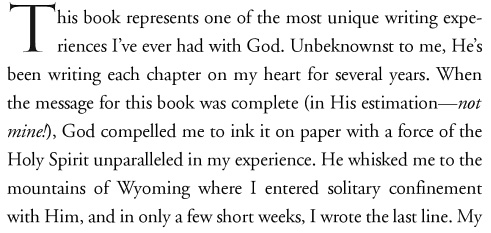
In her book “When Godly People Do Ungodly Things, in the preface she states,

Now here is the question. Beth Moore says that she holed up in a cabin by herself, and a written work poured out, emerging complete and not by her own hand, so why DON’T say it is not of Godly origin? How is it different when Kipling says “My Daemon was with me in the Jungle Books, Kim, and both Puck books and good care I took to walk delicately, lest he should withdraw. I know that he did not because when those books were finished they said so themselves…” from what Moore says: “When the message of the book was complete, in His estimation, not my own”?? In both cases, disembodied spirits were telling the authors what to write and when to stop!

How is it any different when Yeats says the writing emerged from an invisible force channeled automatically through his hand, and Moore says that she was ‘compelled by God to put ink to paper with a force unparalleled’?? In both cases their physical bodies were used by a disembodied spirit to write things down and in both cases they felt like they could not resist the force!

How is it any different when Catholic Mystic Hildegard of Bingen says “And I spoke and wrote these things not by the invention of my heart or that of any other person, but as by the secret mysteries of God I heard and received them in the heavenly places” and Moore saying “Before God tells me a secret, He knows “up front I’m going to tell it! By and large, that’s our “deal.” (Beth Moore, Praying God’s Word, pgs 1-2). Or when Hildegard said she heard a voice say “write what you see and hear” and Moore saying “He began to say to me, ‘I’m gonna tell you something right now, Beth, and boy you write this one down, and you say it as often as I give you utterance to say it…” In both cases, the women were being directed to write what the spirit said, and both were told by a disembodied spirit that they were recipients of secrets extant of the bible but were doctrinally important just the same!

Yet in all the former cases we dismiss the experience from Yeats, Kipling, and Hildegard, easily detecting that they were of demonic origins. Yet we accept Moore’s writings from that same source and by the same method without question. Why? Why is it like this?

“He silences the lips of trusted advisers, and takes away the discernment of elders.” (Job 12:20)

“The days are coming,” declares the Sovereign LORD, “when I will send a famine through the land–not a famine of food or a thirst for water, but a famine of hearing the words of the LORD.” (Amos 8:11).

“Calamity upon calamity will come, and rumor upon rumor. They will try to get a vision from the prophet; the teaching of the law by the priest will be lost, as will the counsel of the elders.” (Ezekiel 7:26)

Clarke’s Commentary explains– “Then shall they seek a vision – Vision shall perish from the prophet, the law from the priest, and counsel from the ancients. Previously to great national judgments, God restrains the influences of his Spirit. His word is not accompanied with the usual unction; and the wise men of the land, the senators and celebrated statesmen, devise foolish schemes; and thus, in endeavoring to avert it, they hasten on the national ruin. How true is the saying, Quem Deus vult perdere, prius dementat. “Those whom God designs to destroy, he first infatuates.”

If you are infatuated with The Shack, stop. If you are infatuated with Beth Moore, quit. I cannot say more strongly that we all need to pray for discernment in these days just prior to national judgment, we need to seek the truth, not automatically generated spirit writings that offer special secrets or additional insight apart from the bible.

“And this I pray, that your love may abound still more and more in real knowledge and all discernment,” (Philippians 1:9)

John MacArthur has written over 150 books. He has preached expositionally from the pulpit at Grace Community Church for 43 years. I would say he is an elder of the faith. In a Q&A session at the conclusion of the Truth Matters Conference he was asked: “What is your perspective that the Holy Spirit leads us by nudging us, or whispering to us or leading through dreams, things like that?”

MacArthur: “Well, I think the Holy Spirit does lead us, but there is no way to perceive that that’s happening. I don’t have a red light that goes on in my head that goes around and around when the Holy Spirit is leading. I don’t know when the Holy Spirit is leading or when I’m following my own impulses or my own desires, or whatever. I have no mechanism to know that. But in retrospect I see it, and I categorize that as the Providences of God. … For example the Friday they brought me a big list of places they want me to speak, and what did I do? Did I go into a trance and say OMMMM or some see if I can induce the Holy Spirit to know what to do? No. I simply looked at the list and thought, I can’t do that one, and I couldn’t do that one, and oh, that one looks doable. You know what would happen, if I am open and want to do God’s will it is amazing how in retrospect that I can look back and say that it was absolutely critical I be there…

“There is no mechanism that we possess that tells us at the moment when the Holy Spirit is leading us in some supernatural way but that in retrospect we can look back and discern by the Providences of God as it unfolded. … I’m not interested in the mystical stuff. I don’t expect the Holy Spirit to give me special impulses or special revelations.”

Interviewer Phil Johnson added, “The mistake a lot of Charismatics make is looking for special revelation when God doesn’t lead us by giving us new special revelation. He leads us by Providence but He is just as active in leading us.”

The mistake that people like Beth Moore and her followers make is that when special revelation is absent, they believe that God is NOT working, that He is NOT leading. So on the one hand we have a preacher of 50 years who says he has no special direct, auditory, or experiential connection to God nor the Holy Spirit that delivers personal direction to him, nor any mechanism that alerts him to when they are working. And when he writes a book he studies, reads, writes, edits, passes it to his circle of editors for revision and goes around again. And on the opposite end of the scale we have Beth Moore breathlessly saying that God “whisked her to Wyoming” where wholly perfect books are delivered through her hand whilst she is having lively conversations in complete sentences with the Spirit.

You choose which is the more likely the truthful Godly experience…and which is not.

Posted in automatic writing, beth moore, demonic influence

Making no distinction between Victorian channeling writers of yore and today’s certain Christian authors (Part 1)

By Elizabeth Prata

Part 1: Making no distinction between Victorian channeling writers of yore and today’s Christian
Part 2: Making no distinction between Victorian channeling writers of yore and today’s Christian
Part 3: Walsch, Young, and Beth Moore: ungodly channelers all (Part 3)
Conclusion: How do Christian authors end up channeling spirits and producing books from them? Pride
———————————

Remember when New Age channeling was the thing? In the 70s, Shirley MacLaine promoted it. But channeling is really older than that, it not so ‘new’. At the turn of the last century, many British luminaries participated in the Spiritist/Spiritualist movement of which channeling was a major part. They sat around and had seances all the time. It was wildly popular but despite the many adherents and the wild popularity, Spiritism never really formed into one church or one doctrine because the movement was extremely individualistic. Each person relied on his or her own experiences with the supernatural to discern the qualities of an afterlife and of understanding the supernatural in general.

Sound familiar today? It is. “Christians” of today claim individualistic and personal experiences with the “Divine” and then produce works that are touted as specially insightful because of the personal revelation. Everything old is new again. “What has been will be again, what has been done will be done again; there is nothing new under the sun.” (Eccelesiastes 1:9)

When adherents to Spiritism held seances or channeled spirits in private, oftentimes the ‘spirit’ delivered creative products to their brain and hand. This Spiritist activity is called “automatic writing.”

In the heyday of the Victorian Spiritist movement, automatic writing was all the rage. It is “A type of divination where the pen appears to direct the writer instead of the writer directing the pen. With pen in hand, the writer sits back, attempts to clear his mind, and waits for the pen, seemingly, to take on a life of its own. … Spiritualists believe that automatic writing is a form of spirit contact with the living; hence the name “spirit writing”. (source)

Automatic writing is really channeling. It is a method of capturing concepts and thoughts from ‘the other side’ through our hand without conscious thought to interfere or censor the thoughts. Automatic writing in spiritism happens when spirits are claimed to take control of the hand of a person to write messages, letters, and even entire books. Automatic writing can happen in a trance or waking state” (Wiki)

Yeat’s famous poem Second Coming (Slouching Toward Bethlehem) was a product of such a kind of supernatural revelatory delivery system. The poem was delivered in toto to Yeats through a spirit while Yeats was in a trance state. Sir Arthur Conan Doyle of Sherlock Holmes fame was also an adherent to spiritism (Theosophical Society member) and his works were influenced by it as were painter Gauguin’s and many others.

Rudyard Kipling was an automatic writer, too. He has written of his process and product,  “My Daemon was with me in the Jungle Books, Kim, and both Puck books and good care I took to walk delicately, lest he should withdraw. I know that he did not because when those books were finished they said so themselves… When your Daemon is in charge, do not try to think consciously. Drift, wait and obey.” (source)

Spiritism flourished during the Victorian era from 1840 to 1920. But Spiritism was not born in the 1840s nor did it die out in the 1920s. Its roots extend to today and backward to the 1740s and Emanuel Swedenborg. An inventor and philosopher, in 1741 at the age of fifty-three, Swedenborg entered into a spiritual phase in which he eventually began to experience dreams and visions beginning on Easter weekend April 6, 1744. This culminated in a spiritual awakening, whereupon he claimed he was appointed by the Lord to write a heavenly doctrine to reform Christianity. Swedenborg and Franz Mesmer are credited with birthing the modern Spiritist movement. (Yes, Mesmer’s name is where we get the term “mesmerized”, meaning when spiritual forces come grouped together and you get mesmerized.).

The mystical qualities of communing with spirits that results in written or composed works goes back even further than Swedenborg. There are myriad Catholic mystics such as Hildegarde of Bingen, who in 1141, at the age of 42, Hildegard received a vision she believed to be an instruction from God, to “write down that which you see and hear.” Hildegarde wrote, “I set my hand to the writing. While I was doing it, I sensed, as I mentioned before, the deep profundity of scriptural exposition; and, raising myself from illness by the strength I received, I brought this work to a close – though just barely – in ten years. […] And I spoke and wrote these things not by the invention of my heart or that of any other person, but as by the secret mysteries of God I heard and received them in the heavenly places.” (source)

We can go back, and back, and back to the beginning but we won’t go back that far, we can stay in the 20th century with the modern day Spiritualists and their seances and mediums, that gave birth to the New Agers of pharmaceutical trances and automatic writing which morphed into today’s Christian mystics engaged in receiving divinely inspired writings after a lengthy bouts of contemplative prayer. It is all the same, you see. This essay and its companion piece conclusion examines these things, and asks the question:

How is receiving a poem through automatic writing after a seance through a spirit guide any different from holing up in a cabin, having a long conversation with God and writing down by invisible force the ‘Christian’ doctrines that are then published to today’s fervent acclaim? 

There is no doubt that automatic writing is thrilling. The Irish National Library says that “automatic writing proved to be a revitalizing force for W.B. Yeats.” It is hard to think up your own stuff. It is easy to let someone/something else plop it into your mind for you.

When we hear of writing that has come from an external, automatic source, such as a seance or a spirit guide, we can comfortably become suspicious because there is the glaring problem of authorship and credibility. Virginia Moore puts the problem of Yeat’s visions and writings gained from automatic writing succinctly: and we can ask this question of all such writers, even (and especially) those who write that way today but claim the writing is from God–

“Invariably students of A Vision ask, Was it really spirit-controlled discourse? Or was it, on Mrs. Yeats’ part, either a garnering of her subconscious, or a telepathic reading of her husband’s mind, neither of which requires extranatural help? Or was it a fabrication on the part of Yeats and/or his wife? Or something else?”

How DOES one discern whether such writings are originating from a subsumed personal will, the subconscious, or a supernatural source either divine or demonic? With the current problem of lack of discernment in the Christian church, these good questions are asked less frequently instead of more frequently. It is easy to point to Victorian Spiritists and mediums holding seances and say that any or all creative products resulting from these sessions have a demonic, not divine, origin. However, we rarely hear of Christians questioning the origin and appropriateness of reading and absorbing as doctrine such writings from today’s pseudo-Christians.

In the next part, I’ll use three examples of popular Christian writers who used the exact same methods as the Victorian Spiritists to produce creative works: they went into seclusion, they contacted or were allowed to be contacted from the spirit world, they were used in automatic writing, and they produced a personal revelation they claim is divine in origin.

Posted in beth moore, bible, bible jesus, end time

Discernment lesson: The Shack and Beth Moore’s treatment of Paul. Part 2

I have extensively written against Mrs Moore as a false teacher in a 7-part series titled Troubled by Beth Moore Teachings. I wrote a second series of my reactions to a two-day Beth Moore conference, here. All those essays, however, were based on video and auditory presentations. I watched her online. I listened to her online. I sat through a DVD teaching. I heard her in person. How about when she writes? Is her doctrine improved when she has time to choose her words carefully over time, edit, and reflect?

The answer is NO.

Mrs Moore wrote “To Live is Christ: Joining Paul’s Journey of Faith” in 2001. This book is touted as “A spiritual odyssey through one of Christianity’s most fervent journeymen and one of Christ’s most passionate followers, Apostle Paul.” One would have hoped Mrs Moore would have taken the attendant time to present the man clearly and biblically, but she did not.

Some of the book is good and some is entertaining, but much of it is based on the original problem I have with Mrs Moore: she approaches her lessons through a personal lens. She admits she is insecure, and then from that humanly flawed perspective sees everyone else that way too. Worse, Mrs Moore then attempts to show that people’s subsequent actions are caused by their insecurity, including reactions and actions of biblical people. I wish she would approach her video, live, or written lessons from a biblical perspective but she prefers to look at the bible as a self-help book populated by people with flaws similar to her own. This is reason enough to reject her teachings. But I’ll be specific.

I am not saying that the people who read the bible are not flawed nor am I saying that the people IN the bible are not flawed (except for Jesus, God, and the Holy Spirit). I am saying that there is a difference in noticing a biblical character’s humanness and it is quite another to see them through your own lens and expect that they have behaved a certain way because of that flaw.

Here is one example. It is actually from Mrs Moore’s book “So Long, Insecurity“, but this passage provides a basis for her approach to Paul. Who, of course, is insecure. Here, she is addressing 2 Cor 11:5-6,

“I do not think I am in the least inferior to those “super-apostles.” I may indeed be untrained as a speaker, but I do have knowledge. We have made this perfectly clear to you in every way.” “Tell me that’s not insecurity. If you’re not convinced, take a look at what blurted from his pen only a chapter later: “I have made a fool of myself, but you drove me to it. I ought to have been commended by you, for I am not in the least inferior to the ‘super-apostles,’ even though I am nothing.” [2 Corinthians 12:11]. Do you think just maybe he protests too much? In all probability, he fought the awful feeling that he wasn’t as good as the others who hadn’t done nearly so much wrong. I totally grasp that. At the same time, Paul also battled a big, fat ego. He was a complex mound of clay just like the rest of us, belittling and boasting of himself in a dizzying psychological zigzag.” (source p. 56-57).

Now let’s look at how bible teacher John MacArthur explains the same verse (2 Cor 12:11). In his sermon “Signs of an Apostle“, he wrote,

“Now starting at the beginning of chapter 10 and up until now, Paul has been directly confronting the false apostles. He started that in chapter 10 and he’ll conclude it in our text. Starting particularly in chapter 11 verse 22, he has given his own credentials as a superior apostle. And as I said, in this two verses he sums that up. And basically there were three things that indicated his true apostleship. The first one he mentions here was the supernatural. He did the signs of a true apostle. The second was his perseverance during suffering, he mentions that in verse 12 when he says, “With all perseverance.” And the third was his utter unselfishness. In verse 13 he says that he did nothing to become a burden to them. When he wants to affirm the character of his true apostleship, he has them look on the supernatural power of God coming through him. He has them look at his perseverance in suffering. And he has them look at his utter unselfishness, because those are in contrast to the false apostles who are void of the power of God, who don’t want to suffer anything but get rich at the expense of the people that they deceive, and who, thirdly, are self-centered and self-focused, seeking only personal gain.”

“In distinction to them, Paul does show the power of God, willingly suffers and perseveres and is utterly unselfish, never being a burden to them in any sense at all. But as far as compared to them, I am not inferior to them in any category. But when he refers to the most eminent apostles, he’s a little sarcastic. That is the extra-super apostles, that’s what they had labeled themselves, these false apostles. They are also called that back in chapter 11 verse 5 where he says, “I consider myself not in the least inferior to the most eminent apostles.” It’s sarcasm. They called themselves the extra-super apostles and they demeaned Paul as a nobody. But he says you know in no category do I come behind them, though myself I am nothing. You have forced me now to this comparison. You have forced me to it because you wouldn’t come to my defense. You have forced me to this folly.” “

My, oh my, how two bible teachers can come to such wildly divergent conclusions over the same passage. MacArthur’s is biblical and Moore’s is emotional. Moore’s, therefore, is wrong.

In Mrs Moore’s book “To live is Christ” which is also about Paul, she uses the words ‘probably’ and ‘I believe’ a lot, but the dots are far from each other. However, that does not stop her from connecting them. In the chapter Idols of Athens, Moore said, “Admittedly I am speculating based on hints in the accounts.” Well kudos to her for alerting her readers that the next part of the paragraph is based on speculation. She continues,

“I suspect that Paul’s visit to Athens was affecting him far more than we realize…”
“Paul was overwhelmed by the polytheistic beliefs of the residents.” (no bible verse given to support this statement)
“During those long hours, I believe he convinced himself that every effort in Athens had failed.”
I suspect he became so focused on the negative that he lost focus of the positive.”
Then Mrs Moore goes on to explain how aloneness affects us and our state of mind. “Solitude exaggerates our negative feelings,” and concludes,
I believe the more Paul thought about his experiences in Athens, the worse he felt.
“You can imagine the beating his ego took in Athens.”
I think Paul felt like a failure.”

She finishes by saying “Obviously, Paul’s experience had a great impact on his next opportunity.”

No, not obviously. An author can spend a page and a half gleaning suspicions from the bible as Mrs Moore does here on page 132-133 but to conclude that her beliefs add up to an obvious impact on his next Godly task is more than a stretch. It is wrong.

She asks, “Does seeing Paul’s experience in this light help you to relate to him as a fellow struggler on the road to serve Christ?” Frankly, no. The struggle she presented was based on her admitted speculations.

Blogger Kim at The Upward Call wrote of Mrs Moore’s approach, addressing Moore’s speculative approach in her lessons on The Patriarchs,

“Speculation doesn’t introduce me to God. It may get my imagination going, and it may engage my emotions, but it does not help me understand God. The appeal to emotions and imagination is popular in “women’s” bible studies, and it is understandable: women like that kind of thing. Emotions and imagination can be set apart for God, but to use them as bible study tools just does not sit well with me. My emotions and my imagination are frequently mistaken.”

If Mrs Moore wants to show Paul as a struggler then she should show his actual struggles from the bible. He had plenty.

Back to choosing certain words. Do you believe that Paul engaged in a ‘dizzying psychological zigzag’ because of his struggle with insecurity and a damaged ego? Presenting him this way does him, and the bible, a disservice. When we get to heaven, we can ask him directly. Meanwhile, gleaning speculations from the bible based on her personal struggle with insecurity is just another in the long line of ways Mrs Moore disrespects her pupils, readers, and the bible itself.

The most egregious effect of the words chosen in So long, Insecurity are these, “If you’re not convinced, take a look at what blurted from his pen only a chapter later: ” She then quotes 2 Corinthians 12:11, interpretations from Moore and MacArthur I shared with you above. It is egregious because what Mrs Moore is saying is that because of Paul’s struggle with a battered ego and deep insecurity, he took out his emotions toward the Corinthians through the pen. ‘Blurted’ evokes a mindless, knee-jerk emotional reaction to a situation. Thus Moore claims that the inspired and carefully constructed words of the bible in that verse were in actuality written hastily, with Paul practically crying over his candle, tears blotting the page as he tore through papyrus to get the words down before his emotions overwhelmed him. Her interpretation is awful. But how many readers will overlook or not even notice her carefully chosen words which skew the bible’s integrity in this way? Many.

Synonyms for blurted are babble, blab, burst out with, jabber, let slip, run off at the mouth, …

Let’s substitute Mrs Moore’s word blurted with a few of those synonyms and remember, we are talking of the holy scripture, every word of which was inspired and is good for reproof, doctrine, and education (2 Timothy 3:16).

‘If you’re not convinced, take a look at [2 Corinthians 12:11] that babbled from his pen only a chapter later:’
‘If you’re not convinced, take a look at [2 Corinthians 12:11] that jabbered from his pen only a chapter later:’

Do you believe that Paul was so upset that he was babbling from a fountain of hurt ego, and that Paul’s blurted holy scripture is now good for our education? Do you believe the Holy Spirit allowed a babbling and emotional Paul to write the words that have come down to us? I do not. I also do not accept that Paul was on a ‘dizzying psychological zig zag’.

Mrs Moore chose these words to include in her book. I reject her assumptions, her lessons, and her approach based on the fact that she does not take a biblical enough approach and that her conclusions in “So Long, Insecurity” and “To Live Is Christ” are admittedly based on her speculation, personal beliefs, and suspicions. I choose not to learn speculations about the bible but rather choose to accept teachings like MacArthur’s which are based on solid biblical understanding of context, history, and scripture.

How about you?
http://platform.twitter.com/widgets.jshttp://www.facebook.com/widgets/like.php?href=%20http://the-end-time.blogspot.com/2011/08/discernment-lesson-shack-and-beth_27.html

http://s7.addthis.com/js/250/addthis_widget.js#pubid=xa-4df8df7d18b59150

Posted in beth moore, bible, bible jesus, discernment, heresy, the shack

Discernment lesson: The Shack and Beth Moore’s treatment of Paul. Part 1

Writers live with words. We are immersed in them, basking in their variety and understanding their power. I have been a journalist, so I know this intimately. A reporter chooses words consciously because we are limited to short article lengths. We must be precise, knowing that each word must convey a certain meaning in a short amount of space. I’ve been a grant writer, and have been even more restricted to limiting the number of words we are allowed to use. I know that each word counts and is consciously placed on the technical document to convey a certain thought. I’ve been an academic researcher, overlaying words to express what the numbers are saying. When I read a book I know that the author has chosen each word, and in some cases likely has fought with an editor over them.

Therefore when I read a book like William P. Young’s “The Shack” or Beth Moore’s “To Live Is Christ: a Study of Paul’s Life and Ministry,” I know that each word is on the page consciously and for an author-chosen reason. I also know that most readers absorb information unconsciously. The most dangerous heresies come from books, in my opinion, because a speaker could possibly be forgiven for misspeaking (once or twice). An author cannot. Writing takes time, and as noted above, each word is chosen purposely.

Most people read books without thinking of the words, but they are absorbed into the mind and certain emotions the author wanted to evoke will be created in the reader’s heart. So please take note carefully when I say that discerning either Christian novels such as The Shack, or biblical non-fiction theological books as the ones Beth Moore writes have an intent. They are sharing a point of view in which the author desires to present a point and often that point is made without you even noticing it. Let’s take a look at exactly what I mean when I say words count and they shade meaning.

I wrote a few years ago in a blog entry on The Quiet Life that “The Shack is a devilish Deception. I’d said about The Shack,  “A concern is also in the sly ways the book chips away at solid biblical principles with craftily written statements such as, “the dusty old King James Bible” or church attendance is “religious conditioning” or that the term “Christian” is “outdated”, as uttered by in the book by the character “Jesus”, saying,  “Who said anything about being a Christian? I am not a Christian.” People may not even be consciously aware of having read negative intent against the bible or Jesus but they are influenced by them anyway.”

Pastor Walter Henegar at the blog byFaith wrote of the sly craftiness of Young’s choice of words in The Shack, and their cumulative effect: “[D]isdain is conveyed early on: “God’s voice had been reduced to paper. … Nobody wanted God in a box, just in a book. Especially an expensive one bound in gilt edges, or was that guilt edges?” (p. 65-67). … More significant, when Mack [the main character] mentions biblical events or concepts (often in gross caricature), “God” promptly brushes them off and glibly explains how it really is. Unlike the biblical Jesus, who constantly quoted the Old Testament and spent many post-resurrection hours “opening their minds to understand the scriptures,” The Shack’s Papa, Jesus, and Sarayu turn Mack’s attention away from Scripture, coaxing him to trust instead their simplistic lessons set in idyllic, Thomas Kinkade-like scenes and delivered in the familiar therapeutic language of our age. … The result? To the extent that you trust The Shack, you will distrust your Bible—including huge chunks of the Old Testament and at least half of the red letters. Few errors are more corrosive to vigorous Christian faith. Some will plead that there is enough meat for careful readers to spit out the bones, but sadly, this yeast leavens the whole loaf.”

Mr Henegar makes a good point about the leaven. A leavening agent is used in recipes where the desired outcome lightens and softens the entire batch. Yeast is a common leavening agent. The dough rises upon foaming bubbles as carbon dioxide is released, making air pockets. However, since leaven is an ingredient, it is mixed thoroughly in the batch, and no part of the batch is left untouched by it. If the leaven is bad, the whole loaf will be spoiled.

That is a good metaphor for bad doctrine. No part of the church will be left untouched by heresy coming from the pulpit. No part of the mind will be left untouched by a false doctrine when reading it in a book. Such use of sly language is highly corrosive. Avoid The Shack. And when reading any book that alleges affiliation with Christianity, be mindful of the words the author chooses. Young says the bible is dusty, old, and outdated. I say the bible is fresh, living, and inspired. The difference in the words we choose reveals a point of view. Don’t absorb Young’s.

To those who dismiss any criticism of The Shack because it is ‘just’ a novel, Mr Henegar explains, “Of course, not every detail is worth dissecting; a novel is not systematic theology. Yet it’s clearly more than just fiction. Mack’s conversations with Papa, Jesus, and Sarayu make up the bulk of the book, with his questions serving as little more than prompts for their extended divine speeches. Though never citing Scripture directly, the characters make enough allusions to biblical content to imply fidelity to orthodox Christianity.”

Of course if Young has written, “Don’t believe the bible because it is old and outdated” you would spot the heresy easily. The craftiest heresy doesn’t announce itself. It lays lurking in the negative words authors use to describe holy things.

I feel so strongly that The Shack contains crafty heresy, that not only did I write about it on my secular blog, but also on this blog, The End Time. Four times in all.

Burning Down The Shack

Why Christians Should Not Read The Shack

The Shack is a Doctrine of Demons

In the next blog entry coming up momentarily, let’s take a look at a book that is not a Christian novel but a biblical exploration of the life of Paul from Christian speaker Beth Moore. We’ll look at how Mrs Moore uses words to shape your perspective of Paul away from the biblical presentation of his character and toward her own skewed and emotional point of view of the man.
http://platform.twitter.com/widgets.jshttp://www.facebook.com/widgets/like.php?href=%20http://the-end-time.blogspot.com/2011/08/discernment-lesson-shack-and-beth.html

http://s7.addthis.com/js/250/addthis_widget.js#pubid=xa-4df8df7d18b59150

Posted in beth moore, bible

Beth Moore: reactions to Living Proof teaching in Charlotte. Part 4: A final word

By Elizabeth Prata

Previous essays on my reaction, here:

Beth Moore: reactions part 1, The Women

Beth Moore: reactions part 2, The Music

Beth Moore: part 3a: The Teaching

Beth Moore: reactions part 3b: The Teaching

You know, it might be nice to be in a helps ministry. Everyone loves to see you coming. You’re filling a need. You’re bringing cake. There is an immediate satisfaction of a product of the help one can see (a cleaned house for an invalid, a casserole simmering for a bereaved family).

When in an exhortation ministry usually no one likes to see you coming. You have to say some unpleasant things sometimes. You have to challenge the status quo, and no one likes that. It makes people angry and it makes them uncomfortable.

But what does the Bible say? Titus 1:9 says church elders must be “holding fast the faithful word which is in accordance with the teaching, so that he will be able both to exhort in sound doctrine and to refute those who contradict.” Refute. Refute! Jude 1:3 says “Dear friends, although I was very eager to write to you about the salvation we share, I felt I had to write and urge you to contend for the faith that was once for all entrusted to the saints.” Contend defined in the Greek is “to struggle with skill and commitment in opposing whatever is not of faith (God’s persuasion).” Contend. Contend!

As we left the arena at the first session’s conclusion I cried but not in joy. It was in repentance, asking forgiveness for this preaching. But examining everything as we are instructed to do is a ceaseless activity. You’re never set. You’re never done. No matter how peeved you are, you have to let that burn off and then set about examining if there is truth to the charge.

So what do we think that satan’s subtlety looks like? (Genesis 3:1). It’s easy to say that rapture date-setter Harold Camping was wrong but harder to say where exactly the error is in Beth Moore’s stuff. But the Bible says satan is the most subtle creature on earth. Subtlety defined is “fine or delicate in meaning or intent; difficult to perceive or understand.” It is going to take a lot of effort, prayer and open ears and eyes to catch it.

What do we think false doctrine acts like? It doesn’t burst in, it creeps. (Jude 1:4). We’d notice if a bear stormed into our campsite. We do not notice when a snake curls up under our pillow. We can’t tell if a scorpion is slumbering in the shoe. They creep. They may go undetected for a long time, hiding there in your tent.

What do we think false doctrine will sound like? A Jerry Springer? With crashing chairs and loud yells and fights sprawling all over the stage? You’d want to get out of there pretty fast. “For the time will come when they will not endure sound doctrine; but wanting to have their ears tickled, they will accumulate for themselves teachers in accordance to their own desires…” I don’t know about you but when someone is tickling me, I don’t want them to stop. Really deadly false doctrine will sound good and you’ll want to let it continue.

False doctrine is going to come pretty close to the real thing. Consider what Satan said to Eve when tempting her with the fruit: (Gen 3:4-5)

“And the serpent said unto the woman,
–Ye shall not surely die: (half right. Flesh is alive, spirit is dead, he only told half the story)
–For God doth know that in the day ye eat thereof, then your eyes shall be opened, (true)
–and ye shall be as gods, (false)
–knowing good and evil.” (true, but forgot to mention the penalty)

We HAVE TO “Prove all things; hold fast that which is good” (1 Thess 5:21). “The meaning here is, that they were carefully to examine everything proposed for their belief. They were not to receive it on trust; to take it on assertion; to believe it because it was urged with vehemence, zeal, or plausibility”, says Barnes Notes. Moore certainly is full of zeal. She urges with vehemence. She is quite plausible. But I had to prove her and she failed the test. Now my job is to share my proofs with the body.

Now when we have a favorite teacher we get angry when someone says that their teaching contains false things. We might reject that assertion out of hand. We might reject that friend out of hand. As the person on the exhorting end of things, we might hold our exhortation because we do not want to make a friend mad. I was certainly not happy that I had to be the naysayer. Here my friend was, in the thrall of an emotional and what she felt was an uplifting evening, and I threw cold water all over her head. That’s what I mean when I say it is not an easy thing to contend and exhort. But we are called to defend the truth as Jesus revealed it to us, and we must obey the Spirit when He prompts us to do the unpleasant exhortations.

Sailing requires almost constant course corrections. The wind from above will push you off course. The current from below will push you off course. You must pay constant attention if you want to arrive in port safely. You keep a weather eye for clouds. You stay away from pirates. Now, the rocks are easy to spot and you can avoid those. But the underwater reefs are not easy to spot. The chart tells you where they are but if you don’t check the chart, or get off course through inattention, or failure to constantly check the compass, you can crack the bottom of your boat so fast that you won’t know what happened to you.

Catching false doctrines is like sailing. You have to be alert to the smallest of course corrections because before you know it you’re off course. It doesn’t happen right away. It is the accumulation of failures to correct that sends you up on the rocks. We’re told that this will happen, falsity will creep in:

“Now the Spirit speaketh expressly, that in the latter times some shall depart from the faith, giving heed to seducing spirits, and doctrines of devils;” (1 Timothy 4:1)

“Then we will no longer be infants, tossed back and forth by the waves, and blown here and there by every wind of teaching and by the cunning and craftiness of men in their deceitful scheming.” (Eph 4:14). Notice the language here, ‘cunning’, ‘crafty’, ‘deceitful’ ‘schemes’. In other words- Hard. To. Spot.

“Now I beseech you, brethren, mark them which cause divisions and offences contrary to the doctrine which ye have learned; and avoid them. For they that are such serve not our Lord Jesus Christ, but their own belly; and by good words and fair speeches deceive the hearts of the simple [innocent, unsuspecting].” (Romans 16:17-18)

Proclaiming error is not easy when it’s about someone who is popular, embedded, and sounds so appealing and gospel-y. But we have to take the risk we will offend someone when we exhort in love and gentleness. It is what contending means. The Bible says that the infants are tossed by every wind of doctrine but as we exercise our faith through prayer, corporate worship, Bible study and in the active parts of faith through discerning, contending and refuting, we soon become more mature. “He will be like a tree planted by the water that sends out its roots by the stream. It does not fear when heat comes; its leaves are always green. It has no worries in a year of drought and never fails to bear fruit.” Do not fear! The living water will keep your leaves green.

He is ALL GLORY, He is the treasure upon which we set our eyes. He is so exalted, the very courts of praise rock with the living angels who proclaim HOLY HOLY HOLY is He! His holiness should not be besmirched by Bible teachers who put man in the center and talk about how the relationship is reciprocal. “Great is the LORD, and greatly to be praised; and his greatness is unsearchable.’ (Psalms 145:3)