Posted in theology

The Doctrines of Grace

By Elizabeth Prata

Our church is going through the ‘T-U-L-I-P’ right now. I believe all of the following, because it’s biblical.

I found this explanation of the doctrines on the website Grace Gems, a gem of a site! I re-post it here.

The Doctrines of Grace

TOTAL DEPRAVITY
We believe that all men since the fall of Adam are both guilty and helpless as sinners. All men are born with a sinful nature. All men are guilty of sin. All men are spiritually dead in sin. All men are helplessly lost by nature (Romans 3:9-19; 5:12; Ephesians 2:1-3).

UNCONDITIONAL ELECTION
God sovereignly chose the people whom He would save before the world began, not because of anything good which He foresaw in them, but simply according to His own good pleasure (John 15:16; Romans 9:11-13; Ephesians 1:3-4; 2 Thessalonians 2:13; 2 Timothy 1:9).

LIMITED ATONEMENT
We believe, according to the Scriptures that the Lord Jesus Christ died for and redeemed only His own elect, those who are actually saved by His grace. He did not die in vain, for those who perish under the justice of God; but He actually accomplished the redemption of His people. The benefits of Christ’s atonement are limited to the elect of God, according to God’s own purpose. Christ died for a particular people and effectually satisfied the justice of God for those people, guaranteeing their eternal salvation (Isaiah 53:8; John 10:11; Hebrews 9:12).

IRRESISTIBLE GRACE
God the Holy Spirit regenerates those sinners who were chosen by God and redeemed by Christ, and calls them to Christ, creating faith in their hearts by irresistible grace and power. All who are effectually called by the Holy Spirit, do come to Christ in faith (Psalm 65:4; 110:3; John 6:37-40; Romans 9:16).

PERSEVERANCE OF THE SAINTS
All true believers shall continue in the faith, persevere in grace, and inherit eternal glory, being preserved by the power and grace of God in Christ. Not one chosen, redeemed, regenerate sinner shall perish. Grace cannot allow it! (John 10:28-29; Romans 8:29-39; Philippians 1:6; 1 Peter 1:3-5).

These blessed truths of the Gospel we believe and preach to the glory of God and for the salvation of sinners through the grace of our Lord Jesus Christ. (Don Fortner)

~ ~ ~ ~ ~

TOTAL DEPRAVITY
Because of the fall, man is unable of himself to savingly believe the gospel. The sinner is dead, blind, and deaf to the things of God; his heart is deceitful and desperately corrupt. His will is not free, it is in bondage to his evil nature; therefore, he will not — indeed he cannot — choose good over evil in the spiritual realm. Consequently, it takes much more than the Spirit’s assistance to bring a sinner to Christ — it takes regeneration by which the Spirit makes the sinner alive and gives him a new nature. Faith is not something man contributes to salvation, but is itself a part of God’s gift of salvation. Faith is God’s gift to the sinner — not the sinner’s gift to God.

UNCONDITIONAL ELECTION
God’s choice of certain individuals unto salvation before the foundation of the world rested solely in His own sovereign will. His choice of particular sinners was not based on any foreseen response or obedience on their part, such as faith, repentance, etc. On the contrary, God gives faith and repentance to each individual whom He selected. These acts are the result, not the cause of God’s choice. Election therefore was not determined by or conditioned upon any virtuous quality or act foreseen in man. Those whom God sovereignly elected, He brings through the power of the Spirit to a willing acceptance of Christ. Thus God’s choice of the sinner, not the sinner’s choice of Christ, is the ultimate cause of salvation.

LIMITED ATONEMENT
Christ’s redeeming work was intended to save the elect only, and actually secured salvation for them. His death was a substitutionary endurance of the penalty of sin in the place of certain specified sinners. In addition to putting away the sins of His people, Christ’s redemption secured everything necessary for their salvation, including faith which united them to Him. The gift of faith is infallibly applied by the Spirit to all for whom Christ died, thereby guaranteeing their salvation.

IRRESISTIBLE GRACE
In addition to the outward general call to salvation which is made to everyone who hears the gospel, the Holy Spirit extends to the elect a special inward call that inevitably brings them to salvation. The external call (which is made to all without distinction) can be, and often is, rejected; whereas the internal call (which is made only to the elect) cannot be rejected — it always results in conversion. By means of this special call, the Spirit irresistibly draws sinners to Christ. He is not limited in His work of applying salvation by man’s will, nor is He dependent upon man’s cooperation for success. The Spirit graciously causes the elect sinner to cooperate, to believe, to repent, and to come freely and willingly to Christ. God’s grace, therefore, is invincible — it never fails to result in the salvation of those to whom it is extended.

PERSEVERANCE OF THE SAINTS
All who were chosen by God, redeemed by Christ, and given faith by the Spirit — are eternally saved. They are kept in faith by the power of Almighty God, and thus persevere to the end.

(The above was taken from Appendix D of Steele and Thomas’ “Romans, An Interpretive Outline”)

Charles Spurgeon: “The doctrines of original sin, election, effectual calling, final perseverance, and all those great truths which are called Calvinism—though Calvin was not the author of them, but simply an able writer and preacher upon the subject—are, I believe, the essential doctrines of the Gospel that is in Jesus Christ.

“Now, I do not ask you whether you believe all this—it is possible you may not; but I believe you will before you enter Heaven. I am persuaded, that as God may have washed your hearts–He will wash your brains before you enter Heaven!”

Posted in theology

The Eternal Angst of the Pagan Heart

By Elizabeth Prata

Elon Musk tweeted something that made me stop and think. And also made me sad.

Elon Musk, the wealthiest person on planet Earth, is a business magnate and investor, says Wikipedia. He is the founder, CEO, and chief engineer of SpaceX; angel investor, CEO and product architect of Tesla, Inc.; owner and CTO of Twitter (now named ‘X’) founder of the Boring Company; co-founder of Neuralink and OpenAI; and president of the philanthropic Musk Foundation. He has been married and divorced 3 times (twice to the same woman) and also has/had a long-time partner. He has 10 children.

All this to say that Elon Musk is brilliant, accomplished, noteworthy, desirable, famous, feted; truly a person who has been through almost all of King Solomon’s Ecclesiastes levels. Except one: Musk has not realized it’s all in vain.

He seems to be searching, to be open, to be close. But we know that ‘close’ won’t deliver a person from the wrath of God. It won’t solve the eternal questions all pagans know but suppress in their unrighteousness. (Romans 1:18).

What he tweeted was this:

The Fermi Paradox, named for Italian-American Enrico Fermi, notes the “discrepancy between the lack of conclusive evidence of advanced extraterrestrial life and the apparently high likelihood of its existence.” You can learn more about the Fermi Paradox, here.

I was saddened to see that tweet, because within it is the eternal hopelessness of a pagan heart. In it contains all the curiosity about the universe with no satisfying answer. Conceiving of a vast universe with humankind as the only meager flickering candle against all that inky darkness is a mind-numbing thought. Craving an answer to it all but having none is a grief to a wondering mind.

Christians know the heart-warning thought- that the All-Powerful Yahweh created man uniquely, lovingly, and specifically in order to commune with Him. Knowing the reason for our existence, chiefly to glorify God for who He is and enjoy Him forever settles the eternal hopelessness and angst we all feel, but for the unsaved soul, is too immeasurable to ponder for long. The boundless well of the abyss is terrifying to contemplate.

Though, for some, like Musk, whose business IS the stars, the unformed thought behind his thought is equally terrifying. What if there IS another race of beings out there? How did THEY come to be? What are THEIR intentions? Does knowing another race is out there salve the loneliness felt in the limitless black? Do THEY have souls? And it doesn’t solve the basic question: did an Intelligence create them? And if so, why?

Our sins keep us from knowing these answers. Sin is the abyss that wedges between our soul and all the solutions to these seemingly thorny problems. The Great Chasm is not the vast universe, but the place between sin and repentance. If we repent of our sins (sin is anything we think, say, or do that is against God, and we are ALL sinners) and believe in Jesus Christ, we will be saved.

The unfathomable question is not ‘are there others out there?’ but “Why would God solve our sin problem by sending His infinite Son to incarnate into finite flesh, live perfectly, die an excruciating death on the cross, be buried, and rise to life again, ascending to the pleased Father, on behalf of man? For the ones He intends to save? Why?

The question ‘are there aliens out there?” is not the eternal question. (And the answer is yes, there are aliens, they are called holy and unholy angels, extra terrestrials of vast power and intelligence who visit earth to interfere with God’s works or to execute God’s works). The eternal question is, “How may I be saved?”

How Can I Be Saved? Ligonier.org: short article or short 1:29 video
or this,
What Must I do to be Saved? Ligonier.org short article or short video

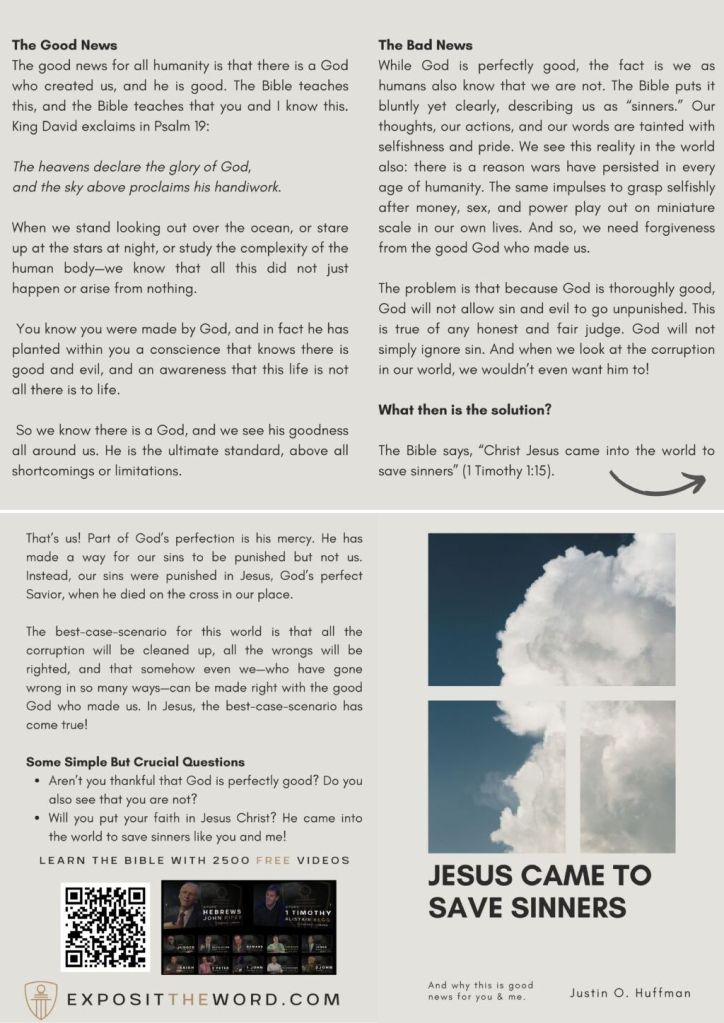
Jesus Came To Save Sinners: tract at Exposit the Word-

Posted in theology

Courage

By Elizabeth Prata

Podcast link-

https://podcasters.spotify.com/pod/show/elizabeth-prata/episodes/Episode-476-Courage-e27kqhg

“Esther Denouncing Haman” 1888. Ernest Normand (1857–1923). Public Domain.

The other day Grace To You’s Phil Johnson tweeted this:

@Phil_Johnson_“Devil give you colic! How dare you say the Mass in my ear?” 386 years ago today, Jenny Geddes threw her stool at the Dean of Edinburgh as he read from the prayer book in St. Giles Cathedral. Her act stirred the courage of the Covenanters.

Jenny was in church that day and she was sitting on her stool. The problem had been that ever since King Charles I had had his coronation service in Scotland, he’d wanted to bring more Anglicanism to Scotland churches. The Church of England was the Church of England which was a United Kingdom after all, and that also meant Scotland. But the Scots were more Puritan in their beliefs than Anglican.

Always independent, the Puritan Scots had become suspicious of the increasing encroachment of liturgy and rigid traditions a la the Roman Catholic Church. They had observed the coronation rites King Charles I used, and were displeased with his use of Anglican rituals. Next came forced use of the Book of Common Prayer, a high Episcopalian book, with its readings in the Apocrypha. King Charles issued a warrant in 1635 declaring his spiritual power over the Church of Scotland, insisting that the Church would be issued with a new book of liturgy which would be read at services. And on July 23, 1637 in St. Giles Cathedral, the Common Book of Prayer was opened and John Hanna, Dean of Edinburgh, began to read.

Jenny disagreed.

Her act reputedly sparked a riot, which led to the Wars of the Three Kingdoms, which included the English Civil War.


In 2013 a concert called “The Armed Man: A Mass for Peace” written by Welsh composer Karl Jenkins, was scheduled to be performed in a church in Speyer, Germany. The church was built to honor the great reformer Martin Luther. This church is considered an important place in our Protestant history, it’s where the ‘Protestation at Speyer‘ sealed the schism of the Christian church and is considered the birth of Protestantism. From this time on the adherents of the reformation movement were called Protestants.

So in 2013, in this church, at this concert, Heidi Mund had heard that the program included a Muslim Call to Prayer. Heidi was concerned. She prayed, and asked her brother to accompany her. They bought tickets. The officials had designated a protesting place outside, and one of the restrictions was the protest must be silent. Heidi chose to see for herself and bought a ticket with her brother and settled in her seat in the balcony.

Rahab hiding the spies

There is a 6-minute opening song called The Armed Man, and then a Muslim is supposed to call to prayer for two minutes. The rumors were true, the muezzin stood up and began to ululate his call. At that moment, a righteous anger rose in Mund, as she said later. She unfurled her German flag-banner emblazoned with “Jesus Christ” and shouted “Jesus Christ alone is Lord over Germany! I break this curse [of Muslim prayer]. I am standing here, I cannot do otherwise! [As Luther had said]. This is the church of Martin Luther! I stand here, I cannot do otherwise!” It was about that time she was approached by security and escorted out. Her brother kept filming.

It takes courage to directly oppose authorities. It takes courage to behave in ways contrary to societal expectations- to cause a ruckus in church or to yell out in disruption at a concert. Jenny and Heidi had that courage. The spotless name of Christ was being impugned- IN church.

It also takes wisdom to intuit a pivotal moment. Is this the tipping point? Is THIS? Now, I do not recommend disruption for the sake of disruption. A civil society has unwritten rules of conduct and we all know how to act in whatever venue we find ourselves.

I remember my first trip to Italy. In America, you form a line and wait patiently for your turn. You don’t rush the line, cut in line, or maneuver for better position in line. But in Italy it’s a free-for-all. It’s totally acceptable and expected that you rush the counter, jostle, and finagle your way to the closest clerk. Doing the opposite in the opposite country would be considered weird.

Yet there are some behavioral standards that are universal. Being a respectful audience member, especially in church, is one of them. There comes a time though that even in those situations we must obey God rather than man. In Acts 5:29 when Peter was told not to teach in the name of Jesus in public, he stated that very fact. We must obey God rather than man.

Normally we strive to obey God AND man, by adhering to His Law and to societal laws and even unwritten rules of conduct. But sometimes it’s important to disrupt. It will take wisdom and discernment to know which is which. The time is coming upon us and soon, where we will have to make decisions like Jenny did and Heidi did. Heidi knew it was coming and had prayed fervently beforehand, and had a plan of what to do in case it played out the way she heard it might. (She brought her Jesus flag with her).

Jenny’s situation was a surprise. Not a total one, there had been indications the Book of Common Prayer was going to be used, and soon, but when it happened, it happened. Jenny’s reaction was, well, a reaction-at-the-moment. She had just a few moments to react until the prayer was over.

In the Bible, Barak’s courage failed when he needed it most. Rahab’s didn’t. David courageously faced Goliath. Esther defied a social protocol at risk of her life. At the moment he needed courage most, Peter failed, denying God three times to a little slave girl.

There are many instances in the Bible of strong courage and failed courage. It just shows us we are human. Sometimes we don’t know at the moment it’s time to stand up and the moment passes us by. Other times we know it’s time but we choose to remain silent. Still others we see it coming and can fortify ourselves for a response.

As you read your Bible and come across examples of people who passed or failed the test, ponder the fact that we are all called to make decisions for Christ. Some of them are private decisions within our own conscience. That happens almost daily. Others, we might have to decide publicly, as Jenny and Heidi did. As the restrictions against Christians happen more frequently, there may indeed come a time in your life where you must make a stand in a pivotal moment. What will you do? What will you do? Prepare now.

Posted in Uncategorized

Keep on the sunny side, Christians!

By Elizabeth Prata

EPrata photo

I used to spend the Fourth of July in Lubec-Eastport Maine. If you visualize Maine as the profile of a dog, Eastport and Lubec would be the nostrils. They are as far east as you can go in Maine and not be in Canada. The highest tides in the world begin there, with the Bay of Fundy beginning the funnel to a small inlet where massive tides are pushed in several times a day. They are nautical cities, driven by the sea, which surrounds both of them. And as for the air, there’s cool, fog, and cold. Those are the seasons. One one side of the street it’s sunny and the other it’s shady. The difference in temps between the shady side and the sunny side would be at least ten degrees.

Even on the Fourth the temperatures remain cool – in the sun- and out of the sun you will need either long sleeves or a sweatshirt. I loved it.

The Eastport parade drew about 8000-9000 annually, helped by the docking of a navy ship of one kind or another which gave tours. The navy men marched in the parade down Water Street, a sea of white hats swooping down the gentle hill as we clapped for their service and dedication.

I used to get there early because the parade street ran north-south. The sun at the starting time was shining on one side of the street and the other was in shadow. The shadow side was cool and dimmer than the sunny side. It was simply more practical to get there early and be in the warm sun. (Note the ladies are wearing fleeces and huddling under blankets on the dark side of the street. It’s cold on the shady side!)

I’ve noticed something lately. Many of my Christian brothers and sisters are sad. Times are tough, and there is much illness, uncertainty, and confusion. I see a lot of reporting of miscarriages or child deaths, which is utterly tragic. Many people I come across are sad about things in their lives that happened to them on an interpersonal level. (We should be sad over sin too.) I get sad sometimes, thinking of the wrongs done to me or the loss of relationships or I mourn for the way things used to be in my earlier days 50 years ago. I am sad when I see people claiming to be Christians engaged in blatant sin and not repenting.

Jesus got sad, too. Jesus even wept. When He arrived at the place where Lazarus had died, Mary fell at His feet weeping, and “Jesus was deeply moved in spirit and was troubled,” (John 11:33b).

But there is a danger in allowing sadness to veer from a useful emotion that cleanses and wallowing in it. The Merriam-Webster dictionary defines wallowing as “to indulge oneself immoderately.”

One would not normally think of being sad as something one chooses to indulge in, but it is, and is the point of this post. Things happen to us that make us sad, it is part of life. As a strong Christian you are more likely to have events occur that wind up in sadness. The world does not like us. “If the world hates you, you know that it has hated Me before it hated you. “If you were of the world, the world would love its own; but because you are not of the world, but I chose you out of the world, because of this the world hates you.” (John 15:18-19). So prepare to be occasionally sad. But do not choose to wallow.

Yes, wallowing is a choice, one that all too many Christians indulge in. Do you return in your mind to that last dreadful conversation and mentally list all the really terrible things your ex-husband/boss/mother said to you? Do you revisit the terrible circumstances, re-telling it constantly in conversation? Even thought it happened last year, ten years ago? Do you sit in your room and cry more often that you sit in your room and praise? You’re wallowing.

Yes, Jesus wept, but look what He did right after that: “So the Jews were saying, “See how He loved him!” But some of them said, “Could not this man, who opened the eyes of the blind man, have kept this man also from dying?” So Jesus, again being deeply moved within, came to the tomb” (John 11:35-38a) Jesus kept moving. He ‘came to the tomb’, He engaged in action, He didn’t sit by the road and cry with His friends who all were crying and had been for days. He kept moving because He had a job to do.

Our job is to be salt and light. We can’t be that if we stop moving. We can’t be that if we are wallowing in sadness over the things that happened to us. If we expend salt on our own tears and our light is dimmed by wallowing, then we are not fulfilling our obligations to the Lord Who also wept, but Who also kept moving.

Christians you can choose to be sad and wallow in ‘what he said’ or ‘what she did,’ and that is a never-ending pit because the world hates us and would love to steal your effectiveness as a joyful Christian on the move. Or you can weep but move on to the next task with all the salt and light you can muster. If you have a hard time doing that, ask the Lord for help, and see what He can do: “You turned my wailing into dancing; you removed my sackcloth and clothed me with joy.” (Ps 30:11) Keep on the sunny side, Christians! And keep moving!

Here are the lyrics to the song-

There’s a dark and a troubled side of life
There’s a bright, there’s a sunny side, too
Tho’ we meet with the darkness and strife
The sunny side we also may view

[cho:] Keep on the sunny side, always on the sunny side,
Keep on the sunny side of life
It will help us ev’ry day, it will brighten all the way
If we’ll keep on the sunny side of life

The storm and its fury broke today,
Crushing hopes that we cherish so dear;
Clouds and storms will, in time, pass away
The sun again will shine bright and clear.
Let us greet with the song of hope each day
Tho’ the moment be cloudy or fair
Let us trust in our Saviour alway
Who keepeth everyone in His care

Posted in theology

“Lord, do you not care?”

By Elizabeth Prata

Podcast link-

https://podcasters.spotify.com/pod/show/elizabeth-prata/episodes/Episode-474-Lord–Do-You-Not-Care-e27knt2

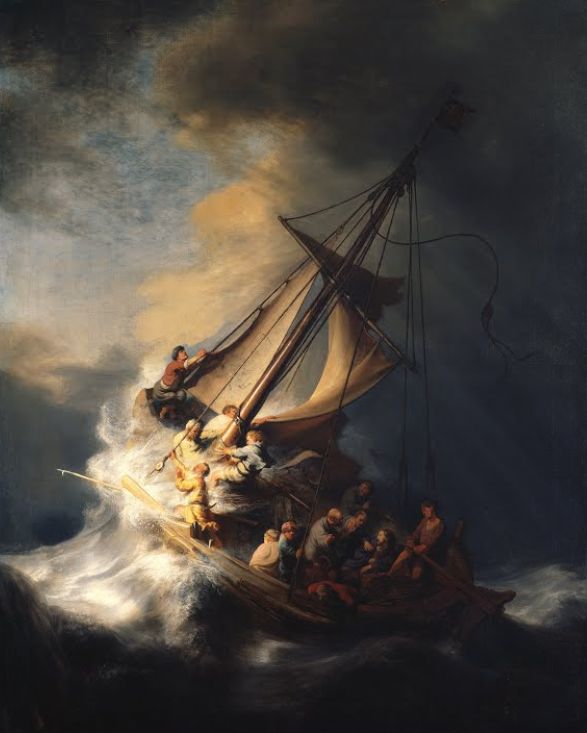
Storm on the Sea of Galilee, by Rembrandt

SCRIPTURE: “And on that day, when evening came, He said to them, “Let us go over to the other side.” And leaving the crowd, they took Him along with them in the boat, just as He was; and other boats were with Him. And a great windstorm arose, and the waves were breaking into the boat so that the boat was already filling up. And Jesus Himself was in the stern, sleeping on the cushion; and they got Him up and said to Him, “Teacher, do You not care that we are perishing?” And He woke up and rebuked the wind and said to the sea, “Silence! Be still.” And the wind died down and it became perfectly calm. And He said to them, “Why are you so cowardly? Do you still have no faith?” And they became very afraid and were saying to one another, “Who then is this, that even the wind and the sea obey Him?” (Mark 4:35-41).


A few things before I move on. These were seasoned fishermen, used to the sudden squalls particular to the sea of Galilee (which is 700′ below sea level). Winds would sweep down the mountain at speed and ruffle the waters of the Sea until the waves were towering and short spaced between each other. For these experienced fishermen to be this scared of a storm, the storm must have been especially ferocious.

But secondly, after Jesus calmed the storm with a word, they became MORE afraid (afraid…’very’ afraid). The word for very is megas, meaning “large, great, in the widest sense.” It’s where we get the word mega from. Their fear changed from a physical danger type fear of the storm to a spiritual fear.

Now for the second passage today, where afterward I’ll compare the two.

Luke 10:38-42: “Now as they were traveling along, He entered a village; and a woman named Martha welcomed Him into her home. And she had a sister called Mary, who was also seated at the Lord’s feet, listening to His word. But Martha was distracted with all her preparations; and she came up to Him and said, “Lord, do You not care that my sister has left me to do all the preparations alone? Then tell her to help me.” But the Lord answered and said to her, “Martha, Martha, you are worried and bothered about so many things, but only one thing is necessary, for Mary has chosen the good part, which shall not be taken away from her.”

Lord do you not care… that we are perishing?’
Lord, do you not care… that I’m overwhelmed and she’s lounging?’

Of course it is a silly question. We see that’s so, once the storm has passed, or once the frustration levels out. Of course the Lord cares. He had just spent the day with the disciples caring for the thousands of sick and possessed. He chose Mary, Martha, and Lazarus’ home because he loved them. Of course He cared. He was on earth because He cared. He faced the cross because He cared.

But aren’t we silly, in our moments of fear and frustration; we lash out at God.

In both those cases of ‘Lord, do you not care?’ the people asking it were looking at another person rather than God. The disciples were looking at each other ‘we are perishing!’ Martha was looking at Mary, not Jesus.

We care for ourselves physically, as does the Lord, but the Lord also wants us to take care of ourselves spiritually. He was gentle with Martha, telling her that Mary chose (CHOSE) to apply herself spiritually while she had the chance, letting the physical needs of cooking and cleaning and serving go by the wayside temporarily.

He was a bit harsher with the disciples. In Mark’s Gospel Jesus asked them why they were so cowardly. In all 3 Gospels where the story is recounted, (Matthew 8:23–27, Mark 4:35–41, and Luke 8:22–25) Jesus asked the men ‘where is your faith?’

The issue at the root of it is, do not let your physical needs, wants, or fears swamp your spiritual strength. If Jesus had intended for all the men to drown in the storm and immediately resurrect them, so be it. If He had intended for them to die and resurrect on Resurrection Day, so be it.

Of course it’s easier said than done. When we get cancer we might cry out “Lord, do you not care?” When the baby dies, “Lord, do you not care”? Our fear and our grief are so large it blots out reason, even sometimes, faith.

Gordon Lightfoot famously asked in his song “The Wreck of the Edmund Fitzgerald: “Does anyone know where the love of God goes when the waves turn the minutes to hours?”

Not that God withdraws His love. He never rescinds the love He has chosen to set upon His children, and for the ones who are not His children, common grace abounds. But that we, in our fear, anger, grief, our frustration, FEEL like God has withdrawn it.

Always choose the better portion. Jesus in effect said this to Peter, who had asked about John. “What about that guy?” Jesus said never you mind about Him, you, follow ME.’ (John 21:22)

We do not resolve our fears by looking to our surroundings or to what other people are doing, but by looking to Jesus.

Look unto me, and be ye saved, all the ends of the earth: for I am God, and there is none else. (Isaiah 45:22 KJV)

Posted in theology

Prata Potpourri: The Scandal of Christian muckraking, For wives: ‘False Messages’, Free documentary, Genealogy tips, more

By Elizabeth Prata

I’m an educator. That means summers off (we don’t get paid), and time to refresh from the bustle of the school year. Also, time to enjoy whatever it is we like to enjoy. For me that is reading, being at home, and surfing the web. I like watching Youtube of thrifting videos, cat videos, design videos, and cop videos. I also like Korean dramas on Netflix. I did the free trial week of Hallmark Movies Now that’s part of Amazon Prime because I had found “Martha’s Vineyard Mysteries” with Jesse Metcalfe. I thought there were 5 MVM movies but there are only 4.

I love Signed, Sealed, Delivered on Hallmark Now Movies, too, and watched a few of those, but overall, I decided not to pay the extra. I already pay enough for streaming with Amazon, Hulu Netflix, and Pandora.

But now summer is ending. I have a few more days then I go back to work. The kids come August 4. August is usually hard, I go from 100% sedentary to 100% busy in one day flat, with treading miles on the concrete floors for 8 hours. I come home tired till I adjust.

I’ve enjoyed the luxury of time, time to write these blogs and record these podcasts. The ‘Potpourri’ blogs actually take a lot longer to put together than just researching and writing one. Here is what I found for you online these last 2 weeks that I think may be of interest:

Janet Mefferd is a true journalist, a true Christian journalist, writing on important topics related to Christian personalities or Christian church life. She has been a solid journalist for a long time. From her experience and perspective she sees a decline in Christian journalism, and outlines the why and how, here

The Scandal of Christian Muckraking


Tim Challies is known for a lot of things- book reviewer, pastor, blogger, videographer. He has developed a niche in his writing that he is also known for: sexual issues for men, including pornography. He wrote the book Sexual Detox for men. Afterward, he said he received so many emails asking about wives’ sexual issues, that his wife Aileen wrote a short treatment on that subject as well. It is downloadable, and it’s titled “False Messages: A Guide for the Godly Bride.” It’s free and you can freely distribute it. It seeks to guide you as a woman, to a biblical view of sexuality.


Speaking of Godly women, did you know that Susan J. Heck, her ministry titled “With the Master,” offers 250 lessons here? Susan is a solid teacher. FYI: https://www.youtube.com/@WiththeMaster


Seaking of videos, here is a link to a free documentary about the Prince of Preachers, Charles Spurgeon called “Through the Eyes of Spurgeon“. It’s the official documentary. Free.


I do grumble sometimes. Mainly to myself. But sadly I also complain sometimes in public: about the weather, the workload, the aching bones, whatever. Both grumbling and complaining are sins. Here we have Marci Ferrell the Thankful Homemaker offering ways to be dealing with our grumbling and complaining. She gives a short written intro and then the podcast explains more. Recommended!


I have done some light genealogy over the years. I visited Ellis Island that 2 grandparents and 2 great-grandparents came through. I have read the Ellis Island ship manifests and found their names. It’s fascinating.

@itskellydiane on Twitter and Instagram gives some helpful tips if you are into genealogy. She writes- “I’ve been doing genealogy research for over seven years and I’m a member of the DAR who taught me a lot about historical research and documents. If this is helpful for anyone, here’s some things I’ve learned that have helped me over the years.”


Demons are a biblical subject but not one spoken of very frequently, at least among true Christians. The false Christians tell us that demons lurk around every corner and every sin is really just a demon that we can cast out. But is that true? Here, the Bible Thumping Wingnut Tim Hurd offers a clip from John MacArthur answering an audience question about demons. (short video). As always with JMac, the answer is full of wisdom.

By the way, in that clip, Dr MacArthur references an incident that occurred in his office. He has been preaching for 54 years. He said that only about three times has he actually been involved with an actual demon. Once was in 2000, 23 years ago now, which he mentions in this sermon. But he goes into deeper detail of another incident that he references in the BTWN clip of a demon possessed girl in his office back in early 1970s. He and a man named Jerry were trying to help this gal and they tried all sorts of things to ‘exorcise’ it or ‘bind it’ but only ONE THING helped. You can read or listen the longer and detailed account of that incident, here, embedded in this sermon on Luke 4

Jesus’ Authority Over Demons” part 2


Lately a lot of the questions or comments I receive revolve more around marital issues than doctrinal issues. I know that everything at root is doctrinal, but more questions have been coming to me on the topic of relational issues. I find that interesting. Maybe a lot of people are having issues in that sphere now. So I include this from Challies, If Satan Took Up Marriage Counseling“:


Here’s a budget friendly blog from Jessica Fisher on Good Cheap Eats about How to Stop Eating Out. I do not eat out. I have so many food intolerances that the only thing I’d be able to eat at a restaurant is the napkin. But I’ve noticed that food prices at the grocery store are 3X higher than this time last year, and they were high then too. Even if I didn’t have food intolerances I don’t think I’d feel good paying $12 for a cheese quesadilla or $5 for a cup of coffee. Those prices are now showing up in restaurant fare. Eating out is expensive. Here is a blog on How to Stop Eating Out.


Finally, here is a page from a blog called Atlas Obscura. It presents the enchanting Wisteria Vines of Japan. God created this world and He chose to make it beautiful. Enjoy –

Tunnels of Wisteria

Posted in theology

Isaac Asimov, the Humanist-Atheist without hope

By Elizabeth Prata

My summer reading this school break included an Isaac Asimov book I picked up at a thrift store. When I was in high school I read a lot of science fiction. I had decided to return to the genre. I hadn’t read any sci-fi in 40 years. Asimov is one of the fathers of science fiction, and one of the most prolific.

He was born in Russia in 1920. He emigrated as a boy and then attended an annex of Columbia University majoring in chemistry, and became a writer and professor of biochemistry at Boston University. Asimov was considered one of the “Big Three” science fiction writers, along with Robert A. Heinlein (“Stranger In A Strange Land”) and Arthur C. Clarke (2001: A Space Odyssey”), even during his own lifetime, a feat of fame. He wrote or edited more than 500 books and also wrote an estimated 90,000 letters and postcards. That’s why he is considered prolific.

Asimov coined the term ‘robotics,’ a combination of the words mechanics and hydraulics. He also wrote the Three Laws of Robotics, which are:

First Law
A robot may not injure a human being or, through inaction, allow a human being to come to harm.
Second Law
A robot must obey the orders given it by human beings except where such orders would conflict with the First Law.
Third Law
A robot must protect its own existence as long as such protection does not conflict with the First or Second Law.

Isaac Asimov

One of the books Asimov wrote was a compilation of short stories called “Nine Tomorrows” published in 1959. They are 9 short stories (plus a poem) set in the future. That’s the one I picked up.

I enjoyed Asimov when I first read him as a teen and young adult. I appreciated his easy writing and his engaging stories. But reading him again as an adult I was blown away by his brilliance. A detective story using things for clues that hadn’t been invented yet. Time travel. Space travel layovers. Genetic Modification- of humans. How successive iterations of computer programming forces a creativity decline and derivative thinking arise. Mutual Assured Destruction.

He was a supremely intelligent man. Seeing many of his ‘tomorrows’ become ‘todays’ and even ‘yesterdays’ after the initial writing 70+ years ago is amazing. Now we do have artificial intelligence, robotics on a level Asimov would have understood, and space travel. He wrote 100 of his books even before the US moon landing in 1969.


Sin begins in the mind. Our faith begins in the mind. I admire people who use their mind for Christ. To have an ability to understand complex ideas and relate them to a layman so they can be absorbed by anyone. The Bible is complex. The war between the world and the kingdom is complex. The scientific people at the Institute for Creation Research and The Math3ma Institute are intellects for the faith. I admire that they use their mind for Jesus and His glory. And by contrast it is such a waste to have a mind such as Asimov’s used for satan. Isaac Asimov was an atheist and a firm humanist.

Though I enjoyed most of his stories in “Nine Tomorrows” there was one I rejected. “The Last Question” explored entropy in the universe, (“the degradation of the matter and energy in the universe to an ultimate state of inert uniformity. Entropy is the general trend of the universe toward death and disorder“), man’s reason for existence, the end of all things, and that knowledge was the supreme treasure of the universe, then comes annihilation and peace.

It is an atheistic, humanist view. It is also a hopeless view.

How sad. Reading Asimov now on this side of salvation shows me the utter sadness when a person possesses such a hopeless outlook.

So many things in life remind me of the sadness of the life of a lost person. The more I grow in His likeness the more I think about the Great Gulf Fixed which no man may cross. There is only lost or found. Darkness or light. Hell or heaven.

And I think of hell enlarging its mouth to receive a great many- the myriads upon myriads of unholy angels who will receive the just punishment for their demonic deeds. The millions of those who dwelled in sin all their life and will also receive the just punishment of their deeds. All that flesh. All those minds. What a waste.

I think of this kind of thing more and more. The tragedy of sin, the waste of a mind that could be glorifying God and thanking Him for its intellect. Asimov denied the Creator. When he passed away in 1992, the Institute for Creation Research wrote a piece called “Asimov Meets His Creator” in which we see this quote from Asimov-

ASIMOV’S VIEW ON DEATH

“Although the time of death is approaching for me, I am not afraid of dying and going to Hell, or [what would be considerably worse] going to the popularized version of Heaven. I expect death to be nothingness and by removing from me all possible fears of death, I am thankful to atheism.”

Isaac Asimov’s Science Fiction Magazine January 1992

The linked ICR piece is worth reading.

Asimov’s expectations were not met. Asimov discovered that knowledge in and of itself is not the chief end of man. God is the chief end of man by glorifying Him. Heaven IS considerably better than anything one can imagine, and hell is real and considerably worse. Nothingness is not in the future for any person born on this earth or even those not born but perish due to miscarriage or abortion.

It’s heaven (for babies and the repentant) and hell for those who reject and whose default is to continue in sin. Christians rightly do not fear death but the unsaved should. They do not know…

“Your wickedness makes you as it were heavy as lead, and to tend downwards with great weight and pressure towards hell; and if God should let you go, you would immediately sink and swiftly descend and plunge into the bottomless gulf, and your healthy constitution, and your own care and prudence, and best contrivance, and all your righteousness, would have no more influence to uphold you and keep you out of hell, than a spider’s web would have to stop a falling rock. Were it not for the sovereign pleasure of God, the earth would not bear you one moment; for you are a burden to it; the creation groans with you; the creature is made subject to the bondage of your corruption, not willingly; the sun does not willingly shine upon you to give you light to serve sin and Satan; the earth does not willingly yield her increase to satisfy your lusts; nor is it willingly a stage for your wickedness to be acted upon; the air does not willingly serve you for breath to maintain the flame of life in your vitals, while you spend your life in the service of God’s enemies.” ~Sinners in the Hands of an Angry God by Jonathan Edwards

The unsaved should fear death very much, and moreover, FEAR GOD.

Posted in theology

Anxious about Hospitality?

By Elizabeth Prata

As keepers of the home, we women are often encouraged to invite or even expect others to visit our homes. The hospitality offered by Lydia, Martha & Mary, and the home of Mary the mother of John Mark (where Rhoda was so startled when jailed Peter showed up during the prayer gathering) are homes in the NT where women hosted gladly.

We are called to do the same: Titus 1:8, Romans 12:13, 1 Peter 4:9, 1 Timothy 5:10

I quail at the thought. I am like many women, who would be afraid to host someone in my home when it is less than sparkling clean. I’d want it to be where everything is always put away and I have fresh flowers arranged just so in charming vases and fresh towels in the bathroom with rose petals on them waiting for the random friend to stop over. LOL. Well, that’s how I imagine it anyway.

Of course our homes are never like that. If we really live, we really have a house that’s lived in. Kids toys are all around, there might be – gasp! – dirty dishes in the sink, popcorn kernels in the couch, a pile of mail needing tending to, open books and magazines on the coffee table accompanied by empty mugs of coffee or sticky soda cans…

I remember the most hospitable person I’ve ever known. She isn’t saved. But she is a great wife and mom. Her stance was that she wanted to be the house where her kids’ friends came to, all the better to keep an eye on her kids.

In her house were piles of clutter, worn out sofa, small rooms crowded with ‘stuff’ or oddly arranged. According to design rules, the place wasn’t suited for company. When it got to be dinner time, without a fuss the hostess would cook up a pan of scrambled eggs or baked beans from a can with brown bread (also from a can) and just hand it out on paper plates. Sometimes the husband or the grown kid would pull out a guitar or mandolin and we’d sing.

Anyone and everyone was always invited. Absolutely everyone was treated with warmth, respect, and dignity. And the hostess did collect oddballs, me included. But all were equal, loved, and given a place of acceptance. As I said, she wasn’t saved. She did all this effortlessly and created a safe space I’ll remember forever.

As Christians, we should do that and more. Now, it is certain we should do our best to have a clean house, or at least one that’s fairly picked up. We don’t want to serve food on dirty plates from unsanitary counters, or allow piles of laundry to get strewn as a tripping hazard. There is a balance between sparkling perfection and filthy hoarder.

But there is no need to panic if you’re asked to host a Book Group or a Bible Study or a Fellowship dinner in your home.

I saw this book on Marci Ferrell’s Thankful Homemaker site, here. It’s:

Having a Martha Home the Mary Way: 31 Days to a Clean House and a Satisfied Soul by Sarah Mae. Here is the blurb,

Sarah Mae wants to let you in on a little secret about being a good homemaker: It’s not about having a clean house. She’d never claim to be a natural, organized cleaner herself―yet, like you, she wants a beautiful space to call home, a place where people feel loved and at peace. Where people can really settle in with good food, comfy pillows, and wide-open hearts. Is it possible to find a balance?”

I have not read the book, but I did read the 29 pages allowed in the Google preview. She seemed to be saying the right things and the tone was non-judgmental. If you find that you’d like to increase your hospitality, I’d say try this book. Here are some other resources-

Ligonier: How Can I Practice Christian Hospitality?

Christian Library: The Biblical Basis for Hospitality

Reformed Theological Seminary, 3-min video clip: Why is true Christian Hospitality so Important?

Start small, invite one lady over, or ask the mom who’s picking up her kid from your house to stay for a cup of tea. The key is love. Just love them.

Posted in theology

Example: God’s Omniscience

By Elizabeth Prata

Example: God’s Provision
Example: God’s Healing

In this short, simple series, I show some of God’s actions and attributes from His word. An example of God’s provision was when the student-prophet in 2 Kings 6 God made the axe head float. His provision doesn’t have to be the “big things” like feeding the 5000, He made provision for an impoverished student who had borrowed an axe and lost it in the river.

In this example today, we see an example of God’s omniscience. Omniscience is an attribute of God. Omniscience is defined as “the state of having total knowledge, the quality of knowing everything.” Another way to say God is omniscient is to say God is all-knowing.

Now the king of Aram was making war against Israel; and he consulted with his servants, saying, “In such and such a place shall be my camp.” But the man of God sent word to the king of Israel, saying, “Be careful that you do not pass this place, because the Arameans are coming down there.” And the king of Israel sent scouts to the place about which the man of God had told him; so he warned him, so that he was on his guard there, more than once or twice.

Then the heart of the king of Aram was enraged over this thing; and he called his servants and said to them, “Will you not tell me which of us is for the king of Israel?” And one of his servants said, “No, my lord, O king; but Elisha, the prophet who is in Israel, tells the king of Israel the words that you speak in your bedroom.” (2 Kings 6:8-12).

The King of Aram wondered who among his servants was the spy, leaking information to the King of Israel, but the servants said, ‘No it’s Yahweh who hears the words you speak in your bedroom.’ And they were right.

It’s interesting that the servants knew of the nature of Elisha’s relationship with God and that the information was coming from Him, but the king of Aram didn’t. It never even crossed his mind.

God knows everything that has happened, is happening, and is going to happen- because He is the author and architect of history. He knows what is in a person’s mind. He knows what is in a person’s heart.

Even before there is a word on my tongue,
Behold, O Yahweh, You know it all.
(Psalm 139:4)

And there is no creature hidden from His sight, but all things are uncovered and laid bare to the eyes of Him to whom we have an account to give. (Hebrews 4:13)