Posted in theology

Get our allegiances right!

By Elizabeth Prata

People advocate for the false teacher and denounce the person that is calling the false teacher to task. I see this more and more often.

What sparked this observation is another exchange on social media that is true to the adage I’d shared above. Social media is important because it influences both to the good, and to the bad. So, I’ll repost it, with my replies, then share 3 points and some verses from the Bible. People are giving too much sway to false teachers and not enough allegiance to Jesus and I’ll share why this is inappropriate and actually a virtue signal or just an unwise stance.

Beth Moore made a tweet and a man replied.

Back-Up Tambourine Player saw the exchange and commented on it thus- Incredibly tacky, to be honest. When people we do not like encourage us to do very good and biblical things like memorize and meditate on God’s word and not ourselves, they don’t deserve our ridicule. That’s the mark of an immature mind.”

I replied to Backup Tambouring Player-, “[The] reply to @BethMooreLPM was proper. She’s a preaching rebel, usurping God-ordained role & inserting herself into places God didn’t design women to go. She makes a living off scripture rebellion & turns around & urges scripture memorization? This hypocrite deserves ALL the ridicule

The man used scripture to call a false teacher to repent. That’s proper. The OP errantly called that “ridicule”. It’s not. One way we pray for the lost is to use scripture. We MUST call a rebel a rebel to their face if they are to repent, not coddle them in their rebellion.

Beth Moore urged people to memorize scripture and the original poster called that ‘biblical and very good’. It’s not, when it comes from an agent of satan.(Acts 16:16-18). The hypocrisy is, Moore urging us to memorize scripture but she ignoring 1 Tim 2:12 and rebellling against it.

It’s troubling that the man who used scripture to call false teacher Beth Moore to repent is seen as “ridiculing”, while false teacher Moore’s words are called ‘biblically and very good’. Woe to those who call evil good and good evil, says Isaiah 5:20.

Elsewhere, the original poster Backup Tambourine Player said to someone else, “I don’t mind occasional joking with my theologically opposites, it’s good fun. I just don’t think he has a track record of doing it in kind. And I’m not trying to defend Beth, I don’t particularly care for her teaching. But I say, joke where appropriate!

Lots to comment on here.

Point #1: The original poster mentioned we should not ridicule people we don’t like. That she doesn’t care for Moore’s teaching. This is wise and true. However, Moore is a false teacher. There is more to it than just disliking her personally or not caring for her teaching, as the poster claimed. Perhaps someone doesn’t like her active style at the pulpit. Perhaps someone doesn’t like her accent. Perhaps someone doesn’t like her clothes or her cornbread recipes. Fine. That’s just personal opinions and of course we don’t denounce people based on personal opinion.

However, Moore is a false teacher. This means Moore promotes satan’s agenda, not God’s. The Bible has MUCH to say about what to do when we come across a false teacher. Speaking out against false teachers is a must. It’s not that we don’ like Beth Moore personally, it’s that we don’t like her biblically.

Point #2: The replier to Moore used scripture. Using scripture to denounce a false teacher is biblical. It’s not “ridicule.” A case could be made for using so many emojis in a sarcastic way, but then again, maybe not, it could be a good punctuation for a woman who urged people to study the Bible yet who also hypocritically rejects the Bible parts she doesn’t like. Jesus reserved His most scathing comments for the hypocrites.

Point #3: In this exchange and too many others, people coddle the false teacher while denouncing the one who denounces the false teacher. False teachers are a scourge. They are evil. Yes, evil. There is only Light and dark, narrow or broad, truth and lie. We need NO HELP from false teachers.

Remember in Acts 16 when Paul was “greatly annoyed” with the demon possessed slave girl who kept following him and saying, “These men are slaves of the Most High God, who are proclaiming to you the way of salvation”? The slave girl was speaking truth. Why did Paul get annoyed? Backup Tambourine Player would say, after all, the girl is “encouraging us to do very good and biblical things“.

Paul was annoyed because we do not need help from satan to declare the truth. Matthew Henry says of the Acts 16 verse,

Satan, though the father of lies, will declare the most important truths, when he can thereby serve his purposes. But much mischief is done to the real servants of Christ, by unholy and false preachers of the gospel, who are confounded with them by careless observers.

Don’t be a careless observer.

There are too many good teachers who “encourage us to good and biblical things“, than to pick the one or two things a false teacher said and give them any credence at all. False teachers are flatterers, they perform and act, they are good at disguising themselves as godly, yet all the while deny the power of God.

Romans 16:18 says –
For such men are slaves, not of our Lord Christ but of their own appetites; and by their smooth and flattering speech they deceive the hearts of the unsuspecting.

Matthew 6:1 says – Beware of practicing [performing] your righteousness before men to be noticed by them; otherwise you have no reward with your Father who is in heaven.

2 Corinthians 11:14 says – For such men are false apostles, deceitful workers, disguising themselves as apostles of Christ.

2 Timothy 3:5 says – holding to a form of godliness although they have denied its power; avoid such people as these.

It is stated in 1 Thessalonians 5:21 to “test everything; hold fast what is good, abstain from every form of evil.

False teachers like Beth Moore are said in the Bible to be deceivers, promote myths, secretly bring in destructive heresies, upset whole families, pervert the grace of our God into sensuality, are puffed up with conceit and understand nothing, are unfruitful, are from the world, and are impostors. Those are just a few of the things the Bible calls a false teacher, not even all of them.

Disguised as a worker of God, Beth Moore performs. She doesn’t teach, having denied His power.

Why listen to ANY PART of a false teacher when so many good teachers are out there? Do you want to be seen as promoting evil and be aligned with them? Paul would say NO.

If your own test of credibility has found a teacher to be false, or if your own pastor has said so, or if other solid Christians have alerted you, take this information on board. Do not give even a quarter inch to a false teacher even when they seem to say good and biblical things. They are purposely saying these things so as to deceive the unwary and to draw you away.

Behold, I send you out as sheep in the midst of wolves; so be shrewd as serpents and innocent as doves. Matthew 10:16

Posted in theology

Reporter no more

By Elizabeth Prata

When I was writing for the local paper and the Athens Banner Herald some years ago, I’d developed a following of people who enjoyed my column and my features articles. Someone asked me if I was planning to go back to reporting. I said it was a negative business and I wanted to get out. Over the 6 1/2 years of running a small-town weekly paper, I had to learn and know things that I normally would never have wanted to know, the dirtiness, dishonesty, things about peoples’ lives, government sausage making. It takes a toll on one’s spirit.

I was so looking forward to my last day of work, August 9, 2006. The company that had bought my paper had already closed my local office and I had been commuting 10 miles to my new office, shared with the editor of one of the other newspapers they own. I was not fond of the commute, parts of it were dangerous. It was early, 5:30 a.m., on my last day as I hopped in the car and took off into the fog.

I came upon a crash scene. Dawn revealed the tragedy. Officials were diverting traffic, which a normal person would be happy to go around but I was a reporter, if for 8 more hours. I told the Officer that I was a journalist and I needed to get some shots. He waved me ahead and told me to stay 200 feet away from the workers. “It’s a bad one,” he said.

Two television channels were already shooting video. I had to jockey for position. At 4:30 a.m. conditions had been foggy, the tv guys told me, and an 18 year old girl had been zooming to work. She lost control of her small car, it skidded on the dew drenched road, flew, flipped then wrapped around a tree 100 feet into the woods. She was thrown from the vehicle and killed instantly. Rescue had a very hard time extracting the nearly disintegrated car and a very hard time extracting her from the woods.

EPrata photo

We stood around for an hour, the TV guys and me, waiting for the shots we knew we had to get. The white sheeted body being pulled from the trees, stretcher being loaded into the ambulance, close ups of the wreckage. The car was so shattered there was nothing for the tow truck to hook onto and it took a long time to find some solid metal to hook onto. It was boring so when it got close to when things emerged from the woods, we couldn’t help but get agitated. We scuttled forward, trying to get the money shot. I hated this part.

The whole time I kept thinking about the morning’s quietude, how the girl was probably singing and driving and planning about her day. And how suddenly her life was gone, and all that was left was a crushed car and three media journalists trying to get a shot that would represent her last moments by a bloody sheet and a hanging fender. My final shot was of long strands of grass hanging off the inside mangled wheel well as it was slowly winched on the truck bed. I left then.

When I got to the office the other editor had heard the scanner and was about to send someone out. I told him I got the whole thing already, including shots and quotes. He’s ghoulish and kind of likes car crashes. He likes them better if someone dies. He jumped up and pumped his hand in the air. “Yes! That’s great!” He looked at me sideways, and asked “Do you want to call the family?” We had to get a quote from them. I looked hard at the guy and I said “I’ve gone almost 7 years without having to make the call to a grieving family and I really don’t want to go out with one on my last day.”

Things like this affected me too much, but equally I was afraid of the day that they wouldn’t affect me, that I’d become like that other editor where a death of a human being represented newspaper sales.

I had recently been saved by the grace of God and my worldview had shifted. I thought about the brevity of life. She was most likely a Muslim, her family was from Iran and barely spoke English. Though I’d thought about the brevity of life prior to being saved, it was always an occasion either for puzzlement (where do we go after we die?) or an inescapable mystery founded on the fact that we all die and I will too. My thoughts usually ended there, with a shudder and a firm mental push of that thought away from me.

But now that I know that I know my eternal destination, it is both a comfort knowing my end will be bliss, but also a grief that many others won’t be.

Life is short. We must be about our Father’s business.

Behold, You have made my days as handbreadths,
And my lifetime as nothing before You;
Surely every man, even standing firm, is altogether vanity. Selah.
(Psalm 39:5)

I’m glad the Lord gave me employment with children, a much more positive and soul-warming thing that reporting in misdeeds, tragedies, and negative news.

The cycle of news is endless because sin is endless. Thefts, murders, malfeasance, corrupt officials, tsunamis, hurricanes, fires, abductions, the list goes on and on. It’s important to cover the news, yes, let people know what is going on in fair and balanced fashion. But I was glad to step out. What a glory to know that there will come a day we will not need newspaper reporters because there will be no sin, no tragedy, no death. “Obituary writer” will be a thing of the past.

For people nowadays who cry out “Why is the news always negative? How about some good news once in a while?” the Day will come when we will only speak of the excellencies of Christ. His GOOD NEWS, and the wonder of His justified Bride. What a day that will be.

Further Resources

The Brevity of Life…A Call to Improve It, Sermon 6 – by Andrew Gray (1634-1656) (Puritan who died young, having had a three-year ministry).

James Smith, “The Time is Short!” 1860

Thomas Watson: Time’s Shortne)ss (A sermon preached July 2, 1676, at the funeral of Pastor John Wells).

The Brevity of Life– sermon by Alistair Begg, audio and transcript

Posted in theology

Taste and see?

By Elizabeth Prata

O taste and see that Yahweh is good; How blessed is the man who takes refuge in Him! (Psalm 34:8)

As a Christian, we don’t have simply a mental assent that God is good. It’s not just a cognitive comprehension.

For example, we can know a certain dish is good, maybe Shepherd’s Pie. We can see the list of ingredients in the recipe and know that its culmination will be tasty. We can see photos of the completed dish and see it is good.

But when we taste it, THEN the item comes inside is to be digested and its goodness applied to every organ. We are then absorbing it into our whole body, its goodness is sent along the bloodstream, and its good properties applied to every part of our body.

When we taste something we are experiencing it in its entirety. See two old time Commenters on the Psalm 34 ‘taste and see’:

Barnes’ Notes on the Bible,
The word “taste” here – טעם ṭâ‛am – means properly to try the flavor of anything, Job 12:11; to eat a little so as to ascertain what a thing is, 1 Samuel 14:24, 1 Samuel 14:29, 1 Samuel 14:43; Jonah 3:7; and then to perceive by the mind, to try, to experience, Proverbs 31:18.

Gill’s Exposition,
in conversion a new taste is given, so as to have a saving experimental knowledge of the grace and goodness of God in Christ, an application of it to them; and in such manner as to live upon it, and be nourished by it; and though this is not a superficial taste of things, like that of hypocrites, nor a single one only, being frequently repeated; yet it is but a taste in comparison of the enjoyment of it in the heavenly state; and every taste now influences and engages trust in the Lord

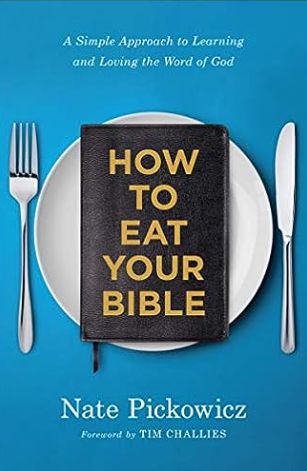
Here is a resource along those lines: a book by pastor Nate Pickowicz, “How to Eat Your Bible: A Simple Approach to Learning and Loving the Word of God”.

Blurb:
Loving God means loving His Word.
If you’re feeling distant from God, could it be because you’re ignoring His Word? But maybe you don’t know where to start. Maybe the long books and strange names feel overwhelming. Maybe you just don’t like reading. Whatever the case, How to Eat Your Bible will help you cultivate an appetite for life-long study of God’s Word. Find practical guidance for overcoming the hurdles that have kept you from making Bible study a regular part of your life. You’ll also become encouraged to pursue God’s Word by learning how other Christians throughout time maintained this crucial practice. Pastor Nate Pickowicz also includes a unique Seven Year Bible Plan so that you can apply what you’ve learned and continue drawing near to God as you consume His Word.

Consume the banquet of His word. I need to do that myself. School starting a few weeks ago has hit me hard and I’m often tired both in the morning and in the evening. I have been spotty with tasting that that Lord is good. His word when consumed, goes into the brain and then the Holy Spirit applies the Living and Active word to my living body. He illuminates it to my mind and it circulates in my whole being, finally resting in my beating heart, now a permanent part of me. Why do I leave off absorbing the word of God? It is a fine meal.

Posted in theology

Kay Cude Poetry: In Song and In Praise

Kay Cude is a Texas Poet. Used with permission.

Artist’s statement. She has been through an extremely rough year,

“… and yet as I’ve been brought to repentance and a deeper desire to draw close to the Lord in obedience and worship, I find that some of the greatest encouragement and rest for me comes through this beautifully simple hymn! Therefore, I am compelled to share it with the redeemed as a reminder and with the lost as an encouragement to respond to a call to salvation. I am far from how I desire to be!

Dear reader, when you go through tough times, rely on the scriptures, and bathe in good hymns, too. The older ones have scripture IN them, or are closely based on scripture. Find comfort in God’s word.

Posted in theology

Three points about Russell Moore’s opinion of John Bunyan & Pilgrim’s Progress

By Elizabeth Prata

1685, John Bunyan (1628 – 1688), the English writer and preacher who wrote ‘Pilgrim’s Progress’. Original Artwork: Drawn by Kenneth Maclean from a rare print by Francis Hall, after the painting by T Sadler. (Photo by Hulton Archive/Getty Images)

I listened to the podcast of Russell Moore and Karen Prior that people are up in arms about. It’s called Losing Our Religion: Evangelical Imagination with Karen Swallow Prior.

Russell Moore is Editor in Chief of Christianity Today and had been the President of the ERLC. He holds a Ph.D. in systematic theology from the Southern Baptist Theological Seminary. Karen Swallow Prior had until very recently been the professor of Christianity & Culture at Southeastern Baptist Theological Seminary. She is an author, speaker, and podcaster.

It is sad. Prior could be so interesting & the topic of imagination, literature, and how God uses us to create, would be wonderful to delve into, IF she wasn’t such a liberal and Moore so far from evangelical. There was one thing Prior said that I agree with: for too long we have neglected the aesthetic in literature. As modernists, I also think we have neglected the aesthetic in music, art, and architecture, too.

I’ve often studied this topic- imagination, art, and the Christian. I’ve blogged on “Writing, and writing for the Lord“. I enjoy Sheehan Quirke’s “Cultural Tutor” twitter threads and his newsletter “Areopagus”. For example, here, he talks about minimizing design too much.

I’m not necessarily talking about beauty here. I’m just talking about things having some discernible qualities & characteristics. The bollard on the left is hardly “beautiful,” but it *does* have some character. The one on the right… it exists. That’s all. S.Quirke

And when Sheehan Quirke does talk about beauty, wow. Beauty in music, art, architecture, literature. It is God-honoring to attribute creativity and means to the Lord.

I took and completed a wonderful course at Ligonier called “Recovering the Beauty of the Arts”. RC Sproul taught it. The premise is that “the first step in recovering the lost beauty of the arts — God’s glory — is to begin to think critically and clearly about the Christian’s relationship to art and aesthetics. … and to motivate you to support God-honoring art within and without the Church, so that we can heed more fully the apostle’s charge by meditating on “whatever is true, . . . honorable, . . . just, . . . pure, . . . lovely, [and] commendable” (Phil. 4:8).”

Beauty. In Ezra 3:12-13, the young men wept with joy when the temple foundation was laid, but the old men who had seen the glory and splendor and beauty of the previous one, Solomon’s temple, they wept and mourned. The second Temple would not be as beautiful or grand. Not even close.

Beauty is important. It moves us, it brings tears to one’s eyes. So does the lack of it. It is sad to see a graceful building decay…a glorious piece of art slashed…a masterpiece of literature rejected. And that brings us to Moore and Prior.

Youtube video with transcript here
Podcast website, episode here

There are three points to discuss here. But first, let’s see what Moore and Prior said. Excerpt:

Moore: I don’t like John Bunyan. I like the person of John Bunyan. I like the life of John Bunyan, but Pilgrim’s Progress leaves me cold and Grace Abounding to the Chief of Sinners even more so. And I think because I’ve seen so many people who started reading some Puritan literature from that time period who became so morose and so introspective and believing there’s no way they could really be a Christian.

And all of the tests that they were giving to themselves, then they would test whether or not they had the objectivity to go through the tests, you know, all of that. That Puritan era, I think, brought some things that just really creeped me out.

But you talk about in the book just how significant Pilgrim’s Progress really was in terms of shaping everything around us, which I don’t think I’d ever thought about before. I mean, I knew it was at one point the most popular book other than the Bible, but I didn’t really think about how the story actually changed the way we see things.

Prior: I’m going to be completely honest here. I mean, the Pilgrim’s Progress is kind of a drag to read. I mean, even teaching it, my students love to hate it, and I love to teach it to try to hate it with them and help them see it. And I’m so glad, actually, that I came to it as a student of literature before more than a Christian. I mean, I was a Christian, but I approached it as literature.

Point #1: Rejection of some books is more telling than just having an opinion about them

First, it is correct to say that people have opinions of books and authors and they are just opinions. Moore expressed his high opinion of southern writer Flannery O’Connor. I’m not a huge fan of O’Connor, I enjoy Zora Neale Hurston more. OK fine.

However Pilgrim’s Progress is not just any book. It is obviously sparked by God in a man whose imagination had been influenced by His word. It is a book designed to evoke vivid mental pictures and emotional responses toward God. No, it’s not the word OF God, but is closely parallels it. For Moore to say it ‘leaves him cold’ raises questions in people who understand that a book that has been in print for 346 years, and until recently was the 2nd most printed book after the Bible.

Point #2: Hating on the writing from the entire Puritan era.

Even if we put that aside, my second of three points here today is this: Moore dismissed the entire era of Puritan writing. THE WHOLE THING. “It really creeped me out,” he said.

Let’s look at the Puritan era for a moment. The era’s beginning and ending, though nebulous, is generally considered to have lasted from 1533 to 1740. Two hundred years. Why would a professor and an editor such as Moore dismiss the entire two hundred years of writing from evangelical Reformers? They had impact on theology AND history. For example, the article at the First Amendment Encyclopedia at Middle Tennessee State says,

“The bravery and initiative of the Puritans served as a source of inspiration for colonists during the Revolutionary War. Later, the framers of the Constitution would look to the Puritan era in history for guidance when crafting the First Amendment rights for freedom of religion.”

The Founding Fathers considered the Puritan writings to be good enough to include their precepts into the Constitution. In fact, the first civil agreement in the US was the Mayflower Compact, and so became the first document to establish self-government in the New World.

Mayflower Compact laid the foundations for two other revolutionary documents: the Declaration of Independence, which stated that governments derive their powers “from the consent of the governed,” and the Constitutionwrites The History Channel.

But the Puritan era’s writers really creep Moore out.

Point #3: Liberals love their emotions and decide things based on them. Moore is no exception.

The third thing is that he not only dismissed an obvious and enduring work of God in rejecting Pilgrim’s Progress, and not only rejected important writing from a 200-year-period of our history, but he did so on the basis of emotions.

Moore left, Prior right.

And that is the liberal to a T. How they FEEL about a thing becomes their truth about the thing. “It left me cold”. “It creeped me out”. Moore observed others becoming “morose”, ‘doubtful’ and “introspective.” These are emotions.

Feelings are everything to a liberal. Truth is what they feel, not what they know. Feelings are their guide, not what is objectively true.

Prior later complained amid the outcry, “So you can listen to a very clipped clip that’s circulating, or you can read the books. (Yeah, we know what the click-baiters will choose.)”

She is being disingenuous. It’s a clip but it’s the entire part about Bunyan. I listened to the whole podcast and the clip of their discussion and rejection of Bunyan’s works is presented in its entirety. It didn’t range over long hours with only a minimal clip cherry picked for spitefulness, as Prior seems to allude. It extends from minute 26:00 to 27:28. A minute and a half. That’s all the talk of Bunyan there was. So, it IS a clipped clip, Mrs Prior. And since your talk was public and you were free to say all you wanted to say about Bunyan and the writing and aesthetic from “the Puritan era”, we are likewise free to comment publicly on your and Moore’s comments.

If you are interested in aesthetics and God, as good old RC used to say, what is good, what is beautiful, and what is true, then here are some for you-

RESOURCES

Here are some more solid resources for you on the topic of imagination, aesthetic, and God:

Article: The Triune God, Good, beautiful, and True, by Harry Reeder

Book: The Liberated Imagination: Thinking Christianly About the Arts, by Leland Ryken.

Pamphlet: Art for God’s Sake: A Call to Recover the Arts, Leland Ryken

Novelette: Art & The Bible, by Francis Schaeffer

Art Book: Visual Exegesis Vol I, by Christopher Powers of the ministry Full of Eyes, a ministry that “seeking to help people see, savor, and sing the beauty of God in Jesus Christ.”

Course: Recovering the Beauty of the Arts: Ligonier.org, RC SProul

Online article: Aesthetics and Worship by James S. Spiegel

Posted in confess, court, jesus

Jesus is our Judge

By Elizabeth Prata

Jesus is our judge. He is the sole authority to Whom we will answer, and our sins are crimes we have committed against Him. (Acts 10:42; 2 Timothy 4:8)

The world hates this notion, and continually rebels against it. They say that we only answer to ourselves, or that Jesus doesn’t exist, in the vain hope that their lawlessness will go unpunished. Most people will acknowledge there is some sort of God, distant and perhaps disinterested. But Jesus is the name at which they cringe. That is because He convicts of sin and will judge it. Deep down, they know this. (Romans 1:18-20)

“There is only one Lawgiver and Judge, the one who is able to save and destroy.” (James 4:12).

If you really think about all the language of the Bible, you realize just how much of it is “legal” language. This is because sin, also known as lawlessness, is a crime. (1 John 3:4). It is a crime against God. Like any crime, it must be judged.

Many people say that the Bible is a “love letter from God.” In a way, it is. Others say that Jesus is our Friend, our Comforter, our Father, and all these are true too. However, when I came to Jesus for salvation, I came with a deep knowing of how pervasive and ugly sin is. By contrast, I understand His holiness. I appeal to Him as my Judge. Though Jesus is all things that are Good, and I enjoy my relationship with Him as Father and Friend, I relate to Him also as my Judge.

Far from it being a cold, distant relationship, I enjoy the order of His courts, the regularity and perfection of His dispensing of Justice, past, present and future. I am the kind of person who has always lived for justice, order, and for moral good, and in Jesus I finally found my home in that and it comforts me like a security blanket.

When we tune our ear, the Christian use of legal language is pervasive, all of it from the Bible. I bet we say these things without really envisioning them being used actively in His court in a legal context, by God, Jesus, satan… But, let’s.

By the way, I deliberately chose verses mostly from the New Testament to show that there is one God, not two. The Bible does not show us an ‘OT God of wrath’ and a ‘NT Jesus of love.’ They are one and the same. He is wrathful in the first place because He hates sin. He is also a God of love because he loves the creation He made, including humans.

Accuser

“And I heard a loud voice in heaven, saying, “Now the salvation and the power and the kingdom of our God and the authority of his Christ have come, for the accuser of our brothers has been thrown down, who accuses them day and night before our God.” (Revelation 12:10)

Advocate

“My little children, I am writing these things to you so that you may not sin. But if anyone does sin, we have an advocate with the Father, Jesus Christ the righteous.’ ” (1 John 2:1)

Confess

“because, if you confess with your mouth that Jesus is Lord and believe in your heart that God raised him from the dead, you will be saved” (Romans 10:9)

Convicted

“I got convicted of that activity when I heard the preacher’s sermon.”

“It was also about these that Enoch, the seventh from Adam, prophesied, saying, “Behold, the Lord comes with ten thousands of his holy ones, 15to execute judgment on all and to convict all the ungodly of all their deeds of ungodliness that they have committed in such an ungodly way, and of all the harsh things that ungodly sinners have spoken against him.” (Jude 1:14-15).

Court
There is a heavenly court, you know! It is much more perfect to be judged by God than by man.

“But with me it is a very small thing that I should be judged by you or by any human court. In fact, I do not even judge myself.” (1 Corinthians 4:3)

Judge

“I charge you in the presence of God and of Christ Jesus, who is to judge the living and the dead, and by his appearing and his kingdom:” (2 Timothy 4:1)

Lawlessness

“I am speaking in human terms, because of your natural limitations. For just as you once presented your members as slaves to impurity and to lawlessness leading to more lawlessness, so now present your members as slaves to righteousness leading to sanctification.” (Romans 6:19).

Pardon
He pardons us of our crimes!

“Therefore he had to be made like his brothers in every respect, so that he might become a merciful and faithful high priest in the service of God, to make propitiation for the sins of the people” (Hebrews 2:17)

Penalty

“and the men likewise gave up natural relations with women and were consumed with passion for one another, men committing shameless acts with men and receiving in themselves the due penalty for their error.” (Romans 1:27)

Testimony

During the Tribulation, the Two Witnesses testify to and of Jesus constantly for three and a half years.

“And when they have finished their testimony, the beast that rises from the bottomless pit will make war on them and conquer them and kill them,’ (Revelation 11:7)

Verdict

“‘The decision is announced by messengers [‘Watchers’ in ESV], the holy ones declare the verdict, so that the living may know that the Most High is sovereign over the kingdoms of men and gives them to anyone he wishes and sets over them the lowliest of men.'” (Daniel 4:17).

I sure would like to know who these mysterious Watchers are mentioned three times in Daniel 4:13, 17, 23 but nowhere else. They seem to be a class of angel, because they are holy, and angel, because they are messengers. The term is introduced by Nebuchadnezzar who describes how he saw “a watcher, a holy one come down (singular verb) from heaven.” They seem to me to be both Bailiff keeping watch over proceedings, and Jury Foreman announcing the verdict. But I don’t know for sure. The Bible is cloaked on the subject, only alluding to but not explaining these Watchers.

Witness
Paul is ordained as a witness for Jesus.

“for you will be a witness for him to everyone of what you have seen and heard” (Acts 22:15)

The Two Witnesses testify to the power and holiness of God. Rev 11:1-14. (Gérard Jollain, engraving 1670)

This article is intended to remind us of the fact that God is HOLY HOLY HOLY. Everything stems from that. Sin, its effects, its lawlessness, our pardon, His justice…is all about dealing with sin in the face of a Holy God. Oh, yes, Jesus will judge. Are you ready?

All a person needs to do is be penitent, that means, to be sorry for your sins. You must ask the Judge (who is Jesus) to pardon you. His death on the cross satisfied the justice required from God as the blood sacrifice to satisfy the penalty. God’s wrath is therefore satisfied in all people who come to Him through Jesus. You will be pardoned and washed clean of your crimes. The Judge will say “You are justified and free to go.”

Failure to repent before your own death means that you die having committed many crimes. Those must still be dealt with. Just because you’re dead doesn’t mean your crimes go away. They are in fact still boomeranging around the Universe, tainting everything. On the day of Judgment, Jesus will stand you before Himself and you will answer for those crimes in His court. The penalty for them is eternity in hell (jail) with no hope of parole. All judgments are final. But all His mercies are eternal!

Posted in atonement, doctrines of demons, end time, prophecy, sin

Language that hides or softens sin is lies

By Elizabeth Prata

The declaration of the fact we are sinners is rare these days. I’ve become saddened that so many people refuse to see that they are indeed wretched sinners, in need of a savior. The mere mention of the fact that we sin is enough these days to engender a harsh reaction, even profanity and blasphemy. I’m not kidding, the reactions are loud and brash.

People say that rather than see ourselves as at the core evil, we are created in the image of God and insinuate that then, of course, we are intrinsically good and worthy. They say things like ‘we’ve gone off course’, or ‘missed the mark’, or just ‘need a mid-course correction.’

NOOOOOOOO! It is a pure satanic twist, perpetuating the oldest and most basic satanic lie: changing the plain language of “sin”.

If we are intrinsically good and worthy, we do not believe we need a savior, which suits satan just fine. Satan’s first lie is that man is intrinsically good. We are not. Satan says if we are left to ourselves, we will do things that are moral, just and upright, (like heal the planet and refrain from wars and enact social justice and behave equitably.

Don’t you think that if we could collectively do that which is just and moral we would have already? Satan’s lie about just how good we are is refuted in Romans 5:12 “Wherefore by one man sin entered the world and death by sin, so then death is passed upon all men for all have sinned.”

Once the notion of sin is pushed away, and made to seem like just little stumbles, we can feel safe in taking the safe path toward a SELF-correction. That path is NOT safe, it is the worst of dangers and snares! “The fear of the LORD is a fountain of life, That one may avoid the snares of death.” (Proverbs 14:7).

So do we believe the sins of the world can be cured by intrinsically good and worthy people working together to stop the ‘mistakes’ of oil drilling and excessive carbon emissions and social injustice? Has it worked, yet? This is another satanic lie, that we can control our own destiny.

Satan says man “is the captain of my own fate.” The LORD is the captain of our fate. The Scripture says, “A man can do nothing except it be given him from heaven.” (John 3:27) and “We can make our plans, but the final outcome is in God’s hands.” (Proverbs 16:1)

Even words previously commonly understood like racism, misogyny, equity, justice have been perverted to mean things they are not.

“They exchanged the truth of God for a lie, and worshiped and served created things rather than the Creator–who is forever praised. Amen.” (Romans 1:25). Earth-worship is not new, but calling oil drilling or climate change a sin or that we can manage ‘climate change’ by dwelling in a hotter house are vain acts.

It is the end time. “The Spirit clearly says that in later times some will abandon the faith and follow deceiving spirits and things taught by demons. (1 Timothy 4:1).

In these days of doctrines of demons, we read a great many things that are couched slyly as satan would say, with insinuating concepts of God as outdated, of personal sin as too harsh to accept against our innate goodness, of men who can collectively make a list and change the world through strength and actions of their own control of destiny.

Watch for statements like those, of conversations that accept these lies. We must be strong and call these statements what they are, not mistakes, or wrong thinking, but lies. We do not need correction of national mistakes, but forgiveness of personal sin. Why be so clear and pointed? Jesus calls them lies. Jesus calls them antichrists. “For many deceivers have gone out into the world, those who do not acknowledge Jesus Christ as coming in the flesh. This is the deceiver and the antichrist.” (2 John 1:7). “Children, it is the last hour; and just as you heard that antichrist is coming, even now many antichrists have appeared; from this we know that it is the last hour.”

Posted in theology

What is Spiritual exhaustion?

By Elizabeth Prata

Spiritual exhaustion can be a real thing.

I’m not talking about the burnout that some busy pastors or elders experience, though that is a real thing as well. A genuinely burned out pastor is a tragedy. It happens over time from mental stresses of studying to produce an accurate sermon or two each week; from sadness of counseling relationally broken relationships, or physical exhaustion of small church pastors who do everything from mow the grass to paint the fellowship hall.

I’m not talking about spiritual weariness either. That’s when the relentlessness of daily Bible reading, prayer, intercession, church-going one or more times per week, just the long-term weariness that comes when you do anything for along time. Some days you (or I) might not feel like reading the Bible. We might not feel like praying. We might not feel like leading or participating in home devotions. We might feel ‘dry’ or distant from God. We’re weary.

I’m talking about spiritual exhaustion. Like after you’ve delved into a Bible teacher in a discernment project and discovered he or she is false. Like after a series of close encounters in a spiritual battle over your sin or the impact of others’ sin upon you. Like after a period of extra-closeness with the Lord. Close-up holiness is spiritually exhausting to the still-sinful human.

Here is a biblical example of spiritual exhaustion. Daniel.

This precious prophet was given a lengthy vision of the time of the end. All the abominations and trampling and death and inexplicable scenes, and especially the blasphemy, passed through his Yahweh-loving mind and his heart. When the vision was done, Daniel said,

Then I, Daniel, was exhausted and sick for days. Then I got up again and carried on the king’s business; but I was astounded at the vision, and there was none to explain it. (Daniel 8:27).

He said in the next chapter,

while I was still speaking in prayer, the man Gabriel, whom I had seen in the vision previously, came to me in my extreme weariness about the time of the evening offering (Daniel 9:21).

Paul experienced spiritual exhaustion. And no wonder! He endured more hardships over 40 years than anyone I can think of! He traveled thousands of miles planting churches, relentlessly writing letters to each, urging spiritual strength and reliance on God. And he was the model of it. He said that he was weary often to the point of exhaustion, excessively grieved, sorrowful, angry, concerned… He relentlessly prayed for his congregations. He mourned over their sin. He engaged in endless spiritual battles.

When he wrote he was poured out like a drink offering, it means he had served the Lord down to his dregs. He was exhausted, used up, wrung out, and rejoiced in his soon homecoming.

Not many of us are called to serve like that, but in our frailties, we do get spiritually exhausted. Always turn in prayer and the word of God to refresh. His is an infinite and endless fountain of refreshment in living water.

He will lift you, sustain you, refresh you!

“For I satisfy the weary soul and fill up every soul who wastes away.” (Jeremiah 31:25)

EPrata photo
Posted in ears tickled, end time, god no longer male, prophecy

What happens when a national church rules that God is no longer male?

By Elizabeth Prata

In 2010 I reported on a stunning move by the Scottish Episcopal Church to change all male-oriented language to gender neutral language. Well 13 years ago it was stunning. A new order of service produced by the Scottish Episcopal Church has caused controversy by removing masculine references to God.

“Female priests asked why God was still referred to as a man. The new form of worship, which removes words such as “Lord, he, his, him” and “mankind” from services, has been written by the church in an attempt to acknowledge that God is “beyond human gender”. Episcopalian bishops have approved the introduction of more “inclusive” language, which deliberately removes references suggesting that God is of male gender.”

They were already on a bad path. Did you catch that? “Female priests.” It sounds humble to say God is beyond gender. And while it is true, it is not humble. God revealed Himself as male in His word in His own words.

Once man decides to alter God’s word, it never stops there. It’s like all the leashes, and guardrails, and boundaries suddenly disappear and all bets are off. The Bible becomes a free-for-all.

Since sin never lays still and never ceases to try and pollute God’s people and His church, I decided to check back in now that 13 years have passed. Let’s see how the Scottish Episcopal Church is doing now. There is an advantage to have been blogging for 15 years, the chronicling I’ve done allows me to see trajectories. So, I checked back in with the Scottish Episcopal church now that it’s 2023 and 13 years have passed.

What happens when the rock starts sliding down the hill? It picks up speed. By 2017 the Scottish Episcopal Church voted to allow homosexual marriage. To become homosexual “inclusive”. Just 7 years after the change of language of God as male. It was stated,

By removing gender from our marriage canon, our church now affirms that a same sex couple are not just married but are married in the sight of God. 

By the way, they call homosexual marriage “equal marriage”.

Gay times indeed.

First, we already know that God is spirit and thus beyond human gender. Reiterating that fact by changing the language is not necessary. That language is already in the Bible. As John 4:24 states, “God is spirit, and his worshipers must worship in spirit and in truth.” God is a spiritual being. We all know that if we read the Bible.

However, when the ‘female priests asked why God is referred to as a man’, their first answer should have been to refer to the scriptures. The answer is that though God is Spirit, He chose to reveal Himself to humankind as male, and His son was revealed to us as a male also. It is too bad that the method God chose to speak of Himself and the way He chose to reveal Himself to us is not sufficient for the priests at this church. But they were female priests, so…already in sin and therefore unable to think properly of the things above.

Secondly, Jesus, His son, referred to Him as male.

John 8:19 – “So they were saying to Him, “Where is Your Father?” Jesus answered, “You know neither Me nor My Father; if you knew Me, you would know My Father also.””

John 20:17 – “Jesus said to her, “Stop clinging to Me, for I have not yet ascended to the Father; but go to My brethren and say to them, ‘I ascend to My Father and your Father, and My God and your God.'”” The Apostles also referred to God as a male. (Jude 1:1; 1 Peter 1:3; 2 Thess 1:2…) I’m sorry that the way that our Savior spoke of our Father is not credible to the priests.

They use the word ‘inclusive.” The word ‘inclusive’ these days is usually a code for ‘man’s fleshly desire.’ God is inclusive because anyone who calls on the name of God and repents will be saved.

Changing the scriptures to align with individual desires or mass culture is not only dangerous, but blasphemy. Why? “All Scripture is God-breathed and is useful for teaching, rebuking, correcting and training in righteousness,” (2 Tim 3:16). The scriptures the Scottish Church is changing were delivered by God. Man’s corruption of God’s work is blasphemy because it directly disrespects God and His sacred Word. Again, to use an overused word, “all scripture” means ALL, inclusive of Genesis 1:1 to Revelation 22:21.

But! We were told that the days would come when people would not stand for the scriptures as is,  but succumb to the pleasant words of man, wanting their ears tickled instead. “For the time will come when men will not put up with sound doctrine. Instead, to suit their own desires, they will gather around them a great number of teachers to say what their itching ears want to hear.”

UK Telegraph article concludes, “the blessing at the end of services has been changed by some ministers from “Father, Son and Holy Spirit” to “Creator, Redeemer and Sanctifier”. “The changing of God language is a little tricky,” admitted Rev Darren McFarland, convener of the church’s liturgy committee…” Well that explains it. A committee!

Posted in theology

Watch out for Jealousy!

By Elizabeth Prata

Someone got a raise you thought you should receive. Jealous! A friend got a new dress and it looks good on her. Jealous! Someone has a better relationship with the boss than you do. Jealous!

Photo by negar nikkhah on Unsplash

There are a million ways to sin with the sin of jealousy. Sin is endless and inventive. We could be jealous of someone’s looks, their power, their influence, their speaking ability, their clothes, their car, their house, their kids, their husband… Goodness, I could fill the internet with more ways to be jealous. It is a very old sin and it appears suddenly as an angry flash or simmers in a low burn that settles in with a long lease of resentment that eats away your insides.

We see in the Bible numerous instances of jealousy. None of them had a good ending.

Miriam and Aaron were jealous against their brother Moses (Numbers 12).

In this instance, Miriam seems to be the ringleader. She was jealous that God spoke to Moses and not to her (or Aaron). Barnes’ Notes says,

Miriam, as a prophetess (compare Exodus 15:20-21) no less than as the sister of Moses and Aaron, took the first rank among the women of Israel; and Aaron may be regarded as the ecclesiastical head of the whole nation. But instead of being grateful for these high dignities they challenged the special vocation of Moses and the exclusive authority which God had assigned to him.

She dare not accuse God, so she accused his intermarriage with an Ethiopian woman. This turned out to be a critical mistake. God gave Miriam leprosy. Moses begged, and God changed it to leprosy for a week. I surmise it was a lesson Miriam never forgot.

A tranquil heart is life to the body, But jealousy is rottenness to the bones. (Proverbs 14:30).

Miriam is cursed with Leprosy, stained glass, mid-16th c., Museum Schnütgen. Wikimedia

Eliab (the eldest) was jealous of his brother David (the youngest) (1 Samuel 17:28-29)

Now Eliab his oldest brother heard when he spoke to the men; and Eliab’s anger burned against David and he said, “Why have you come down? And with whom have you left those few sheep in the wilderness? I know your insolence and the wickedness of your heart; for you have come down in order to see the battle.” 29But David said, “What have I done now?”

First of all we see in David’s reply that this isn’t the first time his oldest brother had spoken this way to the youngest. Perhaps Eliab was still smarting over David being selected for king over him. Matthew Henry points out the nature of jealousy here:

Consider this, (1.) As the fruit of Eliab’s jealousy. He was the eldest brother, and David the youngest, and perhaps it had been customary with him (as it is with too many elder brothers) to trample upon him and take every occasion to chide him. But those who thus exalt themselves over their juniors may perhaps live to see themselves, by a righteous providence, abased, and those to whom they are abusive exalted. Time may come when the elder may serve the younger. But Eliab was now vexed that his younger brother should speak those bold words against the Philistine which he himself durst not say. He knew what honour David had already had in the court, and, if he should now get honour in the camp (from which he thought he had found means effectively to seclude him, v. 15), the glory of his elder brethren would be eclipsed and stained; and therefore (such is the nature of jealousy)

Henry, M. (1994). Matthew Henry’s commentary on the whole Bible: complete and unabridged in one volume (p. 413). Hendrickson.

Eliab had thought that a lowly occupation such as shepherding was proper for the ruddy faced runt, while Eliab perhaps intended to gain glory on the battlefield, a nobler pursuit in his eyes. And now here was David intruding on his sphere, which Eliab had thought was all to himself! Jealous! We know the end. David slew Goliath and his stature grew. Eliab’s faded.

Proverbs 29:23A person’s pride will bring him low, But a humble spirit will obtain honor.


A most famous instance of jealousy is King Saul against David.

“Saul Endeavours to Pierce David” James Jacques Joseph Tissot (French, 1836-1902)

Now it happened as they were coming, when David returned from killing the Philistine, that the women came out of all the cities of Israel, singing and dancing, to meet King Saul, with tambourines, with joy and with other musical instruments. 7 The women sang as they played, and said,

“Saul has slain his thousands,
And David his ten thousands.”

8 Then Saul became very angry, for this lyric displeased him; and he said, “They have given David credit for ten thousands, but to me they have given credit for only thousands! Now what more can he have but the kingdom?” (1 Samuel 18:6-8)

In his increasing jealousy-fueled paranoia, Saul tried to kill David numerous times. This is the end result of jealousy. Or, perhaps even further along the spectrum, madness is. Saul in the end tried to commune with a witch and contact the dead. Crazy time.

Sin will always drag you along a path you don’t want to go. If you were shown where unresolved jealousy ends up from the beginning, you would either be horrified and repent immediately, or you would just not believe it. But like leaven that puffs up dough, sin spreads and infuses your soul in ever increasing amounts. Jealousy is one of those sins.

Other instances of jealousy that didn’t turn out well are of course, Joseph and his brothers (they didn’t like hearing they would bow down to Joseph, nor did they like their father’s favoritism). (Genesis 37:11). They had a point with that last one. But that is no reason to attempt murder. See? Jealousy brings a person along. If the brothers were told when Joseph was born, looking at that sweet innocent baby, that one day they would try to kill him, throw him down a well, and later sell him to slave traders, they’d be aghast. But jealousy builds.

The Corinthians. Paul had to speak severely to that group. They were dividing into factions, and puffed up with pride and jealousy, which was causing strife.

And I, brothers and sisters, could not speak to you as spiritual people, but only as fleshly, as to infants in Christ. 2 I gave you milk to drink, not solid food; for you were not yet able to consume it. But even now you are not yet able, 3 for you are still fleshly. For since there is jealousy and strife among you, are you not fleshly, and are you not walking like ordinary people? 4 For when one person says, “I am with Paul,” and another, “I am with Apollos,” are you not ordinary people? (1 Corinthians 3:1-4).

In my opinion, people think too little of the seriousness of sin these days. All sins. Any sin. Jerry Bridges wrote a terrific book called Respectable Sins. “Have we become so focused on “major” sins that we’ve grown apathetic about our subtle sins? Renowned author Jerry Bridges takes you into a deep look at the corrosive patterns of behavior that we often accept as normal”…

No, while sin is part of our nature, sin is not normal. It didn’t start out that way. In the beginning, all things were “very good.” But disobedience to the Holy God of creation occurred and we inherited sin natures from Adam. Before salvation we sinned every day…every moment. We are awash in sin and do not recognize it. But once the Light comes and we see the darkness of our heart, we are grateful for the Holy Spirit’s help in slaying jealousy and other sins that try to thwart our holy walk with God.

Jealousy may be common to the human condition, as we see in the biblical examples, but it is not right. It leads down a tunnel of darkness that could end in murder, madness, or separation from God*. At the very least, it hinders our walk with God and destroys earthly relationships.

The good news is as Christians we can ask the Holy Spirit to help us identify its presence in our life, and once detected, to kill it. Step on that spider making a strangling web around your heart, and come back into full light of holiness.

*If we are saved, we cannot lose our salvation, but we could feel separate from God and the unrepented-of sin could hinder our walk, and destroy blessings. If we are not saved, jealousy could indicate that the person isn’t saved, and in the end demonstrate their walk was not genuine.