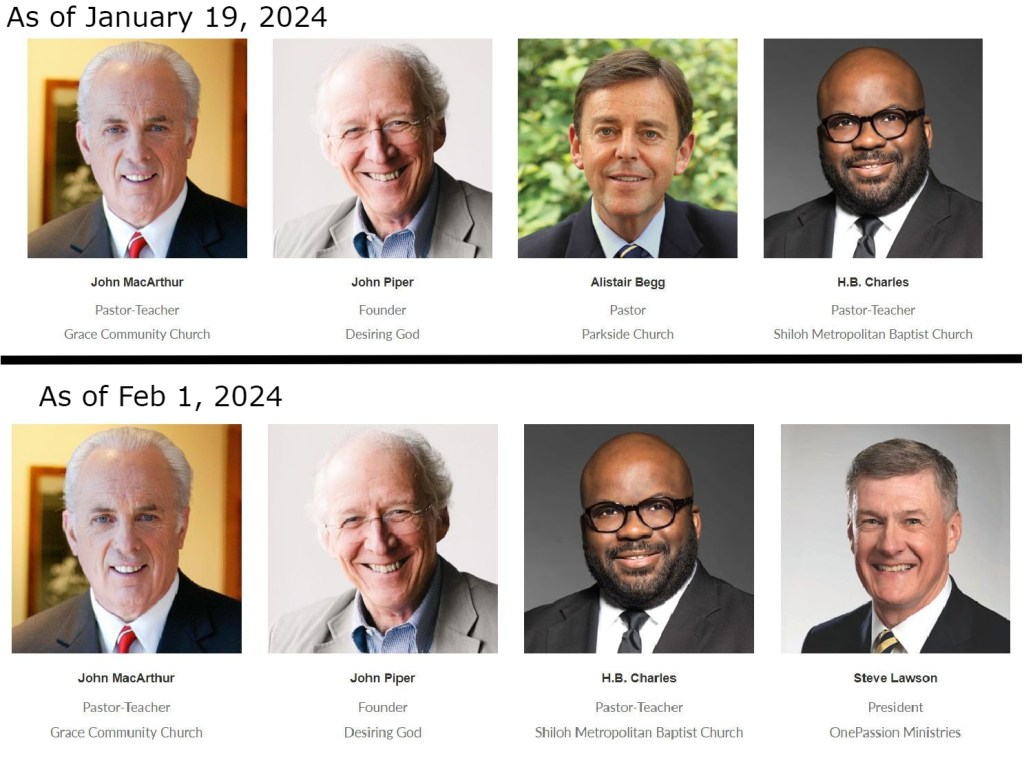
Sadly, yesterday, Alistair Begg was no longer listed as a speaker at the 2024 Shepherds Conference at Grace Community Church.
This is a major conference founded and led by John MacArthur specifically to edify and minister to Pastors. After Begg’s January 19 remarks which he counseled a grandmother that it was OK for her to attend the transgender wedding of her grandson, controversy erupted.
Initially, behind the scenes brethren urged Begg to reconsider this counsel. Then, American Family Radio contacted Begg’s ministry and had an extended conversation with his representatives, where pleas to repent were not heard. So AFR dropped Begg from their broadcasting roster.
One whose ear listens to a life-giving rebuke Will stay among the wise. One who neglects discipline rejects himself, (Proverbs 15:31-32).
Later, Begg said some even his own pastoral team disagreed with Begg’s advice.
Controversy continued. So this past Sunday, Begg preached a clarifying statement. In it, the defense of his counsel was worse than the counsel because it included anger, calling his critics Pharisees, and a misuse of the scripture he was preaching which was twisted to justify his defense of his position.
Then what people had been watching for: ShepCon. Apparently a conversation was had between ShepCon leader MacArthur and Begg. Begg withdrew from speaking, with MacArthur associate Phil Johnson telling a news organization “it was necessary for him to withdraw.”
The original advice should have been for the grandmother to refrain from participating as a celebrant and witness to a perversion of marriage. Sometimes one’s absence speaks louder than all the words up to that point.
And now Begg is undergoing the same treatment: our beliefs have consequences. At some point, we must part from a person when their beliefs (or acts) diverge from the Bible’s standards. In this, Begg’s truculent refusal to even listen to advice, never mind the actual original advice he gave the grandmother, indicates a necessary parting.
What would have been the effect, do we think, if the ShepCon organizers had said “Pastor Begg, we disagree with your advice, seeing it is unbiblical, and your misuse of the passage in Luke 15 was wrong exegesis, but come along to the Conference anyway, we don’t want to be seen as judgmental.” He would have felt justified, wouldn’t he?
Earlier in life I learned that what people SAY and what people DO, must match up.
Sometimes actions speak louder than words. Lines in the sand exist for a reason.
Worship Jesus and Jesus alone. Worship this same Jesus as God revealed Him to the world.
Do not worship Prophets, past or present.
“And Peter said to Jesus, “Lord, it is good that we are here. If you wish, I will make three tents here, one for you and one for Moses and one for Elijah.”” He was still speaking when, behold, a bright cloud overshadowed them, and a voice from the cloud said, “This is my beloved Son, with whom I am well pleased; listen to him.” (Matthew 17:4-5).
Jesus stopped Peter from making three tabernacles. It is acceptable to worship ONLY Jesus. This is such a strong truth that the Spirit stopped Peter from proclaiming worship of Moses and Elijah while he was still saying it.
Do not worship Angels.
“I, John, am the one who heard and saw these things. And when I heard and saw them, I fell down to worship at the feet of the angel who showed them to me, but he said to me, “You must not do that! I am a fellow servant with you and your brothers the prophets, and with those who keep the words of this book. Worship God.” (Revelation 22:8-9).
Again we read, ‘Worship God.’ Angels are fellow servants with us of the Most High God.
Do not worship men.
“And when the crowds saw what Paul had done, they lifted up their voices, saying in Lycaonian, “The gods have come down to us in the likeness of men!” Barnabas they called Zeus, and Paul, Hermes, because he was the chief speaker. And the priest of Zeus, whose temple was at the entrance to the city, brought oxen and garlands to the gates and wanted to offer sacrifice with the crowds. But when the apostles Barnabas and Paul heard of it, they tore their garments and rushed out into the crowd, crying out, “Men, why are you doing these things? We also are men, of like nature with you, and we bring you good news, that you should turn from these vain things to a living God, who made the heaven and the earth and the sea and all that is in them.” (Acts 14:11-15).
In these apostate times it’s easy to become depressed at all the false teaching, the turning aside of beloved friends, the wolves coming out of the woodwork. God promised this, He said it would happen and it is.
But His promises of faithfulness are just as sterling and perfect, too. There is a verse I love. It is John 10:35-
If he called them gods to whom the word of God came—and Scripture cannot be broken—
The verse is part of a longer conversation between Jesus and the Pharisees, but let’s focus on the fragment inserted into the verse: scripture can’t be broken.
In today’s world, everything breaks. I have a Weber Showcase & Fixture Co. turn of the last century Banker’s Chair. It is heavy oak, with a steampunk mounting and swivel that would hold a tank. It is well made. Only in the last year did it break. The threads stripped enough so the chair won’t stay high at the table for me to use it. In the beginning of the 20th century and the century before, they made things to last.
Now, everything’s broken. We have broken marriages, broken homes, disposable toasters, throw away watches. Your TV breaks? Buy another. Dishes are no longer carefully handed down from generation to generation, when they break, just go to Target and buy some more.
Scripture CANNOT be broken. It will never be broken. Pulpit Commentary says of the John 10:35 verse,
cannot he broken; loosed, destroyed. A fine testimony to the confidence which our Lord exercised in the Holy Scripture. He was accustomed to educe principles of life from its inward structure, from its concealed framework, from its underlying verities.
There is one other point I think we ought to notice. And that’s that little statement, “And the Scripture cannot be broken,” in John 10 verse 35. That gives us some idea of our Lord’s view of the word of God. The Scripture cannot be broken. It is of indefectible authority. It cannot fail and the things that it teaches cannot fail either. All of the designs and purposes of the word of God shall be accomplished, just as all of the designs and purposes of the Son of God shall be accomplished. The Scripture cannot be broken. That’s striking isn’t it?
What joy to see our Savior model complete trust and rest in His Father’s word. We do the same. We know that though false religions will come, and wolves and destroyers; so will peace, fulfillment of all the scriptures, and everlasting promises of the Lord our God.
The scripture cannot be broken. In wrapping ourselves in the scriptures, we cannot be broken either. No matter how upsetting, no matter how concerning, no matter how terrible things get, all the promises God said would happen will happen- including His working things to the good, our coming hope and joy, the Banquet, Jesus with us in person, eternal perfect worship. All of it. Because…scripture cannot be broken.
Paul spoke against the worship of angels in Colossians 2.
There are 6 main elements that Paul refutes in Colossians- 1. secret knowledge, (refuted in Col 1:27; 2:3) 2. asceticism, (Col 2:18) 3. depreciation of Christ (lowering Him in name and in glory), (Col 2:18b) 4. strict rule-keeping, ceremonies, or rituals (Col 2:23) 5. worship of angels, (Col 2:18) 6. and reliance on human wisdom and traditions (Col 2:20b-22)
One way to depreciate Jesus, the SOLE arbiter and dispenser of Truth, is to encourage people to shift their gaze to angels instead. (Like the Catholics want you to look at Mary, not Jesus). Anything to move Him to second place.
There is a reason that “voluntary humility” is followed by “worship of angels.” Here is a comment on Colossians 2:18 from Ellicott’s Commentary for English Readers:
Worshipping of angels.—This is closely connected with the “voluntary humility” above “that we must be brought near by angels and not by Christ, for that were too high a thing for us” (Chrysostom).
Everything old is new again, and elements of it are infiltrating everywhere today. It is a practice/philosophy that wants the adherent to look within herself for truth. “Follow your heart”, “The truth is in you”, “Be true to yourself” and something we hear a lot today, “MY truth”, and so on.
In refuting the false doctrines that had infiltrated the church at Colossae, Paul wrote:
“Do not let anyone who delights in false humility and the worship of angels disqualify you for the prize.” (Colossians 2:18a).
“At the core of Gnosticism is the belief that knowledge, typically secret knowledge – knowledge from angels, from the stars and planets, from the ancients – was the path to holiness and salvation,” David Grabbe wrote in Forerunner Commentary.
Paul warned about this again in Galatians 1:8, writing, “But though we, or an angel from heaven, preach any other gospel unto you than that which we have preached unto you, let him be accursed.“
How many false religions were started by or are perpetuated by a fallen angel? Most. Mormonism, Islam, Seventh Day Adventists, and Jehovah’s Witnesses were started via “angels”, and Catholicism and New Age Mysticism make heavy use of angelic visits though angelic-seeming spirit guides, saint worship, and Marian apparitions. Many New Age sects began through the contact of “Spirit Guides”.
Why be so (falsely) humble? Because that way, neo-Gnostics can appear to be pious and make up their own rules at the same time. They say, “I’m too humble to know God’s word for sure, but THIS I know for sure, I was visited by an angel who showed me … And I know it’s true because it happened to me!” This aspect of neo-Gnosticism is re-emerging today in increasing amounts. Many are straying away from God’s word and substituting mystical experiences and intuition for truth.
Mike Ratliffe wrote, “These reactions are rooted in the “Hermeneutic of Humility,” which is a way of looking at our faith and interpreting the very Word of God through a filter that sees certainty as a product of pride and uncertainty as a virtue. … people contend that to be certain divides people while uncertainty creates an environment of unity. I contend that the “Hermeneutic of Humility” is that decaying point from which the godlessness in these days has become so manifest in the visible church in our time.”
Now, angels are not divine and worship of them is explicitly prohibited (as in Col. 2:18; Rev. 19:10; 22:9).
Heresy doesn’t always mean that a sect or a doctrine denies Jesus outright. The most successful sects and heretics preach Jesus, but they preach a different Jesus. They say that more must be done to attain salvation, that Jesus isn’t sufficient. They chip away at His sovereignty and slowly build man up as a partner on the sanctification process. Did you ever wonder why the verse in Acts 1:11 says, “Which also said, Ye men of Galilee, why stand ye gazing up into heaven? this same Jesus, which is taken up from you into heaven, shall so come in like manner as ye have seen him go into heaven.”
Paul referred to a Gnostic’s false humility. A false humility goes something like this: “‘so humble unworthy me can’t think of worshiping a Holy God. I’ll worship this angel instead.” But what is true humility? One can find a definition at Christian Research and Apologetics Ministry (CARM):
“Humility is the right understanding of who you are before God. Notice, I did not say it means that you have to hate yourself, or call yourself names, or say you aren’t worth anything, etc. Humility is that quality of a Christian that demonstrates a right relationship and position before God. This demonstration is manifested in attitude, words, and deeds.”
Paul referred to real humility in Colossians 3:12- “Put on then, as God’s chosen ones, holy and beloved, compassionate hearts, kindness, humility, meekness, and patience,” and the word for humility is translated “lowliness of mind.” Quite the opposite of the Gnostic’s puffed up sense of self and the high importance he places on his visions and experiences and knowledge!
——————
Gnostic buzzwords to watch out for, –“received” as in ‘received a text’, ‘received a revelation’, –ascend, higher, elevation –spirit guide, spirit being, ascended masters (other terms for false angels and their worship), –mystery, alchemy, altered states of consciousness, –elementals (Paul refuted the necessity of seeking elemental forces in Col 2:8) –new, as in new revelation, new light, new approach, new interpretation. Also, ‘fresh’.
Always look to Jesus. He is the sole source of Truth, Goodness, and Beauty. It all begins and ends with Him. Angels are His servants. Angels are not bringing any further revelation to anyone these days, because the canon is closed. If you think you have been visited by an angel who told you secret things, new things, fresh things, things outside of the Bible, you were visited by a demon.
The selection of music in churches is important and is not based simply on preferences. Do not pooh-pooh the music by marginalizing it to a second tier of concerns and assigning it as simply a “preference.” Music is doctrine, sacred music is unique to the redeemed because it is our response to His redeeming work, and it is either reflective of the culture or it is reflective of the worshipful heart.
First, let’s talk about what music in church is NOT. These are taken from John MacArthur’s sermon “Is Music Worship?” based on the verses at Ephesians 5:18-20.
Music is not worship. Music is a means to express worship, but it is not worship.
Secondly, a misconception is that music motivates worship, music induces worship. That’s not true either. … [T]he motive for all of our songs is not a sound, it’s a truth.
Another misconception is that when people have trouble worshiping, music will create worship, music will create the mood for worship. Worship is not a mood experience.
What true worship IS, is-
a permanent attitude. John 4, “We worship in spirit and truth.” That’s who we are. … The music of the redeemed is different. We live in a different world. We are citizens of a different kingdom. The music of the redeemed is alien to the music of the world. The music of the redeemed is reflective of that which is most lofty, most elevated, most exalted, most noble: the truth of God – it never changes. So our music doesn’t ride the culture. Music doesn’t ride the culture among the redeemed, it simply reveals the truth, and the truth never changes. (Source)
I encourage you to listen to the sermon. The explanation about music and its place in worship among the redeemed is stupendously explained, especially when you arrive at the powerful ending.
Meanwhile, I’d read missionary Gladys Aylward’s autobiography and was struck by something described at the end of the book. The following is my retelling of Aylward’s event.
Unsplash photo, free to use
There is a great story in China Missionary Gladys Aylward’s autobiographical book “The Little Woman.” This occurred in the mid-1930s. She is trying to escape the invading Japanese, because they had put a price on her head. So she walked in a direction no Chinese went, over some mountains where the map was blank. She was with one other missionary. At dusk, seeing no human, no town, no habitation at all, they were debating whether to go back. The man told Aylward to sit on this nearby stump and he would go ahead a bit and see what’s what. Alone, Gladys began to sing hymns.
Soon the man came back and said, no luck. They might freeze out there or if they go back they might be killed. Just then a Lama (Buddhist Monk) came up. He said, come with me, we will take you to our lamastery. No people were EVER invited into a lamastery. But the duo believed it was an ordained appointment. I mean, what were the odds, right? So they went. They were led up the side of the mountain high up to a lamastery carved into the rock. They were greeted happily and warmly and fed and made comfortable.
She asked the head Lama the next day why they had been so cordially welcomed to such a private and mysterious place. Lama said that 7 years ago they brought to town their licorice that they pick and sell. They heard a lone man in the square saying that there is a God who loves them and salvation is free, if they believe- come to this building tonight to hear more. They were astounded that such a doctrine existed. There is a God? He loves? They accepted the tract the man was handing out, simply the verse at John 3:16 and the address, nothing more.
For five years they sought to learn more but were unable. Every time they went to town to sell their licorice they asked everyone about where to find “the God who loves.” No one else could tell them. Then one day a man was there and he did say yes, go to the China Inland Mission over there and they will tell you. A Mission house had been established.
They went to the Mission house and received New Testament Bibles and tracts, which they brought back to the lamastery and read eagerly. They delighted in the notion that there was a “God who loves” but there was much in the book they did not understand. Still, they read, and they came to the verse where Christ had said of his apostles, “Go ye into all the world and preach the Gospel.” And the monks believed that one day a person would come and preach to them them, because it said so in the book.
And three years later when they heard singing, they knew the person had come, because as the Monk said, “Only people who know God will sing.” And the person was Gladys and her companion. They rejoiced, knowing they were about to learn more. So she and the other missionary told all the monks about Jesus and then they left the next day, not knowing if the lamas were saved or became saved, but trusting that some would, sometime.
~~~~~~~~~~~~~~~~~~~~~~
I had never thought about it before, but no other major religion really sings. Of course anything other than biblical Christianity is a false religion. You get chants, but no hymns. No singing. On that cold, dusky night, Gladys was recognized by Buddhists because she sang. Our music IS unique and we are eternally identified with it. It is not simply a preference. Toward the end of his sermon, John MacArthur said this:
And by the way, Christians are the only religion that sing. Muslims don’t sing, Buddhists don’t sing, Hindus don’t sing. They don’t sing. Some chant in a minor key; Christians sing. But when the Reformation came, music was reintroduced to the church; and you sing a hymn written by Martin Luther who launched the Reformation: A Mighty Fortress is our God. Five-hundred years after that, we’re still singing that hymn.
We sing because we have been redeemed. We sing a new song, one that the world does not hear. We sing because-
He brought me up out of the pit of destruction, out of the miry clay, and He set my feet upon a rock making my footsteps firm. He put a new song in my mouth, a song of praise to our God; many will see and fear and will trust in the Lord. (Psalm 40:2-3)
Alistair Begg addresses controversial comments he’d made in an interview last September regarding counsel to a grandmother to attend wedding of her grandson and his transgender fiancé. He’d said as long as the grandma had made it clear she disapproved and had shared the Gospel, she should attend. The grandson might be surprised by her love, rather than her absence likely confirming her criticalness and judgmentalism.
The Interview was held between Bob Lepine and Begg, upon the occasion of the publication of Begg’s new book, “The Christian Manifesto.” That interview is here. Slide to 26:30 to hear the question posed to Begg and Begg’s controversial reply.
Though the interview was published in September 2023, it seemed to sink into the murk until it surfaced on January 18 and was shared on social media. A huge controversy ensued, with attendant discussion in all corners of the internet.
One of the major radio stations who carried Begg’s radio program Truth For Life contacted the ministry and had a lengthy conversation with Begg’s representatives, who assured American Family Radio that Begg meant what he said and was not changing his stance. The Radio ministry subsequently dropped Truth for Life from its roster of broadcasted programs.
This week, Begg said his colleagues had told Begg that it would be wise for Begg to acknowledge the tremendous amount of noise on the internet about this issue and to say something about it.
That statement occurred on January 28, 2024 at Parkside Church and was uploaded to the internet. His 46 minute sermon is titled Compassion vs. Condemnation, and the blurb says,
“How are Christians to walk the fine line between affirming and reviling those whose actions declare them to be God’s enemies? That is the question Alistair Begg seeks to answer as he addresses the controversy surrounding the counsel he gave to a grandmother in the summer of 2023. Turning to Luke 15, Alistair reminds us that the inclination toward pharisaism is alive and well within all our hearts. It is something we always must guard against—especially as we press on toward purity and holiness in the midst of an aimless and confused generation. Scripture: Luke 15 Preached: January 28, 2024.
I have not listened to it but I post it here as a follow up to the articles I published earlier on this issue. See what you think.
I am working my way through a course called Heaven and Hell led by Dr. Kevin Zuber. The first half of the course focuses on hell and those false philosophies that try to explain hell away. The second half focuses on heaven. I’m almost there.
I’ve learned a lot, but mainly I’ve decided that we do not talk about hell enough.
When you mention ‘Jonathan Edwards,’ people immediately think of his famous sermon, “Sinners in the Hands of an Angry God” a sermon that sparked an awakening in the pagans who heard it, an awakening which spread throughout New England and beyond, thanks to George Whitfield who pushed it on. Edwards is also known for his sermon titled “A Faithful Narrative of the Surprising Work of God in the Conversion of Many Hundred Souls in Northampton (1737),” a treatment on justification by faith. This sermon was reprinted and read widely across America and in Britain.
But Edwards was more than just the hellfire preacher. He was genuinely concerned for the sluggish, apathetic, sleepy pagans and the nominal Christians who professed but likely didn’t possess the Spirit. One of his goals was to awaken them to both heaven’s bliss and hell’s agonies. He actually preached on heaven more than hell, but his preaching on hell was startling and made deep impressions.
The following is from his 16 part series (16 parts!!) called “Heaven, a World of Love”. It is from part 16, the last part. Edwards contrasted the bliss of heaven he had already preached on in previous parts, with the holiness of God’s wrath in hell.
I know hell isn’t the most comfortable subject, but it is a big part of the Christian life. When we say ‘I’m saved!’ we should ask, FROM WHAT? From the just penalty of eternity in hell, paying for the sins we performed in this life against a holy God. Every person born on this planet is destined for hell by default because of our sin nature. (Babies and the cognitively unable are another subject). Please, please, gird up your loins, take a deep breath, and read on. We must confront the uncomfortable subject of hell. We must!
When you share the Gospel, DON’T leave out hell.
Here’s Jonathan Edwards:
What has been said on this subject may well awaken and alarm the impenitent. — And,
First, by putting them in mind of their misery, in that they have no portion or right in this world of love. You have heard what has been said of heaven, what kind of glory and blessedness is there, and how happy the saints and angels are in that world of perfect love. But consider that none of this belongs to you. When you hear of such things, you hear of that in which you have no interest. No such person as you, a wicked hater of God and Christ, and one that is under the power of a spirit of enmity against all that is good, shall ever enter there. Such as you are, never belong to the faithful Israel of God, and shall never enter their heavenly rest.
It may be said to you, as Peter said to Simon (Acts 8:21), “Thou hast neither part nor lot in this matter, for thy heart is not right in the sight of God;” and as Nehemiah said to Sanballat and his associates (Neh. 2:20), “You have no portion, nor right, nor memorial, in Jerusalem.” If such a soul as yours should be admitted into heaven, that world of love, how nauseous would it be to those blest spirits whose souls are as a flame of love! and how would it discompose that loving and blessed society, and put everything in confusion! It would make heaven no longer heaven, if such souls should be admitted there. It would change it from a world of love to a world of hatred, and pride, and envy, and malice, and revenge, as this world is! But this shall never be; and the only alternative is, that such as you shall be shut out with “dogs, and sorcerers, and whoremongers, and murderers, and idolaters, and whosoever loveth and maketh a lie,” (Rev. 22:15); that is, with all that is vile, and unclean, and unholy. And this subject may well awaken and alarm the impenitent,
Secondly, by showing themthat they are in danger of hell, which is a world of hatred. There are three worlds. One is this, which is an intermediate world — a world in which good and evil are so mixed together as to be a sure sign that this world is not to continue forever. Another is heaven, a world of love, without any hatred. And the other is hell, a world of hatred, where there is no love, which is the world to which all of you who are in a Christless state properly belong. This last is the world where God manifests his displeasure and wrath, as in heaven he manifests his love. Everything in hell is hateful. There is not one solitary object there that is not odious and detestable, horrid and hateful. There is no person or thing to be seen there, that is amiable or lovely; nothing that is pure, or holy, or pleasant, but everything abominable and odious. There are no beings there but devils, and damned spirits that are like devils. Hell is, as it were, a vast den of poisonous hissing serpents; the old serpent, who is the devil and Satan, and with him all his hateful brood.
In that dark world there are none but those whom God hates with a perfect and everlasting hatred. He exercises no love, and extends no mercy to any one object there, but pours out upon them horrors without mixture. All things in the wide universe that are hateful shall be gathered together in hell, as in a vast receptacle provided on purpose, that the universe which God has made may be cleansed of its filthiness, by casting it all into this great sink of wickedness and woe. It is a world prepared on purpose for the expression of God’s wrath. He has made hell for this; and he has no other use for it but there to testify forever his hatred of sin and sinners, where there is no token of love or mercy. There is nothing there but what shows forth the Divine indignation and wrath. Every object shows forth wrath. It is a world all overflowed with a deluge of wrath, as it were, with a deluge of liquid fire, so as to be called a lake of fire and brimstone, and the second death.
The entire sermon contained in a short booklet you can download free or read online, is here.
A six-part series on the Life of Jonathan Edwards is here at Ligonier. I took this class, it’s good. First message is free, successive lessons are behind a paywall. Or, you can get Nichols’ book Jonathan Edwards: A Guided Tour of His Life and Thought in paperback (used) for $1.99 at Amazon.
Institute for Christian Life: Heaven & Hell by Dr. Zuber is here.
I found it interesting because much of women’s ministry teaching comes from this kind of study. The Grandmother of word studies is Beth Moore. Her proteges are following suit and her proteges’ proteges, third generation Bible teachers for women, are following suit also.
I attended a BM Living Proof “study” in North Carolina years ago. I had begun going to church regularly only a few years prior. So I was a newbie to church and to the faith. I was totally new to discernment. Most of my earliesty blogging had to do more with prophecy than discernment or encouragement.
I re-read the discernment essays I had written back then regarding Moore’s teaching and I am proud of the Holy Spirit because I think they hold up over time. I believe I was on the money with my concerns to a degree that only the Holy Spirit can take credit because, as I said, I was new and fairly unlearned. I had written a review about my concern with how Moore approaches a teaching she said she constructs for delivery at Living Proof.
She explained how she arrives at the lessons she teaches on her tour. She said that when she prays the Holy Spirit will deliver a word to her. [This is an extrabiblical, Mystical practice] In the case for the teaching in Charlotte, it had been “Hold Fast.” In the case of her next tour in Columbia, it will be “Prepare.” She then creates an acrostic of teaching points that begin with each letter in the main word. In that long-ago Living Proof conference I attended ours was –
His affection is set upon us Only He is your praise Loving Him awakens your true heart Doing His will does us good Fleeing to Him means fleeing with Him Any tighter embrace will also replace Satan wants what we have The Lord is your life
Looks kind of OK, doesn’t it? I won’t explain each of the eight mantras point by point, but share with you some of what troubled me most. I think word studies are good, and I like when teachers look into the Greek or the Hebrew meaning. This manner of exegetical study, finding all the words that relate to a subject and building a lesson out of it is fraught with danger. You lose the context of each passage you are extracting the word from. If you cross OT to NT that context gets more complicated because you have to research whether the word used in a context was meant only for the Jews in the Old Covenant or can be extrapolated into the New Covenant for the Gentiles. Getting meaning from the Hebrew-to-Greek is also problematic for a layman.
This approach also means that you wind up using a LOT of verses in one study and that tends to feel cobbled together and superficial. Rick Warren does this constantly and he has been called out for it. You can’t really explain to full depth each verse so you simply refer to them, and there winds up being a lot of different points. It gets unfocused, really fast.
What is Hermeneutics? from Ligonier, “the art science of biblical interpretation” … more at link
Moore had said that she found every ‘hold fast’ in the Bible, OT or NT, and she put together a lesson from that. A lot of people in the audience were so impressed with her mention of the Greek word for this or the Hebrew word for that. Even at my naïve state years ago, ripping out a word from its context and matching it to other words it may seem like, wasn’t a good approach. Context is everything.
The Master’s Seminary article explains in detail just why students should not absorb lessons from teachers who crafted lessons based on these kinds of word studies, nor should teachers create lessons based on studies of these kinds. Below are two short excerpts from the short version of their article. If you want to go deeper into the whys and wherefores, there is a fuller, lengthier version of the same article, here.
When it comes to studying Scripture, word studies are popular, easily obtained from available resources and an easy way to procure sermon content. However, word studies are also subject to radical extrapolations and erroneous applications. It is not always possible to strike exegetical gold by extracting a word from the text for close examination. Word studies alone will not suffice. Indeed, over-occupation with word studies can be a sign of laziness and ignorance involved in much of what passes for biblical exposition in our times.
Study of the words alone will not present us with a consistent interpretation or theology. This is one of the misleading aspects of theological dictionaries/wordbooks. One learns far more about obedience/disobedience or sacrifice and sin from the full statement of a passage like 1 Sam 15:22–23 than he will from word studies of key terms like “sacrifice,” “obey,” or “sin” in the text.
The most important thing about studying the Bible is actually reading the Bible. Too many people spend too much time warming up first. Getting the right chair, the cup of coffee, the notebook, the pen, the devotional, the book about how to read the Bible … all fussing over the preparations and never digging into the main event.
Be a good Bible student. And watch out for shallow word study teachers. Just because they mention “Greek” or “Hebrew” doesn’t necessarily mean they’ve delved deeply. Many times it means the opposite.
Recommended resources:
Hermeneutics: her·me·neu·tics- ˌhərməˈn(y)o͞odiks/ noun. The branch of knowledge that deals with interpretation, especially of the Bible or literary texts.
Short book: How to Eat Your Bible: A Simple Approach to Learning and Loving the Word of God by Nate Pickowicz
Because the times are so hard and the world is so dark, I’ve been posting some short essays on worship. Just worship. It’s a way to remind me, and anyone, that “Man’s chief end is to glorify God, and to enjoy Him for ever” says the Westminster Shorter Catechism. Let’s just find ways every day to enjoy God!
I like natural history. It’s God’s creation. I like thinking about how He has created everything from nothing with just a word. I see the intricacy of His creatures and flora and fauna and I’m just amazed.
I walked across my apartment parking lot yesterday when I got home from school. The frigid weather had turned to 68 degrees and it was warm and humid. Halfway across I heard what sounded like a frog. Frogs! I thought it’s way too early for frogs! There is a pond next door butt the sound was coming from high up in the trees on the onterside of the road in the woods.
I went inside and searched for “bird that sounds like a frog” and came up with Hooded Merganser.
But reading natural history books is a two-edged sword. Most are written from a secular point of view, and at some point the constant lies within such books begins to grate, and I abandon them.
One of the natural history books mentioned in the Atlas Obscura article was a seaweed journal by Margaret Gatty. Atlas Obscura wrote of her,
One of the best known and most dedicated of these so-called seaweeders was Margaret Gatty, a children’s book author who took up the hobby while convalescing in Hastings, on Britain’s southeast coast, in 1848. Gatty’s crowning work of algology, British Sea-Weeds, is an exhaustive compilation of local seaweeds, fully described and illustrated in 86 colored plates.
I did not know there was a whole field of study called ‘algology’. These are selected plates of her seaweed drawings,
Selected plates from Margaret Gatty’s “British Sea-Weeds.” BIODIVERSITY HERITAGE LIBRARY/PUBLIC DOMAIN
I love those colored plates from natural history books from the 1800s. I owned two rare books,
A popular history of the mollusca : comprising a familiar account of their classification, instincts and habits and of the growth and distinguishing characters of their shells, by Mary Roberts, 1851; and
Popular British conchology. A familiar history of the molluscs inhabiting the British Isles, By George Brettingham Sowerby, 1854.
I love the hand colored plates of the plants or animals they carefully drew. I also have several books by Harvard University paleontologist Stephen Jay Gould (secular guy, sigh). There’s French poet-philosopher Paul Valery in his engaging meditation on the aesthetics of the seashell, as Amazon describes his work. Anne Morrow Lindbergh’s musings on shells in her famous Gift from the Sea. And so many other books. I guess now that I’m thinking of listing them, my library contains quite a few natural history books. Rachel Carson, Farley Mowat, John Hay, Abbot & Dance…
In 1664 John Evelyn, diarist, country gentleman, and commissioner at the court of Charles II, produced his monumental book on trees: Sylva, or a Discourse of Forest Trees. It was a seventeenth-century best seller. Evelyn was a true son of the Renaissance. His book is learned and witty and practical and passionate all by turns. No later book on trees has ever had such an impact on the British public.
Hmmm, maybe that’s why the Monty Python comedy troupe mentioned THE LARCH so often…
I love trees. Maybe I’ll get that book.
As much as I love reading about the creation from scientists of various kinds, there’s nothing like reading the Bible, God’s actual account of His world. As poetic as Lindbergh was, as witty as John Evelyn was, as precise as Sowerby or Roberts was, the thrill of reading about the creation from God Himself never fails to thrill me. As familiar as these verses are, they still ignite a reverent awe at His power:
In the beginning, God created the heavens and the earth. 2The earth was without form and void, and darkness was over the face of the deep. And the Spirit of God was hovering over the face of the waters.
3And God said, “Let there be light,” and there was light. 4And God saw that the light was good. And God separated the light from the darkness. 5God called the light Day, and the darkness he called Night. And there was evening and there was morning, the first day.
6And God said, “Let there be an expanse in the midst of the waters, and let it separate the waters from the waters.” 7And God made the expanse and separated the waters that were under the expanse from the waters that were above the expanse. And it was so. 8And God called the expanse Heaven. And there was evening and there was morning, the second day. (Genesis 1:1-8)
Nature displays God’s glory. The best place to read about that is His word, what He, Himself, has declared.
Let the heavens rejoice, let the earth be glad; let the sea resound, and all that is in it. Let the fields be jubilant, and everything in them; let all the trees of the forest sing for joy. (Psalm 96:11-12)
We are glad because as Job 12:10 says,
In his hand is the life of every creature and the breath of all mankind.
Is there any better place to be, if you’re saved? In His hand? Is there any worse place to be, if you’re not saved?
It is a fearful thing to fall into the hands of the living God. (Hebrews 10:31)
Read of His creation. The essays, poems, philosophies of the secular writers and scientists is fine, also good are Natural History books on the Bible such as The Scripture Alphabet of Animals by Mrs. Harriet N. Cook, 1842; The Plants of the Bible by John Hutton Balfour, 1885. But the originator of it all is the one to be worshiped and the best place to do that is read of Him in His word-
Do you not know? Have you not heard? The Everlasting God, the Lord, the Creator of the ends of the earth Does not become weary or tired. His understanding is inscrutable. (Isaiah 40:28)





 the-end-time.org