Many people start off in their salvific walk with God well, but end badly. I don’t mean ones like Judas or Demas, who were always bad but hid it well until the end. I mean genuinely faithful men whom the LORD loved, but strayed from the path of righteousness and ended badly. Let’s take a look at the #1 object lesson in this sad state of affairs, King Solomon.
“But King Solomon loved many strange women — Solomon’s extraordinary gift of wisdom was not sufficient to preserve him from falling into grievous and fatal errors. A fairer promise of true greatness, a more beautiful picture of juvenile piety, never was seen than that which he exhibited at the commencement of his reign. No sadder, more humiliating, or awful spectacle can be imagined than the besotted apostasy of his old age; and to him may be applied the words of Paul (Ga 3:3), of John (Re 3:17), and of Isaiah (Isa 14:21). A love of the world, a ceaseless round of pleasure, had insensibly corrupted his heart, and produced, for a while at least, a state of mental darkness. The grace of God deserted him; and the son of the pious David — the religiously trained child of Bath-sheba (Pr 31:1-3), and pupil of Nathan, instead of showing the stability of sound principle and mature experience became at last an old and foolish king (Ec 4:13). His fall is traced to his “love of many strange women.”source (Commentary Critical and Explanatory on the Whole Bible — Robert Jamieson at Biblehub)
It would seem that Peter started off well and it seemed his ending was a sad state of affairs. He closely followed Jesus in Jesus’ incarnation for years, was the leader of the group, was the first to say the right things (and sometimes the wrong things, but for the right reasons). But when Jesus was crucified, at the moment when Peter needed to pull together all his strength, he denied Christ.
But that was not the end! It was the beginning! The difference came when the disciples received the Holy Spirit, including Peter. He was endowed with superhuman knowledge and a tongue to preach praises to God in a sermon that stands forever. He became bold, wise, and earnest.
Solomon did not have the benefit of an indwelling Holy Spirit. He had direct access to God. God visited Solomon in dreams, but for daily holy help in resisting sin, following God’s statutes, Solomon relied on his flesh. And we know how that turned out.
We have the indwelling Spirit in us. We still have our flesh, the devil, and the world harassing us, tempting us, and trying to make us swerve from the path. But the Spirit in us is our holy help to stay inside the narrow lanes of God’s statutes and expectations. What Solomon’s experience teaches us is that no matter how wise we are, our wisdom and even our desire to please God is no match for the world. cf: Peter.
Our flesh, our emotions, and our innate weakness cannot withstand sin. Only the Holy Spirit can help us do that, because He transcends sin. He is holy, supernatural, and is present in us specifically to help us grow in Christ’s likeness.
I think of the scene in Acts where the demon-possessed slave girl kept following Paul around hollering about salvation. Even though she was saying what sounded like a true thing, it as just vague enough to please Jews and upset pagans. Paul was mightily aggravated. This is what our flesh does to us, our thoughts, the world, and our own minion demons that might be harassing us in the invisibles. Saying things that sound vaguely true but are false.
Solomon’s failure was incremental. I’m sure the first wife who had proposed setting up an altar to her false god didn’t come right out and say to Solomon, ‘Let’s worship Baal!’ Incremental creep must be nipped in the bud before it grows, settles, and spreads its tentacles. Eve’s failure was listening to the serpent for too long. She should have turned away the moment it said “Hath God said?” He caused her to doubt, then contradicted God’s word, then offered a tempting promise. Three strikes and she was out. So was Adam.
Christ’s grace is sufficient for us. But how often do we rely on it? How often do we appeal to God in our own weakness for His strength?
Peter eventually did. In the Spirit’s strength, Peter became so brave and humble he did not even want to die in the same manner as Jesus did. Tradition says he died crucified upside down.
Reliance on the Holy Spirit will aid us faster and better and more accurately in our pursuit of righteousness in sanctification than our own flesh. Here are further resources on the Holy Spirit. Remember, the very God Himself in the Person of the Holy Spirit is inside us, helping us become like brave like Peter end even ultimately like Jesus, and avoid pitfalling like Solomon.
Look carefully then how you walk, not as unwise but as wise, 16 making the best use of the time, because the days are evil.
Of this passage in context, Matthew Henry said,
“These verses contain a caution against all manner of uncleanness, with proper remedies and arguments proposed: some further cautions are added, and other duties recommended.”
One of the cautions is that the days are evil, so we redeem the time. If we do, we are wise. Henry further comments on the part about redeeming the time,
It follows, redeeming the time (v. 16), literally, buying the opportunity. It is a metaphor taken from merchants and traders who diligently observe and improve the seasons for merchandise and trade. It is a great part of Christian wisdom to redeem the time. Good Christians must be good stewards of their time, and take care to improve it to the best of purposes, by watching against temptations, by doing good while it is in the power of their hands, and by filling it up with proper work—one special preservative from sin. Our time is a talent given us by God for some good end, and it is misspent and lost when it is not employed according to his design. If we have lost our time heretofore, we must endeavour to redeem it by doubling our diligence in doing our duty for the future.
The Bible Exposition Commentary by Warren Wiersbe says of the Ephesian 5:15-16 verses,
It is a mark of wisdom (v. 15). Only a fool drifts with the wind and tide. A wise man marks out his course, sets his sails, and guides the rudder until he reaches his destination. When a man wants to build a house, he first draws his plans so he knows what he is doing. Yet, how many Christians plan their days so that they use their opportunities wisely? True, we cannot know what a day may bring forth (James 4:13–17). But it is also true that a planned life can better deal with unexpected events. Someone said, “When the pilot does not know what port he is heading for, no wind is the right wind.” Life is short (v. 16a). “Buying up the opportunity—taking advantage of it.”
An old Chinese adage says, “Opportunity has a forelock so you can seize it when you meet it. Once it is past, you cannot seize it again.” Our English word opportunity comes from the Latin and means “toward the port.” It suggests a ship taking advantage of the wind and tide to arrive safely in the harbor. The brevity of life is a strong argument for making the best use of the opportunities God gives us.
I ask Jesus to expand the time for me, to help me make use of the time, and to convict me when I fail to be “wise.” He always hears that prayer, because it belies a heart that wants to glorify Him more, and not less. If I can glorify Him one minute more each day, even one minute, by purposeful prayer, or conduct, or Bible study, then that is a beautiful thing.
EPrata artwork, paper collage, scanned, & digitally altered
I admire and respect fishermen. I’ve watched the hardy lobstermen of Maine, or the cod fishermen of Massachusetts, the watermen fishing for crabs in the Chesapeake, the shrimpers of the south or the bonefish, sponge, and conch fishermen of the Caribbean waters. Fishing for a living is hard. It is not for the weak or the lazy.
There are no days off, you go out in storms, heat, rain, and ice. You use your body as one with the boat and the sea, drawing from it food and life.
It was no different for the fishermen of Galilee in Jesus’ day. Jesus called four fishermen as His disciples. Simon-Peter and his brother Andrew, and John and his brother James, the sons of Zebedee who was also a fisherman.
Fishing villages along the shore of the Sea of Galilee included Capernaum, where Jesus based much of His ministry, (Mark 2:1); Bethsaida (Luke 9:10); and Magdala, town of Mary Magdalene (Matt 15:39).
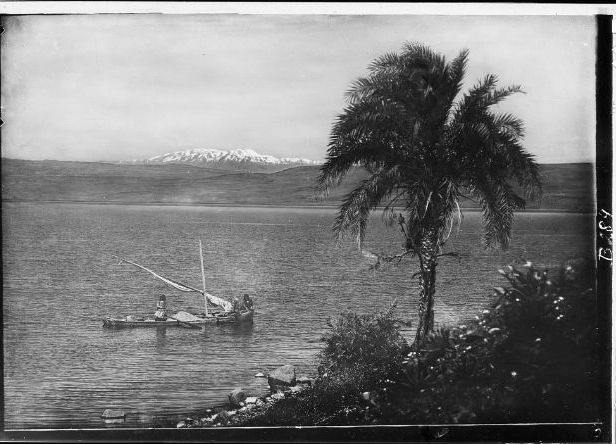
The pictures of the Holy Land around 1900 are important because life and traditions in Palestine didn’t change much until after WWI. A photo depicting life in 1900 would be almost a copy of any scene from the time of Jesus. These Library of Congress photos offer a glimpse into not just the recent past of the 20th century, but a peek back 2000 years.
While walking by the Sea of Galilee, he saw two brothers, Simon (who is called Peter) and Andrew his brother, casting a net into the sea, for they were fishermen. And he said to them, “Follow me, and I will make you fishers of men.” Immediately they left their nets and followed him. And going on from there he saw two other brothers, James the son of Zebedee and John his brother, in the boat with Zebedee their father, mending their nets, and he called them. Immediately they left the boat and their father and followed him. (Matthew 4:18-22).
We learn so much from just these 4 verses.
WHERE: They fished the Sea of Galilee WHO: as mentioned, the two sets of brothers WHAT: They were net fishermen as opposed to hook and line fishermen. They cast from boats they owned and they mended their nets (this shows us they were diligent). WHY: Fishing was hard, but gave a living, generationally, in John and James’s case. The dad was a fisherman. Yet when THE Father called, the men left their profession and immediately followed Jesus.
The Sea of Galilee was also called Kinneret or Kinnereth, and Lake Tiberias. It’s Israel’s largest freshwater lake. A fisherman’s day would begin at pre-dusk, because they fished at night. Why? The nets were made of linen which were lighter colored. They’d be more visible to the fish by day, since the waters were cool and clear. The fish would avoid the nets.
In addition, the fish were more active and feeding closer to the surface at night. You caught fish at night, in shallow water.
So they fished at night. (John 21:3). The men would launch their boat from shore and sail gently into the shallow areas along the shore. They’d cast their nets, which were really a three-walled net of decreasing size mesh holes, into the water. Little weights along the bottom would help the net sink vertically down, and the top would float, since there were little buoys of cork or wood attached.
They might be catching little fish, (Matthew 15:34), a Kinneret sardine, processed at the salting and drying station of the town of Bethsaida (House of Fish). Or they might be catching big fish, a kind of tilapia with white flesh and good to eat. (John 21:11).
If the fisherman wasn’t using his boat or didn’t have one, he stood near shore, casting a smaller net. When Jesus called Simon-Peter and Andrew, they were on the shore throwing out their nets from land. (Matthew 4:18). When He called James and John, they were throwing nets from their boat with their father Zebedee.
One other way to fish with nets was with a dragnet. Jesus compared dragnet fishing to the kingdom of heaven-
Once again, the kingdom of heaven is like a dragnet that was cast into the sea and caught fish of every kind. (Matthew 13:47)
This is where a net would be laid out in a horseshoe shape from shore, and dragged in, catching many different kinds of fish. The men would then sort the good fish from the bad, tossing the unmarketable fish away and keeping the good.
Dragnet fishing at Sea of Galilee, circa 1900. Library of Congress, LC-matpc-04570
Either way, the fisherman would swim to the center and dive down to gather either the fish or draw up the net. He’d do this naked. (Meaning with only his light undergarment on, not bare-skin naked). Peter was fishing this way when the verse says he put on his clothes to go meet Jesus. (John 21:7). The nets set from the boat could be several hundred feet long and 20 feet high. In Luke 5:6 when Jesus miraculously filled their nets, the huge nets became so heavy that they needed the other boat crew to help drag it aboard, then the nets were breaking, and the boat began to sink as they brought in the haul!
On a normal, miracle-less day, whether from the boat or from the shore, it still was heavy labor to throw the nets out, wait for them to settle, and then circle back by sail or swim back to haul them in. Repeat. All night. Fishermen were hard workers, strong, and were usually peasants and therefore used to a rough life.
In the morning, the fishermen would stop and bring their gear ashore. They’d eat breakfast. Then they would set to fixing their gear. It was time to spread their nets and examine them. (Ezekiel 47:10). Do any of the stone weights along the bottom need replacing? They’d have to gather more stones, drill holes, and tie them to the bottom. Do any of the cork or wood buoys along the top need replacing? Do the nets need re-sewing? Are they rinsed off? Is the debris picked out of the nets?
The same attention needs to be given to the boat. These items were their livelihood. So the fishermen would examine the sails and sew or patch any worn areas. Check the anchor rope and the mast and the underside. Tar or pitch could be heated to cover the planks to seal them. Ropes need to be re-twined and add pitch to the ends to ensure it doesn’t fray.
At the end of their day they would fold the nets and store them in the boat, waiting for the night-time when they’d put out in the Sea of Galilee again.
A day in the life of a Galilean fisherman was hard, but it offered a living. As with any trade, a father taught the son. Joseph taught Jesus carpentry. Zebedee taught his sons James and John how to fish. Net fishing hasn’t changed much in 2000 years. You could see similar scenes as the ones above in Indonesia, China, Viet Nam, Venezuela or any place. What has changed is the incarnation of Jesus, molding these rough outdoor peasant men into gentle, loving Christians, ready to catch men with the net of the Gospel. And as with these men, our spiritual forefathers, they teach us to this day.
And Jesus said to Simon, “Do not be afraid; from now on you will be catching men.” And when they had brought their boats to land, they left everything and followed him. (Luke 5:10b).
I pray you and I catch many souls with our net of the Gospel and a life well lived through following Him.
What word in the New Testament is used only once, in Matthew 24:12?
First, the scene.
Vincent Van Gogh
The disciples had asked Jesus about the Temple, the times, and when His return would be. His answer is the longest discourse in the NT after the Sermon on the Mount, and the longest answer to any question the disciples asked. It comprises the entire chapters of Matthew 24 and goes on to Matthew 25. The response, given on the Mount of Olives and thus known as the Olivet Discourse, is about the Tribulation period. The Time of Jacob’s Trouble, when Jesus pours out His wrath on the unbelieving world, and punishes Israel for the final 7 years of time, three and a half of which are called the Great Tribulation. (Revelation 12:14, Daniel 7:25; Daniel 12:7).
Jesus lists the conditions that will be on earth during the time, synopsis of the lengthier descriptions of the judgments of Revelation 6-18, which parallel Matthew 24 and 25. Jesus said one of the conditions on earth will be:
And because lawlessness will be increased, the love of many will grow cold. (Matthew 24:12)
The “many” here means the “majority.”
Jesus means lawlessness in the spiritual sense. The Tribulation will be a time when Jesus asked if He would even find faith on the earth, so few will real believers be, (Luke 18:8) compared to the numerous population that will revel in a false religion of the global deception that the antichrist will perpetrate. The Greek synonyms for lawlessness in this verse are disobedience and sin, the end-result of a negative influence on a person’s soul.
iniquity is especially injurious to the growth of love. ~Charles Spurgeon It is an interesting metaphor, the love gone cold. We often think of love between a man and a woman or husband and wife, in romantic terms as fiery, hot, the spark between us, a fire is kindled. When love dims between unsaved people, the songsters sing of love cold as ashes, the fire is gone out, the heat is gone. Of course, the songsters and poets mean sexual love and romantic love, but it is a common metaphor, love is hot or cold.
The unusual word Jesus uses uniquely here in Matthew 24:12 is psuchó. Psucho is used this one and only time in the NT. Strong’s Concordance defines it:
originally, “to breathe out,” cf. J. Thayer) – properly, “to blow, refresh with cool air” (figuratively) “to breathe cool by blowing, to grow cold, ‘spiritual energy blighted or chilled by a malign or poisonous wind’, used only in Mt 24:12.
Here Jesus means the love of Christians will grow cold. Love will be cold for Him, and love will be cold for each other (the two greatest commandments).
What could not be accomplished by persecutors outside the Church and traitors inside, would be attempted by teachers of heresy—“Many false prophets shall rise, and shall deceive many.” They have risen in all ages! In these modern times they have risen in clouds till the air is thick with them, as with an army of devouring locusts!
These are the men who invent new doctrines and who seem to think that the religion of Jesus Christ is something that a man may twist into any form and shape that he pleases. Alas that such teachers should have any disciples! It is doubly sad that they should be able to lead astray “many.” Yet, when it so happens, let us remember that the King said that it would be so.
Is it any wonder that where such “iniquity abounds” and such lawlessness is multiplied, “the love of many shall grow cold”? If the teachers deceive the people and give them “another gospel which is not another,” it is no marvel that there is a lack of love and zeal.
Spurgeon spoke more as to the specifics of what causes love to grow cold, as the Strong’s definition interestingly shows us from this basis, “spiritual energy blighted or chilled by a malign or poisonous wind'”. Spurgeon poetically and theologically describes just how spiritual energy is blighted-
Iniquity is naturally opposed to Grace, but it is most of all injurious to the Grace of love. If sin abounds in a Church, it is little wonder if the love of many should grow cold. Young members introduced into the Church after a short time find that those whom they looked upon as being examples are walking disorderly and using lightness of speech and of behavior. Those young people cannot be very warm in love—they are led to stumble and are scandalized. Older saints who have for years held onto their way in integrity, and by Grace have kept their garments unspotted from the world, see those around them who have come into the Church who seem to be of quite another race, who can drink of the cup of Belial and of the cup of the Lord, who seem to follow Christ and the devil, too! Seeing this evil, these godly men and women gather up their garments in holy indignation and find it difficult to feel the love of purer days.
Oh, Friends, if the frost of sin rules in a Church, every tender flower is injured and nothing flourishes! Love is a sensitive plant and if it is touched by the finger of sin, it will show it. The lilies of Love’s Paradise cannot bloom amid the smoke and dust of unholiness!
I was reading the passage this week and thinking deeply about the theological definitions and implications of love gone cold (and Revelation 3:15-16 also). I was also reading the ‘Christian” headlines and noting the devastating apostasy abounding, the acceptance of gay marriage in the church, the refusal to draw doctrinal lines between believers and unbelievers, the refusal to rebuke false teachers, the refusal even to recognize them, the seeking after pornography, the ridiculous church services that are mere entertainments for the goats…and I noted finally the weather.
I could not help but notice the rapid apostasizing of “Christians” and the rapid cooling of the world. The word psucho and its definition, “to breathe cool by blowing, to grow cold” has poignant meaning.
O church, where are you? Spurgeon said that a boat is fine even when waters storm outside it. But when the waters breach and stream inside the boat, the boat is in danger. It is the same with the church. When the world stays outside, no matter how they rage and storm, the church is OK. When the pollution of sin streams inside, there is the danger. Worse is when the sailors inside the boat pull up the boat’s wooden planks, ALLOWING the icy waters to stream inside.
So you see the cycle. Love grows cold, and that is because sin abounds. If not dealt with, the icy sin’s fingers reach more hearts, and the ship of the church grows heavy and stuck in Arctic ice. Sin unaddressed allows more sin.
Listen to Spurgeon’s pleas from his sermon A Prophetic Warning, Matthew 24:12
Reddit is so woke. I like to lurk in Reddit groups that discuss TV programs. I enjoy seeing other people’s perspective of a character arc, or share details that I missed. I also enjoy reality TV competitive creative shows like Blown Away (glassblowing) Masterchef (cooking), and fashion like project Runway, Making the Cut, Next in Fashion. VERY occasionally, I comment.
Now, I know Project Runway is totally culturally caved in to all the liberal philosophies that exist, but get this. I followed a thread on a new program under Project Runway, “Dress My Tour”. It’s pretty rough & I didn’t finish the series. But early on, someone on Reddit asked-
“Is Vee a man or a woman or trans? Seriously can not tell? I am binging the show.😂.”
I replied to the commenter: “Veejay born a boy. Transitioned to a girl. Still looks like a boy.”
Reddit jumped in. The moderators said they muted my answer and I could not reply or comment for 28 days due to breaking the content rules about derogatory language and slurs.
Mind you, the original question still stands to this day, where the commenter asked which gender that particular contestant was. I messaged the mods and said that the contestant was open about the sex change, even participating in a trans beauty contest. We weren’t outing anyone. I said that it was a fact, V WAS born a boy and V DID transition to a girl. That is what transitioning means, changing from one thing to another thing. It was my opinion V looked like a boy, and that perhaps the transitioning process was not completed yet. I asked for my comment to be reinstated. I was careful to use the contestant’s name only, not a gender (mis)identification of he or she which would violate my conscience.
So then the mods permanently banned me from that subreddit. (But only that subreddit, I can still comment on Masterchef, Burn Notice or White Collar if I want).
I had quit watching the show by then, there were too many cultural excesses to overlook. I had nothing more to say in the discussion about Dress My Tour, anyway. The fashion wasn’t that good (although I liked how the mentors approached helping the contestant) but the emphasis was on drama and backbiting in addition to all the queer and trans lifestyles etc being shown. And skin.
Liberals who hold to the current cultural philosophies are fiercely attached to them. The tentacles run deep and strong.
But the speed and harshness with which the liberal population, an ever-growing one by the way, is in a sense to be admired. The liberal population certainly does defend their philosophies with vigor. Christians in that regard could take a page from their book. Do we defend Jesus as protectively, swiftly, and fiercely?
We’ve looked at the sellers of purple. Lydia was one. The manufacturing process of purple dye was lengthy and expensive, making purple dye a luxury only a few could afford. However, everyone needed pots. Rich or poor, woman or man, mansion or hut, every person in the ancient biblical world needed ceramics. Therefore, pottery was ancient Palestine’s biggest industry.
POTTERY The production of pottery was one of man’s great innovations in the later stages of the prehistoric period (Prehistory), and one of the most important landmarks in the long process of transition from the nomadic life of hunters and food-gatherers towards a settled existence. Pottery is made of clay, a type of soil almost universally available, which with the addition of water acquires plasticity, enabling the potter to shape it as required. Once fired, the shape given to it is retained. Source: Negev, A. (1990). In The Archaeological encyclopedia of the Holy Land (3rd ed.). New York: Prentice Hall Press.
Amphorae were ancient Roman or Greek cargo pots that goods were shipped in. Excavators and archaeologists could date a shipwreck by the design of the amphora. Every single ship carrying anything had ceramics on board as the cargo containers.
Amphorae are of great use to maritime archaeologists, as they often indicate the age of a shipwreck and the geographic origin of the cargo. They are occasionally so well preserved that the original content is still present, providing information on foodstuffs and mercantile systems. (Wikipedia)
Ceramics for common uses such as shipping containers (amphorae) and water, wine and oil jugs were so ubiquitous that-
Amphorae were too cheap and plentiful to return to their origin-point and so, when empty, they were broken up at their destination. At a breakage site in Rome, Testaccio, close to the Tiber, the fragments, later wetted with Calcium hydroxide (Calce viva), remained to create a hill now named Monte Testaccio, 148 ft high. (Wikipedia)
You can picture Job sitting near the pot sherd pile scraping his boils. When Paul was on the ship that was in the terrible storm (Jonah too) the men who threw the cargo overboard were most likely throwing over pots like these.
Amphorae stacking. Suggestion on how amphorae may have been stacked on a galley. (Bodrum Castle (Turkey). A Galley (from Greek γαλέα – galea) is an ancient ship which is entirely propelled by human oarsmen. Source Wikimedia
Smith’s Bible Dictionary says of potters and pottery-
The art of pottery is one of the most common and most ancient of all manufactures. It is abundantly evident, both that the Hebrews used earthenware vessels in the wilderness and that the potter’s trade was afterward carried on in Palestine. They had themselves been concerned in the potter’s trade in Egypt, (Psalms 81:6) and the wall-paintings minutely illustrate the Egyptian process. The clay, when dug, was trodden by men’s feet so as to form a paste, (Isaiah 41:25) Wisd. 15:7; then placed by the potter on the wheel beside which he sat, and shaped by him with his hands. How early the wheel came into use in Palestine is not known, but it seems likely that it was adopted from Egypt. (Isaiah 45:9; Jeremiah 15:3) The vessel was then smoothed and coated with a glaze, and finally burnt in a furnace. There was at Jerusalem a royal establishment of potters, (1 Chronicles 4:23) from whose employment, and from the fragments cast away in the process, the Potter’s Field perhaps received its name. (Isaiah 30:11)
Before 2500BC pottery was handmade. After 1500 or so, a wheel was used. EPrata photo
Pitchers, water jugs, cups. Perfume jars, juglets, cruets. Wine and oil storage up to 25 quarts. Wide mouth jars stored grain. Sadly, household gods was a thriving pottery industry. Remember Rebekah in Genesis 31, she stole the household gods. These were called teraphim, and they probably looked something like this: (Three Syrian terra cotta idols, 2nd millennium BC, Source)
Pottery objects were made for children, too. War horses for boys and and small cooking pots for girls have been found, as well as rattles and baby feeding bottles for infants. Oil lamps for household illumination were made of pottery. Even broken pottery had uses. Larger sherds would be used as scoops and dippers. Others, to carry coals from one fire to another.
Pottery represented one of the major manufacturing industries of the ancient world, and the Israelite potters were what we called “up and coming businessmen.” With the potter’s wheel, they had assembly line methods of manufacture with different men performing different parts of the process. They knew the temperatures various clays with their various impurities would fire at. They had standard sizes which ran in staggered sizes. Pride of manufacture is indicated by potter’s marks.
Pottery industry was organized by families and guilds (1 Chronicles 4:23). The most difficult part for the apprentice was mastering the firing of the kiln and this was probably passed from father to son. Greeks used to pray to the gods before firing the kiln and the medieval potters offered prayers first.
(Source for above information, Palestinian Pottery in Bible Times, J. L. Kelso and J. Palin Thorley, The Biblical Archaeologist, Vol. 8, No. 4 (Dec., 1945), pp. 81-93 (13 pages)
The life of a potter was good, because what he produced is always in demand. His wares were not for the luxe crowd as was the purple seller’s, even the poorest of the poor could afford a thrown small water jug. It cost a penny. It was a physical job (see jpg) but not as physical as a dyer or a tanner, nor as dangerous as a shepherd. The local potter was a middle to upper class businessman.
Click to enlarge. Source “Public Life in Bible Times”, JI Packer
Clay was plentiful in Palestine, the potter never had far to go for gathering raw materials. He couldn’t perform his craft just anywhere, though. His shop was likely at the edge of town so that the smoke from the kilns would not offend residents. It was a safety feature also, as it prevented fires in the crowded town. This is what the LORD says: “Go, buy a clay jar from a potter. Take some of the elders of the people and leaders of the priests, and go out to the valley of Ben-hinnom near the entrance of the Potsherd Gate.” (Jeremiah 19:1-2).
Note the verse in Jeremiah 18:2 where God said for Jeremiah to “go down” to the potter’s house, no other direction was necessary. Pottery was a necessity and everyone would know where the potter’s house was. There would be at least one in every village.
The Psalms have a series of songs called Song of Ascents, this was to be sung on the way up. So when God said for Jeremiah to go down to the Potter’s House, it was likely that the potter was situated outside the city at the bottom of the mount. The raw materials were there, anyway.
The specific area where potters were is noted in Jeremiah 19:1-2,
Ben-hinnom later was transliterated to Gehenna, the waste dump with fires that Jesus likened to the fires of hell. One can imagine this quarter of the city and environs, with kiln fires constantly blowing smoke over the valley, piles of raw material clay, clay covered potters at work, waste mountains like the one mentioned above in Italy that was 148 feet high. source Biblical Archeology
In one of the Bible’s most beautiful metaphors, God likened Himself to a Potter and His creations as clay. His work is completely sovereign.
Jeremiah 18:1-6
The Potter and the Clay 18 The word that came to Jeremiah from the Lord: 2 “Arise, and go down to the potter’s house, and there I will let you hear my words.” 3 So I went down to the potter’s house, and there he was working at his wheel. 4 And the vessel he was making of clay was spoiled in the potter’s hand, and he reworked it into another vessel, as it seemed good to the potter to do. 5 Then the word of the Lord came to me: 6 “O house of Israel, can I not do with you as this potter has done? declares the Lord. Behold, like the clay in the potter’s hand, so are you in my hand, O house of Israel.
There is a traditional saying about the roots of the word sincere. Not all potters were honest, as happens in every trade, there were a few bad apples floating around.
On the other hand, it also could have as its root two words in the Greek, one word meaning sun, the other meaning to judge, so that it literally in its root meaning has the idea of testing something by sunlight – testing something by sunlight. That, by the way, we don’t know for sure if that’s the root of eilikrins, which is the Greek term, but it is the root of sincere, which is a Latin derivative.
The Latin word is sin cerae, and it literally means “without wax.” Now, let me explain what that means. A potter who was making a jar, or a bowl, or a plate, or a dish of some kind, would turn it on his wheel; and then when it was completed, he would take it and fire it, bake it, as you know. Frequently, because of some impurity in the clay, or some error in judgment in terms of the temperature, or whatever, it would come up with a crack. A cracked jar, or pot, or bowl, or dish, would be useless.
But because of the money invested in it, the unscrupulous potters would try to cover up the crack, and they would take a hard wax, and they would fill the crack with wax. And then they would cover it over with whatever they were using to coat or to paint the pot or the bowl. And so when any wise person went into the marketplace to buy a piece of pottery, they would typically hold the pottery up to the sunlight and rotate it to see if it was without wax, because the sunlight could shine through the crack and reveal the wax – which, of course, the first time anything heated was put in it, would melt, and it would be discovered as useless.
A life, then, needs to be held up to the sunlight to determine whether it’s got any flaws that are being falsely covered over by the wax of hypocrisy. That’s the idea. That may well be the root of the word “sincere.” That certainly is behind the Latin concept, sine cera, which means without wax.
I ‘sincerely’ hope you’ve enjoyed this peek at the potter. There is actually much more to be enjoyed about the long history of pottery, which began in or near Egypt perhaps as early as 5000 BC. There are different ages of the evolution of pottery, Palestinian trends in pottery, the painting and decoration of ceramics. A potter was a skilled artisan, busy from dawn to nightfall, creating useful and decorative items for the many people and tribes in his area. He was one of many workers depicted in our Bible, such as the Seller of Purple, Tanner, and Shepherd.
If you have a suggestion for ‘a day in the life of’, please let me know in the comments!
While He was in His incarnation, we often think of the Pharisees as the object of Jesus’ most fervent wrath. But the Sadducees and the Scribes also endured invective from our Savior. The scribes were themselves filled with sinful hate toward Jesus. Here are just a few examples:
For I tell you, unless your righteousness exceeds that of the scribes and Pharisees, you will never enter the kingdom of heaven. (Matthew 5:20).
Then Jesus said to the crowds and to his disciples, 2 “The scribes and the Pharisees sit on Moses’ seat, 3 so do and observe whatever they tell you, but not the works they do. For they preach, but do not practice. (Matthew 23:1-3).
Now the Feast of Unleavened Bread drew near, which is called the Passover. 2 And the chief priests and the scribes were seeking how to put him to death, for they feared the people. (Luke 22:1-2).
Jesus’s declaration in the first verse above Matthew 5:20 was a shocking message. The Scribes were supposed to be the incubators of righteousness, the guardians of truth, and the teachers of teachers of Israel. How did things get so out of whack? Why did Jesus condemn them?? What IS a scribe anyway?
Prior to the time of Ezra the Scribe, the scribes acted as secretaries of the state/king/pharaoh. (Esther 3:12). Baruch was scribe to Prophet Jeremiah. They prepared and issued decrees in the name of the king (2 Samuel 8:17; 20:25; 1 Chronicles 18:16; 24:6; 1 Kings 4:3; 2 Kings 12:9-11; 18:18-37, etc.).
The class of Scribe for our purposes today began at the time of Ezra during the period of the return from Exile. Ezra was a priest and a scribe.
At a great gathering of the people, of which an account is given in Nehemiah 8-10, the Law was publicly read by Ezra, and a solemn covenant entered into for national obedience to it. Being thus established as the binding rule of both civil and religious life, it became necessary that the Law should be thoroughly studied and interpreted to the people, who otherwise could not reasonably be expected to comprehend fully its principles and their application. This duty at first fell naturally to the priests, who for a time continued the main teachers and guardians of the Law. But gradually there grew up an independent class of men, other than the priests, who devoted themselves to the study of the Law, and made acquaintance with it their profession. These were the Scribes. Possibly at first their chief duty was to make copies of the Law, but the higher function of interpretation was soon added; and as the supreme importance of the Law came more and more to be recognized, so the profession of a Scribe came to be held in higher estimation than even that of a priest. Source
The scribes taught the Law, and did so since Ezra the Scribe (who was also a priest) through to the time of Jesus and beyond to today.
The scribe’s job was to copy and recopy the scrolls, preserve them, and interpret them. When Jesus did the reading of the Old Testament at synagogue (Luke 4:16-17), He was handed a scroll. This had no doubt been copied by a scribe at some point. A copying scribe was meticulous in copying the letters perfectly, even counting the spaces between each word so it matched exactly to its original. His title was sofer, (sopher) which in Hebrew literally means, “counting,” as in letters.
In the Holman treasury of key Bible words, we read,
In New Testament times, the scribes were a class of scholars who taught, copied, and interpreted the Jewish Law for the people. They appear in the Gospels primarily as opponents of Jesus. They continually accused Him of violating the Law on numerous occasions: in forgiving sins (Matt. 9:1–3; Luke 5:17–26), in breaking their notion of Sabbath observance through work and healing (Luke 6:1–2, 6–11), in not following their accepted ceremonial washings (Mark 7:2–5), and in ignoring their practice of fasting (Luke 5:33–39). Not surprisingly, they especially disapproved of Jesus’ practice of mingling with the unclean and outcasts of Jewish society (Mark 2:16–17; Luke 15:1–2).
Being a scribe came with a high esteem, the people regarded them highly because of their literacy, their education, and their influence in the community. They performed several functions:
Scribes studied and interpreted the Law
Scribes taught the Law, especially to youth
Scribes judged in the community, as well as wrote official documents such as marriage contracts etc.
Scribes copied and preserved the scrolls.
A youth whose family designated him for the life of a scribe would send him to a school at about age 13. If he was accepted, his training would commence then and last until about age 30. Depending on which career track he wound up in, a day in the life of a scribe of any type would no doubt be inside, not as the dyers, tanners, or shepherdslived, out of doors at the mercy of the elements. He was not a blue collar worker, he was a white collar professional.
If he was a little more fortunate, his career track might take him to litigator or an arbiter or even an executor. (Luke 12:14). He might be appointed to the Sanhedrin or become an esteemed teacher at one of the schools. If he was a copying scribe, he would do his work at his home or an office, have adequate lighting, sit at a table with quill, ink, and parchment, and bend for hours over his papers. His days and weeks would look like this:
Several centuries ago the laws of the Soferim, called STaM, were unified to give consistency in writing Sefri Torahs. It generally takes one year to write a Torah. On an average each Torah will have 245 columns with 42 lines each with a consistent total 304,805 letters. A very rough estimate required for a Sofer’s time would be one sheet per week (average 52 sheets per Sefer Torah), one column per day, six lines per hour, and 3 letters per minute.
Cattermole, George, 1800-1868; The Scribe
A scribe understood the Law, interpreted it, and debated fine points of the law with his clan, or in practical manner aided the community members in living it to the letter via the official documents such as wills or marriage contracts he drew up. It was a good profession and a lucrative one at that. The long years in apprenticeship and training were worth it. It was good work even at the lower rungs as copyist or executor in a small town. Sadly, over time the scribes began to add to the Law by oral tradition and precedent. Their esteem came to be so high that,
As time passed on the “words of the scribes” were honored above the law. It was a greater crime to offend against them than against the law. The first step was taken toward annulling the commandments of God for the sake of their own traditions. (Mark 7:13) …While the scribes repeated the traditions of the elders, Jesus “spake as one having authority,” “not as the scribes.” (Matthew 7:29). Source
So when the people said that Jesus spoke as one having authority, not as one of the Scribes, this was a big deal. By that time, Scribes had ascended quite high int he socio-economic ladder and had much influence and authority.
Equally, it was a big deal that the Scribes opposed Jesus and plotted to kill Him. (Luke 22:2). They had the money and influence to do it, and we know that they succeeded. They were active in obtaining Jesus’s death. (Matthew 26:3; Luke 23:10).
Where is the one who is wise? Where is the scribe? Where is the debater of this age? Has not God made foolish the wisdom of the world? (1 Corinthians 1:20 )
——————————
Some Scribes named in the Bible
Baruch (scribe to Jeremiah) Ezra (Ezra 7:1-25) Zadok (Nehemiah 13:13) Shemaiah (1 Chronicles 24:6) Jonathan, David’s uncle, was a counselor, being a man of understanding and a scribe (1 Chronicles 27:32) Shimshai (Ezra 4:8)
I was disappointed to see Midwestern Baptist Theological Seminary’s social media outreach @forthechurch feature Jen Wilkin at their upcoming Women’s pre-conference in September. Sadly, Jen is not solid. Her egalitarian, gyno-centric, angry, usurping preaching should be a no-go for women, and the men at that seminary should evidence better discernment.
It is QUITE ironic to me that the topic of her speech will be ‘faithful to the family’, when Jen has not been faithful to GOD! She preaches to men, violating the very word she promises to strengthen you by. (1 Timothy 2:12)
Jen has spent the last decade or more urging pastors and leaders to put women in “visible leadership positions” and even preach, when the Bible says for wives to do good at home. (Titus 2:3-5).
But that has not been Jen’s MO for years. She has a heavy speaking schedule and up until last September for the 12 years previous to that had been on staff at The Village Church. Jen has children, is married, and totally violates the topic of her own upcoming speech. Can a student go higher than his teacher? Can one learn how to strengthen one’s walk by listening to a usurper? No. Avoid Jen Wilkin.
What was a day in the life like for a person who lived in New Testament Bible times? It depended on what trade the person made their living. The first time I looked at the woman of Thyatira, Lydia, a seller of purple. Then we looked at tanners, such as Simon the Tanner whom Peter lodged with. Today I’m interested in what a day in the life of a shepherd would be like.
EPrata photo
Shepherding is one of the oldest professions in the Bible. The first was gardener or overseer. God told Adam to keep the Garden (Genesis 2:15). Shepherd is mentioned second. Genesis 4:2 says, “Now Abel was a keeper of flocks…”
Many of the men and women of the Bible were shepherds. Abel, Abraham, Isaac, Jacob, Lot, Laban, Moses, Rachel, David, Amos are a few examples of shepherds in the Bible. Of course we know the angels came to announce the birth of Christ to unnamed shepherds protecting their flocks by night near Bethlehem.
Life in Palestine was lived mainly outdoors, and animal husbandry was a major occupation. Even so, by the time of Jesus, that profession was considered unskilled. Shepherds were relegated to the lower socio-economic strata of society. It is therefore poignant that God chose to send angels to shepherds for the first announcement of the Savior’s appearance on earth.
Shepherding was hard.
The duties of a shepherd in an unenclosed country like Palestine were very onerous. In early morning he led forth the flock from the fold, marching at its head to the spot where they were to be pastured. Here he watched them all day, taking care that none of the sheep strayed, and if any for a time eluded his watch and wandered away from the rest, seeking diligently till he found and brought it back. King James Bible Dictionary
David mentions that one duty of the shepherd was to protect the sheep from predators, of which there were many. Lions, bears, wolves, hyenas, and leopards were all interested in a sheep dinner. Sheep won’t fight back, run, or hide. Instead, when a predator appeared, they gather together, giving the predator a big choice on which sheep to pick for his dinner.
EPrata photo
David said he had protected the flock from lions and bears, single-handedly fighting off both at different times (1 Sam 17:34-37). Wolves were the worst enemy of the flock. They were more numerous than lions or bears. They were canny, constant, and fierce. They rarely left off trying to invade the fold and make off with a lamb or young sheep. Wolves are often mentioned in scripture as a symbol of treachery.
In those lands sheep require to be supplied regularly with water, and the shepherd for this purpose has to guide them either to some running stream or to wells dug in the wilderness and furnished with troughs. King James Bible Dictionary
Water was always in short supply in desert lands. That is why it was a special trouble for Isaac when the Philistines, who envied his healthy flocks and herds, stopped up the wells. (Genesis 26:14-15). And it couldn’t be just any water, running water as in a stream or river would spook the sheep. They prefer still water, but it also has to be clean.
The shepherd is not only always on guard against predators (of which are also the human kind, thieves) but he or she must protect the sheep from themselves. If a sheep falls into running water, it will drown, their woolly coats soak up quickly and sheep cannot swim. He needs to be led to calm waters. (Psalm 23:2-3).
Drinking from puddles would give the sheep parasites and they become ill. If the shepherd moves his flocks to the pasture early enough in the morning, the dew-laden grass would contain enough moisture for the sheep.
EPrata photo
Sheep eat a lot of grass, they are totally focused on eating. Because they are so absorbed in nibbling grass, all day, all the time, one or two usually tend to wander away from the flock and get lost. (Luke 15:3-6).
After eating, the sheep needs to rest. She lays down and while resting, chews her cud and digests, as the sheep in a ruminant. Sometimes he won’t lie down on his own. He needs to be made to lie down. (Psalm 23:2-3).
This is not a process wehre the shspherd goes arond adn forces he cheep down (unless it’s to inspect hooves or administer medicine.) The shepherd makes them lie down by providing the condition in which the sheep feel comfortable enough to lie down. They have eaten, they feel safe, they are not at enmity with other sheep. They feel chill, they are fed and full, watered, and they will lie down since the shepherd made the acceptable environment for them.
At night he brought the flock home to the fold, counting them as they passed under the rod at the door to assure himself that none were missing. Nor did his labours always end with sunset. Often he had to guard the fold through the dark hours from the attack of wild beasts, or the wily attempts of the prowling thief (see 1 Samuel 17:34). King James Bible Dictionary
A good shepherd also delivers the lambs, (Isaiah 40:11), grooms and shears the sheep. (Deuteronomy 18:4; 1 Samuel 25:4)
He has an extra incentive to be extra vigilant. If a sheep goes missing, and the shepherd cannot prove it was shredded by predators, the shepherd must pay for the sheep himself. (Genesis 31:38-39, Exodus 22:10-13). That is one reason he is so careful to count them as he brings them into the fold at night. He uses the rod or staff to lower on each one in a careful count. He also runs the rod along the wool so he can examine the condition of the skin and the wool.
When his day is done and all sheep are accounted for, whatever kind of sheepfold he has brought he flock into (enclosed shed, circle of stones with a crude roof of boughs of thorns, cave, etc) the shepherd will sleep across the door to protect the sheep while they sleep. If a predator tries to enter, the shepherd will awaken and beat it back. He will do the same against thieves too. (John 10:1-2).
Sometimes the shepherd will mix in with other shepherds and split the night watches. It is not a problem separating out the sheep the next morning as the sheep know their own shepherd’s voice. (Genesis 29:1-3; John 10:27-28).
When Jesus preached using shepherd allusions, the local people all over Palestine knew exactly what He was speaking about. There are many examples of shepherds and their duties (which were numerous and constant) so it is no wonder that the word ‘pastor’ is often used interchangeably with shepherd.
A day in the life of a shepherd was strenuous, long, has its many dangers, with walking many miles in all weathers. But worthwhile. God chose to give many of our Bible heroes the job of shepherd, and to One, He gave the highest job of all. Jesus is THE GOOD SHEPHERD.
I am the good shepherd. The good shepherd lays down his life for the sheep. He who is a hired hand and not a shepherd, who does not own the sheep, sees the wolf coming and leaves the sheep and flees, and the wolf snatches them and scatters them. He flees because he is a hired hand and cares nothing for the sheep. I am the good shepherd. I know my own and my own know me, just as the Father knows me and I know the Father; and I lay down my life for the sheep. And I have other sheep that are not of this fold. I must bring them also, and they will listen to my voice. So there will be one flock, one shepherd. For this reason the Father loves me, because I lay down my life that I may take it up again. No one takes it from me, but I lay it down of my own accord. I have authority to lay it down, and I have authority to take it up again. This charge I have received from my Father. (John 10:11-18)




 the-end-time.org